How to Fix Persistent Crawl Space Ventilation Problems
Persistent crawl space ventilation problems can lead to ongoing moisture buildup, recurring mold growth, and gradual structural damage beneath your home. While minor airflow issues can often be corrected through routine maintenance, persistent problems usually indicate deeper ventilation failures that require repair-level solutions.
Many homeowners begin by clearing blocked vents or removing obstructions, but when moisture continues despite these improvements, the ventilation system itself may need correction. These long-term airflow failures often follow the patterns described in signs that crawl space ventilation needs repair, where maintenance alone no longer resolves humidity problems.
To fix persistent crawl space ventilation problems, start by confirming that the vents are not just blocked, then repair or replace damaged vents, correct uneven vent placement, remove dead zones, add cross-ventilation where the layout allows, and use mechanical ventilation only when passive airflow cannot keep humidity stable. If moisture still returns after airflow repairs, the problem is usually not ventilation alone and should be evaluated as part of a broader structural moisture problem.
Why Some Crawl Space Ventilation Problems Persist
Persistent ventilation problems usually remain after basic maintenance because the crawl space has a repair-level limitation: damaged vents, poor vent placement, weak cross-ventilation, blocked interior airflow paths, or moisture sources that ventilation cannot overcome.
The Layout Cannot Move Air Through the Whole Crawl Space
Some crawl spaces are built with ventilation layouts that limit airflow movement. Even when vents remain open and unobstructed, poor placement or insufficient airflow pathways can prevent air from circulating evenly.
Structural limitations commonly include:
- Vents placed too far apart
- Uneven vent spacing along foundation walls
- Limited cross-ventilation opportunities
- Airflow pathways blocked by foundation features
- Vent locations that restrict natural air movement
These limitations often prevent airflow from reaching all areas of the crawl space, creating persistent moisture zones.
If these patterns remain after the vents are clear, the next step is usually layout correction, added vent capacity, or mechanical airflow support rather than more cleaning.
Vent Damage Reduces Airflow Capacity
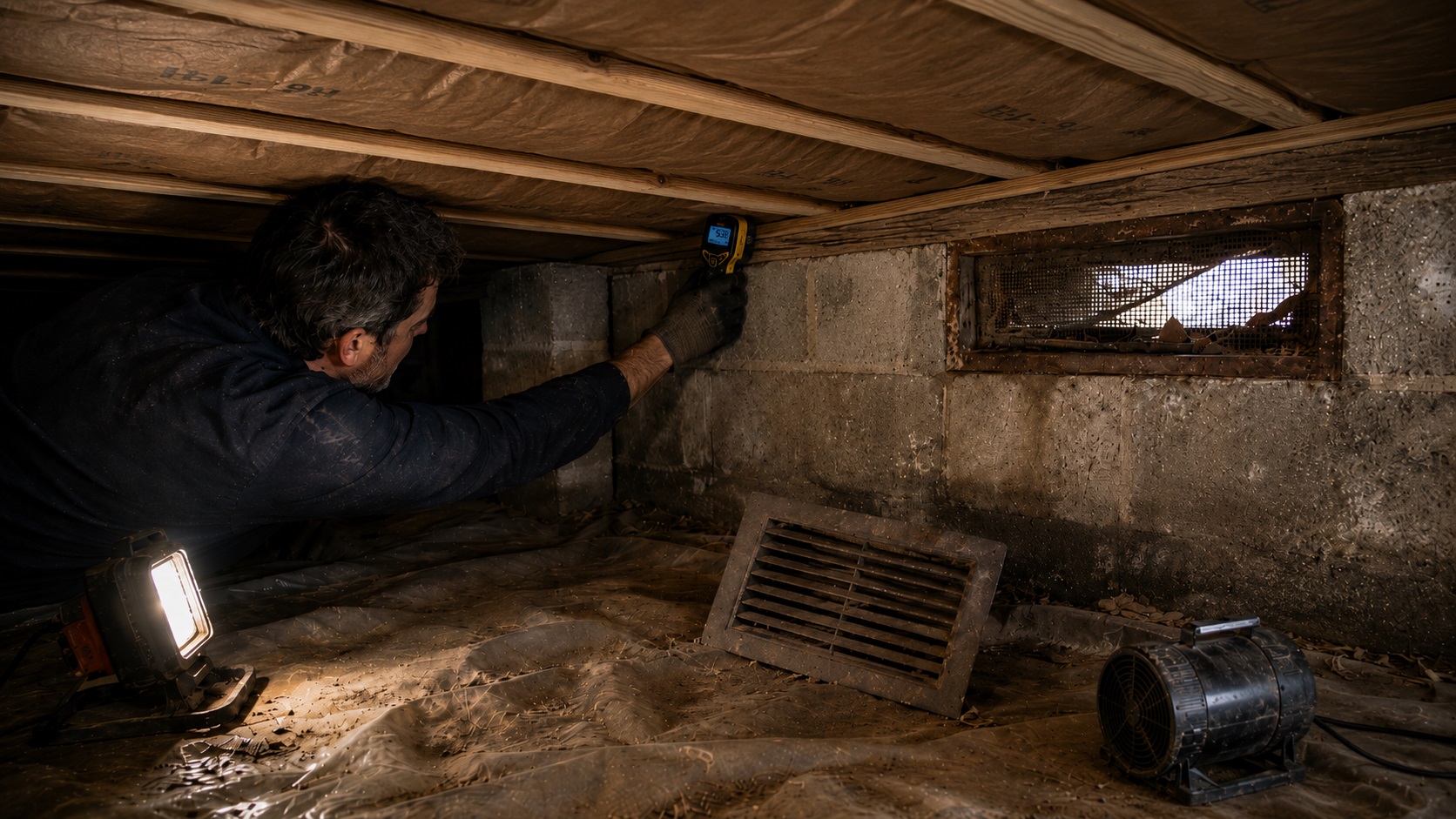
Over time, crawl space vents may deteriorate due to environmental exposure. Damaged vents restrict airflow even when openings appear clear.
Common damage-related airflow failures include:
- Cracked vent housings
- Broken or missing louvers
- Rust or corrosion weakening vent materials
- Loose vent frames allowing debris entry
- Deformed vent covers blocking airflow paths
When vents are damaged, airflow decreases gradually, allowing humidity to build over time.
Dead Zones Create Persistent Moisture Areas
Dead zones are sections of the crawl space where airflow remains weak or stagnant. These areas often trap moisture even when vents appear functional.
Dead zones typically develop:
- Behind structural supports
- In crawl space corners
- Beneath large ductwork systems
- Near blocked airflow pathways
- In areas far from vent openings
Persistent dead zones are a major reason airflow improvements fail to produce lasting results.
Replace Damaged Crawl Space Vents
Replacing damaged crawl space vents is one of the most direct ways to restore airflow capacity. When vents become damaged or deteriorated, airflow decreases significantly—even if the openings appear functional from a distance.
Identify Vents That Require Replacement
Visual inspection often reveals vent damage that restricts airflow. Over time, exposure to moisture and outdoor conditions weakens vent components.
Look for these warning signs:
- Cracked or broken vent frames
- Rust holes in metal vent covers
- Missing vent screens or louvers
- Loose or unstable vent assemblies
- Debris entering through damaged openings
When these problems are present, replacing damaged vents restores airflow and prevents further moisture accumulation.
Select Proper Replacement Vent Types
Replacement vents should match the existing foundation opening, provide at least the same open airflow area as the damaged vent, and use corrosion-resistant materials suited to outdoor exposure. A vent that fits the hole but has a smaller screen or louver opening can reduce airflow even though it looks properly installed.
Factors to consider when selecting replacement vents include:
- Vent size compatible with existing openings
- Materials resistant to corrosion
- Screen protection to prevent pest entry
- Durable construction suitable for outdoor exposure
- Designs that support consistent airflow
Proper vent selection improves airflow reliability and reduces the risk of future failure.
Ensure Vents Are Installed Securely
Installing replacement vents securely is essential for long-term performance. Loose installations allow airflow leaks, debris intrusion, and structural movement.
Secure installation should include:
- Firm attachment to foundation surfaces
- Sealing gaps around the vent frame without blocking drainage or airflow openings
- Stable alignment within foundation openings
- Protection against moisture infiltration
Well-installed vents restore ventilation capacity and help maintain stable airflow conditions.
Correct Improper Vent Placement
Even when crawl space vents are in good condition, improper placement can prevent effective airflow. Poor placement creates uneven ventilation patterns that trap moisture in certain areas. Correcting placement problems restores balanced airflow across the entire crawl space.
Identify Signs of Improper Vent Placement
Vent placement problems often produce uneven moisture patterns. Some areas of the crawl space may remain dry while others stay consistently damp.
Common signs of placement problems include:
- Moisture concentrated in specific crawl space sections
- Persistent dead zones far from existing vents
- Uneven humidity patterns across the crawl space
- Mold growth limited to isolated areas
- Airflow that feels stronger near certain vents but weak elsewhere
These patterns often resemble airflow failures explained in why crawl space airflow problems lead to mold growth, where trapped humidity develops due to uneven ventilation.
Restore Balanced Airflow Across Foundation Walls
Effective ventilation requires balanced airflow entering and exiting from multiple sides of the crawl space. When vents are concentrated on one side, airflow cannot circulate evenly.
Correcting airflow imbalance may involve:
- Redistributing airflow pathways
- Adjusting vent alignment
- Ensuring opposing airflow entry and exit points
- Removing barriers interfering with airflow distribution
Balanced airflow ensures moisture is removed consistently across the entire crawl space.
Address Structural Barriers That Block Air Movement
Foundation features, interior supports, and utility installations can interfere with airflow patterns. When structural barriers prevent air from circulating freely, moisture accumulates in hidden sections.
Examples of structural airflow barriers include:
- Foundation piers blocking airflow channels
- Closely spaced supports limiting air movement
- Ductwork creating airflow shadows
- Plumbing installations restricting air circulation
Correcting these limitations often restores airflow consistency and reduces humidity buildup.
Add Vents to Improve Cross-Ventilation
Some crawl spaces suffer from insufficient vent coverage. In these cases, adding vents improves cross-ventilation and allows air to circulate more effectively.
However, adding vents is not automatically the right fix in every climate or crawl space design. If outdoor air is frequently humid, more vent area can sometimes bring more moisture into the crawl space unless ground moisture, drainage, and airflow direction are also controlled.
When Additional Vents Become Necessary
Adding vents may be required when existing openings cannot provide sufficient airflow across the crawl space.
Typical conditions requiring additional vents include:
- Large crawl space areas with limited airflow
- Persistent moisture despite clear vents
- Dead zones that remain after airflow improvements
- Long crawl spaces with uneven ventilation coverage
- Structures with limited original vent installations
These situations often require expanding ventilation capacity to restore consistent airflow.
Improve Cross-Ventilation With Strategic Placement
Cross-ventilation allows air to move from one side of the crawl space to another. Strategic placement of additional vents improves airflow direction and helps remove trapped humidity.
Effective cross-ventilation improvements include:
- Installing vents on opposing foundation walls
- Positioning vents to support directional airflow
- Spacing vents to cover the full crawl space area
- Maintaining consistent airflow pathways between openings
Proper placement ensures that new vents contribute to overall airflow improvement rather than creating isolated air pockets.
Evaluate Crawl Space Layout Before Adding Vents
Before adding vents, evaluating the crawl space layout helps prevent ineffective placement. Poorly positioned vents may fail to improve airflow or create uneven circulation.
Important layout considerations include:
- Foundation wall length and orientation
- Structural obstacles affecting airflow
- Natural airflow direction based on environment
- Existing moisture concentration zones
Careful planning improves the effectiveness of added ventilation openings.
Eliminate Persistent Dead Zones
Dead zones are one of the most difficult airflow problems to correct. These stagnant areas trap moisture and allow mold growth to develop even when other parts of the crawl space remain dry.
Identify Areas With Limited Air Movement
Dead zones are typically found in areas where airflow cannot reach effectively. Identifying these areas is critical to restoring balanced ventilation.
Common dead zone indicators include:
- Localized mold growth
- Persistent moisture in isolated areas
- Slow drying of materials in specific zones
- Condensation forming repeatedly in the same locations
These patterns indicate airflow distribution problems that require targeted correction.
Improve Airflow Pathways Through Problem Areas
Restoring airflow to dead zones often involves modifying airflow pathways so air can move freely into isolated sections.
Improvement strategies may include:
- Removing barriers blocking airflow routes
- Repositioning materials interfering with circulation
- Creating clear pathways between vent openings
- Improving airflow direction through problem areas
These corrections help eliminate stagnant air pockets that trap moisture.
Support Airflow With Targeted Air Movement
In some cases, additional airflow support may be needed to reach corners, ductwork shadows, or areas behind interior piers. This may involve a crawl-space-rated fan, a redirected airflow path, or a mechanical system designed to move air through the stagnant section rather than only across the vent opening.
Targeted airflow should be used to correct a confirmed dead zone, not to mask standing water, wet soil, damaged vapor barriers, or foundation leakage.
Install Mechanical Ventilation Systems When Passive Airflow Is Not Enough
Some crawl spaces continue to experience humidity problems even after vents are repaired, repositioned, or added. In these situations, mechanical ventilation systems may be required to provide consistent airflow. Mechanical systems help move air through the crawl space when natural airflow cannot maintain stable moisture conditions.
When Mechanical Ventilation Is Necessary
Mechanical airflow solutions are typically used when passive ventilation methods fail to control humidity. These systems support airflow in crawl spaces where layout limitations or environmental conditions prevent adequate natural circulation.
Situations that may require mechanical ventilation include:
- Persistent humidity despite vent repairs
- Large crawl spaces with limited natural airflow
- Dead zones that remain after airflow corrections
- Homes located in humid climates
- Seasonal moisture levels that exceed normal ventilation capacity
These conditions usually mean the crawl space needs a designed airflow solution rather than another round of basic vent cleaning.
Types of Mechanical Ventilation Systems
Several mechanical ventilation options exist for crawl spaces. The correct system depends on crawl space size, humidity levels, and airflow limitations.
Common mechanical ventilation systems include:
- Powered crawl space fans that promote airflow movement
- Continuous ventilation units that operate automatically
- Timed or humidity-controlled systems designed to run only when outdoor and crawl space conditions make ventilation useful
- Humidity-controlled fans that adjust based on moisture levels
Each system type provides airflow support designed to maintain stable humidity conditions beneath the home.
In humid regions, mechanical ventilation should be selected carefully because pulling damp outdoor air into the crawl space can raise humidity instead of lowering it.
Limitations of Mechanical Ventilation Systems
Although mechanical systems improve airflow, they cannot solve every moisture problem. Mechanical ventilation supports airflow but does not eliminate moisture sources.
Mechanical ventilation alone may not resolve:
- Groundwater seepage problems
- Damaged vapor barriers
- Foundation leaks
- Surface water intrusion
For best results, mechanical ventilation should be combined with moisture control strategies.
Combine Ventilation Repair With Moisture Control
Ventilation repair works best when moisture sources are also addressed. Without moisture control, airflow improvements may reduce humidity temporarily but fail to produce lasting results.
If damp soil, standing water, foundation seepage, or repeated high humidity continue after ventilation repairs, use how to fix persistent crawl space moisture problems to evaluate the moisture source beyond the ventilation system.
Inspect Vapor Barriers for Damage
Vapor barriers reduce moisture rising from the ground, but damaged barriers allow humidity to enter the crawl space continuously.
Common vapor barrier problems include:
- Torn plastic sheets
- Loose seams between barrier sections
- Incomplete soil coverage
- Barrier edges lifting away from walls
Repairing vapor barrier damage helps limit moisture sources and improves the effectiveness of ventilation repairs.
Control Ground Moisture Levels
Soil moisture plays a major role in crawl space humidity. Excess ground moisture increases the workload on ventilation systems.
Moisture control methods may include:
- Maintaining effective drainage around the home
- Redirecting water away from foundation areas
- Reducing standing water near crawl space entrances
- Improving exterior grading to prevent water accumulation
These steps help reduce moisture entering the crawl space environment.
Address Surface Water Intrusion
Surface water entering crawl spaces often overwhelms ventilation systems. Identifying and correcting water entry points supports long-term ventilation stability.
Signs of surface water intrusion include:
- Wet soil immediately after rainfall
- Water stains along foundation walls
- Pooled water near crawl space openings
- Repeated damp conditions during storms
Correcting these issues supports airflow improvements and prevents recurring moisture buildup.
When Professional Crawl Space Repair Is Required
Some ventilation repairs involve structural modifications that require professional knowledge and tools. Recognizing when professional repair is necessary helps prevent unsafe or ineffective repair attempts.
Structural Vent Placement Changes
Adding or repositioning vents often requires modifying foundation walls. Because these changes affect structural components, professional installation is recommended.
Professional repair may be necessary when:
- New vents must be added to foundation walls
- Existing vents require relocation
- Structural barriers block airflow paths
- Foundation modifications are required
Professional installation ensures that new vents function correctly without weakening the structure.
Installation of Mechanical Ventilation Systems
Mechanical ventilation systems often require electrical connections and airflow calibration. Proper installation ensures reliable operation and long-term performance.
Professional installation may include:
- Electrical system integration
- Equipment positioning and calibration
- System performance testing
- Ongoing maintenance recommendations
These services help ensure that mechanical systems operate safely and efficiently.
Advanced Moisture Correction Measures
When moisture problems remain severe, professional repair may involve additional moisture control measures. These actions support ventilation repairs and stabilize crawl space conditions.
Professional correction may include:
- Extensive vapor barrier installation
- Drainage system improvements
- Foundation moisture control upgrades
- Long-term humidity stabilization methods
Combining airflow repair with moisture control creates the most reliable long-term solution.
How to Confirm Ventilation Repairs Are Working
After completing crawl space ventilation repairs, confirming that airflow improvements are effective is essential. Successful repairs should produce noticeable changes in moisture levels, airflow patterns, and crawl space conditions over time.
Humidity Levels Become More Stable
One of the clearest signs of successful ventilation repair is more stable humidity over several days and weather cycles, not just a single dry reading. Crawl spaces that previously stayed damp should show fewer humidity spikes, less condensation, and more even drying after rain or humid weather.
Positive signs include:
- Reduced condensation on framing and ductwork
- Faster drying of damp materials
- Less frequent humidity spikes
- More consistent airflow throughout the crawl space
These improvements indicate that airflow is functioning as intended.
Moisture Patterns Become More Even
Before repair, crawl spaces often show uneven moisture patterns. After repair, moisture distribution should become more balanced across the entire space.
Improved conditions may include:
- Fewer localized damp areas
- Reduction of persistent dead zones
- Even drying across foundation walls
- More consistent environmental stability
Balanced airflow helps eliminate the uneven moisture conditions that allow mold to develop.
Recurring Mold Growth Stops
Another strong sign of successful ventilation repair is that cleaned or treated mold areas do not quickly return. Ventilation repair reduces the moisture conditions that support mold, but existing mold still needs proper cleanup and any remaining moisture source must be corrected.
If mold growth continues after ventilation repair, additional moisture sources may still be present. In those situations, further investigation may be required to identify remaining causes.
How Long Ventilation Repairs Typically Last
Most crawl space ventilation repairs provide long-term benefits when properly installed and maintained. However, long-term success depends on ongoing maintenance and environmental conditions.
Routine Maintenance Supports Long-Term Performance
Regular inspection helps ensure that ventilation systems continue functioning correctly. Without maintenance, vents may become blocked or damaged again over time.
Routine maintenance should include:
- Clearing debris from vent openings
- Checking for signs of corrosion
- Inspecting airflow pathways
- Monitoring crawl space humidity levels
- Maintaining vapor barriers and drainage systems
These maintenance actions extend the lifespan of ventilation repairs and reduce the chance that blocked vents, damaged barriers, or drainage problems will bring humidity back.
Environmental Conditions Influence Longevity
Climate conditions affect how long ventilation repairs remain effective. Homes in humid climates may require more frequent inspection and maintenance than those in dry regions.
Environmental factors affecting repair lifespan include:
- Regional humidity levels
- Seasonal rainfall patterns
- Soil moisture conditions
- Outdoor temperature fluctuations
In humid or rainy regions, plan to check vents, fans, vapor barriers, and drainage more often because small failures can bring moisture back quickly.
FAQ: How to Fix Persistent Crawl Space Ventilation Problems
Can damaged crawl space vents be replaced individually?
Yes. Individual damaged vents can often be replaced without modifying the entire ventilation system. However, if multiple vents fail or placement problems exist, broader repairs may be necessary.
How long does it take to fix crawl space ventilation problems?
The repair timeline depends on the severity of the problem. Simple vent replacement may take a few hours, while major ventilation redesign projects may require several days.
Will ventilation repair eliminate mold problems permanently?
Ventilation repair can reduce the moisture conditions that allow mold to return, but it does not remove existing mold or guarantee permanent prevention by itself. If mold has already developed, the affected materials still need proper cleanup, and any ground moisture, drainage, vapor barrier, or foundation water problem must also be corrected.
How do I know if ventilation repairs were successful?
Ventilation repairs are working when humidity readings become more stable over several days, condensation decreases, damp areas dry more evenly, and the same crawl space corners or ductwork shadows no longer stay wet after rain or humid weather. One dry reading is not enough to confirm success.
Is professional repair always required for persistent ventilation problems?
Not always. Some minor repairs can be handled safely by homeowners. However, structural modifications, mechanical ventilation installation, and extensive moisture correction typically require professional expertise.
Conclusion: Fix the Airflow Problem and the Moisture Source
Persistent crawl space ventilation problems usually need more than cleared vents. Damaged vents, poor placement, weak cross-ventilation, dead zones, or moisture sources can all keep humidity returning.
The best repair path is to restore airflow, confirm humidity is stabilizing over time, and correct any ground moisture, drainage, or vapor barrier problems that ventilation cannot solve by itself.
Key Takeaways
Persistent crawl space ventilation problems usually require repair-level fixes, not repeated vent cleaning. The most common solutions are replacing damaged vents, correcting poor vent placement, adding cross-ventilation where appropriate, eliminating dead zones, and using mechanical airflow only when passive ventilation cannot keep humidity stable. Long-term success also depends on controlling ground moisture, drainage, and vapor barrier problems.