Do Air Purifiers Reduce Mold Exposure Risks?
Air purifiers can reduce mold exposure risk in a limited but useful way. A properly sized air purifier with a true HEPA filter can capture airborne mold spores, mold fragments, dust, and other particles as air passes through the unit. That can make the air in a specific room cleaner while the purifier is running, especially in bedrooms, living areas, or rooms where musty odors and allergy-like irritation seem worse.
But an air purifier is not a mold removal solution. It does not remove mold growing on drywall, wood, insulation, carpet, cabinets, HVAC parts, or hidden surfaces. It does not fix leaks, lower humidity enough to stop mold growth, dry damp materials, or confirm whether mold is causing symptoms. If mold is actively growing indoors, the real solution is still to find the moisture source, correct the damp condition, and clean or remove the affected material.
That distinction matters because a room can smell better while the mold source remains active. A purifier can help reduce what is floating in the air, but it cannot fix what is growing on wet materials. For a broader explanation of how mold, moisture, and breathing-zone air quality fit together, see this guide to mold exposure and indoor air quality.
Can Air Purifiers Actually Reduce Mold Exposure Risk?
Yes, air purifiers can help reduce mold exposure risk when the risk involves airborne particles. Mold releases spores and tiny fragments into indoor air, especially when growth is disturbed, materials dry out, air moves across contaminated surfaces, or mold is growing in areas connected to household airflow. A HEPA air purifier can capture many of those particles as they pass through the filter.
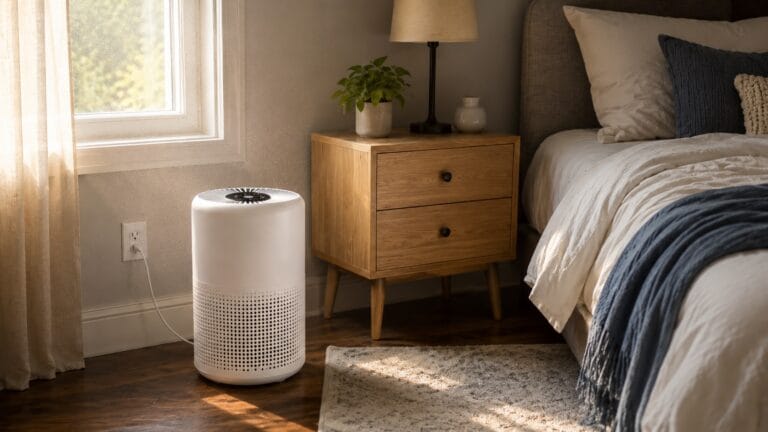
This is most useful in the room where the purifier is operating. For example, if you place a properly sized HEPA purifier in a bedroom and run it continuously, it may reduce the amount of airborne mold-related particulate matter in that bedroom. That can be helpful if someone is sensitive to indoor air irritants, if the home has a lingering musty smell after cleanup, or if you are trying to improve air quality while investigating a suspected mold source.
However, “reducing exposure risk” does not mean “eliminating mold exposure.” Air purifiers only clean the air that reaches the unit. They do not pull mold out of wall cavities, stop spores from being released by an active source, or correct the conditions that allowed mold to grow. If a bathroom wall, basement corner, crawl space, attic, or HVAC component is still damp and contaminated, the purifier may only reduce some airborne particles while the source continues producing more.
Air filtration is a support layer, not the foundation of mold control. The foundation is moisture control. If you need to trace the larger problem, start with the broader process of how to find, fix, and prevent moisture problems in your home.
What HEPA Air Purifiers Can Do for Mold Spores
A true HEPA air purifier can help because mold spores and mold fragments are particles. When the purifier pulls room air through the filter, those particles can be trapped instead of continuing to circulate. This is the main reason HEPA filtration is usually the most relevant air purifier feature for mold concerns.
For homeowners, the practical benefit is not that the purifier “kills mold.” The practical benefit is that it can lower the amount of mold-related material floating in the air of a room. That may be useful in several common situations:
- A bedroom smells musty, but the source has not been found yet.
- A basement has a damp odor and is used regularly.
- Visible mold was recently cleaned from a small hard surface, and the homeowner wants to reduce lingering airborne particles.
- A sensitive person spends time in a room where indoor air feels stale or irritating.
- The homeowner is waiting for mold testing, inspection, or contractor availability.
In those cases, using a HEPA purifier may be a reasonable short-term or ongoing support step. It can help improve the air in occupied rooms while the larger moisture or mold question is being addressed. If you are comparing product options, a dedicated guide to HEPA air purifiers for mold concerns is the better place to evaluate specific models, room sizes, and features.
Air Purifiers Work Best on Airborne Particles
The biggest strength of an air purifier is also its biggest limitation: it works on air. If mold spores, dust, pet dander, and other particles are floating through the room and passing through the purifier, the filter can capture some of them. If mold is stuck to damp drywall paper, growing behind a baseboard, embedded in insulation, or hidden under flooring, the purifier cannot reach it.
This is why an air purifier may improve air quality without solving the reason the air became moldy or musty in the first place. A musty room may feel better when a purifier is running, but if the underlying cause is a damp wall cavity, wet carpet pad, foundation seepage, or crawl space moisture, the air quality problem can continue returning.
Air Purifiers May Help After Cleanup
Air purifiers can also be helpful after small, properly handled cleanup work. Cleaning mold from a limited hard surface can disturb particles, even when the work is done carefully. Running a HEPA purifier afterward may help reduce particles that remain suspended in the room air.
That does not mean an air purifier makes cleanup safe in every situation. Disturbing moldy porous materials, cutting contaminated drywall, removing wet insulation, or opening a hidden cavity can release much more material into the air. Larger or hidden mold problems may require containment, protective equipment, and professional remediation rather than simple room filtration.
What Air Purifiers Cannot Do About Mold
The most important thing to understand is that an air purifier does not remove mold from the home. It only filters air that passes through the unit. If mold is growing on a surface or inside a material, that source remains in place until it is cleaned, removed, dried, or professionally remediated.
This is where many homeowners make a costly mistake. They buy a purifier, notice that the room smells a little better, and assume the mold problem has been handled. In reality, the purifier may be reducing airborne particles while the mold source continues growing behind a wall, under flooring, inside a cabinet, in an attic, or in a damp basement.
Air Purifiers Do Not Fix Moisture Problems
Mold growth depends on moisture. If the home has a leak, condensation problem, high humidity, seepage issue, damp crawl space, wet insulation, or poor ventilation, an air purifier cannot correct any of those conditions. It may reduce some airborne particles, but it does not remove the reason mold is growing.
For example, a HEPA purifier in a basement may help reduce airborne particles in that space, but it will not stop basement wall seepage, dry stored cardboard boxes, correct foundation drainage, or lower humidity across the entire basement by itself. If the air still feels damp or musty, the homeowner also needs to look at moisture control, drying, and humidity reduction.
This is why air purifiers work best as part of a broader plan. When moisture keeps returning, the priority is to identify the source, dry affected materials, and prevent recurrence. If indoor humidity is part of the problem, a separate guide on how to reduce humidity in your house can help explain the moisture-control side of the issue.
Air Purifiers Do Not Remove Mold Growing on Surfaces
A purifier cannot clean mold from drywall, wood, carpet, insulation, grout, furniture, cabinets, or HVAC surfaces. Mold growing on a material must be addressed at the material level. Sometimes that means cleaning a small hard surface. Sometimes it means removing porous material that has been contaminated. Sometimes it means hiring a professional when the growth is extensive, hidden, or connected to water damage.
If the mold source remains, airborne particles can continue being released. This is especially true when moldy materials are disturbed, when air moves across contaminated surfaces, or when the area repeatedly dries and becomes damp again. In those situations, filtration may help reduce what is airborne, but it cannot stop the source from contributing to indoor air concerns.
Air Purifiers Do Not Confirm Whether Mold Is Present
An air purifier is not a mold test. It cannot tell you whether mold is growing behind a wall, whether a musty odor is coming from a crawl space, whether an HVAC system is contaminated, or whether symptoms are connected to indoor mold exposure. It also cannot tell you whether the mold source has been fully removed.
If you are unsure whether the home is contributing to exposure concerns, the next step is investigation rather than just filtration. That may include checking for moisture, looking for hidden water damage, comparing humidity levels between rooms, using a mold test kit in limited situations, or hiring an inspector when the source is unclear. For a more diagnostic approach, see how to confirm mold exposure risks inside your home.
Air Purifiers Do Not Replace Professional Remediation
If mold growth is widespread, hidden, caused by sewage or contaminated water, inside HVAC components, or affecting porous building materials, an air purifier should not be treated as the solution. It may be useful in an occupied room while decisions are being made, but it does not replace containment, source removal, material replacement, or professional cleanup.
A purifier also should not encourage risky DIY work. Cutting into moldy drywall, pulling up contaminated flooring, or removing damp insulation without proper precautions can release particles into the air. In those situations, the better decision may be professional testing or remediation rather than relying on a room purifier after the fact.
When an Air Purifier Makes Sense for Mold Concerns
An air purifier makes the most sense when you understand its role clearly. It is useful when the goal is to reduce airborne particles in an occupied room. It is not enough when the goal is to remove mold growth, dry a structure, fix a leak, or prove that the home is safe.
When You Are Concerned About Airborne Mold Particles
If a room smells musty, feels stale, or seems to trigger irritation, a HEPA purifier may help reduce airborne particles while you investigate the cause. This can be especially helpful in rooms where people spend many hours, such as bedrooms, home offices, nurseries, or living rooms.
The purifier should be sized for the room and run consistently. Occasional use for a few minutes is less useful than steady operation because indoor air is constantly moving, mixing, and being affected by surfaces, HVAC airflow, doors, windows, and occupant activity.
When Someone in the Home Is Sensitive to Indoor Air
Some people are more sensitive to indoor air irritants than others. A person with allergies, asthma, respiratory sensitivity, or strong reactions to dust and musty air may notice indoor conditions more quickly. In those households, air filtration can be a reasonable layer of protection while the home is being evaluated.
Even then, the purifier should not be treated as a medical solution. If symptoms are persistent, severe, or clearly linked to time spent in the home, the homeowner should consider both the building environment and appropriate medical guidance. The purifier may reduce airborne particles, but it does not diagnose or treat health problems.
When Mold Was Recently Cleaned From a Small Area
After a small, non-porous surface has been cleaned properly and the moisture source has been corrected, a HEPA purifier can help reduce lingering airborne particles in that room. This is most appropriate after minor cleanup, not after major demolition or large mold disturbance.
The order matters. First correct the moisture source. Then clean or remove the affected material safely. Then use filtration as a support step. Running a purifier without fixing the water problem usually leads to a cycle where the room temporarily seems better but the mold concern keeps returning.
When You Are Waiting for Testing or Inspection
Sometimes a homeowner cannot immediately confirm the source of a mold concern. Maybe the smell is intermittent. Maybe symptoms seem worse in one room. Maybe there was past water damage, but the wall or floor now looks dry. In that waiting period, a HEPA purifier may be useful in the most occupied rooms.
This should be viewed as temporary risk reduction, not a final answer. If the concern continues, testing or inspection may still be needed. This is especially true if there are children, older adults, asthma-sensitive occupants, or people with immune concerns in the home.
When an Air Purifier Is Not Enough
An air purifier is not enough when there are signs that mold is actively growing or moisture is still present. In those cases, filtration may improve the air temporarily, but the underlying problem can continue producing mold particles and odors.
Visible Mold Growth
If you can see mold growing on a wall, ceiling, floor, trim, cabinet, stored item, or HVAC surface, the priority is not air purification. The priority is to determine why the material is damp and whether the affected surface can be safely cleaned or must be removed.
Running a purifier nearby may reduce some airborne particles, especially if the room is occupied, but the visible mold still needs to be addressed. Leaving it in place allows the source to remain active.
Musty Smells That Keep Returning
A musty odor that keeps coming back usually points to a moisture source or contaminated material. It may be behind a wall, under flooring, inside a cabinet, in a basement, in a crawl space, in stored belongings, or near HVAC components. A purifier may reduce the odor in the room, but odor reduction does not prove the source has been removed.
If the smell returns when the purifier is off, after rain, when the HVAC runs, or when humidity rises, the home likely needs a moisture investigation. This is where air filtration should be paired with source tracing rather than treated as the whole solution.
Damp Materials or Active Leaks
An air purifier cannot dry wet drywall, wood, insulation, carpet pad, subflooring, or basement materials. If materials are damp, the mold risk remains until they dry fully or are removed. The same is true if there is an active leak. Filtration may reduce some airborne particles, but it cannot stop new moisture from entering the system.
Common warning signs include bubbling paint, swollen baseboards, soft flooring, damp carpet edges, ceiling stains, condensation on windows, wet insulation, or a basement smell that gets worse after rain. These are moisture problems first and air quality problems second.
Recurring Symptoms in One Area of the Home
If people feel worse in one room, one basement area, or one part of the home, a purifier may help in that room, but it should not be the only response. Room-specific symptoms can point to a localized source such as a hidden leak, damp HVAC duct, moldy window area, crawl space air pathway, wet carpet pad, or contaminated storage area.
In that situation, use the purifier as a support step while investigating the structure. If symptoms continue or the source remains unclear, it may be time to test your home after mold exposure symptoms or consider a more detailed inspection.
Air Purifier vs Dehumidifier for Mold Exposure Risk
Air purifiers and dehumidifiers solve different parts of a mold-prone home. An air purifier filters airborne particles. A dehumidifier removes moisture from the air. Neither one removes established mold growth from contaminated materials.
| Problem | Better tool | Why it matters |
|---|---|---|
| Airborne mold spores, dust, and fragments in an occupied room | True HEPA air purifier | It reduces particles that pass through the filter. |
| Damp air, high humidity, or musty basement conditions | Dehumidifier | It helps reduce the moisture conditions that support mold growth. |
| Visible mold on drywall, wood, carpet, insulation, or cabinets | Cleanup, removal, drying, or remediation | Devices do not remove mold growing on materials. |
| Musty odor that keeps returning | Moisture investigation first, filtration as support | Odor reduction does not prove the source is gone. |
In many mold-prone homes, the best answer is not one device. A bedroom may benefit from HEPA filtration, while a damp basement may need dehumidification, leak repair, drainage correction, or material drying. For the moisture-control side of the issue, see whether dehumidifiers reduce mold exposure risk.
How to Choose an Air Purifier for Mold Exposure Support
Choosing an air purifier for mold concerns is not about finding a device with the most aggressive marketing language. It is about choosing a purifier that can reliably filter room air, capture fine particles, and operate long enough to make a practical difference. The best choice is usually simple, properly sized, and easy to maintain.
Look for True HEPA Filtration
For mold-related particle reduction, true HEPA filtration should be the starting point. Mold spores and fragments are particles, so the purifier needs a filter designed for particle capture. Avoid relying on vague labels such as “HEPA-like,” “HEPA-type,” or “mold destroyer” without clear filtration information.
A carbon filter may help with some odors, but it is not a substitute for HEPA particle filtration. If a purifier has both HEPA filtration and an activated carbon layer, it may be more useful for rooms with musty odor concerns. Still, odor control should not be confused with source removal. If the odor keeps returning, the mold or moisture source still needs to be found.
Match the Purifier to the Room Size
A small purifier placed in a large basement or open living area may not move enough air to matter. Room size matters because the purifier can only filter the air it pulls through the unit. A unit designed for a small bedroom may be overwhelmed in a large family room, finished basement, or open-plan space.
Before buying, compare the purifier’s room coverage to the room where it will actually be used, not the whole house. If the mold concern is strongest in a bedroom, size the purifier for that bedroom. If the concern is in a basement, size it for the occupied basement area and remember that it still will not fix seepage, high humidity, wet storage, or damp materials.
Choose a Purifier You Will Actually Run
An air purifier only helps while it is running and moving air through the filter. A loud, expensive, or inconvenient unit may sit unused. For mold exposure support, consistent operation is usually more valuable than occasional high-speed use.
Noise level, filter cost, filter availability, energy use, and maintenance reminders all matter. A purifier that runs quietly in a bedroom every night may be more useful than a more powerful unit that is too loud, too expensive to maintain, or too inconvenient to run consistently.
Avoid Ozone and Overhyped Mold Claims
Be careful with products that claim to kill mold in the air, sterilize the whole room, or eliminate mold problems without source correction. Mold control is not solved by a device alone. Strong marketing claims can distract homeowners from the real work: finding moisture, drying materials, removing contamination, and preventing recurrence.
Avoid intentionally using ozone generators in occupied homes for mold concerns. Ozone can irritate the lungs, and it should not be treated as a normal substitute for filtration, moisture control, or remediation.
For most homeowners, a conventional true HEPA purifier is the safer and more practical route than devices built around harsh treatment claims. If you want to compare options more directly, use a guide focused on air purifiers for mold spores rather than relying only on general-purpose purifier marketing.
How to Use an Air Purifier Around Mold Concerns
Even a good air purifier can perform poorly if it is placed badly, run inconsistently, or used as a substitute for moisture control. The goal is to use the purifier where it can reduce airborne particles while you continue addressing the source of the mold concern.
Start With the Most Occupied Room
If you only have one purifier, place it where people spend the most time. For many homes, that means a bedroom, living room, or home office. Reducing airborne particles in a bedroom can be especially practical because people spend several continuous hours there with the door closed or partially closed.
If the strongest mold concern is in a basement or utility room that people rarely use, think carefully before placing the only purifier there. It may be more useful to control humidity and address the source in the basement while using filtration in the living space where people breathe for longer periods.
Keep Airflow Around the Unit Open
Do not tuck the purifier behind furniture, inside a closet, under a desk, or tight against a wall if that blocks airflow. The unit needs enough open space to pull in room air and push filtered air back into the room. Poor placement limits how much air reaches the filter.
Follow the manufacturer’s clearance instructions when possible. In practical terms, the purifier should be in the room you want to treat, with open airflow around the intake and outlet. It should not be placed directly against visible mold growth where it could disturb contaminated material or pull heavy contamination into the filter from a nearby source.
Run It Consistently
Because indoor air is always mixing, occasional purifier use has limited value. Doors open, HVAC systems cycle, people walk through rooms, dust settles and becomes disturbed, and outdoor air enters through leaks or ventilation. For mold exposure support, steady operation is usually more useful than short bursts.
Many homeowners run purifiers on a moderate setting most of the time and use a higher setting after cleaning, vacuuming, or spending time in a room that feels musty. The exact schedule depends on the room, noise tolerance, and product design, but the basic principle is simple: filtration only happens when air is moving through the filter.
Replace Filters on Schedule
A purifier with an old, overloaded, or poorly seated filter will not perform as intended. Mold concerns make filter maintenance especially important because the filter is collecting particles you do not want recirculating through the room.
Check the manufacturer’s filter replacement schedule and inspect filters more often in dusty, damp, or high-use rooms. When changing a filter after mold-related use, handle it gently, bag it if needed, and avoid shaking it indoors. Also make sure the filter is seated correctly after replacement; a loose or poorly installed filter can let air bypass the filter media.
When Filtration Should Lead to Testing or Inspection
An air purifier can reduce airborne particles, but it should not delay testing, inspection, or professional help when the signs point to a larger mold or moisture problem. The question is not only, “Can I filter the air?” It is also, “Where are the particles or odors coming from?”
Testing or inspection makes more sense when the source is unclear, a musty smell keeps returning, symptoms seem worse in one room, staining spreads, damp materials will not dry, or the home has past water damage in a wall, ceiling, floor, attic, basement, crawl space, or HVAC area. In those cases, a purifier can support the breathing space, but it cannot identify or remove the source.
Do not disturb moldy materials just because a purifier is nearby. Cutting drywall, pulling up flooring, removing wet insulation, scraping large moldy surfaces, or opening a contaminated cavity can release more particles than a room purifier can reasonably control. For next-step guidance, see when to test your home after mold exposure symptoms and when mold exposure requires professional testing.
FAQ
Do air purifiers remove mold spores completely?
No. Air purifiers can reduce airborne mold spores that pass through the filter, but they do not remove every spore from the home. Spores can settle on surfaces, remain in hidden cavities, enter from outdoors, or continue coming from an active mold source. A purifier is best understood as a particle-reduction tool, not a complete mold-removal system.
Can an air purifier help with musty mold smells?
It may help with musty rooms, but the benefit is different by filter type. A true HEPA filter helps capture airborne particles, while an activated carbon filter may reduce some odor compounds. However, reducing odor does not prove the mold source is gone. If the musty smell keeps returning, gets worse after rain, or is strongest in a damp area, the home still needs a moisture and source investigation.
Is a HEPA filter necessary for mold exposure concerns?
For mold-related particle reduction, true HEPA filtration is usually the most relevant feature. Mold spores and fragments are particles, so the purifier needs strong particle filtration. Carbon filters can help with some odors, but they do not replace HEPA filtration for airborne particles.
Can an air purifier prevent mold from growing in a damp room?
Not by itself. Mold growth is mainly controlled by moisture. A purifier may reduce airborne particles in a damp room, but it does not stop leaks, dry wet materials, or lower humidity like a dehumidifier. To prevent mold growth, the home needs moisture control, drying, ventilation, dehumidification, or repairs depending on the source.
Should I use an air purifier before or after mold testing?
If you are using a formal testing method, follow the instructions from the test kit, inspector, or lab. Running an air purifier before air sampling may affect airborne particle levels in that room. If testing is meant to understand normal indoor conditions, ask the testing provider how the purifier should be handled before the sample is taken.
Is an air purifier better than a dehumidifier for mold?
They do different jobs. An air purifier reduces airborne particles. A dehumidifier reduces excess moisture in the air. If the concern is breathing-zone particles, a purifier may help. If the problem is damp air, high humidity, or recurring mold growth, moisture control is more important. Many mold-prone homes need both filtration and humidity control.
Should I run an air purifier in a basement with mold?
You can run a HEPA air purifier in a basement to reduce airborne particles, especially if people spend time there. But the purifier should not be the main solution. Basement mold usually points to moisture, seepage, humidity, poor ventilation, damp storage, or drainage problems. Those conditions must be corrected, or mold concerns can continue returning.
Bottom Line: Air Purifiers Help the Air, Not the Mold Source
Air purifiers can reduce mold exposure risks in a limited, practical way. A properly sized true HEPA purifier can capture airborne mold spores, fragments, dust, and other particles in the room where it is used.
But an air purifier is not a mold fix. It does not remove mold from materials, dry damp surfaces, stop leaks, lower humidity enough to prevent growth, or prove that a home is safe. If mold is growing indoors, the source must still be found and corrected.
The best approach is to use filtration as one layer of a larger plan: identify moisture, dry or remove affected materials, control humidity, test or inspect when needed, and use a HEPA purifier to reduce airborne particles in the rooms where people spend the most time. If you are ready to compare product options, start with a guide to HEPA air purifiers for mold concerns.