Best Water Heater Expansion Tanks
Introduction
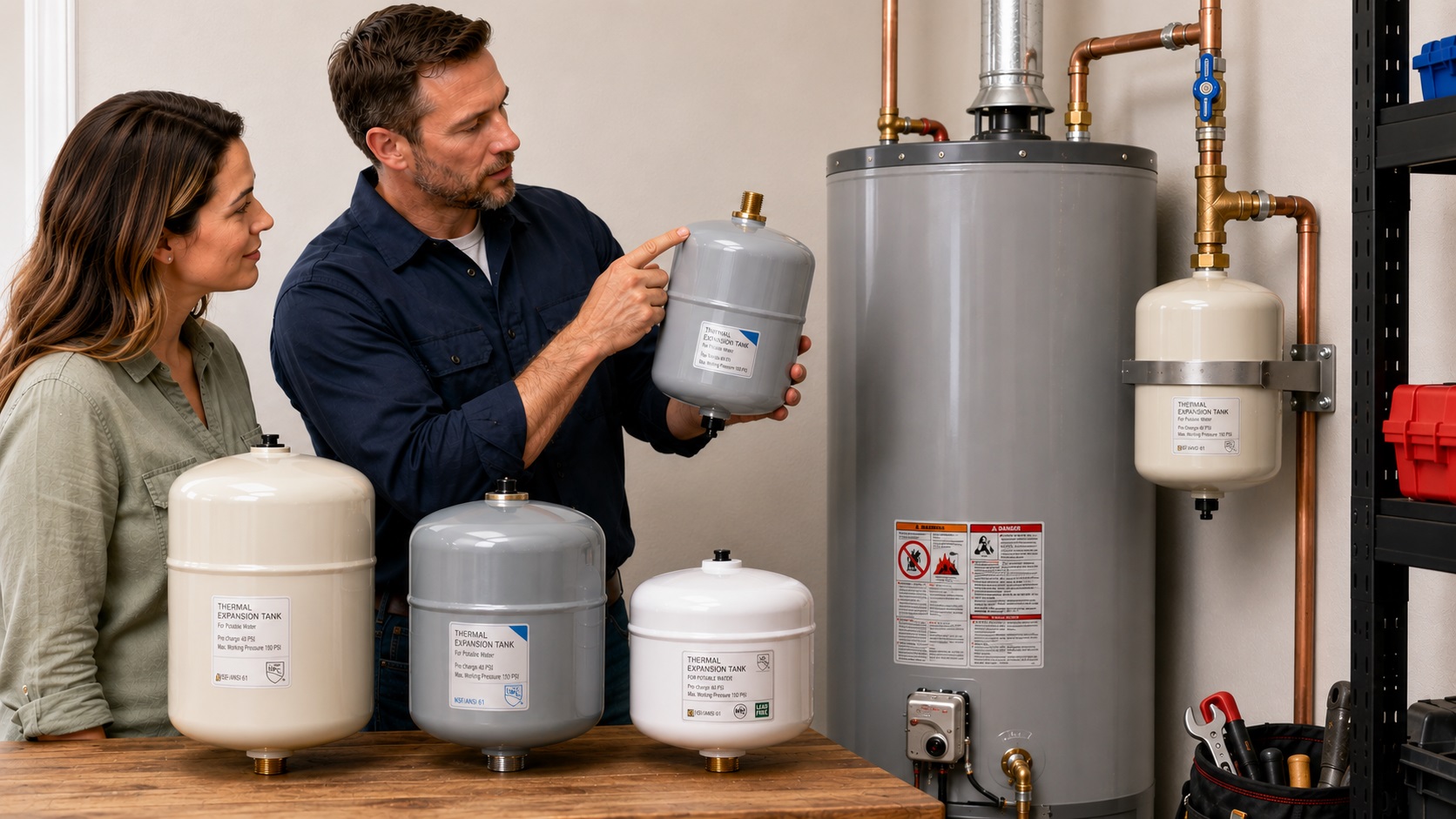
A water heater expansion tank is a small plumbing component, but it can play an important role in protecting a closed plumbing system from pressure swings. When water heats inside a tank-style water heater, it expands. If that extra volume has nowhere to go, pressure can build inside the plumbing system and stress the water heater, fittings, supply lines, relief valve, and nearby connections.
The best water heater expansion tanks give that expanding water a controlled place to move, helping reduce pressure-related strain in homes with check valves, pressure-reducing valves, backflow preventers, or other closed-system conditions. This matters for homeowners who want to reduce the risk of leaks, moisture damage, and avoidable water heater plumbing problems.
This guide compares reliable residential expansion tanks available through Amazon. It focuses on potable-water models for standard residential water heaters, not hydronic heating tanks or tiny hammer-arrestor-style products meant for tankless or point-of-use heaters.
An expansion tank does not catch leaks or alert you to water on the floor. Its job is to help manage thermal expansion pressure inside a closed plumbing system. For visible leak containment, a water heater leak pan is a separate product category.
As an Amazon Associate, this site earns from qualifying purchases. This does not affect the price you pay. Our recommendations are based on research, product reliability, and real-world usability in moisture-prone environments.
For broader plumbing moisture prevention, see our guide to how plumbing leaks cause structural damage.
Quick Picks: Best Water Heater Expansion Tanks by Situation
| Category | Recommended Product | Amazon Link |
|---|---|---|
| Best Overall for Larger Residential Systems | Watts PLT-12 4.5-Gallon Potable Water Expansion Tank | Check availability on Amazon |
| Best Premium Brand | Amtrol ST-5 Thermal Expansion Tank | Check availability on Amazon |
| Best for Standard Residential Water Heaters | Eastman Thermal Expansion Tank, 2 gal, 3/4 in MIP Connection, 60022 | Check availability on Amazon |
| Best Eastman Option for Larger Systems | Eastman Thermal Expansion Tank, 4.5 gal, 3/4 in MIP Connection, 60023 | Check availability on Amazon |
| Best Compact Watts Option | Watts PLT-5 2.1-Gallon Potable Water Expansion Tank | Check availability on Amazon |
Important: These quick picks are starting points, not universal sizing recommendations. Before buying, confirm the correct expansion tank size using the manufacturer’s sizing chart, your water heater capacity, your home’s static water pressure, and any local plumbing code requirements.
Detailed Reviews of the Best Water Heater Expansion Tanks
Watts PLT-12 4.5-Gallon Potable Water Expansion Tank — Best Overall for Larger Residential Systems
The Watts PLT-12 is the strongest overall pick in this lineup for homeowners who need a larger expansion tank. A 4.5-gallon expansion tank can be useful in larger residential systems, homes with higher water heater capacity, or installations where the sizing chart points beyond a compact 2-gallon model.
This is not a “bigger is always better” recommendation. Expansion tanks should be sized to your water heater volume, static water pressure, temperature setting, and manufacturer sizing guidance. But when a home needs a larger potable-water expansion tank, the Watts PLT-12 is a practical and recognizable option from a well-known plumbing brand.
Important Specs and Features
- 4.5-gallon potable-water expansion tank design
- Suitable for many residential tank-style water heater systems when correctly sized
- 3/4-inch male connection for common water heater plumbing configurations
- Designed to absorb thermal expansion in closed domestic water systems
- Recognizable plumbing brand with strong category credibility
What Works Well
- ✔ Larger capacity than compact 2-gallon models
- ✔ Good fit for many larger residential water heater setups
- ✔ Strong brand recognition in plumbing components
- ✔ Potable-water design for domestic water systems
Limitations to Know
- ✖ Requires more installation space than smaller expansion tanks
- ✖ May be more tank than some smaller systems need
- ✖ Pre-charge and sizing still need to be checked before installation
Best Fit
- Homeowners who need a larger-capacity expansion tank for a standard residential water heater
- Homes where a sizing chart or plumber points toward a 4.5-gallon model
- Buyers who prefer a major plumbing brand
Amtrol ST-5 Thermal Expansion Tank — Best Premium Brand
The Amtrol ST-5 is a strong choice for homeowners who want a proven expansion tank brand with a long history in pressure-control products. Amtrol’s Therm-X-Trol line is widely recognized in plumbing and mechanical systems, making the ST-5 a good fit for readers who care about brand reputation and established design.
This is a compact thermal expansion tank, so it is most appropriate when a smaller tank is correctly sized for the home’s water heater and pressure conditions. It should not be chosen only because it is a familiar name. The installer still needs to confirm that the tank capacity, connection, and pre-charge match the system.
Important Specs and Features
- Compact residential thermal expansion tank
- Designed for closed potable hot water systems
- Commonly used with standard tank-style residential water heaters
- Strong brand recognition among plumbers and mechanical contractors
- Useful option when a smaller expansion tank is properly sized for the system
What Works Well
- ✔ Excellent brand reputation in expansion tanks
- ✔ Compact footprint compared with larger 4.5-gallon tanks
- ✔ Good fit for standard residential installations when properly sized
- ✔ Strong premium-brand option for the article lineup
Limitations to Know
- ✖ Smaller capacity than 4.5-gallon options
- ✖ May not be the right size for larger water heaters or higher-pressure systems
- ✖ Often positioned as a premium option, so availability can vary
Best Fit
- Homeowners replacing a similar compact expansion tank
- Readers who want a trusted premium brand
- Standard residential water heater systems where the ST-5 size is appropriate
Check the Amtrol ST-5 Thermal Expansion Tank on Amazon to see current availability.
Eastman Thermal Expansion Tank, 2 gal, 3/4 in MIP Connection, 60022 — Best for Standard Residential Water Heaters
The Eastman 60022 is a practical 2-gallon expansion tank for homeowners who need a standard residential replacement option. It is sized for many common tank-style water heater installations when the plumbing conditions match the manufacturer’s sizing guidance. The 3/4-inch MIP connection also matches the type of connection many homeowners expect to see on residential expansion tanks.
This is the Eastman model to consider for typical residential water heater expansion tank use, not the Eastman 60008 mini tank. The 60008 is a different type of product intended for much smaller tankless or point-of-use applications and should not be treated as a direct substitute for a standard water heater expansion tank.
Important Specs and Features
- 2-gallon residential thermal expansion tank
- 3/4-inch MIP connection
- Designed for potable water heater thermal expansion applications
- Compact size for many standard residential installations
- Good option for replacing an existing 2-gallon expansion tank when properly matched
What Works Well
- ✔ Practical size for many common residential setups
- ✔ Smaller footprint than 4.5-gallon tanks
- ✔ Recognizable plumbing product brand
- ✔ Better fit for standard water heaters than mini hammer-arrestor-style tanks
Limitations to Know
- ✖ Not automatically large enough for every 40- or 50-gallon water heater
- ✖ Sizing still depends on water pressure and temperature setting
- ✖ May not be ideal for larger systems where a 4.5-gallon model is needed
Best Fit
- Standard residential water heater systems that call for a 2-gallon expansion tank
- Homeowners replacing a similar existing expansion tank
- Installations where space is limited but a standard potable expansion tank is still required
Check the Eastman 60022 2-Gallon Thermal Expansion Tank on Amazon to see current availability.
Eastman Thermal Expansion Tank, 4.5 gal, 3/4 in MIP Connection, 60023 — Best Eastman Option for Larger Systems
The Eastman 60023 is the larger-capacity Eastman option in this lineup. It makes sense for homeowners who like the Eastman brand but need more expansion capacity than the 2-gallon 60022 provides. This can be useful in larger residential water heater systems or situations where the manufacturer’s sizing guidance points toward a larger tank.
Because this model has a larger body, it may require more planning around installation space, support, and pipe layout. Expansion tanks should not be left unsupported in ways that strain the piping. If the tank is installed horizontally or in a tight utility area, the installer should follow local code and manufacturer guidance.
Important Specs and Features
- 4.5-gallon residential thermal expansion tank
- 3/4-inch MIP connection
- Larger expansion capacity than the Eastman 60022
- Designed for potable water heater expansion control
- Good Eastman alternative to larger Watts expansion tanks
What Works Well
- ✔ Larger capacity for systems that need more expansion volume
- ✔ Good brand match for readers who prefer Eastman plumbing components
- ✔ Useful alternative if the Watts PLT-12 is unavailable
- ✔ Better suited to larger applications than compact 2-gallon models
Limitations to Know
- ✖ Takes up more room than a compact 2-gallon tank
- ✖ Can be oversized for smaller systems if sizing does not call for it
- ✖ May need additional support depending on installation orientation
Best Fit
- Larger residential water heater setups where a 4.5-gallon tank is appropriate
- Homeowners who want an Eastman-branded larger expansion tank
- Systems where a smaller expansion tank may be undersized
Check the Eastman 60023 4.5-Gallon Thermal Expansion Tank on Amazon to see current availability.
Watts PLT-5 2.1-Gallon Potable Water Expansion Tank — Best Compact Watts Option
The Watts PLT-5 is the compact Watts option for homeowners who need a smaller potable-water expansion tank. It competes most directly with the Eastman 60022 and Amtrol ST-5. If your water heater system calls for a tank in this size range and you prefer Watts, this is the model to compare.
This tank should be considered only when a compact expansion tank is properly sized for the system. It is not a universal solution for every residential water heater. Homes with larger tanks, higher static pressure, or higher temperature settings may need a larger model such as the Watts PLT-12 or Eastman 60023.
Important Specs and Features
- 2.1-gallon potable water expansion tank
- Compact Watts alternative to larger 4.5-gallon models
- Designed for domestic hot water thermal expansion applications
- Useful when a smaller expansion tank is appropriate
- Good companion option to the larger Watts PLT-12
What Works Well
- ✔ Compact size for tight utility areas
- ✔ Strong brand recognition
- ✔ Good option for standard systems that do not need a larger tank
- ✔ Easier to place than larger expansion tanks in some installations
Limitations to Know
- ✖ Smaller capacity than the Watts PLT-12
- ✖ Not ideal for systems that require more expansion volume
- ✖ Availability can vary by seller, so confirm the listing before publishing or buying
Best Fit
- Homeowners who want a compact Watts expansion tank
- Standard residential water heater systems where 2.1 gallons is properly sized
- Tight utility closets or smaller installations where a large tank would be awkward
Check the Watts PLT-5 2.1-Gallon Potable Water Expansion Tank on Amazon to see current availability.
Water Heater Expansion Tank Comparison Table
| Product | Category | Best Use Case | Key Strengths | Main Limitation | Amazon Link |
|---|---|---|---|---|---|
| Watts PLT-12 4.5-Gallon Potable Water Expansion Tank | Best Overall for Larger Residential Systems | Larger residential water heater systems | Larger capacity, potable-water design, trusted plumbing brand | Requires more installation space than compact tanks | View on Amazon |
| Amtrol ST-5 Thermal Expansion Tank | Best Premium Brand | Standard systems where a compact premium tank is correctly sized | Excellent brand reputation and compact form | Smaller capacity than 4.5-gallon tanks | View on Amazon |
| Eastman Thermal Expansion Tank, 2 gal, 60022 | Best for Standard Residential Water Heaters | Replacing a standard 2-gallon expansion tank | Practical size, 3/4-inch connection, residential water heater focus | Not large enough for every system | View on Amazon |
| Eastman Thermal Expansion Tank, 4.5 gal, 60023 | Best Eastman Option for Larger Systems | Larger systems where an Eastman tank is preferred | Higher capacity and established brand | Can be oversized for smaller systems if not properly sized | View on Amazon |
| Watts PLT-5 2.1-Gallon Potable Water Expansion Tank | Best Compact Watts Option | Compact Watts option for standard residential systems | Compact design and strong plumbing brand recognition | May be too small for larger or higher-pressure systems | View on Amazon |
How to Choose the Right Expansion Tank for Your Water Heater
Choosing the right water heater expansion tank is not the same as choosing a leak sensor, drain pan, or basic plumbing accessory. The tank needs to match the pressure behavior of your plumbing system. A model with strong reviews can still be wrong for your home if it is undersized, oversized, incorrectly pre-charged, or installed in the wrong location.
Start with Your Water Heater Size
Expansion tank sizing begins with the size of your water heater. A smaller tank-style water heater may only need a compact expansion tank, while a larger water heater may require more expansion volume. This is why the list includes both compact 2-gallon class tanks and larger 4.5-gallon tanks.
A 2-gallon tank is not automatically right for every 40- or 50-gallon water heater. A 4.5-gallon tank is not automatically better for every home. The correct size depends on the full system.
Check Static Water Pressure
Static water pressure is one of the biggest factors in expansion tank sizing. A home with higher incoming pressure may need a different expansion tank than a home with lower pressure, even if both homes have the same size water heater.
If you are already seeing pressure-related symptoms, such as a dripping relief valve, recurring connection leaks, or unexplained moisture near the water heater, read our guide to signs water heater plumbing components are failing. This product guide is for choosing an expansion tank, not diagnosing every possible water heater leak source.
Understand Pre-Charge
Expansion tanks contain an air side and a water side. The air side is pre-charged, and that pre-charge should normally be adjusted to match the home’s static water pressure before installation. If the pre-charge is too low or too high for the system, the tank may not perform as intended.
This is one reason many homeowners should have a plumber install or at least verify the setup. The tank itself is only one part of the job. Correct pressure matching matters.
Confirm Potable Water Compatibility
For a domestic water heater, choose a potable-water expansion tank. Do not buy a hydronic heating expansion tank unless the manufacturer clearly says it is suitable for potable domestic water. Hydronic tanks are used in heating systems and are not the same thing as potable water heater expansion tanks.
Choose the Right Connection Size
Most standard residential water heater expansion tanks use a 3/4-inch connection. That is why the main lineup focuses on models intended for normal tank-style water heater systems. Smaller mini tanks with 1/2-inch connections may be intended for different applications and should not be treated as direct replacements.
Think About Installation Space and Support
A larger 4.5-gallon expansion tank takes up more room and weighs more when in service. Depending on installation orientation, it may need support so the plumbing connection is not carrying unnecessary stress. This is especially important in utility closets, garages, basements, and laundry rooms where water heaters are often installed near walls, shelves, or other mechanical equipment.
If your water heater is in a vulnerable area, a containment pan may also be worth considering. See our companion guide to the best water heater leak pans.
Installation and Pressure Setup Tips for Expansion Tanks
A water heater expansion tank should be installed according to the manufacturer’s instructions and local plumbing code. Many homes require expansion tanks when the water system is closed by a check valve, pressure-reducing valve, backflow preventer, or meter assembly that prevents expanded water from moving backward into the supply.
Before installation, the home’s static water pressure should be checked. The tank pre-charge should then be adjusted to match that pressure. This is usually done before the tank is connected to the plumbing system. Skipping this step can reduce the usefulness of the tank.
The tank should be installed on the cold-water side of the water heater unless the manufacturer or local code specifies otherwise. It should be accessible for future inspection and replacement. Do not bury it behind finished walls or place it where the air valve cannot be reached.
After installation, check for leaks at the threaded connection and nearby fittings. A small drip at the expansion tank connection can become a hidden moisture problem if it goes unnoticed in a utility closet, garage, basement, or finished laundry area.
Expansion tanks do not last forever. For replacement timing and failure signs, see our article on how long water heater expansion tanks last. That guide covers lifespan and replacement indicators in more detail.
For broader home moisture prevention after leaks or plumbing upgrades, see how to prevent recurring moisture damage and the sitewide guide to how to find, fix, and prevent moisture problems in homes.
Expansion Tank Mistakes That Can Lead to Pressure or Leak Problems
Choosing Only by Amazon Rating
A high rating does not mean the tank is correctly sized for your system. Expansion tank selection should start with water heater size, static pressure, temperature setting, and manufacturer sizing guidance.
Buying a Mini Tank Instead of a Standard Expansion Tank
Mini expansion tanks or hammer arrestor-style tanks may be useful in specific small applications, but they are not direct substitutes for standard residential water heater expansion tanks. For this article, the Eastman 60008 mini tank was intentionally excluded for that reason.
Using a Non-Potable Hydronic Expansion Tank
Hydronic heating tanks are not the same as potable water heater expansion tanks. For domestic water, choose a tank designed for potable water use.
Ignoring Pre-Charge
The air charge inside the tank matters. If it is not matched to the home’s static water pressure, the tank may not absorb expansion properly.
Assuming Bigger Is Always Better
A larger expansion tank can be appropriate for some systems, but it is not automatically the right choice. Oversizing may create unnecessary installation challenges, while undersizing may fail to provide enough expansion volume.
Leaving the Tank Unsupported
Expansion tanks can become heavy when in service. If the tank is installed in a way that strains the pipe, fitting, or water heater connection, it can create future leak risk.
Ignoring Nearby Water Heater Components
An expansion tank is not the only component that affects water heater leak risk. Supply lines, drain valves, and relief valves also age. For related maintenance, see when to replace water heater supply lines and when to replace temperature pressure relief valves.
Water Heater Expansion Tank FAQ
What does a water heater expansion tank do?
A water heater expansion tank gives heated, expanding water a place to move in a closed plumbing system. This helps reduce pressure stress on the water heater, pipes, valves, and nearby fittings.
Do all homes need a water heater expansion tank?
No. Expansion tanks are mainly needed in closed plumbing systems where expanded water cannot move backward into the supply. Many homes with pressure-reducing valves, backflow preventers, check valves, or certain water meter setups may need one. Local code may also require one.
Is a 2-gallon expansion tank enough for a water heater?
Sometimes, but not always. A 2-gallon expansion tank may be appropriate for many standard residential systems, but correct sizing depends on water heater capacity, static water pressure, temperature setting, and manufacturer sizing charts.
Is a 4.5-gallon expansion tank too large?
Not necessarily. A 4.5-gallon model can be appropriate for larger systems or higher expansion demand, but it should not be chosen just because it is larger. Confirm sizing before installation.
Can I install a water heater expansion tank myself?
Some experienced DIY homeowners may be able to install one, but many people should use a plumber. The work involves water pressure, potable plumbing, threaded fittings, local code, and correct pre-charge adjustment.
Where should a water heater expansion tank be installed?
Expansion tanks are commonly installed on the cold-water side of the water heater, but installation should follow the tank manufacturer’s instructions and local plumbing requirements.
How long do water heater expansion tanks last?
Expansion tank lifespan varies by water quality, pressure, installation conditions, and product design. For a dedicated guide, read how long water heater expansion tanks last.
Can an expansion tank prevent all water heater leaks?
No. An expansion tank can help manage thermal expansion pressure, but it cannot prevent every type of water heater leak. Tank corrosion, old supply lines, loose fittings, drain valve problems, and relief valve issues can still cause moisture damage.
Final Verdict: Which Water Heater Expansion Tank Should You Choose?
The best water heater expansion tank is the one that fits your actual plumbing system, not simply the one with the largest capacity or most familiar brand name. For many homeowners who need a larger tank, the Watts PLT-12 4.5-Gallon Potable Water Expansion Tank is the strongest overall pick because it combines larger capacity with a trusted plumbing name.
If you want a premium compact option, the Amtrol ST-5 Thermal Expansion Tank is the best brand-focused choice. For standard residential systems where a 2-gallon tank is appropriate, the Eastman 60022 is a practical pick. If you prefer Eastman but need more capacity, consider the Eastman 60023. If you want a compact Watts option, the Watts PLT-5 is the one to compare.
If you are unsure whether your system needs a 2-gallon, 2.1-gallon, or 4.5-gallon tank, have a plumber verify the sizing before installation.
Before buying, confirm the tank size, pre-charge requirements, connection size, potable-water compatibility, and local plumbing code. A correctly selected and installed expansion tank can help reduce pressure stress, but it should be part of a broader water heater leak-prevention plan.