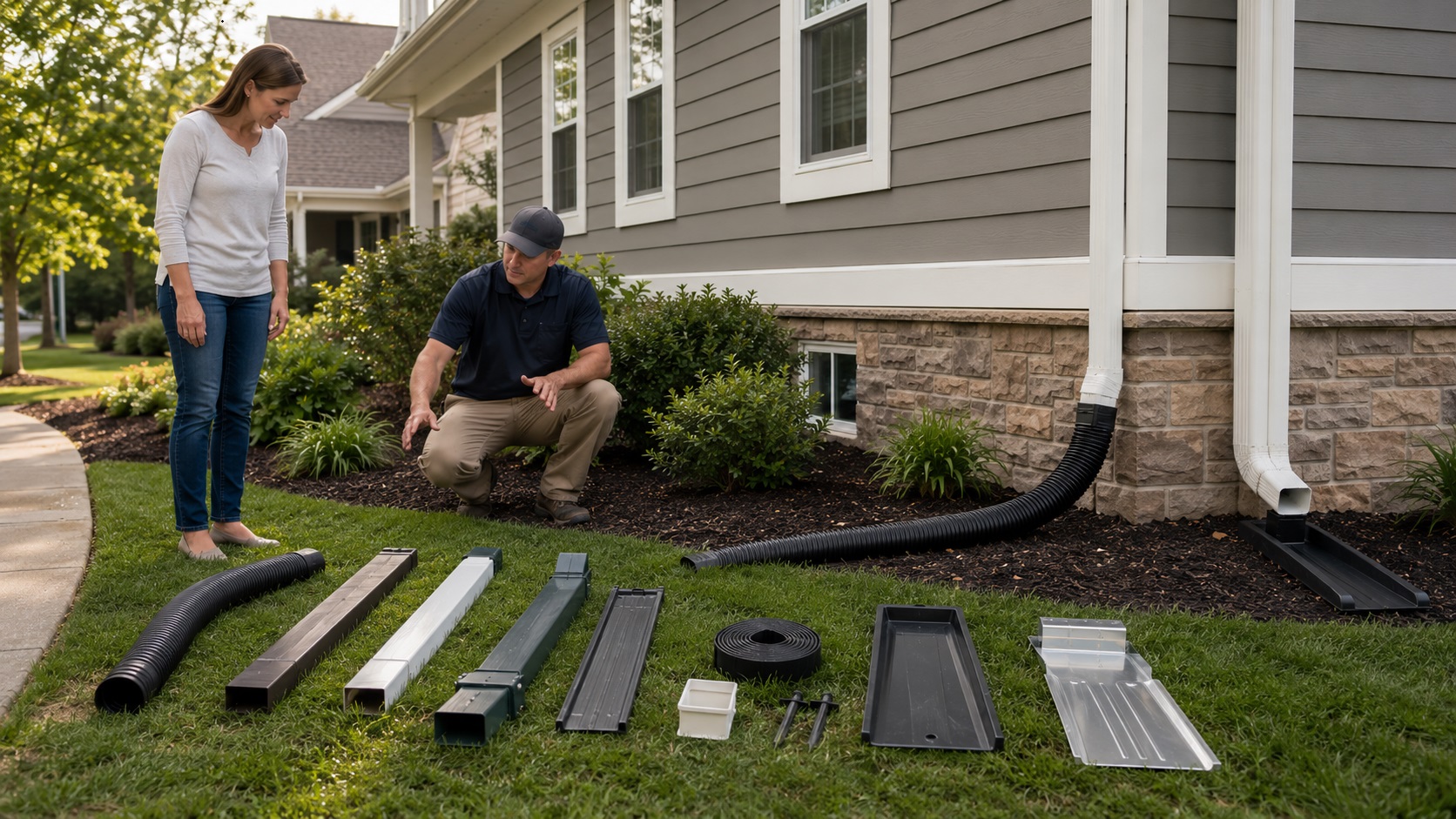
Best Downspout Extensions and Splash Blocks for Foundation Protection
Water leaving a downspout can quickly become a basement or foundation problem when it empties too close to the house. Concentrated roof runoff may saturate soil along the foundation, erode landscaping, contribute to wet basement walls, and keep foundation edges damp long after a storm ends. The right downspout accessory helps move that water toward a safer discharge point before it can pool beside the structure.
To understand the connection between roof runoff and persistently wet soil beside a house, see How Downspouts Affect Foundation Moisture.
The best downspout extensions and splash blocks for foundation protection are not all designed for the same situation. A long flexible extension can carry water several feet across a yard, while a splash block mainly spreads runoff over soil that already slopes away from the home. Hinged hardware makes an existing metal extension easier to lift for mowing, and a catch-basin-style system can collect water beneath an awkwardly positioned outlet.
This guide compares five practical above-ground options for controlling roof runoff. It also explains when these products are appropriate, how to install them correctly, and when a larger drainage or grading problem requires more than an extension.
As an Amazon Associate, this site earns from qualifying purchases. This does not affect the price you pay. Our recommendations are based on research, product reliability, and real-world usability in moisture-prone environments.
Quick Picks for Redirecting Downspout Water
- Best Overall Long-Reach Extension: plusgutter 11.5ft Long Flexible Downspout Extension, Brown
- Best Low-Profile Runoff System: NAACOO 12×12-Inch Catch Basin Downspout Extender with 8-Foot Flexible Pipe
- Best Hinged Option for Mowing: Zip Hinge Downspout Gutter Hinge, 1 Pack
- Best Splash Block: NAACOO 2-Pack 24-Inch Downspout Splash Blocks with Anchoring Stakes
- Best Budget Multipack: YOTODY 2-Pack Flexible Downspout Extensions, Brown
Which Downspout Extension or Splash Block Fits Each Drainage Situation?
Best Overall Long-Reach Extension: plusgutter 11.5ft Long Flexible Downspout Extension
The plusgutter extension is the best fit in this lineup for homeowners who need to move roof runoff substantially farther from the foundation without installing buried drainage pipe. Its extended reach gives it a practical advantage over common accordion-style extensions that stop after approximately four or five feet.
The corrugated tube can bend around shrubs, air-conditioning pads, landscaping edges, and other obstacles. Two adapters are included to accommodate several common rectangular downspout sizes. This makes the product useful when a downspout ends beside a garden bed or when the safest discharge point is not directly in line with the outlet.
Its long reach does not eliminate the need for proper slope. Corrugated tubing can retain water, collect roof granules, or trap leaves when it is laid flat or allowed to sag. It works best when the full length descends continuously toward an outlet where water can disperse safely.
Key Features
- Extends from approximately 2.6 feet to a maximum of about 11.5 feet.
- Four-inch corrugated tube provides a substantial channel for residential downspout runoff.
- Includes two adapters for several common residential downspout dimensions.
- Flexible construction can route water around landscaping and exterior obstacles.
- Attachment screws help secure the adapter to the downspout outlet.
- Polyethylene construction is intended for outdoor exposure through changing weather.
Pros
- ✔ Provides considerably more reach than most basic flexible extenders.
- ✔ Can be shortened or expanded as site conditions change.
- ✔ Useful where the discharge point is several feet from the foundation.
- ✔ Multiple adapter options reduce the chance of ordering the wrong connector.
- ✔ Flexible route can work around plants, steps, and other fixed objects.
Cons
- ✖ Corrugations may hold debris or standing water if the tube lacks adequate fall.
- ✖ The long extension may shift unless it is supported or anchored.
- ✖ An exposed 11.5-foot tube may be visually noticeable in a finished landscape.
- ✖ It can interfere with mowing if it must cross an open lawn.
Best For
- Homes where downspout water must travel much farther than a splash block can carry it.
- Landscaped areas where a flexible route is more useful than a straight rigid extension.
- Homeowners seeking an above-ground solution that can be adjusted seasonally.
Check the plusgutter 11.5ft Long Flexible Downspout Extension on Amazon to see current availability.
Best Low-Profile Runoff System: NAACOO 12×12-Inch Catch Basin Downspout Extender
The NAACOO catch-basin system is designed for downspouts that terminate above mulch, landscaping, concrete edges, or other areas where a normal adapter does not connect cleanly. Instead of attaching directly to the downspout, the wide basin collects falling water and channels it into a flexible discharge pipe.
This arrangement can be particularly useful when the bottom of the downspout is damaged, irregularly shaped, positioned above a rain chain, or located where a conventional extension would sit awkwardly. The grate helps block larger debris, while an additional screen provides another level of filtration before runoff enters the pipe.
The system is sometimes described in retail language as a no-dig French drain, but it should not be confused with a true French drain. It is better understood as a surface collection basin connected to an adjustable outlet pipe. It can redirect roof runoff, but it does not manage widespread groundwater or replace a properly designed buried drainage system.
Key Features
- Wide 12-by-12-inch basin collects water below a downspout or rain chain.
- Flexible pipe extends from approximately 2.5 feet to about 8 feet.
- Grated top helps keep larger leaves and yard debris out of the basin.
- Secondary screen helps reduce the amount of smaller material entering the pipe.
- Low-profile pipe can be positioned along the surface or lightly concealed with landscaping material.
- Pipe can be routed around obstacles rather than requiring a perfectly straight path.
Pros
- ✔ Does not require a sealed connection directly to the downspout.
- ✔ Helpful for awkward outlet locations or downspouts ending above landscape beds.
- ✔ Basin captures water over a wider area than a narrow connector.
- ✔ Flexible pipe provides more reach than a typical splash block.
- ✔ Low-profile layout can be less visually intrusive than a large exposed tube.
Cons
- ✖ Grate and filter surfaces require periodic cleaning.
- ✖ Sediment may collect inside the basin after repeated storms.
- ✖ It does not replace a French drain, yard grading correction, or underground solid-pipe system.
- ✖ The pipe can still hold water when installed without continuous downward slope.
Best For
- Downspouts that end above mulch, gravel, concrete borders, or irregular terrain.
- Rain-chain discharge areas that need a wider collection point.
- Homeowners who want a lower-profile runoff route without committing to a buried system.
Check the NAACOO Catch Basin Downspout Extender on Amazon to see current availability.
Best Hinged Option for Mowing: Zip Hinge Downspout Gutter Hinge
The Zip Hinge is not a complete downspout extension. It is hinge hardware that allows an existing metal extension to swing upward when the lawn needs mowing, trimming, snow clearing, or temporary access.
This makes it a practical choice for homeowners who already have a sturdy metal downspout extension and do not want to replace it with flexible plastic. When installed correctly, the hinge lets the extension remain aligned during rain and then fold upward without repeatedly disconnecting it from the downspout.
The product is especially useful where an extension crosses a lawn. Constantly removing and reattaching a metal section can loosen screws, damage the lower downspout, or lead homeowners to leave the extension disconnected. A permanent hinge reduces that inconvenience while preserving the durability and appearance of a metal runoff channel.
Key Features
- Aluminum hinge system designed for rectangular or square downspouts.
- Allows an existing metal extension to flip upward for lawn access.
- Includes corrosion-resistant installation hardware.
- Optional clasp helps hold the extension in the raised position.
- Compatible with several common downspout dimensions.
- Package includes a magnetic hex nutsetter for installation.
Pros
- ✔ Makes mowing and trimming around the downspout easier.
- ✔ Reduces the need to disconnect and reconnect a metal extension.
- ✔ Preserves the cleaner appearance of a matching metal downspout system.
- ✔ Aluminum hardware is more durable than many thin molded-plastic hinges.
- ✔ Useful in areas where a flexible tube would be inconvenient or unattractive.
Cons
- ✖ The downspout extension itself is not included.
- ✖ Installation requires drilling or fastening into existing metal components.
- ✖ The extension must be lowered before rain to provide foundation protection.
- ✖ It does not increase discharge distance unless paired with a sufficiently long extension.
Best For
- Homeowners with existing metal downspout extensions crossing lawn areas.
- Properties where mowing convenience is the main reason extensions are frequently removed.
- Users who prefer a permanent metal drainage setup over a flexible plastic tube.
Important: This listing is for hinge hardware only. A compatible downspout extension is required separately.
Check the Zip Hinge Downspout Gutter Hinge on Amazon to see current availability.
Best Splash Block: NAACOO 2-Pack 24-Inch Downspout Splash Blocks
The NAACOO splash-block set is the simplest recommendation in this guide. Each block sits beneath a downspout outlet and guides concentrated runoff across a molded channel rather than allowing it to strike bare soil directly beside the foundation.
Splash blocks are best suited to homes where the surrounding grade already slopes away from the building. They help reduce erosion, soil displacement, and localized puddling immediately beneath the outlet, but their short length cannot carry water across a flat yard or overcome soil that slopes back toward the house.
This set includes two finished 24-inch splash blocks assembled from four interlocking sections. Anchoring stakes help keep the blocks aligned in wind, strong runoff, or areas that are frequently disturbed during yard maintenance.
Key Features
- Includes two complete splash blocks for two downspout locations.
- Each assembled block measures approximately 24 inches long.
- Molded channel directs concentrated runoff away from the outlet.
- Raised interior pattern helps guide and spread flowing water.
- Anchoring stakes reduce movement during storms and lawn maintenance.
- Open design works beneath different downspout shapes without an adapter.
Pros
- ✔ Simple installation requires no connection to the downspout.
- ✔ Two-pack is convenient for paired corners or front and rear downspouts.
- ✔ Stakes improve stability compared with unsecured lightweight blocks.
- ✔ Helps reduce erosion directly beneath the outlet.
- ✔ Low-profile appearance works well in visible landscaped areas.
Cons
- ✖ Twenty-four inches of reach is not enough for flat or reverse-sloped ground.
- ✖ Water can still pool at the end if the surrounding soil does not drain away.
- ✖ The open channel may collect leaves, mulch, or sediment.
- ✖ A splash block cannot replace a connected extension where longer redirection is necessary.
Best For
- Properties with clear positive grading away from the foundation.
- Downspouts that mainly need erosion control directly below the outlet.
- Homeowners seeking a simple, low-profile solution for two locations.
Check the NAACOO 2-Pack Downspout Splash Blocks on Amazon to see current availability.
Best Budget Multipack: YOTODY 2-Pack Flexible Downspout Extensions
The YOTODY two-pack is a practical option for homeowners who need to extend two downspouts without purchasing separate units. Each corrugated extension adjusts to approximately 22 to 58 inches, giving it enough reach for basic residential runoff control where the safe discharge area is relatively close.
The flexible shape can be routed around small landscaping obstacles, and the brown finish may blend more naturally with mulch, soil, or darker exterior materials than a bright white extension. Adapters are intended to fit common residential downspout sizes, and screws help reduce the chance of the connector pulling loose during a storm.
This model is not as long as the plusgutter extension, so it is better suited to homes that need moderate redirection rather than a route extending across a wide planting bed or lawn. As with other corrugated designs, it needs steady downward fall to prevent trapped water and debris.
Key Features
- Two flexible extensions included in one package.
- Each unit adjusts from approximately 22 to 58 inches.
- Adapters fit common 2-by-3-inch and 3-by-4-inch residential downspouts.
- Corrugated construction bends around small obstacles.
- Brown finish blends with many mulch beds and soil-colored landscapes.
- Attachment hardware helps secure the adapter to the downspout.
Pros
- ✔ Two-pack covers multiple downspout locations.
- ✔ Adjustable length works for different discharge distances.
- ✔ Flexible tube is easy to reposition when landscaping changes.
- ✔ Useful for basic runoff control without a complex installation.
- ✔ Darker color is less conspicuous in many garden beds.
Cons
- ✖ Shorter maximum reach than the plusgutter model.
- ✖ Corrugations may collect debris or hold water on nearly level ground.
- ✖ Lightweight tubing may need support in exposed or windy locations.
- ✖ Product listings have shown inconsistent maximum-length information, so the conservative 58-inch figure is more reliable.
Best For
- Homeowners who need basic extensions for two downspouts.
- Landscape beds where moderate reach is sufficient.
- Budget-conscious users who do not need an extra-long discharge route.
Check the YOTODY 2-Pack Flexible Downspout Extensions on Amazon to see current availability.
Compare the Best Downspout Extensions and Splash Blocks
| Product | Category | Best Use Case | Key Strengths | Main Limitation | Amazon Link |
|---|---|---|---|---|---|
| plusgutter 11.5ft Flexible Extension | Best Overall Long-Reach Extension | Moving water several feet across landscaping | Long reach, flexible route, multiple adapters | Needs continuous slope and may require anchoring | View on Amazon |
| NAACOO Catch Basin Downspout Extender | Best Low-Profile Runoff System | Awkward outlets above mulch, gravel, or landscape borders | Wide collection basin, debris screens, approximately 8-foot pipe | Requires cleaning and is not a true French drain | View on Amazon |
| Zip Hinge Downspout Gutter Hinge | Best Hinged Option for Mowing | Existing metal extensions crossing a lawn | Folds upward, durable hardware, avoids repeated removal | Hinge only; extension not included | View on Amazon |
| NAACOO 24-Inch Splash Blocks, 2-Pack | Best Splash Block | Positive grade where only short runoff guidance is needed | Two blocks, anchoring stakes, simple installation | Too short for flat or reverse-sloped yards | View on Amazon |
| YOTODY Flexible Extensions, 2-Pack | Best Budget Multipack | Moderate redirection at two downspout locations | Two adjustable tubes, common adapters, easy routing | Limited reach compared with longer models | View on Amazon |
How to Choose the Right Downspout Runoff Solution
Start With the Distance to a Safe Discharge Point
Do not choose an extension based only on its advertised maximum length. First identify where the water can safely exit. The outlet should not direct runoff toward the foundation, a neighboring property, a public sidewalk, a septic area, retaining-wall backfill, or a slope that is already eroding.
There is no universal minimum distance that works for every home. Soil type, roof area, runoff volume, ground slope, and foundation design all affect how far the water should travel. A short splash block may be adequate on a steep positive grade, while a long flexible extension may still be insufficient on flat clay soil.
For a deeper explanation of how exterior runoff reaches basement walls, read Why Basement Walls Leak During Rain.
Choose a Splash Block Only When the Grade Already Works
A splash block spreads and guides water immediately below the downspout. It is not a long-distance drainage system. Use one where the soil clearly slopes away from the house and water naturally continues moving after leaving the end of the block.
If puddles form at the end, a connected extension is usually the better choice. Installing a decorative block on reverse-sloped ground may simply move the puddle two feet farther from the wall without solving the moisture problem.
Use a Connected Extension When Water Must Travel Farther
Flexible corrugated extensions work well when the runoff route must curve around plants, air-conditioning pads, steps, or other obstacles. The plusgutter model is preferable when the discharge point is far away, while the YOTODY two-pack makes sense when two downspouts need moderate extensions.
A connected adapter also reduces splashing and water loss near the downspout. Check the outlet dimensions before ordering, especially if the home has oversized or nonstandard downspouts.
Consider Mowing and Walkway Access
An extension crossing a lawn may be effective during rain but frustrating during routine maintenance. A hinge can solve that problem when paired with a metal extension. Flexible tubes can also be moved, but repeated dragging may loosen adapters or damage the tubing.
Avoid routing an extension across a frequently used walkway unless it can be recessed safely or repositioned when conditions are dry. A low-profile product is not automatically safe if it still creates a tripping hazard.
Account for Runoff Volume
A large roof section can send substantial water through one downspout during intense rain. Narrow, partially collapsed, or sharply bent extensions can restrict that flow. Water may then back up at the adapter or spill near the foundation.
High runoff volume also increases the need for anchoring. Lightweight tubes and splash blocks can shift when a strong stream strikes them. Stakes, screws, clips, or landscape supports help keep the outlet pointed toward the intended discharge area.
Recognize When an Extension Is Not Enough
Downspout accessories cannot compensate for clogged gutters, undersized downspouts, leaking gutter seams, reverse yard grading, foundation cracks, or failed perimeter drainage. If water repeatedly returns toward the house after leaving the extension, the larger drainage pattern needs attention. These signs of poor drainage near foundations can help determine whether the problem extends beyond the downspout outlet.
See How to Redirect Water Away From Foundations for a broader explanation of surface-water control, grading, and discharge planning. You can also use the sitewide guide, How to Find, Fix, and Prevent Moisture Problems in Homes, when the downspout is only one part of a larger moisture problem.
How to Position Downspout Accessories So Water Keeps Moving Away
Test the Route Before Securing Everything
Place the extension or splash block in the intended position and run water through the gutter with a garden hose. Watch the entire path, including the adapter, joints, low spots, and final outlet. Confirm that water keeps moving away rather than collecting beside the house.
Maintain Continuous Downward Fall
Flexible corrugated extensions should not contain dips. Even a shallow sag can hold water between storms, collect sediment, and freeze in cold weather. Support the tube with compacted soil, pavers, landscape edging, or purpose-made anchors where needed.
Secure the Downspout Connection
Push the adapter fully onto the outlet and use the included screws or clamps where appropriate. A connection that appears secure in dry weather may separate when a full gutter sends water through it rapidly.
Protect the Final Outlet From Erosion
Long extensions solve one problem but can create another if they release concentrated water onto bare soil. Position the outlet over a stable area where runoff can spread or continue moving without washing away soil. Depending on the site, this may include established grass, gravel, or stone.
Inspect the System During Real Rain
A hose test is useful, but it does not always reproduce storm conditions. During the next safe rainfall, check whether gutters overflow, connections leak, tubing shifts, or water circles back toward the foundation.
Prepare for Winter Conditions
Standing water inside corrugated tubing can freeze. Ice may block the outlet, split thin material, or force runoff to escape near the downspout. Before freezing weather, clear debris and confirm that the extension drains completely.
Common Mistakes That Reduce Foundation Protection
Assuming Every Home Needs the Same Extension Distance
A fixed distance recommendation ignores soil, slope, roof size, and drainage conditions. The correct length is the distance required to reach a stable location where runoff continues away from the building.
Installing Corrugated Tubing Flat
Flexible tubing may look level while containing several small dips. These low areas hold water and debris. Stretch the tube only as far as needed and support it so the interior drains fully.
Using a Splash Block on Reverse Grade
A splash block cannot force water uphill. If the ground slopes toward the foundation, runoff leaving the block may flow directly back toward the basement wall.
Pointing Water Toward Another Problem Area
Moving runoff away from one foundation corner does not help if the outlet empties beside a retaining wall, onto a sidewalk, toward a neighbor, or into an erosion channel. Evaluate the complete route before installation.
Forgetting That a Hinge Must Be Lowered
A raised extension provides no protection during rain. Develop a routine for lowering hinged extensions after mowing or yard work, especially when storms are forecast.
Ignoring Gutter Overflow
An extension cannot redirect water that never reaches the downspout. If gutters overflow during rain, check for clogs, poor gutter slope, undersized components, or insufficient downspout capacity.
Buying the Wrong Product Type
A hinge is not an extension, and a splash block is not a long-distance drainage pipe. Confirm exactly what is included before ordering, particularly when a listing shows several sizes or package variations.
Questions Homeowners Ask About Downspout Extensions and Splash Blocks
Are downspout extensions better than splash blocks?
Neither is universally better. A splash block may be adequate where the soil slopes clearly away from the house. A connected extension is preferable when water must travel farther before reaching a safe discharge point.
How far should a downspout extension reach from the foundation?
There is no single distance that applies to every property. The extension should reach far enough for runoff to continue moving away without pooling, returning toward the house, damaging neighboring property, or causing erosion.
Can flexible downspout extensions be left outside all year?
Many are designed for outdoor use, but seasonal conditions still matter. UV exposure, lawn equipment, standing water, snow, and freezing can shorten the life of flexible tubing. Inspect it periodically for cracks, sagging, and loose connections.
Do corrugated extensions clog easily?
They can collect leaves, shingle granules, and sediment, especially when installed with low spots. Keeping gutters clean and maintaining continuous downward slope reduces the risk.
Will a splash block stop basement leaks?
A splash block may reduce concentrated water beside the foundation, but it cannot guarantee that basement leakage will stop. Foundation cracks, poor grading, clogged gutters, saturated soil, and failed drainage systems may also contribute.
Can I bury a flexible downspout extension?
Some manufacturers allow shallow concealment, but flexible corrugated tubing is generally less suitable for permanent buried drainage than properly selected solid pipe. Buried systems also require planning for slope, cleanouts, outlet protection, and local conditions.
How do I keep an extension from blowing away?
Secure the adapter with appropriate screws or clamps, then support the tube with stakes, clips, landscape edging, or other non-damaging anchors. Avoid placing heavy objects directly on the tube where they could restrict flow.
What should I do if water pools at the extension outlet?
The outlet may need to be moved farther away, redirected to a better-draining location, or protected against erosion. Persistent pooling can also indicate poor grading or poorly draining soil that a simple extension cannot correct.
Which Downspout Accessory Should You Choose?
The plusgutter 11.5ft Long Flexible Downspout Extension is the best overall choice when the main goal is carrying water significantly farther from the foundation. Its long adjustable reach and flexible route make it suitable for many residential layouts.
Choose the NAACOO Catch Basin Downspout Extender when the outlet ends awkwardly above mulch, gravel, a rain chain, or an area where a direct adapter is impractical. It provides a broad collection point and a lower-profile discharge route.
The Zip Hinge is the most useful option for homeowners who already have metal extensions but repeatedly remove them for mowing. Remember that it is hinge hardware only and does not include the extension.
The NAACOO Splash Block 2-Pack is appropriate where the grade already moves water away and the main need is erosion control beneath two downspouts. For a simpler multipack of connected extensions, the YOTODY 2-Pack offers moderate reach at two locations.
No accessory should be treated as a cure for every exterior moisture problem. Confirm that the gutters are functioning, the soil slopes appropriately, and the final outlet releases water somewhere safe. The best downspout extensions and splash blocks for foundation protection work by supporting a good drainage pattern—not by compensating for a failed one.