
Why Gutters Cause Water Problems Around Homes
Gutters cause water problems around homes when they stop moving roof runoff away from the structure. A gutter system is supposed to collect rainwater from the roof, carry it to downspouts, and discharge it away from the foundation. When gutters clog, overflow, sag, leak, pull away, or drain too close to the house, roof water can end up soaking the areas it was meant to protect.
The confusing part is that gutter problems often show up somewhere else. A homeowner may notice water pooling near the foundation, damp basement walls, crawl space humidity, soil erosion, stained siding, or moisture near doors and windows before realizing the roof runoff system is involved. The gutter may be the starting point, but the visible moisture problem may appear at ground level or inside the home after rain.
Gutters do not need to fail completely to create moisture issues. A small clog, bad slope, loose hanger, leaky corner, short downspout, or discharge point aimed at the wrong surface can redirect roof runoff toward the house. Over time, that repeated wetting can saturate soil, splash siding, wet trim, overload drainage paths, and increase the chance of water finding structural gaps.
Why Gutters Matter for Moisture Control
Gutters are part of the home’s exterior moisture-control system, not just roof accessories. Every time it rains, the roof collects water across a large surface area and sheds it toward the edges. Without a working gutter system, that water can drop near the foundation or run down surfaces that were not designed for repeated soaking.
The main job of a gutter is to control where roof water goes. Instead of allowing runoff to fall along the foundation line, the gutter collects that water and sends it toward downspouts. From there, the water should be discharged far enough away that it does not run back toward the structure. When that chain works, roof runoff is managed before it becomes a wall, foundation, basement, crawl space, or siding problem.
When that chain breaks, water can reach vulnerable areas. It may spill over the front edge of the gutter and fall beside the foundation. It may leak through a seam and soak the same wall area during every storm. It may run behind a loose gutter and wet fascia, soffits, or wall edges. It may discharge from a downspout too close to the house and collect near the foundation. These are some of the ways gutters connect to how water enters homes through structural gaps.
Gutter-related water problems are especially common around roof valleys, inside corners, long roof runs, second-story rooflines, and areas where several roof sections drain into one gutter. These places receive concentrated runoff. If the gutter is clogged, undersized, poorly sloped, or not securely attached, water may overflow even when the rest of the gutter system seems normal.
Because gutters sit above the problem area, homeowners sometimes overlook them. They may focus on the wet mulch, damp basement wall, or puddle near the house without looking up at the roof edge. But roof runoff is often the first water source to check when moisture appears after rain. A complete approach to finding and preventing moisture problems around the home should always include the roof runoff system.
How Gutters Are Supposed to Move Roof Water
A working gutter system follows a simple path: roof water enters the gutter, flows through the trough, reaches the downspout, and exits away from the home. Every part of that path matters. If one section fails, water may spill, back up, leak, or discharge in the wrong place.
The gutter trough should be clean enough for water to flow. Leaves, twigs, shingle grit, seeds, nests, and roof debris can slow or block movement. The gutter should also have enough slope to guide water toward the downspout. If the pitch is wrong, water can stand in the trough, overflow during rain, or leak through weak seams.
The gutter must also stay attached tightly to the fascia. Loose hangers or sagging sections can create gaps behind the gutter. When that happens, water may run between the gutter and the roof edge instead of entering the trough. This can wet fascia boards, soffits, wall sheathing, siding edges, and trim. The homeowner may see stains or rot before realizing the gutter is no longer catching water correctly.
Downspouts complete the system. A clean gutter can still cause moisture problems if the downspout dumps water at the foundation. The discharge should move water away from the house, not onto a surface that slopes back toward the wall. Splash blocks, short extensions, disconnected elbows, and underground drains that are clogged or crushed can all defeat the purpose of the gutter system.
A properly functioning gutter system should:
- Catch roof runoff before it drops near the foundation.
- Move water smoothly through the gutter trough.
- Prevent water from spilling behind the gutter.
- Carry water through open downspouts.
- Discharge water where it continues moving away from the house.
- Keep siding, trim, fascia, basement walls, crawl spaces, and foundation edges from repeated wetting.
When gutters cause water problems, it is usually because one or more of those steps has failed. The problem may look like overflowing gutters, but it may also look like wet soil, siding stains, basement dampness, crawl space odor, or repeated moisture near the home after rain.
What Happens When Gutters Clog or Overflow
Clogged gutters are one of the most common ways roof runoff turns into a water problem around the home. When leaves, twigs, shingle grit, seeds, pine needles, roof debris, or ice block the gutter trough, water can no longer move freely toward the downspout. During rain, the gutter fills faster than it can drain, and water begins taking uncontrolled paths.
Overflowing water may spill over the front edge of the gutter and fall directly beside the foundation. It may pour over one corner where debris has collected. It may spill behind the gutter if the gutter has pulled away from the roof edge. In heavier rain, water may overshoot the gutter entirely if the roof valley sends too much runoff into one small section.
Once water leaves the gutter system, it can create problems below. Soil may erode under the drip line. Mulch may wash away. Splashback may stain siding. Water may collect near basement walls, crawl space edges, garage slabs, patios, steps, or low areas next to the house. If this pattern repeats during storms, the problem is no longer just a dirty gutter. It has become part of the home’s exterior water-management problem.
Overflow can also be intermittent. A gutter may handle light rain but fail during heavy rain. That makes the problem easy to miss unless you observe the system during a storm or look for evidence afterward. Water marks, soil trenches, displaced mulch, stained siding, and wet areas below the roof edge can all point to overflow even if the gutter looks normal on a dry day.
A simple clue is whether the wettest area lines up with a gutter corner, valley discharge point, seam, or downspout outlet above it.
If the main visible problem is overflow, a more focused checklist of signs your gutters are overflowing can help confirm whether the issue is clogging, poor pitch, undersized sections, blocked downspouts, or water overshooting the gutter during heavy rain.
Why Leaking or Sagging Gutters Wet the House Edge
Gutters do not have to be completely clogged to cause water problems. A gutter can be mostly open and still fail if it leaks, sags, slopes the wrong way, or pulls away from the fascia. These problems often create repeated wetting in one location, which can be just as damaging as obvious overflow.
A sagging gutter can hold standing water instead of sending it toward the downspout. Over time, that standing water adds weight, stresses hangers, and makes the sag worse. During rain, the low point may overflow repeatedly. If the low point is near a wall corner, window, door, or foundation edge, the same area can become wet after every storm.
Leaking seams and corners create a similar problem. A small leak may drip in the same place every time it rains. That steady drip can erode soil, stain siding, wet trim, or soak a foundation corner. Because the leak is localized, the homeowner may blame the wall, soil, or basement area instead of the gutter joint above it.
Loose gutters can be even more serious because they may allow water to run behind the gutter. When water slips between the gutter and fascia, it can wet the roof edge, fascia board, soffit, siding top edge, or wall materials behind trim. This can lead to peeling paint, rot, staining, and hidden moisture at the upper wall area.
Watch for these gutter condition problems:
- Sections that sag or look lower than the rest of the run
- Standing water in the gutter after rain has stopped
- Loose or missing hangers
- Gaps between the gutter and fascia
- Water stains below seams or corners
- Peeling paint or rot near the roof edge
- Overflow from one section even when the gutter is not full of debris
- Water dripping behind the gutter instead of into it
These issues matter because water repeatedly hits the same part of the home. Repeated wetting is what turns a small gutter defect into a siding, trim, fascia, foundation, or wall moisture problem. If water is reaching the exterior wall, it may also find small gaps around trim, penetrations, or wall transitions.
How Poor Downspout Discharge Creates Foundation Moisture
Downspouts are part of the gutter system, not a separate detail. Gutters collect water, but downspouts decide where that water goes. If downspouts discharge too close to the house, the gutter system may successfully move water off the roof while still delivering it to the foundation.
This is one of the most common reasons homeowners see water problems even when the gutters look clean. The troughs are open, the water reaches the downspout, and the downspout drains quickly. But the water exits at the base of the wall, onto a short splash block, onto a walkway that slopes back toward the house, or into a low area where it collects.
When downspouts dump water too close to the foundation, the soil near the house becomes wetter than the surrounding yard. That wet soil can increase moisture against basement walls, crawl space perimeters, slab edges, and foundation corners. During repeated storms, the ground may stay damp long after the rain stops. That is when gutter problems begin to look like foundation drainage problems.
Poor downspout discharge can create several patterns:
- Puddles near foundation corners
- Wet mulch or soil below downspout outlets
- Basement dampness after rain
- Crawl space humidity after storms
- Water running back toward the house from a splash block
- Driveway, patio, or walkway runoff carrying downspout water toward the wall
- Erosion channels where downspout water repeatedly flows
The fix is not only to clean the gutter. The water needs to keep moving away after it leaves the downspout. That may require extensions, better discharge locations, grading corrections, splash control, or drainage improvements. For a deeper explanation of this part of the system, see how downspouts affect foundation moisture.
If water is already collecting near the house after the downspout discharges, the gutter system may be contributing to a larger drainage issue. At that point, the next step is to trace where water flows after it reaches the ground, not just whether the gutter trough is clean.
Why Gutter Problems Can Lead to Basement or Crawl Space Dampness
Gutter problems often show up as basement or crawl space moisture because roof runoff eventually becomes ground-level water. When gutters overflow or downspouts discharge too close to the house, soil near the foundation can become saturated. Once that soil stays wet, moisture has more opportunity to move toward basement walls, crawl space edges, slab joints, cracks, and porous foundation materials.
This does not mean every damp basement is caused by gutters. Basement and crawl space moisture can come from grading, groundwater, foundation cracks, hydrostatic pressure, missing drainage systems, plumbing leaks, or poor ventilation. But gutters are one of the first exterior systems to check because they control a major source of rainwater before it reaches the ground.
The pattern is important. If the basement wall, crawl space perimeter, or lower level smells damp after rain, look outside at the gutter and downspout system above that area. Water may be overflowing from the roof edge, leaking at a gutter seam, dumping from a short downspout, or pooling near the foundation. If the moisture appears repeatedly after storms, roof runoff may be contributing even if the gutter itself does not look dramatic on a dry day.
Gutter-related basement and crawl space dampness is more likely when:
- Water pools near the foundation after rain.
- Downspouts discharge near basement walls or crawl space vents.
- Gutters overflow above the damp interior area.
- Mulch, soil, or landscaping stays wet near the wall.
- Basement dampness is worse after heavy rain.
- Crawl space humidity rises after storms.
- Foundation corners stay wet below gutter valleys or downspout outlets.
When water repeatedly collects near the foundation, the issue may overlap with signs of poor drainage near foundations. If basement walls leak during rain, the gutter system may be one part of a larger exterior water problem that also involves soil saturation, wall seepage, cracks, or drainage pressure. In that case, it helps to compare the symptoms with why basement walls leak during rain.
How Gutter Overflow Damages Siding, Trim, and Exterior Walls
Gutter-related water problems do not only happen at the foundation. Overflowing, leaking, or misaligned gutters can wet the upper parts of the exterior wall as well. When water spills behind a gutter, runs down the fascia, splashes against siding, or repeatedly hits trim, it can create moisture problems above grade before the water ever reaches the soil.
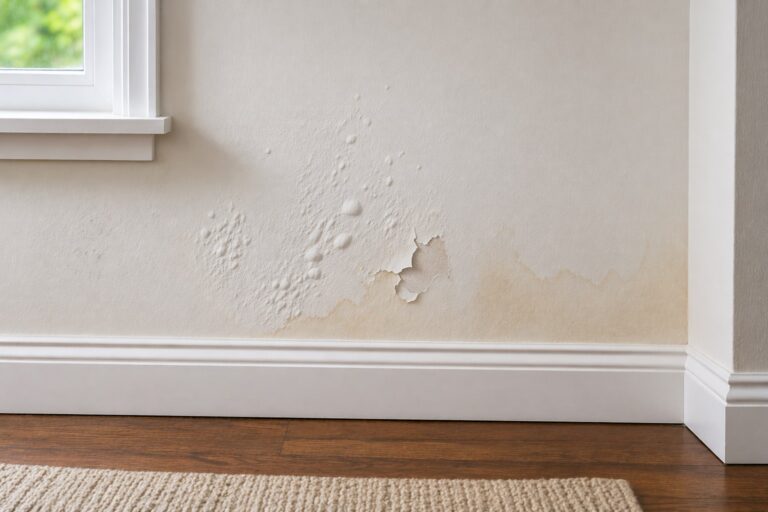
Siding and trim are designed to shed normal weather exposure, but they are not meant to handle concentrated roof runoff in the same spot during every storm. Repeated wetting can stain siding, peel paint, soften trim, damage caulk joints, and push moisture behind exterior materials. If water reaches gaps around windows, doors, wall penetrations, or siding transitions, it may move behind the surface and create hidden moisture risks.
Watch for exterior wall clues below problem gutters:
- Vertical stains below gutter seams or corners
- Green, black, or brown discoloration on siding
- Peeling paint near fascia, soffits, or trim
- Rotting wood near roof edges
- Wet siding below roof valleys
- Splash marks near the bottom of walls
- Caulk failure around trim or wall joints
- Moisture near windows, doors, or exterior penetrations after rain
These signs matter because water often enters homes through small weaknesses, not large openings. A gutter leak may not look serious, but if it repeatedly wets a trim joint, siding seam, window edge, or wall transition, it can increase the chance of hidden water intrusion. This is why gutter problems should be considered part of the exterior wall moisture system, not only the roof drainage system.
If siding stains or trim damage are strongest below one gutter section, focus your inspection above that area. Check for clogs, leaks, loose hangers, bad pitch, water spilling behind the gutter, or roof valleys that overload the gutter during heavy rain. The location of the wall damage often points back to the failed section of the gutter system.
How to Tell When Gutters Are Part of a Larger Drainage Problem
Sometimes gutters are not the only cause of water problems around a home. They may be one part of a larger drainage pattern. This happens when roof runoff leaves the gutter system and then flows across surfaces that direct water back toward the house. In that situation, cleaning the gutters may help, but it will not fully solve the problem.
For example, a downspout may discharge onto a driveway that slopes toward the garage. A gutter may send water into a low landscape bed that holds moisture against the wall. A splash block may slow water down but still allow it to run back toward the foundation. A patio, walkway, or compacted soil area may prevent water from draining away. In each case, the gutter system is moving water off the roof, but the ground-level drainage is still failing.
Look at where the water goes after it leaves the downspout or overflow point. If it collects near the house, flows back toward the foundation, or remains in the soil long after rain, the gutter problem has become part of a broader exterior drainage issue.
Gutters may be part of a larger drainage problem when:
- Water pools near the home after the gutters discharge.
- Soil remains wet for days after storms.
- Downspout water flows across walkways, patios, or driveways toward the house.
- Foundation corners stay wet even after gutters are cleaned.
- Multiple areas around the house become damp after heavy rain.
- Basement or crawl space moisture continues after basic gutter maintenance.
- Water collects where the yard, driveway, or landscaping slopes toward the structure.
If water keeps collecting around the house after storms, compare the pattern with why water pools around houses after rain. If the goal is to correct the movement path, the next step is often to redirect water away from foundations instead of only cleaning the gutter troughs.
Recurring drainage issues also deserve a broader inspection when the same wet areas keep coming back. Gutter overflow, short downspouts, poor grading, blocked surface drains, and compacted soil can work together. If the home shows multiple water symptoms after rain, review the signs exterior drainage is failing so the gutter system is evaluated as part of the whole exterior water-control system.
When Gutter-Related Moisture Needs Professional Attention
Some gutter-related water problems are simple maintenance issues. Cleaning debris, reconnecting an elbow, extending a downspout, or replacing a worn splash block may solve the problem if water has not reached building materials. But recurring water near the same foundation edge, wall, siding area, basement, crawl space, or garage slab deserves a closer inspection.
Professional attention may be needed when the gutter system is damaged, unsafe to access, or tied to a larger moisture pattern. Multi-story gutters, steep roof edges, rotted fascia, sagging gutter runs, underground downspout drains, repeated basement dampness, and water entering behind siding require more caution than routine cleaning.
Do not climb to inspect gutters during active rain, high wind, icy conditions, or when the roof edge, fascia, or ladder footing is unstable. In those cases, observe water patterns from the ground and have the system inspected safely.
Call a qualified gutter, roofing, drainage, waterproofing, or home repair professional if you notice:
- Gutters pulling away from the fascia
- Rotting fascia, soffits, or roof-edge trim
- Water spilling behind the gutter during rain
- Repeated basement or crawl space dampness after storms
- Foundation-edge pooling that returns after gutter cleaning
- Water stains below gutter seams, corners, or roof valleys
- Siding, trim, or window areas that stay wet after rain
- Downspouts connected to underground drains that may be blocked
- Soil erosion near the foundation or exposed footing areas
- Moisture appearing inside the home after gutter overflow
The goal is not to assume every gutter problem means major damage. The goal is to stop repeated wetting before it spreads. If gutters are failing at the roof edge, water can damage fascia and siding. If downspouts discharge poorly, water can saturate soil near the foundation. If drainage around the home is already weak, gutter runoff can overload it during heavy rain.
When you are unsure, inspect the pattern after rain. Look at where water leaves the roof, where it exits the downspout, where it travels across the ground, and where the home shows moisture symptoms. If the same path repeats during storms, the gutter system is part of the moisture problem even if the visible damage is somewhere else.
FAQ About Gutter-Related Water Problems
Can clogged gutters cause water around the foundation?
Yes. Clogged gutters can overflow and dump roof runoff directly beside the foundation. When this happens repeatedly, the soil near the house can become saturated, water can pool near walls, and basement or crawl space moisture may become more likely after rain.
Can bad gutters cause basement moisture?
Bad gutters can contribute to basement moisture by sending too much roof water toward basement walls. Gutters do not usually cause basement leaks by themselves, but clogged gutters, short downspouts, overflowing corners, and poor discharge can overload the soil near the foundation and increase rain-related seepage risk.
Why does water pool near my house when gutters overflow?
Water pools near the house when gutters overflow because roof runoff is no longer being carried away in a controlled path. Instead of moving through the gutter and downspout system, the water falls near the wall, saturates nearby soil, washes out mulch, or follows low spots back toward the foundation.
Are downspouts part of the gutter problem?
Yes. Downspouts are part of the same water-control system. Gutters collect roof runoff, but downspouts determine where that water is discharged. If downspouts are clogged, disconnected, too short, or draining onto surfaces that slope back toward the house, the gutter system can still cause water problems.
Can gutter overflow damage siding and trim?
Yes. Gutter overflow can wet siding, fascia, soffits, trim, window edges, and wall transitions. Repeated wetting can lead to staining, peeling paint, caulk failure, wood rot, and hidden moisture behind exterior materials, especially where water spills behind the gutter or overflows from the same section repeatedly.
When should gutter-related water problems be inspected professionally?
Gutter-related water problems should be inspected professionally when water reaches the basement, crawl space, siding, fascia, foundation edge, windows, doors, or interior walls. Professional help is also wise when gutters are sagging, pulling away, unsafe to access, tied into blocked underground drains, or still causing water problems after cleaning.
Follow the Roof Water Path
Gutters cause water problems around homes when they fail to control roof runoff. A clogged, leaking, sagging, poorly pitched, or poorly discharged gutter system can send water toward the foundation, siding, trim, basement walls, crawl spaces, garage slabs, windows, and doors. The gutter problem may begin at the roof edge, but the moisture symptoms often appear at ground level or inside the home after rain.
The most important step is to follow the water path. Look at how water leaves the roof, whether the gutter catches it, whether the trough drains properly, where the downspout discharges, and whether water keeps moving away from the house. If water spills, pools, splashes, or returns toward the structure, the gutter system is no longer protecting the home the way it should.
One Comment
Comments are closed.