
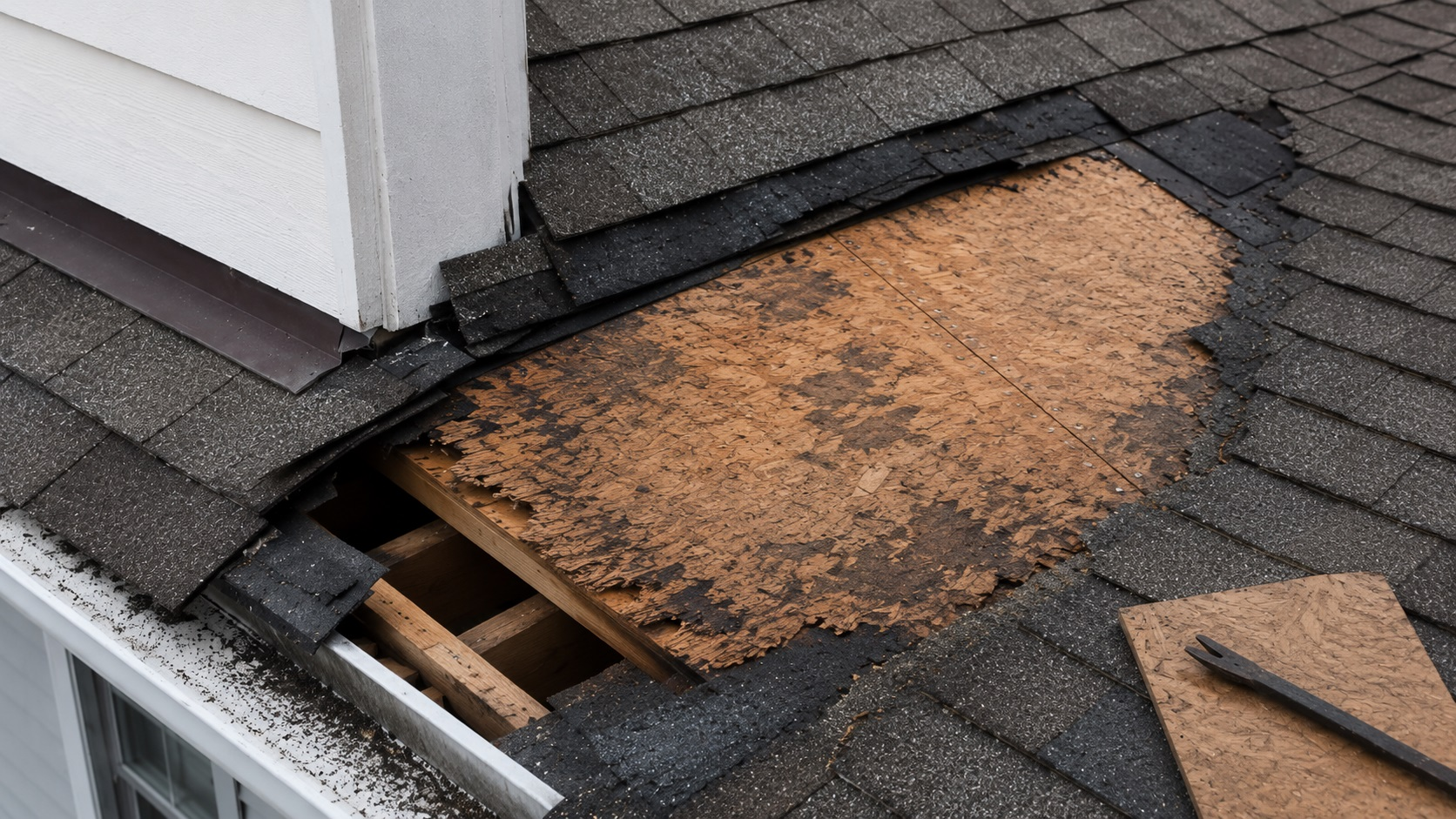
When Roof Decking Must Be Replaced
Roof decking must be replaced when it is too soft, rotten, swollen, delaminated, sagging, or moisture-damaged to support the roofing system properly. The roof deck is the structural surface beneath shingles, underlayment, flashing details, and roof fasteners. If that surface can no longer hold nails, stay flat, or support roofing materials safely, covering it with new shingles does not solve the problem.
Not every dark stain on roof decking means the wood has to come out. Some stains are left behind by old leaks that were repaired years ago. The real question is whether the decking is still structurally sound. A firm, dry, flat section of plywood or OSB may be serviceable even if it is discolored. A soft, spongy, swollen, crumbling, or fastener-failing section usually needs replacement.
This is why roof decking decisions often happen during tear-off. Before a new roof covering goes on, the exposed deck has to be evaluated as part of the larger roofing system. Compared with many common roofing material failures, roof decking damage is serious because it affects the surface every other roofing layer depends on.
When Roof Decking Must Be Replaced
Roof decking must usually be replaced when moisture damage has weakened the wood enough that it can no longer act as a solid base for the roof. This includes decking that bends under weight, breaks apart when probed, flakes at the surface, separates into layers, swells at the edges, or no longer holds roofing nails securely.
The most common replacement-level conditions include:
- Soft or spongy decking: The wood compresses, flexes, or feels unstable instead of firm.
- Rotten decking: The wood fibers have deteriorated and may crumble, flake, or break apart.
- Delaminated plywood: The layers of plywood have separated after moisture exposure.
- Swollen OSB: The panel edges or surface have expanded, roughened, or lost density.
- Sagging sheathing: The roof deck dips between rafters or trusses instead of staying flat.
- Poor fastener hold: Nails do not bite properly, pull through, or fail to secure the roofing system.
- Active saturation: The decking is still wet because the leak source has not been corrected.
These conditions matter because roof decking is not just a hidden layer. It gives the roof system its nailing base, shape, and support. If the deck is compromised, the shingles or other roof covering may look new from the outside while the structure underneath remains weak.
Replacing damaged decking is only one part of the solution. The leak, condensation, flashing defect, or ventilation problem that damaged it must also be corrected so the new decking is not exposed to the same moisture source.
Why Damaged Roof Decking Cannot Always Stay in Place
Damaged roof decking cannot always stay in place because shingles, underlayment, flashing transitions, drip edge, and fasteners all depend on a stable substrate. If the deck is soft, swollen, sagging, delaminated, or rotten, the new roof may be installed over a surface that is already failing.
The biggest problems are fastener holding, surface support, and hidden moisture. Nails may not grip correctly in deteriorated wood. Shingles may not lie flat over uneven sheathing. If damp or rotting decking is covered before the moisture source is fixed, the new roof can trap an old problem beneath fresh materials.
That is why a roofer may recommend replacing damaged sheets during tear-off rather than simply installing new shingles over them. The recommendation should still be specific. A good explanation should identify whether the issue is softness, rot, delamination, swelling, sagging, or fastener failure—not just say that the decking “looks bad.”
Stained Roof Decking Does Not Always Mean Replacement
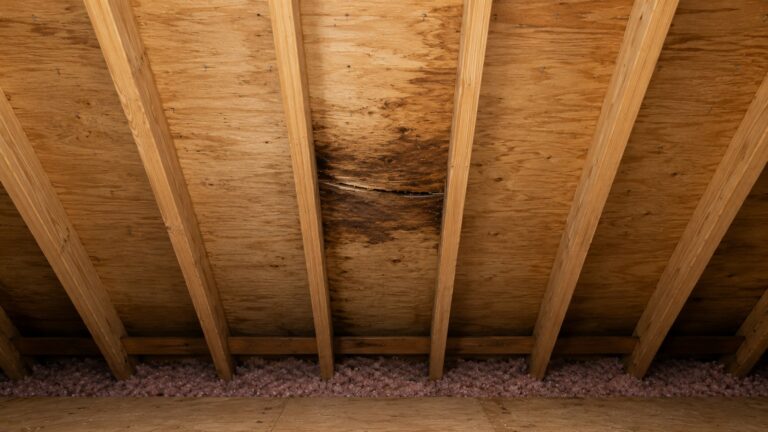
One of the biggest homeowner misunderstandings is assuming that every dark stain on the underside of roof decking means the deck must be replaced. Staining is a clue, but it is not the same as structural failure.
A roof deck can be stained from an older leak that was repaired, from a short-term condensation event, or from minor past moisture exposure. If the wood is now dry, firm, flat, and still holds fasteners properly, staining alone may not justify replacement. The more important question is whether the material has lost strength.
Replacement becomes more likely when staining is combined with other warning signs. For example, a dark stain around a roof penetration may be less serious if the wood is firm and dry. But dark staining with softness, mold-like growth, flaking wood, a musty attic odor, or visible sagging suggests a deeper problem. If you need a symptom-focused breakdown, the companion article on signs roof decking is rotten covers that territory more directly.
The safest way to think about staining is this: discoloration tells you where moisture may have been. Texture, strength, dryness, shape, and fastener performance tell you whether the decking can stay.
Replacement-Level Signs of Roof Decking Damage
The clearest replacement signs are the ones that show the wood has lost strength, shape, or fastening ability. Cosmetic discoloration can be monitored, but structural weakness should not be covered with new roofing.
For a fuller symptom-by-symptom breakdown, see the guide to signs roof decking is rotten. This article focuses on when those symptoms cross the line into replacement.
Soft or Spongy Decking
Soft decking is one of the strongest replacement indicators. If a section of plywood or OSB compresses, flexes, or feels spongy under careful professional inspection, the wood has likely absorbed enough moisture to weaken its structure. A roof surface should not feel unstable between framing members.
Once the deck has lost firmness, drying alone may not restore its strength.
Rotten Wood Fibers
Rot is different from staining. Staining changes the appearance of the wood. Rot changes the condition of the wood itself. Rotten roof decking may crumble, flake, break apart, or feel punky when touched or probed. It may also have darkened areas with visible fiber breakdown.
Rotten decking usually needs replacement because it cannot reliably hold fasteners or support the roof covering. Even if only one section is affected, the damaged area should be cut out and replaced with sound material before the roof is covered again.
Delaminated Plywood
Plywood decking is made of bonded layers. When moisture breaks down that bond, the layers can separate. This is called delamination. Delaminated plywood may appear bubbled, split, uneven, or flaky at the edges.
Once plywood separates into layers, it no longer behaves like a single strong panel. A delaminated section is usually a replacement candidate, especially if the roof covering needs to be fastened over that area.
Swollen or Crumbling OSB
OSB can perform well as roof sheathing when it stays dry and is properly installed, but repeated moisture exposure can cause swelling, rough edges, flaking, and loss of density. Swollen OSB is especially common near roof leaks, eaves, valleys, flashing failures, and areas where water has backed up under the roof covering.
If OSB is only slightly discolored but still flat and firm, it may not automatically need replacement. But if it has expanded, crumbled, or lost its ability to hold nails, that damaged section should usually be removed.
Sagging Between Rafters or Trusses
Sagging roof decking is a serious warning sign. It may indicate moisture-weakened sheathing, improper panel thickness, excessive span, long-term load stress, or damage to the framing below. A sagging roof deck can also create low spots that affect water flow on the roof surface.
If sagging is visible from the attic or roof surface, the issue should be evaluated carefully. In some cases, the decking is the only damaged layer. In more serious cases, rafters, trusses, or other framing members may also be affected.
Nails That No Longer Hold
Fastener failure is one of the most practical reasons roof decking must be replaced. If nails spin, pull out easily, pull through the decking, or fail to bite into the material, the roof covering cannot be secured properly.
This matters because roof coverings depend on mechanical attachment. A new shingle roof installed over weak decking may be more vulnerable to wind damage, loose shingles, and premature failure. If the deck cannot hold fasteners, it is no longer doing one of its primary jobs.
When Wet Roof Decking Can Sometimes Be Saved
Wet roof decking does not always have to be replaced. The key question is whether the material is simply wet or whether it has already been damaged by moisture. A recently wetted section of roof decking may be able to dry if the leak source is fixed quickly and the wood remains firm, flat, and structurally sound.
Wet decking is more likely to be salvageable when:
- The leak was recent and short-lived.
- The wood is still firm when checked safely.
- There is no crumbling, swelling, or delamination.
- The panel remains flat and properly supported.
- The moisture source has been corrected.
- The area can dry before being covered again.
Wet decking is less likely to be salvageable when it has been soaked repeatedly, stayed damp for a long time, developed rot, grown mold, swollen at the edges, or become soft between framing members. At that point, the issue is no longer just moisture. It is material deterioration.
This distinction matters after roof leaks. Sometimes wet decking must be replaced. Other times, the leak source must be repaired first, the area must be dried, and the decking must be evaluated for strength. If the leak is still active inside the home, review the signs of roof leaks inside the house so the source is not ignored.
When Partial Roof Decking Replacement Is Enough
Partial roof decking replacement is often enough when the damage is limited to a specific area. For example, a small section around a failed pipe boot, chimney flashing problem, valley leak, or missing shingle may be damaged while the surrounding decking remains firm and dry.
In these cases, the damaged panel or section can usually be cut out and replaced without removing all of the decking on the roof. The replacement must tie into sound framing, match the required thickness, and provide a solid surface for the new roofing materials.
Partial replacement may make sense when:
- The damaged area is isolated.
- The surrounding decking is firm and dry.
- The framing below the decking is still sound.
- The moisture source has been corrected.
- The replacement section can be properly fastened.
This is common during roof replacement. Once old shingles are removed, roofers may discover that only a few sheets of decking need replacement. That does not necessarily mean the whole roof deck is bad. It means the damaged areas should be corrected before the new roof covering is installed.
When Widespread Roof Decking Replacement May Be Necessary
Widespread roof decking replacement may be necessary when damage is not limited to one leak location. If several areas of the roof deck are soft, sagging, swollen, or rotten, the issue may be larger than a single failed shingle or flashing detail. In that situation, replacing only one small patch may leave other weak areas under the new roof.
Widespread decking damage is more likely when the roof has had long-term leaks, repeated storm damage, poor attic ventilation, chronic condensation, or years of neglected maintenance.
Widespread replacement may be needed when:
- Multiple roof planes have soft or weakened decking.
- Several panels show swelling, delamination, or rot.
- The roof has sagging areas between rafters or trusses.
- Old leaks were repaired on the surface but the deck stayed damaged.
- Attic condensation has affected broad sections of sheathing.
- The existing deck is too deteriorated to hold new roofing fasteners consistently.
This does not always mean every sheet on the entire roof must be replaced. It does mean the roofer should evaluate the full deck carefully, not just the most obvious leak area. If damage is widespread, the replacement plan should explain which sections are affected, why they cannot stay, and whether framing repairs are also needed.
How Roofers Decide Whether Decking Needs Replacement
Roofers usually make the final decking decision during tear-off because that is when the roof deck is fully exposed. From the ground, a roof can look acceptable while hidden sheathing damage remains under the shingles. From inside the attic, some problems may be visible, but the top surface of the deck may still be hidden until the old roof covering is removed.
A roofer may decide decking needs replacement based on several checks:
- Visual condition: The roofer looks for rot, swelling, delamination, cracking, or damaged panel edges.
- Surface feel: Soft or spongy areas suggest the panel has lost strength.
- Fastener holding: Decking that will not hold nails properly is usually not acceptable for a new roof covering.
- Panel flatness: Sagging, buckling, or uneven sheathing can interfere with roof installation.
- Moisture evidence: Active dampness, recurring staining, or wet insulation below the deck can point to an unresolved moisture problem.
- Underside clues: Attic-side inspection may show staining, mold-like growth, darkened sheathing, or visible deterioration.
Homeowners can often review some underside clues before roof work begins by learning how to inspect roof decking from the attic. That does not replace a professional tear-off inspection, but it can help you understand why a roofer is recommending replacement later.
Do not walk on a roof area that may have soft decking. A weak section can fail under body weight, and damage that looks minor from below may be more dangerous from above.
A good contractor should be able to show you the damaged decking and explain the reason for replacement in plain language. “It looks old” is not as useful as “this sheet is soft around the valley,” “these OSB edges are swollen,” or “the nails are not holding in this rotten section.” Specific evidence matters.
Questions to Ask Before Approving Roof Decking Replacement
Roof decking replacement is sometimes unavoidable, but homeowners should still ask clear questions before approving the scope. This is especially important when the recommendation comes during an active roof replacement and the old shingles have already been removed.
Useful questions include:
- Where is the damaged decking? Ask whether the damage is near a valley, eave, chimney, skylight, vent pipe, ridge, or another leak-prone area.
- How many sheets or sections are affected? A specific quantity helps you understand whether the issue is isolated or widespread.
- What kind of damage is present? Ask whether it is rot, softness, swelling, delamination, sagging, active wetness, or poor nail holding.
- Is the surrounding decking still sound? This helps determine whether partial replacement is enough.
- Has the moisture source been fixed? Replacing decking without correcting the leak or condensation problem can lead to repeat damage.
- Is any framing damaged? If rafters, trusses, or blocking are affected, the issue is more serious than decking alone.
- Will the replacement match the existing deck thickness? The new section should create a smooth, properly supported roof plane.
- Can I see photos? Ask for photos that show the damaged sheet, the surrounding sound decking, and the exact reason the material cannot stay.
These questions do not mean you should refuse necessary replacement. They help make sure the decision is based on actual deck condition rather than vague concern. If the roofer can show soft, rotten, swollen, or fastener-failing decking, replacement is usually a legitimate part of the repair.
Why the Moisture Source Must Be Fixed First
Replacing roof decking only solves the damaged-material part of the problem. It does not automatically solve the reason the decking became wet. If the original leak path, ventilation issue, or condensation problem remains, the new decking can eventually suffer the same damage.
Common moisture sources that can damage roof decking include failed flashing, damaged shingles, leaking valleys, cracked pipe boots, ice dam issues, poor attic ventilation, bath fans venting into the attic, and humid indoor air reaching cold roof sheathing. Each of these problems needs a different solution.
This is why roof decking replacement should be paired with source control. If the problem came from a roof leak, the leak pathway must be repaired. If the problem came from attic condensation, ventilation and air leakage may need attention. If the problem came from flashing failure, the flashing detail must be corrected instead of simply covering the area again.
When the source is unclear, the replacement decision should wait until the roofer identifies whether the moisture came from an active leak, attic condensation, failed flashing, blocked ventilation, or another roof-system problem.
When Roof Decking Damage Needs Professional Evaluation
You should call a roofing professional when roof decking damage appears structural, widespread, or connected to an active moisture problem. A small stain in the attic may be something to monitor, but soft decking, sagging sheathing, visible rot, recurring leaks, or fastener failure should not be treated as a simple cosmetic issue.
Professional evaluation is especially important when:
- The roof surface feels soft or uneven.
- The attic side of the decking is dark, soft, moldy, or sagging.
- Water stains keep returning after roof repairs.
- Multiple areas of decking are damaged during tear-off.
- Roofing nails no longer hold securely.
- There is visible sagging between rafters or trusses.
- You are unsure whether the problem is a roof leak, attic condensation, or both.
If the damage is active, do not wait until the next full roof replacement to investigate it. Decking damage can spread when leaks continue, insulation stays wet, or attic moisture remains trapped. Ceiling staining, attic dampness, wet insulation, musty odors, and recurring roof stains can all point to roof moisture that needs attention before it causes deeper damage.
Should You Approve Roof Decking Replacement During a Roof Job?
You should approve roof decking replacement during a roof job when the contractor can show that the affected decking is structurally unsound, rotten, swollen, delaminated, sagging, or unable to hold fasteners. Ask more questions when the recommendation is vague. “The decking looks bad” is not enough by itself.
A better explanation should identify the specific condition and location of the damage. For example, the contractor may say that two sheets near the chimney are soft from a flashing leak, or that OSB along the eave has swollen from repeated water exposure. If the damage is widespread, ask whether the problem is isolated to the roof deck or whether the framing below it also needs evaluation.
Also confirm that the original leak path or moisture condition has been corrected.
FAQ About Roof Decking Replacement
Does stained roof decking have to be replaced?
Stained roof decking does not always have to be replaced. Staining shows that moisture was present at some point, but the replacement decision depends on the condition of the wood. If the decking is dry, firm, flat, and still holds fasteners properly, staining alone may not require replacement.
Can you install new shingles over soft roof decking?
New shingles should not be installed over soft roof decking. Soft decking cannot provide a reliable nailing base or stable support for the roofing system. Even if the finished roof looks acceptable from the outside, the weak substrate underneath can lead to fastening problems, uneven surfaces, and future leaks.
Can only part of the roof decking be replaced?
Yes. Partial roof decking replacement is common when damage is limited to a specific area, such as around a chimney, valley, vent pipe, skylight, or roof edge. The damaged section can usually be removed and replaced as long as the surrounding decking and framing are sound.
Does wet OSB roof decking need to be replaced?
Wet OSB does not automatically need replacement if it is still firm, flat, and able to dry fully after the moisture source is corrected. OSB becomes a replacement concern when the edges swell, the surface flakes, the panel crumbles, the sheet feels soft, or roofing nails no longer hold securely.
Should roof decking be replaced every time a roof is replaced?
No. Roof decking does not need to be replaced every time a roof is replaced if the existing deck is sound. During tear-off, the roofer should inspect the decking and replace sections that are soft, rotten, swollen, delaminated, sagging, unable to hold fasteners, or otherwise unsuitable for the new roof system.
Final Decision: Replace Weak Decking, Not Every Stained Panel
Roof decking must be replaced when moisture, rot, swelling, delamination, sagging, or fastener failure has weakened the material beyond safe reuse. The goal is not to replace every stained board or panel. The goal is to make sure the roof covering is installed over a solid, dry, stable substrate that can support the system properly.
Localized damage can often be handled with partial decking replacement. Widespread softness, repeated saturation, sagging, or poor fastener holding may require a larger repair plan. In every case, the moisture source must be corrected before damaged decking is covered again.
If you are facing this decision during a roof repair or replacement, ask for specific evidence. Find out where the damage is, what type of failure is present, how much decking is affected, and whether the surrounding structure is still sound. A clear replacement decision protects the new roof and helps prevent the same moisture problem from returning.
One Comment
Comments are closed.