
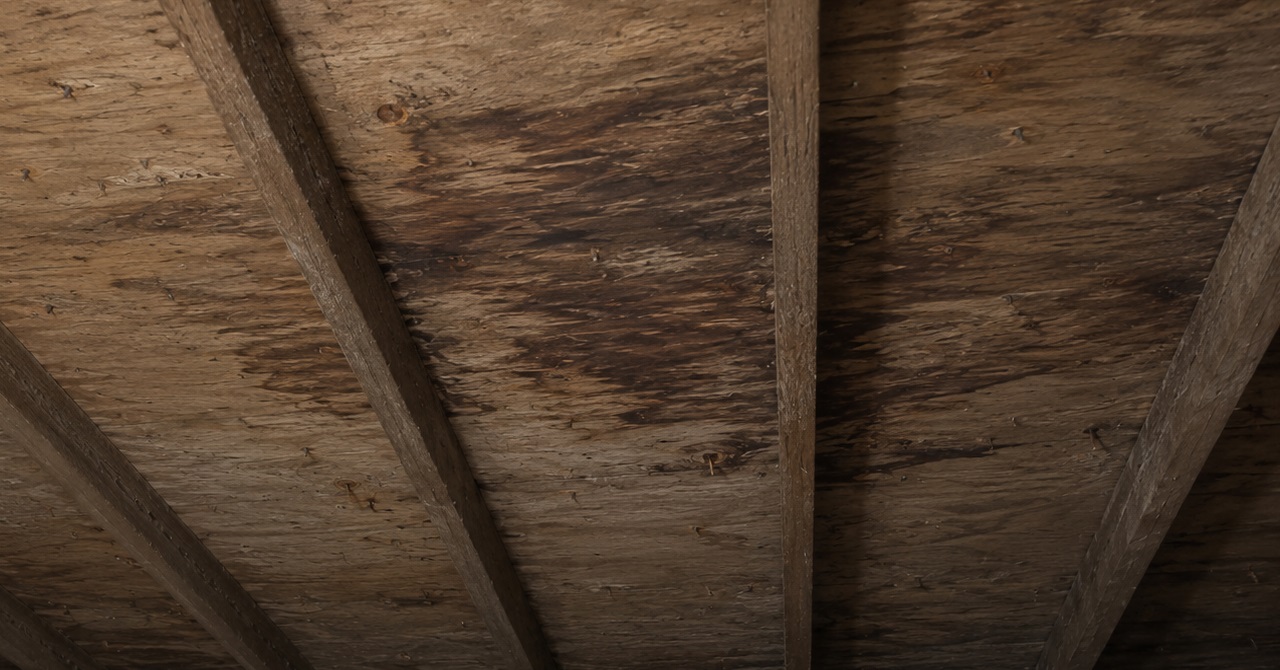
Signs of Long-Term Roof Moisture Damage
Long-term roof moisture damage usually develops slowly. Roof framing may get wet, partially dry, and then absorb moisture again until rafters, trusses, roof decking, or connection points begin to show deeper signs of deterioration.
The clearest signs of long-term roof moisture damage include soft or crumbly wood, deep staining, warped rafters, recurring mold, loose fasteners, sagging roof lines, and musty attic odors that return after ventilation or drying. These signs are more serious than a fresh water stain because they suggest repeated moisture exposure or incomplete drying.
If moisture problems have occurred in your attic or roof framing, Why Roof Rafters Stay Wet explains the moisture conditions that often lead to long-term structural damage. If mold is already visible on framing, Signs of Mold Growth in Roof Framing covers the mold-specific warning signs.
This article focuses on warning signs that moisture has been present long enough to create possible structural concern, not on full roof leak tracing, mold cleanup, or roof repair instructions.
For a broader look at roof system deterioration, material failure, and when roof damage moves beyond isolated moisture staining, see Most Common Roofing Material Failures.
Why Long-Term Roof Moisture Damage Is Dangerous
Moisture damage that lasts for months or years can affect rafters, trusses, ridge boards, roof decking, and structural connections. These parts are meant to stay dry enough to preserve their strength, shape, and fastener holding power.
Structural Wood Gradually Loses Strength
Wood framing loses reliability when repeated moisture exposure leads to swelling, shrinkage, checking, decay, or fastener movement. The concern is not just that the wood got wet once, but that it stayed damp long enough for physical or biological deterioration to begin.
Over time, this repeated moisture cycle can lead to:
- Reduced load-bearing strength
- Surface checking or cracking along grain lines
- Greater vulnerability to decay
- Loose fasteners or weakened connections
These changes may occur slowly enough to remain unnoticed until major structural problems develop.
Long-Term Moisture Encourages Decay Organisms
When wood remains damp for extended periods, decay organisms begin feeding on organic material within the wood. Unlike surface mold, decay fungi penetrate deeper into wood fibers, causing permanent damage.
Common results of decay activity include:
- Softened wood surfaces
- Crumbly structural material
- Loss of dimensional stability
- Progressive weakening of framing members
Once decay begins, reversing the damage becomes difficult. In many cases, affected wood must be repaired or replaced.
Damage Often Spreads Beyond Visible Areas
Long-term roof moisture damage may extend beyond the first visible stain because water can follow roof decking seams, framing joints, fasteners, insulation edges, and gravity paths.
This means damage may extend into:
- Adjacent rafters or trusses
- Roof decking connections
- Structural joints and supports
- Hidden framing behind insulation
Even when visible damage appears limited, surrounding materials may also be affected.
Most Common Signs of Long-Term Roof Moisture Damage
Long-term roof moisture damage is usually identified by patterns, not one isolated stain. The strongest warning signs involve material softness, shape changes, recurring growth, persistent odor, or structural movement.
Soft or Rotting Structural Wood
Soft wood is one of the strongest indicators that moisture damage has existed for an extended period. When wood fibers weaken, the material begins to lose firmness and structural strength.
Common warning signs include:
- Wood that feels soft when pressed gently
- Surface material breaking apart easily
- Wood crumbling when touched
- Loose or deteriorating structural edges
- Splintering that appears deeper than surface level
Soft wood often indicates rot activity, which occurs only after long-term moisture exposure.
Do not force a screwdriver, knife, or probe deeply into a rafter or truss member to “test” it. Gentle checking is enough for a homeowner; structural probing should be left to a qualified inspector or contractor.
Warped or Twisted Rafters
Repeated wetting and drying cycles cause wood to expand and contract. Over time, these cycles distort the natural shape of framing members.
Warped rafters may appear:
- Bent along their length
- Twisted out of alignment
- Uneven compared to adjacent rafters
- Misaligned with roof decking
Warping reduces structural efficiency and may affect how loads are distributed across the roof.
For earlier rafter-specific warning signs before damage becomes advanced, see Signs of Moisture Damage in Roof Rafters.
Deep Structural Discoloration
Deep discoloration in structural wood often signals that moisture exposure has been occurring for an extended period. Unlike light surface stains caused by short-term moisture, long-term damage produces darker, deeper color changes that penetrate into the wood.
These discoloration patterns often indicate repeated moisture absorption followed by incomplete drying cycles.
Watch for:
- Dark brown or black staining that extends deep into wood grain
- Large sections of continuous discoloration
- Multiple layers of staining across the same area
- Color differences between older and newer wood sections
- Discoloration concentrated near known moisture pathways
Deep discoloration suggests that moisture has been present long enough to affect the internal structure of the wood.
Repeated Mold Growth in the Same Areas
Recurring mold growth can be a warning sign of long-term roof moisture, especially when it returns on the same rafters, roof decking, or attic sheathing after cleaning or drying.
Repeated growth usually means the moisture source, air movement problem, or drying failure has not been corrected.
Common signs include:
- Mold reappearing in previously cleaned areas
- Growth spreading across multiple framing members
- Mold developing in new nearby locations
- Visible mold patches becoming larger over time
If mold continues to return, it often means that moisture sources remain active or that drying was incomplete. Understanding moisture persistence patterns in Why Roof Rafters Stay Wet can help explain why mold keeps recurring.
Persistent Musty Odors That Never Fully Disappear
Musty odors that remain present over long periods often indicate hidden moisture, mold, or decay activity somewhere in the attic or roof assembly. Even when visible surfaces appear dry, persistent odors can mean damp materials remain nearby.
Long-term moisture odors often:
- Remain present despite ventilation efforts
- Intensify during humid weather
- Spread into adjacent living spaces
- Return after temporary odor reduction
Structural Separation and Loose Fasteners
Long-term moisture exposure weakens connections between structural components. As wood softens and shifts, fasteners may loosen and joints may begin separating.
Structural separation often appears as:
- Gaps forming between framing members
- Nails pulling partially away from wood
- Loose fasteners around joints
- Separation along beam or rafter connections
- Visible cracks near structural attachment points
Loose connections reduce the overall stability of the roof structure and should be evaluated promptly.
How Moisture Damage Becomes Permanent
Some roof moisture damage can be stopped by correcting the moisture source and drying the structure, but drying does not restore wood that has already decayed, softened, split, distorted, or lost reliable fastener holding power.
Drying Does Not Restore Decayed or Distorted Wood
Drying can stop active moisture exposure, but it does not reverse structural changes that have already occurred. Wood that has become soft, crumbly, deeply checked, twisted, or unable to hold fasteners reliably may need repair or replacement even after it dries.
Decay Fungi Cause Permanent Structural Damage
Decay fungi develop when wood remains wet for extended periods. Unlike surface mold, decay fungi penetrate deeply into wood fibers and consume structural material.
Effects of decay fungi include:
- Loss of wood density
- Deep structural weakening
- Formation of crumbly material
- Permanent damage requiring repair
Once decay begins, drying alone cannot restore lost strength.
Repeated Moisture Causes Structural Movement
Moisture cycles cause wood to expand and contract repeatedly. These movements gradually distort the shape of structural components.
Over time, this movement may cause:
- Misalignment between framing members
- Distorted roof decking connections
- Uneven load distribution
- Reduced structural efficiency
Movement-related damage often becomes more visible as moisture exposure continues.
If moisture is still present, drying may still be necessary before repair decisions are made. The drying process for roof framing is covered in How to Dry Structural Roof Components.
Structural Warning Signs That Should Never Be Ignored
Some long-term moisture damage indicators signal elevated structural risk and should never be ignored. These warning signs suggest that deterioration has progressed beyond cosmetic concerns and may be affecting the safety of the roof system.
Recognizing these high-risk conditions early allows homeowners to seek professional evaluation before severe structural failure occurs.
Sagging or Uneven Roof Lines
One of the most serious visible indicators of long-term roof moisture damage is a sagging or uneven roof line. From outside the home, this may appear as a dip in the roof plane, a wavy ridge, uneven eaves, or a section of roof that no longer looks straight compared with nearby areas.
Signs of sagging may include:
- Roof sections that appear lower than surrounding areas
- Uneven ridgelines visible from the exterior
- Visible dips in roof surfaces
- Ceiling sagging beneath roof areas
- Doors or windows becoming difficult to close due to shifting structure
Sagging indicates that structural components may already be weakened. This condition requires immediate professional inspection.
Large Areas of Structural Rot
Extensive rot signals prolonged moisture exposure that has allowed decay organisms to penetrate deeply into wood fibers. Large rot areas rarely develop from short-term moisture problems.
Watch for:
- Wide sections of softened wood
- Wood that breaks apart easily under light pressure
- Deep cavities forming inside structural members
- Surfaces that crumble when touched
- Visible decay extending across multiple rafters
Large rot zones typically require structural repair or replacement rather than simple drying.
Repeated Structural Movement or Distortion
When moisture exposure continues over long periods, structural movement becomes more pronounced. Movement often occurs gradually and may go unnoticed until significant distortion develops.
Warning indicators include:
- Rafters shifting from original alignment
- Visible twisting of structural members
- Separation between framing components
- New cracks forming near structural joints
- Changes in roof surface alignment
Movement-related changes indicate weakening support structures and should be evaluated without delay.
If you inspect an attic, avoid stepping between joists, touching wet electrical components, or walking on damaged framing. Long-term moisture damage can weaken materials that may still look solid from above.
When Professional Structural Inspection Is Necessary
Professional inspection is necessary when roof moisture signs suggest rot, movement, sagging, widespread staining, or weakened connections. At that point, the question is no longer just whether the area is wet, but whether the roof framing still performs safely.
Signs That Require Immediate Professional Evaluation
Certain warning signs indicate urgent structural concerns that should not be delayed.
- Soft or crumbling structural wood
- Visible roof sagging or deformation
- Large areas of rot or deep discoloration
- Repeated mold growth cycles
- Persistent musty odors despite drying attempts
These indicators often suggest that moisture damage has progressed beyond simple maintenance concerns.
If the damage is not yet severe but you need to confirm whether framing is still damp, use How to Detect Moisture in Roof Framing for the inspection-focused next step.
When Moisture Problems Continue Despite Repairs
If moisture returns repeatedly after attempted repairs, deeper structural issues may exist. Recurring problems often indicate unresolved moisture pathways.
Frequently Asked Questions About Signs of Long-Term Moisture Damage
How do I know if roof wood is rotting?
Rotting roof wood usually feels soft or crumbly when pressed gently. It may break apart easily, show deep discoloration, or develop cavities inside the wood. If wood loses its firmness or structural shape, rot is likely present and should be evaluated promptly.
Can long-term roof moisture damage be reversed?
Drying can stop ongoing moisture damage, but it cannot restore wood that has already deteriorated. Once structural fibers weaken or decay develops, repairs or replacement of affected components may be required.
What happens if long-term roof moisture damage is ignored?
Ignoring long-term moisture damage allows deterioration to continue. Over time, wood loses strength, mold spreads, and structural movement may develop. In severe cases, roof sections can sag or fail, leading to costly repairs and safety risks.
Is dark roof framing always a sign of long-term moisture damage?
Dark roof framing is not always proof of active long-term moisture damage. Some wood darkens from age, old staining, dust, or prior leaks that are no longer active. Dark staining becomes more concerning when it appears with softness, musty odor, recurring mold, high moisture readings, loose fasteners, or visible roof movement.
What is the difference between an old roof leak stain and long-term moisture damage?
An old roof leak stain may be dry, firm, and unchanged over time. Long-term moisture damage is more likely when the stained area is soft, spreading, musty, moldy, warped, repeatedly damp, or connected to loose fasteners, sagging roof lines, or damaged decking.
Conclusion
Long-term roof moisture damage is different from a fresh stain or a one-time damp area. Soft wood, recurring mold, deep discoloration, warped rafters, loose fasteners, musty attic odors, and sagging roof lines all suggest that moisture may have been present long enough to weaken structural materials.
If these signs appear, confirm whether moisture is still active, avoid disturbing questionable framing, and get professional evaluation when structural movement, rot, or widespread deterioration is visible. For repair-focused next steps, see How to Fix Persistent Structural Roof Moisture Problems.
Key Takeaways
- Long-term roof moisture damage develops through repeated wetting and incomplete drying cycles.
- Soft wood, rot, and deep discoloration are strong indicators of prolonged moisture exposure.
- Warped rafters and sagging roof lines signal potential structural weakening.
- Repeated mold growth often indicates unresolved long-term moisture conditions.
- Drying alone cannot reverse advanced structural deterioration.
- Professional inspection is recommended when severe damage indicators appear.
One Comment
Comments are closed.