Klein Tools ET140 Moisture Meter Review: Is It Worth It?
The Klein Tools ET140 is worth considering if you want a pinless moisture meter for checking suspicious moisture without poking holes in finished surfaces. It is best for homeowners, landlords, and DIY inspectors who need to scan drywall, masonry, hardwood, or softwood around stains, damp basement walls, leak-prone window areas, or questionable wood trim.
The ET140 is not a room hygrometer or a smart leak alarm. It is a handheld tool for scanning compatible building materials and comparing relative moisture patterns. That makes it most useful as part of a broader inspection process, especially if you are comparing options in a guide to the best moisture meters for hidden water damage.
Disclosure: This article may contain affiliate links. If you buy through these links, we may earn a commission at no extra cost to you.
Quick Verdict on the Klein Tools ET140
Best for: Homeowners, landlords, and DIY inspectors who want non-destructive moisture checks in drywall, masonry, hardwood, and softwood.
Not ideal for: Continuous humidity monitoring, smart leak alerts, mold testing, or official inspection documentation.
Main strength: Pinless scanning helps you compare suspicious areas without leaving probe holes.
Main limitation: Drywall and masonry readings are relative, so the ET140 is better for finding moisture patterns than proving the full cause or severity of a problem.
Bottom line: The Klein Tools ET140 is a strong moisture-screening tool for checking common building materials after leaks, stains, or dampness concerns, especially when you compare suspicious areas against known dry sections.
What the Klein Tools ET140 Moisture Meter Does
The Klein Tools ET140 is a pinless moisture meter designed to detect relative moisture below the surface of compatible materials. According to Klein Tools, it is calibrated for drywall, masonry, hardwood, and softwood, with sensing up to 3/4 inch below the surface. That makes it most useful for scanning common home surfaces where moisture may be present but not obvious from appearance alone.
Klein ET140 Product Details
- Meter type: Pinless moisture meter.
- Detection method: Non-destructive relative moisture detection using an electromagnetic field.
- Compatible material modes: Drywall, masonry, hardwood, and softwood.
- Sensing depth: Up to 3/4 inch below the surface.
- Reading ranges: Hardwood 0–35%, softwood 0–55%, and drywall/masonry 0–100 relative readings.
- Accuracy note: Klein lists wood accuracy at ±4%; drywall and masonry readings are relative readings rather than direct material moisture percentages.
- Display: Reverse-contrast display with a nine-bar LED moisture indicator.
- Functions: Material mode selection, hold, low-battery indicator, auto-power off, audible alert, and visual notification.
- Power: One 9V battery, included with the meter.
- Size and weight: About 6 inches long, 2.5 inches wide, 1 inch thick, and roughly 7 ounces with battery.
- Included items: Moisture meter, 9V battery, and instruction manual.
The main reason to choose a pinless meter is simple: you can scan without pushing pins into the material. That matters if you are checking painted drywall, finished trim, wood flooring, or an area you may need to test repeatedly while it dries.
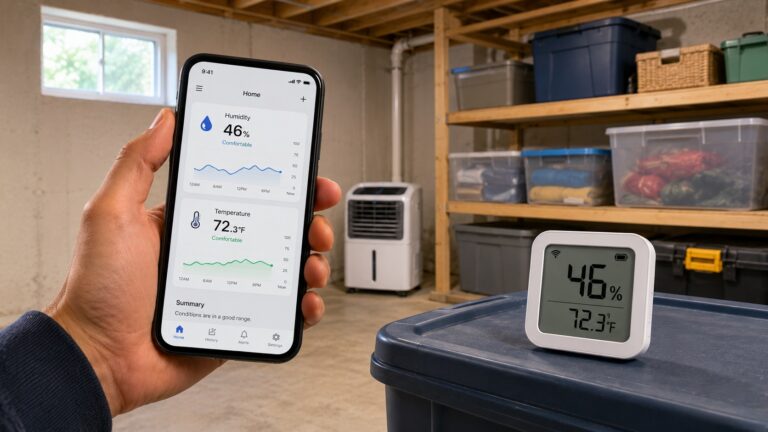
This is different from using a hygrometer. A hygrometer helps you understand air conditions, while a moisture meter helps you check materials. If you are still building a basic testing setup for your home, it is worth understanding how to test indoor humidity levels separately from how to test walls, wood, and masonry.
View the Klein Tools ET140 on Amazon
Klein ET140 Features That Matter for Moisture Checks
Pinless Moisture Detection
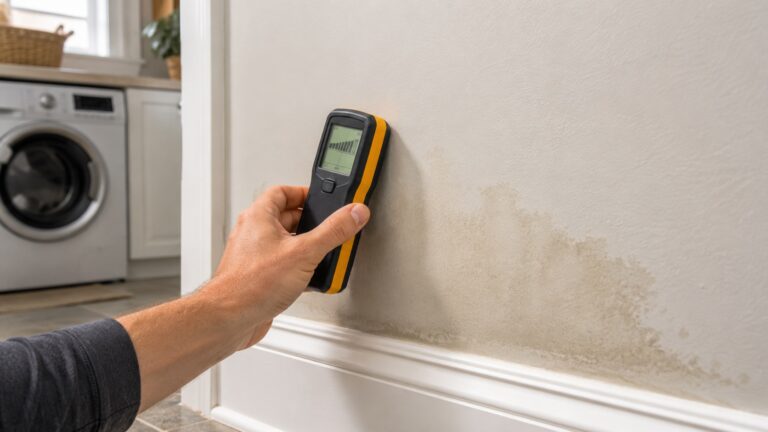
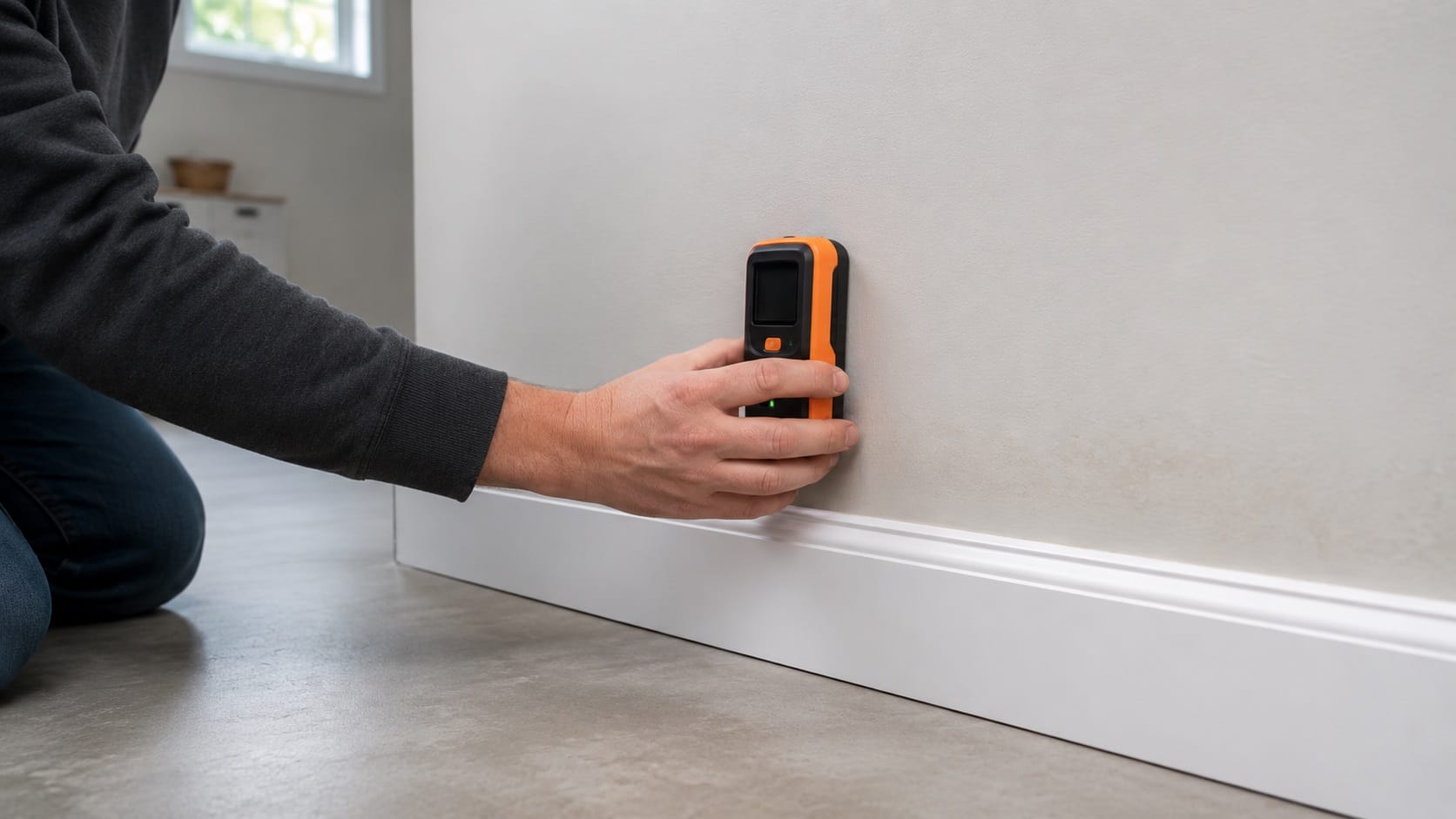
The ET140’s main appeal is pinless moisture detection. Instead of pushing metal probes into the material, you press the sensor area flat against the surface and scan for changes. That is useful on painted drywall, finished trim, wood flooring, and other visible surfaces where you do not want probe marks.
This is most helpful when you are looking for a pattern. For example, if a stain near a window reads higher than the surrounding wall, or a baseboard area reads higher than a nearby dry section, the meter helps identify where closer inspection makes sense.
Material Modes for Common Building Surfaces
The ET140 includes material modes for drywall, masonry, hardwood, and softwood. This matters because different materials respond differently to moisture. Drywall, masonry, and wood do not behave the same way, so choosing the correct mode helps make the reading more useful.
For a homeowner, this makes the tool more flexible. You might use drywall mode on a wall beneath a window, masonry mode on a basement wall, and wood mode on trim, framing, or flooring. That range gives the ET140 broader practical use than a very narrow meter that only works well on one material type.
The wood modes are also where the meter’s percentage-style readings are most meaningful. Klein lists separate detection ranges for hardwood and softwood, while drywall and masonry are treated as relative readings. That distinction matters because a drywall reading should be compared against nearby drywall, not treated exactly like a wood moisture-content measurement.
The important caution is that the meter should not be assumed to work equally well on every surface in a home. Tile assemblies, carpet, insulation, metal-backed materials, and layered wall systems can affect readings, so the ET140 should stay within the materials Klein lists for this model.
Display, LED Bar Graph, and Alerts
The ET140 has a reverse-contrast display and a visual LED bar graph. That is helpful during real inspection work because moisture checks often happen in dim corners, under cabinets, along baseboards, inside closets, or near basement walls where a small display can be harder to read.
The LED bar graph can also make it easier to understand changes quickly. Instead of focusing only on a number, you can watch how the reading changes as you move across an area. That is especially useful when trying to identify whether moisture is localized or spread across a wider section.
The meter also includes practical usability features such as audible alerts, hold, low-battery indication, and auto-power off. These do not make the meter more diagnostic by themselves, but they do make it easier to use during repeated checks around the home.
Tool-Like Build and Battery Design
The ET140 is built more like a handheld jobsite tester than a tiny household gadget. Klein lists 6.6-foot drop protection, an ABS plastic housing, a 9V battery, and an overall size of about 6 inches long by 2.5 inches wide by 1 inch thick. At roughly 7 ounces with the battery, it is still easy to carry around a basement, utility room, rental property, or renovation area.
That build is one reason the ET140 makes sense for repeated checks. It is still simple enough for homeowners, but it feels more appropriate for ongoing moisture inspections than the cheapest light-duty meters.
How the ET140 Performs in Home Moisture Checks
In real use, the Klein Tools ET140 is most useful for comparing one area against another. Start with a section that should be dry, then scan the stained, damp-looking, or leak-prone area. Keep the sensor flat, use the same material mode, and compare the questionable spot with the same type of material nearby rather than comparing drywall to wood or masonry. A noticeably higher reading does not prove the source of the problem, but it helps confirm that the area deserves closer attention.
This is especially useful after a known leak. A homeowner can scan the affected area immediately after cleanup, then check it again later to see whether readings are trending downward. That does not replace proper drying or professional evaluation after major water damage, but it can help you avoid relying only on touch or appearance. Surfaces can look dry while deeper materials still hold moisture.
The ET140 is also useful when checking around windows, baseboards, under-sink cabinets, basement walls, ceilings below bathrooms, and walls near plumbing. These are places where moisture often starts small before becoming visible damage. Used carefully, the meter can help identify areas that deserve closer observation or professional evaluation.
One caution is that moisture readings need context. Different materials have different normal behavior, and relative readings can be affected by density, layering, and what is behind the surface. Before making repair decisions based on any meter, it helps to understand moisture levels that indicate water damage and how readings should be interpreted.
Where the Klein Tools ET140 Works Best
The Klein Tools ET140 is especially useful on finished drywall. If you suspect moisture around a window, behind a baseboard, near a ceiling stain, or below a bathroom, a pinless scan can help you identify whether the questionable area stands out from the surrounding dry surface. That is exactly the kind of situation where a homeowner may want to detect moisture without opening walls.
It can also be useful on wood trim, hardwood, softwood, and masonry surfaces. In a basement, masonry mode may help you compare damp-looking sections against drier areas. Around trim and flooring, wood modes can help you look for moisture patterns that may not be obvious yet.
The ET140 also makes sense for follow-up checks after a plumbing leak, window leak, or minor water event has been fixed. Rechecking the same material over time can help catch moisture that returns after a repair or drying attempt.
Klein ET140 Limitations to Know Before Buying
The ET140’s biggest limitation is that it shows moisture patterns, not causes. A high reading near a window could come from condensation, flashing failure, air leakage, roof runoff, or old water damage. The meter helps you decide where to investigate, but it does not explain why the moisture is there.
It also is not the right tool for continuous monitoring. If you want alerts under a sink, beside a water heater, near a sump pump, or behind an appliance, a leak sensor is more appropriate. If you want to track room humidity over time, a hygrometer or smart humidity monitor is the better fit.
The other limitation is material compatibility. The ET140 is calibrated for drywall, masonry, hardwood, and softwood only. Tile assemblies, carpet, insulation, metal-backed materials, nails, pipes, corner bead, and layered wall systems can affect readings, so those situations may require a different tool or a professional inspection.
Who the Klein Tools ET140 Makes the Most Sense For
The Klein Tools ET140 makes the most sense for homeowners who want a practical way to check suspicious moisture without damaging finished surfaces. If you have a stain on drywall, a damp-looking basement wall, swelling trim, or an area that recently had a leak, this meter gives you a way to scan the surface and compare readings before deciding what to do next.
It is also a strong fit for people who expect to use a moisture meter more than once. The pinless design, material modes, display, LED bar graph, and tool-like build make sense for landlords, property managers, DIY renovators, and homeowners who regularly check basements, bathrooms, windows, plumbing areas, or rental properties.
It is also a good fit for leak follow-up. After the visible water is gone, moisture can remain inside drywall, wood, or masonry. Because the ET140 scans without probe holes, you can recheck the same area over time and compare it with nearby dry sections.
Check current availability on Amazon
When to Choose a Different Tool Instead
Choose a different tool if your main concern is room humidity or continuous leak protection. For humidity trends, use a hygrometer or humidity monitor. For alerts under a sink, near a water heater, beside a sump pump, or behind a washing machine, use a water leak sensor instead.
The ET140 also is not a mold test. High moisture readings may show that conditions could support mold growth, but the meter does not confirm mold, identify mold species, or determine whether remediation is needed.
Finally, homeowners who need official inspection documentation, insurance-level reporting, invasive moisture mapping, or professional remediation decisions should not rely on this tool alone.
How the Klein Tools ET140 Compares to Typical Alternatives
Compared with a pin-type moisture meter, the ET140’s biggest advantage is non-destructive scanning. Pin meters can be useful for direct wood checks, but they leave small holes. The ET140 is better when you want to move across painted drywall, trim, masonry, or finished surfaces without damaging them.
Compared with cheaper pinless meters, the ET140 stands out because it combines material modes, a clear display, a nine-bar LED indicator, hold function, audible alert, and a tougher tool-style body. Those extras matter most if you expect to check more than one area or monitor a repaired leak over time.
Compared with a thermal camera, the ET140 is more directly focused on material moisture. A thermal camera can show temperature patterns that may suggest wet areas, missing insulation, or air leakage, but it does not directly measure moisture. A moisture meter is usually more practical for confirming whether a suspicious area deserves closer inspection.
Compared with water leak sensors, the ET140 is better for manual scanning, while leak sensors are better for ongoing alerts. If you are still comparing tool types, see the guide to the best pinless moisture meters for home use before choosing one model.
Frequently Asked Questions About the Klein Tools ET140 Moisture Meter
Is the Klein Tools ET140 good for drywall moisture?
Yes, the ET140 is designed for drywall moisture screening when used in the correct material mode. It is best for comparing suspicious areas against nearby dry areas and looking for patterns. It should not be treated as final proof of the source, depth, or severity of the problem.
Does the Klein ET140 detect mold?
No. The ET140 detects relative moisture in compatible materials. Moisture can increase the risk of mold, but the meter does not confirm whether mold is present. Visible mold, strong odors, or health concerns may require a different inspection process.
Is the ET140 better than a pin-type moisture meter?
It depends on the job. The ET140 is better when you want non-destructive scanning on finished surfaces. A pin-type meter may be better when you need direct contact readings in wood and do not mind making small probe holes.
Can the ET140 help find hidden leaks inside walls?
It can help identify suspicious moisture patterns that may point toward a hidden leak, but it does not locate the exact leak source by itself. If ET140 readings are high near plumbing, windows, ceilings, or basement walls, use the reading as a clue for further inspection rather than proof of the exact leak path.
Does the ET140 measure indoor humidity?
No. The ET140 is a moisture meter for materials, not a hygrometer. It does not track room humidity, humidity trends, or indoor air moisture levels.
What should I do if the meter shows high moisture?
Compare the reading with nearby areas that should be dry, check whether the reading is localized or spreading, and look for the possible source of water. If moisture remains high, returns after drying, appears near structural materials, or is close to plumbing, roofing, or electrical areas, stop treating the reading as a simple DIY check and consider getting professional help.
Is the Klein Tools ET140 Worth Buying?
The Klein Tools ET140 is worth considering if you want a practical pinless moisture meter for checking drywall, masonry, hardwood, and softwood without making holes. Its biggest strength is helping you compare moisture patterns across finished surfaces so you can decide which areas need closer inspection.
It is best for DIY moisture checks, leak follow-up, suspicious stains, damp basement walls, window areas, baseboards, and wood trim. The 3/4-inch sensing depth, material modes, nine-bar LED indicator, hold function, and 9V battery design make it more useful than a bare-bones meter for repeated home checks.
Skip it if you need continuous leak alerts, room humidity tracking, mold testing, official inspection documentation, or a tool designed for materials outside its listed modes. For its intended purpose, though, the ET140 is a solid choice for non-invasive home moisture checks.