General Tools MMD7NP Moisture Meter Review: Is It Worth It?
The General Tools MMD7NP is a pinless moisture meter for checking moisture conditions in drywall, wood, masonry, floors, ceilings, and other finished surfaces without leaving probe holes. It is designed for spot-checking suspicious areas after leaks, before repairs, or anywhere moisture may be present below the surface.
This review looks at where the MMD7NP is genuinely useful, where its readings need caution, and whether it makes sense as a homeowner inspection tool. It is not a room hygrometer, mold tester, or deep leak-locating system. Its best role is helping you compare suspicious areas against nearby dry areas before deciding whether a problem needs closer inspection.
For broader comparison shopping, see our guide to the best pinless moisture meters for home use.
Disclosure: This article may contain affiliate links. If you buy through these links, we may earn a commission at no extra cost to you.
General Tools MMD7NP: Quick Verdict for Home Moisture Checks
- Best for: Homeowners who want a non-invasive way to scan drywall, wood, masonry, floors, ceilings, and trim-adjacent areas for possible moisture.
- Not ideal for: Certified inspection reports, mold identification, deep wall-cavity scanning, continuous humidity monitoring, or exact leak-source diagnosis.
- Main strength: The pinless sensor pad checks finished surfaces without leaving probe holes.
- Main limitation: It is best for comparative scanning; readings can be affected by material type, hidden metal, pipes, fasteners, surface texture, and user technique.
- Key specs: Four material settings, up to 3/4-inch sensing depth, 0–53% softwood range, 0–35% hardwood range, ±4% listed accuracy, tricolor bar graph, audible alarm, and 9V battery power.
- Bottom line: The MMD7NP is a useful homeowner moisture scanner when you need a first-step check, not a complete moisture-damage diagnosis.
What the General Tools MMD7NP Measures
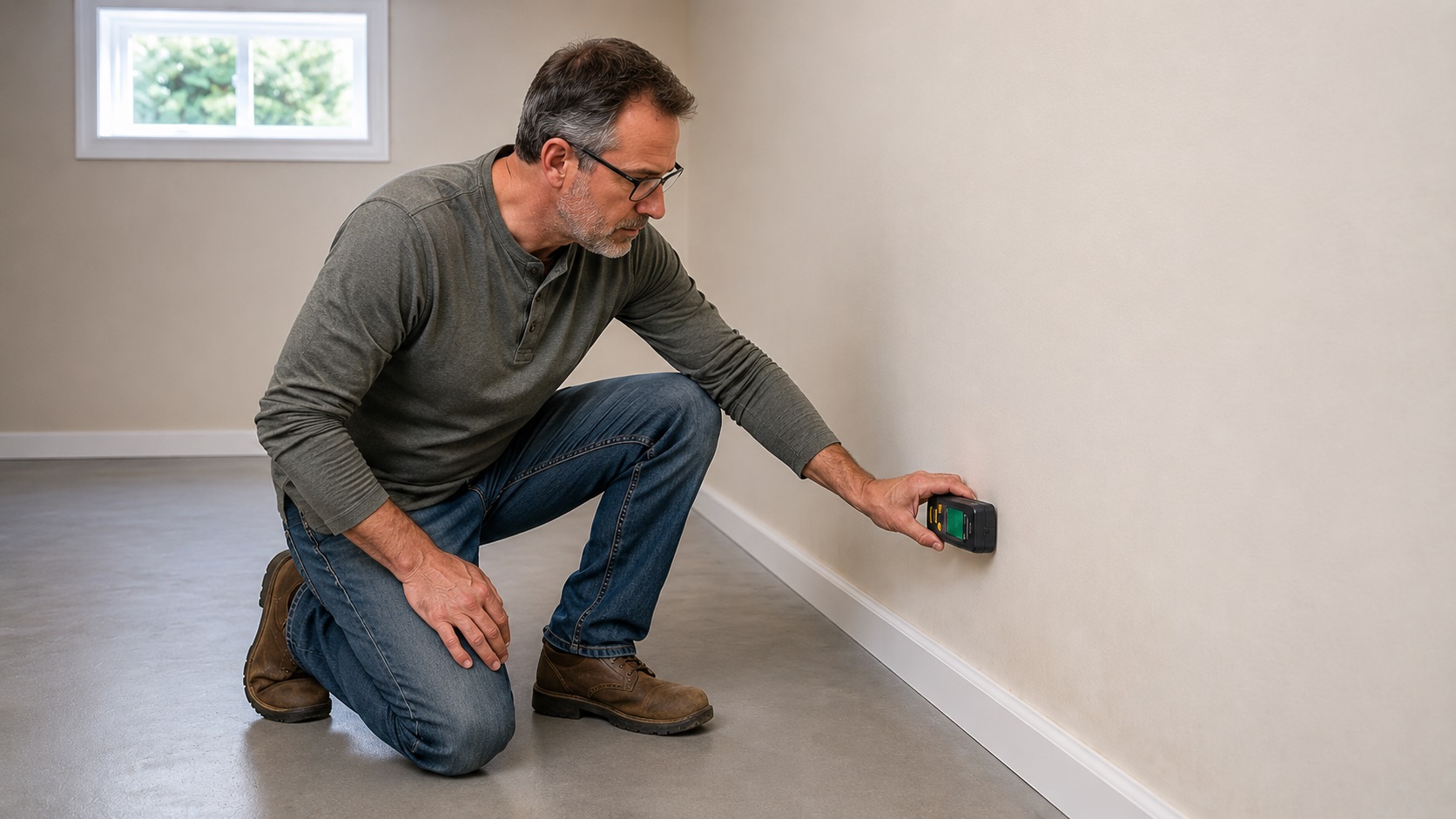
The General Tools MMD7NP is a pinless digital moisture meter with a sensor pad on the back of the tool. Instead of pushing metal pins into the material, you place the pad flat against the surface and scan the area. This makes it especially useful when you want to check painted drywall, finished wood, trim-adjacent areas, ceilings, floors, or basement surfaces without leaving marks.
The tool is designed for common building materials, including wallboard, masonry, hardwood, and softwood. That makes it more flexible than a meter intended only for lumber. For homeowners, the main value is simple: you can test areas that look suspicious and compare them with nearby areas that appear dry.
The MMD7NP belongs in the broader group of moisture testing tools, but it should not be confused with a hygrometer. A hygrometer measures air humidity. The MMD7NP checks moisture conditions in materials. For a broader explanation of where moisture meters fit among home testing tools, see our guide on how to test indoor humidity levels and moisture conditions.
Important MMD7NP Specs
The most important specs are straightforward: the MMD7NP uses a 1.5-inch by 1.5-inch pinless sensor pad, has settings for wallboard, masonry, hardwood, and softwood, and can detect moisture up to 3/4 inch below the surface. General Tools lists a 0–53% range for softwood, a 0–35% range for hardwood, and relative readings for wallboard and masonry.
The meter also includes a tricolor moisture bar, audible out-of-range alarm, hold function, low-battery indicator, and auto shutoff. It runs on a 9V battery, measures about 6.7 x 2.9 x 1.2 inches, and has a listed accuracy of ±4% for wood readings. These specs make it practical for homeowner scanning, but not a substitute for professional moisture documentation.
View the General Tools MMD7NP on Amazon
MMD7NP Features That Matter in Real Home Use
Pinless Moisture Scanning
The MMD7NP’s main advantage is that it scans with a flat pad instead of metal probes. That matters when you are checking painted drywall, finished trim, flooring, or ceilings and do not want to leave small pinholes behind.
That makes it useful around baseboards, window trim, bathroom walls, basement walls, ceilings, and flooring. If you are trying to detect moisture without opening walls, it gives you a first scan before more invasive inspection.
The tradeoff is that pinless readings can be influenced by hidden metal, pipes, fasteners, layered materials, surface texture, and material density. The MMD7NP is strongest when you compare several similar areas instead of trusting one isolated reading.
Four Material Modes
The MMD7NP has separate modes for wallboard, masonry, hardwood, and softwood. That is useful because a moisture reading in drywall does not mean the same thing as a reading in wood or masonry.
For a homeowner, those modes make the meter more useful across the house. You can use wallboard mode for drywall, masonry mode for basement walls, and the wood modes for trim, framing, subfloors, or other wood surfaces.
The mode still has to match the material being scanned. Drywall over studs, plaster, tile assemblies, metal lath, pipes, fasteners, and layered flooring can all affect readings, so the meter is strongest when you compare similar materials against each other.
Tricolor Bar Graph and Audible Alarm
The display is designed to be easy to read during a home inspection. In addition to numerical readings, the tricolor bar graph gives a quick low, medium, or high moisture indication. The audible alarm can also help when scanning awkward areas where you cannot easily watch the screen the whole time.
General Tools lists the alarm threshold at above 17% for wood and above 70% for drywall or masonry, giving the user a clear warning that the area should be checked more carefully.
Still, the bar graph should not be treated as a final diagnosis. A high reading means the area deserves closer attention. It does not automatically prove an active leak, mold growth, or structural damage.
3/4-Inch Sensing Depth
The MMD7NP is rated to detect moisture up to 3/4 inch below the surface. That is useful when a wall, floor, or ceiling looks dry on the outside but still holds moisture just beneath the surface.
That sensing depth should be taken seriously, but not overstated. The meter can help flag shallow hidden moisture patterns; it does not see deep into wall cavities, map plumbing lines, or prove exactly where a leak starts.
Hold Button, Auto Shutoff, and 9V Battery
The hold button helps when you take a reading in an awkward position and need to look at the display afterward. Auto shutoff helps preserve battery life, and the 9V battery is easy to replace. These are useful convenience features, but the main reason to buy this meter is still the pinless scanning pad.
How the MMD7NP Performs During Home Moisture Checks
In real home use, the MMD7NP is most helpful when you scan slowly and compare similar materials. One reading by itself can be misleading. A pattern of higher readings near a window, baseboard, ceiling stain, basement corner, or floor edge is more useful than a single number.
Good technique matters. Keep the sensor pad flat, move gradually across the surface, and compare the questionable area with nearby dry-looking areas. A useful pattern is usually several higher readings clustered around the same stain, trim edge, ceiling mark, or floor section, not one random high number by itself. This is especially important because pinless readings can be influenced by surface texture, material density, hidden metal, fasteners, pipes, and layered materials.
The MMD7NP can be helpful after minor leaks, around bathroom walls, near basement seepage areas, under suspicious ceiling stains, and around flooring that feels soft or looks discolored. It may also help when checking whether a material appears dry enough before painting, sealing, or making cosmetic repairs.
However, it should not be used as the only decision-maker when damage may be serious. If the meter shows repeated high readings, if the surface is soft or deteriorated, if there is a musty smell, or if moisture keeps returning after cleanup, the next step may involve more detailed inspection. For more context on interpreting problem readings, see our guide to moisture levels that indicate water damage.
Best Home Uses for the General Tools MMD7NP
The General Tools MMD7NP works best for quick, non-invasive checks on painted drywall, ceilings, finished wood, trim, floors, and basement masonry when the material matches one of the tool’s settings.
It can also be useful for post-leak monitoring. After a small leak is stopped, a meter can help you recheck the same area over time. If readings drop and stay low, that is a good sign. If readings remain elevated or rise again, the area may still be holding moisture or the source may not be fully fixed.
For broader spot-checking routines, see our guide on how to monitor moisture levels throughout your home.
MMD7NP Limitations to Know Before Buying
The MMD7NP may fall short if you expect it to do more than a pinless meter can realistically do. It does not identify mold. It does not test air humidity. It does not tell you the exact source of a leak. It does not replace opening a wall, checking plumbing, inspecting flashing, or calling a qualified professional when the situation is serious.
It may also be less suitable for users who need documented professional readings. Restoration contractors, inspectors, and serious woodworkers may prefer more advanced tools with deeper calibration options, probe accessories, logging features, or more specialized measurement modes.
Who the General Tools MMD7NP Makes Sense For
The MMD7NP makes sense for homeowners who want a first-step moisture check before opening a wall, replacing trim, repainting, or calling a contractor. It is especially useful when you have a ceiling stain, damp-looking basement wall, swollen baseboard, musty corner, or recently repaired leak area.
It is also a good fit for DIYers who want to scan several areas without damaging finished surfaces. Bathrooms, basements, laundry rooms, window areas, baseboards, ceilings, and floor edges are all realistic places to use it.
The best buyer understands that the MMD7NP is a pattern-finding tool. If one section of similar material reads much higher than the surrounding area, that is useful information. It does not have to answer every question to help you decide what to inspect next.
Check current availability on Amazon
When the MMD7NP Is Not Enough for Moisture Diagnosis
Skip the MMD7NP if you need professional documentation for restoration reports, insurance work, certified inspections, or serious building diagnostics. It can help with screening, but it is not a full professional moisture inspection system.
You should also skip it if your main goal is continuous monitoring. The MMD7NP is a handheld meter. It does not sit in one location and alert you when humidity rises or a leak begins. If you want ongoing room humidity tracking, a hygrometer or smart humidity monitor is a better fit. If you want an alert under a sink, near a water heater, or beside a sump pump, a leak detector is a better tool.
It is also the wrong tool if you expect it to identify mold. Moisture readings can point to areas where mold risk may be higher, but the meter does not detect spores, identify mold species, or confirm active growth.
Do not rely on it alone when there are signs of active water intrusion, structural damage, soft drywall, recurring stains, visible mold, or moisture that returns after cleanup. Those situations require finding and fixing the moisture source, not just scanning the surface.
MMD7NP vs Pin Meters, Hygrometers, and Thermal Cameras
A pin-type moisture meter is better when you need direct probe contact at a specific point and do not mind making small holes. The MMD7NP is better when you want to scan finished surfaces quickly without marking the wall, floor, ceiling, or trim.
A hygrometer answers a different question. It tells you whether the air in a room is too humid. The MMD7NP checks moisture conditions in materials such as drywall, wood, and masonry. In a moisture-prone home, both tools can be useful, but they are not interchangeable.
A thermal camera can show temperature patterns that may suggest damp areas, missing insulation, or air movement, but it does not directly measure moisture. The MMD7NP is more focused on checking the suspicious material itself.
Compared with higher-end professional meters, the MMD7NP is simpler and more homeowner-focused. It does not offer the same documentation or advanced probe options, but it is easier to justify for occasional home moisture checks.
For readers comparing several models before buying, the better next step is our guide to the best pinless moisture meters for home use.
Frequently Asked Questions About the General Tools MMD7NP Moisture Meter
Is the General Tools MMD7NP accurate?
General Tools lists ±4% accuracy for wood readings, but real-world accuracy still depends on material type, surface conditions, hidden metal, pipes, fasteners, and user technique. For homeowners, the safest way to use the MMD7NP is to compare suspicious areas with nearby dry areas made of similar material.
Can the MMD7NP detect moisture behind walls?
The MMD7NP can detect moisture up to 3/4 inch below the surface, so it may help identify shallow moisture patterns in drywall or other materials. It should not be treated as a deep wall scanner, and it does not map wall cavities or prove the exact source of a hidden leak.
Does the General Tools MMD7NP detect mold?
No. The MMD7NP does not detect mold. It detects moisture conditions in materials. Since moisture can support mold growth, the meter may help you find areas that deserve closer inspection, but it cannot confirm whether mold is present.
Is a pinless moisture meter better than a pin-type meter?
A pinless meter is better when you want to scan finished surfaces without leaving holes. A pin-type meter can be better when you need direct readings at a specific point and do not mind puncturing the material. For many homeowners, a pinless meter is easier for first-step inspection.
Can homeowners use the MMD7NP after a leak?
Yes, homeowners can use it after a minor leak to compare readings over time. If readings drop and stay low, the area may be drying. If readings remain elevated or rise again, moisture may still be present or the leak may not be fully resolved.
Can this replace a professional inspection?
No. The MMD7NP can help you identify suspicious moisture patterns, but it should not replace professional inspection when there is active leaking, structural damage, recurring moisture, visible mold, or a serious musty odor.
Final Verdict: Is the General Tools MMD7NP Worth It?
The General Tools MMD7NP is worth buying if you want a practical pinless moisture meter for basic home inspection tasks. Its biggest advantage is simple: it lets you scan drywall, wood, masonry, floors, ceilings, and trim areas without leaving probe holes.
It works best as a comparison tool. Scan the questionable area, scan nearby dry-looking areas of similar material, and look for patterns. Used that way, the MMD7NP can help you catch moisture concerns around bathrooms, basements, ceilings, windows, baseboards, and flooring before the next step becomes guesswork.
Skip it if you need mold testing, air humidity monitoring, certified inspection reports, deep wall scanning, or exact leak-source diagnosis. Serious moisture problems still require proper inspection and repair.
For homeowners who want a non-invasive tool for spot checks after leaks, before repairs, or around suspicious stains, the MMD7NP is a strong candidate. It will not answer every moisture question, but it can help you decide where to look next.