Radon Eye RD200 Monitor Review: Is It Worth It for Basement Radon Monitoring?
The Radon Eye RD200 is a dedicated digital radon monitor for homeowners who want ongoing visibility into radon levels, especially in basements and lower-level rooms. It is not a mold detector, humidity monitor, moisture meter, air purifier, or full indoor air quality station. Its job is narrower: it tracks radon gas so you can see whether a lower-level space needs continued monitoring, follow-up testing, or mitigation.
That focused purpose matters. A basement can have several indoor air concerns, including dampness, musty odors, mold risk, and radon, but each problem needs the right kind of test. If you are comparing broader home air issues, start with our Mold Exposure and Indoor Air Quality: Complete Home Guide. If your concern is radon specifically, this review looks at where the RD200 fits.
Disclosure: This article may contain affiliate links. If you buy through these links, we may earn a commission at no extra cost to you.
Radon Eye RD200 Quick Verdict
- Best for: Homeowners who want continuous radon monitoring in lower-level spaces or homes with previous radon concerns.
- Not ideal for: People who need a lower-cost one-time test, official testing documentation, mold detection, humidity tracking, or a full air quality monitor.
- Main strength: Frequent radon readings and trend awareness instead of a single one-time test result.
- Main limitation: It only monitors radon; it does not lower radon levels or replace every professional testing situation.
- Bottom line: The Radon Eye RD200 is a strong fit if you want a dedicated basement radon monitor and understand that monitoring is not the same as mitigation.
What the Radon Eye RD200 Is Designed to Do
The Radon Eye RD200 is designed to measure radon levels in indoor air. Radon is different from the moisture and mold problems often discussed on DryHomeGuide. You cannot see or smell it, and it is not caused by damp drywall, condensation, or visible mold growth. It is a radioactive gas that can enter homes from soil and foundation openings, which is why basements and lower levels are common monitoring locations.
The key value of a device like the RD200 is that it gives homeowners ongoing feedback. A passive radon test kit can be useful for an initial screening, but it usually gives a result after a fixed test period. A digital monitor lets you keep watching levels over time, which can be especially helpful if you are trying to understand whether radon levels rise during certain weather patterns, after ventilation changes, or after a mitigation system has been installed.
This is where the RD200 fits best. It is not a repair product. It will not seal a foundation, improve ventilation by itself, or lower radon levels. Instead, it helps you see what is happening so you can decide whether further testing, mitigation, or professional evaluation makes sense.
The key practical details are simple: the RD200 is a plug-in radon monitor with a built-in display, Bluetooth app tracking, readings that update every 10 minutes, rolling hourly averages, and a listed measurement range of 0.2–99.9 pCi/L. That is enough context for most homeowner monitoring situations without turning this review into a technical manual.
For readers coming from the broader Mold Exposure and Indoor Air Quality: Complete Home Guide, the important distinction is this: radon monitoring and mold investigation are separate issues. A basement can have more than one indoor air concern, but one device does not test for everything.
View the Radon Eye RD200 on Amazon
Radon Eye RD200 Features That Matter for Basement Monitoring
Continuous Radon Monitoring
The main reason to consider the Radon Eye RD200 is continuous monitoring. Radon levels can change over time, and a single short reading should not be treated as the full picture. Ongoing monitoring is useful because it can show patterns rather than only one isolated result.
Fast Early Feedback
One of the major appeals of the RD200 is that it provides fast early feedback compared with traditional passive radon testing. That does not mean a very short reading should be treated as a final long-term radon decision. It means the device can start giving you a sense of what is happening sooner, while longer monitoring still gives a better picture.
This is especially helpful after a change in the home. For example, if a radon mitigation system has been installed, if basement ventilation has changed, or if you moved the monitor to a different room, the RD200 can help you watch how readings respond over time.
Built-In Display
The built-in display is useful for quick checks. You do not need to open an app every time you want to see the current reading. For a basement utility area or lower-level room, that makes the device easier to live with as a permanent monitor.
This is practical, not just convenient. A radon monitor that is easy to check is more likely to be used consistently, especially in a basement where air-quality concerns are easy to ignore after the first few days.
Bluetooth Trend Tracking
The RD200 also supports app-based trend viewing through Bluetooth. This can be useful if you want more than a single number on the display. Trends help you see whether readings are stable, increasing, decreasing, or changing after certain conditions.
The limitation is that Bluetooth is not the same as a full Wi-Fi cloud monitoring system. This is a better fit for local monitoring than for buyers who want remote access from anywhere, multi-user access, or smart-home style automation.
Plug-In Operation
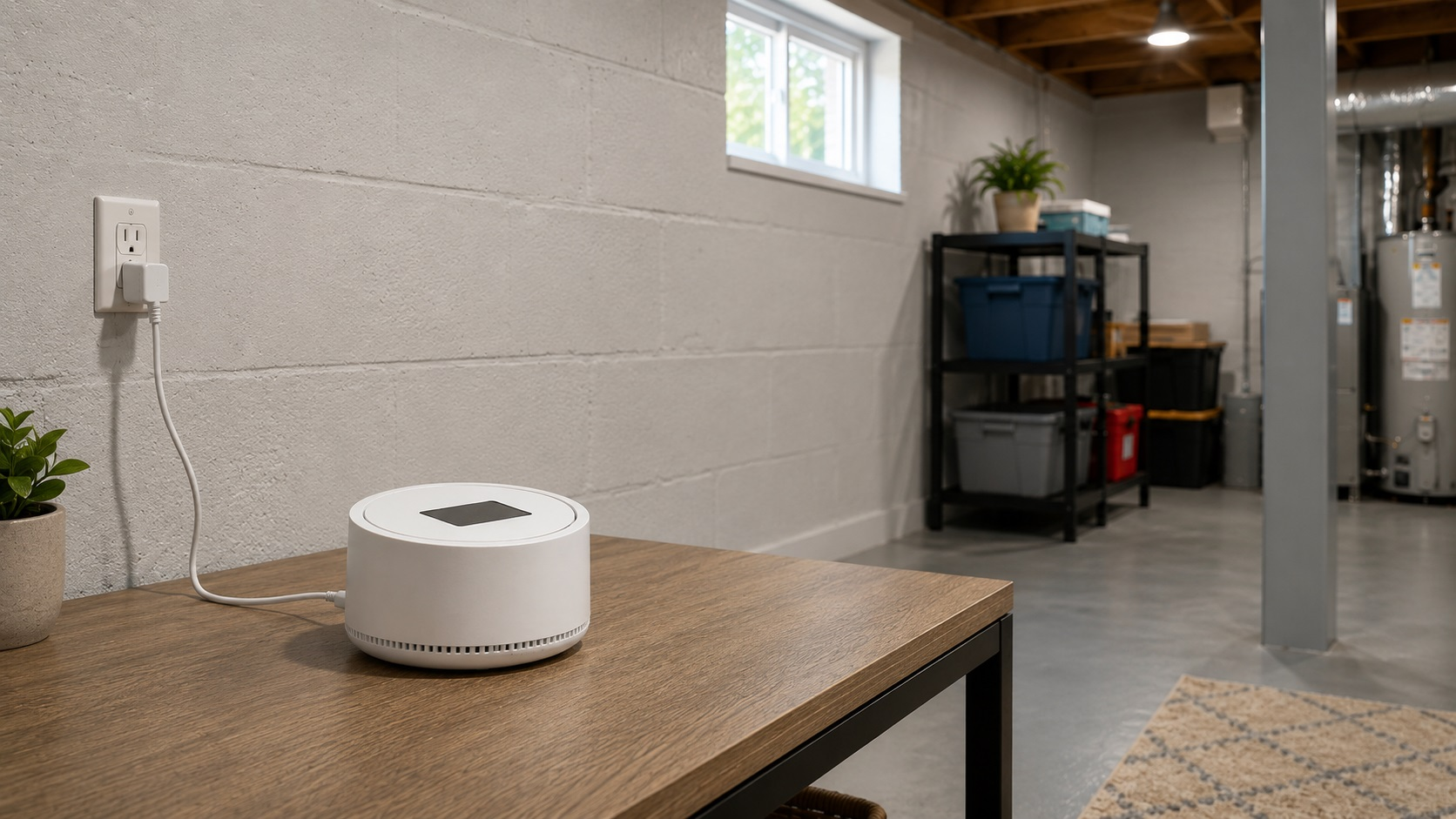
The RD200 is a plug-in monitor, which makes sense for continuous home use. You place it in the area you want to monitor and leave it powered. That is better for long-term basement monitoring than a device you have to remember to charge frequently.
The tradeoff is placement flexibility. You need a suitable outlet and a location where the device can sit undisturbed. For most basements and lower-level rooms, that should not be difficult, but it is still part of the buying decision.
Real-World RD200 Basement Monitoring Performance
The Radon Eye RD200 is most useful when you treat it as a trend monitor, not a panic device. Radon readings can fluctuate because of weather, air pressure, ventilation, soil conditions, and how the home is being used. A single high or low moment is less useful than watching whether the pattern stays low, rises repeatedly, or remains elevated.
In a basement, that trend view is the main advantage over a one-time test kit. Place the monitor in the area you care about most, usually a basement or lower-level occupied room, and keep it in a stable location where it can monitor the same air space over time. If a mitigation system has already been installed, the RD200 can also help you notice whether levels appear to stay controlled after the work is done.
The EPA recommends fixing homes when radon levels are 4 pCi/L or higher, and it also recommends considering action between 2 and 4 pCi/L because there is no known safe level of radon exposure. That context helps readers understand why ongoing monitoring can matter, but the RD200 still gives information only; it does not solve the source of elevated radon.
Where the Radon Eye RD200 Makes the Most Sense
The Radon Eye RD200 works best in homes where radon is a real concern and the homeowner wants ongoing monitoring rather than a one-time test. Basements are the clearest use case. A basement bedroom, basement office, finished recreation room, or lower-level family room can all be reasonable places to monitor if people spend time there regularly.
For the most useful trend, choose one representative room and leave the monitor there rather than moving it from room to room every day.
It also makes sense in homes that have already had elevated radon readings. In that situation, a digital monitor can help you stay aware of whether levels appear stable or whether they may need more attention. This can be especially reassuring after mitigation work, because it lets you continue watching the space instead of assuming the problem is permanently solved.
The device can also fit into a broader basement air quality awareness plan. Basements can have several different air-related concerns, including radon, musty odors, dampness, humidity, and mold risk. The RD200 only addresses the radon side of that picture, but readers concerned about lower-level air problems may also want to understand broader basement indoor air risks.
Radon Eye RD200 Limitations Homeowners Should Know
The biggest limitation is that the Radon Eye RD200 is not a full indoor air quality monitor. It does not test for mold spores, humidity, moisture, carbon dioxide, VOCs, particulates, or musty odors. If your main concern is a damp smell, visible mold, or high indoor humidity, this is the wrong type of device.
It is also not a radon mitigation system. A monitor can tell you that radon may be elevated, but it cannot lower the level by itself. If readings stay high, the next step is radon-specific follow-up testing or mitigation guidance, not mold cleanup, a dehumidifier, or a general air purifier.
Another limitation is official use. Homeowners can use a digital monitor for awareness, but real estate transactions, legal requirements, or formal documentation may require approved testing methods or a qualified professional. Do not assume that a consumer monitor replaces every required radon test.
Finally, check current Amazon availability before relying on this exact listing. Product availability, seller status, and pricing can change, and radon monitors sometimes appear through different sellers or updated listings. If the listing is active when you are ready to buy, the RD200 remains a useful option to consider for dedicated home radon monitoring.
Who Should Consider the Radon Eye RD200
The Radon Eye RD200 makes the most sense for homeowners who want a dedicated radon monitor in a basement, lower-level living space, or home with a known radon concern. It is especially useful if you do not want to rely only on occasional short-term test kits and would rather keep an eye on radon trends over time.
It is also a good fit after an elevated radon result or after a mitigation system has been installed. In those situations, a continuous monitor can help you watch whether readings appear stable, rise again, or respond to changes in ventilation or home conditions.
Homeowners who like visible feedback may appreciate it more than a passive test kit because it shows day-to-day trends in the room they actually use.
Check current availability on Amazon
When the Radon Eye RD200 Is the Wrong Tool
Skip the Radon Eye RD200 if you only need a low-cost, one-time radon screening. A basic short-term radon test kit may be enough for an initial check if you do not care about ongoing monitoring.
You should also avoid treating it as a substitute for every professional or official radon test. Real estate transactions, rental requirements, or local rules may require approved testing methods or qualified professionals.
This is also the wrong product if your main concern is mold, damp air, or general indoor air quality. The RD200 does not measure humidity, moisture, airborne mold spores, carbon dioxide, VOCs, or particulate matter. If a basement smells musty or feels damp, radon monitoring may still matter, but those symptoms need a separate moisture, mold, or air-quality investigation.
Finally, buyers who want full remote monitoring should understand the Bluetooth limitation. The RD200 is useful as a dedicated local radon monitor, but it is not the same as a Wi-Fi cloud-connected system you can check from anywhere.
Radon Eye RD200 vs One-Time Radon Test Kits and Professional Testing
The simplest alternative to the Radon Eye RD200 is a passive radon test kit. Passive kits are usually less expensive and can be useful for initial screening. Their weakness is that they do not give continuous feedback. You run the test, wait for the result, and then decide what to do next.
The RD200 is different because it is meant to stay in the home and keep monitoring. That makes it more useful for homeowners who want to watch trends, compare readings over time, or keep an eye on a basement after mitigation. It is not automatically better for every situation; it is better for ongoing awareness.
Professional radon testing is another alternative. That may be the better choice when documentation, formal evaluation, or high-stakes decisions are involved. A professional can also help interpret results and recommend next steps if levels are elevated. The RD200 is more of a homeowner monitoring tool than a full professional service.
There are also multi-sensor indoor air quality monitors. Those may track things like particulate matter, VOCs, carbon dioxide, temperature, or humidity, depending on the model. The important thing is not to assume that a general air quality monitor measures radon. If radon is your concern, you need a device specifically designed for radon monitoring.
If you want a broader indoor air monitor that includes radon among other air-quality readings, compare this dedicated monitor with our Airthings Wave Plus review before deciding.
Frequently Asked Questions
Does the Radon Eye RD200 detect mold?
No. The Radon Eye RD200 monitors radon. It does not detect mold, mildew, moisture, humidity, airborne spores, or musty odors. If you suspect mold in a basement or lower-level room, that needs a separate inspection or testing approach.
Is the Radon Eye RD200 good for basements?
Yes, basements are one of the most logical places to use the RD200. Basements and lower-level rooms are often closer to the soil and foundation pathways where radon can enter a home. A monitor can help you watch those spaces over time.
Can the Radon Eye RD200 replace professional radon testing?
It can be useful for ongoing homeowner awareness, but it should not be assumed to replace every professional or official test. Real estate transactions, rental requirements, local rules, or formal documentation may require approved testing methods or qualified professionals.
Is a digital radon monitor better than a one-time radon test kit?
It depends on the goal. A one-time kit can be useful for a lower-cost initial screening. A digital monitor like the RD200 is more useful if you want to watch radon levels over time, compare changes, or monitor after mitigation.
Where should the Radon Eye RD200 be placed?
Place it in the area you want to monitor, often a basement or lower-level occupied room where people spend time. Keep it in a stable location where it can monitor the same air space over time, and avoid moving it around constantly if you are trying to understand trends in one room.
Radon Eye RD200 Review Verdict
The Radon Eye RD200 is worth considering if you want continuous radon visibility in a basement or lower-level room. Its main value is not that it fixes radon, but that it lets you keep watching a space where radon levels can fluctuate over time.
It is strongest for basement bedrooms, basement offices, finished lower levels, homes with previous elevated radon readings, and homes with mitigation systems already installed. In those situations, ongoing monitoring is more useful than relying only on memory or occasional one-time tests.
Skip it if you only need a lower-cost screening kit, official test documentation, or a broader indoor air quality monitor. But if your concern is radon specifically, the RD200 is a practical dedicated monitor for homeowner awareness.