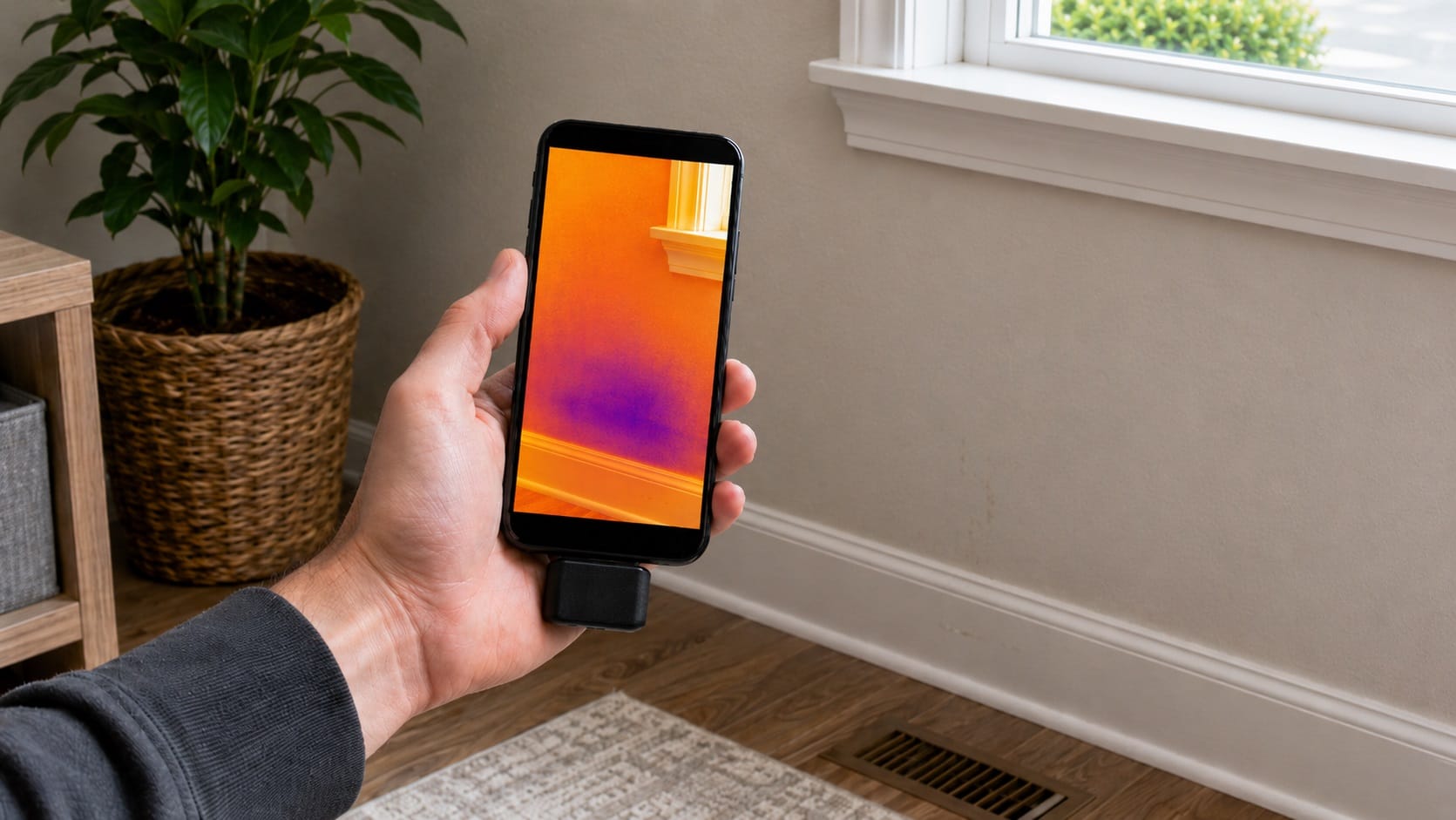
FLIR ONE Thermal Camera Review: Is It Worth It for Detecting Hidden Moisture?
The FLIR ONE Thermal Camera is a compact smartphone thermal imaging attachment for scanning temperature differences on walls, ceilings, floors, and trim. For hidden moisture checks, that matters because damp materials, air leaks, missing insulation, and cooled surfaces can all create thermal patterns that are invisible to the eye.
The important limitation is simple: the FLIR ONE does not read moisture content or see through drywall. It helps you find suspicious areas that may deserve a moisture meter reading, closer inspection, or professional evaluation.
Disclosure: This article may contain affiliate links. If you buy through these links, we may earn a commission at no extra cost to you.
If you are comparing thermal cameras more broadly, see our guide to the best thermal imaging cameras for detecting moisture. This review focuses on the FLIR ONE specifically: where it helps, where it can mislead you, and whether it is worth buying for homeowner moisture checks.
FLIR ONE Quick Verdict for Moisture Checks
- Best for: Homeowners who want a compact thermal screening tool for suspicious moisture patterns around walls, ceilings, floors, windows, HVAC areas, and previous leak zones.
- Not ideal for: Buyers who expect direct moisture readings, hidden mold confirmation, or professional-grade inspection reporting.
- Main strength: It can reveal temperature anomalies that may point to damp materials, hidden leaks, missing insulation, or air leakage.
- Main limitation: It shows temperature patterns, not moisture readings, so suspicious areas still need follow-up testing when damage risk is serious.
- Bottom line: The FLIR ONE is useful for early investigation, but it should be treated as a screening tool rather than a final diagnosis tool.
What the FLIR ONE Thermal Camera Actually Does
The FLIR ONE is a smartphone-based thermal camera attachment, not a standalone inspection camera. It connects to a compatible phone and uses the FLIR app to display a thermal image. The version reviewed here is the Android USB-C model, so it makes sense for buyers with compatible USB-C Android phones; iPhone users or buyers with a different connector need the FLIR ONE version made for their device.
FLIR ONE Gen 3 Specs That Matter for Moisture Checks
The most important FLIR ONE Gen 3 specs for homeowner moisture checks are:
- Thermal resolution: 80 × 60
- Visual image resolution: 1440 × 1080
- Object temperature range: -20°C to 120°C
- Focus: Fixed focus from 15 cm to infinity
- Frame rate: 8.7 Hz
- Battery life: Approximately 1 hour
- Measurement: One centered spot meter for surface temperature checks
- Image enhancement: MSX image blending for visible detail over the thermal image
The practical takeaway is that this is an entry-level thermal attachment with enough resolution for broad homeowner screening, but not enough detail for professional inspection reports or subtle moisture confirmation by itself. The 80 × 60 thermal sensor can help reveal larger temperature patterns, but subtle moisture, deep cavity moisture, or unclear wall conditions still need confirmation with a moisture meter, borescope, or professional inspection.
For hidden moisture work, the FLIR ONE is most useful when you already have a reason to suspect a problem. For example, you may notice a musty odor, a recurring stain, a wall that feels colder than nearby surfaces, swelling trim, peeling paint, or other signs of hidden moisture in walls. The camera can help you scan the area and look for temperature patterns that deserve closer testing.
This makes the FLIR ONE a practical tool for homeowners who want to investigate before opening drywall. It fits especially well into a non-invasive inspection process where you first look for visual clues, scan with thermal imaging, then confirm suspicious areas with a moisture meter. For a broader process, see our guide on how to detect moisture without opening walls.
View the FLIR ONE Thermal Camera on Amazon
FLIR ONE Features That Matter for Moisture Inspection
Smartphone Thermal Imaging Attachment
The smartphone attachment design is the main reason the FLIR ONE works for occasional homeowner inspections. It is small enough to keep in a drawer or tool bag, and it lets you scan a wall below a bathroom, a ceiling after a roof leak, or a window area without carrying a separate handheld camera.
The tradeoff is that this version only makes sense if it physically fits your phone and works with your app setup. For most buyers, the safest choice is to match the FLIR ONE connector version to the phone they already use for inspections.
Thermal Pattern Detection
The FLIR ONE detects temperature differences across surfaces. In moisture investigations, that can be helpful because damp materials may heat and cool differently from dry materials. Evaporation can also make wet areas appear cooler than surrounding surfaces under the right conditions.
That is why the FLIR ONE can be useful around walls, ceilings, floors, windows, and HVAC areas. It can show a colder or warmer section that deserves a closer look, but the pattern may also come from missing insulation, drafts, shaded walls, cold pipes, HVAC airflow, or recent sun exposure.
MSX Image Enhancement
FLIR’s MSX image enhancement overlays visible detail onto the thermal image. This matters because raw thermal images can be hard to interpret. With visual detail added, it is easier to tell whether the suspicious pattern is near a window edge, outlet, baseboard, pipe chase, ceiling seam, or wall corner.
For homeowners, this makes the tool easier to use in real spaces. Instead of seeing only an abstract hot-and-cold shape, you get more context about where that pattern appears in the room.
The limitation is that MSX improves visual clarity, not moisture certainty. It can help you understand where the thermal anomaly is located, but it does not turn the FLIR ONE into a direct water detector.
Compact Inspection-Friendly Design
The small size is one of the FLIR ONE’s practical advantages. It is easier to keep nearby than a larger inspection camera, so it is more likely to be used when a stain, leak, or cold wall area first appears.
This is useful after a small leak, after heavy rain, when checking a suspicious ceiling stain, or when monitoring a repaired area. If you are working through a broader inspection, it can support the process described in our guide on how to find hidden moisture in different areas of your home.
The downside is that compact tools involve compromises. The FLIR ONE is better suited for broad screening and homeowner troubleshooting than for formal inspection reports or repeated professional use.
How the FLIR ONE Performs in Home Moisture Checks
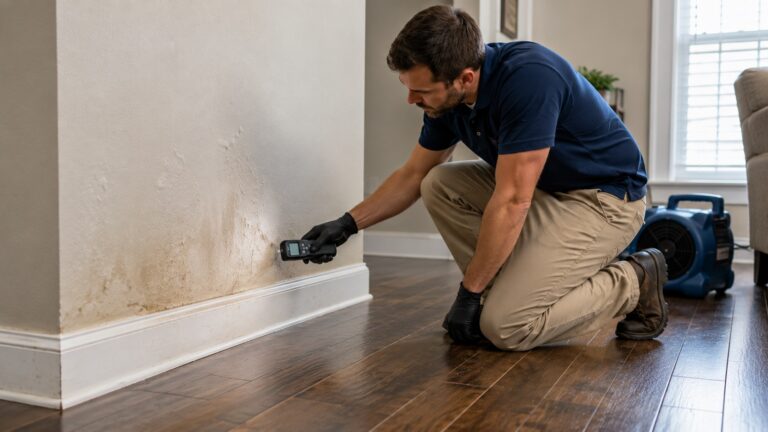
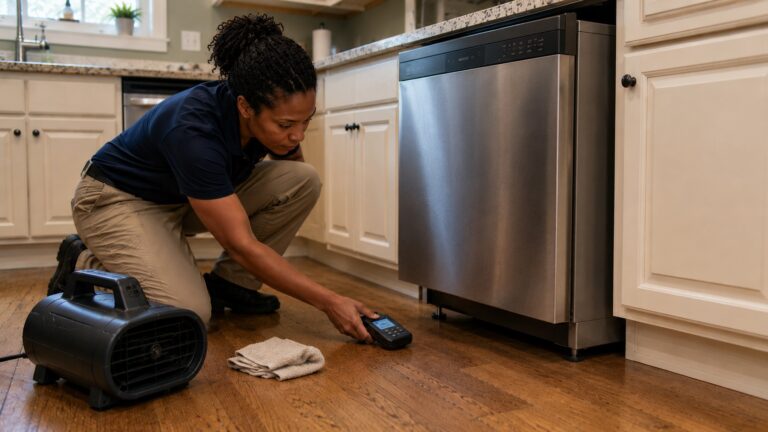
In a real moisture check, the FLIR ONE works best as the first screening step after visual inspection. Look for staining, swelling trim, peeling paint, musty odor, soft drywall, recurring condensation, or unexplained cold spots. Then scan the area with the camera. If the image shows an unusual thermal pattern, test that area with a moisture meter or inspect more closely.
This is most useful around ceilings below bathrooms, walls near plumbing runs, baseboards after minor leaks, exterior walls after wind-driven rain, and window areas where water intrusion or condensation may recur. Thermal patterns are usually more useful when you compare the suspicious area with nearby similar surfaces, not when you judge one cold spot by itself.
The limitation is that inactive leaks, uniform wall temperatures, deep moisture, or subtle dampness may not produce a clear thermal pattern. A clean thermal image should not be treated as proof that a wall cavity is dry.
Best Places to Use the FLIR ONE Around the Home
The FLIR ONE works best for homeowners who want to investigate suspicious areas before taking more invasive steps. It is especially useful when there is already a clue that something may be wrong but the exact location is unclear.
- Walls below bathrooms: It may help reveal unusual cooling patterns near hidden plumbing or wet drywall.
- Ceilings below roof or plumbing leaks: It can help identify the broader area that may need follow-up moisture testing.
- Window and exterior wall areas: It may show temperature anomalies around frames, corners, or wall sections affected by air leakage or water intrusion.
- HVAC condensation concerns: It can help scan areas around ducts, registers, condensate lines, or damp ceiling zones.
- Post-repair monitoring: It can help compare a repaired area with surrounding dry areas over time.
A moisture meter gives point readings. The FLIR ONE gives a broader visual map of where those readings may be worth taking. If you are deciding what confirmation tool to pair with thermal imaging, see our guide to the best moisture meters for hidden water damage.
Where the FLIR ONE Can Mislead Homeowners
The main risk is treating a thermal image as proof. The FLIR ONE measures temperature, not moisture. A cold or warm area may be related to damp material, but it may also come from insulation gaps, drafts, framing, HVAC airflow, sunlight, exterior temperature changes, or normal material differences.
It can also fall short when buyers need professional documentation. Serious water damage, suspected hidden mold, insurance disputes, electrical risk near wet areas, or structural concerns may require a qualified inspector, restoration professional, or higher-resolution equipment.
Battery life and phone dependence are practical limits too. If you plan to scan large properties often, a standalone thermal camera may be more convenient. If you only need ongoing leak alerts under sinks, near appliances, or beside a water heater, a smart leak detector may be a better tool.
Who the FLIR ONE Makes Sense For
The FLIR ONE Thermal Camera makes the most sense for homeowners who want to investigate suspicious moisture patterns before opening walls or calling a contractor. It is especially useful when you already have warning signs but do not know where the problem starts.
It is also a good fit for landlords, property managers, and homeowners who check rental units, basements, bathrooms, exterior walls, or repaired leak areas more than once. The camera gives a broader visual scan than a moisture meter alone, helping you decide where point readings should happen.
The best buyer understands the tool’s role: it narrows the search area, then a moisture meter, closer inspection, or professional evaluation confirms what is actually happening.
Who Should Skip the FLIR ONE
Avoid the FLIR ONE if your main goal is to measure moisture content directly. For confirming whether drywall, wood, trim, or flooring is wet, a moisture meter is usually the more direct tool.
You should also avoid relying on it alone if you suspect serious hidden water damage. Large leaks, recurring stains, soft drywall, active plumbing leaks, mold odor, or structural concerns may require professional inspection.
It may also be a poor fit if you need formal inspection documentation, do not want to deal with phone compatibility, or need continuous leak protection. A standalone thermal camera, professional inspection, or smart leak detector may fit those needs better.
FLIR ONE vs Moisture Meters, Leak Sensors, and Standalone Thermal Cameras
The FLIR ONE sits between basic homeowner tools and more advanced inspection equipment. It gives you a visual way to scan for temperature differences, while moisture meters and leak sensors answer different questions.
A pinless moisture meter is better for checking whether a specific surface area may be wet. A pin-type meter is more invasive but can provide more direct material readings in wood, trim, drywall, or subflooring. In many moisture investigations, the FLIR ONE helps identify the suspicious area, and a moisture meter helps confirm it.
A standalone thermal camera may be better for frequent inspections, longer sessions, better ergonomics, or higher-resolution work. A smart leak detector is better for ongoing alerts in one risk area, such as under a sink or near a water heater. The FLIR ONE is best for manual scanning when you are trying to decide where a hidden moisture pattern may be developing and where to test next.
For a wider product-level comparison, see our guide to the best thermal imaging cameras for detecting moisture.
Frequently Asked Questions
Can the FLIR ONE detect moisture behind walls?
The FLIR ONE can help reveal temperature patterns that may be related to hidden moisture, but it does not directly detect moisture. A suspicious thermal pattern should be confirmed with a moisture meter, closer inspection, or professional evaluation.
Can the FLIR ONE see through drywall?
No. A thermal camera does not see through drywall like an X-ray. It detects surface temperature differences. Those surface patterns may suggest something happening behind or within the wall, but they do not show a direct image of the hidden cavity.
Is the FLIR ONE better than a moisture meter?
No. The FLIR ONE and a moisture meter answer different questions. The FLIR ONE is better for scanning larger areas and finding suspicious thermal patterns. A moisture meter is better for confirming whether a specific material is wet. They work best together.
Is the FLIR ONE useful for finding hidden leaks?
It can be useful for finding areas that deserve further leak investigation. For example, it may show an unusual thermal pattern below a bathroom, near a window, or around a ceiling stain. But it does not identify the exact leak source by itself. For a broader process, see our guide on how to find hidden water leaks inside walls.
Do homeowners need a professional thermal camera instead?
Not always. For occasional homeowner screening, the FLIR ONE may be enough to identify suspicious areas and decide where to test next. For frequent inspections, professional reports, large properties, or serious water damage concerns, a higher-end standalone thermal camera or professional inspection may be more appropriate.
Should I use the FLIR ONE after a leak repair?
Yes, it can be helpful for monitoring repaired areas, especially if you want to compare a previously wet section with nearby dry surfaces. However, thermal imaging should not be the only follow-up method. Use a moisture meter or professional inspection if you need confirmation that materials are dry.
Final Verdict: Is the FLIR ONE Worth Buying for Hidden Moisture Checks?
The FLIR ONE Thermal Camera is worth considering if you want a compact inspection aid for hidden moisture concerns. Its biggest value is narrowing the search area. It helps you spot suspicious temperature patterns so you know where to inspect, test with a moisture meter, or monitor more closely.
It is best suited for suspicious moisture areas where visual clues are not enough. Used alongside a moisture meter and basic inspection logic, it can make homeowner troubleshooting more focused.
Skip it if you expect direct moisture readings, hidden mold confirmation, formal inspection documentation, or continuous leak monitoring. Those jobs call for different tools or professional help.
If you want a compact thermal camera for homeowner moisture screening, check today’s price on Amazon.
For a broader inspection workflow, visit our guide on how to find hidden moisture in different areas of your home.