
How to Choose the Right Leak Pan Size for Appliances and Water Heaters
A leak pan only helps if it actually fits the appliance, fits the space, and allows water to drain or collect in a controlled way. Many homeowners choose a pan by looking at the outside dimensions on the package, then discover that the appliance does not fit inside the usable area, the drain outlet is in the wrong place, or the pan blocks access to hoses, valves, drawers, or service panels.
The safest way to choose a leak pan is to measure the appliance footprint first, compare that measurement with the pan’s usable inside dimensions, then confirm that the pan’s outside dimensions, rim height, and drain outlet location work in the actual room. This matters most for washing machines, water heaters, refrigerators with water lines, and HVAC equipment installed above finished floors or near moisture-sensitive materials.
A correctly sized pan will not stop a leak from starting, but it can help contain small leaks long enough for you to notice them. For the bigger picture, see how plumbing leaks can cause structural damage when moisture reaches flooring, framing, cabinets, or walls.
Why Leak Pan Size Matters More Than Most Homeowners Realize
A leak pan is not just a tray under an appliance. It is a containment area. If it is too small, the appliance may not sit inside it correctly. If it is too tight, hoses, fittings, leveling feet, or access panels may be crowded. If it is too large, it may not fit inside the laundry room, utility closet, mechanical room, or appliance alcove where it needs to go.
The goal is not always to buy the biggest pan possible. The goal is to buy the pan that fits the appliance, allows the appliance to operate safely, leaves room for service access, and works with the drain arrangement in that location.
A poorly sized pan can create several problems:
- The appliance may not fit inside the usable pan area.
- The pan rim may interfere with washer drawers, refrigerator wheels, or water heater connections.
- The drain outlet may be too close to a wall, baseboard, cabinet, or appliance leg.
- The pan may block access to shutoff valves, supply hoses, or service panels.
- The appliance may be harder to level, move, inspect, or maintain.
Size also affects how useful the pan will be during a leak. A shallow or poorly drained pan may catch a small drip but fail during a faster leak, while a pan that barely fits may overflow if the appliance shifts, vibrates, or is not level. Before choosing a size, confirm the appliance dimensions, available floor space, drain route, and service clearance.
Start by Measuring the Appliance Footprint
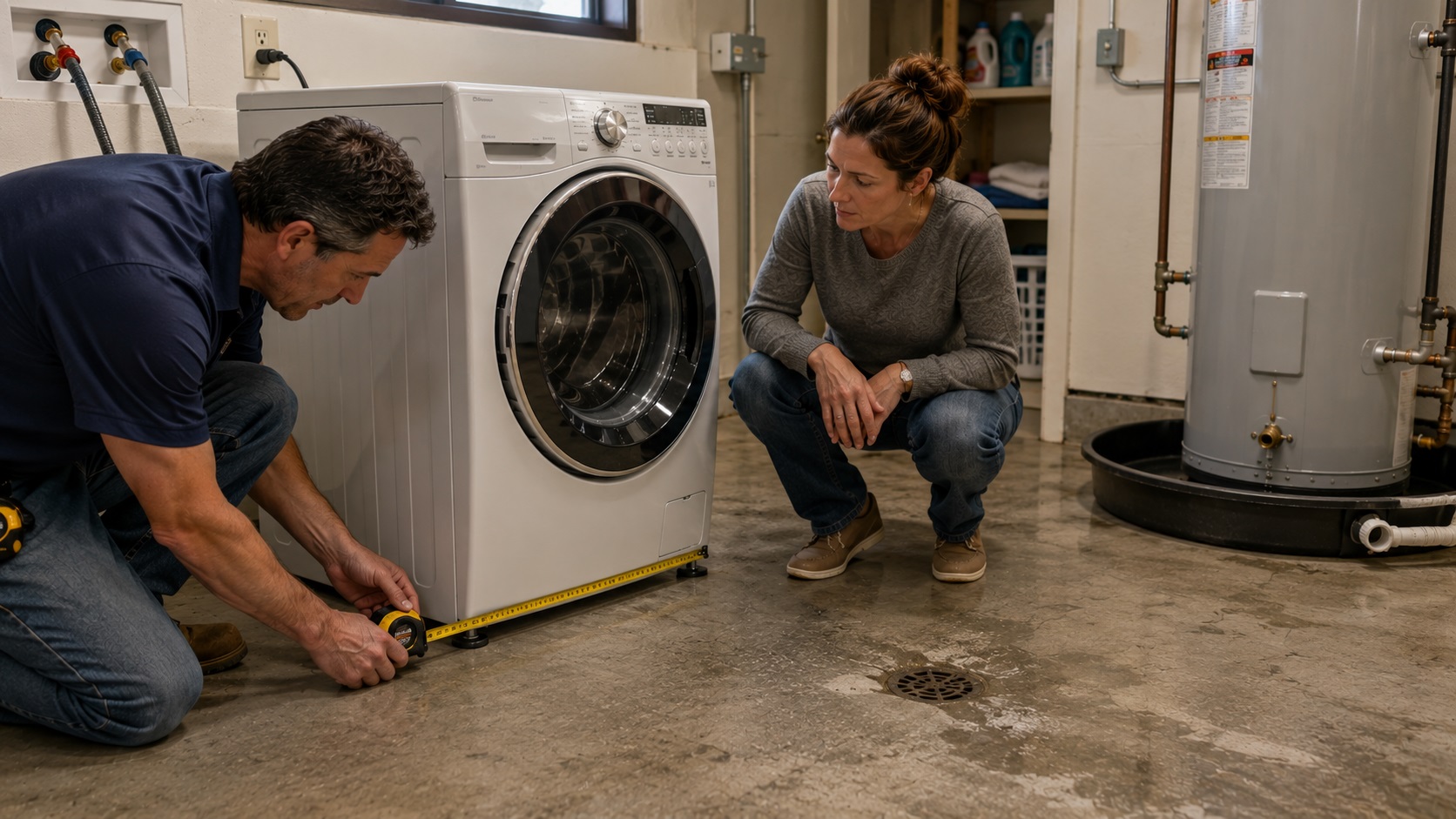
The appliance footprint is the actual amount of floor space the appliance occupies. This is the first measurement to take before choosing a leak pan. Do not rely only on the model’s listed width and depth unless you also verify the actual installed dimensions. Appliance legs, pedestals, trim pieces, leveling feet, rear connections, and cabinet overhangs can all change the usable footprint.
Measure the appliance at the widest and deepest points near the base. For a washing machine, measure the full width and depth of the washer body or pedestal base. For a water heater, measure the diameter of the tank base or support ring. For a refrigerator, measure the base area that will actually sit over the pan, including wheel or leveling-foot positions. For HVAC equipment, measure the base of the unit or air handler cabinet that the pan must protect.
Write down four numbers before shopping: appliance width, appliance depth, available room width, and available room depth. Then compare those numbers with both the pan’s inside and outside dimensions.
After measuring the appliance, measure the available floor space. This is where many sizing mistakes happen. A pan may fit the appliance but fail to fit the room. Tight laundry closets, mechanical closets, basement corners, water heater platforms, and utility rooms often have less usable space than they appear to have.
Check for anything that reduces available floor space, including:
- Baseboards or trim along the wall
- Door frames and closet openings
- Nearby cabinets or shelving
- Shutoff valves behind the appliance
- Drain standpipes or floor drains
- Gas lines, water lines, or electrical connections
- Appliance doors, drawers, or removable access panels
The best pan size is based on the appliance footprint plus usable clearance, not just the bare appliance dimensions. If the pan is being used as part of whole-home moisture prevention planning, measuring carefully matters because the pan must work with the room, not just the appliance.
Inside Dimensions vs. Outside Dimensions: The Detail That Causes Most Sizing Mistakes
When shopping for a leak pan, always check whether the listed dimensions are outside dimensions or inside dimensions. The outside dimensions tell you how much floor space the entire pan occupies. The inside dimensions tell you how much usable space is available for the appliance.
This difference matters because pan walls, molded corners, rolled edges, and drain-fitting areas reduce usable interior space. A pan that is advertised as 30 inches wide may not provide 30 inches of usable interior width. If your appliance is close to that size, it may not sit flat inside the pan.
For appliance fit, inside dimensions matter most. For room fit, outside dimensions matter most. You need both.
Use this simple rule:
- Use inside dimensions to decide whether the appliance will fit inside the pan.
- Use outside dimensions to decide whether the pan will fit in the room.
- Use drain outlet location to decide whether the pan can actually route water where it needs to go.
A practical buying rule is this: the appliance should fit inside the pan’s usable interior space with enough extra room for feet, fittings, vibration, and service access, while the pan’s outside dimensions still fit the room. If either measurement is tight, do not assume the pan will work just because the package size looks close.
This is especially important for washing machines because washer pans often have molded corners and raised rims. A full-size washer may appear to fit based on the outside pan dimensions, but the actual usable interior may be several inches smaller. The same issue can happen with compact washer pans, refrigerator pans, and water heater drain pans.
If the appliance footprint is close to the inside dimensions of the pan, choose a larger pan when the room allows it. A pan that barely fits on paper may be difficult to use in real life, especially if the appliance vibrates, needs leveling, or must be moved for service.
How Much Clearance Should a Leak Pan Have?
A leak pan should usually provide a small amount of extra space around the appliance rather than touching the appliance tightly on every side. Clearance makes it easier to set the appliance in place, keep it level, inspect the pan, reach fittings, and prevent the rim from rubbing against the appliance body.
There is no single clearance number that works for every appliance and every room. A washing machine in a second-floor laundry closet has different needs than a water heater in an unfinished basement. Still, the principle is the same: the pan should be large enough for the appliance to sit comfortably inside without forcing the appliance against the rim.
When the room allows it, leave enough clearance for:
- Appliance placement and leveling
- Minor washer vibration or movement
- Drain fitting hardware
- Supply hose bends
- Access to shutoff valves
- Cleaning and visual inspection
- Future appliance removal or service
For washing machines, extra clearance is especially useful because washers can vibrate during spin cycles. A washer that barely fits inside the pan may shift against the rim, transfer vibration, or make leveling harder. For front-load washers, also consider whether the pan lip interferes with pedestal drawers or the front access area.
For water heaters, clearance is less about vibration and more about drain fittings, supply connections, pan depth, and service access. The pan should fit the base of the tank while still allowing the drain outlet to be positioned where it can work correctly.
For refrigerators, clearance is different again. A high-rim pan can interfere with wheels, leveling feet, airflow, or the ability to pull the refrigerator forward. In that case, the right size may be a low-profile pan that protects the water-line area without trapping the refrigerator in place.
If the pan fits the appliance but blocks normal use or service access, it is not the right size. Leak protection should not make maintenance harder, because neglected hoses, fittings, and valves are often the real sources of future leaks.
Choosing the Right Leak Pan Size by Appliance Type
Different appliances create different sizing problems. A washer pan, water heater pan, refrigerator pan, and HVAC drain pan may all collect water, but they do not need the same clearance, rim height, or drain position. Use the appliance-specific notes below to avoid choosing a pan that fits on paper but fails in the actual space.
Washing Machines
Washing machines often need leak pans in upstairs laundry rooms, finished basements, condos, apartments, and laundry closets. For sizing, the main concerns are washer vibration, pedestal clearance, hose access, and whether the pan can drain without blocking the machine.
For a washing machine, start by measuring the full width and depth of the washer at the base. If the washer sits on a pedestal, measure the pedestal footprint instead of the washer body. The pedestal may be wider, deeper, or shaped differently than the machine itself.
The leak pan’s inside dimensions should be larger than the washer footprint. A pan that barely fits may seem acceptable when the washer is off, but it can become a problem during use. Washers vibrate, shift slightly, and need to be leveled properly. If the machine is pressed tightly against the pan walls, the rim may interfere with leveling feet or transfer vibration.
Front-load washers need extra attention. If the washer has a pedestal drawer, check whether the pan rim blocks the drawer from opening. Some pans have lower front walls for easier access, while others have a full-height rim on every side. The rim design can matter almost as much as the overall dimensions.
The pan should also leave room for supply hoses, drain hose routing, and rear access. If the pan makes hose inspection harder, it is not a good fit even if the washer technically sits inside it. For hose-specific failure timing, see when washing machine hoses should be replaced.
If you are comparing pan options, keep the sizing decision separate from the product decision. This article covers fit, clearance, and drain location; product comparisons belong in a dedicated guide to washing machine leak pans.
Water Heaters
Water heater drain pans have different sizing concerns than washer pans. The heater does not vibrate like a washer, so the main concerns are base diameter, pan depth, drain outlet position, code requirements, and service access around the heater.
Measure the diameter or base footprint of the water heater. The pan should be large enough for the heater base to sit fully inside it without crowding the rim. If the pan is round, compare the tank base to the usable interior diameter. If the pan is square or rectangular, compare the tank base and any stand, legs, or support structure to the inside dimensions.
Depth also matters with water heaters. In many areas, water heater pan requirements are influenced by plumbing code, manufacturer instructions, or local rules. The pan may need to be deep enough, corrosion-resistant enough for the application, and drained properly when leakage could damage the building. Because code details can vary, treat this sizing guidance as planning information and verify local requirements when a water heater pan is required.
Drain location is another major factor. A water heater pan with the right diameter can still be wrong if the drain outlet points toward a wall, corner, blocked area, or location where piping cannot be routed. The pan needs enough room around the base for the drain connection and enough clearance for the drain line to leave the pan without being crushed or sharply bent.
If you are still deciding which type of pan fits the heater and location, compare sizing, material, and drain compatibility in a dedicated guide to water heater leak pans.
Refrigerators With Water Lines
Refrigerators with ice makers or water dispensers can leak from supply lines, filters, valves, or connections behind the unit. A leak pan may help in some situations, but refrigerator sizing requires caution because refrigerators must often be moved for cleaning, filter access, coil access, leveling, or water-line service.
Do not choose a refrigerator pan only by matching the width and depth of the refrigerator body. Check the location of the wheels, leveling feet, rear connections, and airflow areas. A high-rim pan can make it difficult to roll the refrigerator forward or may interfere with the feet. A pan that traps the refrigerator in place may create a maintenance problem.
For refrigerators, a low-profile pan or targeted water-line protection may be more practical than a deep containment pan. The pan must not block airflow, pinch the water line, prevent leveling, or make the appliance unsafe to move. If the refrigerator is installed in a tight cabinet opening, measure both the appliance footprint and the cabinet opening carefully before choosing a pan.
HVAC and Condensate Equipment
HVAC leak pans are often used under air handlers, evaporator coils, condensate-producing equipment, or mechanical systems where overflow could damage ceilings, floors, or framing. These pans are different from washer pans because they are often designed around condensate overflow rather than sudden appliance hose failure.
Measure the base of the HVAC unit or cabinet and compare it to the usable interior pan size. Also check where the condensate line, service panels, access doors, and electrical connections are located. The pan should not block a technician from opening the unit or servicing the condensate system.
Drain slope and outlet location are especially important with HVAC pans. If the pan has a drain, it must be positioned so water can leave the pan properly. A pan that is technically large enough but cannot drain correctly is a poor choice. For HVAC equipment in attics, closets, or above finished ceilings, pan sizing should usually be reviewed carefully because access is limited and water damage can spread before it is noticed.
Tight Laundry Rooms, Closets, and Utility Spaces
Small rooms create some of the hardest leak pan sizing decisions. In a tight laundry closet or utility room, the pan must fit the appliance, but it must also fit through the opening and sit flat in the final location. Door trim, baseboards, wall corners, valve boxes, drain standpipes, and nearby cabinets can all reduce usable space.
Before buying a pan for a tight space, measure the path into the room as well as the final floor area. A pan may fit on the floor but be too wide to angle through a closet opening. A rigid pan that must be bent, forced, or cut to fit is usually the wrong size.
Also think about whether the appliance can still be pulled out for service. If the pan fills the entire closet floor with no room to maneuver, the setup may make future inspections harder. A correctly sized pan should leave enough access to reach hoses, valves, drains, and fittings later.
Pan Depth, Rim Height, and Drain Capacity
Width and depth are not the only dimensions that matter. Pan depth and rim height affect both containment and usability. A deeper pan can hold more water before overflowing, but it can also make appliance access more difficult. A shallow pan may be easier to work around, but it may offer limited protection during a faster leak.
For washing machines, rim height should not interfere with leveling feet, pedestal drawers, or normal movement. A pan with a very high front rim may make it harder to access a pedestal drawer or inspect under the front of the washer. A pan with a very low rim may be easier to use but may hold less water before it overflows.
For water heaters, pan depth may be affected by code, local requirements, or manufacturer guidance. In areas where a water heater pan is required, the pan often needs both adequate depth and a properly sized drain. Because these details can vary, the safest approach is to choose a pan that meets the appliance manufacturer’s instructions and local requirements rather than choosing only by appearance.
For refrigerators and low-clearance appliances, rim height can create more problems than it solves. A deep pan may block wheels, interfere with leveling, restrict movement, or trap the appliance in place. In these cases, lower-profile protection may be more practical than a tall-rim pan.
Drain capacity matters because a pan without a useful drain is only temporary containment. A pan may catch a slow drip, but it may not manage a faster leak if the outlet is too small, clogged, blocked, or poorly routed. Keep the sizing decision tied to drain layout, but leave detailed fitting selection to a dedicated drain-fitting guide.
Drain Outlet Location and Fitting Clearance
The drain outlet location can make or break a leak pan choice. A pan may be the correct width and depth, but still be the wrong pan if the drain outlet is in a location that cannot connect to a drain route. This is especially common in tight laundry closets, water heater closets, mechanical rooms, and appliance alcoves where walls, trim, valves, or nearby equipment limit the available direction for drainage.
Before choosing a pan, look at where water would need to go if the pan collected a leak. Some pans have side outlets. Some have bottom outlets. Some have molded areas where a drain fitting can be installed. The outlet location affects how close the pan can sit to a wall, whether a fitting has room to attach, and whether the drain line can leave the pan without being crushed, sharply bent, or blocked.
Drain fittings also take up physical space. The fitting body, gasket, locknut, adapter, and connected pipe or hose may extend beyond the pan wall or below the pan floor. If the pan is pushed tightly against a wall or appliance base, there may not be enough room for the fitting to sit correctly.
For this article, the key point is simple: do not choose a pan size without thinking about the drain hardware. The pan must be large enough for the appliance and positioned so the outlet can actually work. If you need to compare the hardware itself, the better next step is reviewing drain fittings for leak pans.
Drain location matters most when the pan is being used in a finished area, second-floor laundry room, water heater closet, or mechanical space above a finished ceiling. In those locations, a pan that only catches water but does not drain properly may provide very limited protection. It may buy time during a small drip, but it may not prevent damage during a larger leak.
When evaluating drain outlet location, check these details before buying:
- Whether the pan outlet points toward an available drain route
- Whether the fitting has enough clearance from the wall or appliance
- Whether the drain line can slope or route properly
- Whether the outlet location conflicts with appliance feet or pedestals
- Whether the fitting will be accessible for inspection later
If the appliance location has no practical drain route, the pan may still help with small leaks, but the size and depth become more important because the pan is only providing temporary containment. In higher-risk locations, especially above finished living areas, it may be worth having a plumber or qualified installer evaluate whether a drained pan can be installed correctly.
Common Leak Pan Sizing Mistakes
Most leak pan problems come from choosing a pan based on one measurement instead of the whole installation area. A pan must fit the appliance, the room, the drain route, and the service needs of the appliance. Missing any one of those details can turn a good-looking pan into a poor fit.
Buying by Outside Dimensions Only
This is the most common mistake. The outside dimensions tell you how much floor space the pan occupies. They do not tell you how much room the appliance has inside the pan. If the appliance footprint is close to the listed pan size, confirm the inside dimensions before buying.
Forgetting About Pedestals, Feet, and Bases
Washers, dryers, refrigerators, and water heaters do not always sit on a simple flat rectangle. Pedestals, support rings, leveling feet, wheels, stands, and base plates can change the real footprint. Measure the part that actually sits in or over the pan.
Ignoring Hose and Valve Clearance
A leak pan should not crowd the same hoses and valves you need to inspect. If the pan makes it harder to reach the shutoff valves, supply hoses, or drain connections, it may reduce maintenance instead of improving protection.
Choosing a Pan That Is Too Shallow for the Risk
A very shallow pan may catch minor drips, but it may overflow quickly during a more serious leak. Pan depth matters more in areas where water could damage finished flooring, ceilings, cabinets, or framing before anyone notices the problem.
Choosing a Pan That Is Too Deep for the Appliance
Deeper is not always better. A high rim can interfere with front-load washer drawers, refrigerator movement, appliance leveling, or service access. The pan must contain water without making the appliance difficult to use or maintain.
Forgetting Drain Outlet Position
A pan with the wrong outlet location may force the drain connection into a wall, baseboard, appliance foot, or blocked corner. Outlet position should be checked before buying, not discovered during installation.
Assuming a Pan Replaces Maintenance
A leak pan should support inspection and maintenance, not block access to the hoses, fittings, valves, or panels that need to be checked later.
When a Standard Leak Pan Size Is Not Enough
Standard leak pans work for many common appliances, but some situations need more careful planning. If the appliance is oversized, installed in a tight room, located above finished living space, or connected to aging plumbing, a basic pan size may not provide enough protection.
A standard pan may not be enough when:
- The appliance barely fits inside the pan’s usable interior dimensions.
- The pan cannot sit flat because of trim, flooring transitions, or uneven surfaces.
- The drain outlet does not line up with any realistic drain route.
- The appliance has a pedestal, drawer, or service panel near the base.
- The pan blocks access to shutoff valves or supply connections.
- The appliance is installed on an upper floor or above finished ceilings.
- Local code or manufacturer instructions require a specific pan type or drain setup.
Be especially careful with upper-floor laundry rooms, finished water heater closets, and mechanical areas above finished ceilings. In those spaces, a pan that barely fits, has no practical drain, or blocks service access can create a false sense of protection. If placement is still uncertain, review where leak pans should be installed before choosing the final size.
Final Leak Pan Size Checklist Before Buying
Before choosing a leak pan, confirm every measurement that affects fit, access, and drainage. This checklist can help prevent the most common buying mistakes.
- Measure the appliance width at the base.
- Measure the appliance depth at the base.
- Include pedestals, feet, wheels, support rings, and base extensions.
- Compare the appliance footprint to the pan’s inside dimensions.
- Compare the pan’s outside dimensions to the room’s available floor space.
- Check whether the pan can fit through the doorway or closet opening.
- Confirm that the pan rim will not block drawers, doors, feet, or access panels.
- Check the drain outlet location before buying.
- Make sure the drain fitting has enough clearance.
- Confirm that hoses, valves, and service areas remain reachable.
- Consider pan depth based on the leak risk and appliance location.
- Check manufacturer instructions and local requirements when applicable.
If the pan passes this checklist, it is much more likely to fit correctly and provide useful protection. If several items are uncertain, especially inside clearance, drain routing, rim height, or code-sensitive water heater placement, choose a different pan or get professional input before installing it.
When to Get Professional Help Choosing or Setting Up a Leak Pan
Many leak pan sizing decisions are simple enough for a homeowner to make with careful measurements, but professional input is wise when the pan is tied to plumbing, drainage, code requirements, or a high-risk appliance location.
Get help if the appliance is above finished living space, inside a tight mechanical closet, near electrical equipment, or in a location where the drain route is unclear. This is especially important for water heaters, attic equipment, elevated platforms, and upper-floor laundry rooms where a poorly sized or poorly drained pan can create a false sense of protection.
For washing machines, professional help may be useful when the laundry area is upstairs, the drain connection is not obvious, or the pan must be added without damaging flooring. A pan should not pinch hoses, block shutoff valves, or make it harder to inspect the area. If you are still deciding whether the pan belongs under a certain appliance or in a certain room, review where leak pans should be installed before choosing the final size.
Quick Leak Pan Sizing Rules
- The right leak pan size depends on appliance footprint, usable inside dimensions, outside room clearance, pan depth, and drain outlet location.
- Inside dimensions determine whether the appliance fits inside the pan; outside dimensions determine whether the pan fits in the room.
- A pan should usually provide enough extra space for leveling, fittings, hoses, inspection, and service access.
- Washing machines, water heaters, refrigerators, and HVAC equipment have different sizing needs.
- Drain outlet position matters as much as pan size when the pan needs to route water away.
- A deeper pan is not always better if the rim blocks drawers, wheels, leveling feet, or service panels.
- A leak pan should support inspection and maintenance, not block access to the hoses, fittings, valves, or panels that need to be checked later.
Frequently Asked Questions
Should a leak pan be bigger than the appliance?
Yes. The pan’s usable inside dimensions should usually be slightly larger than the appliance footprint. This gives the appliance room to sit flat, be leveled, and allow space for fittings, hoses, and inspection. A pan that barely fits may be difficult to use and may interfere with normal maintenance.
Do inside dimensions or outside dimensions matter more?
Both matter, but for different reasons. Inside dimensions matter for appliance fit because they show the usable space inside the pan. Outside dimensions matter for room fit because they show how much floor space the pan occupies. Always check both before buying.
What size leak pan do I need for a washing machine?
Measure the washer’s actual base footprint, including any pedestal, feet, or base extensions. Then choose a pan with inside dimensions larger than that footprint. Also check that the pan rim will not block a pedestal drawer, leveling feet, hose access, or the washer’s ability to sit level.
What size drain pan do I need for a water heater?
A water heater drain pan should fit the base of the tank or support ring while leaving room for the drain outlet and fitting. Pan depth and drain setup may be affected by local code or manufacturer instructions, especially when leakage could damage finished areas. Verify local requirements when the pan is required.
Can a leak pan be too large?
Yes. A pan can be too large if it does not fit the room, blocks access to valves or service panels, interferes with appliance movement, or places the drain outlet in the wrong location. Bigger is not automatically better if the pan makes the appliance harder to maintain.
Does leak pan size change if the pan has a drain?
Yes. A drained pan still needs enough inside space for the appliance, but it also needs fitting clearance and outlet placement. Check that the drain outlet is not blocked by a wall, appliance foot, pedestal, baseboard, or tight corner.
Can a leak pan rim be too high?
Yes. A high rim can interfere with washer pedestal drawers, refrigerator wheels, leveling feet, service panels, or appliance movement. Choose a rim height that gives useful containment without blocking normal use, inspection, or maintenance.
Choose the Pan That Fits the Appliance and the Room
The right leak pan is not automatically the largest or deepest option. It is the pan that fits the appliance footprint, fits the room, leaves practical clearance, allows hose and valve access, and places the drain outlet where it can actually work.
If the space is tight, finished, upstairs, code-sensitive, or difficult to drain, do not choose by package dimensions alone. Confirm the usable inside dimensions, outside room clearance, rim height, and drain fitting location before buying.
One Comment
Comments are closed.