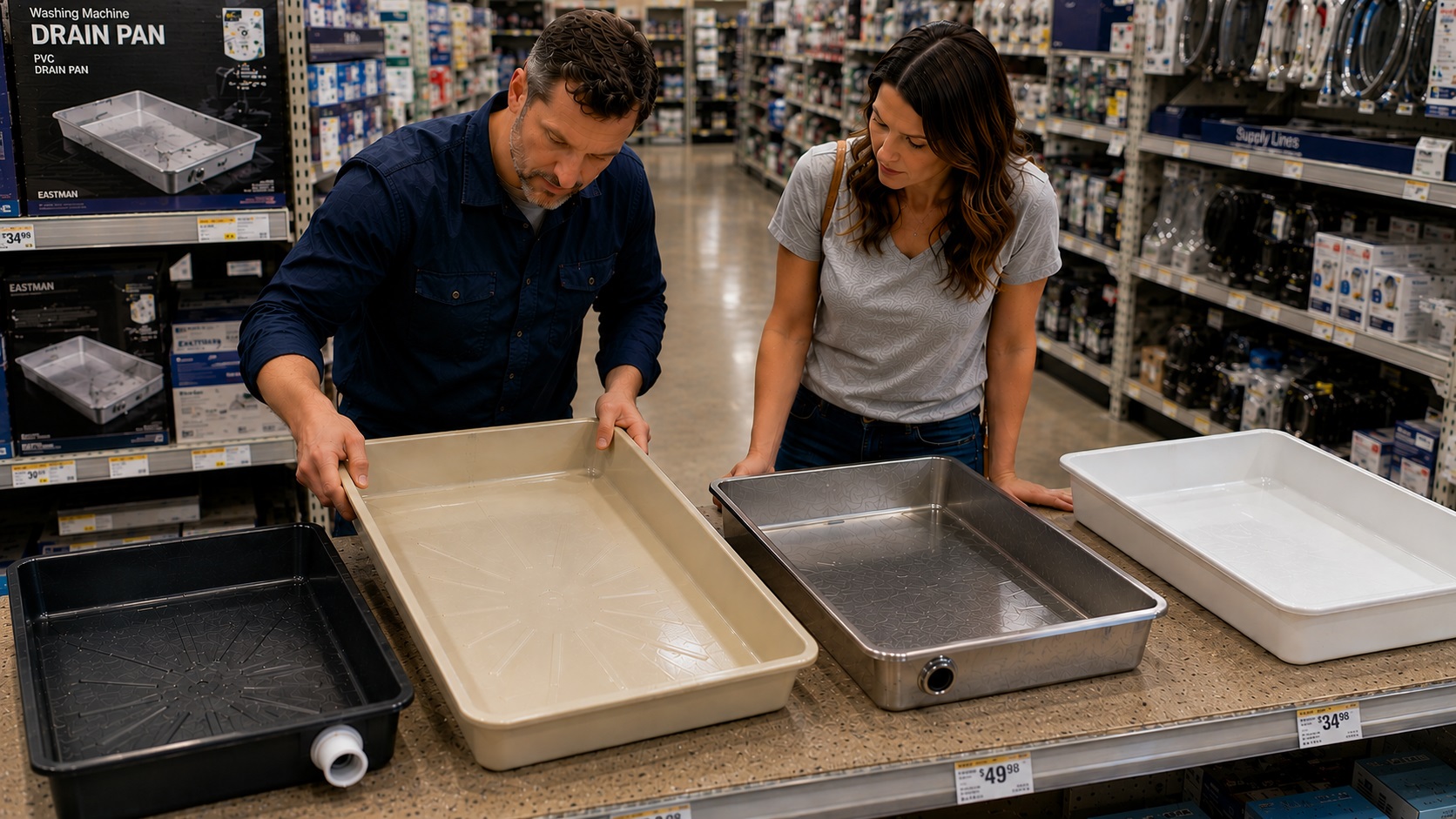
Best Washing Machine Leak Pans for Protecting Laundry Room Floors
Introduction
A washing machine leak can start small and still cause real damage before you notice it. A slow hose drip, loose drain connection, overflowing washer, or hidden leak behind the machine can soak flooring, reach baseboards, and create the kind of damp conditions that lead to stains, swelling, odors, and mold concerns. That is why many homeowners look for the best washing machine leak pans before a leak turns into a larger repair problem.
A washer drain pan is not a complete leak-prevention system. It will not stop a burst hose, fix a drain backup, or replace a water leak sensor. What it can do is provide a containment layer under the washing machine, especially when it is connected to a drain or placed where small leaks would otherwise reach finished flooring. This guide compares practical washing machine leak pans for residential laundry rooms, including standard plastic pans, low-profile pans for front-load machines, stackable washer pans, and a heavier-duty stainless steel option.
For broader appliance leak prevention, this article fits under How Plumbing Leaks Cause Structural Damage. You may also want to review signs of water damage around washing machines if you already suspect a leak.
As an Amazon Associate, this site earns from qualifying purchases. This does not affect the price you pay. Our recommendations are based on research, product reliability, and real-world usability in moisture-prone environments.
Quick Picks: Best Washing Machine Leak Pans by Use Case
- Best Standard Washer Pan: Camco Washing Machine Drain Pan 20750
- Best Low-Profile Pan for Front-Load Washers: Camco Low Profile Washing Machine Drain Pan 20788
- Best for Stackable Washers: Camco Stackable Washing Machine Drain Pan 21006
- Best Plumbing-Brand Alternative: Oatey 34067 Washing Machine Drain Pan
- Best Heavy-Duty Stainless Steel Option: VEVOR 32 x 30 x 2.5 Inch Stainless Steel Washing Machine Pan
Washing Machine Leak Pan Reviews
Best Standard Washer Pan: Camco Washing Machine Drain Pan 20750
The Camco Washing Machine Drain Pan 20750 is the most practical starting point for many homeowners who need a simple washer pan under a standard machine. Its standard rectangular footprint makes it useful for laundry rooms where the washer sits directly on the floor and the main concern is catching small leaks before they spread across finished flooring.
This is a good fit when you want a basic drainable plastic pan from a widely recognized RV, plumbing, and home utility accessory brand. It is not the heaviest-duty option in this guide, but it gives most homeowners the right combination of size, drain-fitting support, and straightforward installation for common residential laundry spaces.
Key Features
- Standard washer pan size designed for typical laundry room installations.
- Includes a drain fitting so water can be routed away if the pan is connected properly.
- Plastic construction keeps the pan lightweight enough for homeowner installation.
- Low sidewalls help contain smaller leaks without adding excessive height under the washer.
- Neutral graphite-style appearance works well in utility rooms, laundry closets, and basements.
Pros
- ✔ Strong fit for standard residential washing machines.
- ✔ Drain fitting makes it more useful than a simple tray if routed to a safe drain location.
- ✔ Lightweight enough for many DIY laundry room projects.
- ✔ Good choice for homeowners who want a simple, familiar brand instead of a generic pan.
Cons
- ✖ Plastic can crack if the washer is dragged across it carelessly during installation.
- ✖ Not the best option for unusually large front-load machines or pedestal setups.
- ✖ A drain pan alone does not shut off the water supply if a hose bursts.
Best For
- Homeowners replacing an old laundry pan under a standard washing machine.
- Basement or utility room laundry areas with a nearby floor drain.
- Buyers who want a straightforward washer drain pan without paying for a metal option.
Check the Camco Washing Machine Drain Pan 20750 on Amazon to see current availability.
Best Low-Profile Pan for Front-Load Washers: Camco Low Profile Washing Machine Drain Pan 20788
The Camco Low Profile Washing Machine Drain Pan 20788 is designed for situations where a standard tall-sided washer pan can be awkward. Front-load washers, pedestal drawers, and tight laundry rooms can make installation difficult because the washer often needs to slide into place without catching on a high pan edge.
This low-profile model is especially useful when you want containment under a larger washer but do not want the pan to interfere with machine access. It is also one of the better choices if your washer area already has limited vertical clearance, such as a laundry closet with shelving, countertop space, or a stacked configuration nearby. It still needs careful sizing, especially with wide front-load machines, but its larger footprint and lower wall height make it more practical than many standard pans for modern laundry setups.
Key Features
- Low-profile design helps reduce the step-up height under the washing machine.
- Larger footprint is useful for many front-load washers and pedestal-style laundry setups.
- Includes a PVC-style drain fitting for routing water when connected correctly.
- Designed to help catch small leaks and overflow water before it spreads across the floor.
- Pewter-colored finish gives it a cleaner look than plain white utility pans.
Pros
- ✔ Better suited to front-load washers than many smaller standard pans.
- ✔ Easier to work with in tight spaces because the sidewall is lower.
- ✔ Helpful for laundry rooms where washer access and door clearance matter.
- ✔ Drainable design gives it more protection value than a non-drain tray.
Cons
- ✖ Lower sidewalls mean less vertical overflow capacity than deeper pans.
- ✖ Availability can vary, so check the live Amazon listing before making it your final pick.
- ✖ Not a substitute for replacing old washer hoses or adding a leak shutoff device.
Best For
- Front-load washing machines.
- Washer setups with pedestal drawers.
- Laundry rooms where a standard deep pan makes machine placement difficult.
Check the Camco Low Profile Washing Machine Drain Pan 20788 on Amazon to see current availability.
Best for Stackable Washers: Camco Stackable Washing Machine Drain Pan 21006
The Camco Stackable Washing Machine Drain Pan 21006 is the most useful option in this lineup for compact laundry areas. Many standard washer pans are too large for stackable units, apartment-sized washers, and tight laundry closets. A pan that is too large can block trim, interfere with doors, or make the washer sit too far from the wall. A pan that is too small may not catch water from the machine base or drain area.
This model is designed around smaller laundry footprints. It is a good choice when your priority is fitting a compact washer safely into a closet or apartment-style laundry space while still adding a basic layer of water containment. Because compact installations are often harder to access after the washer is installed, it is especially important to measure the washer feet, drain placement, and hose routing before ordering.
Key Features
- Smaller footprint designed for stackable and apartment-sized washing machines.
- Includes drain-fitting hardware for installations where water can be routed away.
- Plastic construction keeps it manageable for tight-space installations.
- Raised edges help contain small leaks under compact machines.
- Useful for laundry closets where standard pans are too wide or deep.
Pros
- ✔ Better size match for compact washers than full-size pans.
- ✔ Good choice for second-floor laundry closets where even small leaks matter.
- ✔ Helps protect tight laundry areas that are difficult to inspect regularly.
- ✔ Drainable design supports a more complete setup when connected correctly.
Cons
- ✖ Too small for many full-size washers.
- ✖ Compact laundry spaces can make drain fitting installation more difficult.
- ✖ Not ideal if you need maximum containment volume.
Best For
- Stackable washer and dryer units.
- Apartment-sized washing machines.
- Small laundry closets where a full-size pan will not fit.
Check the Camco Stackable Washing Machine Drain Pan 21006 on Amazon to see current availability.
Best Plumbing-Brand Alternative: Oatey 34067 Washing Machine Drain Pan
The Oatey 34067 Washing Machine Drain Pan is a good alternative for homeowners who prefer a plumbing-focused brand. Oatey is well known in the plumbing category, and that makes this pan worth considering if you want something from a brand commonly associated with drains, sealants, fittings, and water management products.
This is not the product I would describe as the most rugged pan in the group. Review sentiment around plastic thickness and durability can be mixed, which is common with molded plastic washer pans. Still, it remains a useful option for buyers who want a recognized plumbing brand and a basic pan for standard leak containment. It works best when installed carefully, supported evenly, and not abused during washer placement.
Key Features
- Made by a well-known plumbing accessory brand.
- Designed to sit under a washing machine and collect small leaks or overflow water.
- Compatible with drain fitting setups depending on the installation configuration.
- Simple white appearance fits utility rooms, closets, and laundry areas.
- Useful as a brand-name alternative to Camco models.
Pros
- ✔ Good option for buyers who prefer a traditional plumbing brand.
- ✔ Simple design works for many standard washer installations.
- ✔ Can be a useful backup choice if preferred Camco models are unavailable.
- ✔ Helps contain small leaks when properly sized and installed.
Cons
- ✖ Some buyers may find the plastic lighter than expected.
- ✖ Should not be dragged, flexed, or stressed during installation.
- ✖ Not the top choice for heavy front-load machines or harsh utility-room use.
Best For
- Homeowners who want a plumbing-brand alternative to Camco.
- Standard laundry rooms with moderate protection needs.
- Buyers replacing an older white washer pan.
Check the Oatey 34067 Washing Machine Drain Pan on Amazon to see current availability.
Best Heavy-Duty Stainless Steel Option: VEVOR 32 x 30 x 2.5 Inch Stainless Steel Washing Machine Pan
The VEVOR 32 x 30 x 2.5 Inch Stainless Steel Washing Machine Pan is the strongest choice in this guide for homeowners who do not want a molded plastic pan. Stainless steel pans cost more than basic plastic options, but they are appealing in laundry rooms where durability, rigidity, and long-term corrosion resistance matter more than having the lowest-cost solution.
This type of pan is especially useful for heavier laundry machines, utility rooms, basements, rental properties, and areas where the washer may need to be moved occasionally for maintenance. It is also a good option for homeowners who have had plastic pans crack during installation or who want something more rigid under a large machine. The tradeoff is that the review base is smaller than the leading Camco options, so it should be framed as a premium material choice rather than the safest mass-market pick.
Key Features
- Stainless steel construction for a more rigid and durable pan body.
- Heavy-duty design suited to utility rooms and larger laundry machines.
- Raised edges help contain small leaks beneath the washer.
- Drain opening and adapter support water routing when installed correctly.
- Metal finish resists the brittle cracking risk associated with some plastic pans.
Pros
- ✔ Stronger material choice than standard molded plastic.
- ✔ Good for homeowners who want a premium, long-lasting washer pan.
- ✔ Better suited to heavy machines and harder-use laundry rooms.
- ✔ Stainless steel is easier to clean than textured or scratched plastic.
Cons
- ✖ Lower review depth than the main Camco options.
- ✖ Heavier and less forgiving to maneuver during installation.
- ✖ Metal edges and fit should be checked carefully before placing the washer.
Best For
- Large laundry rooms and utility rooms.
- Homeowners who want a more durable alternative to plastic pans.
- Rental properties, basements, and laundry areas where the washer may be moved for service.
Washing Machine Leak Pan Comparison Table
| Product | Pick | Best Use Case | Key Strengths | Main Limitation | Amazon Link |
|---|---|---|---|---|---|
| Camco Washing Machine Drain Pan 20750 | Best Standard Washer Pan | Standard laundry rooms and common residential washers | Simple size, drain fitting, lightweight plastic, strong general-purpose fit | Not ideal for unusually large machines or pedestal setups | View on Amazon |
| Camco Low Profile Washing Machine Drain Pan 20788 | Best Low-Profile Pan for Front-Load Washers | Front-load washers, pedestal setups, and tight laundry spaces | Low-profile edge, larger footprint, easier machine access | Lower sidewalls reduce overflow depth | View on Amazon |
| Camco Stackable Washing Machine Drain Pan 21006 | Best for Stackable Washers | Compact washers, apartment laundry spaces, and laundry closets | Smaller footprint, stackable-unit fit, drain fitting support | Too small for many full-size washers | View on Amazon |
| Oatey 34067 Washing Machine Drain Pan | Best Plumbing-Brand Alternative | Homeowners who prefer a recognized plumbing brand | Simple design, brand recognition, standard washer protection | Mixed feedback on plastic thickness and durability | View on Amazon |
| VEVOR 32 x 30 x 2.5 Inch Stainless Steel Washing Machine Pan | Best Heavy-Duty Stainless Steel Option | Heavy washers, basements, rentals, and utility rooms | Stainless steel body, rigid construction, premium durability | Lower review depth than the main plastic picks | View on Amazon |
Buying Guide: How to Choose the Right Washing Machine Leak Pan
The best washing machine leak pan is the one that fits your washer, your floor, and your drain setup. A pan that is too small, too shallow, or impossible to connect to a drain can create false confidence. Before choosing, measure carefully and think about how water would actually move if your washer leaked.
Start With Washer Size, Not Pan Size
Measure the washing machine footprint at the feet, not just the cabinet width. Some washers have feet that sit slightly inward, while others have a wider base or pedestal. The pan must support the washer feet fully inside the pan. If the washer feet sit on the rim, the pan can crack, tilt, or fail to contain water correctly.
For standard top-load or basic front-load machines, the Camco 20750 is usually the most sensible starting point. For larger front-load models or pedestal drawers, the Camco 20788 is often a better shape because of its larger, lower-profile design. For stackable units, the Camco 21006 is more realistic than trying to force a full-size pan into a compact closet.
Decide Whether You Need a Drainable Pan
A drainable washer pan is much more useful than a sealed tray when water can be routed safely to a floor drain, standpipe, or approved drain line. Without a drain connection, the pan only holds a limited amount of water. That can still help with a slow drip, but it will not handle a major supply hose failure.
If you are unsure about fittings, routing, or local plumbing requirements, review best drain fittings for leak pans or ask a plumber before cutting into floors or connecting the pan to a drain. A poor drain connection can become its own leak source.
Choose Plastic for Simple Protection and Stainless Steel for Durability
Plastic washer pans are common because they are lightweight, affordable, and easy to position. They work well in many homes, but they can crack if the washer is dragged across the pan or if the machine weight is concentrated on the wrong spot.
Stainless steel pans are stronger and more rigid. They make sense in basements, utility rooms, rental homes, or laundry areas where durability matters. The VEVOR stainless steel pan is the best option in this guide if you are specifically trying to avoid the weaknesses of plastic. The tradeoff is that metal pans can be heavier, more expensive, and less forgiving during installation.
Match the Pan to the Type of Leak You Are Worried About
If your concern is a slow washer drip, a pan can be useful. If your concern is a burst hose, a pan alone is not enough. For hose-related risk, you should also look at when to replace washing machine hoses and consider stronger hose protection options.
If you want automatic protection rather than passive containment, a leak pan should be paired with other devices. A washer pan collects water; a sensor alerts you; a shutoff device may stop water flow. Those are different layers of protection, and this article focuses only on the pan layer.
How to Set Up a Washing Machine Leak Pan Correctly
Installing a washing machine drain pan is simple in concept, but small mistakes can reduce its usefulness. The goal is to keep the pan level, avoid cracking it, and route water where it can be handled safely.
Install the Pan Before the Washer Is Fully Positioned
Do not try to force a pan under a washer that is already in place. Shut off the water supply, disconnect hoses if needed, and move the machine carefully. Many plastic pans are damaged during installation because the washer is dragged or dropped into the pan instead of lifted and positioned.
Keep the Washer Feet Inside the Flat Bottom Area
The washer feet should sit on the bottom of the pan, not on the rim or sloped edge. If the washer is not level after installation, adjust the machine feet according to the washer manual. A rocking washer can stress the pan, damage flooring, and make leaks harder to notice.
Check the Drain Fitting Before Trusting the Setup
If the pan has a drain fitting, inspect the gasket, connection, and drain route. Pour a small amount of water into the pan only if it is safe to do so and you know where the water will go. Watch for dripping around the fitting. A pan drain connection should not leak into the ceiling, subfloor, wall cavity, or cabinet below.
Use the Pan as Part of a Laundry Moisture Routine
Inspect the pan regularly. Look for standing water, detergent residue, rust stains, moldy odors, or damp flooring around the outside edge. If you see repeated moisture, the pan is showing you that another problem needs attention. To investigate further, see how to detect hidden washing machine leaks.
Washing Machine Leak Pan Mistakes That Can Still Leave Floors Wet
Buying a Pan Without Measuring the Washer
Many poor results come from buying based on the product title instead of actual dimensions. Measure the washer width, depth, foot placement, and available room around the washer. Leave room for hose bends, drain access, and machine vibration.
Assuming a Pan Will Handle a Burst Hose
A washing machine leak pan can help with small leaks and limited overflow. It is not a guarantee against flooding. A full-pressure supply hose failure can release water faster than a shallow pan can manage, especially if there is no working drain connection.
Ignoring Old Washer Hoses
If your washer hoses are old, kinked, cracked, bulging, or corroded at the fittings, the pan is not the main issue. Replace risky hoses before they fail. For product options, see best washing machine hoses.
Installing the Drain Fitting Poorly
A drain fitting that is loose, cross-threaded, or routed to the wrong location can create a hidden leak. The fitting should be tight enough to seal but not overtightened to the point of cracking plastic. If the pan drains through a floor, the connection must be appropriate for that space.
Using a Pan to Hide an Active Leak
If water appears in the pan more than once, do not ignore it. The pan is a warning sign, not a repair. Repeated moisture can reach flooring, baseboards, framing, or nearby walls. If flooring has already been soaked, review how to dry floors after washing machine leaks.
Choosing a Pan That Blocks Service Access
In tight laundry closets, a large pan can make the washer harder to pull out later. Make sure you can still reach shutoff valves, hoses, the drain area, and the washer plug. A leak protection setup should make maintenance easier, not harder.
Washing Machine Leak Pan FAQ
Do washing machine leak pans really work?
Washing machine leak pans can work for small leaks, drips, and limited overflow, especially when connected to a drain. They are less effective against major hose bursts or large drain backups. For a deeper look at the limits, see do washing machine leak pans really work.
Should a washing machine pan have a drain?
A drain is strongly preferred when the pan is installed in a finished laundry room, second-floor laundry area, or space where standing water could damage flooring. A non-drained pan may still catch a small drip, but it can overflow if the leak continues unnoticed.
Can I use a washer pan without connecting the drain fitting?
Yes, but only as limited containment. If the drain opening is not used, it must be sealed correctly so the pan does not leak from the hole. A sealed pan may help with small drips, but it should not be treated as flood protection.
Are plastic or stainless steel washing machine pans better?
Plastic pans are lighter, easier to handle, and common in residential laundry rooms. Stainless steel pans are more rigid and durable, making them a better choice for heavy washers, utility rooms, rentals, and homeowners who want to avoid cracked plastic. The best choice depends on your washer weight, budget, and installation space.
What size washing machine leak pan do I need?
The pan should be larger than the washer footprint and allow all washer feet to sit inside the flat bottom area. Measure the washer depth, width, and foot placement before ordering. For more detailed sizing support, see how to choose the right leak pan size.
Can a leak pan prevent mold under a washing machine?
A leak pan can help reduce water spread, but it does not guarantee mold prevention. Mold risk depends on whether moisture is discovered quickly, dried properly, and stopped at the source. Standing water left in a pan can still contribute to odors and moisture problems.
Should I use a leak sensor with a washer pan?
In many homes, yes. A pan collects water, but a sensor can alert you when water appears. This is especially helpful in second-floor laundry rooms, finished basements, and laundry closets where leaks may not be noticed right away.
Where should a washing machine leak pan be installed?
The pan should sit directly under the washer, with the washer level and all feet supported inside the pan. It is most useful in laundry rooms, utility closets, basements, and upper-floor laundry areas where even a small leak could damage flooring or nearby materials. For broader placement guidance, see where leak pans should be installed.
Conclusion
For most homeowners, the Camco Washing Machine Drain Pan 20750 is the most practical standard choice. It fits the needs of many common laundry rooms and gives you a simple drainable pan from an established brand.
If you have a front-load washer, pedestal setup, or larger laundry machine, the Camco Low Profile Washing Machine Drain Pan 20788 is the better fit because its lower profile and larger footprint are more suitable for modern front-load layouts. For compact laundry closets and apartment-style machines, the Camco Stackable Washing Machine Drain Pan 21006 is the most targeted option.
The Oatey 34067 Washing Machine Drain Pan is a reasonable plumbing-brand alternative, but it should be installed carefully because plastic washer pans can be vulnerable to cracking if misused. If you want a more durable material, the VEVOR Stainless Steel Washing Machine Pan is the strongest heavy-duty option in this list.
No washing machine leak pan should be treated as a complete protection system. For best results, combine the right pan with sound hose maintenance, regular inspections, and quick drying if water appears. You can also use the sitewide guide, How to Find, Fix, and Prevent Moisture Problems in Homes, to understand how small leaks fit into larger moisture prevention planning.