Best Drain Fittings for Leak Pans: What to Use for Appliance Drain Pans
A leak pan is only as useful as the drain path it can create. The pan catches water, but the drain fitting determines whether that water can leave the pan in a controlled way. If the fitting is the wrong size, points in the wrong direction, leaks around the gasket, or cannot connect to the intended drain route, the pan may provide much less protection than expected.
The best drain fitting for a leak pan is the fitting that matches the pan outlet, seals cleanly with the gasket, points toward a workable drain route, and connects to the pipe, tubing, hose, or drain opening you actually have. A fitting that works well for a washing machine pan may not be right for a water heater pan, HVAC condensate pan, or low-profile appliance tray.
Drain fittings matter most in places where water damage would be expensive or hard to see. A pan under an upstairs washer, water heater closet, attic air handler, or finished utility room needs a reliable outlet because plumbing leaks can damage structural materials when water escapes into flooring, drywall, ceilings, cabinets, or framing.
What a Leak Pan Drain Fitting Needs to Do
A drainable leak pan has two jobs: catch water at the appliance and send that water toward a controlled drain path. The drain fitting is the connection point between the pan and that route.
A good leak pan drain fitting needs to do three things well:
- Seal to the pan: The gasket, washer, nut, or threaded connection must keep water from leaking around the outlet.
- Match the drain route: The outlet must connect to the pipe, tubing, hose, or approved drain path being used.
- Fit the appliance location: The fitting needs enough clearance so it does not hit a wall, floor, appliance foot, pedestal, cabinet, or service panel.
If the fitting is wrong, water may leak around the outlet, drain too slowly, kink the connected tubing, block service access, or overflow the pan before reaching the drain path. That is why fitting selection should be part of whole-home moisture prevention planning, especially in finished rooms, upper floors, closets, attics, and utility areas.
A drain fitting does not stop the appliance from leaking. It also does not guarantee that water damage cannot happen. The drain can clog, the fitting can leak, the pan can crack, or water can come from a source outside the pan. Before choosing the fitting, make sure the pan itself is right for the appliance and room. Start with choosing the right leak pan size, then match the fitting to the pan and drain route.
Main Types of Drain Fittings for Leak Pans
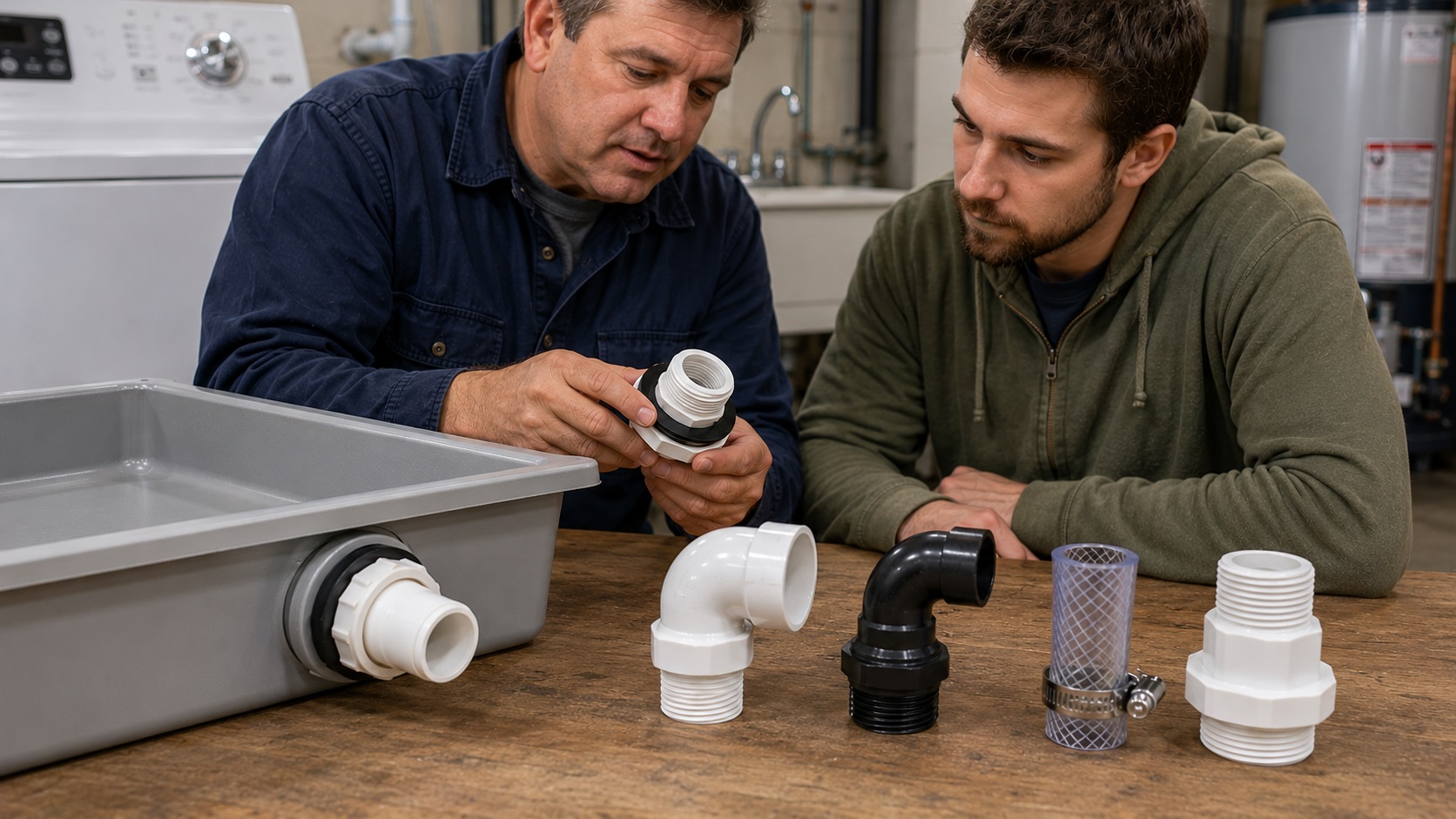
Leak pan drain fittings come in several common styles. The right one depends on the outlet shape, seal type, connection size, and whether water needs to leave through the side of the pan, the bottom of the pan, rigid pipe, or flexible tubing.
| Fitting type | Usually best for | Main caution |
|---|---|---|
| PVC drain adapter | Planned rigid or semi-rigid drain routes | Must match outlet and pipe size |
| Bulkhead fitting | Gasketed side or bottom pan outlets | Needs a flat sealing surface |
| Threaded fitting | Pans with molded or matching threaded outlets | Threads must match exactly |
| Hose barb adapter | Short flexible tubing runs | Tubing can kink, sag, or slip if mismatched |
| Side outlet fitting | Pans sitting directly on floors | Needs clearance beside the pan |
| Bottom outlet fitting | Pans over a designed drain opening | Needs clearance below the pan |
PVC Drain Adapter Fittings
PVC drain adapter fittings are common for appliance pans, washing machine pans, water heater pans, and utility drain pans. They are used when the pan needs to connect to a more rigid or semi-rigid drain path rather than simply hold water.
A PVC-style fitting may be useful when the drain route is planned, accessible, and compatible with the pan outlet. These fittings are often simple, affordable, and easy to find, but they must match the pan opening and the intended connection. A fitting that is close in size but not correct can leak, loosen, or fail to seal properly.
PVC drain adapters are often best for:
- Utility-room pans with a planned drain route
- Some washing machine drain pans
- Some water heater drain pans
- Appliance pans where rigid or semi-rigid drainage is practical
The main caution is compatibility. Check the pan outlet size, fitting diameter, gasket design, and pipe or adapter connection before buying. Do not assume that any PVC-looking fitting will fit any leak pan.
Bulkhead-Style Fittings With Gasket and Nut
Bulkhead-style fittings are designed to clamp through the wall or floor of a pan. They usually use a threaded body, gasket or washer, and retaining nut to create a sealed outlet. This style is common when the fitting needs to pass through the pan material and seal tightly around the hole.
This type of fitting can be useful when replacing a missing or damaged fitting, creating a secure side outlet, or working with a pan that has a compatible outlet opening. The gasket is especially important because it creates the seal between the fitting and the pan surface.
Bulkhead-style fittings are often best for:
- Replacement drain outlets
- Side-wall pan outlets
- Thin plastic pans designed for gasketed fittings
- Leak pans where a secure clamping connection is needed
The pan surface around the opening should be suitable for sealing. If the surface is curved, rough, cracked, warped, or too thin for the fitting style, the gasket may not seal well. A poor seal can let water leak around the fitting instead of through the drain path.
Threaded Drain Pan Fittings
Threaded drain pan fittings are used when the pan outlet or adapter connection is designed around matching threads. These fittings may appear on replacement fitting kits, pan outlet assemblies, water heater pans, appliance trays, or specialty drain pan systems.
The important detail is that threaded fittings must match the thread style and size. A fitting may look close but still fail to tighten correctly, seal properly, or connect to the intended drain route. If the threads do not match, forcing the fitting can damage the pan outlet or create a leak point.
Threaded drain pan fittings are often best for:
- Pans with molded threaded outlets
- Replacement fittings that match the original part
- Drain setups where the adapter must connect securely to another threaded part
- Appliance pans that use a manufacturer-specific outlet design
Before buying a threaded fitting, check whether the pan requires a specific replacement part. Some pans use common fittings, while others use proprietary or less common thread patterns. When in doubt, match the fitting to the pan model instead of relying only on visual similarity.
Hose Barb Adapters
A hose barb adapter is designed to connect a drain pan outlet to flexible tubing. The barbed end grips the inside of the tubing so water can be routed away from the pan. This can be useful when rigid pipe is not practical or when the drain route needs a short flexible connection.
Hose barb adapters are often best for:
- Flexible tubing routes
- Minor drips, condensate-style drainage, or other low-volume drainage situations
- Utility pans where tubing can be inspected
- Locations where a short tubing connection is more practical than rigid pipe
The main risk is that flexible tubing can kink, sag, clog, or move out of position. A hose connection that looks acceptable at first may fail if the tubing is bent too sharply or routed uphill. The tubing size must also match the barb. If the tubing is too loose, it may leak or slip off. If it is too tight, it may not seat properly.
Hose barb fittings are not automatically the best choice for every leak pan. They work best when the tubing route is short, visible, protected from damage, and easy to inspect.
Side Outlet Fittings
Side outlet fittings allow water to leave through the side wall of the pan. These are common on washing machine pans, some appliance pans, and pans that sit directly on a floor. A side outlet is often practical because the drain connection can leave horizontally instead of requiring space below the pan.
Side outlet fittings are often best for:
- Washing machine pans on finished floors
- Leak pans sitting directly on a slab or subfloor
- Pan locations where downward drainage is not available
- Situations where the drain route needs to exit toward a wall or nearby drain path
The main limitation is side clearance. The fitting body, gasket, nut, and connected pipe or tubing need room outside the pan. If the pan is pushed tightly against a wall, cabinet, washer pedestal, appliance foot, or baseboard, the fitting may not fit correctly.
Side outlet fittings should be chosen only after the pan location is clear. If you are still deciding the best appliance location for the pan, review where leak pans should be installed before choosing the final outlet style.
Bottom Outlet Fittings
Bottom outlet fittings allow water to drain through the floor of the pan. This can work well when the pan sits over a designed drain opening, recessed drain, or equipment setup where downward drainage is practical. However, bottom outlets are not ideal for every appliance pan.
Bottom outlet fittings are often best for:
- Pans positioned directly over a drain opening
- Some HVAC condensate or mechanical equipment pans
- Installations with space below the pan for the fitting and drain route
- Situations where side clearance is limited but downward drainage is available
The main problem is clearance below the pan. If the pan sits flat on a floor with no recessed drain opening or space for the fitting, a bottom outlet may not work. The fitting may lift the pan, prevent it from sitting flat, or create a stress point under the pan.
A bottom outlet should be chosen only when the location is designed for downward drainage. If the appliance sits on a normal flat floor, a side outlet may be more practical.
Best Drain Fitting Type by Leak Pan Use
The best fitting style depends partly on the appliance or equipment the pan protects. A washer pan, water heater pan, HVAC pan, and general utility pan may all need different outlet arrangements. The fitting should match the way water is likely to collect and where it can realistically drain.
Washing Machine Pans
Washing machine pans often use side outlet fittings because the pan usually sits directly on the laundry room floor. A side outlet can route water toward a nearby drain path without requiring space below the pan. Some washer pans include a basic PVC-style fitting kit, but the included fitting should still be checked for size, gasket quality, and outlet direction.
For washer pans, fitting clearance matters because the washer may vibrate, shift slightly, or sit close to the pan wall. The fitting should not interfere with washer feet, a pedestal, drain hose, supply hoses, or rear access. If the fitting or drain line crowds the hose connections, it may make inspections harder.
A drain fitting also does not replace washer hose maintenance. If the washer hoses are old, kinked, swollen, rusted at the couplings, or difficult to shut off, the leak risk remains high even with a drained pan. For prevention planning, understand when washing machine hoses should be replaced.
If you are still choosing the pan itself, compare washing machine leak pans before choosing the final fitting, because outlet location and included hardware vary by pan design.
Water Heater Pans
Water heater pans usually need a drain fitting that allows water to leave the pan reliably if the tank, valve, or nearby fitting leaks. The best fitting depends on the pan outlet, drain route, local requirements, and the physical space around the water heater.
Side outlet fittings are common when the drain must leave the pan horizontally. Bottom outlets may work only where downward drainage is specifically available. In either case, the fitting should be accessible enough to inspect and should not interfere with the water heater base or service access.
Water heater drain pans may also be affected by code or manufacturer requirements, especially when leakage could damage finished areas. The fitting choice should not be separated from the location and risk level. If the water heater area already shows corrosion, seepage, staining, or questionable fittings, review the signs water heater plumbing components are failing instead of relying only on the pan drain.
If the pan itself is being selected at the same time, review water heater leak pans before buying the drain fitting so the outlet style, pan depth, and connection hardware work together.
HVAC Condensate Pans
HVAC condensate pans are usually about overflow control. If the primary condensate drain clogs or the equipment leaks, the secondary pan needs a reliable way to collect and route water before it damages ceiling drywall, insulation, framing, or nearby finishes.
For attic or ceiling-mounted HVAC equipment, a pan drain problem can damage ceilings before anyone sees the water. If the pan, fitting, or drain line is part of a required secondary drain system, follow the equipment instructions and local requirements rather than improvising a connection.
For HVAC pans, the fitting should match the expected condensate route and should not block service access. Side outlets can work where water needs to leave horizontally. Bottom outlets can work only where the pan is designed for downward drainage. Sensors are often helpful because HVAC pans may be located in attics, closets, or other areas homeowners do not inspect daily.
General Utility and Appliance Pans
General utility pans may be used under small appliances, equipment, softeners, filters, or other water-connected devices. In these cases, the best fitting depends on the pan material, outlet style, drain route, and how easy the area is to inspect.
If the pan is in a visible utility room, a simple fitting may be enough for minor drips. If the pan is in a finished closet, above a ceiling, or near materials that absorb water, the drain fitting should be more carefully matched to the risk. A fitting that is acceptable in a low-risk location may not be reliable enough for a high-risk one.
Side Outlet vs. Bottom Outlet Drain Fittings
Side outlet and bottom outlet fittings solve different layout problems. A side outlet is usually more practical when the pan sits directly on a finished floor or subfloor and the drain route needs to leave horizontally. A bottom outlet is useful only when the pan sits over a designed drain opening, recessed drain, equipment platform, or other setup with clearance below the pan.
Choose a side outlet when there is room beside the pan for the fitting body, nut, gasket, and connected pipe or tubing. Choose a bottom outlet only when the fitting will not lift the pan, stress the pan floor, or become impossible to inspect later.
The wrong outlet style can make the pan less useful. A bottom outlet with no downward drain path may keep the pan from sitting flat. A side outlet with no wall clearance may leave no room for the connection. Before choosing either style, confirm both the pan location and the route water would take after leaving the pan.
What Size Drain Fitting Do You Need?
The correct drain fitting size depends on the pan outlet and the drain route. Do not assume all leak pan fittings are universal. Different pans may use different hole sizes, thread sizes, gasket styles, and outlet designs. Even fittings that look similar may not seal or connect correctly.
Before buying a drain fitting, check:
- The pan outlet diameter
- The hole size or molded drain opening
- Whether the outlet is threaded or smooth
- The pipe, hose, or tubing size being connected
- The gasket or washer diameter
- The thickness of the pan wall or floor
- Whether the fitting is designed for a side outlet or bottom outlet
- Whether local requirements apply to that appliance location
If the pan came with a fitting kit, start by checking whether the included fitting matches the outlet and route. If it does, it may be enough. If the outlet direction, gasket style, or connection size does not work with the space, you may need a different fitting.
A simple way to narrow the choice is to start at the pan, not the drain line: identify the pan outlet first, then match the gasket and fitting body, then match the pipe, hose, or tubing connection. Choosing the drain-line connection first can lead to a fitting that connects to the pipe but does not seal correctly to the pan.
Water heater pans deserve extra caution because local code, manufacturer instructions, and installation location may affect the drain size, route, discharge point, or outlet arrangement. This article is not a plumbing-code substitute. If the water heater is installed in a finished area, attic, elevated platform, or closet, confirm the pan and fitting requirements before relying on the setup.
Gaskets, Seals, and Leak Resistance
The gasket is one of the most important parts of a leak pan drain fitting. The fitting may be the correct size and style, but if the gasket does not seal against the pan, water can leak around the outlet instead of draining through it.
A good fitting should create even contact between the gasket and the pan surface. The sealing area should be flat enough for the gasket to compress properly. If the pan wall is curved, warped, cracked, rough, or uneven around the opening, the fitting may not seal well.
Common gasket and seal problems include:
- A gasket that is too small for the opening
- A gasket that does not match the fitting body
- A fitting installed against a curved or molded surface that cannot seal evenly
- A pan wall that is too thin or flexible for the fitting style
- Plastic threads that crack or strip
- Overtightening that distorts the gasket or pan wall
- A rough hole edge that prevents full gasket contact
Leak resistance depends on compatibility, not just tightness. Tightening a mismatched fitting harder can damage the pan, deform the gasket, or crack plastic parts. A fitting should seal because it fits correctly, not because it has been forced into place.
After the fitting is assembled, a small test with clean water can reveal obvious gasket leaks before the appliance is pushed fully into place. Do not test in a way that sends water into an unapproved drain route or onto finished materials.
After choosing a fitting, the connection should remain visible enough to inspect later. If the fitting is hidden behind the appliance, under stored items, or behind a wall, a small leak at the fitting may go unnoticed until water has already reached surrounding materials.
When the Included Fitting Kit Is Enough
Many leak pans come with a basic fitting kit. In simple setups, the included fitting may be completely adequate. This is most likely when the fitting matches the pan outlet, points in the right direction, seals cleanly, and connects to the intended drain route without extra adapters.
The included fitting kit may be enough when:
- The fitting is designed for that exact pan.
- The gasket seals against a flat, compatible surface.
- The outlet direction matches the drain route.
- The fitting size matches the pipe, hose, or tubing being used.
- The fitting does not block appliance feet, hoses, panels, or access.
- The appliance is in a lower-risk or easy-to-inspect location.
Included fittings are often chosen to match the pan, but they may not match every room layout. A fitting that works in an open utility area may be awkward in a tight closet. A fitting that works with flexible tubing may not be right for a rigid drain route. A fitting that drains to one side may not work if that side faces a wall.
When You Need a Separate or Better Drain Fitting
A separate fitting may be needed when the original fitting is missing, damaged, poorly sealed, or incompatible with the drain route. It may also be needed when the pan is being used in a higher-risk location where reliability matters more.
Consider a separate or better fitting when:
- The pan did not include a fitting kit.
- The included fitting does not match the drain route.
- The fitting points toward a wall, cabinet, or blocked area.
- The gasket looks thin, damaged, or poorly matched.
- The fitting leaks around the pan outlet.
- The connection needs to transition to flexible tubing.
- The connection needs to transition to rigid pipe.
- The fitting is cracked, stripped, loose, or difficult to tighten.
- The appliance is in a finished or high-risk location.
When the location is high-risk, the fitting choice deserves more attention. A laundry room above finished space, water heater closet, or attic HVAC pan should not rely on a fitting that barely fits or cannot be inspected. The more damage a leak could cause, the more important it is for the fitting, pan, drain route, and access to work together.
Common Mistakes When Choosing Leak Pan Drain Fittings
Most drain fitting problems come from small compatibility mistakes. The outlet connection has to match the pan, appliance location, gasket surface, and drain route.
Assuming Drain Fittings Are Universal
Leak pan drain fittings are not always universal. Different pans can use different outlet diameters, thread styles, gasket shapes, and wall thicknesses. A fitting that works on one washer pan may not fit a water heater pan or HVAC pan correctly.
Ignoring the Pan Outlet Size
The fitting must match the outlet size or hole diameter. If the fitting is too small, it may not seal. If it is too large, it may not fit without damaging the pan. Always check the pan specifications before buying a replacement or upgraded fitting.
Choosing a Bottom Outlet With No Downward Drain Path
A bottom outlet only works when water can drain downward and the fitting has space below the pan. If the pan sits flat on a finished floor, a bottom fitting may prevent the pan from sitting correctly or create a pressure point under the pan.
Choosing a Side Outlet With No Side Clearance
A side outlet needs space outside the pan for the fitting, gasket, nut, and connected drain line. If the outlet faces a wall, baseboard, cabinet, appliance leg, or pedestal, the connection may be crowded or unusable.
Using Flexible Tubing Without Considering Kinks
Flexible tubing can be useful, but it must be routed in a way that allows water to flow. If the tubing bends sharply, sags, gets pinched behind an appliance, or runs uphill, the pan may not drain properly.
Ignoring Gasket Quality
The gasket is what keeps water from leaking around the pan outlet. A thin, damaged, mismatched, or poorly compressed gasket can turn the drain connection into a leak point. The fitting should seal cleanly without needing to be forced.
Blocking Service Access
A drain fitting should not make it harder to reach hoses, valves, filters, panels, or appliance connections. If the fitting route blocks inspection, the setup may hide early warning signs instead of preventing damage.
Treating a Drain Fitting as Complete Protection
A drain fitting helps water leave the pan, but it does not prevent leaks, detect water, or shut off the supply. The drain can clog, the fitting can leak, and the appliance can leak from a location the pan does not catch. The fitting is only one part of a prevention system.
When to Use Sensors or Shutoff Protection Too
A drained pan is stronger than an undrained pan, but it still does not provide complete protection. In high-risk locations, combine the pan and fitting with water alerts, shutoff access, and regular maintenance.
Water sensors are useful near appliance pans because they can alert you if the drain clogs, the fitting leaks, the pan fills unexpectedly, or water appears outside the pan. If you are adding protection around a pan, compare water leak sensors for early detection.
Smart shutoff systems are not necessary for every appliance pan, but they may be worth considering in homes with upstairs laundry, finished basements, older plumbing, frequent travel, or expensive finished spaces below leak-prone appliances. To understand that layer, review how smart water shutoff systems work.
Buyer Checklist Before Choosing a Drain Fitting
Before buying a leak pan drain fitting, confirm the details that affect fit, sealing, drainage, and access. This checklist can help prevent the most common compatibility mistakes.
- Check the leak pan outlet type.
- Measure or confirm the outlet diameter.
- Confirm whether the outlet is side-mounted or bottom-mounted.
- Check whether the pan outlet is threaded or smooth.
- Confirm the pipe, hose, or tubing size you need to connect.
- Make sure the gasket matches the fitting and pan surface.
- Check whether the pan wall or floor thickness matches the fitting design.
- Confirm that the fitting has enough clearance from walls, cabinets, and appliance feet.
- Make sure the connected drain route will not kink, sag, or become crushed.
- Confirm that the fitting can still be inspected after the appliance is in place.
- Consider whether the appliance location also needs a leak sensor.
- Check local requirements and manufacturer instructions when the fitting is for a water heater, HVAC pan, attic installation, elevated platform, or other code-sensitive location.
If the fitting passes this checklist, it is more likely to work with the pan and location. If several items are uncertain, especially outlet size, gasket fit, or drain routing, choose a different fitting or get professional guidance before relying on the setup.
Quick Buying Summary
- The best drain fitting for a leak pan depends on the pan outlet, drain route, appliance location, fitting size, and gasket style.
- PVC adapter fittings, bulkhead fittings, threaded fittings, hose barb adapters, side outlets, and bottom outlets all solve different problems.
- Side outlet fittings are often practical when the pan sits directly on a floor.
- Bottom outlet fittings only work well when downward drainage is available and the fitting has clearance below the pan.
- Drain fittings are not always universal, so outlet size and connection type must be checked before buying.
- Gaskets matter because a poor seal can make the fitting itself leak.
- A drained pan still works best with leak sensors, accessible shutoff valves, clear drain routing, and regular appliance maintenance.
Frequently Asked Questions
What fitting do I need for a leak pan?
You need a fitting that matches the pan outlet, hole size, drain route, and pipe or tubing connection. The correct fitting depends on whether the pan uses a side outlet, bottom outlet, threaded connection, gasketed bulkhead fitting, hose adapter, or PVC-style drain adapter.
Are leak pan drain fittings universal?
No. Leak pan drain fittings are not always universal. Outlet diameters, thread styles, gasket shapes, pan wall thickness, and connection types can vary. Always match the fitting to the pan specifications instead of assuming a similar-looking fitting will work.
Is a side outlet or bottom outlet better?
Neither is always better. A side outlet is often better when the pan sits directly on a floor and water needs to drain horizontally. A bottom outlet is useful only when the pan is designed to drain downward and there is space or a drain opening below it.
Can I connect a hose to a leak pan drain?
Sometimes. A hose barb adapter can connect a pan drain to flexible tubing when the fitting and tubing sizes match. The tubing must be routed so it does not kink, sag, clog, or run uphill. Flexible tubing should also remain visible enough to inspect.
What size drain fitting is common for washing machine and water heater pans?
Many washing machine and water heater pans use small drain connections, but the correct size must be verified from the pan and fitting specifications. Do not choose by appearance alone. Check the outlet diameter, thread type if present, gasket size, pan wall thickness, and the pipe or tubing size being connected.
Does every leak pan need a drain fitting?
No. Some pans are used only for temporary containment or early warning, especially when paired with a leak sensor. However, a drained pan is usually more useful in high-risk locations where overflow could damage finished floors, ceilings, cabinets, or framing. Without a drain, the pan can overflow during a larger leak.
Can a drain fitting leak?
Yes. A drain fitting can leak if the gasket is damaged, the hole size is wrong, the fitting is overtightened, the pan surface is uneven, or the plastic parts crack. The fitting should seal because it fits correctly, not because it has been forced tight.
Should I use a sensor even if the pan has a drain?
In high-risk locations, yes. A sensor can alert you if the drain clogs, the fitting leaks, the pan fills unexpectedly, or water appears outside the pan. This is especially useful in laundry closets, mechanical rooms, finished basements, and attic HVAC areas.
Final Check Before You Rely on the Pan Drain
Before relying on a leak pan drain, confirm five things: the fitting matches the pan outlet, the gasket seals against a flat surface, the outlet points toward a workable drain route, the connected pipe or tubing will not kink or sag, and the fitting can still be inspected after the appliance is in place.
A good drain fitting makes a leak pan more useful, but it is still only one layer of protection. In higher-risk locations, combine the pan and fitting with leak sensors, accessible shutoff valves, hose maintenance, and regular inspection so appliance leaks are caught before they become hidden water damage.