Signs of Mold Growth Caused by Flashing Failures
Mold that appears around windows, doors, siding edges, or roof intersections is often dismissed as a simple surface problem. In many homes, however, this type of mold is actually a warning sign of a deeper issue — failed or improperly installed flashing allowing water to enter the structure.
Flashing is designed to redirect water away from vulnerable joints in your home’s exterior. When it fails, water doesn’t always pour in visibly. Instead, it seeps slowly behind walls, saturating materials and creating the ideal environment for hidden mold growth.
The specific signs of mold caused by flashing failures are usually location-based: recurring mold near exterior openings, stains that follow seams, musty odors after rain, or growth that keeps returning in the same wall area.
For the broader cleanup and source-control process, see how to remove mold permanently. This article stays focused on the signs that mold is being fed by flashing-related water intrusion.
Why Flashing Failures Often Lead to Hidden Mold Problems
Flashing is installed in critical areas where different building materials meet — places where water naturally tries to enter. These include:
- Window and door openings
- Roof-to-wall intersections
- Chimneys and vents
- Siding transitions and trim edges
When flashing is properly installed, it creates a layered drainage path that pushes water outward. But when flashing fails — whether due to poor installation, age, or damage — water begins to move in the opposite direction, slipping behind exterior materials.
Unlike obvious roof leaks or burst pipes, flashing failures usually create slow, repetitive moisture intrusion. Rainwater enters during storms, gets trapped inside wall cavities, and only partially dries before the next wetting cycle begins.
This pattern creates ideal conditions for mold growth:
- Consistent moisture exposure
- Limited airflow inside walls
- Organic materials like wood and drywall backing
- Dark, enclosed spaces
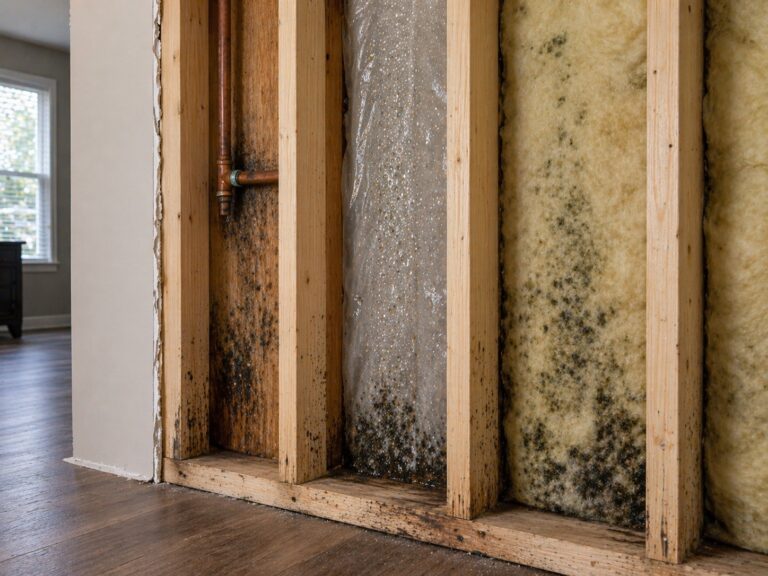
Because of this, flashing-related mold often starts behind trim, drywall, sheathing, or insulation before it appears on the room side of the wall.
If you’re unsure whether water is entering through flashing points, learning how to identify hidden intrusion is critical. A deeper inspection approach is explained in how to detect water intrusion from flashing failures.
Early Signs of Mold Caused by Flashing Problems
Mold linked to flashing failures usually follows a pattern: it appears near an exterior joint, worsens after rain, and returns after cleaning because the wall is still being wetted from behind.
Musty Odors Near Exterior Walls or Openings
One of the earliest indicators is a persistent musty smell near:
- Windows
- Exterior doors
- Upper wall corners
- Areas near roof lines
This odor is more suspicious when it becomes stronger after rain or when the smell is concentrated near one exterior wall, window, door, chimney chase, or roof-to-wall area.
Discoloration Near Trim or Seams
Flashing-related moisture tends to follow structural edges. You may notice:
- Slight yellow or brown staining
- Darkening along trim lines
- Uneven discoloration near joints
Unlike random wall stains, these marks usually appear in specific, repeated locations tied to exterior openings, roof intersections, siding transitions, or trim edges.
Recurring Small Mold Spots
If you clean mold and it comes back in the same place, that’s a strong indicator of an ongoing moisture source.
A useful clue is timing: mold that looks worse a day or two after wind-driven rain is more suspicious than mold that appears only during humid indoor conditions.
Flashing failures often cause:
- Small mold patches that reappear after rain
- Growth concentrated near seams or edges
- Repeated issues despite cleaning
That pattern points more strongly to a leak path than to general indoor humidity, which usually affects broader cold or poorly ventilated surfaces.
Paint Bubbling or Peeling Near Openings
Moisture trapped behind walls affects finishes first. Early signs include:
- Bubbling paint
- Peeling near window or door frames
- Blistering drywall surfaces
These changes often appear before mold becomes visible, making them an important early warning.
If these symptoms appear near windows specifically, you may want to compare patterns with signs of water leaks around windows to better understand the source.
Visible Mold Patterns That Suggest Flashing Failure
As flashing-related mold becomes more established, it often follows the water path: down from a failed joint, along a seam, across trim, or outward from a hidden wet cavity.
Mold Forming Along Vertical Seams
When flashing fails along siding joints or wall transitions, water often travels downward behind the exterior surface. This can lead to:
- Vertical streaks of mold on interior walls
- Dark lines forming near drywall seams
- Concentrated growth along framing lines
These vertical patterns are a strong indicator that water is entering from above and following gravity through the wall system.
Mold Near Window Tops and Upper Corners
Improper or failed window flashing frequently allows water to enter at the top of the window opening. As a result, mold often appears:
- Along the upper corners of windows
- Across the top edge of interior window trim
- Extending slightly downward from the header area
This pattern is different from simple condensation on glass. Mold concentrated at the top trim, upper corners, or drywall edge suggests water may be entering above the window instead of forming only on cold interior surfaces.
For a deeper comparison of window-specific mold behavior, see signs of mold growth around windows.
Mold Below Roof-to-Wall Intersections
Where roofs meet vertical walls, flashing plays a critical role in keeping water out. When this flashing fails, water can enter and move downward inside the wall, leading to:
- Mold forming near ceiling edges
- Discoloration where walls meet ceilings
- Growth spreading downward from upper corners
These symptoms often appear after repeated rain events and may worsen over time as moisture accumulates inside the wall cavity.
Mold Appearing Along Trim and Siding Edges
Flashing is often hidden behind trim and siding transitions. When it fails, moisture becomes trapped behind these materials and eventually shows up as:
- Mold lines following trim edges
- Growth at the base of siding sections
- Localized patches where materials meet
These areas are especially prone to recurring mold because they receive repeated moisture exposure during rain cycles.
Hidden Mold Warning Signs Behind Walls
Flashing-related mold often becomes visible only after hidden materials have already stayed damp through repeated rain cycles.
Soft or Spongy Drywall
When moisture remains trapped inside walls, drywall begins to lose its structural integrity. You may notice:
- Walls that feel soft when pressed
- Subtle indentations forming near seams
- Areas that no longer feel solid
This often indicates long-term moisture exposure, which supports mold growth behind the surface.
Warped or Swollen Trim
Wood trim around windows, doors, and wall edges absorbs moisture over time. Signs of hidden problems include:
- Trim pulling away from the wall
- Visible swelling or distortion
- Cracking or separation at joints
These changes are commonly linked to water entering through failed flashing behind the trim.
Persistent Dampness Without a Clear Source
If one wall area feels damp after storms but no plumbing fixture is nearby, suspect exterior water entry. Flashing failures often wet a wall intermittently, then leave materials only partially dry before the next rain.
Mold Odor Without Visible Growth
A strong musty smell with no visible mold is a classic sign of hidden contamination. This often means:
- Mold is growing inside wall cavities
- Insulation or wood framing is affected
- Moisture is still actively entering the structure
In these cases, surface cleaning won’t solve the problem because the source remains hidden.
Where Flashing-Related Mold Most Commonly Develops
The location of the mold often points to the flashing detail that should be inspected first.
Window Flashing
Window openings are one of the most common failure points. Mold often appears:
- At the top corners of windows
- Along the upper trim line
- Below the window sill inside the wall
Because windows interrupt the wall system, improper flashing here allows water to bypass protective layers.
Door Flashing
Exterior doors face similar risks, especially if thresholds or headers are not properly sealed. Mold may form:
- Around the door frame
- At the base of interior walls near the entry
- Along adjacent flooring edges
If your issue is concentrated near entry points, reviewing signs of water leaks around exterior doors can help confirm the cause.
Roof-to-Wall Flashing
These intersections are highly exposed to rainwater. When flashing fails, moisture often travels downward inside walls, leading to mold in:
- Upper interior walls
- Ceiling corners
- Attic-facing wall sections
Chimney Flashing
Chimneys create complex flashing requirements. Failures here can cause mold to develop:
- Around chimney walls
- In ceiling areas near the chimney
- Inside upper wall cavities
Deck and Ledger Board Flashing
Where decks attach to the home, flashing protects the connection point. When it fails, water can enter the structure and cause mold in:
- Basement or lower-level walls
- Interior wall seams behind the deck area
- Hidden framing near the ledger connection
Why Mold from Flashing Failures Often Returns After Cleaning
One of the most frustrating aspects of flashing-related mold is that it often comes back — even after thorough cleaning. This happens because the visible mold is only a symptom of a deeper moisture problem that hasn’t been resolved.
When flashing fails, water doesn’t just affect the surface. It seeps into:
- Wall cavities
- Insulation
- Wood framing
- Sheathing behind drywall
Cleaning removes surface mold, but these hidden materials can remain damp and contaminated. As soon as moisture conditions return — often during the next rain — mold begins growing again.
Hidden Moisture Reservoirs Inside Walls
Flashing leaks create pockets of trapped moisture that are difficult to fully dry. These reservoirs can:
- Retain moisture long after rain stops
- Support ongoing mold growth behind surfaces
- Reintroduce mold spores to cleaned areas
This is why recurring mold in the same location is one of the strongest indicators of flashing-related water intrusion.
Repeated Wetting Cycles from Rain
Unlike plumbing leaks, which may be constant, flashing failures typically follow weather patterns. Water enters during rain events, then partially dries before the next storm.
This cycle creates ideal conditions for mold:
- Frequent moisture exposure
- Inconsistent drying
- Long-term material saturation
If mold growth seems to worsen after storms or humid weather, flashing failure should be strongly suspected.
Why Surface Cleaning Alone Doesn’t Work
Many homeowners try to solve the problem with cleaning products or surface treatments. While this may temporarily improve appearance, it does not address:
- The source of water intrusion
- Moisture trapped behind walls
- Hidden mold colonies inside structural materials
For long-term resolution, both the moisture source and affected materials must be addressed. If you reach this stage, understanding recovery steps such as how to dry walls after flashing water intrusion becomes essential.
When Flashing-Related Mold Becomes a Structural Risk
Not all mold growth indicates structural damage, but mold caused by flashing failures has a higher risk of progressing beyond surface-level issues. This is because the moisture source is embedded within the building envelope.
Wood Rot and Structural Weakening
When water repeatedly enters wall cavities, wood framing can begin to break down. Warning signs include:
- Soft or crumbling wood near affected areas
- Persistent dampness that doesn’t dry out
- Structural components losing rigidity
At this stage, the issue is no longer cosmetic — it may require structural repair.
Insulation Contamination
Insulation absorbs and holds moisture easily. When it becomes saturated:
- Mold can spread throughout the insulation
- Thermal performance decreases
- Moisture remains trapped inside walls
Contaminated insulation often needs to be removed, as it cannot reliably be cleaned or dried in place.
Expanding Mold Growth Inside Walls
If moisture intrusion continues, mold spreads beyond its original location. This can lead to:
- Larger areas of visible mold
- Contamination of multiple wall sections
- Spread into adjacent rooms or levels
In these cases, professional inspection is usually required to assess the full extent of damage.
When to Call a Professional
While early signs of flashing-related mold can sometimes be monitored, certain conditions require expert evaluation and repair.
You should strongly consider professional help if:
- Mold keeps returning after cleaning
- Growth is spreading across walls or ceilings
- Walls feel soft or show structural changes
- You detect persistent musty odors with no visible source
- Water stains worsen after rain events
Stop surface cleaning and get professional help sooner if the area is larger than a small isolated patch, materials feel soft, water is still entering, or anyone in the home has mold-sensitive health concerns.
These signs suggest the problem has moved beyond surface mold and may involve concealed moisture, damaged materials, or active exterior water entry.
At this stage, inspection of flashing systems and concealed wall areas becomes necessary to prevent further damage.
What to Do If You Suspect Mold from Flashing Failure
If you believe mold growth is being caused by flashing failure, taking the right steps early can prevent more extensive damage.
Start by Identifying the Pattern
Look for recurring mold in:
- The same location after rain
- Areas near exterior openings or seams
- Specific edges or corners of walls
Pattern recognition is one of the most effective ways to distinguish flashing-related mold from other causes.
Monitor Conditions During Weather Events
Pay attention to how the area behaves during and after rain. If symptoms worsen with storms, it strongly suggests exterior water intrusion.
Avoid Assuming It’s Just Condensation
Condensation-related mold typically:
- Forms evenly across surfaces
- Appears during high indoor humidity
- Is not tied to specific structural edges
If your mold does not match this pattern, flashing failure should be investigated.
Prepare for Inspection and Repair
If symptoms persist, the next step is identifying the exact entry point and correcting the flashing system. Compare interior mold patterns with the signs of failed exterior flashing, then review why exterior flashing develops leaks for the common causes behind repeated leakage.
Once the source is confirmed, proper repair and drying are necessary to stop mold from returning.
Frequently Asked Questions About Mold Caused by Flashing Failures
Can flashing leaks really cause mold inside walls?
Yes. Flashing failures are one of the most common causes of hidden mold inside walls. When water enters behind exterior materials, it becomes trapped in enclosed spaces where airflow is limited. This creates ideal conditions for mold growth long before visible signs appear on the surface.
Why does mold keep returning near my window or door trim?
Recurring mold in the same location usually means the moisture source hasn’t been fixed. In many cases, failed flashing above or around the opening allows water to enter repeatedly during rain. Cleaning the surface removes visible mold, but the underlying moisture problem remains.
How long does it take for mold to grow after a flashing failure?
Mold can begin developing within 24–48 hours when materials stay wet, but flashing failures often create a slower pattern. Repeated rain exposure over weeks or months may let mold establish behind trim, drywall, insulation, or sheathing before it becomes visible indoors.
Can mold from flashing leaks spread to other areas of the home?
Yes. If the flashing leak continues, mold can spread along the same concealed water path that rainwater follows. It may move from an upper window corner into adjacent drywall, from a roof-to-wall joint into ceiling edges, or from wet insulation into nearby framing.
Is mold from flashing failures dangerous to structural materials?
Over time, yes. Persistent moisture can weaken wood framing, damage drywall, and degrade insulation. While early mold growth may be limited to surface materials, long-term exposure increases the risk of structural damage.
Should flashing be inspected if mold keeps coming back?
Absolutely. Repeated mold growth near exterior openings or seams is a strong indicator of ongoing water intrusion. Inspecting flashing systems is a critical step in identifying and resolving the root cause of the problem.
Conclusion
Mold caused by flashing failure usually has a pattern: it returns in the same place, follows exterior seams or openings, worsens after rain, or appears with musty odors near one specific wall area.
Cleaning the visible mold is not enough if water is still entering behind the exterior surface. The flashing problem must be found, corrected, and followed by proper drying and mold remediation. For the full source-control process, see how to remove mold permanently.
Key Takeaways
- Mold near windows, doors, siding transitions, roof intersections, and trim seams may point to failed flashing.
- Recurring mold in the same location, especially after rain, is a strong sign of hidden exterior water intrusion.
- Flashing-related mold usually follows water paths, structural edges, seams, and exterior openings.
- Cleaning visible mold will not stop the problem if water is still entering behind the wall.
- Soft drywall, swollen trim, musty odors, or spreading growth may require professional inspection.