Signs of Mold Growth on Basement Floors
Signs of mold growth on basement floors usually include dark or discolored spots, musty odors near the floor, fuzzy or powdery surface growth, recurring patches after cleaning, and mold appearing under stored items. These signs often show up first near cracks, floor edges, drains, low spots, or areas where boxes and rugs trap moisture against the slab.
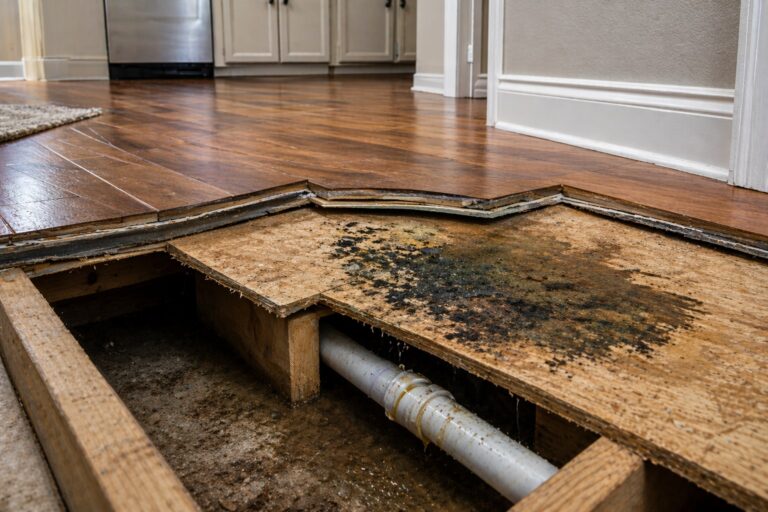
Basement floor mold is usually a symptom of persistent moisture, not just a dirty surface. Water seepage, damp concrete, condensation, high humidity, and poorly ventilated storage areas can all allow mold to grow on dust, cardboard fibers, fabric particles, or other organic debris sitting on the floor.
If you have noticed water entering through the slab, compare the mold symptoms below with these signs of water coming through basement floors. This guide focuses on how basement floor mold looks, smells, spreads, and differs from ordinary staining.
Why Mold Often Starts on Basement Floors
Basement floors are vulnerable because concrete slabs sit close to soil moisture, cool air, and stored materials. Even when the floor looks dry, small amounts of moisture can linger on the surface or move through porous concrete.
Mold does not grow directly on clean concrete alone. Instead, it grows on the organic materials that settle on top of the floor. Dust, dirt, cardboard fibers, fabric particles, and wood debris provide the food mold needs. When moisture is present, these materials allow mold colonies to develop and spread.
Moisture Moves Through Basement Floors Over Time
Concrete may appear solid, but it contains thousands of microscopic pores. These pores allow moisture to move slowly through the slab. This process is known as capillary movement and is a common reason basement floors stay damp without visible standing water.
In many homes, this moisture movement becomes more noticeable during heavy rain, snowmelt, or seasonal humidity changes. If your basement floor frequently feels damp or shows recurring wet areas, you may find it helpful to understand why basement floors stay wet even when leaks are not obvious.
Hydrostatic Pressure Pushes Moisture Upward
Hydrostatic pressure can also contribute to basement floor mold when groundwater builds around the foundation and pushes moisture through cracks, seams, or porous concrete.
This type of moisture movement often explains why mold appears along floor edges, cracks, or low spots. If left unresolved, the same pressure can eventually lead to larger moisture problems that require inspection or repair.
Condensation Can Trigger Mold Without Visible Leaks
Not all mold growth starts with water seepage. In many basements, condensation forms when warm, humid air comes into contact with cooler concrete surfaces. This creates a thin layer of moisture that may not be visible but remains long enough to support mold growth.
Condensation-related mold often develops:
- During humid summer months
- In poorly ventilated basements
- Behind stored items or furniture
- Near walls where airflow is limited
Because condensation can occur silently, mold growth may appear even in basements that have never flooded.
Stored Materials Increase Mold Risk
Many basements are used for storage, which unintentionally increases mold risk. Cardboard boxes, paper goods, fabrics, and wood-based materials collect dust and absorb moisture from the floor surface.
When these materials sit directly on damp concrete, mold can develop beneath them without being noticed. By the time visible signs appear, mold growth may already be well established.
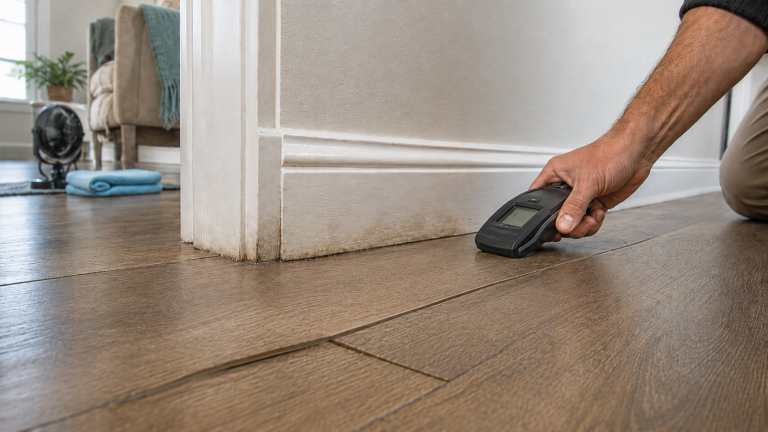
Regular inspection of storage areas and floor surfaces helps prevent mold from spreading unnoticed. If you are unsure whether moisture is present, performing a detailed inspection using the methods outlined in this guide to inspecting basement floors for moisture problems can help identify hidden issues early.
Common Signs of Mold Growth on Basement Floors
Mold on basement floors does not always appear as obvious black patches. In many cases, the early signs are subtle and easy to overlook. Understanding how mold presents itself on different floor surfaces helps you catch the problem before it spreads.
Dark or Discolored Spots on Concrete
One of the earliest and most common signs of mold growth is discoloration on the concrete surface. These spots may appear as:
- Dark gray or black patches
- Greenish or brown staining
- Irregular shapes that gradually expand
Unlike simple dirt or stains, mold spots tend to grow over time and may change in color or intensity. They often appear in areas where moisture lingers, such as near walls, cracks, or low spots in the floor.
If discoloration continues to spread or reappears after cleaning, it is a strong indication that moisture is still present beneath the surface.
Powdery, Fuzzy, or Slimy Surface Texture
Mold growth often creates a noticeable texture on the floor surface. Depending on the type of mold and moisture conditions, it may appear:
- Powdery or dusty
- Fuzzy or slightly raised
- Slimy or damp to the touch
This texture is one of the key differences between mold and ordinary staining. While stains remain flat and unchanged, mold develops a physical structure as it grows.
Avoid touching suspected mold directly. If the area looks fuzzy, slimy, or easily disturbed, use gloves and a mask before moving nearby items or inspecting the surface closely.
Musty Odor Coming From the Floor
A persistent musty smell is often the first clue that mold is present—even before visible signs appear. This odor is caused by microbial volatile organic compounds (MVOCs) released as mold grows.
In basement environments, the smell is typically strongest:
- Close to the floor surface
- In corners or enclosed areas
- Near stored items or furniture
If the odor intensifies after rain or during humid conditions, it strongly suggests an ongoing moisture source feeding mold growth.
Odor without visible mold may indicate early-stage growth or mold developing beneath items or in hidden floor areas.
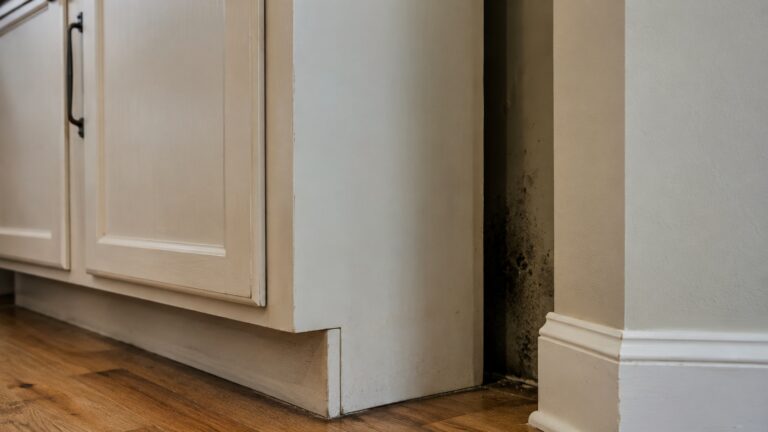
Mold Growth Along Floor Edges and Wall Junctions
The area where the floor meets the wall is one of the most common places for mold to develop. This zone traps moisture due to limited airflow and frequent contact with water intrusion pathways.
Signs of mold in this area include:
- Dark lines forming along the perimeter
- Spotting that spreads outward from the edges
- Discoloration where the wall meets the floor
Because this area is also vulnerable to water entry, mold growth here is often linked to foundation moisture problems. If you notice mold forming consistently along these edges, it may be connected to conditions explained in why basement floors leak during rain.
Recurring Mold After Cleaning
If mold returns after being cleaned, it is a clear sign that the underlying moisture problem has not been resolved. This is one of the most important warning indicators homeowners should not ignore.
Recurring mold often appears:
- In the same location repeatedly
- Within days or weeks after cleaning
- In expanding patches over time
This pattern indicates that moisture is continuously feeding mold growth beneath the surface or within the surrounding environment.
In these cases, simply removing the visible mold is not enough. The source of moisture must be identified and corrected to prevent further growth.
Mold Forming Under Stored Items
Basement storage areas are a common place for mold to develop unnoticed. Items placed directly on the floor can trap moisture and block airflow, creating ideal conditions for mold growth underneath.
Common examples include:
- Cardboard boxes
- Plastic storage bins
- Furniture legs and bases
- Rugs or mats placed on the floor
When these items are moved, homeowners often discover mold patches that were previously hidden. In many cases, the surrounding floor may appear normal, making the problem easy to miss during routine checks.
Regularly inspecting beneath stored items is one of the simplest ways to detect early mold growth before it spreads to larger areas.
Signs That Mold Is Spreading Beyond the Floor
Mold that begins on basement floors rarely stays confined to one area. As moisture persists, colonies can expand outward and begin affecting nearby materials. Recognizing early signs of spread helps prevent more serious structural and air quality problems.
Mold Extending From Floor to Walls
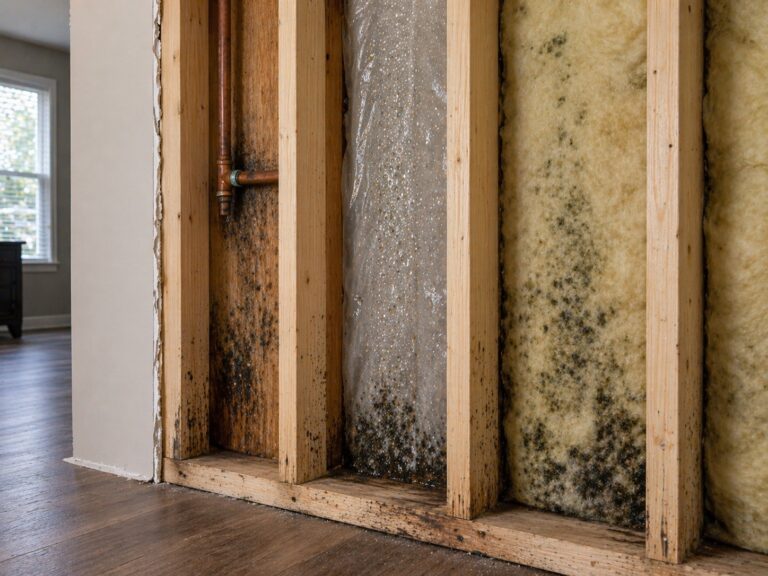
One of the most common spread patterns occurs at the floor-to-wall junction. Mold may begin as small patches on the floor and gradually extend upward along the wall surface.
Warning signs include:
- Dark streaks or spotting moving up from the floor
- Discoloration spreading along baseboards
- Musty odor increasing near wall edges
This type of spread often indicates that moisture is not limited to the floor alone. It may be entering through foundation walls or accumulating in the joint between surfaces.
If you suspect mold is moving beyond the floor, it may be helpful to compare symptoms with these signs of mold growth on basement walls to understand how the problem progresses.
Growth Appearing in Multiple Floor Areas
Mold that appears in more than one location usually points to a broader moisture issue rather than a single isolated problem.
Common patterns include:
- Spots forming in different corners of the basement
- Discoloration near cracks and edges simultaneously
- New patches appearing over time in unrelated areas
This behavior suggests that moisture is affecting the entire slab or multiple entry points. In these situations, surface cleaning will not stop the problem because the underlying cause is widespread.
Increasing Intensity of Musty Odors
As mold spreads, the strength of the musty odor typically increases. The smell may become noticeable throughout the basement rather than being confined to a specific spot.
Signs of progression include:
- Odor lingering even after ventilation
- Smell intensifying during humid conditions
- Mustiness spreading into adjacent rooms
This indicates that mold colonies are growing larger or becoming more active, releasing more airborne compounds into the environment.
Hidden Risk Areas Where Floor Mold Often Develops
Some areas of basement floors are more prone to mold growth than others. These locations trap moisture, restrict airflow, or allow water to enter the slab more easily.
Cracks in the Basement Floor
Cracks are one of the most common starting points for mold growth. They allow moisture to move upward from the soil and create narrow spaces where dirt and organic debris collect.
Signs to watch for:
- Mold forming in a line along cracks
- Darker moisture staining around cracked areas
- Persistent dampness near structural breaks
Even small cracks can support ongoing moisture movement, making them a frequent source of recurring mold.
Expansion Joints and Seams
Basement floors often include expansion joints designed to allow slight movement in the slab. These joints can trap debris and moisture over time.
Mold in these areas may appear as:
- Thin lines of discoloration following the joint
- Localized mold growth along seams
- Darkened or damp material within the joint itself
Because joints are slightly recessed, they tend to hold moisture longer than surrounding surfaces.
Areas Around Floor Drains
Floor drains are another high-risk location for mold growth. Even when functioning properly, they introduce moisture into the surrounding area.
Warning signs include:
- Mold forming in a circular pattern around the drain
- Persistent dampness near the drain opening
- Odors coming from the drain area
If mold consistently appears around a drain, it may indicate poor drainage, slow evaporation, or humidity-related condensation.
Under Rugs, Mats, and Stored Items
Anything placed directly on the basement floor can trap moisture underneath it. This creates an environment where mold can develop unnoticed.
Common hidden risk areas include:
- Rubber-backed rugs
- Exercise mats
- Storage containers with flat bottoms
- Furniture with solid bases
These items prevent airflow and slow down evaporation, allowing moisture to remain in contact with organic debris for extended periods.
How to Tell the Difference Between Mold and Staining
One of the most common challenges homeowners face is distinguishing mold from other types of floor discoloration. Misidentifying the problem can lead to either unnecessary concern or missed warning signs.
Mold vs Efflorescence
Efflorescence is a mineral deposit left behind when water evaporates from concrete. It often appears as a white, powdery residue on the surface.
A simple clue is texture: efflorescence usually looks white, crystalline, or powdery and does not smell musty, while mold is more likely to appear dark, greenish, brown, fuzzy, blotchy, or connected to an odor.
Key differences:
- Efflorescence is dry and chalky
- It does not have a musty odor
- It does not spread in irregular patterns
Mold, by contrast, often has texture, color variation, and a noticeable smell. It may appear fuzzy, patchy, or damp depending on conditions.
Mold vs Dirt or Surface Stains
Dirt and staining can sometimes resemble mold, especially on unfinished concrete floors. However, they behave differently over time.
Stains typically:
- Remain unchanged in size and shape
- Do not develop texture
- Do not produce odor
Mold tends to:
- Spread gradually outward
- Change in color or density
- Produce a musty smell
If a suspected stain grows or returns after cleaning, it is more likely to be mold.
Mold vs Paint or Coating Failure
On painted basement floors, peeling or bubbling paint can sometimes be mistaken for mold. However, paint failure usually has distinct characteristics.
Paint-related issues often show:
- Blistering or lifting surfaces
- Flaking or chipping layers
- Uniform failure patterns
Mold, on the other hand, forms irregular patches and may appear in areas where paint has already failed due to moisture.
In many cases, both issues occur together, since trapped moisture can cause paint damage while also supporting mold growth.
Moisture Conditions That Make Basement Floor Mold Return
Mold on basement floors usually comes from one core problem: moisture that stays long enough for mold to feed on dust, dirt, cardboard fibers, fabric particles, or other organic material on the floor.
Common contributing factors include:
- Moisture moving upward through concrete slabs
- Water entering through cracks or floor joints
- High indoor humidity or condensation on cool concrete
- Poor airflow behind stored items
- Previous water intrusion that never fully dried
If the moisture source is not corrected, mold can return after cleaning. For broader cleanup and prevention guidance, see this guide on how to remove mold permanently.
When Basement Floor Mold Becomes a Serious Problem
Not all mold growth on basement floors presents the same level of risk. Some cases are minor and localized, while others indicate deeper structural moisture issues that require immediate attention.
Low-Level Situations
Minor mold growth may be limited to small areas and caused by temporary conditions. These situations often include:
- Isolated patches with no strong odor
- Dry surrounding surfaces
- No signs of spreading
While still important to address, these cases are less likely to indicate severe underlying problems.
Moderate Concerns
More significant mold growth often involves:
- Multiple spots across the floor
- Persistent musty odors
- Recurring growth after cleaning
This level of activity usually means that moisture is consistently present and requires investigation.
High-Risk Conditions
Serious mold problems are often linked to ongoing water intrusion or structural moisture issues. Warning signs include:
- Mold spreading rapidly across large areas
- Growth appearing in multiple unrelated locations
- Strong odors affecting the entire basement
- Visible moisture entering through cracks or seams
In these cases, the problem goes beyond surface cleaning and may require professional evaluation and repair.
When to Call a Professional
Small, isolated surface patches may be manageable after the floor is dry, but basement floor mold needs professional attention when it points to ongoing water entry, widespread slab moisture, or growth spreading beyond the floor.
You should consider contacting a professional if:
- Mold covers a large portion of the basement floor
- The source of moisture cannot be identified
- Mold continues to return after cleaning
- The problem is linked to structural cracks or water intrusion
- There are strong, persistent odors throughout the basement
Professional inspections can identify hidden moisture sources and determine whether repairs, waterproofing, or remediation are necessary. In many cases, mold growth is only one part of a larger moisture problem that needs to be addressed at its source.
Because mold on basement floors is often tied to broader basement conditions, it may also be helpful to understand the potential health and structural risks discussed in this guide to mold exposure risks from basements.
Frequently Asked Questions About Signs of Mold Growth on Basement Floors
Can mold grow on concrete basement floors?
Yes. While concrete itself is not organic, mold can grow on dust, dirt, and debris that collect on the surface. When moisture is present, these materials allow mold colonies to develop.
How can I tell if black spots on my basement floor are mold?
Black spots are more likely to be mold if they spread, return after cleaning, feel fuzzy or slimy, appear near damp areas, or come with a musty odor. Flat marks that do not change may be dirt, staining, or coating failure instead.
Why does mold keep coming back on my basement floor?
Recurring mold usually means the underlying moisture problem has not been fixed. Cleaning removes the visible growth but does not eliminate the moisture source feeding it.
Is mold on basement floors dangerous?
Mold can affect indoor air quality and may pose health risks, especially for individuals with allergies or respiratory conditions. Larger or persistent mold problems should be taken seriously.
Does sealing a basement floor stop mold growth?
Sealing may help reduce surface moisture in some cases, but it does not fix underlying water intrusion or humidity issues. Mold can still develop if moisture remains present beneath or around the floor.
Key Takeaways
- Basement floor mold often appears as dark spots, musty odor, fuzzy or powdery growth, or recurring patches after cleaning.
- Check floor edges, cracks, drains, low spots, rugs, mats, and areas beneath stored items first.
- White powdery residue may be efflorescence instead of mold, especially if there is no musty odor or fuzzy growth.
- Recurring mold usually means moisture is still coming from the slab, humidity, condensation, seepage, or trapped storage areas.
- Call a professional if mold spreads across multiple areas, returns after cleaning, appears with active water intrusion, or produces strong persistent odors.