
Signs of Mold Growth in Attic Spaces: What Homeowners Should Look For
Signs of mold growth in attic spaces often include dark speckling on roof sheathing, musty odors near the attic access, damp or matted insulation, discoloration around vents or roof penetrations, and staining that appears to spread along wood framing. These signs usually point to moisture that has been active long enough for mold to begin growing.
Many homeowners first suspect attic mold after noticing ceiling stains, stale odors, or damp insulation. Others discover it during roof repairs, ventilation inspections, or seasonal maintenance. If you have already noticed moisture-related warning signs, reviewing the broader indicators covered in how to find hidden moisture in different areas of your home can help place attic symptoms into a whole-house moisture context.
This guide focuses on what attic mold looks and smells like, where it usually appears, and which mold-like stains may have another cause.
Why Attic Mold Is Easy to Miss
Attics are easy to overlook because most homeowners only enter them during roof repairs, insulation work, ventilation checks, or seasonal maintenance.
Several conditions make attics especially vulnerable to mold:
- Warm indoor air leaking into cooler attic air
- Inadequate roof ventilation
- Bathroom or kitchen exhaust venting into the attic
- Roof leaks that go unnoticed for long periods
- Moisture trapped in insulation layers
- Seasonal condensation during cold weather
When warm, humid air reaches cooler attic surfaces, condensation can leave repeated dampness on sheathing, framing, insulation, and stored materials.
Many homeowners assume that attic mold always results from a roof leak. While roof leaks are a common source of moisture, many attic mold problems develop without visible dripping water. Poor ventilation, blocked soffits, or indoor humidity escaping into the attic can create enough dampness for mold to develop. If ventilation issues are suspected, reviewing how to detect hidden moisture in attics can help identify airflow-related moisture conditions.
Because attic mold often develops gradually, early signs are easy to overlook. Subtle changes in smell, insulation texture, or wood appearance may occur long before heavy mold growth becomes obvious.
Common Signs of Attic Mold
Attic mold rarely appears as one dramatic symptom. Instead, it usually develops through a combination of visible, physical, and odor-related changes. Understanding these signs helps homeowners distinguish between harmless dust, staining, and genuine mold growth.
Dark Speckling or Staining on Roof Sheathing
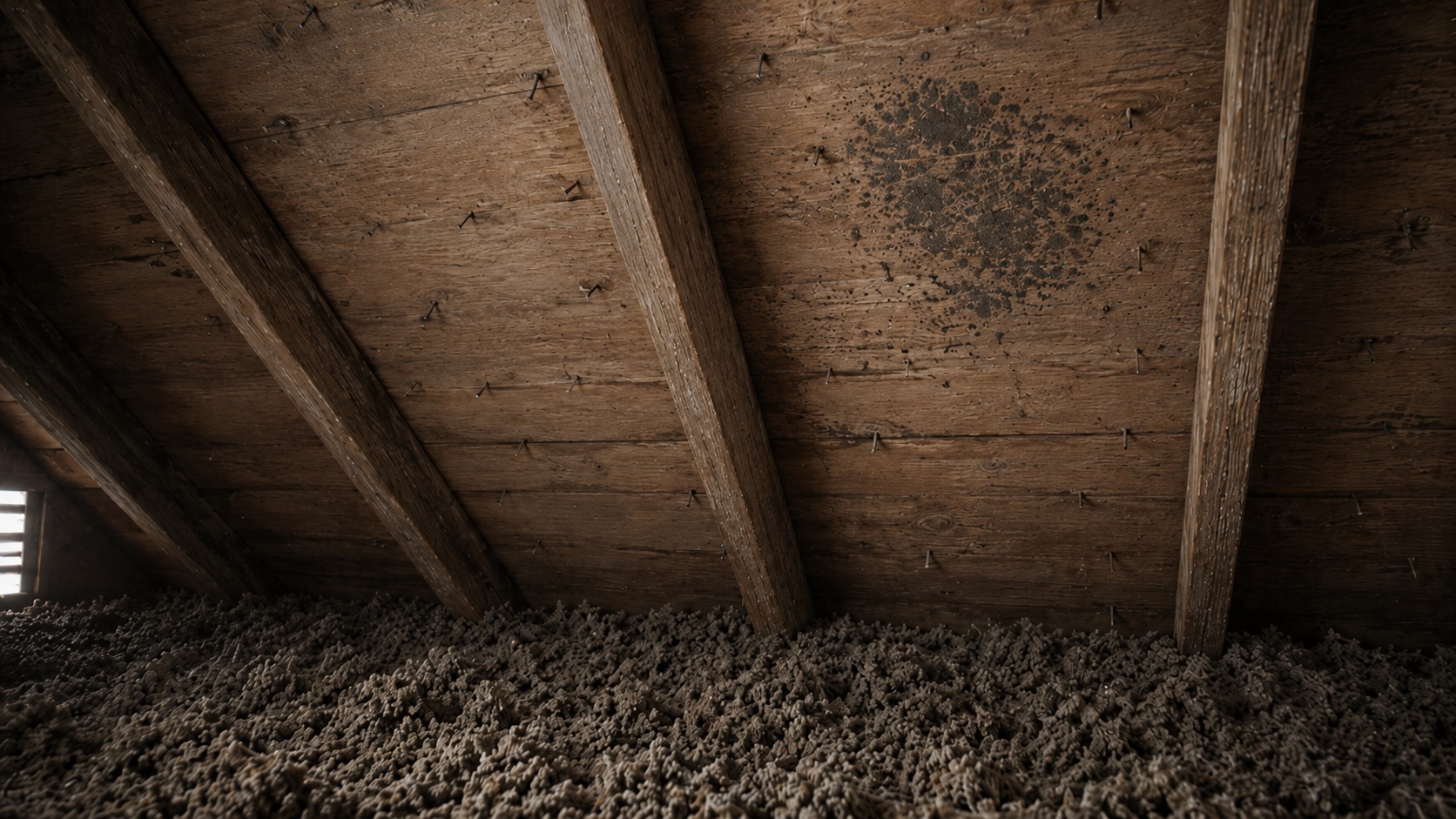
One of the most common signs of attic mold is dark speckling on roof sheathing. This material, typically plywood or oriented strand board (OSB), forms the surface directly beneath roof shingles. Because it is exposed to temperature swings and moisture accumulation, it becomes a prime location for mold growth.
Mold-related staining on roof sheathing often appears as:
- Small black or dark brown specks
- Patchy discoloration spreading across wood panels
- Clusters of dark dots forming near seams or edges
- Uneven darkening along colder sections of the roof
In many attics, staining first appears on the underside of the roof deck near eaves, valleys, cold corners, or areas above poorly sealed ceiling penetrations.
Compare the pattern before assuming it is mold. Aging, dust, and nail oxidation often create more uniform marks, while mold-related staining is usually irregular, spotty, or connected to a moisture path.
If speckling appears alongside moisture indicators such as damp wood or frost buildup, the likelihood of mold growth increases significantly. In these situations, reviewing why attics develop hidden moisture problems can help identify underlying moisture sources.
Musty Odors Coming From the Attic
A persistent musty odor is one of the earliest warning signs of mold growth in attic spaces. Even when mold is not yet visible, microbial growth can release airborne compounds that create a damp, earthy smell.
Homeowners often notice attic-related odors in areas below the attic, such as:
- Upper hallways and stairwells
- Bedrooms located beneath the attic
- Closets along exterior walls
- Ceiling light fixtures or attic access openings
Musty smells are especially noticeable during humid weather or seasonal temperature changes. As moisture levels rise, mold activity can increase, making odors stronger.
However, odor alone does not confirm mold growth. Damp insulation, wet wood, or stagnant air trapped in poorly ventilated spaces can also produce similar smells. When odors persist without an obvious cause, a closer inspection for moisture indicators—such as those described in signs of moisture in attic insulation—is often necessary.
Avoid pressing your face into insulation or brushing stained surfaces while inspecting. A flashlight, careful visual check, and photos from a safe position are usually enough for a first look.
Mold Growth on Attic Insulation Surfaces
Damp attic insulation can show mold-like discoloration when dust, debris, or organic particles trapped in the fibers stay wet long enough to support growth.
Common visual signs of mold on insulation include:
- Dark patches forming on insulation surfaces
- Gray, green, or black discoloration on insulation fibers
- Clumping or compression of insulation material
- Areas that appear damp or matted
Mold on insulation often appears near moisture entry points, including roof leaks, attic vents, plumbing penetrations, and bathroom exhaust ducts.
In some cases, insulation mold develops gradually after repeated condensation events rather than a single major leak. If insulation remains damp after seasonal humidity changes, reviewing why mold forms in attic insulation can help clarify how moisture conditions allow mold growth to continue.
Discoloration Around Roof Penetrations and Vents
Roof penetrations are common places to find attic mold signs because leaks, air leakage, and condensation often concentrate around openings.
Mold-related staining near penetrations often appears as:
- Dark rings surrounding pipe openings
- Patchy staining around duct connections
- Moisture marks forming beneath flashing areas
- Discoloration extending downward along rafters
These patterns often indicate localized moisture exposure caused by minor leaks, condensation, or air leakage. In colder climates, warm indoor air escaping through these openings can condense on nearby wood surfaces.
Repeated moisture exposure near penetrations increases the likelihood of mold formation. If staining appears near ductwork or vent outlets, further inspection methods described in how to detect hidden moisture in attics may help locate concealed moisture sources.
Condensation, Frost, or Damp Wood Surfaces
Moisture accumulation on attic wood surfaces is a strong indicator that mold conditions may develop. Condensation often forms when warm indoor air rises into cooler attic environments and contacts cold surfaces.
Seasonal frost can appear in cold-climate attics when warm indoor air leaks into the attic and condenses on cold surfaces. Frost buildup may appear harmless at first, but when temperatures rise, melting frost can wet insulation and framing materials.
Typical signs include:
- Visible water droplets on roof sheathing
- Frost accumulation during winter months
- Damp or darkened wood surfaces
- Water streaks forming after frost melts
Even small amounts of repeated condensation can create conditions suitable for mold growth. If condensation is present, it often signals deeper ventilation or humidity problems. Addressing airflow issues early—such as those discussed in how to prevent moisture build-up in attics—can help reduce long-term mold risk.
Where Mold Usually Appears in Attics
Mold rarely spreads evenly across an attic. Instead, it develops in predictable locations where moisture exposure occurs most frequently. Understanding these locations helps homeowners focus inspections on the areas most likely to show early warning signs.
Roof Sheathing Near Exterior Edges
The outer edges of roof sheathing often experience greater temperature differences than interior areas. These temperature variations encourage condensation formation along eaves and roof edges.
Blocked soffit vents frequently contribute to this problem. When ventilation airflow is restricted, moisture becomes trapped inside the attic, increasing the likelihood of mold formation near these edges.
If mold-like staining appears near eaves or soffit areas, airflow restrictions may be present. In such cases, identifying moisture behavior patterns explained in why attics develop hidden moisture problems can help clarify the root cause.
Rafters and Trusses Near Moisture Sources
Rafters and trusses may show mold growth when moisture repeatedly contacts structural wood. Unlike general dust accumulation, mold on framing often follows specific moisture paths.
Warning signs include dark streaks, blotchy staining, fuzzy patches, or discoloration that follows the length of a rafter. Mold may also develop where wood members meet roof sheathing or where insulation touches framing.
If structural wood shows widespread discoloration, comparing those conditions with broader attic inspection guidance in how to inspect attic areas for moisture damage can help determine whether the staining points to active moisture or older damage.
Areas Around Exhaust Fans and Ducts
Bathroom and kitchen exhaust fans should vent outdoors, not into the attic. When ducts terminate inside the attic or leak at connections, warm humid air can discharge directly into the space.
Mold often develops around these duct exits, especially on nearby sheathing or insulation. Staining may appear as a localized dark patch around the duct or as a wider pattern spreading upward with warm air movement.
This problem is especially common near bathroom fan ducts because shower moisture carries large amounts of humidity into the attic. If duct-related moisture is suspected, related attic inspection guidance in how to detect hidden moisture in attics can help locate hidden sources.
Stored Items and Cardboard Boxes
Stored belongings can reveal attic moisture problems before structural mold becomes obvious. Cardboard boxes, paper, fabric, and wood furniture absorb humidity and may develop mold when stored in damp attic conditions.
Signs include musty odors on stored items, dark spots on cardboard, white powdery growth on surfaces, or damp-feeling fabrics. These symptoms suggest that attic humidity levels may be high enough to support mold growth elsewhere.
Stored items should not be treated as the only problem. If belongings show mold, the attic environment itself likely needs further evaluation.
How to Tell Mold Signs From Other Attic Stains
Not every dark mark in an attic is mold. Attics contain dust, roofing debris, old water stains, rust marks, and construction-related discoloration. The key is to evaluate the pattern, location, texture, and moisture context.
Pattern and Spread
Mold tends to grow irregularly rather than in perfectly straight or uniform patterns. It may spread outward from a moisture source, follow wood grain, or appear in clusters across multiple surfaces.
Old stains may remain unchanged for years, while active mold often expands when moisture conditions persist. Photographing suspicious areas and comparing them over time can help reveal whether staining is spreading.
Texture and Surface Appearance
Some mold growth appears flat and stain-like, while other growth may look fuzzy, powdery, or slightly raised. Surface texture alone is not always enough to confirm mold, but fuzzy or spreading growth should be taken seriously.
Dust usually wipes or brushes away easily, while mold-related staining often remains embedded in the surface. However, homeowners should avoid disturbing suspected mold growth because brushing or scraping can release spores.
Moisture Association
The strongest clue is whether discoloration appears with moisture symptoms. Mold-like staining becomes more concerning when it appears near damp insulation, condensation marks, roof leaks, or musty odors.
If staining appears in a dry, well-ventilated area and has not changed over time, it may be old water staining or normal discoloration. If the area feels damp, smells musty, or continues to darken, mold growth is more likely.
What Not to Assume From Attic Mold-Like Staining
A single dark mark does not prove active mold. Pattern, location, moisture, odor, and whether the stain changes over time matter more than color alone.
Dust Accumulation Is Not Always Mold
Dust can collect on insulation, framing, and sheathing over time. In attics with air leakage, dust may form dark streaks where air moves through gaps. These marks can look alarming but do not always indicate mold growth.
Dust-related staining often appears near gaps, cracks, or insulation edges where air movement is concentrated. Unlike mold, dust does not usually spread across damp wood surfaces or produce a persistent musty odor.
Old Water Stains May Remain After Repairs
Older roof leaks can leave dark stains on sheathing or framing even after the leak has been repaired. These stains may remain visible for years without indicating active mold growth.
The concern increases if the stain grows larger, feels damp, develops odor, or appears alongside fresh water marks. In that case, the moisture problem may still be active.
Rust and Nail Staining Can Mimic Mold
Roofing nails and metal fasteners can create dark or rusty marks on sheathing. These stains are often small, localized, and connected to nail patterns rather than spreading randomly.
If stains appear only around nail points and do not show moisture, odor, or spread, they may not indicate mold. However, widespread rust staining may still point to condensation problems that should be investigated.
When Attic Mold Requires Professional Inspection
Some attic mold signs call for more than a casual visual check, especially when growth is widespread, moisture is still active, or structural wood appears damaged.
Professional inspection is recommended when:
- Mold covers large surface areas
- The affected area is larger than about 10 square feet
- Staining continues to spread
- Wood feels soft, weak, or deteriorated
- Insulation is wet, compressed, or contaminated
- Musty odors enter living spaces
- Mold returns after previous cleanup
- Roof leaks or ventilation failures remain unresolved
Large attic mold problems may involve hidden moisture sources, air leakage paths, or ventilation problems that require specialized equipment to diagnose. Professionals can identify hidden moisture pathways, insulation failures, and structural weaknesses that may not be visible during routine inspections.
Situations involving persistent moisture patterns frequently connect to long-term attic humidity problems. If repeated mold growth occurs despite corrective measures, further guidance in how to fix persistent attic moisture problems may help determine next steps.
Frequently Asked Questions About Mold Growth in Attic Spaces
Is attic mold always caused by a roof leak?
No. While roof leaks are a common cause, attic mold often develops from humidity problems rather than direct water intrusion. Warm indoor air escaping into a cooler attic can create condensation on wood surfaces, especially during cold weather. Poor ventilation, blocked soffit vents, and improperly routed exhaust ducts are frequent contributors to attic mold growth.
If no obvious leak is visible, reviewing moisture patterns explained in why attics develop hidden moisture problems can help determine whether condensation or airflow issues are responsible.
Can attic insulation grow mold?
Yes. Although fiberglass itself does not feed mold, dust and organic debris trapped in damp insulation can support growth. Discoloration, matting, compression, or persistent dampness are stronger warning signs than color alone.
For more attic-insulation-specific symptoms, compare the area with signs of moisture in attic insulation.
Is black staining always mold?
No. Some black staining results from dust accumulation, aging wood, or nail oxidation. Mold typically forms irregular patterns that spread unevenly across surfaces, while dust or rust marks usually appear consistent and uniform.
If staining appears alongside moisture indicators such as condensation or musty odors, the likelihood of mold increases. When uncertainty exists, professional inspection is often the safest way to confirm whether growth is active.
Can poor ventilation cause attic mold?
Yes. Poor ventilation is one of the most common causes of attic mold. Without proper airflow, moisture becomes trapped inside the attic, increasing humidity levels and allowing condensation to form on cooler surfaces.
Blocked soffits, undersized ridge vents, or restricted airflow paths frequently contribute to this problem. Preventive airflow strategies discussed in how to prevent moisture build-up in attics can help reduce long-term mold risk.
Should I remove attic mold myself?
Small, isolated patches may sometimes be handled by a homeowner using proper protection, but large areas, damp insulation, widespread sheathing stains, or recurring attic moisture should be evaluated professionally. Disturbing contaminated insulation or brushing dry moldy surfaces can release spores into the air and spread contamination.
If mold covers large areas, continues to spread, or affects structural wood or insulation, professional evaluation becomes essential. In these cases, understanding the severity of moisture problems explained in how to remove mold permanently helps guide safe decision-making.
Conclusion: Recognizing Mold Early Prevents Larger Attic Problems
Attic mold signs are easiest to interpret when you look at the whole pattern: dark speckling on sheathing, musty odors, damp insulation, staining near penetrations, condensation, and whether the marks appear to be spreading.
If mold signs appear alongside active moisture, do not focus only on the visible staining. The moisture source must be found and corrected, or attic mold is likely to return.
Key Takeaways
- Dark speckling on roof sheathing is one of the most common signs of attic mold growth.
- Musty odors often indicate hidden moisture problems even before mold becomes visible.
- Mold frequently develops near roof penetrations, ventilation failures, and damp insulation.
- Not all attic staining is mold—dust, rust, and old water marks can create similar appearances.
- Persistent moisture conditions increase the risk of widespread mold growth over time.
- Large mold areas or recurring moisture problems often require professional inspection.

2 Comments
Comments are closed.