Where to Install Hose Burst Protection Devices
Hose burst protection devices should be installed where they can protect the pressurized washing machine supply hose most likely to fail. For many inline devices, that usually means at or near the wall supply valve, before water enters the flexible hose run. If the protection is built into a special automatic shutoff hose, the correct placement depends on that hose assembly’s design and required orientation.
The main rule is simple: the device should protect the vulnerable hose section downstream of where the protection starts. If a device is placed after the hose section most likely to burst, it may not protect that section in the way the homeowner expects.
This article focuses on placement planning, not product comparison or step-by-step plumbing installation. It explains when wall-side placement makes sense, when washer-inlet placement may leave hose length unprotected, why both hot and cold lines matter, and when a tight laundry box or older valve should be checked before adding a device.
Placement matters because washing machine hoses are connected to pressurized water lines. If a hose bursts behind the washer, water can spread into flooring, drywall, trim, cabinets, ceilings, and nearby framing before anyone notices. For the broader damage chain that can follow plumbing failures, see how plumbing leaks cause structural damage.
The Best Place to Install Hose Burst Protection Devices
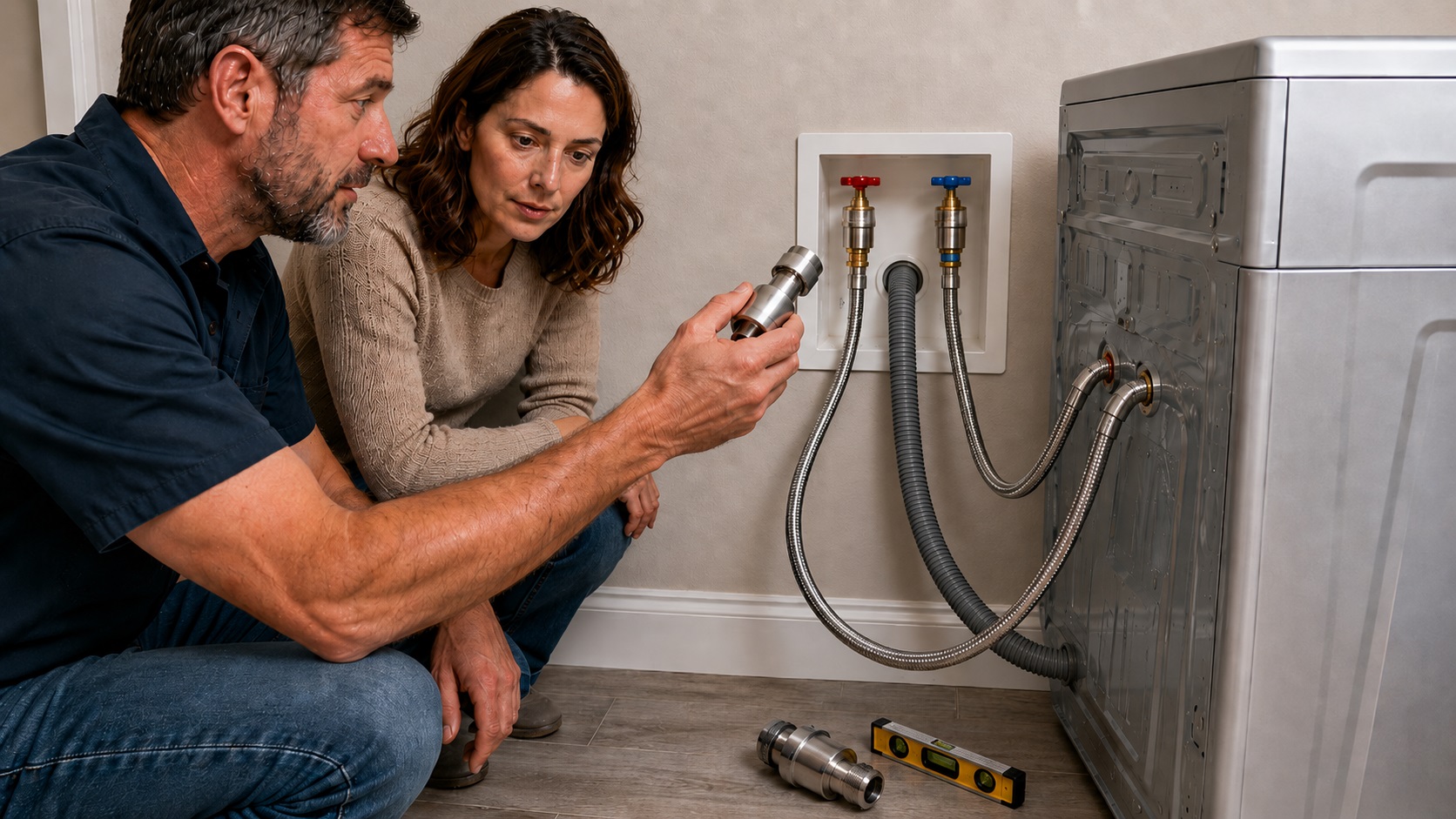
For many inline hose burst protection devices, the best location is close to the wall supply valve, where water leaves the home’s plumbing system and enters the flexible washing machine hose. That placement puts the hose run between the wall and the washer downstream of the protection.
This matters because the flexible hose is usually the part being protected. It can age, bend, vibrate, rub, loosen, or get crushed when the washer is pushed back into place. Wall-side placement keeps the protection close to the source of water entering that vulnerable hose path.
However, wall-side placement is not a universal rule for every product. Some automatic shutoff hoses and flood-safe hose assemblies have the protection built into the hose itself. Those products may have a required end, flow direction, or connector orientation. If the device or hose has marked instructions, those instructions should control the final placement.
The right question is not only “Where will the device fit?” The better question is “What part of the water path does this device protect?” To understand why placement depends on device operation, see how washing machine hose burst protection works.
Why Placement Matters Behind a Washing Machine
The area behind a washing machine is small, hidden, and easy to ignore. A poorly positioned device can create strain, block valve access, or leave the vulnerable hose section unprotected.
A washing machine supply setup usually includes two wall shutoff valves, two flexible hoses, and two washer inlet connections. Each part has a different risk. A hose burst protection device is mainly for the supply hose path. It does not automatically protect against every leak source behind the washer.
Water problems behind a washer can come from several places:
- Supply hoses: A hot or cold hose can burst, crack, loosen, or leak at the fitting.
- Wall shutoff valves: Old valves can drip, seize, corrode, or fail to close fully.
- Washer inlet connections: Threads, washers, and fittings can leak if loose or damaged.
- Drain hose problems: A loose or overflowing drain hose can spill water even if the supply hoses are protected.
- Internal washer leaks: Pumps, inlet valves, tubs, or internal hoses can leak inside the machine.
Because these risks are different, one device should not be treated as full laundry-room protection. Hose burst protection belongs in the supply path. Leak sensors belong where water is likely to collect. Smart shutoff systems have their own placement logic. This article focuses only on placing hose burst protection devices correctly.
Good placement should accomplish three things. First, it should protect the hose section that is most likely to fail. Second, it should avoid creating sharp bends or stress at the fittings. Third, it should keep the valves and connections accessible enough for inspection and emergency shutoff.
Wall Valve Placement vs Washer Inlet Placement
The most common placement question is whether hose burst protection should go at the wall valve or near the washing machine inlet. For many inline devices, wall-side placement is usually more logical because it protects the flexible hose run from the supply side.
Why Wall-Side Placement Often Makes Sense
Wall-side placement often makes sense because the wall valve is the starting point of the flexible hose run. If an inline device is installed at or near that valve, the hose between the wall and the washer is downstream of the device.
This is especially useful in finished spaces, upstairs laundry rooms, and laundry closets where a supply hose rupture could spread water quickly. If the laundry box remains accessible, wall-side placement also lets you check the valve, device, and hose connection together.
Why Washer-Inlet Placement May Leave Hose Length Unprotected
Washer-inlet placement may be less useful for an add-on inline device if the goal is to protect the entire hose length. If the device is installed only at the washer end, much of the hose may remain upstream of the protection. If that upstream hose section bursts, water may escape before it ever reaches the device.
That does not mean a washer-end component is always wrong. Some products are designed with a specific connector location or built-in protective feature. But homeowners should not assume that putting a device at the washer inlet automatically protects the full hose run.
The safe way to think about it is this: if the hose itself is the main risk, the protection should usually begin before the vulnerable hose section, not after it.
Why Device Design Controls the Final Location
Device design controls final placement. A simple inline burst protection fitting may have a different placement requirement than a flood-safe hose assembly. A built-in automatic shutoff hose may have a marked end that connects to the wall valve and another end that connects to the washer. A larger shutoff system may control both hot and cold valves from a central unit.
Do not choose placement based only on convenience. Check whether the device has a required flow direction, a labeled inlet or outlet, a wall-side connector, or a washer-side connector. If the device is installed backward, forced into a tight space, or placed after the section it is supposed to protect, it may not perform as expected.
If you are still choosing between device styles, compare options separately in washing machine hose burst protection devices. Placement should match the device type you actually plan to use.
When Protection Is Built Into the Hose Assembly
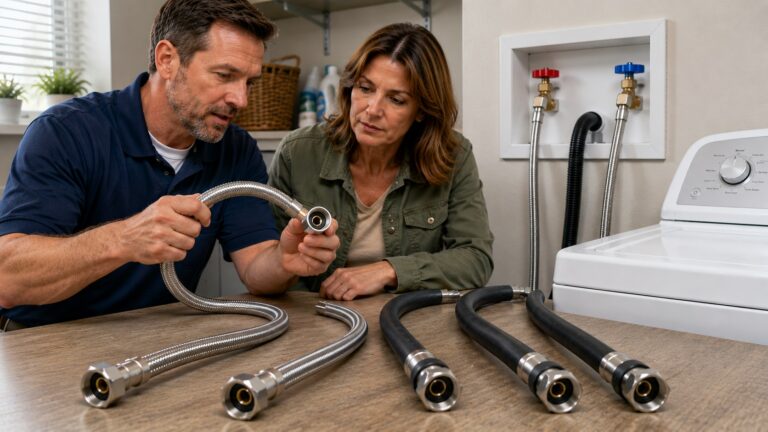
Some washing machine hose burst protection is built into the hose assembly instead of being added as a separate inline device. These products may be described as automatic shutoff hoses, flood-safe washer hoses, water-stop hoses, or protected hose assemblies.
With these products, placement is not simply a matter of adding a device wherever there is room. One end may be designed for the wall valve, while the other end may be designed for the washer inlet. If the hose has a marked direction, labeled connector, or manufacturer-specified orientation, follow that orientation.
Built-in hose protection can be useful in tight laundry areas because it may reduce the need for a separate add-on fitting. However, the hose still needs enough room to curve naturally. A protected hose should not be kinked, crushed, twisted, or forced into a sharp bend behind the washing machine.
A reinforced hose is not always the same as an automatic shutoff hose. Some hoses are stronger than basic rubber hoses but do not contain a shutoff feature. If you are comparing hose assemblies that include their own protective mechanism, see automatic washing machine shutoff hoses.
Should Both Hot and Cold Lines Have Hose Burst Protection?
Both hot and cold washing machine supply lines should be considered risk points if both are connected and pressurized. A washing machine usually has two hoses, and either hose can fail. Protecting only one side leaves the other side exposed.
Some homeowners focus only on the cold water line because it may be used more often, or because the cold valve is easier to reach. But the hot water hose can remain under pressure whenever the hot wall valve is open. It can age, loosen, corrode, kink, or burst just like the cold hose.
If the goal is to reduce water damage risk from washing machine supply hoses, the stronger approach is to protect both lines. That may mean using burst protection on both the hot and cold hose connections, or using a system that controls both supplies together.
Both-line protection matters most in higher-risk laundry setups:
- Upstairs laundry rooms: A burst on either line can damage the laundry room floor and the ceiling below.
- Finished basements: Water can spread under flooring, behind baseboards, or into finished walls.
- Laundry closets: Tight access makes it harder to notice early dripping or reach shutoff valves quickly.
- Homes where the washer runs unattended: A hose failure may continue longer before anyone reacts.
- Older hose setups: If both hoses were installed at the same time, both may be aging together.
Installing hose burst protection is also a good time to evaluate whether the hoses themselves should be replaced. Burst protection should not be used as a way to keep cracked, swollen, kinked, or corroded hoses in service. For hose age and replacement timing, see when to replace washing machine hoses.
Placement in Tight or High-Risk Laundry Areas
Placement is easiest when the washing machine has room behind it and the wall valves are easy to reach. Laundry closets, recessed supply boxes, stacked washer-dryer setups, and upstairs laundry rooms often make that harder.
Tight Laundry Closets
In a tight laundry closet, the washer may sit very close to the back wall. Adding an inline burst protection device can increase the length of the connection between the wall valve and the hose. If there is not enough clearance, the hose may bend sharply as the washer is pushed back.
A sharp bend can stress the hose, pull on the fittings, and make inspection harder. If the device makes the connection stick out farther than the space allows, the layout may need a different hose style, a different device type, or professional adjustment.
The device should not be crushed between the washer and the wall. The hose should leave the connection in a smooth curve, and the valve handles should remain reachable.
Recessed Laundry Boxes
A recessed laundry box can make washer connections look cleaner, but it can also limit space for add-on devices. Some boxes have enough depth and width for a hose burst fitting. Others are too cramped once the valve, device, hose connector, and hose bend are all considered together.
Before choosing a wall-side device for a recessed box, check the full depth of the box with the valve handle turned, the device threaded on, and the hose leaving in a natural curve.
Do not force a device into a recessed box if it blocks the valve handle, bends the hose sharply, or makes the fitting difficult to thread correctly. Cross-threading or uneven tightening can create a leak at the very point you are trying to protect.
If the recessed box is damaged, cracked, loose, corroded, or already damp, the box or valves should be inspected before adding any protection device. A burst protection device should be attached to sound plumbing, not used to cover an existing valve problem.
Upstairs Laundry Rooms
Upstairs laundry rooms deserve extra attention because water can move downward into ceilings, wall cavities, flooring layers, and finished rooms below. Even a short hose failure can create damage beyond the laundry room itself.
In an upstairs laundry room, placement should prioritize both protection and access. The device should protect the supply hose path, but the shutoff valves should still be reachable. A laundry pan, floor drain, or leak sensor may also be useful depending on the room design, but those are separate layers of protection.
Where Not to Install Hose Burst Protection Devices
A hose burst protection device should not be installed anywhere that creates stress, hides a weak connection, or leaves the vulnerable hose section unprotected. The goal is to reduce water damage risk, not simply add another fitting behind the washer.
The most common mistake is placing the device wherever it physically fits without thinking about the protected water path. If the device is installed after the hose section most likely to fail, it may not help with that hose failure. If it is installed in a cramped location that forces the hose into a sharp bend, it may create a new stress point.
Avoid installing hose burst protection where:
- The hose must bend sharply immediately after the device: A tight bend can weaken the hose and strain the fitting.
- The washer presses against the connection: The machine should not crush the hose, device, valve, or connector.
- The shutoff valve becomes inaccessible: You should still be able to turn the water off manually.
- The device hangs under strain: A heavy or awkward fitting should not pull on weak valve threads.
- The fittings do not thread smoothly by hand: Cross-threading can damage the connection and create leaks before the device ever helps.
- The device is not compatible with the hose or valve: Do not force mismatched fittings together.
- The installation hides corrosion or seepage: Existing valve leaks should be repaired before protection is added.
If the wall valve is already wet, corroded, mineral-stained, or difficult to turn, a hose burst device is not the first fix. The valve problem should be addressed before adding a new device or hose assembly. Otherwise, the new protection may be attached to a weak connection that can still leak.
If you see active leaking, shut off the water before moving the washer or disturbing the hose connections.
Good placement should leave the hose with a smooth curve, keep the valve reachable, and allow the connection to be inspected later. If the device makes the area harder to maintain, the placement may not be a good long-term solution.
Hose Burst Protection vs Leak Sensor Placement
Hose burst protection and leak sensors are both useful, but they belong in different places because they solve different problems. A hose burst protection device belongs in the water supply path. A leak sensor belongs where escaping water is likely to collect.
A hose burst protection device is designed to reduce or stop water flow during certain supply hose failures. A leak sensor does not protect the hose mechanically; it detects water after water reaches the sensor location. In a laundry area, that may be behind the washer, near the laundry pan, near the drain standpipe, or at the low point where water would collect.
These tools can work together, but one should not be treated as a replacement for the other. Hose burst protection addresses certain failures in the pressurized supply path, while a floor sensor may alert you to water from a valve drip, drain overflow, internal washer leak, or another nearby source.
For high-risk laundry rooms, especially upstairs laundry areas or finished spaces, a layered approach is often stronger: protect the supply hoses, keep valves accessible, inspect connections regularly, and use a water sensor where leaks are likely to appear. If you are comparing sensor options, see water leak sensors for early detection.
Quick Risk-Zone Check Before You Install
Before installing hose burst protection, look at the washer area in four zones:
- Supply valve zone: The hot and cold valves, laundry box, and valve threads should be dry, solid, and accessible before adding a device.
- Flexible hose zone: The hose run between the wall and washer should be the protected section, and it should not be stretched, twisted, kinked, or crushed.
- Washer inlet zone: The inlet fittings should be checked after any hose or device change because loose washers, worn seals, or cross-threaded connections can still leak.
- Floor and drain zone: Hose burst protection does not prevent drain overflows or internal washer leaks, so this is where a leak sensor or laundry pan may still help.
When to Ask a Plumber Before Installing One
A hose burst protection device should be installed on sound valves, sound threads, and compatible hose connections. If the plumbing behind the washer is already worn or damaged, adding a device may not solve the problem and can sometimes make the connection harder to manage.
Ask a plumber before installing hose burst protection if:
- The hot or cold shutoff valve will not close completely.
- The valve handle is frozen, broken, loose, or heavily corroded.
- The old hose fitting is stuck to the valve threads.
- There is active dripping from the valve body or laundry box.
- The valve threads look damaged or cross-threaded.
- The recessed laundry box is cracked, loose, or too cramped for a safe connection.
- The washer is upstairs and you want a higher-confidence protection setup.
- You are upgrading to a larger automatic shutoff system instead of a simple hose device.
A plumber can also help if the best placement is not possible with the current valve layout. Sometimes the safer solution is to replace old shutoff valves, repair the laundry box, add better access, or use a different protection style rather than forcing an inline device into a bad location.
For ongoing prevention, include the laundry valves and hose connections in your normal maintenance routine. A yearly check can catch corrosion, dampness, stiff hoses, and valve problems before they become water damage events. For a broader checklist, see annual plumbing maintenance tasks for homeowners.
FAQ About Hose Burst Protection Placement
Should hose burst protection go at the wall valve or the washer?
For many inline hose burst protection devices, the wall valve side is usually the better location because it places the flexible hose downstream of the protection. However, the correct location depends on the device design. Built-in shutoff hoses should follow the manufacturer’s required orientation and connection instructions.
Do both washing machine hoses need burst protection?
Yes, if both hot and cold hoses are connected and pressurized, both should be considered potential failure points. Protecting only one hose leaves the other hose able to burst or leak. A complete setup protects both supply lines when both are in use.
Can hose burst protection fit inside a recessed laundry box?
Sometimes. A recessed laundry box may work if there is enough room for the valve, device, hose connector, and a smooth hose bend. If the box is too tight, the device may strain the connection, block valve access, or force the hose into a sharp bend.
Do hose burst protection devices need to stay accessible behind the washer?
Yes. The device and shutoff valves should remain accessible enough for inspection, maintenance, and emergency shutoff. A device may sit behind the washer, but the valve handles should not be blocked or made impossible to reach.
Is hose burst protection the same as a leak sensor?
No. Hose burst protection belongs in the water supply path and is designed to reduce flow during certain hose failures. A leak sensor belongs where water may collect and alerts you when water is detected. They are different tools and can be used together.
Can poor placement keep hose burst protection from working correctly?
Yes. Poor placement can leave the vulnerable hose section upstream of the device, create sharp bends, strain the fittings, block valve access, or hide a weak connection. The device should be placed where it protects the intended hose path without creating new stress.
Should old hoses be replaced before adding burst protection?
Old or damaged hoses should usually be replaced as part of the upgrade. Hose burst protection should not be added as a way to keep cracked, swollen, kinked, corroded, or unreliable hoses in service. The safest setup starts with sound hoses and sound valves.
Final Placement Checklist
Before choosing the final location, confirm four things: the device protects the hose section you are worried about, the hose can curve naturally, the shutoff valves remain reachable, and the fittings thread smoothly without strain.
For many inline devices, that points to wall-side placement near the hot and cold supply valves. For automatic shutoff hoses or flood-safe hose assemblies, follow the marked ends and manufacturer orientation instead of treating the hose like a standard supply line.
Hose burst protection is a useful prevention layer, but it is not full laundry-room flood protection by itself. It should work alongside sound hoses, sound valves, routine inspection, and leak detection where water is likely to collect.