
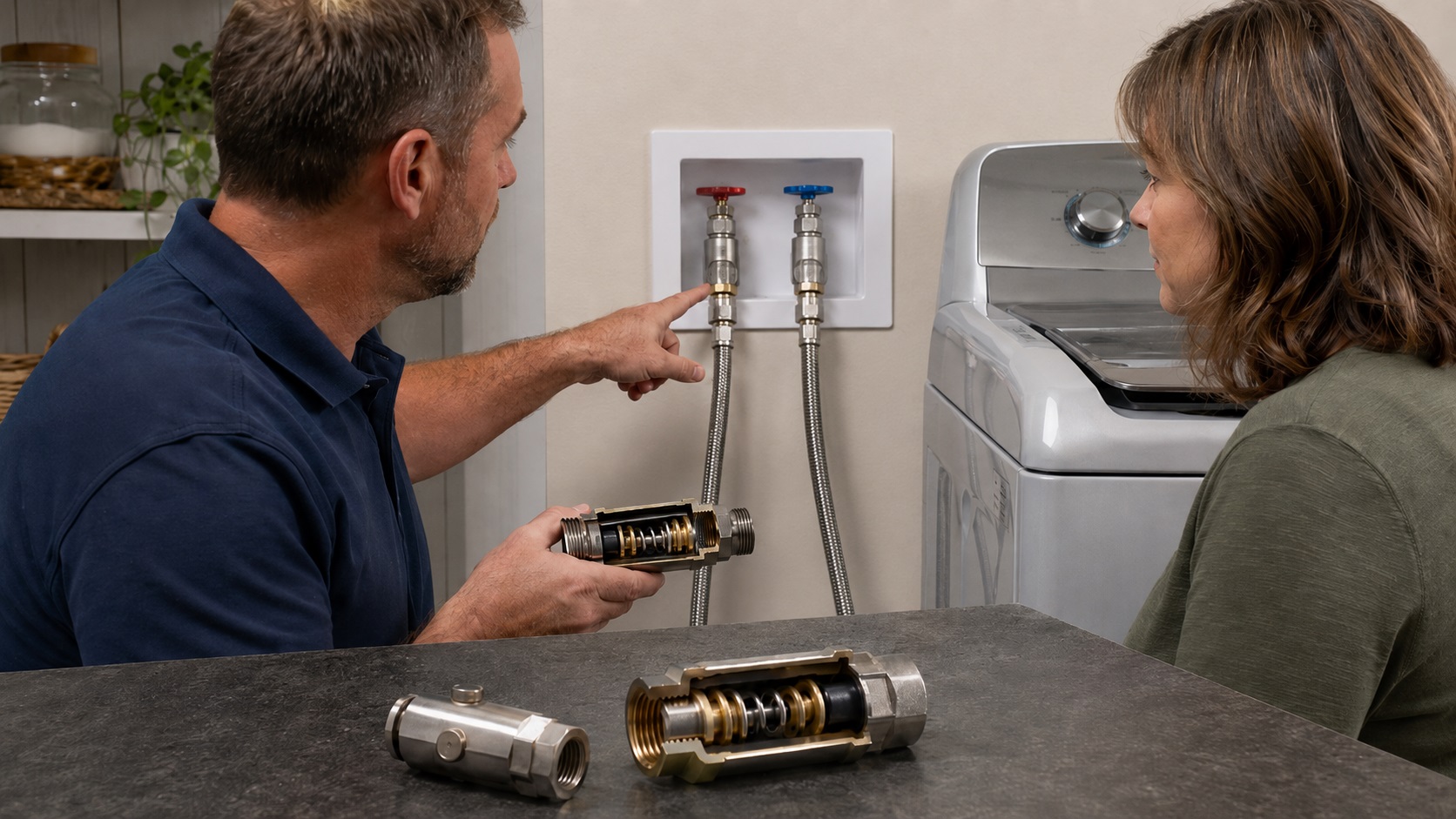
How Washing Machine Hose Burst Protection Works
Washing machine hose burst protection works by reducing or stopping water flow when a pressurized supply hose fails in a sudden, high-flow way. Instead of waiting for water to spread across the floor, a burst protection device reacts at the hose connection or inside the hose assembly when water flow becomes abnormal.
This matters because washing machine hoses are connected to pressurized hot and cold water lines. If a hose ruptures while the supply valves are open, water can continue running until someone notices the problem or shuts the valve manually. In a laundry closet, upstairs laundry room, finished basement, or utility room near flooring and drywall, that kind of failure can quickly lead to moisture damage, mold risk, and structural problems.
Hose burst protection is a local protection layer, not a complete leak-detection system. Most mechanical devices respond to burst-like flow in the washing machine supply line itself, while smart shutoff systems and leak sensors use different methods. For the broader damage chain that can follow plumbing failures, see how plumbing leaks cause structural damage.
What Washing Machine Hose Burst Protection Actually Does
Washing machine hose burst protection is designed to limit water release when a supply hose experiences a sudden failure. Depending on the device, the protection may be built into the hose connector, added as an inline fitting, or integrated into a special flood-safe hose assembly.
In simple terms, the device watches for conditions that look different from normal washer filling. During a normal fill cycle, water moves through the hose at a controlled rate as the washing machine opens its internal inlet valve. During a hose burst, water can rush out much faster because the hose is no longer delivering water into the appliance in the normal way. That sudden change is what many mechanical burst protection devices are designed to react to.
Some devices use a flow-sensitive internal shutoff mechanism. When water moves within the expected range, the device stays open. When flow exceeds the device’s trigger range, an internal valve or blocking mechanism can move into position and restrict or stop the water. Other flood-safe hose designs use a protected hose assembly that responds when the inner hose fails.
The practical goal is the same: reduce the amount of water that escapes from a major hose failure before it damages floors, walls, cabinets, ceilings, or nearby structural materials.
Why Washing Machine Hoses Can Flood a Home So Quickly
A washing machine supply hose is connected to the home’s pressurized plumbing system. When the hot and cold supply valves are left open, each hose can remain under pressure even when the washer is not actively running.
That means a weak hose can fail while the homeowner is away, asleep, or in another part of the house. The washer does not need to be in a wash cycle for a supply hose rupture to become serious.
The risk is higher when hoses are old, kinked, sharply bent, crushed behind the machine, corroded at the fittings, or strained because the washer has been pushed too tightly against the wall. If you are trying to decide whether existing hoses are already past their safe service life, see when to replace washing machine hoses.
Several conditions make washing machine hose failures especially damaging:
- Constant water pressure: The hose can remain pressurized whenever the wall valves are open.
- Hidden placement: Hoses are usually behind the washer, where small warning signs are easy to miss.
- Limited access: In a tight laundry closet, the shutoff valves may be difficult to reach quickly.
- Finished materials nearby: Flooring, drywall, trim, cabinets, and subflooring can absorb water quickly.
- Upstairs laundry rooms: A burst hose can damage the laundry room and the rooms below it.
Hose burst protection is meant for one of the most sudden failure patterns: a major supply hose rupture. It is not mainly designed for slow seepage, condensation, drain overflows, or leaks inside the washing machine cabinet.
How Flow-Triggered Burst Protection Works
Many washing machine hose burst protection devices are flow-triggered. They do not “see” water on the floor. Instead, they respond to water behavior inside the supply line.
During normal operation, the washing machine opens its inlet valve and allows water to enter the machine. The water moves through the hose at a rate the device is designed to tolerate. The burst protection device stays open because the flow looks like normal washer filling.
During a hose burst, the situation changes. Instead of water being controlled by the washer inlet valve, water may rush through an open break in the hose. That can create a much higher flow rate than a normal fill cycle. In a flow-triggered protection device, this abnormal flow can activate the internal shutoff mechanism.
Normal Flow vs. Burst-Level Flow
The difference between normal flow and burst-level flow is the key to understanding this type of protection.
Normal flow is controlled. The washing machine asks for water, the inlet valve opens, water enters the machine, and the hose carries water through a predictable pathway. Even though the hose is pressurized, the water is still moving through a controlled appliance connection.
Burst-level flow is different. If the hose ruptures, water may no longer be restricted by the washer’s normal inlet pathway. Instead, it may discharge freely from the break. That sudden, uncontrolled flow is what the device is designed to recognize as unsafe.
This is also why burst protection may not respond to every small leak. A slow drip at a threaded connection may not move enough water to look like a hose burst. The device may remain open because the flow rate never reaches the trigger point.
A useful homeowner test is visual, not mechanical: check the wall valves, hose washers, hose bends, and washer inlets for dampness, corrosion, mineral buildup, or swelling. Those warning signs may appear long before a flow-triggered device ever reacts.
How the Internal Shutoff Mechanism Blocks Water
The internal design varies by product, but the basic idea is that abnormal water movement causes a valve or blocking mechanism to shift. When the device senses flow beyond its intended range, the mechanism moves into a position that restricts or shuts off the water passing through it.
For homeowners, the exact internal shape matters less than the operating principle: the device is designed to allow normal washer fill flow but stop or reduce burst-like flow. It reacts mechanically to the condition inside the hose connection, not to water damage after the fact.
This is why proper device selection and placement matter. A burst protection device can only help with the part of the water path it is designed to protect. If the leak happens before the device, outside the protected hose section, or inside the appliance itself, the device may not stop that water source.
For homeowners comparing prevention options, the technical explanation in this article pairs naturally with washing machine hose burst protection device options, but this article stays focused on how the protection works rather than which product to buy.
How Hose-within-Hose Flood Protection Works
Some washing machine hose burst protection systems use a hose-within-hose design instead of a simple add-on flow device. In this type of setup, the inner hose carries the water, while an outer protective layer helps contain or redirect water if the inner hose fails.
The exact design depends on the product, but the basic purpose is to prevent a hidden hose rupture from immediately dumping water into the laundry room. If the inner hose splits, leaks, or fails, the outer layer gives the system a second level of protection. Some designs then trigger a shutoff mechanism when water enters the protected outer section.
This is different from a standard braided washing machine hose. A braided stainless steel hose may resist external abrasion and swelling better than a plain rubber hose, but that does not automatically mean it has a built-in shutoff response. A hose can be stronger without being self-shutting. A flood-safe hose or automatic shutoff hose is specifically designed to respond to certain failure conditions.
This distinction matters because marketing terms can be confusing. “Braided,” “burst-resistant,” “flood-safe,” and “automatic shutoff” do not always mean the same thing. A homeowner should look at how the hose is designed to respond during failure, not just whether the hose looks stronger from the outside.
Inner Hose Failure
In a hose-within-hose design, the inner hose is the water-carrying line. Under normal conditions, water moves through this inner hose from the wall shutoff valve to the washing machine inlet. The outer layer is not the normal water pathway. It is there as a protective layer if something goes wrong.
If the inner hose fails, water may enter the outer containment layer instead of spraying directly into the laundry room. Depending on the design, that captured water can activate a shutoff feature or indicate that the hose assembly has failed and needs replacement.
The main advantage is that the hose system is not relying only on visible leakage. It is designed to manage a failure inside the hose assembly before the leak spreads uncontrolled into nearby materials.
Outer Containment Layer
The outer layer is not a reason to ignore the hose. It is a protective feature, not a permanent repair system. Once a hose-within-hose assembly has responded to internal failure, the hose should be treated as compromised. The protection may reduce flooding, but the hose still needs to be replaced according to the manufacturer’s instructions.
The outer layer also does not protect every possible water source behind the washer. It may help with a failure inside that hose assembly, but it will not necessarily stop leaks from the wall valve, the washer’s internal parts, the drain hose, or nearby plumbing connections.
This is why hose burst protection works best as part of a layered prevention plan. A homeowner should still inspect the area, replace aging hoses, keep the washing machine connections accessible, and consider additional leak detection where water damage risk is high.
What Hose Burst Protection Can Stop
Hose burst protection is most useful when the failure looks like the problem it was designed for: a sudden release of water from a pressurized supply hose. When the device is installed correctly and the failure occurs in the protected part of the hose system, it can reduce the amount of water released before the homeowner notices a problem.
Hose burst protection may help with:
- A sudden split in the washing machine supply hose: This is the classic burst scenario these devices are meant to address.
- A major downstream hose rupture: If the protected hose section fails after the device, the abnormal flow may trigger shutoff.
- A severe failure in a protected automatic hose assembly: Some hose systems are designed to respond when the internal hose fails.
- Fast uncontrolled flow from the supply side: If the water movement exceeds the device’s trigger conditions, the device may close or restrict flow.
The phrase “may help” is important. Hose burst protection depends on device design, correct placement, water flow conditions, and the type of failure. A homeowner should not assume that any device will stop every possible laundry room leak.
If the question is whether this kind of protection is worth adding compared with ordinary replacement hoses, that decision belongs more naturally in whether burst-proof washing machine hoses are worth it. This article is focused on the working mechanism and realistic limitations.
What Hose Burst Protection May Not Stop
The biggest misunderstanding about washing machine hose burst protection is assuming that it detects all water problems behind a washer. Most mechanical hose burst devices are not moisture sensors. They do not know whether water has reached the floor. They respond only when the water movement inside the device matches the triggering conditions.
That means some leaks may continue without activating the protection. A slow drip can be damaging over time, but it may not look like a burst to a flow-triggered device. The water volume may be too small, too gradual, or located outside the protected section.
Hose burst protection may not stop:
- Slow threaded-connection leaks: A small drip at the hose fitting may not create enough flow to trigger shutoff.
- Leaks before the device: If water escapes upstream of the protection device, the device may never sense the problem.
- Washer internal leaks: A leaking inlet valve, tub, pump, or internal hose inside the washing machine is a different failure path.
- Drain hose overflows: Burst protection on the supply line does not stop water backing up or spilling from the washer drain.
- Valve body seepage: A leaking wall shutoff valve may not be controlled by a hose-mounted burst device.
- Floor-level water from another source: A nearby water heater, utility sink, condensate line, or floor drain backup is outside the device’s purpose.
This is where the difference between burst protection and water leak sensors becomes important. A burst protection device may stop or reduce water flow during certain hose failures. A leak sensor detects water where the sensor is placed. These tools can work together, but they are not interchangeable.
For broader home protection options beyond mechanical hose devices, see water leak sensors for early detection. Leak sensors are especially useful for slow leaks that may not create a burst-level flow event.
How Fast Hose Burst Protection Responds
Hose burst protection is designed to respond quickly when the triggering conditions are met. In a sudden hose rupture, water flow changes rapidly, and the internal mechanism may close as soon as the device recognizes abnormal flow.
Response time should not be described as identical for every product. Some devices are based on preset flow thresholds, while others are built into hose assemblies. Some may also require specific orientation, water pressure, or flow conditions to work properly.
Fast response matters because water damage is often a timing problem. The less water escapes, the easier it is to dry surfaces, protect subflooring, and prevent moisture from spreading behind baseboards, under flooring, or into lower-level ceilings.
Still, fast response does not eliminate the need for inspection after any shutoff event. If a burst protection device activates, the homeowner should treat it as a warning that something abnormal happened in the hose system. The hose, fittings, wall valves, and washer connections should be checked before water is restored.
Hose burst protection can reduce the size of a sudden event, but the area still needs to be checked for moisture afterward. If water has already reached the laundry area, use the same inspection mindset covered in how to detect hidden washing machine leaks.
Hose Burst Protection vs Smart Water Shutoff Systems
Mechanical hose burst protection and smart water shutoff systems both help reduce water damage risk, but they work in different ways. A hose burst protection device is usually installed directly in the washing machine supply path. It reacts locally to abnormal flow or failure conditions in that hose assembly.
A smart water shutoff system may monitor water use, receive signals from leak sensors, send phone alerts, or close a motorized valve. Mechanical burst protection is simpler and narrower: it does not need Wi-Fi or app setup, but it also does not watch every plumbing fixture or necessarily detect water already on the floor.
The easiest way to think about the difference is this:
- Hose burst protection: Responds to certain failure conditions in the washing machine hose path.
- Leak sensors: Detect water where the sensor is placed.
- Smart shutoff systems: Use electronic monitoring or sensors to close a valve when a leak is detected or suspected.
These systems can complement each other. A homeowner might use mechanical hose burst protection on the washer supply hoses and also place a leak sensor near the laundry floor. The hose device helps with sudden burst-like hose failures, while the sensor helps alert the homeowner to water that appears from slower or unrelated sources.
If you are comparing electronic protection options for multiple parts of the house, see smart leak detectors for homes. This article stays focused on the mechanical side of washing machine hose burst protection.
Why Burst Protection Does Not Replace Hose Maintenance
Hose burst protection is useful, but it should not be treated as permission to ignore old washing machine hoses. It can reduce damage during certain failures, but it does not make worn hoses, corroded fittings, or stuck shutoff valves safe forever.
Washing machine hoses still need regular inspection because many warning signs appear before a major failure. A hose may become stiff, cracked, swollen, kinked, flattened, rusted at the fitting, or difficult to disconnect. The connection may show mineral buildup, corrosion, dampness, or staining. These conditions should be addressed before relying on a burst device to react after the failure has already started.
A good prevention plan includes several layers:
- Use quality washing machine hoses: Choose hoses designed for laundry supply use and compatible with the washer and valves.
- Replace aging hoses: Do not wait for cracking, swelling, or corrosion to become severe.
- Avoid tight bends: A hose crushed behind the washer may be stressed even if it is new.
- Keep valves accessible: Shutoff valves should be reachable without pulling the machine through standing water.
- Inspect after moving the washer: Hoses can loosen, twist, or kink when the appliance is pushed back into place.
- Use burst protection as a backup layer: Treat it as risk reduction, not a substitute for maintenance.
This layered approach is especially important in finished laundry areas. Water from a hose failure can travel under flooring, into wall cavities, behind baseboards, or through ceiling assemblies below the laundry room. Even if a device reduces the water volume, any visible leak should be dried and checked carefully.
For a broader maintenance schedule that includes plumbing fixtures and leak-prone areas, see annual plumbing maintenance tasks for homeowners.
Common Misunderstandings About Burst-Proof Hoses
The phrase “burst-proof” can create unrealistic expectations. In practice, homeowners should think in terms of burst resistance, burst protection, or flood reduction. No hose or device should be treated as impossible to fail.
The safest way to evaluate a product is to ask what kind of failure it is designed to address. Does it strengthen the hose body? Does it include an automatic shutoff mechanism? Does it require a certain flow direction? Does it protect the full hose length or only part of the connection? Does it respond to slow leaks or only sudden high-flow events?
“Burst-Proof” Does Not Mean Leak-Proof
A hose may resist bursting but still leak at a connection. A fitting may loosen. A washer inlet valve may seep. A wall shutoff valve may drip. A drain hose may overflow. These are all water problems, but they are not the same as a supply hose bursting under pressure.
Hose burst protection should be treated as one important layer in a broader laundry-room moisture prevention strategy, not as complete flood protection.
Slow Leaks May Not Trigger Mechanical Shutoff
A slow leak can still cause serious damage because it may continue unnoticed for days or weeks. But mechanically, a slow leak may not create the rapid flow change needed to activate a flow-triggered shutoff device.
For example, a small drip at the hose washer, a faint leak at a threaded fitting, or condensation mistaken for a leak may not cause the internal mechanism to close. The device may be working as designed, yet the slow leak may continue.
This is why visual inspection matters. Homeowners should look for damp flooring, corrosion, mineral deposits, water stains, soft trim, musty odors, or discoloration around the laundry area. These symptoms point to moisture that may not be obvious during normal washer use.
A Stronger Hose Is Not Always an Automatic Shutoff Hose
Some hoses are built with stronger outer layers, stainless steel braiding, or reinforced construction. These features can help reduce wear and improve durability, but they do not always mean the hose has a mechanical shutoff feature.
An automatic shutoff hose or flood-safe hose should specifically describe how it responds to a burst or internal hose failure. If the hose is only reinforced, it may be stronger than a basic rubber hose, but it may not shut off water by itself.
For homeowners choosing between different hose designs, automatic washing machine shutoff hoses are a separate product category from ordinary reinforced hoses.
When Washing Machine Hose Burst Protection Makes the Most Sense
Hose burst protection is most useful when the consequences of a sudden supply hose failure would be high. This section is not a full cost-benefit guide, but it helps show where the mechanical protection layer matters most.
Protection is especially worth considering in:
- Upstairs laundry rooms: Water can damage the laundry room floor and the ceiling below.
- Laundry closets: Tight spaces make hoses harder to inspect and valves harder to reach.
- Finished basements: A hose failure can damage flooring, drywall, stored items, and finished walls.
- Homes where the washer runs unattended: A failure may go unnoticed longer.
- Older plumbing setups: Aging valves, older hoses, and limited access can increase risk.
- Vacation homes or part-time residences: Water damage may continue longer if no one is present.
Hose burst protection can also be useful when replacing older washing machine hoses. If the hoses are already being removed, it is a natural time to decide whether a flood-safe hose assembly or inline burst protection device belongs in the setup.
The placement decision matters just as much as the device type. A burst protection device should be installed where it can protect the hose section most likely to fail. For that specific planning question, see where to install hose burst protection devices.
When to Call a Plumber Instead of Treating It as a Simple Hose Upgrade
Many washing machine hose replacements are straightforward, but not every laundry connection is in good condition. If the shutoff valves are corroded, stuck, leaking, cross-threaded, or difficult to reach, forcing the connection can create a bigger leak than the one you were trying to prevent.
If the valve will not close fully, do not remove the hose while the line is still pressurized. Shut off water upstream or call a plumber before loosening a seized or leaking connection.
A plumber may be the safer choice when:
- The wall shutoff valves do not fully close.
- The valve handles are broken, loose, or heavily corroded.
- The hose fittings are seized onto the valve threads.
- There is active dripping from the valve body.
- The laundry box is damaged or recessed too tightly for safe access.
- The home has older plumbing materials that may be easy to damage.
- You are unsure whether the device is compatible with the existing connections.
This is not about making a simple upgrade sound complicated. It is about recognizing when the risk is no longer just the hose. A burst protection device works only if the surrounding valve, fitting, and hose connections are sound enough to support it.
If moisture damage has already occurred around the laundry area, the priority changes. Control the leak source first, then evaluate wet flooring, trim, drywall, and subfloor areas before assuming the surface is dry.
FAQ About Washing Machine Hose Burst Protection
Does washing machine hose burst protection stop every leak?
No. Hose burst protection is mainly designed for sudden, high-flow failures in the washing machine supply hose. It may not stop slow drips, valve seepage, drain hose overflows, or leaks inside the washing machine. It should be treated as one layer of water damage prevention, not complete leak protection.
Can a hose burst protection device stop a slow drip?
Usually not. Many mechanical burst protection devices respond to abnormal flow, not tiny amounts of water escaping slowly. A slow drip at a threaded connection may not create enough flow to activate the shutoff mechanism. That is why regular inspection and leak sensors are still useful.
Is hose burst protection the same as a smart shutoff valve?
No. Hose burst protection is usually mechanical and local to the washing machine supply hose. A smart shutoff valve may use sensors, electronics, alerts, or motorized valves. Smart systems can cover broader leak scenarios, while mechanical hose protection focuses on burst-like hose failures.
Can hose burst protection trigger by accident?
It can happen with some devices if the water flow pattern looks abnormal to the shutoff mechanism. A sudden surge, improper installation, incompatible connection, or unusual washer fill behavior may cause nuisance shutoff in some situations. If a device trips repeatedly, the hose, valve, washer inlet, and device compatibility should be checked.
Do I still need to replace washing machine hoses if I use burst protection?
Yes. Burst protection does not make hoses permanent. Old, kinked, cracked, swollen, corroded, or strained hoses should still be replaced. The protection device is meant to reduce damage if a failure occurs, not to make aging hoses safe indefinitely.
Does hose burst protection work if the hose fails near the washing machine?
It depends on where the device is installed and what part of the hose system is protected. A device near the wall valve may help if the hose fails downstream of it. If the leak happens before the device, inside the washer, or outside the protected hose path, it may not stop the water.
Are automatic shutoff hoses different from regular braided hoses?
They serve a different purpose. A braided hose may be stronger than a basic rubber hose, but it may not shut off water automatically. An automatic shutoff hose is designed to respond to certain failure conditions. The better choice depends on the homeowner’s risk level, laundry room location, and desired protection layer.
The Bottom Line on Hose Burst Protection
Washing machine hose burst protection works by responding to certain abnormal failure conditions in the washer supply hose. In many mechanical devices, that means reacting to a sudden high-flow event. In some protected hose assemblies, it means using a hose design that contains or responds to internal hose failure.
The most important point is that burst protection is not the same as complete leak detection. It is designed for burst-like failures, not every drip, seep, overflow, or appliance leak. A slow leak at a fitting may continue without triggering a mechanical shutoff device, while a major downstream hose rupture may activate the device quickly if the conditions match its design.
For the best protection, use hose burst protection as part of a broader laundry room prevention plan. Replace aging hoses, keep shutoff valves accessible, avoid tight bends behind the washer, inspect connections regularly, and consider leak sensors in high-risk areas. Mechanical protection can reduce the damage from a sudden hose failure, but it works best when the entire laundry water supply setup is maintained.
One Comment
Comments are closed.