How to Trace the Source of Musty Smells in Your Home
To trace the source of a musty smell, start by narrowing the odor by location, timing, airflow, and nearby materials. A musty smell may come from mold, hidden moisture, damp storage, carpet padding, HVAC airflow, stale air, or a nearby room. If you need the broader cause list first, see what causes musty smells in homes. The goal is not to guess or cover the smell. The goal is to identify where the odor is strongest and what condition is causing it.
Musty odors are often connected to dampness, but smell alone does not prove mold or water damage. A practical inspection starts with simple, non-destructive checks: compare rooms, remove odor-holding items, check cabinets and closets, inspect moisture-prone surfaces, notice when the odor appears, and watch how airflow changes the smell.
The fastest way to trace the source is to work in order: find where the smell is strongest, remove items that can hold odor, check nearby moisture-prone materials, compare the timing of the odor, and then look at airflow or HVAC clues if the smell seems to move.
This guide focuses on tracing the source of the odor. If you still need to understand what a mold-like odor usually smells like, start with how to identify mold smells. For broader indoor air context, see the Mold Exposure and Indoor Air Quality: Complete Home Guide.
Start by Confirming the Odor Pattern
Before you start checking walls, floors, vents, and cabinets, spend a few minutes confirming the odor pattern. This helps you avoid wasting time in the wrong area. A musty smell that appears only in one closet is different from a musty smell that comes from the HVAC system, appears after rain, or spreads through several rooms.
The most useful questions are simple:
- Where is the smell strongest?
- When does the smell appear?
- Does it come and go?
- Does it return after cleaning or ventilation?
- Is it stronger near one material, wall, cabinet, floor, or vent?
- Does it appear after rain, humidity, showers, laundry, or HVAC use?
These questions turn odor tracing into a process: location first, timing second, materials third, and airflow last.
Notice what the smell resembles
A musty smell is often described as damp, earthy, stale, basement-like, or similar to wet cardboard, old books, or damp wood. That type of odor often points toward moisture-prone materials, but it can still have several possible sources.
Try to separate musty odor from other household smells. A sewer or drain odor may smell sharp, sulfur-like, or waste-like. A pet odor may be strongest near bedding, carpet, or furniture. Dirty laundry may smell sour or sweaty. HVAC dust may smell dry and dusty when the system first turns on.
If the odor is damp and organic rather than sharp or chemical, moisture should move higher on the list of possibilities. That does not mean the source is automatically mold. It means you should check materials and spaces that can hold dampness.
Track when the odor appears
Timing is one of the best clues because it shows what activates the odor: rain, humidity, HVAC cycles, showers, laundry, cleaning, or closed-room conditions.
Common timing clues include:
- After rain: possible exterior water entry, basement dampness, crawl space moisture, window leaks, roof leaks, or siding gaps.
- During humid weather: possible humidity-reactivated odor from porous materials, stored items, carpet, or wood.
- After showers or laundry: possible bathroom humidity, poor ventilation, wet towels, damp walls, or laundry moisture.
- When HVAC runs: possible duct, filter, condensate, return-air, basement, crawl space, or air handler odor.
- After the room is closed: possible local odor source, poor airflow, storage odor, damp closet, or cabinet moisture.
- After cleaning: possible hidden or porous source that was not removed by surface cleaning.
If the smell returns after every cleaning attempt, the problem may be deeper than the visible surface. That recurrence pattern is covered more specifically in why musty odors return after cleaning.
Decide whether the smell is local or widespread
A local smell is strongest in one area, such as one cabinet, one closet, one wall, one carpet edge, or one vent. A widespread smell affects several rooms or seems to move through the house. This difference changes how you inspect.
A local odor usually points to a nearby source. Examples include a damp vanity cabinet, wet carpet padding, one exterior wall, a baseboard area, or a closet with stored items. Start close to the strongest odor point.
A widespread odor may involve airflow, HVAC circulation, basement air, crawl space air, attic bypasses, or general indoor humidity. In that case, compare rooms and airflow paths before focusing on one surface. If the odor points toward a broader moisture issue, use how to find the source of moisture in your home to move from odor tracing into moisture-source diagnosis.
Step 1: Isolate the Room or Area
The first practical step is to isolate where the odor is most noticeable. This does not mean sealing the room for days. It means using doors, airflow, and comparison to learn whether the smell is local, spreading, or being carried from somewhere else.
Compare one room against another
Walk through nearby rooms and compare the smell. Start with the room where the odor is strongest, then check adjacent rooms, closets, bathrooms, hallways, basement areas, laundry rooms, and rooms connected by HVAC airflow.
Ask:
- Is one room clearly worse?
- Does the odor fade as you move away from one wall or floor area?
- Does the smell appear in rooms sharing the same exterior wall?
- Does it appear near bathrooms, plumbing walls, or appliance areas?
- Does it seem strongest near supply vents or return grilles?
If only one room smells musty, focus on that room’s materials, storage, humidity, and adjacent spaces. If several rooms smell musty, think about HVAC movement, basement or crawl space air, whole-home humidity, or a shared moisture source.
Close doors briefly and check again
Closing doors for a short period can help identify whether a room has its own odor source. If a room smells mild when open but becomes noticeably musty after the door has been closed, something inside or connected to that room may be releasing odor.
This is especially useful for closets, bathrooms, storage rooms, guest rooms, laundry rooms, and basement rooms. A closed space concentrates odor and can make a hidden source easier to locate.
Do not rely on this method alone. A closed room can smell stale just because air is not moving. The test becomes more useful when the odor is strongest near a material or returns repeatedly in the same space.
Follow the strongest odor point
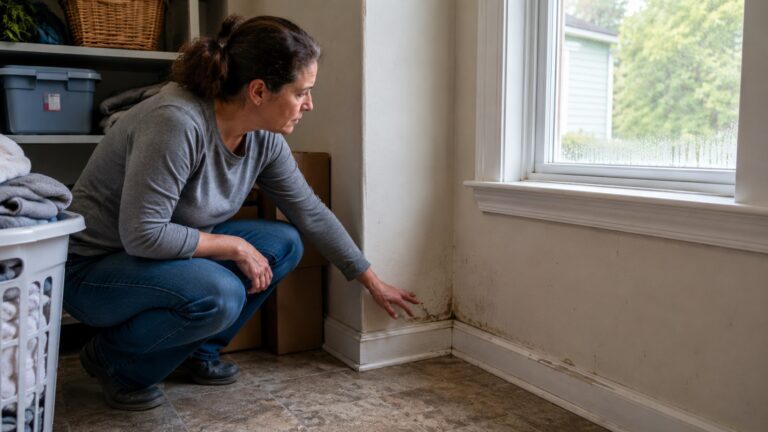
Once you identify the room or zone, move slowly around the area and follow the strongest odor point. Check low first because odor often collects near damp flooring, baseboards, lower walls, and cabinets. Then check enclosed spaces and air movement points.
Common first-check areas include:
- Baseboards and lower walls
- Carpet edges and rugs
- Cabinets and vanities
- Closets and stored items
- Window sills and trim
- Door thresholds
- Ceiling corners or stained areas
- HVAC vents and return grilles
- Rooms or cavities below the odor area
If the odor gets stronger near one surface, do not assume the visible surface is the whole problem. The smell may be coming from behind, below, or inside the material. That is when it helps to compare the odor with signs odors indicate hidden moisture.
Step 2: Remove Obvious Odor-Holding Items
Before assuming the musty smell is inside the wall, floor, or HVAC system, remove the easiest odor sources first. Many musty smells come from items that absorb moisture and odor, especially in closets, basements, bathrooms, storage rooms, and rooms with poor airflow.
This step matters because stored items can both create odor and hide the real source. A cardboard box against a damp wall may smell musty on its own, but it may also be covering a stained baseboard, condensation mark, or soft drywall area behind it.
Check cardboard, fabrics, rugs, shoes, and stored items
Porous items hold odor more easily than hard surfaces. Cardboard, paper, fabric bins, shoes, luggage, rugs, curtains, towels, clothing, books, upholstery, and storage boxes can absorb damp air and release a musty smell later.
Remove these items from the room or area and check them separately. If the smell follows the items, the source may be the stored contents. If the room still smells musty after the items are removed, the source may be in the building materials or airflow path.
Pay special attention to items stored:
- Against exterior walls
- On basement floors
- Inside closed closets
- Under sinks
- Near windows or doors
- On carpeted floors
- In rooms with high humidity
- Near HVAC returns or vents
Do not just move the items to the other side of the same room. Take them out of the area long enough to see whether the odor changes. This helps separate removable odor from building-related odor.
Separate removable odor from building odor
Once stored items are removed, air out the space and check the odor again. If the smell drops sharply and stays gone, the source may have been the items themselves. If the odor returns from the same wall, floor, cabinet, or vent, the source is more likely connected to the room.
A simple way to compare is to smell the removed items in a different location. If a box, rug, towel, or piece of furniture smells musty outside the room, it may be the odor reservoir. If the item smells normal away from the room but the original space still smells damp, the building area needs closer inspection.
This is especially useful in closets and basements. Many homeowners assume the room is moldy when the strongest odor is actually coming from damp boxes, old fabrics, or items stored tightly against cool surfaces. Other times, removing the items reveals the real issue behind them.
Step 3: Check Common Moisture-Prone Sources
After obvious odor-holding items are removed, inspect the areas where musty smells commonly start. Focus on materials that can absorb moisture, dry slowly, or hide dampness behind a finished surface.
Do not start by damaging walls or floors. Start with visible signs, touch comparisons, smell location, and moisture history. If you find stains, swelling, softness, recurring dampness, or odor that is clearly coming from behind a material, that may justify deeper inspection or professional help.
Cabinets and plumbing areas
Under-sink cabinets and bathroom vanities are common sources of musty smells because they combine plumbing, enclosed air, wood-based panels, and stored items. A slow drip can dampen the cabinet floor or back panel without creating a visible puddle.
Open the cabinet and check:
- The cabinet floor
- The back panel
- The side panels
- The toe kick area
- Pipe penetrations
- Supply lines and shutoff valves
- Drain traps and fittings
- Stored cleaning products or paper items
Look for swelling, staining, darkened material, delamination, soft particleboard, rust, mineral deposits, or damp items. If the cabinet smells strongest when first opened, the odor may be trapped inside the cabinet cavity. If the smell is strongest near a pipe opening or back wall, the source may be behind the cabinet rather than on the shelf surface.
Also check appliance areas. Dishwashers, refrigerators with water lines, washing machines, water heaters, and utility sinks can all create small hidden leaks that release musty odor long before major damage is obvious.
Carpet, flooring, and lower walls
Flooring is another common musty odor source because moisture can hide underneath the visible surface. Carpet fibers may dry while padding stays damp. Laminate may swell at seams. Vinyl may trap moisture below the surface. Wood may cup or release a damp smell before obvious damage becomes severe.
Check floor areas near:
- Exterior doors
- Windows
- Bathrooms
- Kitchens
- Laundry rooms
- Basement walls
- Appliances
- Rooms above crawl spaces
- Places where water was previously spilled or leaked
Smell near carpet edges, baseboards, rugs, and low corners. Move furniture if it blocks airflow near a suspicious area. Look for soft spots, warped boards, darkened seams, loose flooring, damp carpet edges, or odor that gets stronger when the surface is disturbed.
Lower walls are important because water often travels along the floor-wall joint. A baseboard may look mostly normal while moisture remains behind it. If the odor is strongest near the floor, compare nearby drywall and trim with dry areas elsewhere in the room.
Windows, doors, ceilings, and exterior walls
Musty smells near windows, doors, ceilings, or exterior walls often follow rain, condensation, or temperature changes. These areas can allow moisture in from outside or trap moisture where warm indoor air meets cooler surfaces.
A window-related odor may be strongest near the sill, lower corners, trim, wall below the window, or nearby floor. Look for staining, peeling paint, soft wood, condensation, darkened caulk, or odor after storms.
Door-related odor may appear near thresholds, side jambs, lower trim, or flooring inside the door. If the smell appears after wind-driven rain, check the door sweep, threshold, weatherstripping, and flooring near the entrance.
Ceiling odors may point to roof leaks, plumbing above the ceiling, attic condensation, or wet insulation. Look for discoloration, sagging, bubbling paint, water rings, or odor that gets stronger after rain or HVAC cycles.
Exterior walls can be harder to diagnose because moisture may be behind the visible surface. A musty smell from one exterior wall, especially after rain or humidity, may justify checking nearby windows, siding, flashing, gutters, interior trim, and adjacent rooms.
Basements and crawl-space-connected rooms
Basements and crawl-space-connected rooms can make odor tracing more complicated because the smell may come from below, not from the room itself. Ground moisture, foundation dampness, stored materials, cool surfaces, poor drainage, and limited airflow can all contribute to musty odor.
In basements, check foundation walls, floor edges, stored boxes, carpet, wall paneling, sump areas, drains, and areas that smell worse after rain. A basement may smell clean for a short time after airing out, then become musty again when humidity rises or foundation moisture returns.
For rooms above crawl spaces, smell near floor edges, closets, plumbing penetrations, duct openings, and HVAC returns. Musty air can move through gaps around pipes, wiring, ductwork, and floor framing. If the odor is strongest near the floor or return-air path, the source may be below the room.
Do not enter a crawl space if it is unsafe, wet, contaminated, structurally questionable, or difficult to access. If the odor appears to come from below and you cannot inspect safely, that is a good point to consider professional inspection.
Step 4: Use Timing to Narrow the Source
Once you know where the smell is strongest, use timing to decide what to check next. Match the odor to the event that makes it stronger: rain, humidity, showers, laundry, HVAC use, cleaning, or a closed room.
Odor after rain
A musty smell after rain often points toward moisture entering from outside or dampening materials near the building shell. The source may be a basement wall, foundation edge, window frame, door threshold, roof leak, siding gap, crawl space, attic area, or exterior wall section.
Check the area where the smell appears after rain and look for nearby water-entry paths. If the odor is near a window, inspect the sill, lower corners, trim, wall below the window, and nearby flooring. If the odor is in a basement, check the foundation wall, floor-wall joint, sump area, stored boxes, and exterior drainage conditions. If the odor is near a ceiling, check whether it follows roof leaks, attic condensation, or plumbing above the ceiling.
A rain-related odor may not appear immediately. It can show up hours later as damp materials warm up or as moisture evaporates into the room. If the same smell returns after repeated storms, treat it as a moisture-entry clue instead of a random odor.
Odor during humidity
A musty smell that appears during humid weather may come from porous materials releasing odor as they absorb moisture from the air. This is common in basements, closets, laundry rooms, bathrooms, storage areas, garages, and rooms with poor airflow.
Humidity can make odor stronger even when there is no active leak. Cardboard, carpet, wood trim, fabrics, drywall paper, dust, and upholstered items can all smell mustier when the air is damp. If the room smells better during dry weather and worse during humid weather, treat humidity as a tracing clue rather than proof of mold.
Measure the room with a hygrometer and compare it with nearby rooms. If the musty room consistently has higher humidity, the source may be poor airflow, damp materials, exterior moisture, or a local condition that keeps the room from drying. For more detail on this mechanism, see how humidity causes odor problems.
Odor after showers or laundry
Musty odor after showers or laundry often points toward moisture being added faster than the room can remove it. In bathrooms, check the exhaust fan, shower walls, caulk, grout, vanity cabinet, baseboards, bath mats, towels, and ceiling areas. A bathroom can smell clean after scrubbing but musty again if steam keeps collecting on surfaces or inside enclosed spaces.
In laundry areas, check damp clothing, washer seals, washer hoses, dryer venting, utility sinks, floor edges, and areas behind appliances. A dryer vent that leaks moist air indoors can make a laundry room smell damp even if there is no visible leak. Wet clothes left too long in a washer or basket can also create a musty odor that seems like a room problem.
If the smell appears only after moisture-producing activities, focus on ventilation, drying time, damp fabrics, and hidden areas near water connections.
Odor when the room is closed
A room that smells musty after being closed overnight may have a local odor source. Closed rooms concentrate odor because air movement is limited. This is common in closets, guest rooms, storage rooms, bathrooms, basement rooms, and rooms with packed furniture or stored items.
After the room has been closed, open the door and notice where the smell is strongest first. Check the back wall, floor corners, closets, cabinets, rugs, stored items, exterior walls, and vents. If the odor fades quickly but returns every time the room is closed, something inside or connected to the room is still releasing odor.
A closed-room smell can be simple stale air, but it becomes more suspicious when it is location-specific, recurring, damp, or paired with humidity, stains, swelling, or stored porous items.
Odor after cleaning
If the musty smell returns after cleaning, the source may be behind, below, or inside something the cleaning did not reach. Damp carpet padding, cabinet backs, drywall, trim, or stored materials can keep releasing odor after the surface smells better. At that point, stop adding fragrance and trace the material or moisture source that survived cleaning.
Step 5: Check Airflow and HVAC Clues
Air movement can make musty smells harder to trace because the odor may not originate where you notice it. HVAC systems, return-air paths, door gaps, floor openings, crawl spaces, basements, attics, and wall cavities can all move odor from one area to another.
If the smell appears only when air moves, treat airflow as part of the investigation.
One vent vs several vents
If the smell is strongest at one vent, the issue may be local to that duct branch, the room served by that duct, or the area around the vent. Check whether the nearby wall, ceiling, floor, or duct area has moisture signs.
If several vents smell musty at the same time, the issue may be closer to the air handler, return side, filter, coil area, condensate drain, duct system, or a damp area being pulled into the HVAC system. A whole-house musty smell during cooling can also point toward humidity control problems.
Do not assume that every musty HVAC odor means mold throughout the ducts. Start by narrowing whether the odor is isolated, system-wide, seasonal, or tied to cooling operation.
Return-air odor
Return grilles can pull odor from nearby spaces and distribute it through the home. If a return is located near a basement door, crawl-space opening, damp closet, laundry area, bathroom, or musty room, the system may carry that smell into other rooms.
Smell near the return grille when the system is off and again when it is running. If the odor becomes stronger at the return, check the area around the return path. The source may be near the return rather than inside every supply duct.
Air handler, filter, and condensate clues
If the musty smell appears during air conditioning, check the air handler area if it is safely accessible. Look for a dirty filter, standing water near the unit, a slow condensate drain, a wet drain pan, damp insulation, or odor in the mechanical area.
A clogged or slow condensate drain can create damp conditions near the system. A dirty filter can hold dust and odor. Damp mechanical rooms, basements, crawl spaces, or attics can also contribute odor that gets pulled into airflow.
If the HVAC area is wet, moldy, difficult to access, or close to electrical components, do not disassemble the system yourself. Limit the inspection to safe visible checks and call a qualified HVAC professional when needed.
Odor from basements, crawl spaces, or attics
Musty air often moves from basements, crawl spaces, and attics into living areas through openings around ducts, pipes, wiring, chases, recessed areas, floor gaps, and return-air paths. This can make a room smell musty even when the room itself looks clean.
If the odor is strongest near the floor, a closet, a return grille, or a mechanical chase, consider whether air may be entering from below or above. In crawl-space-connected rooms, odor may be strongest near floor penetrations or HVAC returns. In attic-connected rooms, odor may appear near ceiling openings, attic access points, or duct runs.
When odor appears to come from a larger moisture pathway rather than a single item, it may be time to look beyond odor tracing and find the source of moisture in your home.
Step 6: Use Simple Tools Carefully
Simple tools can help confirm your observations, but they should not replace judgment. A tool reading is most useful when it supports a pattern you already noticed: odor near one wall, damp smell after rain, musty carpet edges, higher humidity in one room, or visible material changes.
Useful tools include:
- Flashlight: Helps reveal stains, shadows, bubbling paint, cabinet damage, dark corners, and condensation marks.
- Hygrometer: Shows whether the room has higher humidity than nearby areas.
- Moisture meter: Helps compare suspicious drywall, trim, flooring, or cabinets with nearby dry areas.
- Painter’s tape or notes: Helps mark where the smell is strongest without damaging surfaces.
- Photos: Help track whether stains, swelling, or discoloration change over time.
A moisture meter can be helpful when the odor is strongest near a wall, floor, trim, or cabinet, but it does not identify mold by itself. Use it to compare areas. If one section reads differently than similar dry areas nearby, that section deserves closer attention. Mark the suspicious area and compare it again later or after the next rain, shower, HVAC cycle, or humid day.
A hygrometer is useful when the smell changes with weather or room closure. If one room consistently has higher humidity than the rest of the home, the odor may be connected to damp air, poor airflow, or a local moisture source.
Tools are most helpful when they support a decision: keep monitoring, dry the area, remove odor-holding items, inspect further, or call a professional. They are not a substitute for finding why the material or room is damp in the first place.
What Not to Do While Tracing a Musty Smell
Some common reactions can hide the odor pattern or create unnecessary damage. Investigate safely before covering the smell or tearing into materials.
Do not mask the odor before checking the source
Air fresheners, candles, plug-ins, scented sprays, and strong cleaners can hide the clue you need most: where the musty smell is strongest and when it returns.
Fresh air is useful, but do not assume a room is fixed just because the odor fades when windows are open. Ventilation can dilute odor without removing the source. If the smell returns after the room is closed, the source still needs to be found.
Do not assume every musty smell is mold
A musty smell may be mold-related, but it can also come from damp cardboard, old carpet padding, dirty HVAC filters, wet laundry, stale air, drains, pet areas, stored fabrics, or high humidity. Do not assume mold before checking simpler sources.
At the same time, do not dismiss the smell just because you cannot see mold. A musty odor can come from hidden moisture behind trim, under flooring, inside cabinets, above ceilings, or in nearby crawl-space and basement areas. If the smell appears with stains, swelling, softness, dampness, or recurring moisture, compare it with signs odors are linked to mold growth.
Do not open walls or flooring without evidence
It can be tempting to pull up flooring, remove baseboards, or cut into drywall when a smell will not go away. But destructive inspection should not be the first step. Start with safer clues: odor location, timing, moisture history, visible staining, humidity readings, moisture meter comparisons, and nearby leak sources.
Opening materials too soon can create unnecessary repair work. It can also disturb moldy, wet, electrically unsafe, or contaminated materials if they are present. If the evidence points to moisture inside a wall, floor, ceiling, HVAC area, attic, or crawl space, professional inspection may be safer and more useful than guessing.
Do not keep cleaning the same surface without changing the investigation
If you clean the same room repeatedly and the musty smell keeps coming back, the source may not be on the surface you are cleaning. It may be behind, below, inside, or outside the cleaned area.
Repeated cleaning can also add moisture to carpets, upholstery, wood, or porous materials if they are not dried quickly. If the odor returns after cleaning, shift from cleaning to source tracing. Ask what material is releasing the odor and why it keeps getting damp.
When to Stop DIY Tracing and Get Professional Help
Many musty odor sources can be narrowed down with simple homeowner checks. You may find damp boxes, wet towels, a dirty HVAC filter, a leaky cabinet, a humid closet, or a carpet edge that needs attention. But some odor sources are hidden in places that are difficult, unsafe, or damaging to inspect without the right tools.
Consider professional inspection when:
- The musty smell is persistent and you cannot locate the source.
- The odor is strongest near walls, floors, ceilings, cabinets, or HVAC vents.
- The smell appears after rain, flooding, plumbing leaks, roof leaks, or appliance leaks.
- There are stains, soft drywall, swollen trim, warped flooring, or damp carpet edges.
- The HVAC system seems to spread the smell through multiple rooms.
- The odor appears to come from a crawl space, attic, wall cavity, or area you cannot safely access.
- You would need to cut, remove, or disturb building materials to inspect further.
- The smell is paired with visible mold, extensive water damage, or recurring dampness.
Professional help is especially important when electrical systems, structural materials, HVAC components, insulation, attics, crawl spaces, or contaminated materials may be involved. The goal is not to overreact to every odor. The goal is to avoid ignoring a persistent moisture signal until the damage becomes larger.
Once the source is found, the next step is not just making the room smell better. The source must be dried, repaired, removed, ventilated, or controlled. After that, you can focus on how to eliminate persistent musty odors without masking an active moisture problem.
FAQ
How do I find where a musty smell is coming from?
Start by isolating the area where the odor is strongest. Compare nearby rooms, close doors briefly, remove odor-holding items, check cabinets and closets, inspect carpet edges and baseboards, and track when the odor appears. Location, timing, materials, and airflow clues are more useful than smell alone.
Why does the smell seem stronger in one corner?
A corner may smell stronger because of poor airflow, exterior moisture, condensation, stored items, carpet moisture, wall moisture, or moisture trapped behind trim. Corners also concentrate odor when air does not move well. If one corner smells damp repeatedly, check the wall, baseboard, floor edge, nearby window, and adjacent exterior or plumbing areas.
Can HVAC make it harder to trace a musty odor?
Yes. HVAC airflow can move odor from one room, basement, crawl space, attic, return-air path, duct branch, air handler, or condensate area into another space. If the smell appears when the system runs, compare one vent against several vents, check the return grille, and inspect safe visible areas around the filter and air handler.
Should I remove stored items before checking for moisture?
Yes. Cardboard, fabrics, rugs, shoes, luggage, papers, books, and stored clothing can hold odor and hide damp surfaces. Removing them helps separate removable odor from building odor. If the smell follows the items, they may be the source. If the room still smells musty after they are removed, check the walls, floor, cabinets, closets, and airflow paths.
Can a musty smell come from another room?
Yes. Odor can move through door gaps, HVAC systems, return-air paths, floor openings, plumbing penetrations, wall gaps, basements, crawl spaces, attics, and connected closets. The room where you notice the smell may not be the original source, especially if the odor changes when doors close or the HVAC system runs.
Should I use a moisture meter to trace musty smells?
A moisture meter can help compare suspicious materials with nearby dry areas, especially around drywall, trim, flooring, cabinets, and ceiling spots. However, a moisture meter does not identify mold by itself. Use it with odor location, visible signs, humidity readings, water history, and timing patterns.
When should I call a professional if I cannot find the source?
Call a professional when the odor is persistent, hidden, HVAC-related, tied to water damage, or paired with stains, soft drywall, swollen trim, warped flooring, damp carpet, visible mold, or unsafe access areas. Professional inspection is also wise when finding the source would require opening walls, lifting flooring, entering a crawl space, or disturbing damaged materials.
Quick Musty Smell Tracing Checklist
- Tracing a musty smell means narrowing the source by location, timing, airflow, materials, and moisture history.
- The strongest smell is a useful starting point, but odor can travel through HVAC systems, crawl spaces, basements, attics, and connected rooms.
- Remove odor-holding items such as cardboard, fabrics, rugs, shoes, and stored items before assuming hidden mold.
- Musty smells after rain, humidity, showers, HVAC use, or room closure give important source clues.
- Cabinets, carpet padding, baseboards, lower walls, windows, ceilings, basements, and crawl-space-connected rooms are common odor source areas.
- Hygrometers and moisture meters can help, but they do not diagnose mold by themselves.
- Persistent hidden odor with material damage or unsafe access areas should be inspected professionally.
What to Do After You Find the Odor Pattern
A musty smell should be traced by pattern, not guesswork. Start with the strongest location, remove odor-holding items, check nearby moisture-prone materials, then use timing and airflow clues to decide where to inspect next.
The smell is a clue, not a conclusion. If it persists, returns after cleaning, appears with moisture damage, or seems to come from hidden walls, floors, ceilings, HVAC areas, basements, attics, or crawl spaces, stop masking the odor and inspect the likely source before trying to remove the smell permanently.