
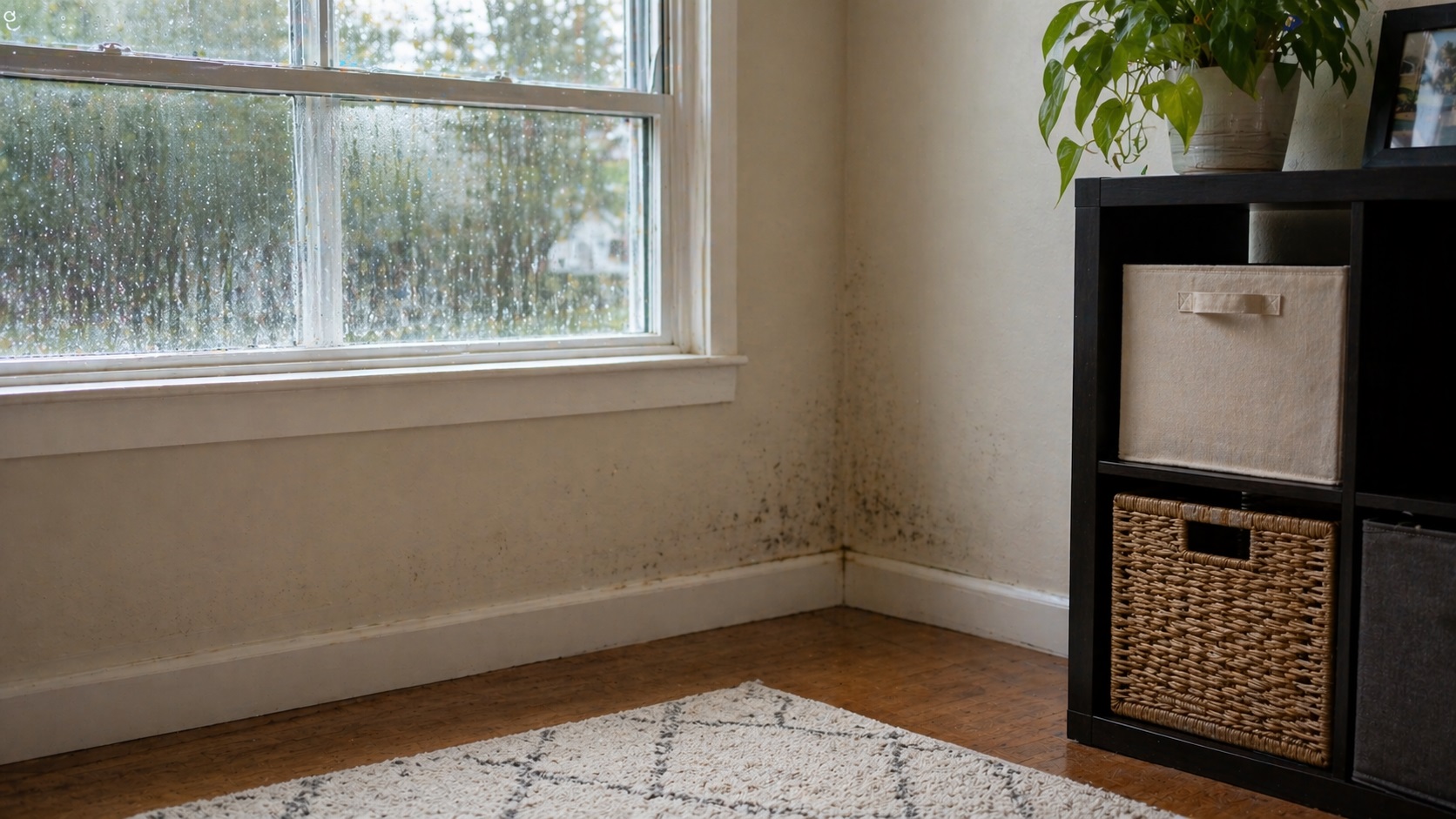
Best Air Purifiers for Mold Spores
Disclosure: As an Amazon Associate, this site earns from qualifying purchases. This does not affect the price you pay. Our recommendations are based on research, product reliability, and real-world usability in moisture-prone environments.
Best HEPA Air Purifiers for Mold — Quick Answer
The best HEPA air purifiers for mold help reduce airborne mold spores while you control moisture and humidity in the home. Strong options include large-room units like the LEVOIT Vital 200S-P, smart models like the LEVOIT Core 400S, and high-capacity units such as the Honeywell HPA304 for large or basement spaces.
Best HEPA Air Purifiers for Mold — Comparison Table
| Model | Best For | Room Size Type | Smart Features | Odor Control | Check Availability |
|---|---|---|---|---|---|
| LEVOIT Vital 200S-P ⭐ | Best Overall | Large Rooms | Yes | Moderate | Check on Amazon |
| LEVOIT Core 400S | Smart Upgrade | Large Rooms | Advanced | Moderate | Check on Amazon |
| Coway Airmega AP-1512HH | Proven Reputation | Medium Rooms | Yes | Moderate | Check on Amazon |
| WINIX 5510 | Odor Control | Large Rooms | Yes | Strong | Check on Amazon |
| GermGuardian AC4825E | Budget Pick | Small–Medium Rooms | No | Basic | Check on Amazon |
| Shark HP201 | Open Living Areas | Large Rooms | Yes | Moderate | Check on Amazon |
| Honeywell HPA304 | Extra-Large Rooms | Very Large Rooms | No | Moderate | Check on Amazon |
Which HEPA Air Purifier Is Right for You?
- Best all-around choice: LEVOIT Vital 200S-P
- Best smart upgrade: LEVOIT Core 400S
- Best for smaller bedrooms or offices: Coway Airmega AP-1512HH
- Best for odor control: WINIX 5510
- Best budget pick: GermGuardian AC4825E
- Best for open living spaces: Shark HP201
- Best for basements and extra-large rooms: Honeywell HPA304
If you are dealing with musty air, recurring moisture problems, or airborne mold concerns, the right air purifier can help improve indoor air quality while you work on the root cause. A true HEPA air purifier can help capture mold spores, dust, and other airborne irritants common in damp spaces.
Common signs you may need an air purifier for mold:
- Persistent musty smells
- Recent leaks or flooding
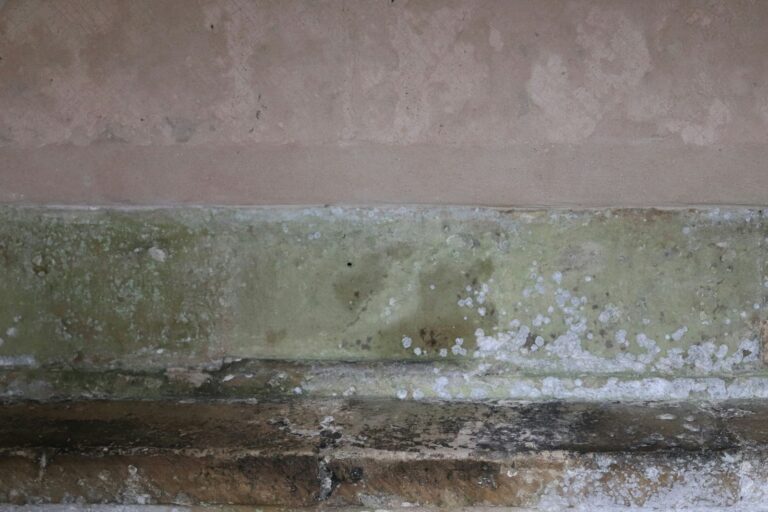
- Visible mold growth
- Allergy symptoms indoors
- High humidity readings
This matters most in homes that have dealt with past water damage, humid basements, poor ventilation, or moisture hiding inside walls and ceilings. If mold is already growing on surfaces, the first priority is correcting the moisture source. Many homeowners assume an air purifier alone will solve the problem, but long-term results almost always depend on fixing the moisture source first.
In this guide, we will look at the best HEPA air purifiers for mold for different room sizes and situations. We will also point you toward tools and articles that can help you control humidity, track moisture, and reduce the conditions that allow mold to keep coming back. For related articles, you can also browse the air quality category and learn more about monitoring indoor humidity levels and the best dehumidifier settings to prevent mold.
Quick Picks: Best HEPA Air Purifiers for Mold
- Best Overall: LEVOIT Vital 200S-P
- Best Smart Upgrade: LEVOIT Core 400S
- Best for Proven Long-Term Reputation: Coway Airmega AP-1512HH
- Best for Large Rooms and Odor Control: WINIX 5510
- Best Budget / Best-Selling Value Pick: GermGuardian AC4825E
- Best for Bigger Open Areas: Shark HP201
- Best for Extra-Large Rooms: Honeywell HPA304
Why HEPA Air Purifiers Matter for Mold and Airborne Mold Spores
Most people searching for the best HEPA air purifiers for mold are dealing with musty odors, visible mold concerns, or worries about airborne spores after a leak or humidity problem.
A true HEPA air purifier can help reduce airborne particles in bedrooms, living rooms, finished basements, and other occupied spaces, but it works best as part of a larger moisture-control plan. If you suspect hidden growth, it also helps to understand the common causes of mold inside walls and the signs of mold behind walls.
To make your decision easier, the models below cover the most common situations homeowners face — from small bedrooms to large basement spaces.
Our Top Picks Reviewed
1. LEVOIT Vital 200S-P
Category Label: Best Overall
For most homeowners, the LEVOIT Vital 200S-P strikes a strong balance between performance and simplicity without making daily operation complicated. It covers a large area, includes a washable pre-filter, and adds smart monitoring features that make it easier to use day-to-day. For homes dealing with damp air, pet dander, dust, and lingering musty conditions, it offers one of the best balances of performance, room coverage, and convenience.
What makes it especially useful is that it fits the real-world needs of mold-prone homes. Many people are not trying to purify a tiny office. They are trying to clean the air in a bedroom, living room, basement, or other larger area of the house while they work on humidity control and moisture prevention. In day-to-day use, this filter handles that role reliably without requiring constant adjustment.
Key Features:
- True HEPA filtration for fine airborne particles
- Large-room coverage suitable for common living spaces
- Washable pre-filter to help capture larger debris
- Air quality monitoring and auto mode
- Smart controls for easier daily use
- Sleep-friendly settings for bedrooms
Pros:
- ✔ Strong all-around performance for mold-spore concerns
- ✔ Good fit for larger rooms without stepping into oversized commercial-style units
- ✔ Useful smart features without being difficult to operate
- ✔ Washable pre-filter adds practical value for long-term maintenance
- ✔ Works well in bedrooms, living rooms, and finished basements
Cons:
- ✖ More expensive than simple budget tower models
- ✖ Still does not replace dehumidification or mold cleanup
- ✖ Smart features may be unnecessary for buyers who want a basic manual unit
Best For:
- Homeowners who want the safest all-around choice
- Bedrooms, family rooms, and larger everyday living spaces
- Homes with recurring humidity, dust, and mold-spore concerns
- Buyers who want a modern purifier with strong convenience features
Check the LEVOIT Vital 200S-P on Amazon to see current availability.
2. LEVOIT Core 400S
Category Label: Best Smart Upgrade
If you want a stronger emphasis on smart controls and app-based convenience, the LEVOIT Core 400S is an easy upgrade pick. It is a good match for homeowners who like being able to track air quality, adjust settings remotely, and let the purifier react automatically as indoor conditions change.
For mold-related use, that matters most when a room has changing air quality throughout the day. For example, a basement may feel drier at one point and more stale later on, or a bedroom may need quieter overnight operation but stronger filtration during the day. The Core 400S handles that kind of daily variation well while still offering the kind of HEPA filtration people want when searching for the best HEPA air purifiers for mold.
Key Features:
- True HEPA filtration with strong large-room capability
- Smart Wi-Fi connectivity and app controls
- Air quality monitor with auto mode
- Sleep mode for quieter operation
- Modern design that works well in visible living spaces
- Useful balance of power and ease of use
Pros:
- ✔ Excellent smart feature set for homeowners who want more control
- ✔ Strong coverage for larger rooms
- ✔ Quiet enough for regular bedroom use on lower settings
- ✔ Easy fit for modern homes where aesthetics also matter
- ✔ Good option for tracking air quality changes over time
Cons:
- ✖ More feature-heavy than some buyers need
- ✖ Not the best value if you do not care about app controls
- ✖ Requires ongoing filter replacement like any serious air purifier
Best For:
- Homeowners who want a smart, connected purifier
- People comparing premium large-room residential units
- Bedrooms, living rooms, and open spaces where auto mode is useful
- Buyers who want a more polished upgrade over basic entry-level models
Check the LEVOIT Core 400S on Amazon to see current availability.
3. Coway Airmega AP-1512HH
Category Label: Best for Proven Long-Term Reputation
The Coway Airmega AP-1512HH has been one of the most trusted residential air purifiers in this category for a long time, which is why it stands out for buyers who value a strong track record over newer design trends. If you want something widely known, well established, and consistently recommended for everyday air cleaning, this is one of the safest picks on the list.
It is especially appealing for smaller to medium-sized rooms where reliable HEPA filtration is needed without moving to a bulkier machine. In mold-prone homes, that makes it a good fit for bedrooms, offices, and smaller living spaces where you want better air cleaning but do not need the largest possible coverage. It also performs reliably as a second purifier in a targeted problem area while moisture issues are being addressed elsewhere in the house.
Key Features:
- True HEPA filtration with multi-stage air cleaning
- Air quality monitoring and automatic operation
- Filter indicator for easier maintenance tracking
- Compact footprint compared with some large-room competitors
- Long-standing reputation in the residential purifier market
Pros:
- ✔ Proven reputation and strong long-term consumer trust
- ✔ Solid choice for bedrooms and medium-sized rooms
- ✔ Straightforward design that is easy to live with
- ✔ Good fit for buyers who want reliability more than flashy extras
- ✔ Useful option for targeted mold-spore concerns in occupied spaces
Cons:
- ✖ Not the strongest fit for very large open areas
- ✖ Less feature-rich than some smart competitors
- ✖ Design feels more practical than premium
Best For:
- Buyers who want a purifier with a long-established reputation
- Bedrooms, offices, and smaller shared rooms
- Homeowners who prefer a simpler proven model over a newer smart unit
- People adding a secondary purifier to a mold-prone part of the home
Check the Coway Airmega AP-1512HH on Amazon to see current availability.
4. WINIX 5510
Category Label: Best for Large Rooms and Odor Control
For homes struggling with musty odors or large shared spaces, the WINIX 5510 stands out as a dependable option. By combining true HEPA filtration with activated carbon and smart sensing technology, it handles rooms where stale air, smoke, or lingering smells tend to build up.
For mold-related situations, odor control is often just as important as particle capture. Musty smells usually indicate moisture or hidden growth somewhere in the home. In situations like this, a HEPA air purifier for musty smell control can make a noticeable difference while you investigate the source.
A purifier like this helps clean the air while you work on solving the moisture problem itself. For example, if you suspect hidden dampness, it can help to learn how to find hidden water leaks inside walls before relying only on filtration.
Key Features:
- True HEPA filtration capturing very small airborne particles
- Activated carbon filter for odor reduction
- Smart air quality sensor with automatic speed adjustment
- Washable pre-filter for larger debris
- Sleep mode for quieter overnight operation
- Wi-Fi compatibility for remote control
Pros:
- ✔ Strong odor control compared to basic HEPA units
- ✔ Good coverage for large shared living spaces
- ✔ Automatic adjustments based on air quality
- ✔ Effective for ongoing daily use
- ✔ Useful in basements and larger living areas
Cons:
- ✖ Larger footprint than compact bedroom models
- ✖ Replacement filters can be more expensive than basic units
- ✖ Some features may be unnecessary for small-room use
Best For:
- Large living rooms or finished basements
- Homes dealing with persistent musty odors
- Spaces where air circulation varies throughout the day
- Homeowners needing strong odor and particle control
Check the WINIX 5510 on Amazon to see current availability.
5. GermGuardian AC4825E
Category Label: Best Budget / Best-Selling Value Pick
The GermGuardian AC4825E is a practical entry-level option for homeowners who want to improve indoor air quality without investing in a larger or more expensive system. While it does not offer the same coverage as high-capacity models, it works well in bedrooms, apartments, and smaller rooms where mold concerns are limited to specific areas.
This type of unit is especially helpful when placed near problem zones, such as a bedroom affected by seasonal humidity or a room that previously experienced moisture damage. Smaller targeted placement can make a noticeable difference when combined with humidity monitoring and moisture control. If you’re unsure how moisture levels affect materials like drywall or wood, this guide to moisture levels that indicate water damage can help you understand the risk.
Key Features:
- True HEPA filtration for airborne particles
- Slim tower design suitable for smaller rooms
- UV-C light feature for additional air treatment
- Carbon filter layer for basic odor reduction
- Simple manual controls
Pros:
- ✔ Affordable entry-level HEPA purifier
- ✔ Compact footprint works well in tight spaces
- ✔ Easy to set up and operate
- ✔ Ideal for bedrooms and small living areas
- ✔ Proven popularity among homeowners
Cons:
- ✖ Smaller coverage area than premium models
- ✖ Limited smart features
- ✖ Less effective for very large rooms
Best For:
- Budget-conscious homeowners
- Bedrooms and apartments
- Small rooms with localized mold concerns
- Secondary units in multi-room homes
Check the GermGuardian AC4825E on Amazon to see current availability.
6. Shark HP201
Category Label: Best for Bigger Open Areas
The Shark HP201 is a strong candidate for homes with open floor plans or connected living spaces. These types of layouts often allow air to circulate freely, which means a purifier must move a large volume of air to remain effective. This model focuses on consistent airflow and simple monitoring, making it suitable for family rooms, kitchens, and combined living spaces.
In mold-prone homes, open areas often serve as central circulation zones where airborne particles travel from one room to another. A larger-capacity purifier helps reduce that movement while moisture problems are being addressed. If you are dealing with moisture that spreads across multiple rooms, it may also help to learn how to detect moisture without opening walls so you can identify hidden trouble spots early.
Key Features:
- True HEPA filtration designed for large spaces
- Clean Sense technology for automatic airflow adjustment
- Strong airflow for open areas
- Large-capacity filtration design
- Modern upright tower layout
Pros:
- ✔ Good airflow for open floor plans
- ✔ Reliable performance in larger shared spaces
- ✔ Automatic air-quality adjustments
- ✔ Strong brand reputation
- ✔ Useful for family rooms and kitchens
Cons:
- ✖ Larger size requires more floor space
- ✖ May be excessive for small bedrooms
- ✖ Replacement filters can add ongoing cost
Best For:
- Open living areas
- Combined kitchen and living spaces
- Homes with large shared airflow zones
- Families needing strong air movement coverage
Check the Shark HP201 on Amazon to see current availability.
7. Honeywell HPA304
Category Label: Best for Extra-Large Rooms
When a standard room purifier isn’t enough, the Honeywell HPA304 is designed to handle larger and more demanding spaces. Extra-large spaces, finished basements, and multi-use rooms often require stronger airflow to maintain consistent air circulation. This model focuses on delivering that capacity while keeping controls straightforward and dependable.
Extra-large rooms are often where humidity and moisture issues become difficult to manage, especially when air becomes stagnant. Basements and large open areas often require stronger airflow because cooler air settles near floors and foundation walls. This type of model is often recommended as the best air purifier for basement mold because it can move enough air to handle large, damp spaces.
In those environments, filtration should be paired with strong moisture control. If your home has experienced past water damage, it may also help to understand how quickly mold can grow after water damage so you can act before conditions worsen.
Key Features:
- True HEPA filtration designed for large areas
- High airflow capacity for wide coverage
- Multiple cleaning levels
- Simple manual operation
- Trusted long-term brand reputation
Pros:
- ✔ Designed for large and extra-large rooms
- ✔ Strong airflow compared to smaller units
- ✔ Reliable long-term brand performance
- ✔ Straightforward operation without complicated setup
- ✔ Good fit for large basements and open rooms
Cons:
- ✖ Larger size may not fit small spaces easily
- ✖ Higher fan speeds can be louder
- ✖ Not necessary for small rooms
Best For:
- Extra-large rooms
- Finished basements
- Homes with large shared air volumes
- Homeowners needing strong airflow capacity
Check the Honeywell HPA304 on Amazon to see current availability.
Why an Air Purifier Works Best With Moisture Control
Even the best HEPA air purifier for mold will do more for your home when paired with humidity control and moisture detection. Many homeowners don’t realize that filtration alone rarely solves recurring mold problems without addressing moisture first.
If your indoor humidity stays high, the long-term solution is to reduce the conditions that allow mold to grow in the first place. In many homes, this means fixing leaks, improving ventilation, or using dehumidifiers consistently rather than only during problem periods.
That is why it helps to use a purifier together with tools such as home hygrometers and to maintain the right dehumidifier settings for mold prevention. Many homeowners compare an air purifier vs. a dehumidifier for mold, but the reality is that both tools work together rather than replacing one another.
If you are dealing with basement dampness, you may also want to compare these basement dehumidifiers for mold and moisture so you are improving both air filtration and moisture control together.
How to Choose the Right HEPA Air Purifier for Mold in Any Room
Choosing the best HEPA air purifier for mold is not just about picking the biggest or most expensive model. Selecting one of the best HEPA air purifiers for mold ensures you are addressing airborne spores while working on long-term moisture control.
The right unit depends on your room size, humidity conditions, airflow patterns, and whether mold problems are ongoing or occasional. Understanding these factors helps you select a purifier that actually improves air quality instead of wasting money on a unit that is too small or poorly placed. Once you understand these basics, choosing between models becomes much more straightforward.
Quick Summary:
- Choose a purifier rated slightly larger than your room
- Look for true HEPA filtration
- Pair filtration with humidity control
- Maintain filters regularly
Before selecting any purifier, it is important to remember that filtration supports mold control but does not replace fixing the moisture source. If mold keeps returning, it usually means water or humidity problems still exist somewhere in the home. If you are unsure where mold might be forming, review these signs of hidden moisture in walls before relying on filtration alone.
1. Choose the Right Room Size Coverage
One of the most common mistakes homeowners make is choosing an air purifier that is too small for the room. This is especially important in mold-prone homes, where airborne particles can spread easily between connected spaces.
Most manufacturers list a recommended room size in square feet. These ratings usually assume ideal airflow conditions, which rarely match real-world homes with furniture, walls, and uneven air movement.
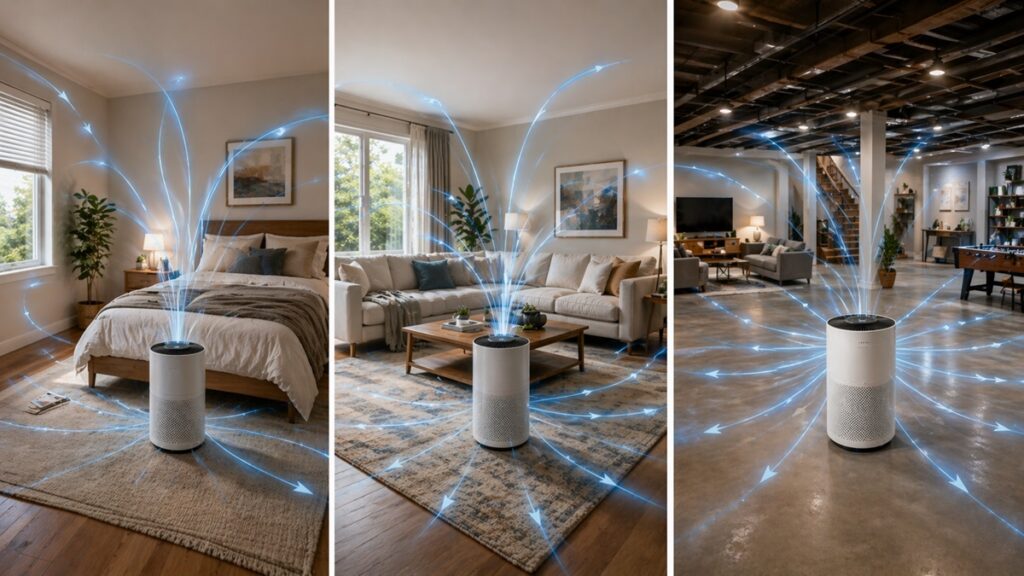
In homes with humidity issues, past water damage, or poor airflow, it is usually better to select a purifier rated slightly larger than your actual room size. In many homes, choosing a large room air purifier for mold provides more reliable performance than relying on smaller units that struggle to circulate enough air.
General sizing recommendations:
- Small rooms (bedrooms, offices): Choose units designed for small to medium spaces
- Medium rooms (living rooms): Choose large-room models with higher airflow
- Basements: Choose large or extra-large coverage units
- Open floor plans: Select models designed for larger combined spaces
If your mold problem started after a leak or flooding event, it also helps to understand how quickly mold grows after water damage, since air quality can decline rapidly in damp environments.
2. Look for True HEPA Filtration
When researching the best HEPA air purifiers for mold, always look for units that clearly state True HEPA filtration. Some lower-cost models use terms like “HEPA-style” or “HEPA-type,” which usually means the filter does not meet full HEPA standards.
True HEPA filters are designed to capture extremely small airborne particles, including many mold spores.
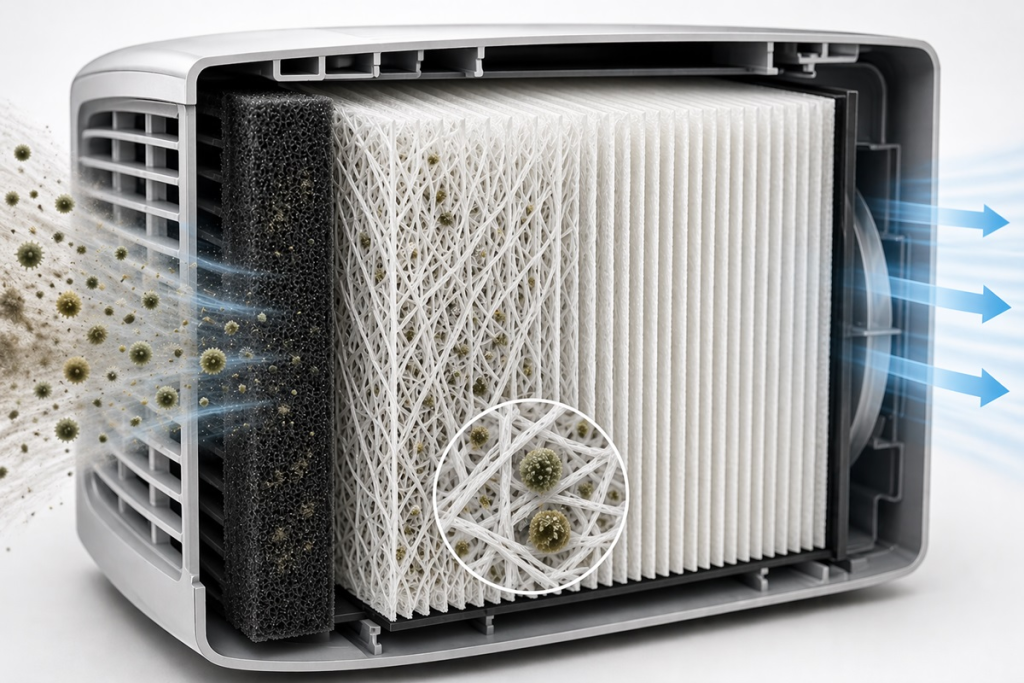
The overall effectiveness of HEPA filters for removing mold spores depends on airflow strength, proper sealing, and regular maintenance. While HEPA filters cannot remove mold growing on surfaces, they can help reduce the number of circulating spores that contribute to indoor air quality problems.
Features that support HEPA performance include:
- Sealed filtration systems
- Multi-stage filters (pre-filter, HEPA, carbon)
- Strong airflow capacity
- Regular filter maintenance
3. Pay Attention to Odor Control Features
Musty smells are often one of the first signs of mold-related problems. While HEPA filters capture particles, odor control usually comes from activated carbon filters or additional odor-reduction stages.
If your home has persistent odors, choose a purifier with:
- Activated carbon filters
- Multi-stage filtration systems
- Strong airflow performance
However, remember that odor reduction alone does not eliminate mold growth. If odors continue, you may need to investigate moisture sources such as leaks, condensation, or humidity buildup. This guide on finding hidden water leaks inside walls can help identify those issues early.
4. Consider Noise Levels for Daily Use
Noise matters more than many people expect. A purifier that is too loud may be turned off frequently, which defeats its purpose.
For bedrooms and living areas, choose units with:
- Sleep mode or low-speed settings
- Quiet fan operation
- Automatic speed adjustment
Higher fan speeds typically create more airflow but also more noise. Many modern units adjust speed automatically, increasing airflow only when air quality declines.
5. Think About Filter Maintenance Costs
All HEPA air purifiers require periodic filter replacement. Ignoring filter maintenance reduces performance and may allow airborne particles to circulate again.
When choosing a unit, consider:
- Filter replacement frequency
- Availability of replacement filters
- Ease of installation
Long-term maintenance planning prevents performance drops and keeps the purifier working effectively.
6. Combine Air Purifiers With Humidity Control
This is one of the most important steps homeowners overlook. Air purifiers remove airborne particles, but mold grows because of moisture. Without controlling humidity, mold conditions can return even if the air initially improves. This often happens during humid summer months when indoor air feels comfortable but hidden moisture levels quietly rise.
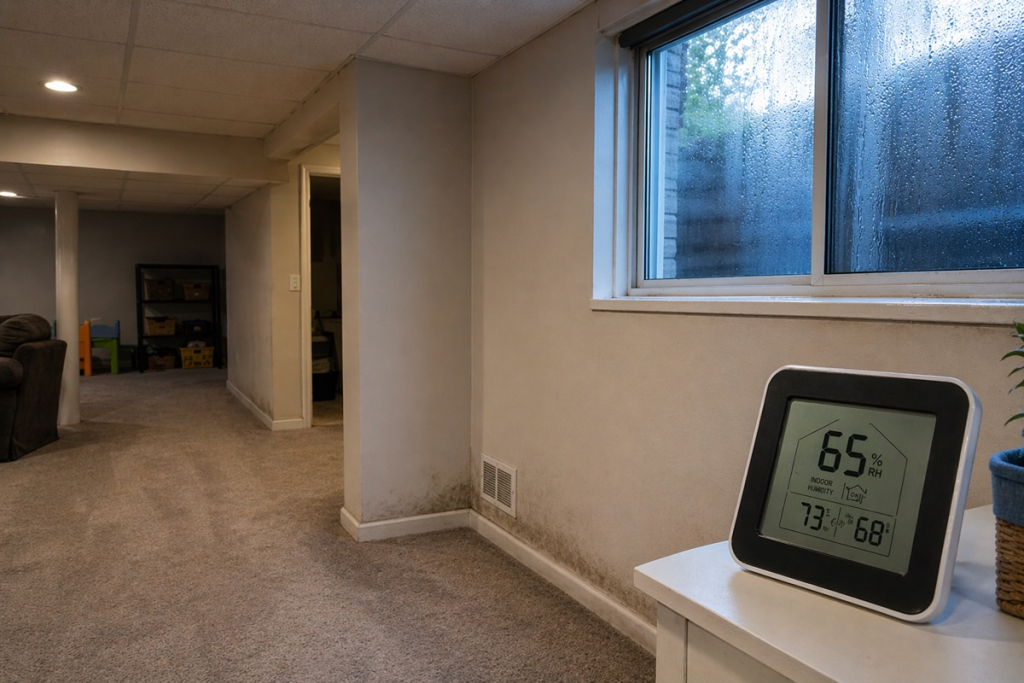
To prevent mold growth long-term, most homes benefit from maintaining humidity between 30% and 50%. If your indoor levels stay above that range, consider adjusting your equipment based on these recommended dehumidifier settings for mold prevention.
Where to Place an Air Purifier for Mold for Maximum Effectiveness
Placement has a major impact on performance. Even the best HEPA air purifier for mold cannot work effectively if placed in the wrong location.
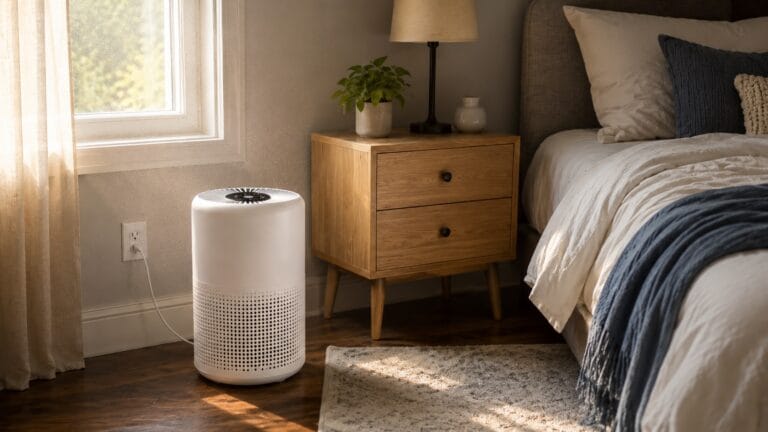
For best results, position your purifier where airflow is strongest and most consistent. Placing the purifier near the center of the space usually works noticeably better than pushing it against a wall.
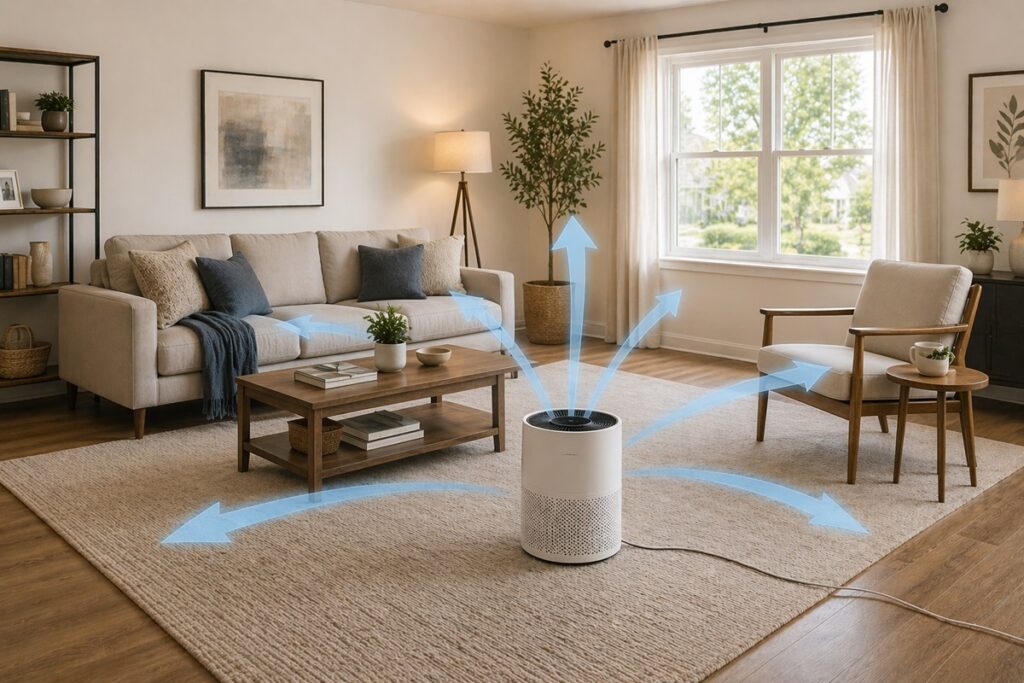
Best Placement Locations
- Bedrooms: Place near sleeping areas to reduce overnight exposure
- Living rooms: Position near central airflow paths
- Basements: Place near known damp areas. Areas with visible condensation or musty odors are usually good starting points
- Rooms with past water damage: Use targeted placement
Avoid placing purifiers directly against walls or inside enclosed corners. Leave several inches of clearance around the unit to allow proper airflow.
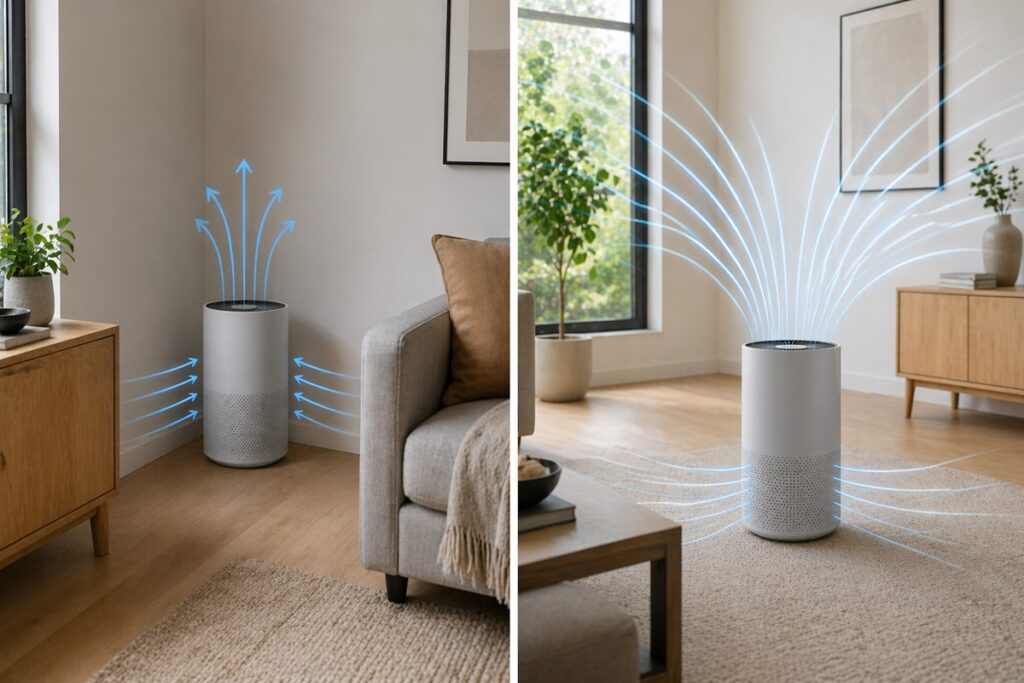
Common Placement Mistakes to Avoid
- Placing the unit behind furniture
- Using undersized purifiers in large spaces
- Running the purifier only occasionally
- Ignoring airflow obstructions
If moisture problems continue despite filtration, you may need to investigate structural sources of dampness. For example, these non-invasive moisture detection methods can help identify trouble areas before major damage occurs.
How to Use an Air Purifier Effectively in Mold-Prone Homes
Simply turning on an air purifier does not guarantee improved air quality. Small adjustments in how the purifier is used can make a noticeable difference in real-world results. Like any equipment, it works best when used consistently and correctly.
Run the Purifier Continuously
For mold-related concerns, running the purifier continuously is usually more effective than turning it on only when odors appear. Airborne particles circulate constantly, especially in humid environments. Understanding how air purifiers help with mold makes it easier to set realistic expectations about what continuous operation can accomplish.
Continuous operation helps:
- Reduce airborne mold spores
- Prevent smells from gradually building up between cleaning cycles
- Improve overall air quality
- Limit odor buildup
- Maintain consistent airflow
For example, many homeowners notice musty smells returning after rainy weather when a purifier is turned off too often.
Use Auto Mode When Available
Many modern units include automatic air quality sensors. These sensors adjust fan speed based on detected particle levels, improving performance while reducing unnecessary noise.
Auto mode is particularly useful in homes where humidity levels fluctuate throughout the day.
Keep Doors and Windows Managed
Open windows introduce outdoor particles and humidity. While ventilation is important in some situations, excessive airflow from outside can reduce purification effectiveness.
If you rely on ventilation, monitor humidity levels carefully to avoid introducing moisture into already vulnerable spaces.
Maintain Filters on Schedule
Clogged filters reduce airflow and filtration efficiency. Most manufacturers recommend replacing filters every few months depending on usage. Homes with pets, heavy dust, or past water damage may require more frequent replacement than standard recommendations.
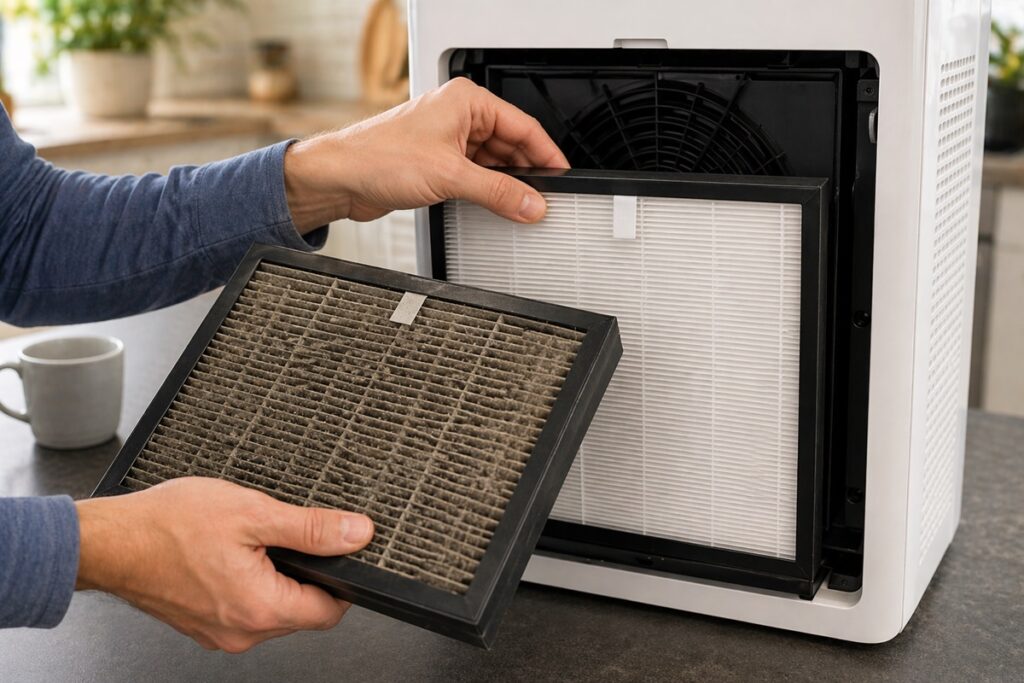
If your home has experienced flooding or ongoing humidity problems, filters may need replacement more frequently.
Common Mistakes to Avoid When Using Air Purifiers for Mold
Even with high-quality equipment, simple mistakes can reduce effectiveness. Avoiding these errors helps you get better performance and protects your indoor air quality.
1. Assuming Air Purifiers Remove Mold From Surfaces
Air purifiers remove airborne particles, not mold attached to walls, floors, or ceilings. Surface mold requires physical removal and moisture correction.
If mold is visible, start by reviewing this complete guide on removing mold permanently before relying on filtration alone.
2. Ignoring Moisture Sources
Mold returns when moisture remains. If the same area develops mold repeatedly, it usually indicates an unresolved moisture source that requires deeper inspection. Leaks, condensation, and poor ventilation must be addressed to prevent recurring problems.
If you are unsure whether moisture is still present, these moisture level guidelines for drywall and wood can help determine if materials are still damp.
3. Choosing a Unit That Is Too Small
Undersized units struggle to clean large volumes of air. Always match purifier capacity to the room size and conditions.
4. Turning the Unit Off Too Often
Short operating times reduce effectiveness. Continuous operation provides the most consistent results.
Safety Tip: If mold covers more than about 10 square feet or returns quickly after cleaning, professional inspection is usually recommended to prevent deeper structural damage.
5. Failing to Monitor Humidity Levels
Humidity is one of the biggest drivers of mold growth. Without monitoring, problems can develop without warning.
Using reliable tools such as humidity monitors helps maintain safe indoor conditions and prevents future mold issues.
Key Takeaways
- A true HEPA air purifier helps reduce airborne mold spores.
- Air purifiers work best when combined with humidity control.
- Choose a purifier rated slightly larger than your room size.
- Basements and large rooms usually require higher-capacity units.
- Continuous operation provides the most consistent results.
Frequently Asked Questions About HEPA Air Purifiers for Mold
Do air purifiers help with mold, or do they just hide the problem?
A HEPA air purifier can help reduce airborne mold spores, dust, and other particles that pass through the unit, but it does not solve the underlying cause of mold. If mold is growing because of leaks, condensation, or high humidity, you still need to correct the moisture problem. Think of an air purifier as a support tool, not a complete mold solution.
What type of air purifier is best for mold spores?
For mold concerns, a purifier with true HEPA filtration is the best choice. True HEPA filters are designed to capture very small airborne particles, including many mold spores. If musty odors are also a concern, it helps to choose a model with an activated carbon stage for better odor reduction.
Can an air purifier remove mold growing on walls, ceilings, or carpet?
No. Air purifiers clean the air, not contaminated surfaces. If mold is growing on drywall, wood, carpet, or other materials, it must be removed properly and the moisture source must be corrected. If you need help with that process, start with this guide on how to remove mold permanently.
Should I run an air purifier all the time in a mold-prone room?
In most cases, yes. Continuous use is usually more effective than turning the purifier on only when odors appear. In damp rooms, finished basements, and other mold-prone areas, airborne particles can circulate throughout the day, so steady operation usually gives better results.
Do I still need a dehumidifier if I already have a HEPA air purifier?
Usually, yes. An air purifier and a dehumidifier do different jobs. The purifier helps clean airborne particles, while the dehumidifier helps lower the moisture level that allows mold to grow. If you are trying to prevent mold long term, controlling humidity is still one of the most important steps. This guide on dehumidifier settings to prevent mold can help.
Where should I place an air purifier for the best mold-related results?
Place it in the room where people spend the most time or where mold-related conditions are most noticeable. Bedrooms, living rooms, finished basements, and recently damp areas are common starting points. Keep the unit out in the open rather than tucked behind furniture so it can pull and circulate air effectively.
How do I know if the room has a moisture problem and not just stale air?
If the room feels damp, smells musty, or has had leaks or condensation issues, moisture is likely part of the problem. Monitoring humidity is one of the simplest ways to catch this early. If you want to track conditions more accurately, these home hygrometers can help you see whether humidity is staying in a mold-friendly range. If deeper issues are still suspected, these warning signs of hidden moisture in walls can help you investigate further.
Final Thoughts: Choosing the Best HEPA Air Purifier for Mold
Choosing the best HEPA air purifier for mold involves more than simply selecting the most powerful unit available. The right choice depends on your room size, humidity conditions, airflow patterns, and the severity of your moisture problem.
For most homeowners, the LEVOIT Vital 200S-P offers the best balance of performance, room coverage, and usability. Those who prefer advanced features may find the LEVOIT Core 400S more appealing, while large-room environments benefit from models such as the Honeywell HPA304 or WINIX 5510.
Regardless of the model you choose, remember that air purification is only one part of mold control. Long-term results depend on reducing moisture and addressing the conditions that allow mold to grow. Many homeowners find that once humidity levels are controlled, air purifiers become much more effective and easier to maintain.
If you suspect ongoing mold growth, begin by identifying the moisture source and following a complete removal process.
Once moisture is controlled and humidity is maintained within safe limits, adding a high-quality HEPA air purifier can help maintain cleaner indoor air and reduce airborne particles that affect comfort and health. For most homes, the best results come from pairing the right HEPA air purifier with steady humidity control and quick attention to leaks or damp areas.
One Comment
Comments are closed.