
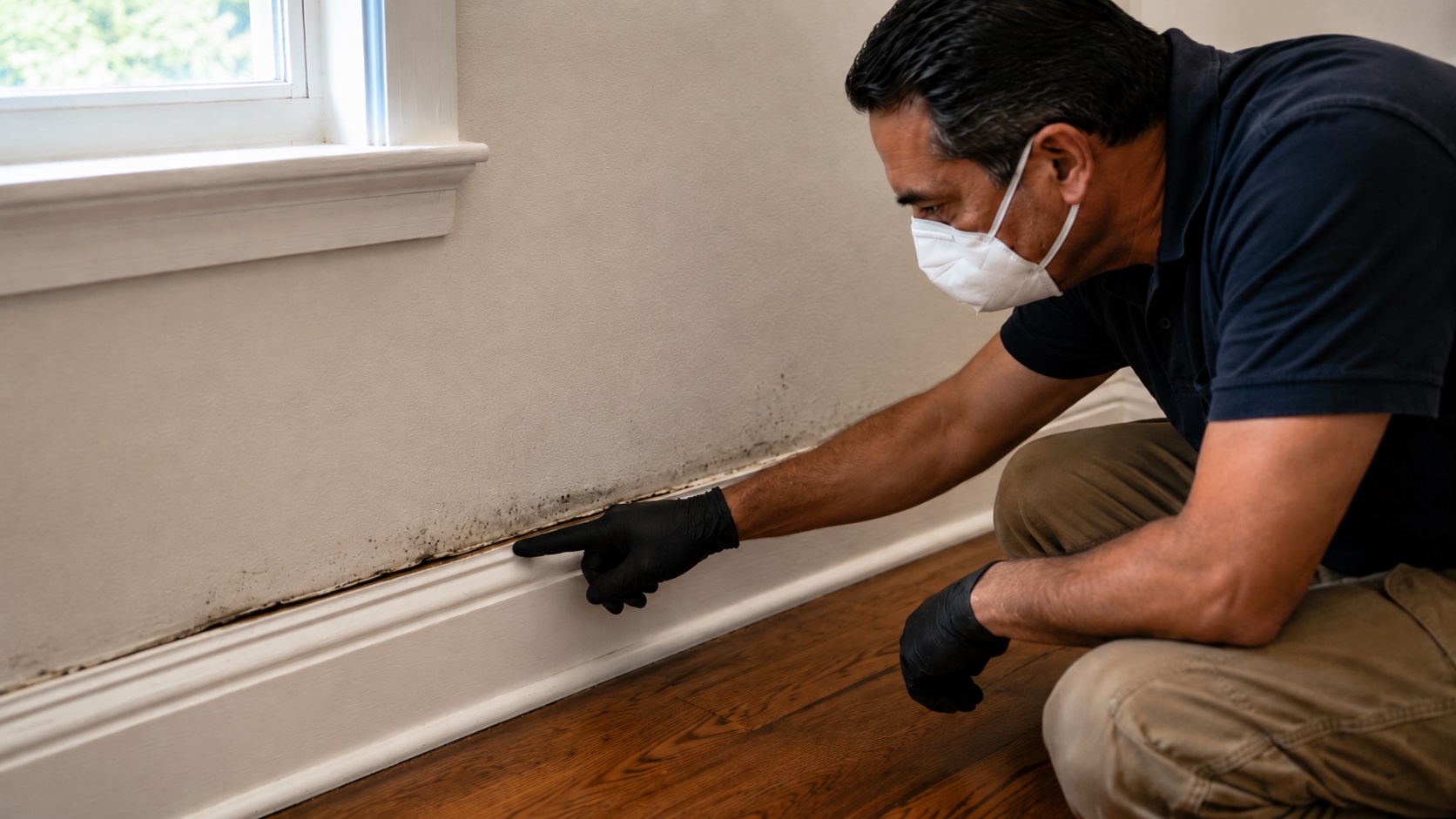
Signs of Mold Behind Baseboards
Mold behind baseboards often starts where trim covers the lowest part of the wall — exactly where moisture collects after leaks, condensation, or minor flooding. The earliest signs are usually musty odors near floor level, recurring discoloration along the trim, caulk staining, spreading spots, or stains that return after cleaning.
Recognizing the early signs of mold behind baseboards can help prevent widespread contamination, protect indoor air quality, and reduce repair costs. Mold growth in these areas often begins after moisture remains trapped near the floor-wall junction, especially following plumbing leaks, condensation problems, or minor flooding events.
If you have not confirmed moisture yet, review how to detect moisture behind baseboards before assuming mold is present. Mold almost always follows persistent moisture, and if hidden growth is confirmed, how to remove mold permanently explains the broader cleanup and source-control process.
Why Mold Often Starts Behind Baseboards
Baseboards create an environment that naturally supports mold growth when moisture is present. Their position along the lowest part of the wall makes them a collection point for water movement, while their shape restricts airflow and traps moisture against vulnerable materials.
Several structural factors contribute to mold growth behind baseboards:
- Gravity-driven moisture movement: Water naturally flows downward through wall materials, concentrating at the floor level.
- Restricted airflow: Baseboards block airflow along the lower wall edge, slowing drying and allowing moisture to remain trapped.
- Absorbent materials: Drywall paper, wood trim, and dust trapped behind trim provide organic material that mold can use as a food source.
- Hidden moisture retention: Even after visible surfaces dry, hidden materials behind the trim may remain damp.
These conditions explain why mold often develops at the baseboard level before appearing in more visible wall areas. For more background on the moisture mechanics, see why baseboards trap moisture.
Even minor plumbing leaks, exterior-wall condensation, or water intrusion below windows and doors can create enough hidden dampness for mold to form behind baseboards.
Early Signs of Mold Behind Baseboards
Early mold growth behind baseboards rarely appears as obvious black patches right away. Instead, the first symptoms often involve subtle sensory changes and small visual clues that develop gradually over time.
The most useful early clues are signs that repeat, spread, smell musty, or return after cleaning.
Musty Odors Near Floor Level
A persistent musty odor near baseboards is often the earliest sign of mold behind trim. Mold produces microbial volatile organic compounds (MVOCs), which create the familiar damp, earthy smell associated with mold growth.
This odor typically develops before visible mold appears. It may be most noticeable in:
- Rooms with previous water exposure
- Areas along exterior walls
- Spaces behind furniture placed against walls
- Rooms with limited airflow
If musty odors remain after cleaning or ventilation, hidden mold behind baseboards becomes more likely. In these situations, it is important to also evaluate moisture conditions because ongoing dampness supports mold development.
Subtle Discoloration Along the Baseboard Edge
Small changes in color along the baseboard surface or adjacent wall often indicate early mold activity. These discolorations may appear faint at first and gradually darken over time.
Look for:
- Light gray or brown staining along trim edges
- Uneven color patches at baseboard seams
- Shadow-like discoloration near corners
- Recurring stains after cleaning
Discoloration that returns repeatedly after cleaning is particularly suspicious because mold growth often originates beneath the visible surface.
Caulk Separation or Staining
Baseboards are typically sealed with caulk along the top edge. When moisture accumulates behind the trim, caulk may separate from the wall or develop discoloration.
Signs to watch for include:
- Darkened caulk lines
- Cracked or peeling caulk joints
- Small gaps forming between trim and wall
- Uneven or distorted caulk surfaces
These changes often reflect repeated moisture exposure rather than a single isolated event.
Recurring Moisture Marks at Floor Level
Recurring stains or damp marks near baseboards often signal conditions that support mold growth. These marks may appear after cleaning, seasonal humidity changes, or minor water exposure.
Watch for:
- Dark spots appearing after rainfall or humidity increases
- Moisture patterns returning after drying
- Stains concentrated along specific wall sections
- Water marks spreading slowly along the baseboard line
If these symptoms occur repeatedly, mold development becomes increasingly likely. Understanding the difference between water damage and mold growth is important at this stage. For more detail on water-related symptoms, review signs of water damage behind baseboards to distinguish moisture damage from active mold growth.
Visible Mold Patterns Behind Baseboards
As mold continues to grow, it often becomes visible in patterns that follow moisture paths behind baseboards. Mold usually changes, spreads, darkens, or returns after cleaning, while simple water staining often stays flat and stable once dry.
Small Spotting Patterns Along Baseboard Edges
One of the earliest visible mold patterns is the appearance of small scattered spots along the baseboard surface or adjacent wall area. These spots may begin as faint discolorations before developing into darker marks.
Common characteristics include:
- Small round or irregular dots
- Clusters forming near seams or corners
- Darkening over time
- Patterns that expand gradually
Spotting patterns usually develop where moisture remains trapped behind trim, especially in areas exposed to repeated humidity or water intrusion.
Linear Growth Along Seams and Edges
Mold often spreads along seams where baseboards meet drywall or flooring. These linear growth patterns follow moisture pathways and commonly appear as narrow lines running parallel to the trim.
Look for:
- Dark lines along trim edges
- Streaks following caulk seams
- Growth concentrated in corners
- Discoloration spreading horizontally
Linear mold growth strongly suggests that moisture is moving along structural seams rather than remaining localized.
Fuzzy vs. Powdery Mold Growth
Mold textures vary depending on environmental conditions. Understanding these differences helps identify whether visible material is likely mold rather than simple staining.
Fuzzy mold growth typically appears when moisture levels remain high. It may look soft or slightly raised from the surface.
Powdery mold growth usually appears in drier conditions and may resemble dust or chalk-like residue.
Both types indicate ongoing moisture exposure. Texture differences help estimate how long moisture has been present.
Darkened Baseboard Back Surfaces
When baseboards are removed during inspection, mold is often found growing on the hidden back surface of the trim. This location receives direct exposure to trapped moisture and organic material.
Common signs include:
- Dark staining across the back of trim boards
- Patchy mold colonies along the lower edge
- Residue that transfers onto nearby materials
- Uneven discoloration along nail lines
If mold appears on the back of the baseboard, additional inspection may be required to determine how far contamination has spread inside the wall cavity.
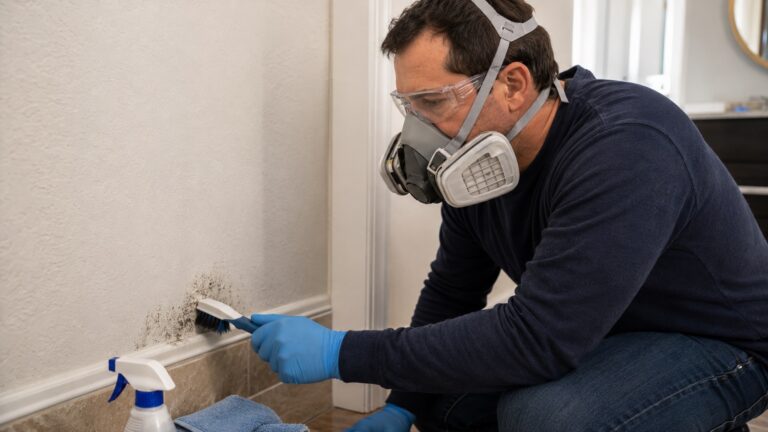
Avoid sanding, scraping, or aggressively brushing suspected mold before the area is evaluated, because disturbing hidden growth can release particles into the room. If trim must be removed, keep the area contained, wear appropriate protection, and stop if the affected area is larger than a small localized section.
Signs Mold May Be Spreading Beyond Baseboards
Mold growth behind baseboards rarely stays confined to a single location if moisture continues. Over time, it may spread into surrounding materials such as drywall, insulation, and flooring.
Wall Discoloration Above the Trim
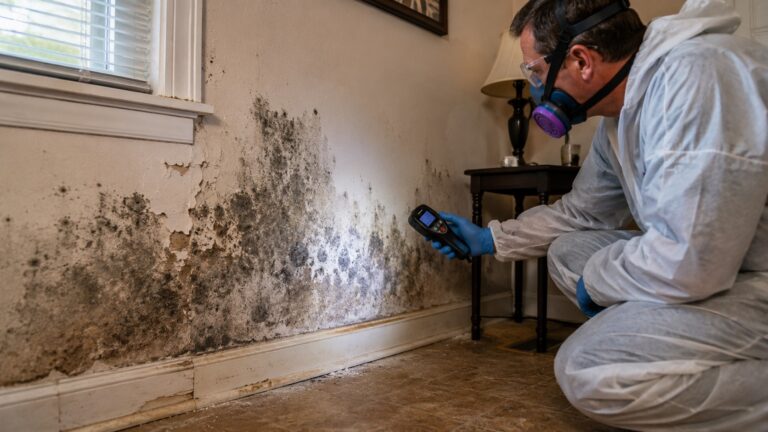
When mold spreads upward from the baseboard, discoloration often becomes visible on the wall surface above the trim. This occurs when moisture travels upward through drywall fibers.
Look for:
- Dark or uneven patches above baseboards
- Discoloration extending vertically
- Stains appearing in repeating patterns
- Gradual expansion of affected areas
Vertical discoloration patterns usually indicate that moisture remains present and supports ongoing mold growth.
Flooring Damage Near Wall Edges
Flooring materials adjacent to baseboards may show damage when mold spreads into lower wall sections. Moisture trapped beneath trim can affect flooring adhesives, wood fibers, and subfloor materials.
Common signs include:
- Dark staining at flooring edges
- Soft or lifted flooring near walls
- Musty odors rising from floor gaps
- Visible mold at floor-wall joints
When both baseboards and flooring show symptoms, the issue may involve a larger moisture source rather than surface-level mold alone.
Persistent Odor After Surface Cleaning
If musty odors continue after baseboards and floors are cleaned, mold may be hidden behind the trim or inside nearby materials. Surface cleaning does not remove mold growing behind the baseboard or inside the wall assembly.
Persistent odor is especially concerning when combined with:
- Recurring discoloration
- High moisture readings
- Past water damage
- Visible staining on nearby surfaces
In these situations, deeper inspection is usually necessary to identify the source and extent of the problem.
How to Distinguish Mold from Water Damage
Water damage and mold growth often appear together, but they are not the same. Water damage refers to staining, swelling, softening, or deterioration caused by moisture. Mold growth is a biological response that occurs when moisture remains long enough for colonies to develop.
Distinguishing between the two helps determine whether the issue is only past moisture damage or active microbial growth.
Signs More Consistent With Water Damage
Some baseboard symptoms indicate moisture exposure without confirming mold growth.
Water damage signs may include:
- Swollen or warped trim
- Peeling paint
- Softened drywall near the floor
- Stains that remain unchanged after drying
- Cracked caulk caused by material movement
These symptoms show that moisture was present, but they do not prove that mold is actively growing.
Signs More Consistent With Mold Growth
Mold-related signs tend to change over time and often return after cleaning.
Mold growth is more likely when you notice:
- Musty odors
- Spots that expand gradually
- Discoloration that reappears after cleaning
- Fuzzy or powdery surface texture
- Dark growth on the back of removed trim
When these signs appear together, mold behind baseboards becomes a stronger possibility.
Common Areas Where Baseboard Mold Appears
Mold behind baseboards is more likely in areas where water exposure, condensation, or restricted airflow is common. Certain rooms and wall sections deserve closer attention during inspection.
Bathrooms and Laundry Rooms
Bathrooms and laundry rooms expose baseboards to frequent humidity, spills, plumbing leaks, and condensation. Mold often forms behind trim near tubs, showers, toilets, washing machines, and exterior walls.
Warning signs in these rooms include:
- Musty odors after showers or laundry cycles
- Discoloration near plumbing fixtures
- Caulk failure along baseboards
- Soft flooring near walls
Because these rooms experience repeated moisture, small signs should not be ignored.
Kitchens and Sink Areas
Kitchen baseboards may develop mold after dishwasher leaks, sink plumbing drips, refrigerator water line issues, or repeated floor cleaning with excessive water.
Inspect baseboards near:
- Dishwashers
- Sink cabinets
- Refrigerators with water lines
- Exterior kitchen walls
Mold in kitchen baseboards often appears near appliance edges or cabinet toe-kick areas where water can remain hidden.
Exterior Walls and Corners
Exterior walls are more likely to experience condensation, cold surface temperatures, and hidden water entry. Baseboards along these walls may stay damp longer than interior trim.
Pay attention to:
- Corners with poor airflow
- Baseboards behind furniture
- Walls below windows
- Areas near exterior doors
These locations often support mold because moisture and poor airflow occur together.
When Baseboard Mold Indicates a Larger Moisture Problem
Mold behind baseboards is often a symptom of a larger moisture issue. Cleaning visible mold without addressing the moisture source usually allows the problem to return.
The presence of mold may indicate one or more hidden conditions.
Hidden Plumbing Leaks
Plumbing leaks inside walls or near floor level can feed mold behind baseboards. These leaks may be slow and difficult to detect visually.
Possible leak indicators include:
- Mold limited to one wall section
- Stains that worsen over time
- Dampness near plumbing fixtures
- High moisture readings despite dry weather
Localized mold growth near plumbing should always be investigated carefully.
Exterior Water Intrusion
Water entering through siding gaps, window leaks, door thresholds, or foundation issues may appear first at baseboard level. Mold behind trim can be an early clue that exterior water is reaching the wall assembly.
Signs may include:
- Mold appearing after rain
- Staining below windows
- Damage near exterior doors
- Recurring dampness along exterior walls
Rain-related mold patterns usually require investigation beyond the interior trim.
Condensation and Poor Airflow
Condensation can form near cold lower wall sections, especially behind furniture or along poorly insulated exterior walls. When airflow is limited, baseboards may remain damp enough to support mold.
Condensation-related mold is more likely when:
- Rooms have high humidity
- Furniture blocks airflow
- Exterior walls feel cold
- Mold appears seasonally
These patterns often point to humidity and airflow issues rather than a single leak event.
When to Inspect Behind the Baseboard
Visible symptoms do not always prove that mold is growing behind the trim, but certain warning signs justify closer inspection. Removing baseboards unnecessarily can damage walls and trim, so inspection should be based on repeated or combined clues.
Inspection behind the baseboard may be appropriate when:
- A musty odor persists near the floor
- Discoloration returns after cleaning
- Moisture readings remain elevated
- Baseboards are swollen or separating from the wall
- There has been recent water damage or flooding
- Visible mold appears along seams or trim edges
If only one faint stain is present and the area is completely dry, continued monitoring may be enough. If multiple signs appear together, hidden mold becomes more likely.
When to Call a Professional
Some baseboard mold situations can be evaluated by homeowners, especially when signs are small and moisture sources are obvious. However, professional help may be needed when mold appears extensive, moisture is ongoing, or the source cannot be identified.
Consider professional evaluation if:
- Mold appears across multiple wall sections
- Musty odors persist after cleaning
- Moisture readings remain high
- Drywall or flooring feels soft
- Mold may have entered wall cavities
- The affected area is larger than a small isolated patch
Professional assessment is especially important when mold may be spreading behind walls or under flooring, because surface-level cleaning may not address hidden contamination.
Health and Indoor Air Quality Concerns
Mold behind baseboards can affect indoor air quality when hidden growth is disturbed or when spores circulate through living spaces. Not every exposure causes symptoms, but persistent odors, visible spread, or mold in bedrooms and frequently used rooms should be taken seriously. For broader exposure context, see mold exposure and indoor air quality.
Common Indoor Air Symptoms Linked to Mold
When hidden mold is disturbed or airflow carries particles into the room, sensitive people may notice irritation symptoms.
Possible symptoms include:
- Sneezing or nasal irritation
- Coughing or throat irritation
- Worsened allergy symptoms
- Eye irritation
- Respiratory discomfort in sensitive individuals
Health symptoms alone do not prove mold is behind baseboards, but they may support further investigation when combined with odors or visible signs.
Why Hidden Mold Can Be Missed
Mold behind baseboards can remain concealed because the visible trim hides the affected surfaces. Even when air quality seems normal, hidden mold may still be present behind materials.
This is why persistent odor, recurring staining, and moisture history are important clues. Hidden mold problems are often identified by patterns rather than one obvious symptom.
Common Mistakes When Evaluating Mold Behind Baseboards
Mistakes during evaluation can cause homeowners to underestimate the problem or disturb mold unnecessarily. Recognizing these mistakes helps prevent further contamination and repeated repairs.
Assuming Surface Cleaning Solves the Problem
Cleaning visible discoloration may remove surface residue, but it does not address mold growing behind the trim. If moisture remains present, mold can return quickly.
Surface cleaning is not enough when:
- Odors remain
- Stains return
- Trim is swollen
- Moisture readings are elevated
The underlying moisture condition must be corrected for mold control to be effective.
Ignoring Odor Because Mold Is Not Visible
A lack of visible mold does not mean the area is clean. Baseboards often conceal the affected surfaces, and odors may appear before visible colonies reach exposed areas.
Persistent musty odor near floor level should be treated as a warning sign, especially in rooms with prior moisture exposure.
Removing Trim Without Moisture Control
Removing baseboards may reveal hidden mold, but it can also disturb spores and expose damaged materials. Inspection should be done carefully, especially when extensive mold is suspected.
Before removing trim, consider whether moisture is still active and whether the affected area may require containment or professional evaluation.
How to Monitor Suspected Mold Behind Baseboards
Monitoring can help determine whether a baseboard issue is stable or getting worse. This is especially useful when signs are subtle and the area does not yet show obvious mold growth.
Track the following conditions over time:
- Whether odors become stronger or more frequent
- Whether stains expand or darken
- Whether moisture readings change
- Whether trim continues to separate or swell
- Whether symptoms appear after rain, humidity, or plumbing use
Patterns matter. Mold behind baseboards is more likely when symptoms repeat under the same conditions or continue to worsen after drying.
FAQ: Signs of Mold Behind Baseboards
What are the first signs of mold behind baseboards?
The first signs are usually musty odors near floor level, subtle discoloration along the trim, darkened caulk lines, recurring stains, or moisture marks that return after drying.
Can mold grow behind baseboards without being visible?
Yes. Mold can grow on the back of baseboards, drywall paper, or hidden wall materials before it becomes visible on the surface. Persistent odor and recurring staining are common warning signs.
Does a musty smell near baseboards mean mold is present?
A musty smell does not prove mold is present, but it is a strong warning sign when combined with moisture history, discoloration, or recurring stains near the baseboard line.
How can I tell if baseboard staining is mold or water damage?
Water damage often appears as stable staining, swelling, or peeling paint. Mold is more likely when spots spread, darken, return after cleaning, feel fuzzy or powdery, or produce a musty odor.
Should I remove baseboards if I suspect mold behind them?
Baseboards may need to be removed if odors, stains, moisture readings, or swelling suggest hidden mold. However, removal should be done carefully because disturbing mold can release spores.
Can mold behind baseboards spread into walls?
Yes. Mold can spread upward into drywall and outward into adjacent materials if moisture remains present. Early detection significantly reduces the likelihood of widespread contamination.
What to Do When You Notice Mold Signs Behind Baseboards
When you notice musty odors, recurring stains, spreading spots, or discoloration that returns after cleaning, treat the baseboard area as a possible hidden moisture and mold location. Confirm whether moisture is still present, compare the pattern with ordinary water staining, and avoid disturbing suspected mold until you know how widespread the issue is.
If the odor is strong, the staining spreads beyond one small area, or moisture keeps returning, further inspection is needed before surface cleaning can solve the problem.
Key Takeaways
- Mold behind baseboards often begins with musty odors, subtle discoloration, caulk staining, or recurring moisture marks.
- Baseboards trap moisture because they restrict airflow and cover the lowest part of the wall.
- Mold is more likely when spots spread, darken, return after cleaning, or appear with a musty odor.
- Water damage and mold often appear together, but water staining alone does not always confirm mold growth.
- Hidden mold may appear on the back of trim, inside drywall, or near flooring edges.
- Persistent moisture, recurring odor, or spreading discoloration should be investigated before the problem expands.
2 Comments
Comments are closed.