
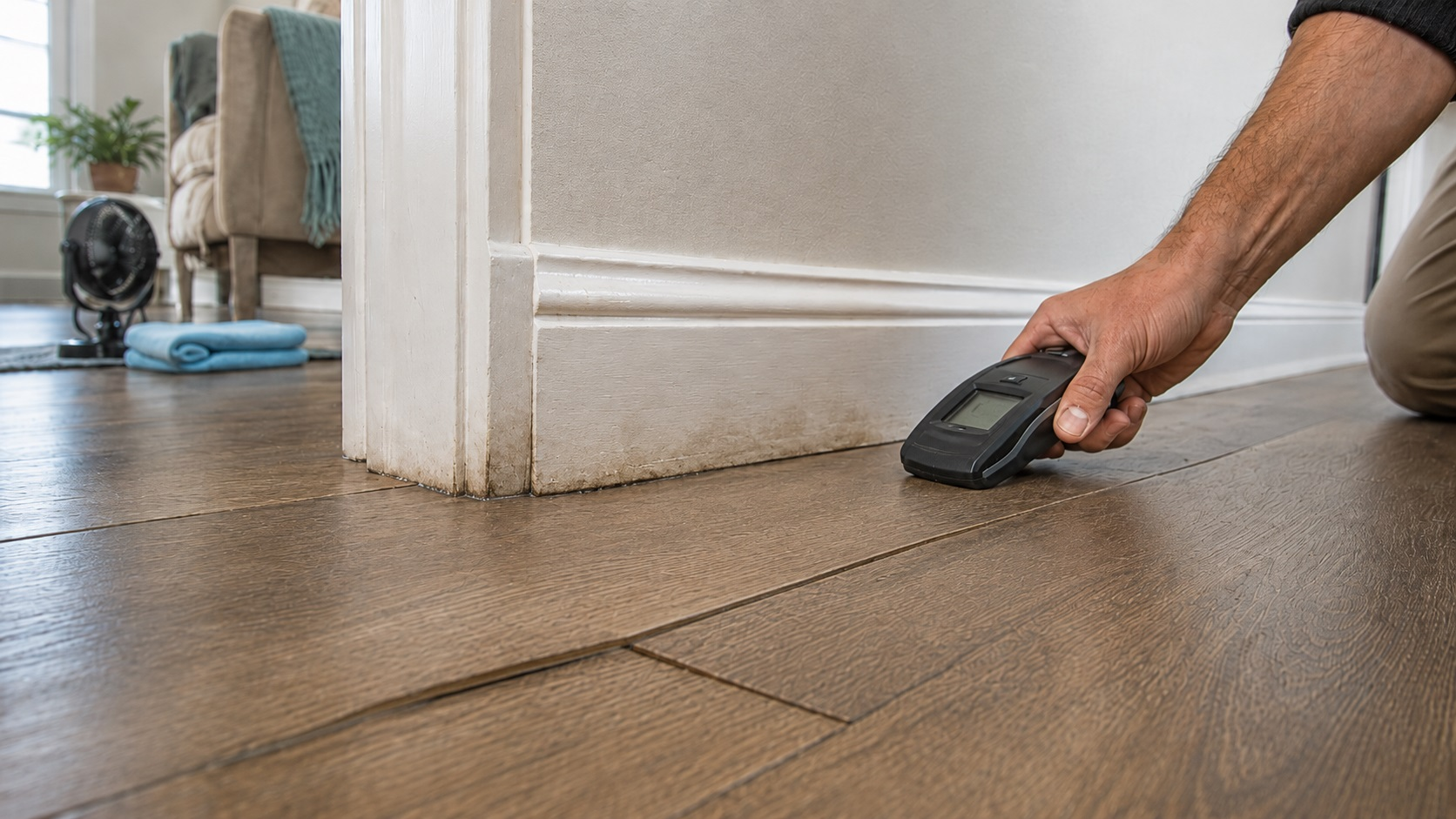
Signs of Mold Under Laminate Flooring
The most common signs of mold under laminate flooring are persistent musty odors, swollen seams, raised board edges, soft or spongy areas, discoloration along joints, and visible mold at floor edges or transitions. These symptoms often appear before mold is visible on the surface because moisture can stay trapped below the laminate layer.
Laminate flooring is especially vulnerable because many boards contain absorbent fiberboard cores and are installed as floating floors over underlayment. When water reaches the seams, wall edges, underlayment, or subfloor, the top surface may look mostly normal while mold develops underneath.
Early recognition matters because laminate mold problems usually begin with subtle changes in smell, board shape, or floor stability. The goal is to identify warning signs early enough to investigate the moisture source before mold spreads into baseboards, subfloor materials, or nearby wall areas.
If laminate-floor symptoms point to hidden mold, the next step is not repeated surface cleaning. Confirm the moisture source, check whether the affected area extends beyond the visible damage, and use safe mold removal guidance before disturbing contaminated flooring materials.
Why Mold Develops Easily Under Laminate Flooring
Laminate flooring can hide mold because moisture often moves below the visible wear layer before homeowners notice a problem. Once water reaches seams, underlayment, or the subfloor, the surface may dry while damp materials remain trapped underneath.
Laminate Core Materials Absorb Moisture Quickly
Most laminate flooring contains a high-density fiberboard (HDF) or medium-density fiberboard (MDF) core. These compressed wood-fiber materials can swell quickly when water reaches board edges, seams, or the underside of the plank.
That swelling is why raised seams, rough edges, and tight joints matter. They often show where moisture has entered the laminate system and may be trapped long enough for mold to develop below the surface.
Floating Floor Systems Trap Moisture Beneath the Surface
Laminate flooring is usually installed as a floating system over underlayment. That design makes installation easier, but it can also leave a concealed layer where moisture collects after leaks, spills, slab moisture, or water entry along walls.
The visible surface may dry while the underlayment or subfloor remains damp. This is why musty odor, seam swelling, or soft spots can matter more than the appearance of the top layer alone.
Underlayment Materials Can Retain Moisture
Underlayment is meant to cushion the floor, reduce noise, and provide limited moisture resistance, but some foam, fiber, or felt-based products can still hold moisture against the subfloor.
When underlayment stays damp, mold may begin below the laminate before any obvious surface growth appears. Odor, localized softness, and edge discoloration are often the clues that the hidden layer is affected.
Common Signs of Mold Under Laminate Flooring
Mold beneath laminate flooring rarely becomes visible right away. Instead, it produces warning signs that develop gradually as moisture remains trapped below the surface. Recognizing these symptoms early can help prevent widespread contamination and structural damage.
Most mold problems beneath laminate floors begin with changes in smell, texture, or board shape. These symptoms often appear in localized areas first before spreading across larger sections of flooring.
Start by comparing the suspicious area with a dry, unaffected section of the same floor. Walk across both areas, feel the seams with your hand, smell near floor edges, and look closely at transitions, baseboards, appliance edges, and doorways where moisture often collects.
Persistent Musty Odors That Do Not Go Away
A persistent musty smell is one of the most reliable early signs of mold developing beneath laminate flooring. Mold releases microbial gases that create the familiar damp, earthy odor commonly associated with wet basements or long-term moisture problems.
This odor often becomes stronger when the room is closed for extended periods, such as overnight or during travel. Many homeowners first notice the smell when entering the room after it has been unused for several hours.
If the smell persists even after cleaning surfaces or airing out the room, the source is likely hidden beneath flooring or within nearby structural materials. Mold growth beneath laminate often spreads across underlayment materials, making odor one of the earliest detectable warning signs.
If musty smells are strongest along wall edges, baseboards, or floor transitions, the problem may extend beyond the laminate itself. In those cases, compare the flooring symptoms with signs of mold behind baseboards to see whether nearby trim or lower wall areas may also be affected.
Swollen or Raised Board Edges
Swelling along laminate seams is a strong indicator that moisture has entered the flooring system. Laminate boards expand when their fiberboard cores absorb water, causing edges to lift or press tightly against neighboring boards.
Raised seams often feel rough when walking barefoot across the floor. In mild cases, seams may appear slightly elevated but remain difficult to see visually. In more advanced cases, seams may become visibly uneven or misaligned. Run your fingertips across the joints and compare the area with a dry section of flooring; mold risk is higher when raised seams are paired with odor or localized softness.
Swelling caused by moisture often appears in localized areas near moisture sources such as dishwashers, refrigerators, sinks, or entry doors. When swelling occurs in specific sections rather than evenly across the floor, mold risk increases significantly.
Soft or Spongy Areas Underfoot
Softness beneath laminate flooring usually indicates moisture damage affecting the underlayment or subfloor. As materials absorb water, they lose strength and begin to compress under weight.
Spongy flooring often feels slightly unstable when walked on. Instead of feeling firm and solid, the surface may shift or flex slightly under pressure. This movement can become more noticeable over time as moisture exposure continues.
Soft flooring conditions are especially concerning when accompanied by odor development or visible swelling. These combined symptoms suggest moisture has been present long enough to create a higher risk of mold growth beneath the flooring.
Discoloration Along Seams or Surface Areas
Discoloration is another common sign of mold beneath laminate flooring. Darkened edges, gray patches, or irregular staining may appear where moisture has traveled upward from below.
Laminate surfaces sometimes show subtle changes in color before more severe swelling occurs. These stains often develop near seams, edges, or areas where moisture remains trapped for extended periods.
Although discoloration does not always confirm mold growth, it strongly suggests long-term moisture exposure—one of the primary conditions required for mold development.
Warping or Bubbling of Laminate Surfaces
Warping occurs when laminate boards change shape due to internal swelling. This distortion may appear as lifting edges, uneven surfaces, or visible curvature across the floor.
Bubbling may also develop when moisture penetrates the protective surface layer. This can cause the top coating to separate slightly from the underlying material, creating raised pockets or surface irregularities.
Warping and bubbling usually indicate prolonged moisture exposure. When these symptoms appear alongside musty odors or softness, mold growth beneath the laminate becomes increasingly likely.
Visible Mold at Floor Edges or Transitions
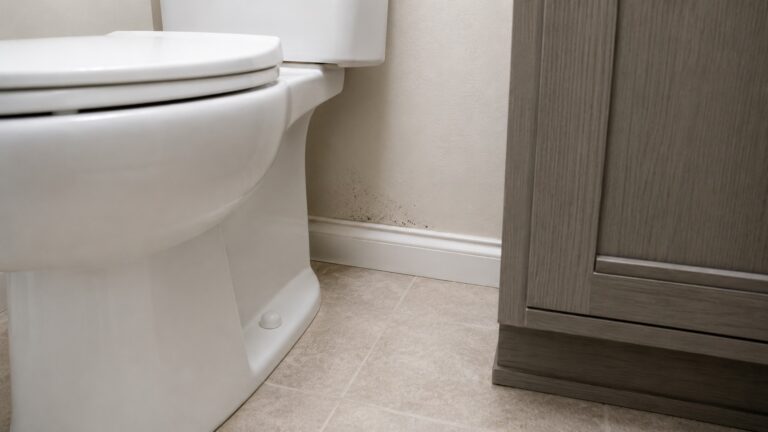
Although mold beneath laminate flooring often remains hidden, it sometimes becomes visible along edges where boards meet walls, doorways, or transitions between flooring types.
Visible mold growth may appear as dark spots, fuzzy patches, or staining along exposed seams. When mold becomes visible at these locations, it usually indicates that mold colonies are already present beneath the flooring surface.
If visible mold appears at edges, immediate investigation is recommended. Mold growth that reaches visible surfaces often indicates prolonged moisture exposure and potential contamination beneath surrounding materials.
Indirect Signs That Mold May Be Beneath Laminate
Not all mold-related symptoms appear directly on flooring surfaces. In many cases, hidden mold produces indirect warning signs that affect indoor air quality, comfort, and health. Recognizing these indirect symptoms can help homeowners identify mold problems that remain concealed beneath laminate flooring.
Air That Smells Stale, Damp, or Earthy
Hidden mold beneath laminate often affects the room before it becomes visible. Watch for air that smells damp, earthy, or stale, especially after the room has been closed overnight or after ventilation temporarily clears the smell and it returns.
This sign is strongest when it appears with physical flooring symptoms such as raised seams, soft spots, or edge discoloration.
Irritation That Appears Worse in the Affected Room
Recurring coughing, sneezing, eye irritation, congestion, or odor sensitivity does not prove that mold is under the laminate. However, these symptoms become more meaningful when they are worse in the affected room and appear alongside musty odor, swelling seams, or visible edge staining.
Recurring Moisture Smells After Cleaning
Repeated surface cleaning will not solve odors coming from mold below laminate. If the floor smells better briefly but the musty odor returns, the source may be under the boards, in the underlayment, or at the subfloor rather than on the visible surface.
How Mold Under Laminate Differs From Moisture Damage Alone
Not all laminate flooring problems involve mold. Moisture alone can cause swelling, warping, and surface damage without microbial growth. However, when moisture remains trapped for extended periods, mold becomes more likely. Understanding the difference between simple moisture damage and mold development helps homeowners make better decisions about inspection and remediation.
Moisture Damage Without Mold
Moisture damage occurs when laminate flooring absorbs water but dries before mold colonies have time to form. In these situations, flooring may swell temporarily, seams may lift, or surfaces may distort. However, these symptoms often stabilize once moisture levels return to normal.
Typical characteristics of moisture-only damage include:
- Temporary swelling that improves as humidity decreases
- Localized distortion after short-term spills
- No persistent musty odors
- No recurring air quality changes
Moisture damage alone does not always mean mold is present. However, repeated wetting events increase the risk of mold growth beneath laminate flooring.
Mold Development After Prolonged Moisture
Mold growth begins when moisture remains trapped long enough to support microbial activity. Laminate flooring systems are particularly vulnerable because they trap moisture beneath the floating surface.
Unlike temporary moisture exposure, mold-related damage produces persistent symptoms that do not disappear on their own. These symptoms often worsen over time as mold spreads across underlayment and subfloor materials.
Key differences that suggest mold development rather than simple moisture damage include:
- Persistent musty odors that do not fade
- Recurring moisture smells even after cleaning
- Soft or spongy areas beneath flooring
- Visible mold growth at edges or transitions
- Worsening symptoms despite drying attempts
If mold-related symptoms develop following water exposure, it is important to understand why floors develop mold after water damage, since prolonged moisture exposure significantly increases the likelihood of microbial growth beneath laminate flooring.
Moisture Sources That Often Cause These Symptoms
Mold symptoms under laminate usually point back to a moisture source. This article should stay focused on symptoms, but the pattern of damage can help you decide where to inspect first.
- Localized swelling near kitchens, laundry areas, or bathrooms: check for slow appliance or plumbing leaks.
- Symptoms after a spill, leak, or minor flood: moisture may have reached the underlayment even if the surface dried.
- Widespread odor or softness across a large area: moisture may be coming from a crawlspace, basement, concrete slab, or damp subfloor.
- Problems soon after installation: the laminate may have been installed over damp materials or without the right moisture barrier.
For a fuller explanation of moisture-related floor mold after wetting, see why floors develop mold after water damage. If the problem followed a recent water event, review how to dry flooring after minor flooding before assuming the surface is fully dry.
When Mold Symptoms Require Immediate Action
Some mold-related warning signs indicate that conditions beneath laminate flooring are becoming more serious. When symptoms spread quickly, reach floor edges, or appear with persistent softness, the area should be checked before the flooring is cleaned, covered, or disturbed.
Rapid Spread of Odor Across Multiple Rooms
Musty odors spreading into multiple rooms often indicate expanding mold growth beneath flooring materials. When smells become noticeable outside the original area, contamination may be spreading through air pathways or structural spaces.
Odor expansion usually signals that mold growth has progressed beyond early stages. This condition requires prompt inspection to prevent further contamination.
Visible Mold Appearing at Floor Edges
Visible mold along baseboards, seams, or transitions should be treated as more than a surface-cleaning issue. At that point, the affected edge, underlayment, and nearby subfloor area may need closer inspection before the floor is cleaned or disturbed.
Immediate action is recommended when visible mold appears. Delaying investigation allows mold to spread into nearby wall cavities, subfloor materials, and adjacent structural components.
Structural Weakness or Persistent Soft Flooring
Soft flooring combined with mold symptoms often indicates prolonged moisture exposure beneath laminate materials. Structural components such as underlayment or subfloor layers may be deteriorating.
Persistent softness should never be ignored, especially when combined with odor or visible mold growth. These symptoms indicate that moisture damage has progressed beyond early warning stages.
If mold symptoms continue despite moisture correction efforts, homeowners may need to evaluate long-term solutions. Understanding how to prevent mold under flooring helps reduce the likelihood of recurring mold conditions after repairs are completed.
When to Call a Professional for Inspection
Many early mold warning signs beneath laminate flooring can be identified by homeowners, but certain situations require professional evaluation. Mold hidden beneath floating floors often spreads farther than expected, and advanced tools may be necessary to confirm the full extent of contamination.
Professional inspectors may use moisture meters, thermal imaging, moisture mapping, and targeted sampling when needed. These tools help determine whether the problem is limited to a small flooring section or whether moisture has spread into underlayment, subfloor materials, baseboards, or nearby walls.
Mold Symptoms Cover Large Sections of Flooring
If mold-related symptoms such as odor, swelling, or softness appear across large areas, professional inspection is strongly recommended. Widespread symptoms usually indicate moisture conditions that extend beyond a single leak or isolated event.
Large-area contamination often involves underlayment and subfloor materials, making removal and remediation more complex. Professional evaluation helps determine whether mold is confined to flooring layers or spreading into nearby structures.
Repeated Mold or Moisture Problems Return
Recurring mold symptoms suggest that the original moisture source has not been fully corrected. Even if previous repairs were performed, hidden leaks or unresolved humidity conditions may still be present.
Repeated odor development, seam swelling, or soft flooring should always be investigated further. Persistent mold problems rarely resolve without identifying the underlying cause.
If recurring moisture is suspected, learning how to inspect flooring for hidden moisture can provide additional insight into whether conditions remain active beneath laminate surfaces.
Health or Air Quality Concerns Become Noticeable
Hidden mold beneath laminate flooring can affect indoor air quality over time. If occupants experience persistent respiratory irritation, allergy symptoms, or unexplained discomfort that improves when leaving the room, professional evaluation may be necessary.
Air quality changes alone do not confirm mold growth, but they strengthen the case for inspection when combined with physical flooring symptoms.
Professional assessment helps determine whether mold contamination has reached levels that require remediation or structural correction.
FAQ — Signs of Mold Under Laminate Flooring
How do I know if mold is under laminate flooring?
The most common indicators include persistent musty odors, swelling seams, soft flooring, discoloration along joints, and visible mold at floor edges. These symptoms often develop gradually as moisture remains trapped beneath laminate flooring materials.
Does laminate flooring trap mold underneath?
Laminate flooring does not create mold directly, but its floating design can trap moisture beneath the surface. When water remains beneath the flooring, mold may develop within the underlayment or subfloor layers.
What does mold smell like under laminate floors?
Mold beneath laminate flooring usually produces a musty, earthy odor similar to damp basements or wet materials. This smell often becomes stronger when rooms remain closed or poorly ventilated.
Can mold grow under laminate without visible damage?
Yes. Mold frequently develops beneath laminate flooring before visible symptoms appear. Odor development is often the earliest detectable warning sign, even when surface materials appear unchanged.
Is laminate flooring more prone to mold than hardwood?
Laminate flooring is generally more susceptible to mold when moisture becomes trapped beneath it. The fiberboard core absorbs water quickly, and floating floor systems can slow drying, increasing the risk of mold development.
Conclusion
Mold under laminate flooring often shows up first as musty odor, swollen seams, soft areas, edge discoloration, or visible growth at transitions. Because laminate can trap moisture below the surface, these symptoms should be investigated instead of covered with repeated cleaning.
The more signs that appear together, the stronger the case for hidden moisture beneath the laminate. Confirming the moisture source early helps prevent mold from spreading into underlayment, subfloor materials, baseboards, or nearby wall areas.
Key Takeaways
- Persistent musty odors are often the earliest warning sign of mold beneath laminate flooring.
- Swollen seams, soft areas, and surface distortion suggest moisture buildup below the flooring.
- Mold can develop beneath laminate without visible growth on the surface.
- Floating floor systems can trap moisture and increase mold risk.
- Professional inspection is recommended when symptoms affect large areas or return repeatedly.
One Comment
Comments are closed.