How to Detect Moisture Under Hardwood Floors
To detect moisture under hardwood floors, look for localized cupping, crowning, dark staining, musty odors, raised seams, unusual floor noise, or cooler areas that differ from the surrounding boards. Then confirm the suspicion with a moisture meter by comparing readings from the affected area, nearby dry-looking boards, floor edges, and areas near possible leak sources.
Hardwood moves naturally as humidity changes, so the key is pattern recognition. Uniform seasonal movement across the room usually points to humidity. Localized distortion, persistent swelling, odor, or meter readings that are higher in one section usually point to trapped moisture beneath the floor.
This article focuses on detection, not drying or replacement decisions. The goal is to observe the floor, compare symptoms, test the right locations, and decide whether the moisture can be monitored or needs professional inspection.
Quick Detection Checklist for Moisture Under Hardwood Floors
- Look for localized cupping, crowning, staining, raised seams, odor, or new floor noise.
- Compare the affected area with a dry-looking area in the same room.
- Check nearby appliances, plumbing walls, exterior doors, crawlspaces, or slab areas.
- Use a moisture meter in several locations instead of relying on one reading.
- Call a professional if readings stay elevated, the area spreads, or the floor feels soft.
Early detection is also critical because hardwood floor symptoms can connect to nearby walls, subfloors, crawlspaces, or plumbing sources. For a broader location-by-location inspection framework, see how to find hidden moisture in different areas of your home.
Why Moisture Under Hardwood Floors Is Hard to Detect
Moisture beneath hardwood often develops below the visible surface, so the first clues are usually pattern changes: localized board movement, edge staining, odor, or meter readings that differ from nearby dry-looking areas.
Wood Movement Can Hide Early Moisture Problems
Hardwood naturally expands and contracts as humidity changes, which can make early moisture symptoms easy to dismiss. The warning sign is not movement by itself. The warning sign is movement that is localized, persistent, uneven, or concentrated near a likely moisture source.
Seasonal humidity usually affects a broad area in a fairly even pattern. Trapped moisture usually affects one section more than the rest of the room, especially near appliances, plumbing lines, exterior doors, wall edges, or previous spill areas.
Subfloor Moisture Is Often Invisible From Above
Moisture may reach the subfloor from plumbing leaks, appliance leaks, slab moisture, crawlspace humidity, exterior water entry, or a past spill that looked dry on the surface. Because plywood and OSB can stay damp after the hardwood surface looks normal, testing is sometimes needed even when damage is not obvious.
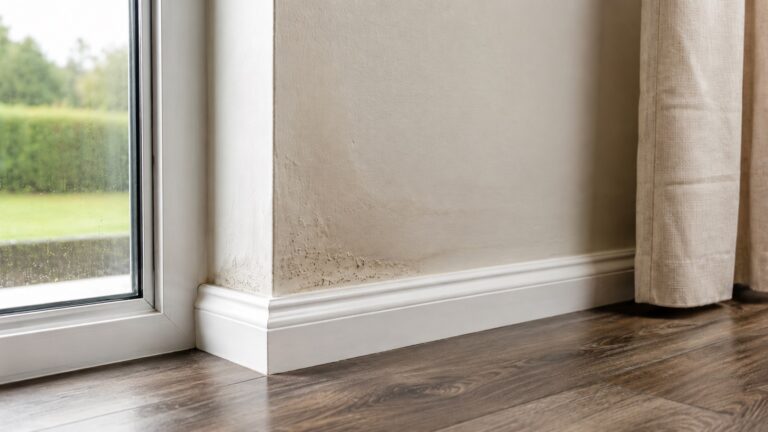
In many cases, early detection requires careful observation of surrounding materials such as baseboards, wall edges, or nearby flooring transitions. If lower wall edges show swelling, staining, or odor near the affected floor, checking for moisture behind baseboards can help identify connected water pathways without turning this hardwood-floor article into a wall-trim inspection guide.
Humidity and Water Intrusion Behave Differently
Humidity-related movement usually appears across a broad area and may improve when indoor humidity returns to normal. Water intrusion is more likely when distortion is localized, irregular, near a moisture source, or paired with odor, staining, raised seams, or high moisture meter readings.
If flooring softness begins to develop along with visible movement, the issue may be progressing beyond surface moisture. Understanding why flooring feels soft after water damage helps explain how structural weakening develops beneath hardwood materials.
Common Signs of Moisture Under Hardwood Floors
No single symptom proves moisture is trapped under hardwood, but several symptoms together make hidden moisture much more likely. Pay closest attention to changes that are localized, worsening, or connected to a recent leak, spill, appliance issue, or exterior water entry point.
Cupping Boards Along the Edges
Cupping is one of the most recognizable signs of moisture beneath hardwood floors. This occurs when the edges of individual boards rise slightly higher than the center, creating a shallow curved shape across the surface.
Cupping develops when moisture accumulates underneath the hardwood planks, causing the underside of the boards to expand more than the top surface. Because the bottom absorbs moisture first, uneven expansion forces the board edges upward.
Early cupping may appear subtle and can feel difficult to detect when walking barefoot. In stronger cases, boards develop noticeable ridges along seams, and the floor may begin to feel uneven underfoot.
Localized cupping—where only certain areas are affected—often indicates hidden moisture sources such as plumbing leaks, appliance overflow, or water intrusion through nearby walls.
Crowning or Warping of Floor Boards
Crowning occurs when the center of a hardwood board becomes higher than its edges. Although crowning may appear similar to cupping at first glance, the underlying causes are different and often indicate longer-term moisture exposure.
This condition frequently develops after flooring has absorbed moisture over time and then begins to dry unevenly. In some cases, crowning can result from attempts to sand cupped flooring before moisture conditions are fully corrected.
Warping may also occur across larger sections of flooring, creating visible waves or irregular shapes. These patterns often indicate extended exposure to trapped moisture rather than short-term humidity fluctuations.
Gaps That Appear or Change Over Time
Small seasonal gaps between hardwood boards are normal, especially during dry winter months. However, changing gap patterns that appear suddenly or remain inconsistent may signal hidden moisture beneath the flooring.
Moisture causes boards to swell unevenly, which can push neighboring boards apart or force them into irregular positions. As moisture levels shift, gaps may widen, narrow, or relocate across the floor.
If gaps appear in isolated sections rather than uniformly across the room, it suggests localized moisture intrusion rather than environmental humidity alone.
Dark Staining or Discoloration
Discoloration along board edges or surface areas often indicates water absorption beneath hardwood flooring. These stains may appear as darker patches, faint gray marks, or irregular color changes that do not match the surrounding wood.
Moisture trapped beneath hardwood may gradually seep upward through seams, carrying minerals or contaminants that alter the wood’s color. Over time, these stains become more visible and may spread outward from the moisture source.
Discoloration near walls or transitions between flooring types can indicate moisture traveling from adjacent structures. If staining appears near baseboards or wall edges, it may be related to moisture conditions developing within the wall assembly.
Musty or Damp Odors Near Flooring
Persistent musty odors are one of the most reliable indicators of hidden moisture beneath hardwood floors. These odors often develop when damp materials begin supporting mold or microbial growth beneath the flooring surface.
Odors may become stronger in enclosed rooms or after the space remains closed for several hours. Many homeowners notice these smells when entering a room after returning from work or waking up in the morning.
If odor development occurs alongside visible floor distortion, the likelihood of trapped moisture increases significantly. In some cases, musty smells near flooring edges may indicate hidden mold growth behind wall materials, making it useful to understand signs of mold behind baseboards when diagnosing related problems.
Increased Floor Noise or Movement
Changes in floor noise can indicate structural movement caused by moisture beneath hardwood planks. Squeaking, popping, or shifting sounds often occur when boards expand against fasteners or rub against adjacent materials.
Moisture causes wood to swell and change shape, which increases friction between boards and subfloor materials. This friction produces new sounds during walking or weight shifts.
Not all noise changes indicate water damage. However, when increased noise occurs alongside visible distortion or odor development, moisture intrusion becomes a likely explanation.
How to Check for Moisture Without Removing Hardwood Floors
You usually do not need to remove hardwood as the first detection step. Start with a surface inspection, compare suspected areas with dry-looking control areas, check humidity, inspect nearby edges and leak sources, and then confirm with a moisture meter before considering invasive inspection.
Visual Surface Inspection
The first step in detecting moisture beneath hardwood floors involves carefully examining the visible surface. Look for subtle changes in shape, color, or texture across the flooring area.
Focus attention on:
- Board seams and joints
- Edges near walls and baseboards
- Areas near plumbing fixtures
- Flooring near exterior doors or windows
- Transitions between flooring materials
Localized symptoms provide stronger evidence of hidden moisture than widespread uniform changes. For example, distortion near a refrigerator, dishwasher, sink wall, exterior door, or bathroom transition may indicate water moving beneath the flooring from a nearby source.
Surface inspection should include areas that rarely receive direct attention, such as corners beneath furniture or sections near wall edges. These areas often show early warning signs because moisture accumulates in low-traffic zones.
Touch Testing for Temperature and Texture Differences
Physical contact with flooring surfaces can reveal subtle moisture-related changes. Moisture beneath hardwood often causes slight cooling effects, particularly in localized areas where evaporation is occurring.
Run your hand across the floor surface and pay attention to:
- Cooler sections compared to surrounding boards
- Slightly damp or sticky textures
- Raised seams or edges
- Uneven surfaces that feel different underfoot
Temperature differences are only clues, not proof. Use them to decide where to test with a meter, especially if the cool area also has raised seams, discoloration, odor, or recent leak history.
Checking Indoor Humidity and Environmental Conditions
Monitoring room humidity provides valuable insight into moisture-related floor movement. Hardwood floors respond strongly to indoor humidity levels, making environmental awareness an important part of detection.
Ideal indoor humidity for hardwood flooring typically ranges between 30% and 50%. When humidity levels remain consistently above this range, moisture-related movement becomes more likely.
Use a hygrometer to measure humidity in rooms where flooring symptoms appear. Persistent humidity above recommended levels increases the likelihood of moisture buildup beneath flooring materials.
Environmental monitoring also helps differentiate between humidity-related expansion and direct water intrusion. If humidity remains normal but flooring distortion continues, hidden moisture sources should be investigated further.
Inspecting Edges, Baseboards, and Adjacent Materials
Floor edges often reveal early evidence of hidden moisture movement. Carefully inspect baseboards, trim, lower wall areas, and flooring transitions for swelling, staining, paint damage, odor, or raised seams.
Moisture beneath hardwood can spread outward into nearby materials, so damage along baseboards or lower walls may help confirm that the problem is not limited to the visible floor surface.
If these inspections reveal widespread signs across multiple flooring types, learning how to inspect flooring for hidden moisture can provide a more structured approach to diagnosing complex moisture patterns throughout the home.
Using Moisture Meters to Confirm Hidden Moisture Under Hardwood
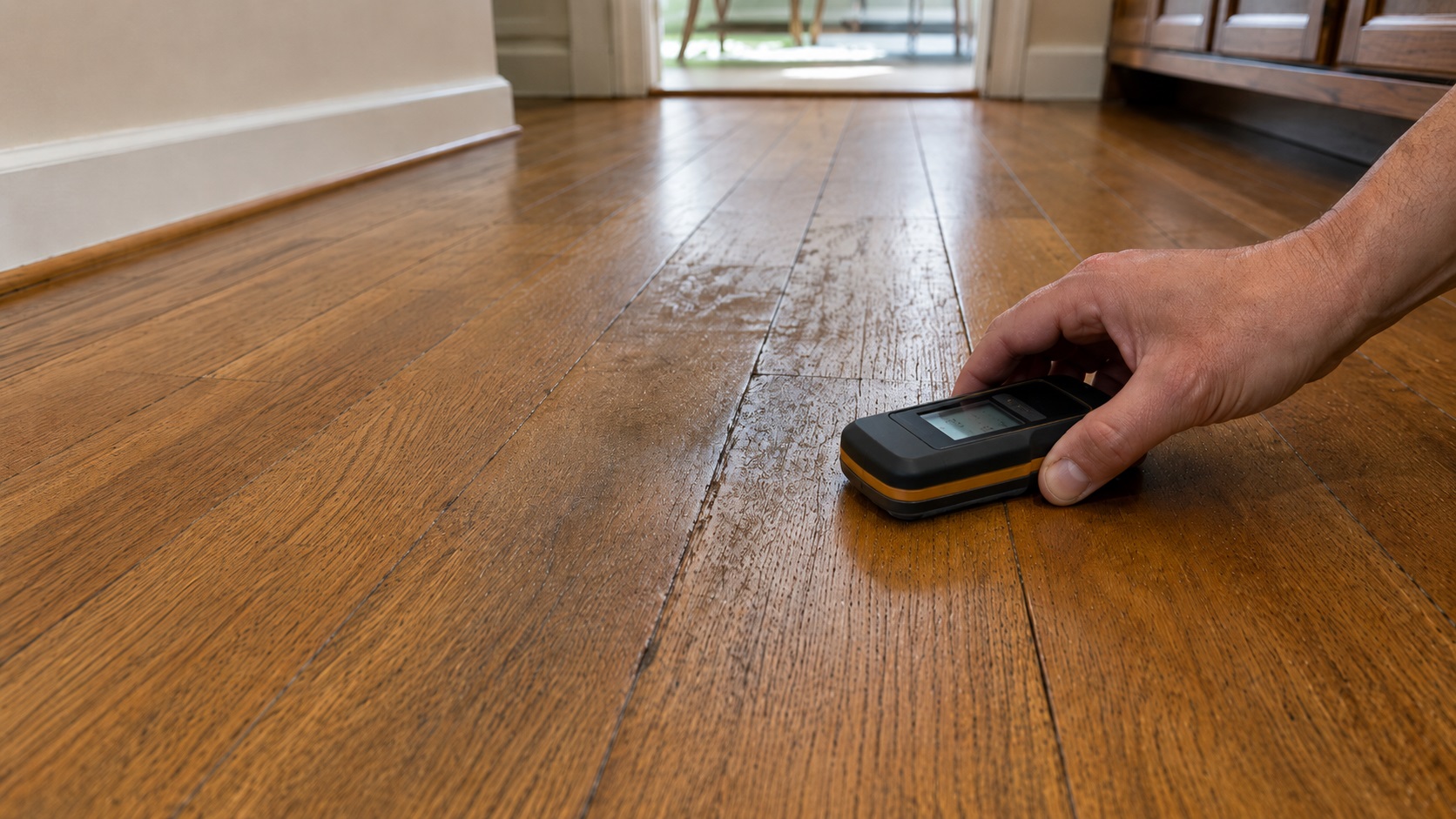
Visual signs and physical inspection methods provide strong clues, but moisture meters offer the most reliable way to confirm whether hidden moisture exists beneath hardwood flooring. When used correctly, they help determine whether visible floor changes are caused by moisture, normal humidity movement, or another flooring issue.
Pin vs Pinless Moisture Meters
Two main types of moisture meters are commonly used for hardwood flooring: pin meters and pinless meters. Each type has advantages depending on the situation.
Pin meters use two small metal probes that penetrate the wood surface to measure moisture content. These meters provide highly accurate readings at specific locations, making them useful for confirming moisture levels in targeted areas.
However, pin meters leave small holes in finished hardwood surfaces. While these holes are usually minor, some homeowners prefer non-invasive options for visible flooring areas.
Pinless moisture meters use electromagnetic scanning technology to measure moisture below the surface without penetrating the wood. These meters glide across the floor surface and provide quick readings across larger areas.
Pinless meters are especially useful for initial detection because they allow fast scanning across multiple floor sections without leaving holes. Regardless of the type used, moisture readings should always be compared across multiple locations to establish a reliable baseline.
Where to Test Hardwood Floors
Testing location matters just as much as the tool itself. Moisture rarely spreads evenly beneath hardwood flooring. Instead, it concentrates around moisture sources and gradually moves outward.
Focus moisture testing in areas such as:
- Near appliances such as refrigerators and dishwashers
- Along exterior walls and window openings
- Near plumbing fixtures and sinks
- At transitions between rooms or flooring types
- In areas showing visible distortion or discoloration
- Near entry doors exposed to outdoor moisture
Comparing readings from affected areas with readings from unaffected areas helps identify abnormal moisture levels. For example, a reading significantly higher in one section of flooring compared to surrounding areas strongly suggests localized moisture intrusion.
It is also helpful to test flooring edges near walls, since moisture often travels beneath hardwood from nearby wall assemblies. Compare edge readings with readings from the center of the room so you can tell whether the moisture pattern is localized near a wall or spread across the flooring system.
Understanding Moisture Meter Readings
Moisture meters estimate moisture content as a percentage of the wood’s weight. For hardwood flooring, normal moisture levels often fall around 6% to 9% in many indoor conditions, depending on climate, season, wood species, and installation conditions.
Moisture readings above normal ranges suggest that water may be present beneath the flooring. However, interpretation requires context.
Important reading guidelines include:
- Small variations between boards are normal
- Large differences between nearby boards often indicate hidden moisture
- Consistently elevated readings across multiple locations signal widespread moisture conditions
- Increasing readings over time suggest ongoing water exposure
Professional flooring installers often compare readings across several locations to determine whether moisture patterns are localized or widespread. Homeowners can follow similar practices by testing multiple points across affected areas.
Common Moisture Meter Mistakes to Avoid
Moisture meters are highly useful tools, but incorrect use can produce misleading results. Many false readings occur because of improper technique or misunderstanding how moisture behaves beneath hardwood floors.
Common mistakes include:
- Testing only one location instead of multiple points
- Ignoring baseline readings from dry areas
- Using the wrong meter settings for wood materials
- Testing immediately after surface spills before moisture has penetrated
- Misinterpreting humidity-related expansion as water damage
Reliable moisture detection depends on patterns rather than individual readings. Consistent differences between wet and dry areas provide stronger confirmation than isolated measurements.
Where Hidden Moisture Usually Starts Under Hardwood Floors
Understanding where moisture usually starts helps homeowners test the right areas first. Hardwood flooring itself rarely creates moisture problems; water usually comes from plumbing, appliances, exterior entry points, crawlspaces, slabs, or surrounding structural materials.
Appliance Leaks and Plumbing Failures
Appliances connected to water lines are among the most common sources of hidden moisture beneath hardwood floors. Refrigerators with ice makers, dishwashers, washing machines, and sinks can leak slowly for weeks or months while water travels beneath the flooring instead of appearing on top.
Typical warning signs include:
- Moisture symptoms near appliances
- Localized warping close to water sources
- Persistent odors near kitchen or laundry areas
- Repeated distortion in the same floor section
Appliance-related leaks often produce concentrated damage patterns that spread outward from the source. Early detection significantly reduces the likelihood of structural subfloor damage.
Subfloor Moisture From Below
Moisture can also rise into hardwood from below, especially in homes built over crawlspaces, basements, or concrete slabs. Poor crawlspace ventilation, high crawlspace humidity, slab moisture migration, or missing vapor protection can dampen the subfloor and eventually affect the hardwood above.
When moisture originates below the flooring structure, symptoms may appear across larger areas rather than in one small isolated section.
Water Intrusion From Exterior Sources
Exterior water intrusion can also create hidden moisture beneath hardwood floors. Rainwater entering through windows, doors, siding defects, or small structural openings may travel along wall cavities and collect near flooring edges before the source is obvious.
Flooring symptoms near exterior walls deserve close attention because perimeter moisture often appears first along wall edges, transitions, and corners.
If moisture patterns appear alongside other structural changes, understanding why floors develop mold after water damage helps explain how hidden moisture creates long-term microbial growth risks beneath hardwood materials.
Signs Moisture Under Hardwood Floors Needs Immediate Attention
Not every moisture concern beneath hardwood is an emergency, but rapid distortion, soft areas, spreading symptoms, persistent odors, or elevated meter readings need quick attention. These signs suggest the problem may still be active or may have reached the subfloor.
Rapid Board Movement or Distortion
When hardwood boards change shape quickly, it usually indicates active moisture exposure rather than old damage. Rapid cupping, lifting, or visible distortion after a plumbing leak, appliance failure, spill, or flooding event suggests that water may still be spreading beneath the flooring.
If boards begin changing shape within days rather than weeks, inspect and test the area promptly instead of waiting to see whether the floor corrects itself.
Soft or Spongy Areas Underfoot
Soft flooring is one of the most serious warning signs because it may indicate that moisture has reached the subfloor. As the subfloor absorbs water, it can weaken and make hardwood feel flexible, unstable, or slightly spongy under pressure.
If softness appears with odor, staining, visible distortion, or elevated meter readings, the problem may extend beyond the surface boards and should be evaluated more carefully.
Persistent Moisture Meter Readings
Moisture meter readings that remain elevated over time suggest ongoing moisture exposure rather than temporary conditions. If readings remain high after several days of monitoring, the source of moisture is likely still active.
Repeated testing in the same areas helps confirm whether moisture levels are stable, increasing, or decreasing. Stable high readings often indicate trapped moisture, while increasing readings suggest active water intrusion.
If moisture readings continue to rise or fail to return to normal ranges, further investigation is necessary to locate and correct the source.
When to Call a Professional
Many moisture detection steps can be done by homeowners, but large affected areas, repeated symptoms, structural softness, persistent odors, or unclear moisture sources require professional inspection. Flooring specialists, restoration technicians, and building inspectors can determine how far moisture has spread before unnecessary removal begins.
Large Areas Show Visible Distortion
If distortion affects large sections of hardwood flooring, professional evaluation is strongly recommended. Widespread movement may indicate crawlspace humidity, slab vapor intrusion, subfloor moisture, or another systemic problem rather than a small localized leak.
Professionals can use advanced moisture meters, thermal imaging, and structural inspection methods to determine how far moisture has spread beneath the flooring system.
Repeated Moisture Problems Occur
If moisture symptoms return after previous drying or repairs, the original source may not have been fully corrected. Repeated flooring distortion, odor development, or elevated moisture readings suggest ongoing water exposure that may require professional leak tracing or structural inspection.
Structural Damage Is Suspected
Signs such as sagging floors, widespread softness, persistent odor, or worsening distortion may indicate subfloor deterioration. At that point, the goal shifts from basic detection to structural evaluation, so avoid sanding, sealing, or covering the floor until the moisture source has been identified.
FAQ — Detecting Moisture Under Hardwood Floors
How do I know if moisture is under hardwood floors?
Moisture beneath hardwood floors usually produces visible changes such as cupping, warping, discoloration, or odor development. Moisture meters provide the most reliable confirmation by measuring moisture content inside flooring materials. Testing multiple areas and comparing readings improves detection accuracy.
Can moisture exist under hardwood without visible damage?
Yes. Moisture often develops beneath hardwood floors before visible symptoms appear. Subfloor materials can absorb water while surface boards remain visually unchanged. This is why moisture testing is important when leaks or water exposure are suspected, even if damage is not immediately visible.
What moisture level is unsafe for hardwood floors?
Typical hardwood flooring moisture content often falls around 6% to 9% in many indoor conditions, but normal readings vary by climate, season, species, and home environment. A localized reading that is several points higher than nearby dry-looking boards is usually more important than one number by itself.
Can humidity cause hardwood to look like it has water damage?
High humidity can cause hardwood to expand slightly, but this usually occurs uniformly across large areas. Localized distortion, persistent swelling, or uneven movement is more likely caused by trapped moisture rather than environmental humidity alone.
Should I remove hardwood to check for moisture?
Removing hardwood flooring should not be the first step in moisture detection. Non-invasive methods such as visual inspection, moisture testing, and environmental monitoring usually provide enough evidence to confirm moisture presence before removal becomes necessary.
What to Do After You Detect Moisture Under Hardwood Floors
If you suspect moisture under hardwood floors, document the visible symptoms, check nearby leak sources, compare several moisture meter readings, and monitor whether the readings fall or remain elevated. If the floor is soft, the affected area is spreading, odors persist, or readings stay high, stop treating the issue as cosmetic and arrange a professional inspection.