
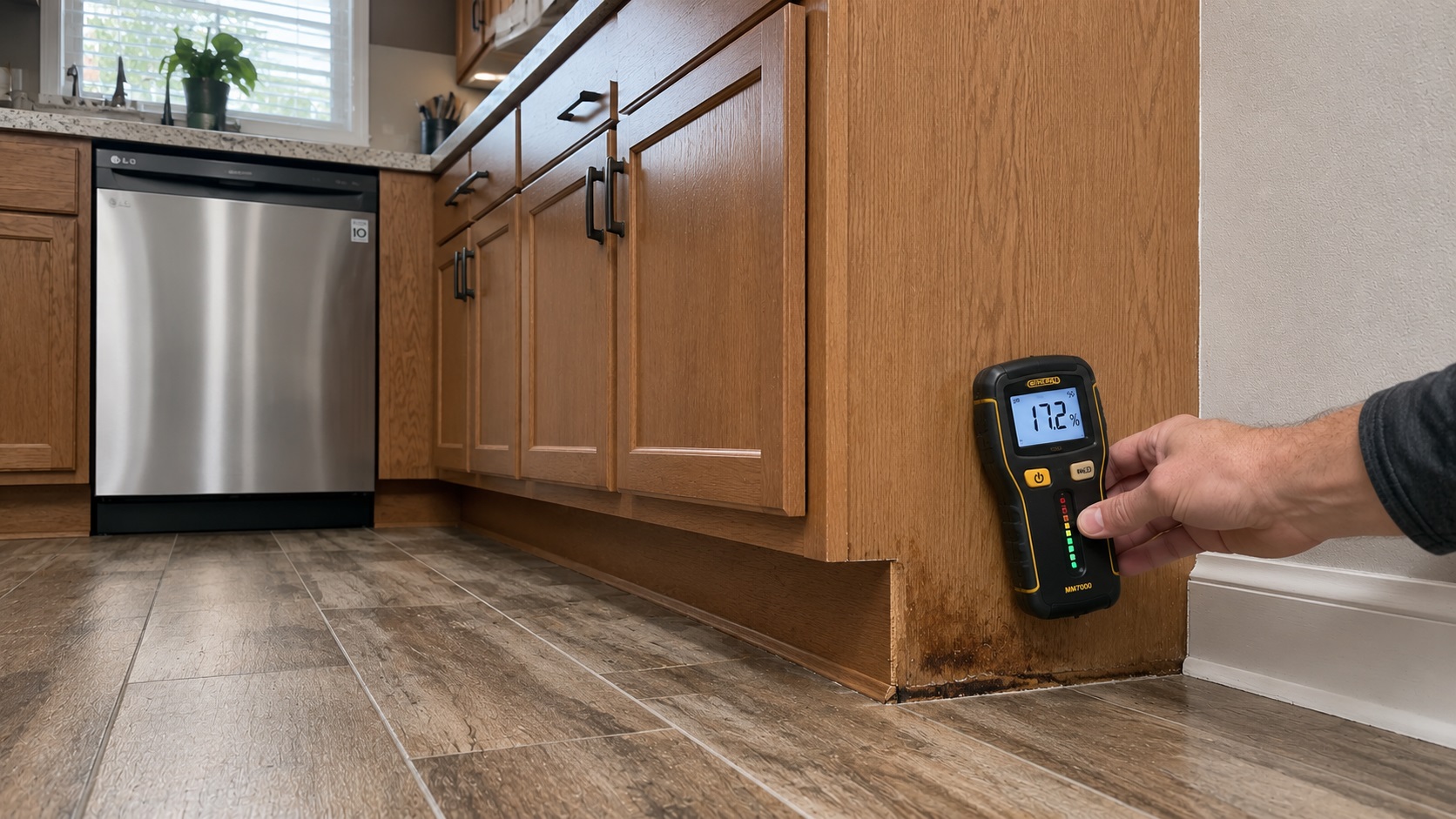
How to Detect Moisture Behind Kitchen Cabinets
To detect moisture behind kitchen cabinets, start by checking for swelling, damp odors, soft cabinet backs, stains near the toe-kick, and moisture meter readings that are higher than nearby dry materials. Cabinet backs and wall surfaces can trap moisture quietly because cabinets block airflow and visibility, so early testing is often needed before mold growth, cabinet damage, or structural deterioration becomes visible.
Many moisture problems behind cabinets begin with slow plumbing leaks, small appliance leaks, or condensation that remains unnoticed. Even small amounts of trapped moisture can lead to material swelling and increase mold risk when the area stays damp. If visible mold signs or persistent musty odors have already appeared, compare the area with signs of mold behind kitchen cabinets.
This guide focuses on practical methods homeowners can use to identify hidden moisture safely and accurately. Understanding how moisture behaves in concealed spaces is the first step toward detecting problems before visible damage appears. For a broader location-by-location inspection framework, review how to find hidden moisture in different areas of your home.
Detecting moisture behind cabinets does not always require demolition. In many cases, visual clues, physical inspection, and simple tools can confirm whether moisture is present. The key is knowing what to look for and where to check.
Why Hidden Cabinet Moisture Is Difficult to Detect
Moisture behind kitchen cabinets is difficult to detect because cabinets create enclosed spaces where water can accumulate without being seen. Unlike open surfaces, these areas receive little airflow, which slows drying and allows moisture to remain trapped for extended periods.
Several structural factors make moisture detection behind cabinets more challenging:
- Limited airflow: Cabinets sit tightly against walls, preventing air circulation that would normally help evaporate moisture.
- Absorbent materials: Many cabinet backs are made from particleboard or fiberboard, which absorb water quickly and hold moisture internally.
- Hidden wall surfaces: Once cabinets are installed, the drywall behind them becomes difficult to inspect without removing panels.
- Multiple nearby water sources: Kitchens contain plumbing lines, dishwashers, and refrigerators that may leak slowly without immediate visibility.
Cabinets installed along exterior walls present an additional challenge. Temperature differences between indoor air and cooler exterior surfaces can create condensation inside wall cavities. This moisture can remain hidden behind cabinet backs for long periods, especially in humid climates or homes with poor ventilation. Understanding why kitchen cabinets trap moisture helps explain how moisture develops in these concealed spaces.
Another reason moisture behind cabinets is difficult to detect is that early damage may not be visible on exposed surfaces. Moisture often spreads gradually through porous materials, affecting hidden layers before noticeable surface changes occur.
Because hidden moisture problems develop slowly, early detection depends on subtle warning signs, careful surface checks, and targeted moisture testing.
Early Warning Signs of Hidden Cabinet Moisture
Moisture behind kitchen cabinets rarely appears suddenly. In most homes, early warning signs develop gradually as materials absorb water and lose structural stability. Learning to recognize these early clues allows homeowners to investigate before mold growth or structural damage begins.
One of the earliest signs of hidden moisture is a change in cabinet materials. Particleboard and fiberboard, which are commonly used in cabinet construction, react quickly to moisture exposure. These materials absorb water easily and may swell even when moisture levels are only moderately elevated.
Common early warning signs of moisture behind kitchen cabinets include:
- Cabinet base swelling: Bottom cabinet panels may expand slightly, causing uneven edges or difficulty closing doors.
- Soft cabinet backs: Interior panels may feel weaker or less rigid than surrounding materials.
- Loose toe-kicks: Trim pieces at the bottom of cabinets may separate as materials swell.
- Recurring damp odor: Moisture often produces a mild humidity smell before mold develops.
- Water stains or discoloration: Yellow, brown, or dark marks may indicate past or ongoing moisture exposure.
- Surface warping: Cabinet panels may begin to curve or bow slightly due to uneven moisture absorption.
These warning signs often appear before visible mold growth develops. Moisture problems may exist even when cabinet interiors look relatively clean. If mold-related odors are already present, the issue may have progressed beyond early moisture exposure, as described in signs of mold behind kitchen cabinets.
If the warning signs are mostly stains, swelling, peeling finishes, or softened material rather than mold growth, compare them with signs of water damage behind kitchen cabinets to separate moisture damage from mold-specific symptoms.
It is also important to pay attention to environmental patterns. Moisture problems often worsen during humid weather, after heavy appliance use, or following plumbing repairs. Changes that occur repeatedly under the same conditions usually indicate a moisture-related cause.
How to Inspect Kitchen Cabinets for Hidden Moisture
Hands-on inspection is one of the most effective ways to detect hidden moisture behind kitchen cabinets. These methods rely on visual observation and physical testing rather than specialized tools. In many cases, careful inspection can reveal early moisture problems before advanced equipment becomes necessary.
Before beginning any inspection, make sure the area is safe to access. Do not touch wet cabinet surfaces near outlets, wiring, garbage disposals, dishwashers, or under-cabinet lighting until power is shut off or the area is confirmed safe.
Start with a systematic visual inspection. Focus on areas where moisture problems are most likely to develop, such as sink cabinets, dishwasher-adjacent cabinets, and exterior wall locations.
During visual inspection, look for:
- Discoloration: Stains along cabinet backs or edges may indicate moisture movement.
- Material distortion: Swelling or warping often signals water absorption.
- Paint or laminate bubbling: Finishes may separate when moisture accumulates underneath.
- Rust on hardware: Hinges and fasteners may corrode when exposed to moisture.
- Water trails: Lines or streaks showing past water movement.
After visual inspection, perform gentle physical testing. Press lightly on suspected areas to check for softness or flexibility. Cabinets exposed to moisture often lose rigidity, particularly near base panels and back surfaces.
Touch-based testing may reveal:
- Spongy material texture: Indicates prolonged moisture exposure.
- Cool surface temperature: Damp materials often feel cooler than surrounding areas.
- Loose fasteners or trim: Swelling materials can loosen screws and mounting points.
It is important to perform these inspections carefully. Avoid forcing panels open or removing cabinet components unnecessarily. If hidden moisture is suspected but cannot be confirmed visually, moisture meter testing provides the next level of detection accuracy. Reviewing structural causes described in why kitchen cabinets trap moisture can also help identify likely problem zones during hands-on evaluation.
Using Moisture Meters to Confirm Hidden Cabinet Moisture
While visual and hands-on inspections can reveal many moisture problems, moisture meters provide a more objective way to confirm whether hidden dampness may exist behind kitchen cabinets. These tools help estimate moisture inside materials such as wood, drywall, and particleboard without requiring full cabinet removal.
Moisture meters are especially useful when early warning signs are present but not yet severe. They help determine whether moisture is actively present or whether staining and swelling occurred in the past.
For best results, test one suspected area and one nearby dry control area made from the same material. A reading that is noticeably higher than the dry comparison point is more meaningful than a single isolated number.
Keep in mind that metal fasteners, pipes, foil-backed materials, tile, and uneven contact can affect readings, so use several test points instead of relying on one number.
There are two primary types of moisture meters commonly used by homeowners:
Pin Moisture Meters
Pin moisture meters use two small metal probes inserted into materials to estimate internal moisture levels below the surface. They can be useful for confirming suspected damp areas when used on the correct material and compared with nearby dry readings.
Advantages of pin moisture meters include:
- High measurement accuracy: Provides precise moisture readings inside cabinet materials.
- Useful for targeted testing: Ideal for confirming suspected moisture areas.
- Effective for drywall and wood: Suitable for cabinet backs and wall surfaces.
Limitations include the need to puncture surfaces slightly, which may leave small pinholes. However, these marks are usually minor and can often be hidden in less visible areas.
Pinless Moisture Meters
Pinless moisture meters use scanning technology to measure moisture without penetrating surfaces. These devices allow rapid scanning across large areas and help identify moisture patterns behind cabinet panels.
Advantages of pinless moisture meters include:
- Non-invasive testing: No damage to cabinet surfaces.
- Fast scanning capability: Useful for identifying wide moisture zones.
- Convenient for initial screening: Helps locate problem areas before deeper testing.
Pinless meters may be slightly less precise than pin meters when measuring deeper moisture levels. For best results, many professionals use pinless scanning first, followed by pin testing to confirm readings.
If you are considering purchasing a detection tool, reviewing recommendations in a guide such as best moisture meters for hidden water damage can help you choose a model suitable for cabinet inspections.
Where to Test Behind Kitchen Cabinets
Correct testing locations are just as important as the tools used. Moisture behind cabinets rarely spreads evenly. Instead, it concentrates near leak sources, condensation zones, or areas with poor airflow.
Testing the right locations improves detection accuracy and reduces unnecessary damage.
Key cabinet testing locations include:
- Cabinet base panels: Moisture often collects at the bottom due to gravity.
- Back panel centers: Hidden wall moisture may appear here first.
- Plumbing entry points: Areas where pipes enter cabinets are common leak zones.
- Cabinet side panels near appliances: Dishwashers and refrigerators frequently cause hidden moisture.
- Lower wall edges: Moisture may migrate downward inside walls.
When testing with a moisture meter, compare readings from suspected areas to readings from dry sections of the same cabinet. Differences between these readings help identify abnormal moisture levels.
Cabinets installed along exterior walls should be tested carefully. Condensation may occur in these locations even when no visible leaks exist. In such cases, seasonal moisture patterns may indicate insulation or ventilation problems rather than plumbing failures.
When Hidden Cabinet Moisture Requires Professional Testing
In some cases, homeowner tools alone may not provide enough information to locate hidden moisture sources. When readings remain elevated or the source cannot be identified, professional evaluation becomes necessary.
Professionals may use specialized tools such as:
- Infrared thermal cameras: Detect temperature differences associated with moisture accumulation.
- Borescopes or inspection cameras: Allow viewing inside wall cavities without full demolition.
- Advanced moisture sensors: Provide detailed readings across multiple materials.
Thermal cameras are particularly useful for identifying areas where moisture may be present, but they do not measure moisture directly. Instead, they reveal temperature differences that suggest damp materials.
If repeated moisture readings remain high despite repairs, the problem may extend behind cabinet backs, into wall materials, or around nearby appliance and plumbing connections. In these situations, reviewing repair-readiness guidance in how to fix persistent moisture behind kitchen cabinets helps determine appropriate next steps.
Professional detection is especially important when moisture problems involve electrical wiring, extensive leaks, or structural components. Attempting invasive inspection without proper equipment can increase repair costs and spread contamination.
Professional inspection is most useful when moisture readings stay high, the source is unclear, or hidden wall cavities may be affected.
Common Mistakes When Checking for Moisture Behind Cabinets
Moisture detection behind kitchen cabinets requires careful observation and accurate testing. However, many homeowners unintentionally make mistakes that lead to incorrect conclusions or delayed repairs. Avoiding these common errors improves detection accuracy and helps prevent unnecessary damage.
One of the most frequent mistakes is assuming that visible dryness means hidden materials are dry. Cabinet backs and wall surfaces can remain damp long after exposed areas appear dry. This is especially true for particleboard and drywall, which absorb water internally.
Other common detection mistakes include:
- Testing only visible surfaces: Moisture often exists behind panels or near plumbing entry points.
- Ignoring small warning signs: Minor swelling or odor changes may indicate early moisture problems.
- Relying on stains alone: Old water stains do not confirm active moisture without testing.
- Using only one test location: Moisture spreads unevenly, so multiple readings improve accuracy.
- Waiting too long to investigate: Delayed detection increases the risk of mold growth and structural damage.
Another frequent mistake is assuming that the absence of visible mold means moisture is harmless. In reality, mold growth may occur later if moisture remains uncorrected, especially when absorbent cabinet materials stay damp behind closed surfaces.
What to Do After Moisture Is Confirmed
Once moisture behind kitchen cabinets is confirmed, the next step is identifying and correcting the source. Moisture will continue to cause damage unless the underlying cause is resolved. Simply drying surfaces without addressing the source often leads to recurring problems.
Do not cover stains, reinstall trim, caulk over gaps, or close the cabinet back up until the moisture source has been corrected and the affected materials have been rechecked.
Common moisture sources behind cabinets include:
- Slow plumbing leaks: Dripping supply lines or loose fittings.
- Slow appliance leaks: Dishwasher seepage, refrigerator water line leaks, or small failures around appliance connections.
- Condensation buildup: Temperature differences along exterior walls.
- Humidity-related moisture: Poor ventilation during cooking or seasonal humidity spikes.
After correcting the moisture source, drying affected materials becomes the priority. If cabinets were exposed to water during a leak, following proper procedures described in how to dry cabinets after kitchen leaks helps prevent mold development.
If moisture problems return repeatedly, deeper cause or repair issues may be involved. Review why kitchen cabinets trap moisture for cause patterns, or use how to fix persistent moisture behind kitchen cabinets when repeated readings suggest a repair decision is needed.
For broader inspection guidance across kitchens, bathrooms, walls, floors, attics, and other hidden areas, use how to find hidden moisture in different areas of your home as the main location-based moisture detection hub.
Frequently Asked Questions
How can I detect moisture behind cabinets without removing them?
You can detect moisture using visual inspection, touch-based testing, and moisture meters. Pinless meters allow scanning without damaging cabinet surfaces, while pin meters provide deeper readings when access is available.
Can moisture exist behind cabinets without visible mold?
Yes. Moisture often exists long before mold becomes visible. Detecting moisture early helps prevent mold growth and structural damage.
What moisture meter readings indicate a problem?
Moisture readings that are noticeably higher than nearby dry areas made from the same material usually deserve further investigation. Exact values vary by material and meter type, so comparison readings are more useful than one isolated number.
Where should moisture testing be performed?
Testing should focus on cabinet bases, plumbing entry points, appliance-adjacent panels, and exterior wall surfaces. These locations face the highest risk of moisture accumulation.
Do I need professional help to detect cabinet moisture?
Professional help may be necessary when moisture readings remain high despite repairs or when wall cavities are suspected to be affected. Professionals use advanced tools to locate hidden moisture without unnecessary demolition.
Key Takeaways
- Moisture behind kitchen cabinets often develops silently due to limited airflow and hidden wall contact.
- Early signs include swelling, damp odors, discoloration, and material softening.
- Moisture meters provide more objective evidence of hidden moisture without major demolition.
- Testing multiple cabinet locations improves detection accuracy.
- Correcting the moisture source is essential to prevent recurring problems.
- Early detection significantly reduces the risk of mold growth and structural damage.
One Comment
Comments are closed.