Best Borescopes for Inspecting Inside Walls
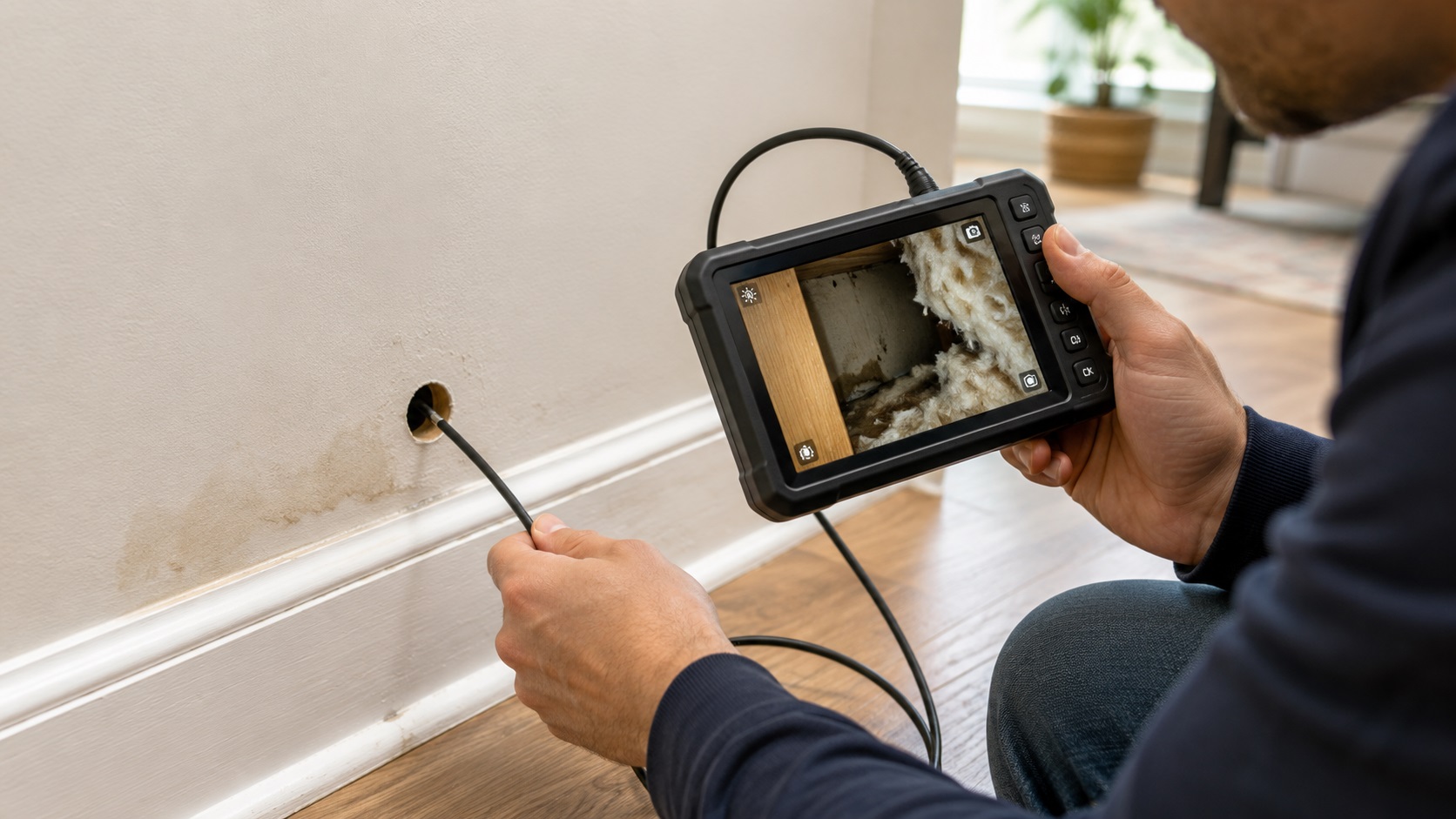
Hidden moisture inside walls is frustrating because the first clues are often vague. A wall may smell musty, show a faint stain, feel soft near the baseboard, or test high with a moisture meter, but you still may not know what is happening inside the cavity. That is where a borescope can help.
For example, a homeowner may notice a musty smell near one wall after rain, but the paint still looks normal. In that situation, a borescope can help you see whether the cavity looks clean and dry or whether there are signs that water has been moving behind the surface.
The best borescopes for inspecting inside walls let homeowners visually check tight spaces through small openings, access holes, plumbing gaps, cabinet openings, HVAC chases, or areas behind trim.
They are not a replacement for a moisture meter, thermal camera, or professional leak inspection. But they can show clues that other tools may miss, such as wet insulation, rusted fasteners, mold-like staining, active dripping, damaged sheathing, or debris inside a wall cavity.
If the drywall already looks stained, soft, bubbled, or uneven, start with how to tell if drywall has water damage before using a camera inside the wall.
This guide focuses on practical borescopes and inspection cameras for residential moisture problems. The goal is to help you choose the right camera for wall cavities, baseboards, cabinets, plumbing chases, HVAC spaces, and other hidden areas where water damage can start before it becomes obvious.
A good wall inspection camera is especially helpful when you want visual evidence before deciding whether to remove trim, cut drywall, or call a professional.
Amazon Affiliate Disclosure: As an Amazon Associate, Dry Home Guide earns from qualifying purchases. This means we may earn a commission if you buy through links on this page, at no extra cost to you.
Which Type of Wall Borescope Should You Choose?
- Choose a built-in screen if you want the easiest setup.
- Choose a small probe if you want the smallest possible access hole.
- Choose articulation if you need to look around pipes, studs, or insulation.
- Choose a phone-compatible model if you only need occasional inspections and are comfortable using an app.
Quick Picks Summary
- Best Overall: DEPSTECH Inspection Endoscope Camera with Light, Dual Lens 1080P, 4.3-Inch Screen, 16.5FT Cable
- Best Small Probe for Tight Wall Openings: NIDAGE Wireless Endoscope Camera with Light, 5.5MM Probe, 4.92FT Cable
- Best Articulating Borescope: Teslong Two-Way Articulating Borescope with Light, 5FT Probe
- Best Premium Screen-Based Articulating Option: Teslong Two-Way Articulating Borescope with 5-Inch IPS Screen, 0.33-Inch Probe
- Best Small-Diameter Premium Upgrade: Teslong Articulating Inspection Borescope with 0.24-Inch Probe, 5FT
- Best Articulating Value Pick: DXZtoz Two-Way Articulating Borescope with Light, 1080P, 5.5FT
- Best Phone-Compatible Budget Pick: Acoath Endoscope Camera with Light, Dual-Lens 1920P, Semi-Rigid Snake Camera for iOS and Android
For a broader moisture inspection strategy, pair a borescope with the parent guide on how to find hidden moisture in different areas of your home. A borescope is best used after you already have a reason to suspect hidden moisture, such as staining, odor, high meter readings, or a recurring leak pattern.
What a Borescope Can and Cannot Show Inside a Wall
- Can show: visible staining, wet insulation, rust, dripping, debris, damaged materials, and mold-like growth.
- Cannot show: moisture hidden inside drywall, moisture behind insulation, mold species, air quality risk, or the full path of a hidden leak.
Product Reviews
DEPSTECH Inspection Endoscope Camera with Light: Dual Lens 1080P Borescope with 4.3″ IPS Screen & 16.5FT Snake Cable
Category Label: Best Overall
For most homeowners, the DEPSTECH dual-lens inspection camera is the easiest model to recommend because it combines a built-in screen, practical reach, a water-resistant camera head, adjustable lighting, and dual-view capability. For wall inspection, the built-in screen is a major advantage because you do not need to connect your phone, download an app, or risk dropping your phone while working near drywall, cabinets, baseboards, or utility areas.
If you want one borescope for wall cavities, cabinet backs, utility areas, and appliance-adjacent moisture checks, this is the best all-around pick in the lineup.
This is a good fit for checking behind access panels, inside cabinet backs, around plumbing penetrations, above ceiling openings, near HVAC lines, and inside short wall cavities. If you are using a moisture meter first and need to see what is behind the wall, this model gives you a simple visual confirmation tool without making the process complicated.
Key Features
- Built-in 4.3-inch viewing screen for app-free inspection.
- Dual-lens camera design helps you look forward and sideways in tight cavities.
- 16.5-foot semi-rigid cable provides enough reach for walls, cabinets, vents, and appliance areas.
- Adjustable LED lighting helps illuminate dark wall and plumbing spaces.
- Water-resistant camera head works well around damp areas, pipes, and drain-adjacent spaces.
Pros
- ✔ Very practical choice for homeowners who want a dedicated inspection screen.
- ✔ Long cable works well for wall cavities, behind appliances, and cabinet runs.
- ✔ Dual-lens viewing is useful when a straight-ahead view is not enough.
- ✔ Does not require WiFi pairing or phone compatibility troubleshooting.
Cons
- ✖ The camera head may still require a larger access opening than very small-probe models.
- ✖ A long cable can be harder to control in very shallow wall cavities.
- ✖ It helps you see hidden conditions, but it does not measure moisture levels.
Best For
- Homeowners who want one dependable borescope for wall cavities, cabinets, plumbing gaps, HVAC spaces, and general moisture investigation.
- DIY users who prefer a built-in screen instead of a phone-connected endoscope.
- Checking suspicious areas after reading Signs of Hidden Moisture in Walls or finding high readings with a moisture meter.
Check the DEPSTECH Inspection Endoscope Camera on Amazon to see current availability.
NIDAGE Wireless Endoscope Camera with Light HD Waterproof WiFi Borescope Flexible 5.5MM Automotive Snake Inspection Camera Compatible Android and iOS Smartphones, iPhone, iPad, 4.92FT
Category Label: Best Small Probe for Tight Wall Openings
Choose the NIDAGE wireless endoscope when the opening is small and you do not want to make the access hole any larger than necessary. Its small 5.5 mm camera head is useful when you want to inspect a wall cavity through a smaller opening, behind trim, under a cabinet lip, or through an existing gap near plumbing or wiring.
This is the kind of camera that makes sense when you are inspecting near finished trim and do not want the repair to become bigger than the inspection.
For moisture investigations, smaller can be better. A large borescope may require a bigger hole, while a slim probe can often fit through small drilled holes or existing access points. This makes the NIDAGE especially useful when you are trying to avoid unnecessary drywall damage. The tradeoff is that it depends on phone connectivity, and the shorter cable is not ideal for long runs.
Key Features
- 5.5 mm camera head for tighter access points.
- Wireless phone-compatible design for iOS and Android devices.
- 4.92-foot semi-rigid cable suited for shallow wall, cabinet, and fixture inspections.
- Built-in LED lighting for dark enclosed spaces.
- Water-resistant camera head for damp inspection areas.
Pros
- ✔ Small probe is helpful for low-damage wall inspections.
- ✔ Good for baseboards, cabinet backs, plumbing penetrations, and shallow cavities.
- ✔ Phone viewing can be convenient if you are comfortable using an app-based tool.
- ✔ Easier to maneuver through tight openings than bulkier screen-based borescopes.
Cons
- ✖ Shorter cable limits use in longer wall runs or deeper inspection paths.
- ✖ Requires phone compatibility and wireless setup.
- ✖ Not as convenient as a dedicated screen model for frequent inspections.
Best For
- Inspecting inside walls through small access holes.
- Looking behind baseboards, bathroom vanities, kitchen cabinets, and trim areas.
- Homeowners who care more about probe diameter than having a built-in screen.
Check the NIDAGE Wireless Endoscope Camera on Amazon to see current availability.
Teslong Two-Way Articulating Borescope with Light, Industrial Endoscope Inspection Camera with Articulated Probe, Flexible Mechanic Fiber Optic Snake Scope Cam for Wall Automotive Engine Inspect-5FT
Category Label: Best Articulating Borescope
The Teslong two-way articulating borescope makes sense when a straight camera keeps showing the wrong part of the cavity. Inside walls, the problem is often not just reach. Studs, insulation, pipes, blocking, wiring, and framing members can prevent a fixed camera from seeing the area that matters. An articulating probe helps you steer the camera head and look around obstacles.
This helps most when you are inspecting a small cavity after a water stain, recurring leak, or musty odor points to one suspicious area. Instead of only seeing straight ahead, you can angle the lens toward pipe connections, wet insulation, backside drywall paper, or the bottom plate area where moisture often settles.
Key Features
- Two-way articulating camera head for directional viewing.
- 5-foot probe length suited for close-range wall and mechanical inspections.
- Built-in lighting for enclosed spaces.
- Designed for wall, automotive, mechanical, and confined-space inspection.
- Helps you look around framing, pipes, insulation, or other obstructions.
Pros
- ✔ Articulating head makes it easier to inspect around pipes, studs, and insulation.
- ✔ Gives better viewing flexibility than a basic fixed-view camera in complex wall cavities.
- ✔ Good option for homeowners who need better visual control.
- ✔ Works well for targeted inspection rather than long-distance cable runs.
Cons
- ✖ Shorter cable than some non-articulating models.
- ✖ Articulating probes usually cost more than basic inspection cameras.
- ✖ More moving parts means you should handle the probe carefully.
Best For
- Wall cavities where you need to look sideways or around an obstruction.
- Checking plumbing chases, fixture walls, and tight utility areas.
- Homeowners who already know the suspicious area and need a better viewing angle.
Check the Teslong Two-Way Articulating Borescope on Amazon to see current availability.
Two-Way Articulating Borescope with Light, Teslong 5-inch IPS Endoscope Inspection Camera with Articulation Head, Automotive Mechanics Fiber Optic Scope-0.33inch
Category Label: Best Premium Screen-Based Articulating Option
This Teslong screen-based articulating borescope is a better fit for homeowners who want the control of an articulating camera without depending on a phone. The larger screen makes it easier to inspect wall cavities carefully, especially when you are trying to distinguish insulation, discoloration, dark stains, wet surfaces, or hidden damage in low light.
When you are trying to confirm hidden water damage, a clearer screen can make a real difference. If you are trying to confirm whether a wall cavity contains wet insulation, water staining, or mold-like growth, squinting at a small phone screen in a dark utility room can make the job harder. This model is best for people who expect to use a borescope more than once and want a more serious inspection tool.
Key Features
- 5-inch IPS display for easier viewing during inspections.
- Two-way articulation helps steer the camera inside tight spaces.
- 0.33-inch probe size balances visibility with access flexibility.
- Integrated lighting for dark wall, cabinet, and mechanical spaces.
- Dedicated screen avoids phone connection issues.
Pros
- ✔ Larger display is helpful for identifying subtle moisture clues.
- ✔ Articulation improves visibility around wall obstructions.
- ✔ Better suited for repeated use than many budget phone-connected cameras.
- ✔ Good choice for homeowners who inspect basements, bathrooms, kitchens, and utility areas regularly.
Cons
- ✖ More expensive than basic borescopes.
- ✖ The 0.33-inch probe may need a larger opening than slim 5.5 mm models.
- ✖ Overkill for someone who only needs one quick look behind a wall.
Best For
- Homeowners who want a premium screen-based borescope for repeated moisture inspections.
- Inspecting around plumbing walls, HVAC spaces, cabinets, and utility rooms.
- Users who want better visibility than a small phone screen provides.
Check the Teslong 5-inch IPS Articulating Borescope on Amazon to see current availability.
Articulating Teslong Inspection Borescope with 0.24inch Probe, 5FT
Category Label: Best Small-Diameter Premium Upgrade
This newer Teslong articulating model is worth considering if you want the benefit of a steerable camera head but also care about a smaller probe diameter. For wall inspection, that combination is valuable. A smaller camera head can reduce the size of the access hole, while articulation helps you aim the lens toward the area you actually need to inspect.
This is a premium-style choice for targeted inspections, not a basic budget camera. It makes the most sense for homeowners who expect to inspect multiple problem areas over time, such as exterior wall leaks, bathroom plumbing walls, kitchen cabinets, attic-adjacent cavities, or recurring moisture zones. If you are comparing this to the larger Teslong screen model, the main reason to choose this one is the smaller probe.
Key Features
- Small 0.24-inch probe for tighter inspection openings.
- Articulating camera head for better viewing angles.
- 5-foot reach suited for close-range residential inspections.
- Useful for wall cavities, mechanical spaces, plumbing areas, and other confined areas.
- Premium-style design for more controlled inspection work.
Pros
- ✔ Smaller probe is useful when you want to limit wall damage.
- ✔ Articulation helps with angled views inside cavities.
- ✔ Good option for targeted inspections behind walls, cabinets, and fixtures.
- ✔ Better for tight access points than bulkier articulating cameras.
Cons
- ✖ Usually a higher-cost option than simple fixed-view borescopes.
- ✖ Shorter reach than long-cable inspection cameras.
- ✖ Best for targeted inspections, not long exploratory runs.
Best For
- Homeowners who want a premium articulating borescope with a smaller access profile.
- Inspecting tight wall openings, baseboard gaps, cabinet backs, and plumbing-adjacent cavities.
- Users who want more control than a fixed camera but less bulk than larger probe models.
Check the newer Teslong 0.24-inch Articulating Borescope on Amazon to see current availability.
DXZtoz Two-Way Articulating Borescope with Light, 1080P Industrial Endoscope Inspection Camera with Flexible Articulated Probe for Automotive Engine Mechanic HVAC- 5.5FT
Category Label: Best Articulating Value Pick
The DXZtoz two-way articulating borescope is the practical middle ground for homeowners who want a steerable camera but do not want the most expensive option in the category. It is especially useful for HVAC gaps, appliance-adjacent cavities, plumbing walls, and other enclosed areas where a fixed lens may not show enough.
For wall inspection, articulation is often more useful than extra cable length. If the camera head cannot turn toward the water source, a long cable may only show the wrong part of the cavity. This model gives homeowners a more flexible inspection tool while still staying focused on practical residential use.
Key Features
- Two-way articulating probe for directional viewing.
- 1080P camera resolution for general inspection clarity.
- 5.5-foot probe length for close-range wall, HVAC, and mechanical spaces.
- Integrated light for dark cavities.
- Useful for HVAC, wall, appliance, and mechanical inspections.
Pros
- ✔ Good value for an articulating borescope.
- ✔ Helps view around obstructions inside walls and utility spaces.
- ✔ Works well for HVAC condensation areas and plumbing-adjacent cavities.
- ✔ Better control than a fixed-view budget camera.
Cons
- ✖ Brand recognition is not as strong as DEPSTECH or Teslong.
- ✖ Shorter cable is not ideal for long exploratory inspections.
- ✖ May be more tool than needed for very simple one-time inspections.
Best For
- Homeowners who want an articulating camera at a more approachable level.
- Inspecting HVAC condensation areas, pipe chases, and wall cavities with obstacles.
- Users who want better viewing control than a basic phone endoscope.
Check the DXZtoz Two-Way Articulating Borescope on Amazon to see current availability.
Acoath Endoscope Camera with Light, Dual-Lens 1920P HD Borescope with 8 Adjustable LED Lights, IP67 Waterproof Boroscope Inspection Tools, Semi-Rigid Snake Camera for iOS & Android
Category Label: Best Phone-Compatible Budget Pick
The Acoath phone-compatible endoscope is the budget-style option in this lineup. It is best for homeowners who only need occasional visual access behind walls, cabinets, fixtures, or appliances and do not want to buy a dedicated screen-based tool. The phone-connected design can keep the tool simple and compact, but it does mean you should confirm compatibility with your device before relying on it for an important inspection.
As an endoscope camera for home inspection, it works best for quick checks in tight areas rather than frequent, detailed wall-cavity investigations.
This type of borescope is most useful when you already know where you want to look. For example, if a moisture meter shows a suspicious reading behind a vanity, under a sink cabinet, or near a wall penetration, a phone-connected camera can help you look inside a small opening before deciding whether more invasive inspection is needed.
Key Features
- Phone-compatible design for iOS and Android devices.
- Dual-lens camera layout for more flexible viewing.
- Adjustable LED lighting for dark enclosed areas.
- Water-resistant camera head for damp inspection zones.
- Semi-rigid cable design for guiding the camera into tight spaces.
Pros
- ✔ Useful budget option for occasional homeowner inspections.
- ✔ Dual-lens design helps when viewing angle matters.
- ✔ Compact and easy to store.
- ✔ Can work well for shallow wall, cabinet, and plumbing inspections.
Cons
- ✖ Depends on phone compatibility and app setup.
- ✖ Listing variations can change, so confirm the active cable length and version before buying.
- ✖ Not as convenient as a built-in screen model for frequent use.
- ✖ Best treated as a light-use option unless the current listing clearly matches the cable length and connector style you need.
Best For
- Budget-minded homeowners who need occasional visual inspection.
- Checking behind cabinets, under fixtures, or near suspected leak points.
- Users comfortable using a phone-connected inspection camera.
Check the Acoath Endoscope Camera on Amazon to see current availability.
Best Borescopes for Inspecting Inside Walls: Product Comparison Table
Use this table as a quick decision guide. The best choice depends less on brand alone and more on probe size, viewing angle, screen style, and how much access you have to the wall cavity.
| Product | Category Label | Best Use Case | Key Strengths | Main Limitation | Amazon Link |
|---|---|---|---|---|---|
| DEPSTECH Dual Lens 1080P Borescope with 4.3-Inch Screen | Best Overall | General inspections behind drywall, cabinets, plumbing runs, HVAC areas, and appliances | Built-in screen, dual lens, long cable, simple setup | Probe may be larger than small-access models | View on Amazon |
| NIDAGE 5.5MM Wireless Endoscope Camera | Best Small Probe for Tight Wall Openings | Small holes, baseboards, trim gaps, cabinet backs, and shallow cavities | Very slim probe, useful for low-damage inspections | Shorter cable and phone-dependent setup | View on Amazon |
| Teslong Two-Way Articulating Borescope, 5FT | Best Articulating Borescope | Looking around studs, pipes, insulation, and wall obstructions | Steerable head gives better viewing angles | Shorter reach than long fixed-camera models | View on Amazon |
| Teslong 5-Inch IPS Articulating Borescope | Best Premium Screen-Based Articulating Option | Repeated inspections where screen size and control matter | Large screen, articulation, dedicated tool design | Higher cost and larger probe than slim models | View on Amazon |
| Teslong 0.24-Inch Articulating Borescope | Best Small-Diameter Premium Upgrade | Tight wall openings where articulation is still needed | Smaller probe plus steerable viewing | Premium choice for targeted inspections, not long runs | View on Amazon |
| DXZtoz Two-Way Articulating Borescope | Best Articulating Value Pick | HVAC, plumbing, and wall cavities where a fixed camera is limiting | Articulation at a more accessible level | Less established brand than some competitors | View on Amazon |
| Acoath Dual-Lens Phone-Compatible Endoscope Camera | Best Phone-Compatible Budget Pick | Occasional inspection behind cabinets, walls, and fixtures | Budget-friendly, compact, phone-compatible | Confirm active variation and phone compatibility before buying | View on Amazon |
How to Choose the Best Borescope for Wall Inspection
Before choosing a borescope, think about the actual spot you need to inspect. A bathroom wall behind a shower valve, a damp baseboard, and a cabinet back panel all call for slightly different tools.
If the problem appears slowly instead of suddenly, compare what you see with the warning signs in Signs of Slow Hidden Water Leaks.
Use the right inspection sequence
- Start with visible clues: stains, swelling, odor, peeling paint, or soft drywall.
- Use a moisture meter or thermal camera to narrow the suspicious area.
- Use a borescope only when visual confirmation will help you decide the next step.
- Stop if you find active leaking, electrical risk, or widespread contamination.
Choose a built-in screen if you want the easiest setup
A built-in screen model, such as the DEPSTECH or premium Teslong screen option, is usually easier for homeowners. You turn on the device, insert the probe, and inspect the area without pairing a phone. This is helpful when you are working in awkward spots, such as under sinks, inside closets, near water heaters, behind appliances, or at floor level.
If you expect to use the camera more than once, a screen-based borescope is usually worth considering. It also keeps your phone away from dirty, damp, or dusty inspection areas.
Choose a small probe when wall damage matters
Probe size matters when you are inspecting drywall. A larger camera may require a larger hole. A smaller camera can often fit through a smaller drilled access point, a gap behind trim, an opening near plumbing, or an existing wall penetration.
When choosing a borescope camera for drywall, probe diameter can matter more than maximum cable length because every access hole has to be patched afterward.
That matters because the inspection hole is usually the easy part. The repair, sanding, texture matching, and repainting are what most homeowners want to avoid.
The NIDAGE 5.5 mm camera and the smaller Teslong articulating option are better choices when you want to limit the size of the opening. That matters if you are inspecting a finished living area, bathroom wall, cabinet back, or baseboard area where patching should be minimal.
Choose articulation when the cavity is complicated
Inside a wall, you rarely get a perfect straight view. Insulation, studs, blocking, pipes, and wiring can all get in the way. An articulating borescope lets you turn the camera head toward the area of concern.
Articulation is especially useful for suspected plumbing leaks, exterior wall leaks, window leaks, shower walls, and HVAC chases. If you are trying to trace a hidden plumbing issue, also read How to Find Hidden Water Leaks Inside Walls before deciding where to inspect.
Choose cable length based on the inspection path
Long cables are useful behind appliances, through cabinet runs, or inside open chases. But inside a shallow wall cavity, too much cable can be harder to control. A 16-foot cable sounds better on paper, but a 5-foot articulating probe may be more useful if you only need to inspect one targeted area.
Match the camera to the access point, not just the problem
A wall stain, musty odor, or high moisture reading tells you where to investigate, but the access point determines which camera will actually work. A narrow gap behind a baseboard may need a small probe, while an open plumbing chase may be easier with a larger screen-based model.
For whole-home moisture problems, do not rely on a borescope alone. The sitewide guide, How to Find, Fix, and Prevent Moisture Problems in Homes, explains how moisture problems start, spread, and return. A borescope is only one inspection tool within that broader system.
Do not confuse a borescope with a moisture meter
A borescope shows what the camera can see. It does not tell you the moisture content of drywall, framing, sheathing, subflooring, or insulation. If you need numbers, use a moisture meter. If you need to understand readings, see Moisture Levels That Indicate Water Damage.
A practical workflow is: first look for symptoms, then test suspicious surfaces, then inspect visually if needed. If you are still deciding which tool type you need, compare this article with Best Moisture Meters for Hidden Water Damage and Best Thermal Imaging Cameras for Detecting Moisture.
An inspection camera for hidden leaks is most useful after you already have a clue, such as a stain, a swollen baseboard, a musty smell, or a suspicious moisture reading.
How to Use a Borescope Inside Walls Without Missing Moisture Problems
Safety note: Do not insert a borescope into areas where you may contact live wiring, energized electrical boxes, sharp metal, or active water near electrical components. If you are unsure what is behind the wall, inspect from a safer access point or call a qualified professional.
Start with the least invasive access point
Before drilling a new hole, look for existing access points. These may include plumbing cutouts under sinks, gaps behind escutcheon plates, openings behind removable trim, HVAC register openings, attic access, basement ceiling openings, cabinet backs, or appliance service gaps.
A snake camera for walls should usually go through an existing opening first, not through a new hole in the middle of a finished surface.
If you do need to make an access hole, choose the smallest practical opening for your camera head. Avoid cutting large holes unless you already know repair is needed.
Use a moisture meter first when possible
A borescope works best when you already have a target area. A moisture meter can help narrow the search area before you insert the camera. This reduces wasted time and helps you avoid inspecting random wall cavities without a reason.
For non-invasive inspection methods before using a borescope, read How to Detect Moisture Without Opening Walls. That article owns the broader detection process, while this article focuses on choosing the right borescope.
Mark the wall before inserting the camera
Use painter’s tape to mark the stain, meter reading, soft spot, or odor source. That helps you keep the camera aimed at the actual problem area instead of wandering through the cavity without a clear target.
Control the light level
Most borescopes have adjustable LEDs. More light is not always better. Too much light can reflect off shiny pipe, foil-faced insulation, standing water, or white PVC and make the image harder to read. Start with moderate light, then adjust as needed.
Move slowly
Fast movement makes wall cavities look confusing. Move the probe slowly and pause when you see stains, dark spots, insulation changes, pipe connections, rust, or debris. If your camera can capture photos or video, document what you see before removing the probe.
A quick sweep through the cavity often misses the most important clue. Slow movement gives your eyes time to catch small stains, droplets, rust marks, and insulation changes.
In real inspections, the biggest clue is often not dramatic. It may be a slightly darker patch of insulation, a rust mark below a pipe, or a water trail at the bottom of the cavity.
Do not force the probe
If the camera gets stuck on insulation, wiring, blocking, or framing, do not force it. Pull back gently and change the angle. Forcing a cable can damage the probe, disturb insulation, or create unnecessary problems inside the wall.
Know when to stop and call a professional
A borescope can help you see clues, but it cannot safely solve active leaks, electrical hazards, structural rot, or mold inside enclosed cavities. If you see active dripping, saturated insulation, blackened structural wood, crumbling drywall, or signs of serious hidden damage, stop and consider professional help.
If the camera shows wet insulation, dark staining, or possible structural damage, use How to Evaluate Hidden Water Damage as a next-step guide before deciding how invasive the repair should be.
Common Borescope Mistakes That Can Hide Moisture Problems
Using a borescope as your only moisture tool
A borescope only shows visible conditions. It can miss moisture hidden behind insulation, inside drywall, or on the far side of framing. Use it with surface clues, moisture readings, humidity monitoring, and leak history.
Buying the longest cable without considering control
Long cables are useful in some situations, but they can be harder to guide inside a shallow wall. If your main use is checking behind baseboards, cabinets, or plumbing walls, probe diameter and camera control may matter more than maximum length.
Ignoring probe diameter
A camera that requires a large access hole may create more repair work than necessary. For finished wall inspections, small-probe models are often more practical.
Expecting a borescope to prove there is no moisture
If the camera does not show water, that does not always mean the cavity is dry. Moisture may be behind insulation, inside materials, or outside the camera’s view. If symptoms continue, use a moisture meter or professional inspection.
Insulation can block the camera’s view. A cavity may look dry from one angle while wet insulation is pressed against the back of the drywall outside the camera’s line of sight.
Misreading dark stains as confirmed mold
A borescope can show discoloration, spotting, or staining, but it usually cannot confirm mold species or exposure risk. Treat suspicious growth seriously, but avoid making unsupported conclusions from camera footage alone.
Inspecting near electrical components carelessly
Do not insert a metal or wet probe into areas with exposed wiring or electrical uncertainty. If water may be near electrical components, stop and get qualified help.
Forgetting to document what you see
Photos and video can help you compare changes over time, show a contractor what you found, or decide whether the problem is getting worse. Documentation is especially useful after repairs or recurring leaks.
FAQ About the Best Borescope for Inspecting Inside Walls
What is the best borescope for inspecting inside walls?
For most homeowners, the DEPSTECH dual-lens borescope with a built-in 4.3-inch screen is the best overall choice because it is simple to use, has a useful cable length, and does not require a phone connection. If you need to inspect through a very small hole, the NIDAGE 5.5 mm model or a smaller Teslong articulating probe may be better.
Borescope vs moisture meter: which one should you use first?
Use a moisture meter first if you need to confirm whether drywall, wood, or trim is holding moisture. Use a borescope afterward when you want to visually check what may be happening inside the cavity. A borescope can show wet insulation, staining, dripping, or mold-like growth, but it does not measure moisture content.
Do I need an articulating borescope for wall inspection?
You do not always need articulation, but it helps when the camera must look around studs, pipes, insulation, or blocking. If you are inspecting complicated wall cavities, plumbing chases, or HVAC spaces, an articulating borescope can be more useful than a fixed straight-view model.
What probe size is best for drywall inspection?
Smaller probes are usually better for finished drywall because they require smaller access openings. A 5.5 mm probe is useful for tight inspections. Larger probes may provide a wider view or stronger features, but they may require a bigger hole.
Is a phone-connected borescope good enough?
A phone-connected borescope can be good enough for occasional inspections, especially behind cabinets, under sinks, or through small access points. However, a built-in screen model is usually easier for repeated use and avoids phone compatibility problems.
Can I use a borescope to inspect for mold behind walls?
You can use a borescope to look for visible mold-like growth, staining, or wet materials behind walls. However, a camera cannot confirm mold type or determine health risk.
If you see suspicious growth inside a wall cavity, focus first on the moisture source. Then decide whether the area needs safe containment, material removal, or professional inspection.
For warning signs before opening a wall, see Signs of Mold Behind Walls.
Should I use a borescope before cutting open drywall?
In many cases, yes. A borescope can help you inspect through a smaller opening before deciding whether a larger drywall cut is necessary. This is especially helpful when you are trying to confirm whether a suspicious area actually contains wet insulation, staining, or visible leak evidence.
Is an inside wall camera better than cutting open drywall?
An inside wall camera can help you inspect a small area before making a larger opening. It is not always enough to diagnose the full problem, but it can help you decide whether cutting drywall is actually necessary.
What should I do if I see wet insulation or active dripping?
Stop treating it as a simple inspection project. Wet insulation and active dripping can indicate an ongoing leak or trapped moisture problem. Shut off the related water source if appropriate, avoid electrical hazards, document what you see, and consider professional inspection or repair.
Conclusion
The right choice comes down to three things: the size of the access point, the viewing angle you need, and how often you expect to use the camera. If you want the simplest all-around choice, the DEPSTECH dual-lens screen model is the best starting point. It gives most homeowners a practical balance of screen size, cable reach, lighting, and ease of use.
If your main concern is making the smallest possible access hole, the NIDAGE 5.5 mm camera is the better fit. If you need to look around obstacles inside the wall, choose an articulating model such as the Teslong two-way borescope, the premium Teslong screen-based model, the smaller Teslong 0.24-inch upgrade, or the DXZtoz articulating value pick.
The Acoath phone-compatible endoscope is best for occasional budget use, but confirm the active listing details and device compatibility before buying. For serious or repeated moisture investigations, a built-in screen or articulating probe is usually easier to work with.
If you are only checking one small spot behind a cabinet, a phone-connected or small-probe camera may be enough. If you expect to inspect several areas over time, a built-in screen and articulating head will usually feel less frustrating.
A borescope will not prevent leaks, stop mold, or measure moisture levels by itself, and it should not be used to justify ignoring a leak that is still active. But when used correctly, it can help you see inside hidden spaces before water damage spreads or before you make unnecessary wall openings. Use it as part of a broader inspection process that includes visual symptoms, moisture testing, humidity awareness, and professional help when the damage looks serious.