Best Roof Sealants for Emergency Repairs
When water is coming through a roof during rain, most homeowners are not trying to complete a perfect permanent repair. They need a temporary way to slow or stop the leak until the roof can be inspected, dried, and repaired correctly. The best roof sealants for emergency repairs are products that can be applied quickly to small leak points, flashing edges, roof seams, gutter joints, RV roof penetrations, or localized trouble spots where water is getting through.
This guide focuses on emergency roof leak sealants, not full roof repair kits, roofing caulks for preventive maintenance, roofing tar products for traditional patching, or peel-and-stick roof patch tapes. Those are separate product categories. Here, the goal is urgent leak control: spray-on rubber sealants, brush-on liquid rubber coatings, wet-surface repair cement, and an RV roof lap sealant for membrane-roof emergencies.
Emergency sealants are not a substitute for fixing damaged shingles, failed flashing, rotted decking, or recurring leak paths. If you are still diagnosing the source, start with how to find roof leaks before mold forms and the roofing hub at Most Common Roofing Material Failures.
As an Amazon Associate, this site earns from qualifying purchases. This does not affect the price you pay. Our recommendations are based on research, product reliability, and real-world usability in moisture-prone environments.
Quick Picks Summary
- Best Overall Emergency Roof Sealant Spray: Gorilla Waterproof Patch & Seal Rubberized Sealant Spray
- Best Recognizable Emergency Spray Sealant: Flex Seal Spray Rubber Sealant Coating
- Best Brush-On Emergency Sealant: Flex Seal Liquid Rubber in a Can
- Best Liquid Rubber for Flat Roof Patches: Liquid Rubber Waterproof Sealant
- Best Wet-Surface Emergency Roof Cement: Henry 208 Wet Patch Roof Leak Repair Cement Cartridge, Pack of 12
- Best for RV Roof Emergencies: Dicor 501LSW-1 Self-Leveling Lap Sealant, 4 Pack
Best Roof Sealants for Emergency Repairs: Product Reviews
Gorilla Waterproof Patch & Seal Rubberized Sealant Spray — Best Overall Emergency Roof Sealant Spray
Gorilla Waterproof Patch & Seal Rubberized Sealant Spray is the strongest overall fit for homeowners who need a quick, spray-on emergency roof sealant for small leaks and exposed trouble spots. It is especially useful when you need to coat a small seam, crack, gutter joint, flashing edge, or roof-adjacent area without brushing on a thick coating. The spray format makes it easier to apply an even layer over irregular surfaces, though it still needs a reasonably clean surface and careful application.
This is a good lead product because it fits the emergency repair intent without drifting too far into roofing tar, permanent caulking, or patch tape territory. It is best understood as a temporary rubberized barrier for localized leak control, not a replacement for fixing failed shingles, missing flashing, or damaged roof decking.
Key Features
- Rubberized spray coating designed to help seal out water, air, and moisture.
- Useful for small roof-adjacent cracks, seams, gutters, flashing edges, and exterior gaps.
- Spray application helps cover uneven shapes more easily than a caulk bead.
- Works best for localized emergency coating, not large roof areas.
- Can be layered when the first coat has been applied properly and allowed to set according to label directions.
Pros
- ✔ Fast spray application for urgent leak-control situations.
- ✔ Good choice for small, irregular areas where a brush or cartridge is awkward.
- ✔ Strong fit for gutters, flashing edges, seams, and minor cracks.
- ✔ Easy for homeowners to keep on hand for emergency moisture problems.
Cons
- ✖ Not the right product for major roof damage, missing shingles, or structural leaks.
- ✖ Overspray can be messy if the area is not masked or controlled.
- ✖ Surface preparation still matters, even in an emergency.
- ✖ A spray coating may not bridge larger openings as well as a repair tape or physical patch.
Best For
- Homeowners who need a fast spray-on emergency roof leak sealant for a small localized leak.
- Minor seepage around gutters, roof edges, flashing transitions, or exterior seams.
- Temporary sealing while waiting for a proper roof inspection or repair.
Flex Seal Spray Rubber Sealant Coating — Best Recognizable Emergency Spray Sealant
Flex Seal Spray is one of the most recognizable emergency waterproofing products for homeowners, and it fits this guide as a quick-use spray sealant for small leak-prone areas. It is not the product to use when a roof needs real reconstruction, but it can be useful when a homeowner needs a temporary coating over a small opening, seam, flashing edge, skylight edge, gutter issue, or RV-related roof trouble spot.
The biggest advantage is convenience. Many homeowners are more comfortable grabbing a spray can during an emergency than loading a caulk gun or brushing on a heavy coating. The tradeoff is that spray sealants require patience and controlled application. A rushed, thin coat over a dirty, wet, moving, or actively separated surface can fail quickly. Use it as a short-term water-control product while you identify the real source of the leak.
Key Features
- Spray-on rubberized coating for localized waterproofing tasks.
- Useful around small roof seams, gutters, skylight edges, flashing details, and RV roof areas.
- Can reach areas where brushing or troweling would be difficult.
- Designed for homeowner-friendly emergency use.
- Available in a familiar format for quick grab-and-apply situations.
Pros
- ✔ Very simple application for homeowners who need a fast temporary seal.
- ✔ Good fit for small roof-adjacent cracks, seams, and joints.
- ✔ Easier to apply around awkward shapes than thick cement-style products.
- ✔ Recognizable product line with broad homeowner familiarity.
Cons
- ✖ Not ideal for large holes, loose materials, or active structural roof failure.
- ✖ May require multiple light coats rather than one heavy coat.
- ✖ Can look obvious depending on color and application area.
- ✖ Should not be treated as a permanent roof repair.
Best For
- Homeowners who want a simple, recognizable spray sealant for urgent small leak control.
- Temporary sealing around gutters, flashing edges, skylights, and roof penetrations.
- Keeping in a storm-preparation kit for minor exterior leak response.
Check the Flex Seal Spray Rubber Sealant Coating on Amazon to see current availability.
Flex Seal Liquid Rubber in a Can — Best Brush-On Emergency Sealant
Flex Seal Liquid Rubber in a Can is better suited than spray products when the emergency area is larger, rougher, or easier to reach with a brush. Instead of misting a thin layer over a small seam, you can brush or roll a heavier rubberized coating over a localized trouble spot. That makes it useful for small roof sections, gutter transitions, flashing edges, and other exterior areas where you need more build than a spray normally provides.
This product is a good choice when the leak area is visible and reachable, but not so damaged that it needs a physical patch, new flashing, or professional repair immediately. It is also helpful when you want more control than a spray can offers. However, brush-on sealants take more effort, can be messy, and need appropriate drying conditions. For active leaks, use it as temporary protection and continue monitoring the area for recurring moisture.
Key Features
- Brush-on liquid rubber coating for localized exterior waterproofing.
- Can be applied more heavily than a typical spray sealant.
- Useful for small roof areas, seams, gutters, flashing details, and roof-adjacent repairs.
- Better for controlled coating work than quick misting.
- Can help create a flexible temporary barrier when applied correctly.
Pros
- ✔ Better coverage control than a spray can for reachable areas.
- ✔ Useful for slightly larger localized patches.
- ✔ Good choice when you need a thicker coating over a small leak-prone zone.
- ✔ Can be brushed into corners and transitions carefully.
Cons
- ✖ Slower and messier than spray products.
- ✖ Requires a brush, roller, or other applicator.
- ✖ Not a substitute for proper flashing replacement or roof repair.
- ✖ Thick coatings can hide the leak source if applied before inspection.
Best For
- Homeowners who need a brush-on emergency sealant for a larger localized leak area.
- Small roof-edge, gutter, flashing, or exterior seam problems where spray is too light.
- Temporary coating while arranging a more complete roof repair.
Check the Flex Seal Liquid Rubber in a Can on Amazon to see current availability.
Liquid Rubber Waterproof Sealant — Best Liquid Rubber for Flat Roof Patches
Liquid Rubber Waterproof Sealant is the best fit in this lineup for localized flat roof or low-slope roof emergency coating. Flat and low-slope roofs behave differently from steep asphalt shingle roofs. Water moves more slowly, puddles are more common, seams are more important, and a small crack or weak spot can keep admitting water until the area is properly repaired. A brush-on liquid waterproofing product can be useful when the leak area is more like a surface patch than a narrow joint.
This should not turn into a whole-roof coating recommendation in an emergency article. The best use here is a targeted patch on a flat, metal, or low-slope roof area where the surface is compatible and the homeowner can follow the application instructions. If the roof has ponding water, membrane separation, saturated insulation, or widespread deterioration, a coating may only hide a larger problem. Use this product for localized emergency sealing and inspect carefully afterward.
Key Features
- Brush-on waterproof sealant suited to flat, low-slope, metal, and similar surfaces.
- Useful for localized surface patches rather than narrow caulk-style joints.
- Can create a flexible coating over small roof trouble spots.
- Better suited to low-slope situations than many spray-only sealants.
- Can be applied with common coating tools when surface conditions are appropriate.
Pros
- ✔ Strong fit for flat or low-slope roof patch areas.
- ✔ Useful where a wider coated area is needed.
- ✔ More practical for surface coating than cartridge sealants.
- ✔ Good option for localized roof, gutter, and metal-surface waterproofing tasks.
Cons
- ✖ Not the simplest choice for a tiny seam or vertical joint.
- ✖ Requires careful surface preparation and application thickness.
- ✖ Not ideal for hidden roof leaks where the entry point has not been found.
- ✖ Can overlap with roof coating or tar-style repairs if the article scope is not kept narrow.
Best For
- Localized emergency coating on flat, low-slope, or metal roof surfaces.
- Homeowners who need a wider brush-on waterproofing patch instead of a spray.
- Temporary surface sealing before a more complete roof repair plan.
Check the Liquid Rubber Waterproof Sealant on Amazon to see current availability.
Henry 208 Wet Patch Roof Leak Repair Cement Cartridge, Pack of 12 — Best Wet-Surface Emergency Roof Cement
Henry 208 Wet Patch Roof Leak Repair Cement is the most traditional emergency leak-control product in this list. It belongs here because wet-surface roof cement can be useful when a leak needs attention during damp conditions and a spray or liquid rubber coating is not the right approach. It can work around roof cracks, seams, holes, flashing edges, vents, and other localized areas where a heavier cement-style material is needed.
For this guide, Henry 208 is included only as the wet-surface emergency roof cement option. It is not meant to turn this comparison into a broader roofing tar or asphalt cement guide. Its role is specific: emergency leak control when a heavier cartridge-applied material makes more sense than a spray or brush-on liquid rubber coating.
Key Features
- Wet-surface roof repair cement for urgent leak-control situations.
- Cartridge format allows controlled application with a caulk gun.
- Useful around localized cracks, seams, flashing details, vents, and roof penetrations.
- Heavier body than spray or thin liquid coatings.
- Best used as a targeted emergency material rather than a broad coating.
Pros
- ✔ Strong choice when the repair area needs a thicker emergency material.
- ✔ Useful in damp roof repair situations where lighter sealants may not be enough.
- ✔ Cartridge application helps control placement.
- ✔ Good emergency option around flashing and roof penetrations when appropriate.
Cons
- ✖ Sold here as a pack of 12, which may be more than some homeowners need.
- ✖ More closely related to roof cement and tar-style products than spray sealants.
- ✖ Can be messy and visible.
- ✖ Not a replacement for correcting failed flashing, damaged shingles, or recurring leak sources.
Best For
- Emergency wet-surface roof leak control around small localized trouble spots.
- Homeowners who need a heavier cartridge-applied repair material.
- Temporary patching around flashing, vents, seams, and small roof defects before proper repair.
Dicor 501LSW-1 Self-Leveling Lap Sealant, 4 Pack — Best for RV Roof Emergencies
Dicor 501LSW-1 Self-Leveling Lap Sealant is the specialized pick in this guide. It is not the right primary choice for a standard residential asphalt shingle roof, but it is highly relevant for RV roof emergencies, membrane-roof seams, roof vents, vent pipes, screw heads, and similar roof penetrations. If your emergency repair involves an RV roof or compatible membrane-style surface, this type of lap sealant is often more appropriate than a general spray coating.
The self-leveling behavior is useful on horizontal roof areas because it helps the sealant settle around the penetration or seam. That same characteristic also means it is not meant for every vertical or steep application. Keep this product clearly positioned for RV and membrane-roof use. For a house roof leak involving shingles, flashing, roof decking, or attic moisture, start with diagnosis and consider whether the issue belongs under a residential roofing repair path instead.
Key Features
- Self-leveling lap sealant designed for RV roof edges, vents, vent pipes, screw heads, and penetrations.
- Useful for compatible EPDM, TPO, and membrane-style roof surfaces.
- Four-pack format gives enough material for multiple RV roof details.
- Designed to flow and settle on horizontal roof areas.
- Best used as a specialized RV and membrane-roof emergency sealant.
Pros
- ✔ Strong fit for RV roof penetrations and membrane roof seams.
- ✔ Better specialized choice than general spray sealants for many RV roof details.
- ✔ Self-leveling behavior helps cover horizontal seams and screw-head areas.
- ✔ Useful for RV owners who need emergency sealing material on hand.
Cons
- ✖ Not the best general-purpose choice for standard residential shingle roofs.
- ✖ Self-leveling formula is not ideal for every vertical or steep surface.
- ✖ Surface compatibility matters.
- ✖ Should not be used to hide larger membrane failure without proper inspection.
Best For
- RV roof emergencies around vents, screw heads, seams, and roof penetrations.
- Compatible membrane-style roof details where self-leveling lap sealant is appropriate.
- RV owners who want a dedicated emergency roof sealant rather than a generic household spray.
Check the Dicor 501LSW-1 Self-Leveling Lap Sealant on Amazon to see current availability.
Emergency Roof Sealant Comparison Table
| Product | Best Pick | Best Use Case | Key Strengths | Main Limitation | Amazon Link |
|---|---|---|---|---|---|
| Gorilla Waterproof Patch & Seal Rubberized Sealant Spray | Best Overall Emergency Roof Sealant Spray | Fast localized emergency sealing around small roof-adjacent leaks | Easy spray application, good for seams, cracks, gutters, and flashing edges | Not enough for major openings, loose roofing, or structural damage | View on Amazon |
| Flex Seal Spray Rubber Sealant Coating | Best Recognizable Emergency Spray Sealant | Simple homeowner emergency sealing for small leak-prone areas | Familiar spray format, easy to keep on hand, useful around awkward details | May require careful multiple-coat application and should not replace proper repair | View on Amazon |
| Flex Seal Liquid Rubber in a Can | Best Brush-On Emergency Sealant | Reachable areas that need a thicker brushed-on emergency coating | More coating control than spray, useful for larger localized patches | Messier and slower than spray products | View on Amazon |
| Liquid Rubber Waterproof Sealant | Best Liquid Rubber for Flat Roof Patches | Localized flat, low-slope, or metal roof surface patches | Good for wider coated areas where a spray or caulk bead is not enough | Not ideal for tiny seams, vertical joints, or unknown leak sources | View on Amazon |
| Henry 208 Wet Patch Roof Leak Repair Cement Cartridge | Best Wet-Surface Emergency Roof Cement | Damp-condition emergency patching around localized roof defects | Heavier cement-style material, controlled cartridge application | More closely related to roof cement/tar and sold as a multi-pack | View on Amazon |
| Dicor 501LSW-1 Self-Leveling Lap Sealant | Best for RV Roof Emergencies | RV roof seams, vents, screw heads, and compatible membrane roof details | Specialized self-leveling formula for horizontal RV roof penetrations | Not a general residential shingle-roof sealant | View on Amazon |
How to Choose the Right Emergency Roof Sealant
The right emergency roof sealant depends less on the brand name and more on the leak situation. A product that works well for a small gutter seam may be the wrong choice for a flat roof surface patch. A self-leveling RV sealant may be excellent around a vent on a camper roof but inappropriate for a steep asphalt shingle roof. Before choosing, identify the surface, the size of the problem, and whether the leak source is actually visible.
For Small Seams, Cracks, and Awkward Details
Choose a spray product such as Gorilla Waterproof Patch & Seal or Flex Seal Spray when the area is small, irregular, and easy to coat from a safe position. Spray sealants are useful when you need quick coverage around small gaps, gutter joints, roof-edge seams, or roof-adjacent openings. They are less useful when the roof material is loose, the gap is wide, or water is entering from underneath a shingle system.
For Reachable Areas That Need More Build
Choose Flex Seal Liquid when the leak zone is accessible and needs more material than a spray normally provides. A brush-on liquid rubber coating can be better for a slightly larger localized area because you can work the coating into edges and build a thicker layer. This is practical for small surface repairs but not for covering a roof area you have not inspected.
For Flat or Low-Slope Roof Trouble Spots
Choose Liquid Rubber Waterproof Sealant when the emergency is a localized flat roof, low-slope roof, or metal roof patch area. Flat roofs often need wider surface coverage rather than a thin bead or quick spray. However, low-slope roofs can also hide deeper problems such as ponding water, membrane separation, saturated substrate, or failed seams. If the leak returns, use signs of recurring roof leaks to decide whether the issue is larger than a surface sealant can handle.
For Damp Conditions and Heavier Emergency Patching
Choose Henry 208 when the repair calls for a heavier wet-surface roof cement. This is useful when spray or liquid rubber is too light for the defect. It can be a practical emergency material around small holes, seams, flashing details, and roof penetrations. Keep the scope narrow: this article is not a roofing tar guide, and Henry 208 should be used here only as the wet-surface emergency roof cement option.
For RV Roofs and Membrane Penetrations
Choose Dicor 501LSW-1 for RV roof emergencies, especially around vents, screw heads, roof edges, and compatible membrane-roof penetrations. It should not be treated as the default choice for residential asphalt shingles. If the leak is inside a house and you are seeing ceiling stains, attic moisture, or damp insulation, review signs of roof leaks inside the house before applying a product blindly.
How to Apply Emergency Roof Sealants Without Hiding the Real Leak
Emergency roof sealants work best when they are used as part of a careful temporary response. Do not climb onto a wet, steep, icy, or storm-damaged roof. If the leak cannot be reached safely, work from inside to contain water, document the damage, and call a roofing professional. A dangerous roof is not worth a DIY sealant application.
Start by identifying the likely leak area. Interior water stains do not always appear directly below the roof opening. Water can travel along rafters, decking, insulation, and framing before dripping into a room. If the source is unclear, read how to detect hidden roof leaks before covering random areas with sealant.
Once the leak area is located, remove loose debris, dirt, leaves, and failing material as much as conditions safely allow. Emergency products may tolerate imperfect conditions, but they still perform better on a clean, stable surface. Do not apply sealant over loose granules, peeling old coating, rotted material, or moving flashing and expect a reliable result.
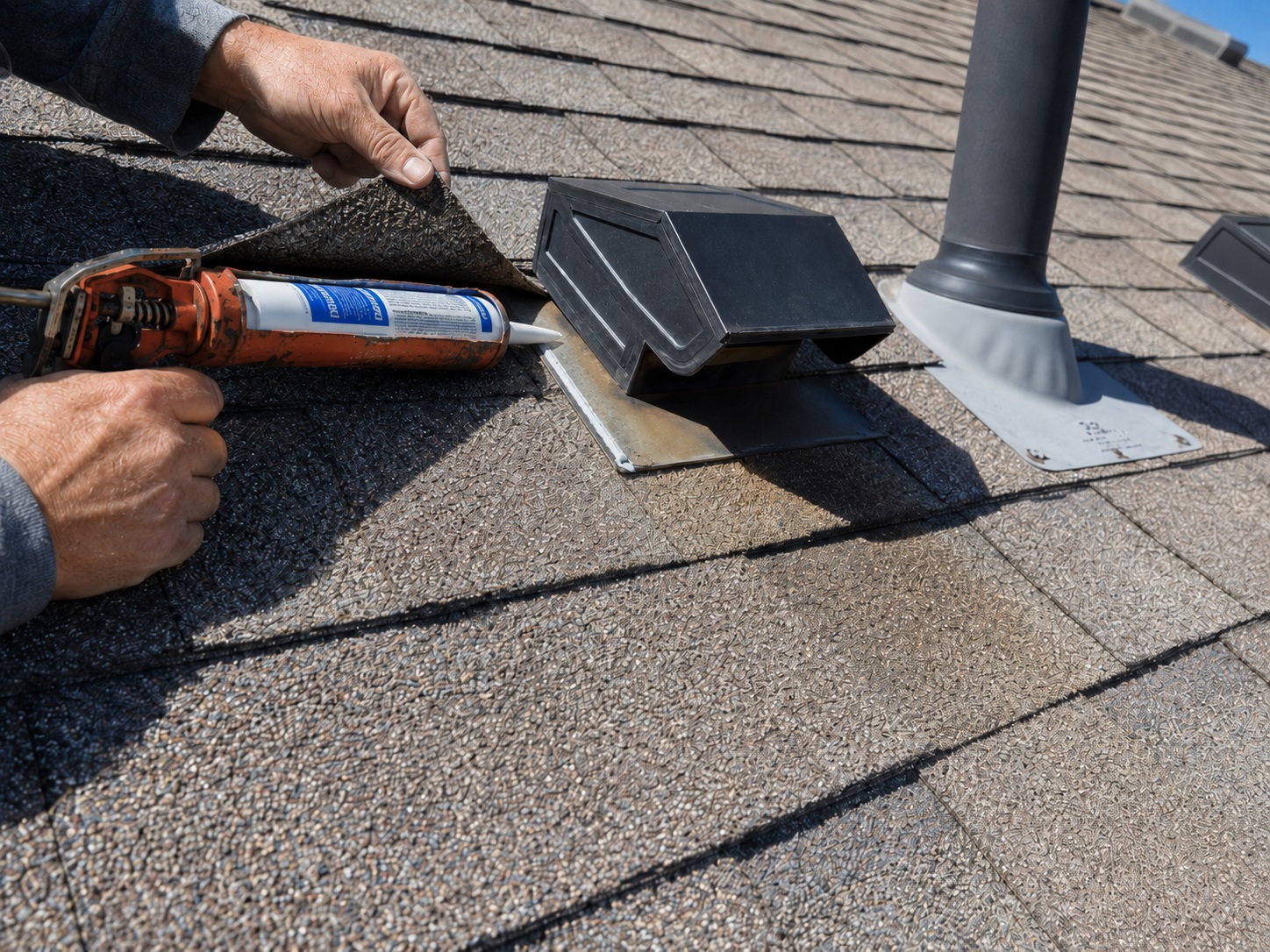
Use thin, controlled coats with spray products. Heavy spray application can run, bubble, or skin over before the lower layer has set. For brush-on products, use the recommended thickness and allow the coating to cure according to the label. With cartridge roof cement, force the material into the small gap or seam instead of just smearing a thin layer over the top.
After the emergency application, monitor the area during the next rainfall. Check the attic, ceiling, wall surfaces, and insulation for ongoing moisture. If water returns, the leak path may be larger, hidden, or structural. At that point, temporary sealants are no longer the main solution; you may need a contractor decision path like how to fix persistent roof leak problems.
Emergency Roof Sealant Mistakes That Can Let Leaks Continue
Using Emergency Sealant as a Permanent Roof Repair
The biggest mistake is treating a temporary emergency roof sealant as the final repair. A sealant may slow water entry, but it does not replace damaged shingles, failed flashing, rotten roof decking, poor ventilation, or defective roof installation. Once conditions are safe, inspect the roof and repair the root cause.
Sealing Before Finding the Leak Source
If you coat the wrong area, water will keep entering and may spread hidden moisture into insulation, decking, rafters, or ceiling drywall. This can make a small roof leak harder to trace later. If the leak location is uncertain, inspect before coating.
Applying Sealant Over Dirty or Loose Surfaces
Dirt, dust, wet leaves, loose granules, old peeling coatings, and unstable roof materials can prevent good adhesion. Emergency conditions are not perfect, but the surface still needs to be as clean and stable as safely possible.
Using the Wrong Product for the Surface
A spray sealant, brush-on coating, wet patch cement, and RV lap sealant are not interchangeable. Match the product to the roof type and repair area. Dicor belongs in RV and compatible membrane-roof contexts. Liquid Rubber is better for flat or low-slope surface patches. Henry 208 is for heavier emergency cement-style repairs.
Ignoring Interior Moisture After the Exterior Leak Slows
Stopping exterior water entry does not dry the materials that are already wet. Check insulation, drywall, ceiling cavities, and attic framing after a leak. If moisture remains trapped, mold and material damage can continue even after the roof appears sealed.
Working on the Roof in Unsafe Conditions
No sealant is worth a fall. Avoid working on wet, steep, icy, unstable, or storm-damaged roofs. If you cannot access the area safely from a ladder or stable surface, call a professional.
Emergency Roof Sealant FAQs for Active Leaks and Temporary Repairs
What is the best roof sealant for emergency repairs?
For most small, urgent roof-adjacent leaks, Gorilla Waterproof Patch & Seal Rubberized Sealant Spray is the best overall pick because it is easy to apply and fits many localized emergency sealing situations. For larger reachable areas, Flex Seal Liquid or Liquid Rubber may be more appropriate. For wet-surface cement-style repairs, Henry 208 is the better fit.
Can roof sealant stop an active leak?
An emergency roof sealant may slow or temporarily stop a small localized leak if the leak source is visible, the surface is compatible, and the product is applied correctly. It should not be relied on for major roof damage, missing shingles, failed flashing systems, rotted decking, or recurring leaks.
Should I use spray sealant or brush-on liquid rubber?
Use spray sealant for small seams, cracks, joints, and awkward roof details where fast coverage matters. Use brush-on liquid rubber when the area is larger, reachable, and needs a thicker controlled coating. If the surface is flat or low-slope, Liquid Rubber Waterproof Sealant may be a better fit than a thin spray.
Is Henry 208 roofing tar?
Henry 208 is a wet patch roof leak repair cement, and it is closer to traditional roof cement than spray rubber sealant. In this article, it is included only as the emergency wet-surface roof cement option. If you are comparing traditional tar-style products for small repairs, that belongs in a separate roofing tar product guide.
Can I use Dicor lap sealant on a house roof?
Dicor 501LSW-1 is best treated as an RV and compatible membrane-roof product, especially around vents, roof edges, screw heads, and penetrations. It is not the best general choice for standard residential asphalt shingle roof leaks.
How long does an emergency roof sealant repair last?
It depends on the product, surface, weather exposure, movement, and the underlying damage. Emergency sealants should be treated as temporary leak-control products unless the manufacturer and the roof condition support longer-term use. Monitor the repair after rain and plan a proper inspection.
Can roof sealant prevent mold after a leak?
Roof sealant can help reduce additional water entry, but it does not dry wet materials or remove mold risk by itself. After a roof leak, inspect ceilings, attic insulation, roof decking, and wall cavities. For broader prevention planning, see How to Find, Fix, and Prevent Moisture Problems in Homes.
When should I call a roofer instead of using emergency sealant?
Call a roofer if the roof is unsafe to access, water is entering heavily, shingles are missing, flashing has pulled away, decking feels soft, leaks keep returning, or the leak source is unclear. Emergency sealants are for temporary control, not structural diagnosis or full repair.
Conclusion: Which Emergency Roof Sealant Should You Choose?
For most homeowners looking for the best roof sealants for emergency repairs, Gorilla Waterproof Patch & Seal Rubberized Sealant Spray is the strongest overall choice because it is practical, fast, and well suited to small localized leak-control situations. If you want a familiar spray product to keep on hand, Flex Seal Spray is the recognizable alternative.
Choose Flex Seal Liquid Rubber in a Can when the emergency area needs a brush-on coating, and choose Liquid Rubber Waterproof Sealant when the issue is a localized flat, low-slope, or metal roof patch. Choose Henry 208 Wet Patch only when you need a heavier wet-surface emergency roof cement. For RV roof seams and penetrations, Dicor 501LSW-1 Self-Leveling Lap Sealant is the specialized pick.
The most important rule is simple: use emergency sealant to control water temporarily, then find and fix the real leak source. That is the difference between a quick stopgap and a recurring roof moisture problem.