Where to Place a Dehumidifier in Your Home for Best Results
Where you place a dehumidifier can change how well it controls humidity. A good location gives the unit access to damp air, allows air to move freely through the intake and exhaust, keeps the unit stable, and makes drainage practical. A poor location can make even a good dehumidifier run longer, remove less moisture, or shut off before the room is actually under control.
The best place is not always the dampest corner. A dehumidifier needs to pull humid air in and push drier air back into the room. If it is trapped behind furniture, pushed tightly against storage boxes, placed inside a closed closet, or set where air cannot circulate, it may not perform well even if it is technically in the right room.
This guide focuses specifically on placement. For the broader process of choosing, sizing, setting up, and using a unit, see this guide on how to choose and use a dehumidifier effectively.
Why Dehumidifier Placement Matters
A dehumidifier works by pulling humid air through the unit, removing moisture, and releasing drier air back into the room. If the intake or exhaust is blocked, performance drops.
Placement affects four main things: airflow, coverage, drainage, and safety. Airflow determines how easily the unit can process damp air. Coverage determines whether the unit can influence the whole space or only the area nearby. Drainage determines whether the unit can keep running without shutting off when the bucket fills. Safety matters because dehumidifiers use electricity and should not be placed where they can be splashed, tipped, blocked, or overheated.
Good placement helps the unit work more efficiently, but it cannot solve every problem. If the unit is too small for the space, poor placement is not the only issue. If water is actively entering through a foundation wall, crawl space soil, roof leak, or plumbing leak, a dehumidifier may reduce air moisture but will not stop the source. Placement helps the machine do its job, but the larger goal is still to find, fix, and prevent moisture problems at the source.
The Best General Place to Put a Dehumidifier
In most rooms, the best place for a dehumidifier is an open, level area where air can move freely around the unit. It should be close enough to the damp area to pull in humid air, but not so tucked away that airflow is blocked. A central or semi-central location often works better than a tight corner, especially in larger rooms.
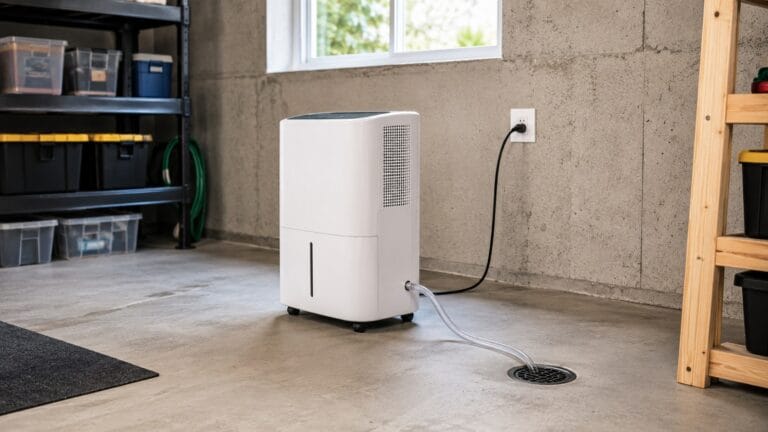
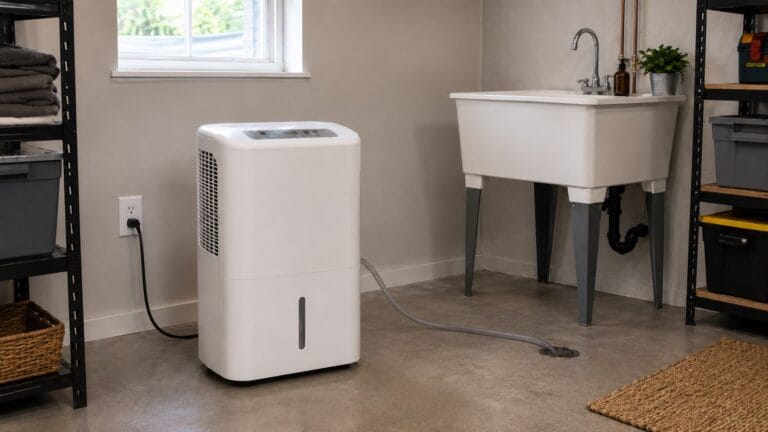
If the unit has a drain hose, the best location also needs a practical drainage path. That may mean placing the dehumidifier near a floor drain, utility sink, sump pit, condensate pump, or another approved drain point. If the unit relies on a bucket, it should be easy to reach so you can empty it before it shuts off.
Leave open space around the intake and exhaust
Most dehumidifiers need clearance around the intake and exhaust areas. The exact clearance depends on the unit design, so the manufacturer’s instructions should always be followed. As a general rule, avoid pushing the unit tightly against walls, furniture, curtains, storage boxes, laundry baskets, or shelving.
Blocked airflow makes the unit work harder. It may remove less moisture, run longer, or fail to sense the room’s humidity accurately. In dusty or cluttered areas, blocked airflow can also make the filter and intake collect debris faster.
Pay attention to where your specific unit pulls air in and where it blows air out. Some units intake from the back, some from the front, and some exhaust from the side or top. The correct placement depends on that airflow pattern. If the discharge air immediately hits a wall, shelf, curtain, or stack of boxes, move the unit so dry air can spread into the room instead of bouncing back into the machine.
Place it where air can circulate
A dehumidifier needs access to the air you want to dry. In an open room, that usually means placing it where air naturally circulates rather than hiding it behind large objects. In a basement, this may be a more open section of the room rather than a storage corner packed with boxes.
If the room has fans, HVAC supply air, or natural air movement from connected spaces, placement can take advantage of that circulation. The goal is not to put the dehumidifier directly in a draft, but to avoid dead zones where humid air sits without moving.
Closed doors can limit performance. If you want one unit to help with a connected room, air must be able to move between those spaces. A dehumidifier in one closed room will not effectively dry another closed room across the hall.
Keep it level and stable
A dehumidifier should sit on a flat, stable surface. This helps the bucket, float switch, compressor, fan, and drainage system work correctly. A tilted unit may drain poorly, shut off unexpectedly, leak from the bucket area, or vibrate more than it should.
Avoid placing the unit on soft surfaces, unstable platforms, thick rugs, uneven floors, or loose boards. In basements and utility areas, make sure the unit is not sitting where water can puddle around the cord or base.
Stability also matters in homes with children, pets, or tight walkways. A dehumidifier should not be placed where it is likely to be bumped, tipped, or used as a shelf.
Should a Dehumidifier Go in the Dampest Spot?
A dehumidifier should usually be near the damp area, but not necessarily in the dampest corner. This is an important distinction. The dampest spot may have the worst airflow, especially if it is behind stored items, under stairs, inside a closet, near a cold wall, or in a corner with little air movement.
If you place the unit directly in a blocked damp corner, it may dry the air immediately around the machine but fail to improve the rest of the room. A better location is often a few feet away from the dampest area, where the unit can still pull in humid air but has enough open space to circulate dry air back into the room.
For example, in a basement with a musty storage corner, placing the unit in the middle of the storage clutter is usually not ideal. Moving it to an open area just outside that corner may allow better airflow while still targeting the damp zone.
The same logic applies to laundry rooms, utility rooms, and lower-level living areas. Do not bury the unit beside the moisture source if that location blocks the intake or exhaust. The unit needs exposure to damp air and enough breathing room to process that air efficiently.
Placement Cannot Make Up for the Wrong Size
Good placement helps a dehumidifier perform better, but it cannot make a small unit control a space that is too large or too damp. If the unit has open airflow, proper drainage, and a reasonable location but still runs constantly while humidity remains high, the problem may be capacity.
This is common in basements and crawl spaces. A unit that works well in a bedroom may not be strong enough for a large lower-level area with concrete walls, cool surfaces, and recurring dampness. In that case, moving the unit from one corner to another may help slightly, but it will not fully solve the problem.
If you are still choosing a unit, make sure you choose the right size dehumidifier before focusing only on placement. Sizing and placement work together, but this article stays focused on the physical setup: airflow, clearance, drainage, and safe location.
Should a Dehumidifier Be Near a Drain or Sink?
If you plan to use continuous drainage, the dehumidifier should be close enough to a suitable drain for the hose to slope properly or reach a pump. Good drainage placement can matter as much as airflow because a unit that shuts off when the bucket fills stops removing moisture.
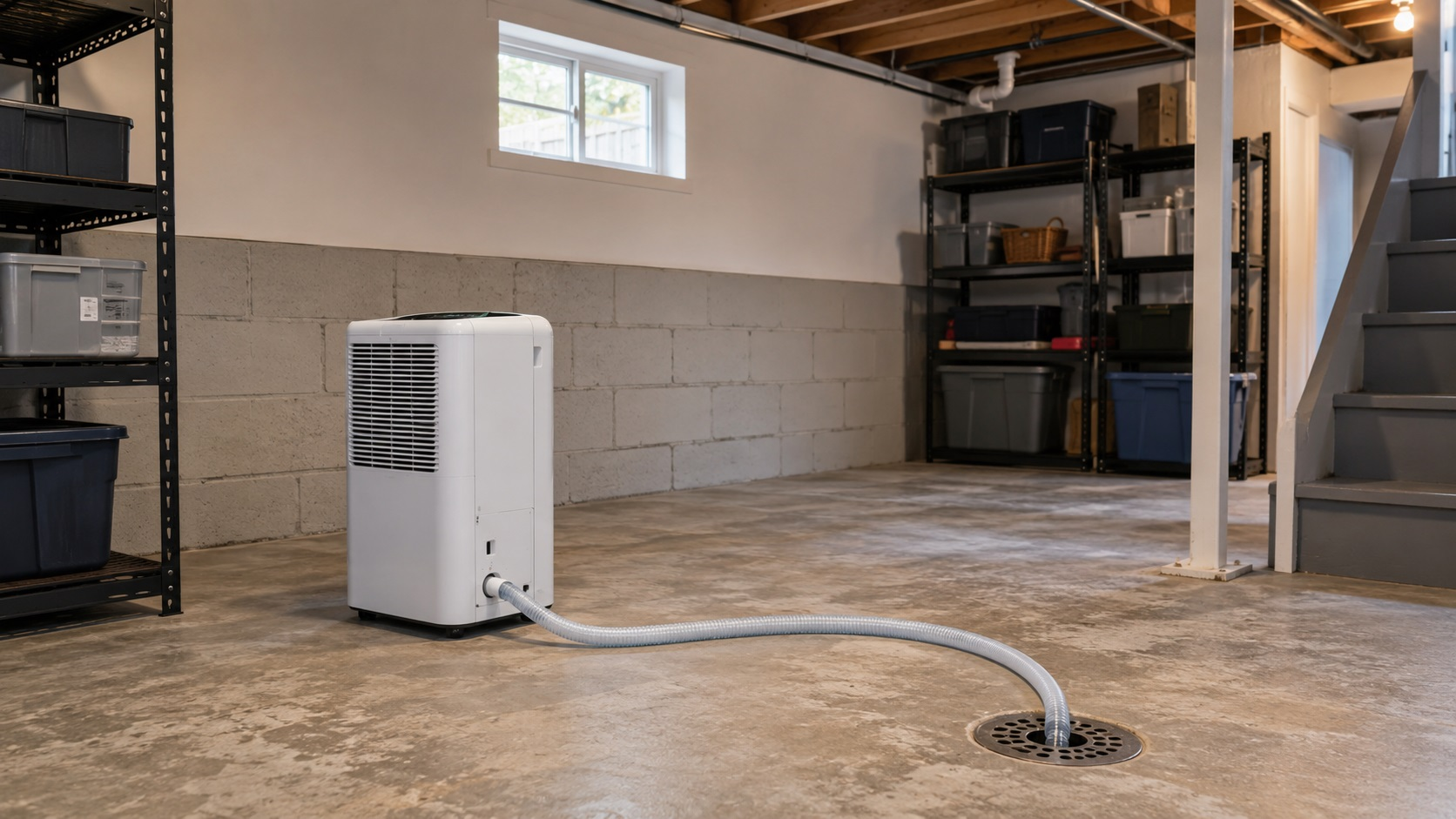
In basements, the best drain options are often a floor drain, sump pit, utility sink, condensate pump, or another approved drainage point. The hose should not be kinked, crushed, or routed uphill unless the unit has a pump designed for that purpose.
If you use the bucket instead of a hose, place the unit where it is easy to reach and empty. A dehumidifier hidden behind boxes or furniture is more likely to be neglected, and once the bucket fills, the unit will shut off.
Where to Place a Dehumidifier in a Basement
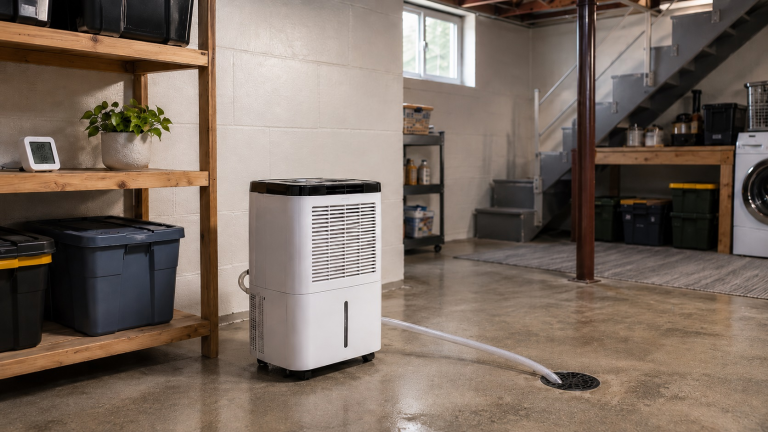
In a basement, place the dehumidifier in an open area where air can circulate through the main damp zone. Avoid tight storage corners, areas blocked by boxes, or spots where the intake or exhaust faces a wall at close range.
A good basement location is often near the center of the damp area, near a practical drain, or in an open section that connects several parts of the basement. If the basement is divided into rooms, keep doors open when possible so air can move between spaces.
Do not place the unit directly in standing water or beside active seepage. A basement dehumidifier can reduce humid air, but it should not be used as a substitute for fixing water entry. Once you know the setup you need, compare suitable units in this guide to the best basement dehumidifiers.
Where to Place a Dehumidifier in a Crawl Space
Crawl space placement depends on clearance, access, drainage, and airflow. The unit should sit on a stable surface, have enough space around the intake and exhaust, and be positioned where it can treat the main crawl space air rather than a blocked pocket.
Drainage is especially important in crawl spaces because bucket emptying is usually impractical. A crawl space dehumidifier often needs a drain hose or condensate pump so it can run without frequent access.
Avoid placing the unit on loose soil, in standing water, or where the filter and controls cannot be reached. If the crawl space is vented, wet, or has exposed soil, placement alone may not be enough. The space may need vapor control or drainage improvements before dehumidification works well.
For equipment designed for low-clearance and long-term crawl space use, see this guide to the best crawl space dehumidifiers.
Where to Place a Dehumidifier in a Bathroom or Laundry Room
Bathroom and laundry room placement requires extra caution because water, electricity, lint, and tight spaces can create problems. A dehumidifier should be placed on a dry, level surface away from tubs, showers, sinks, splashing water, and wet floors.
In bathrooms, ventilation is usually the first tool during and immediately after showers. A dehumidifier may help after the room is no longer actively wet, but it should never be placed where it can be splashed, where the cord can contact water, or where the manufacturer does not allow bathroom use.
In laundry rooms, keep the unit away from lint-heavy areas, dripping clothes, blocked vents, and crowded corners. If the room has a floor drain or utility sink, continuous drainage may make the unit more practical.
Where to Place a Dehumidifier in Bedrooms, Closets, and Living Areas
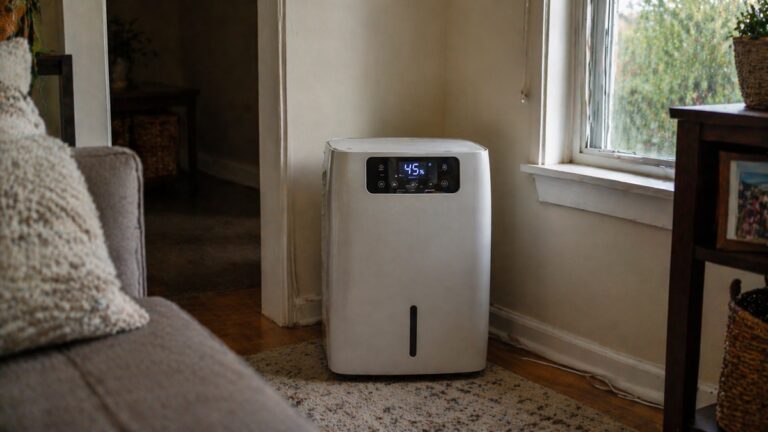
In bedrooms and living areas, place the dehumidifier where it has open airflow but does not block walkways. Avoid pushing it behind curtains, under furniture, inside tight corners, or against upholstered items that can block air movement.
Closets are usually poor locations unless the door can stay open and the unit has enough clearance. A dehumidifier inside a closed closet may dry only the closet air while doing little for the rest of the room.
Can One Dehumidifier Work for Multiple Rooms?
One dehumidifier can help multiple connected spaces only if air can move freely between them. Open doorways, fans, and open floor plans help. Closed doors, long hallways, and divided rooms limit performance.
If humidity is high throughout the home, one portable unit may not be enough. In that case, a larger portable unit, multiple units, or a ducted system may be more practical.
Where Not to Place a Dehumidifier
Avoid placing a dehumidifier in any location that blocks airflow, creates a safety risk, or makes drainage impractical.
- Do not place it tight against walls unless the manufacturer allows it.
- Do not put it behind furniture, curtains, storage boxes, or laundry piles.
- Do not place it on thick carpet, unstable surfaces, or uneven flooring.
- Do not place it where water can splash onto the unit or cord.
- Do not place it in standing water or on a wet floor.
- Do not run an extension cord through a wet area or across a walkway where it can be damaged or tripped over.
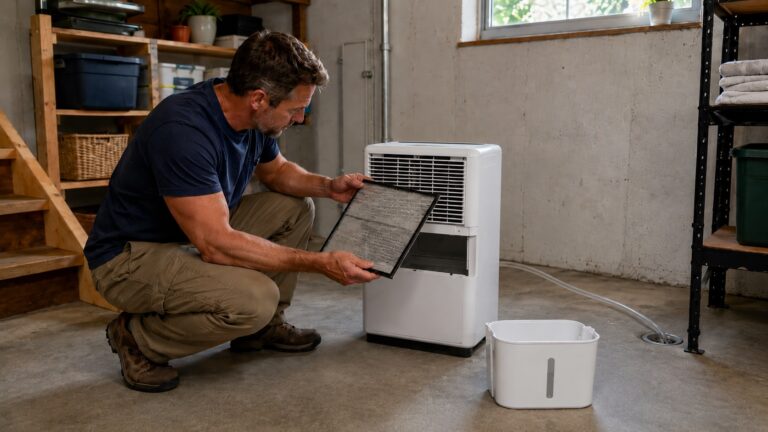
- Do not hide it where the bucket cannot be emptied or the filter cannot be cleaned.
- Do not place it in a closed closet and expect it to dry the whole room.
If you are unsure about a borderline location, choose the safer, more open spot first. You can always retest humidity readings after a few hours and move the unit if the damp area is not improving.
How to Check Whether the Placement Is Working
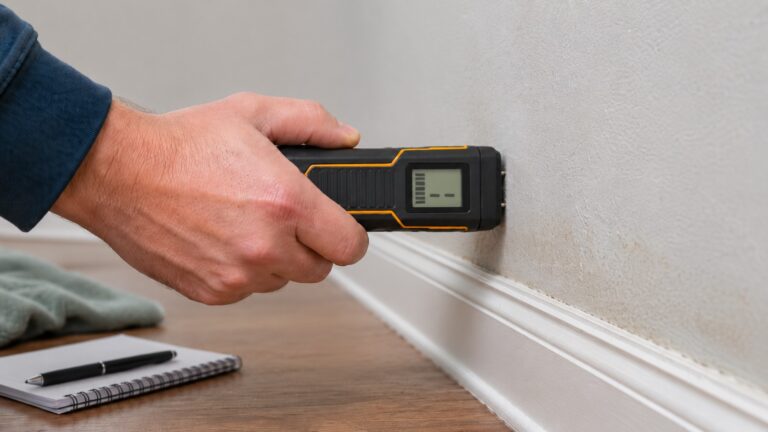
The best way to check placement is to measure humidity before and after the unit runs. If humidity drops steadily and stays controlled, the location is probably working. If the unit runs constantly but humidity remains high, the problem may be airflow, sizing, settings, drainage, or an ongoing moisture source.
A simple test is to compare readings near the unit, across the room, and near the dampest area. If only the reading beside the unit improves, the placement may be drying a small pocket of air instead of the whole space.
Test in more than one spot if the room is large or divided. A hygrometer near the unit may show improvement while a distant corner stays damp. If readings differ widely, try improving air movement or moving the unit to a more open location. For measurement guidance, see how to test indoor humidity levels. If you need help choosing the actual humidity target, see these dehumidifier settings for mold prevention.
If the unit still runs too long after placement is corrected, the issue may be operation pattern rather than location. This guide explains how long to run a dehumidifier each day.
FAQ
Should a dehumidifier be in the center of the room?
A central location often works well because it gives the unit access to more air, but it is not always required. The best location is open, level, close enough to damp air, and practical for drainage.
Can I put a dehumidifier against a wall?
Only if the unit design allows it. Many dehumidifiers need clearance around the intake or exhaust. Check the manual and avoid blocking airflow with walls, furniture, boxes, or curtains.
Should a dehumidifier be near the dampest spot?
It should be near the damp area, but not buried in a blocked corner. A slightly more open spot near the damp zone usually works better than the tightest, wettest location.
Can I put a dehumidifier in a bathroom?
Only in a safe, dry location away from splash zones, wet floors, tubs, showers, and any cord contact with water. Bathroom exhaust ventilation should usually be the first tool during showers.
Should a basement dehumidifier be near a drain?
Yes, if you want continuous drainage. A floor drain, sump pit, utility sink, or pump setup can keep the unit running without shutting off when the bucket fills.
Can one dehumidifier dry multiple rooms?
Only if air can move freely between those rooms. Closed doors, long hallways, and divided layouts limit coverage. If one area stays damp while the room with the unit improves, check that room with a hygrometer and consider better air circulation, more than one unit, or a whole-house option.
How much space should I leave around a dehumidifier?
Follow the manufacturer’s clearance instructions. In general, avoid tight walls, furniture, curtains, boxes, and other objects that block intake or exhaust airflow.
Final Placement Check
Before settling on a location, check four things: open airflow, a level surface, safe distance from water, and a practical way to drain or empty the unit. In most rooms, the right spot is close enough to the damp area to pull in humid air but open enough to push dry air back into the space.
If placement is good but humidity still stays high, the issue may be size, settings, runtime, or an active moisture source. Placement helps the unit work properly, but long-term moisture control still depends on matching the right dehumidifier to the right problem.