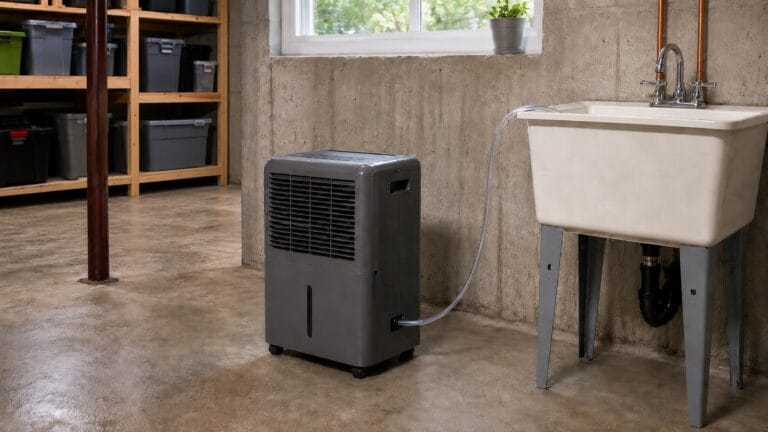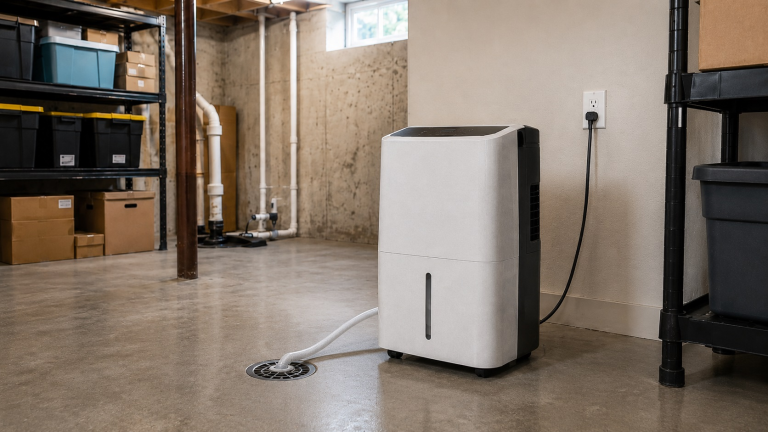
Santa Fe Compact70 Crawl Space Dehumidifier Review: Is It Worth It?
The Santa Fe Compact70 is worth considering if you need a premium crawl space dehumidifier that fits where a basic upright room unit may not. Its main appeal is simple: it puts serious dehumidification capacity into a low-profile body for tight crawl spaces, damp basements, and mechanical areas where standard portable units can be awkward.
This review looks at where the Compact70 makes sense, where it is overkill, and what conditions need to be fixed before a crawl space dehumidifier can perform well. If you are still comparing models, see our guide to the best crawl space dehumidifiers.
Disclosure: This article may contain affiliate links. If you buy through these links, we may earn a commission at no extra cost to you.
Santa Fe Compact70 Quick Verdict
- Best for: Encapsulated crawl spaces, damp basements, low-clearance areas, and homeowners who want a higher-end humidity-control solution.
- Not ideal for: Active flooding, standing water, unsealed crawl spaces, very cold spaces, or shoppers looking for a budget room dehumidifier.
- Main strength: Compact crawl-space-ready design with serious dehumidification capacity for residential moisture control.
- Main limitation: It needs proper drainage, airflow, and moisture-source control to perform well.
- Bottom line: The Santa Fe Compact70 is a strong fit for controlled crawl spaces or damp basements that need compact, long-term humidity control. It is not a substitute for fixing leaks, drainage problems, or missing vapor barriers.
What the Santa Fe Compact70 Is Designed to Do
The Santa Fe Compact70 is a compact residential dehumidifier designed for crawl spaces, basements, mechanical closets, and other tight areas where moisture control is important. Santa Fe lists the unit at 70 pints per day at 80°F and 60% RH, with a 12″W x 12″H x 21″D body, onboard controls, MERV-13 filtration, 150 CFM airflow, a 55 dBA average sound level, and an operating range of 49°F to 95°F.
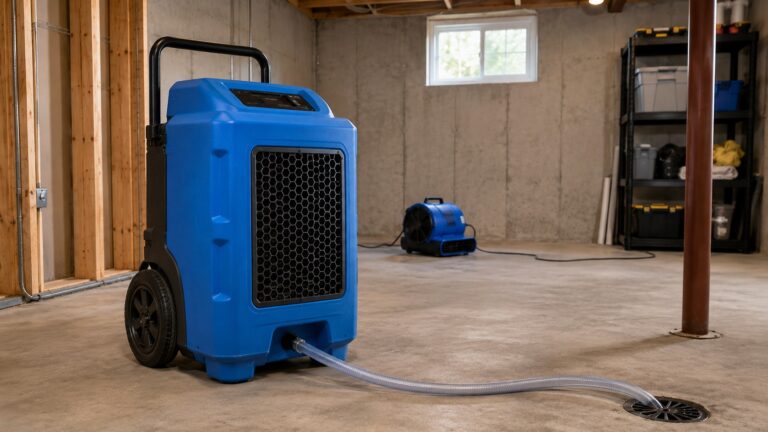
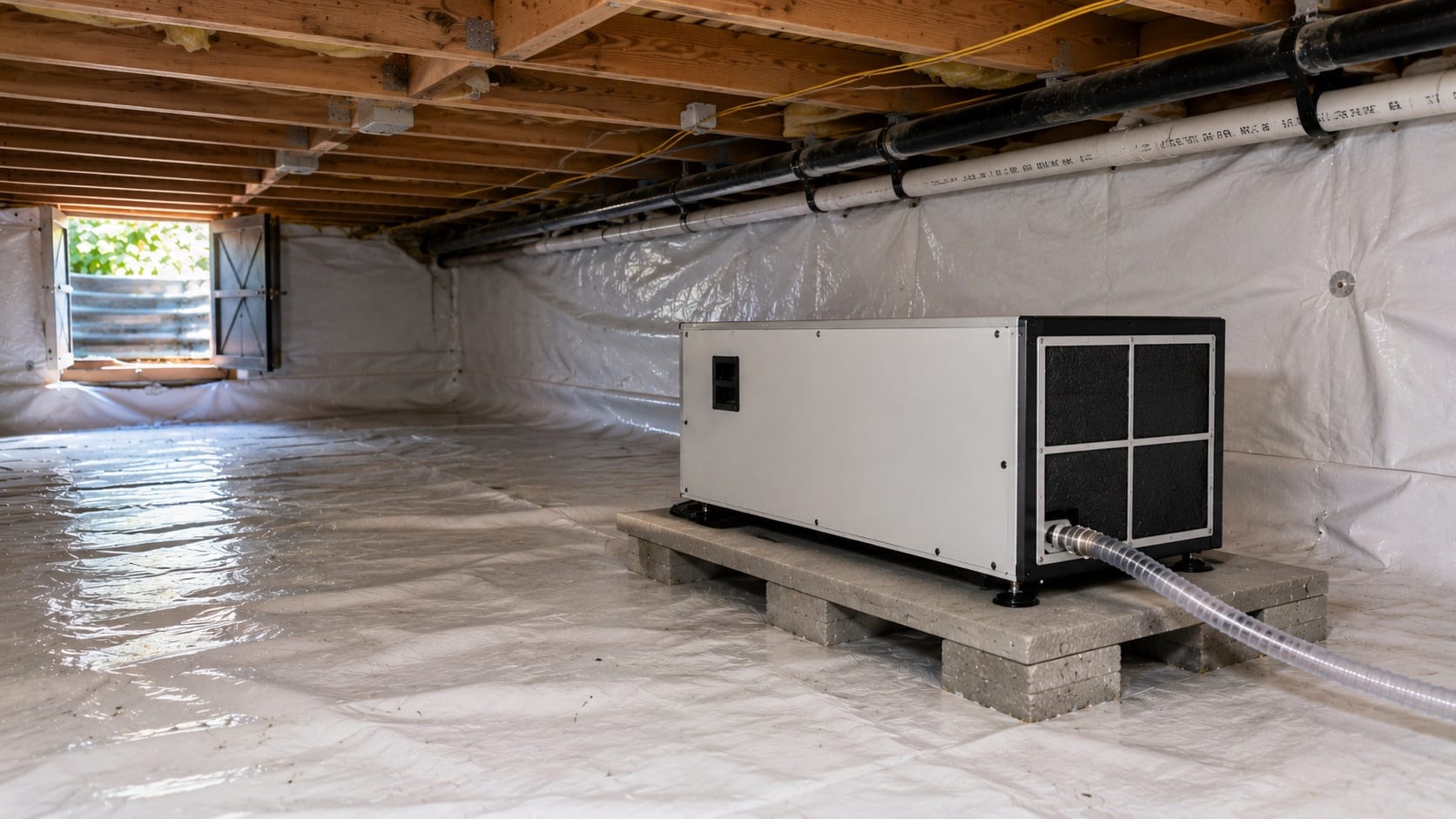
Unlike a standard upright room dehumidifier, this unit is shaped for low-clearance installation and continuous drainage. That matters in crawl spaces, where homeowners usually need a unit that can stay in place, drain automatically, and run without daily bucket emptying.
The Compact70 should still be treated as part of a moisture-control system, not a complete repair by itself. If the crawl space has standing water, open vents pulling in humid outdoor air, poor drainage, or an incomplete vapor barrier, those issues should be addressed first. If you are still deciding how the dehumidifier fits into the larger system, see our guides on what crawl space encapsulation does and how to choose and use a dehumidifier effectively.
Santa Fe Compact70 Features That Matter in Crawl Spaces
Compact Crawl Space Design
The Compact70’s low-profile body is one of its strongest practical advantages. Crawl spaces often have limited headroom, awkward access doors, floor joists, vapor barriers, ducts, plumbing, and electrical lines competing for space. A tall portable dehumidifier may be hard to place, drain, or service correctly.
The 12-inch height helps this unit fit into tighter areas, but placement still matters. Homeowners should plan where the unit will sit, how the drain line will run, whether the filter can be reached, and whether there is enough clearance for airflow and service access.
Serious Moisture Removal for Damp Spaces
The Compact70 is rated for 70 pints per day at 80°F and 60% relative humidity, which puts it well above light-duty room dehumidifiers. That capacity is useful in crawl spaces and basements where a small unit may run constantly without keeping humidity under control.
The rating should still be understood realistically. Dehumidifier performance depends on temperature, relative humidity, square footage, air leakage, vapor barrier quality, drainage, and airflow. A sealed or encapsulated crawl space gives the unit a much better chance of maintaining stable humidity than an open, wet, or poorly controlled space.
Santa Fe’s sizing guidance also varies by how well the space is sealed: the Compact70 is listed for up to 2,600 sq. ft. in tightly sealed crawl spaces, 2,200 sq. ft. in moderately sealed crawl spaces, and 1,800 sq. ft. in loosely sealed crawl spaces. Treat those numbers as a planning range, not a guarantee, because real performance depends heavily on moisture entry and air leakage.
If you are unsure whether this capacity fits your home, review how to choose the right size dehumidifier before relying on one product listing alone.
Continuous Drainage Setup
The Compact70 is designed for continuous drainage, which is a major advantage in a crawl space. Most homeowners do not want to crawl under the house every day to empty a bucket, and long-term humidity control usually needs automatic drainage.
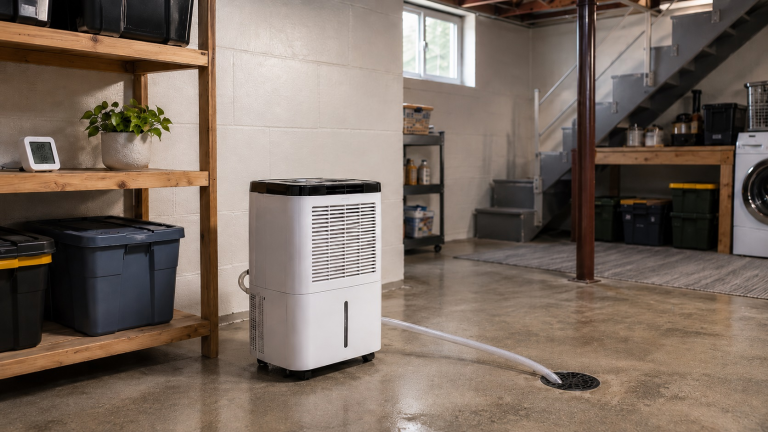
The tradeoff is that drainage must be planned correctly. The hose needs a proper downhill route if using gravity drainage, the unit should sit level, and some installations may require a condensate pump if gravity drainage is not practical. A poor drain setup can cause leakage, poor performance, or maintenance problems later.
Filtration for Equipment Protection
The Santa Fe Compact70 includes filtration designed to protect the unit as air moves through it. This is useful because crawl spaces and basements can be dusty environments, especially if the space has exposed soil, old insulation, wood dust, construction debris, or unsealed gaps.
The filter should not be misunderstood as a full air-purification system or mold-removal solution. Its main role is to help the dehumidifier operate properly by reducing debris entering the equipment. This supports the unit’s long-term performance, but it does not replace mold remediation, crawl space cleanup, or broader indoor air quality work.
Auto Restart for Out-of-Sight Installations
Auto restart is a useful feature for a crawl space dehumidifier because the unit may be installed somewhere the homeowner does not see every day. If the power goes out briefly and the dehumidifier does not restart, humidity can rise without anyone noticing.
With auto restart, the unit is better suited for semi-permanent installations where it is expected to resume operation after a power interruption.
Other practical details also matter. At about 55 lbs., the Compact70 is more installation-oriented than a small room appliance. It still needs a stable location, a reachable filter, a safe power source, and enough access for future service.
How the Compact70 Performs in Real Crawl Spaces and Basements
In real use, the Santa Fe Compact70 should perform best where the main problem is humidity rather than active water entry. It is well matched to homes where the crawl space has already been improved with a vapor barrier, sealed vents, better drainage, or encapsulation work.
That distinction matters. The unit removes moisture from the air, but it does not stop rainwater from entering through foundation gaps, correct grading problems, seal a torn vapor barrier, or remove standing water. If those problems are present, the Compact70 may run more often and still fail to create the controlled environment the homeowner expects.
When the space is reasonably sealed, the unit can help maintain lower humidity, reduce musty conditions, and support a more stable crawl space environment, especially during humid seasons or in homes where crawl space odors affect the living area above.
The unit’s compact size also gives it an advantage in crawl spaces where placement matters. A dehumidifier needs access to air, power, drainage, and service space. If it is jammed into a bad location, even a strong unit can underperform. For more practical placement guidance, see our article on where to place a dehumidifier.
Where the Santa Fe Compact70 Works Best
The Santa Fe Compact70 works best where the crawl space or basement is damp but not actively flooding. The ideal setup has controlled ground moisture, reduced outside-air intrusion, a practical drainage route, and enough airflow around the unit.
It is a strong option for encapsulated crawl spaces because the unit can focus on managing remaining air humidity instead of fighting constant ground moisture or outdoor air. In that kind of environment, a crawl-space-grade dehumidifier can help keep conditions more stable than a basic room unit.
It can also make sense in a basement where a standard portable unit is not keeping up, especially if the homeowner wants a more durable, installation-oriented product with continuous drainage. Basements with musty air, seasonal dampness, or persistent humidity may benefit from a higher-capacity unit like this, assuming water intrusion is not the real underlying problem.
Where the Santa Fe Compact70 May Fall Short
The Santa Fe Compact70 may disappoint buyers who expect it to solve every crawl space moisture problem by itself. If there is standing water, bulk water intrusion, a missing vapor barrier, poor drainage, open vents, or large outside-air leaks, the unit may be fighting a problem that should be fixed at the source. Do not use any dehumidifier as the primary response to sewage, floodwater, unsafe electrical conditions, or structural crawl space damage.
It is also not the right product for homeowners who only need light humidity control in a bedroom, bathroom, or small finished room. In those cases, a smaller and less expensive portable dehumidifier may be more practical.
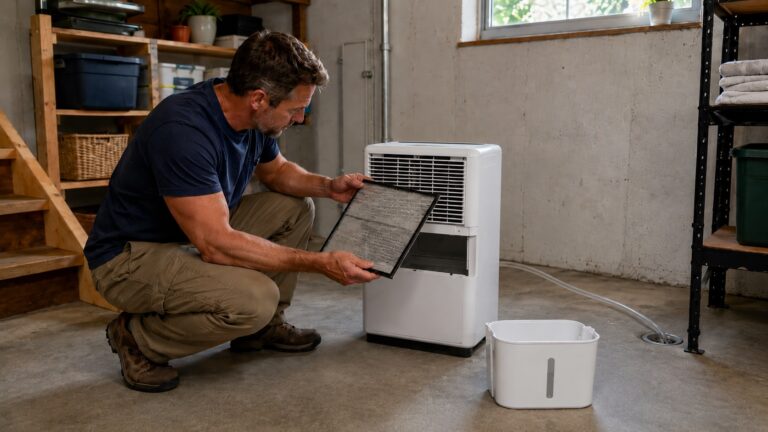
Budget and access are also real limitations. This is a premium crawl space dehumidifier, not a low-cost appliance, and it should be installed where the filter, drain line, power supply, and unit placement remain reachable. For long-term use, follow basic guidance on how to maintain a dehumidifier.
Who the Santa Fe Compact70 Makes the Most Sense For
The Santa Fe Compact70 is best for homeowners who have a real crawl space or basement humidity problem and want a stronger, more permanent solution than a basic room dehumidifier. It makes the most sense when the space is already reasonably controlled but still needs active dehumidification to keep humidity from rising.
This is a good fit if your crawl space has been encapsulated, partly sealed, or improved with a vapor barrier and drainage work. In that kind of environment, the unit is not fighting unlimited ground moisture or outdoor air. It can focus on lowering humidity and helping the space stay more stable.
It is also a strong option for low-clearance areas or for homeowners upgrading from a weaker portable dehumidifier that runs constantly without keeping humidity under control. If your goal is to support a crawl space system, reduce musty conditions, and maintain more consistent humidity over time, this product fits that use case well.
View the Santa Fe Compact70 on Amazon
Who Should Not Spend Premium Money on the Compact70
Skip the Santa Fe Compact70 if your crawl space has active water entry that has not been fixed. A dehumidifier is not a substitute for drainage correction, leak repair, grading improvements, sump systems, or vapor barrier work. If water is entering the space regularly, the first priority is stopping or controlling that water source; for a broader repair framework, see our guide to persistent crawl space moisture problems.
It is also not ideal for crawl spaces that are wide open to outdoor air. If humid outdoor air is constantly entering through open vents, large gaps, or poor sealing, the unit may run too often and still struggle to maintain the desired humidity level.
Budget-focused buyers, light room-humidity users, and homeowners without a reliable drainage path may also want a simpler option. Continuous drainage is one of this unit’s main benefits, but it requires a safe drain route, sump basin, condensate pump setup, or another appropriate drainage solution.
How the Santa Fe Compact70 Compares to Typical Alternatives
Compared with basic portable dehumidifiers, the Santa Fe Compact70 is more specialized. A standard portable unit may be cheaper and easier to move, but it is usually designed for finished rooms, not long-term crawl space installation. The Compact70 is a better match when the space is low, damp, unfinished, and needs continuous drainage.
Compared with larger crawl space dehumidifiers, the Compact70’s main advantage is its smaller body. It is not the largest unit in the crawl space category, but that is part of its appeal. Some homes need a compact dehumidifier that can fit into a difficult area while still offering more serious moisture control than a consumer-grade appliance.
Compared with vapor barriers or encapsulation, the Compact70 serves a different role. A vapor barrier helps reduce moisture entering from the ground, while encapsulation helps separate the crawl space from outdoor moisture and soil vapor. The dehumidifier then helps manage the remaining humidity in the air. These are complementary solutions, not interchangeable ones.
For homeowners comparing several crawl space models, the best next step is to use this review as a single-product evaluation and then compare it against other options in our best crawl space dehumidifiers guide.
Santa Fe Compact70 FAQ
Is the Santa Fe Compact70 good for crawl spaces?
Yes, the Santa Fe Compact70 is well suited for crawl spaces, especially sealed, encapsulated, or improved crawl spaces where humidity remains a problem. It is compact enough for tighter areas and is designed for continuous drainage. It is not meant to fix active water intrusion by itself.
Is the Santa Fe Compact70 worth the higher price?
It can be worth the higher price if you need a compact, crawl-space-ready dehumidifier for long-term humidity control. It is harder to justify if you only need occasional humidity reduction in a finished room or a mild basement dampness problem.
Does the Santa Fe Compact70 need a drain hose?
Yes. This type of crawl space dehumidifier is designed around continuous drainage. That is helpful for long-term use, but it means you need a suitable drain path, condensate pump setup, or another appropriate drainage solution before relying on it.
How much crawl space can the Santa Fe Compact70 handle?
Santa Fe lists the Compact70 for up to 2,600 sq. ft. in tightly sealed crawl spaces, 2,200 sq. ft. in moderately sealed crawl spaces, and 1,800 sq. ft. in loosely sealed crawl spaces. Those numbers depend on sealing, drainage, vapor barrier quality, temperature, and humidity load, so a wet or open crawl space may need repairs before the unit can perform as expected.
Is the Santa Fe Compact70 better than a regular portable dehumidifier?
It can be better for crawl spaces, damp basements, and low-clearance installations. A regular portable dehumidifier may be enough for light room humidity, but the Compact70 is more appropriate when the goal is longer-term moisture control in a harder-working environment.
What should I fix before installing a crawl space dehumidifier?
Before installing a crawl space dehumidifier, address standing water, active leaks, poor drainage, missing or damaged vapor barriers, and major outdoor air intrusion. The dehumidifier will perform better when it is managing humidity in a controlled space instead of fighting unresolved water sources.
Bottom Line on the Santa Fe Compact70
The Santa Fe Compact70 is a strong premium option for homeowners who need serious crawl space or basement humidity control in a compact package. Its best use case is a sealed or improved crawl space where moisture sources have already been reduced and the remaining problem is persistent humidity.
Its biggest strength is the combination of low-profile design, 70-pint rated capacity, continuous drainage, and crawl-space-ready construction. That makes it more appropriate for tight under-home spaces than many ordinary portable dehumidifiers.
Its biggest limitation is that it cannot solve water problems at the source. For the right controlled space, though, the Compact70 is a worthwhile high-end option.