Signs of Mold Growth in Roof Framing
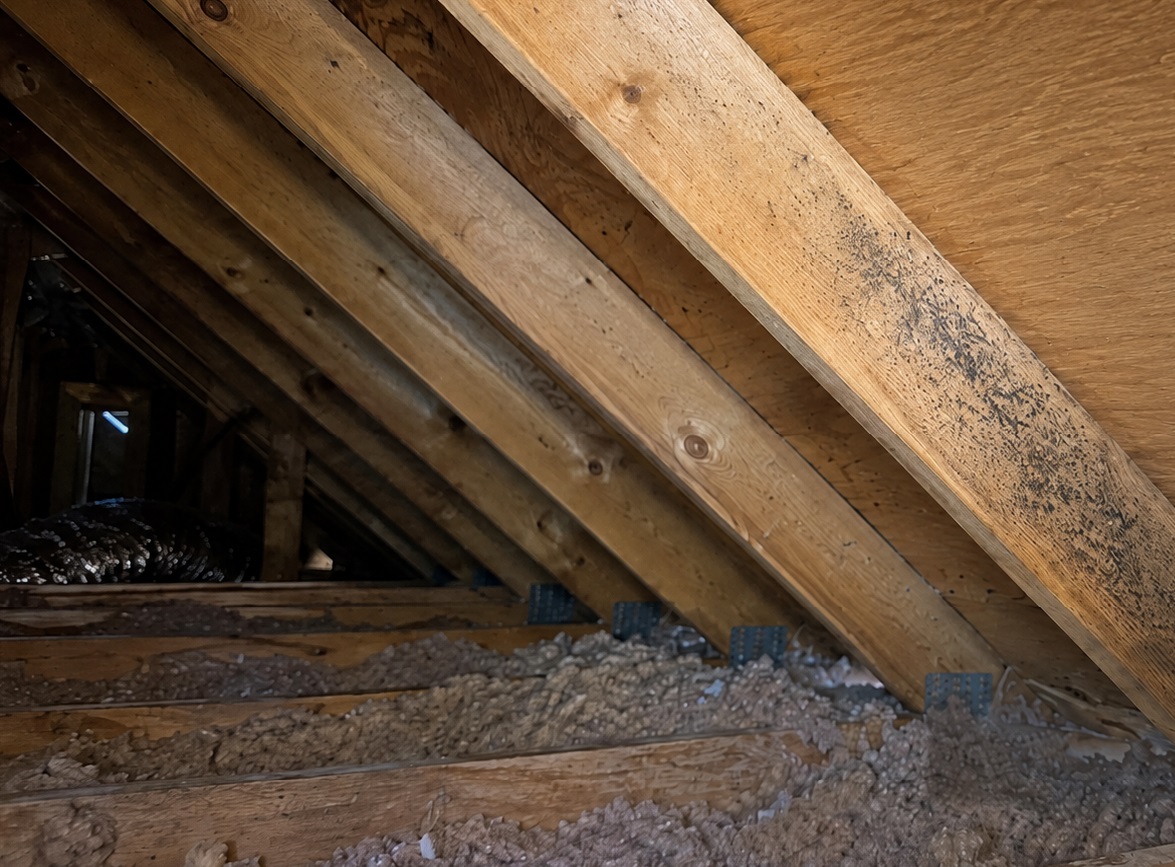
Signs of mold growth in roof framing usually include dark blotchy staining, fuzzy or powdery surface growth, musty attic odors, white or gray filament patterns, and patches that spread across rafters, trusses, ridge boards, or roof decking connections.
Mold on roof framing does not automatically mean the wood has failed, but it does mean moisture has been present long enough to support fungal growth. The moisture may come from a roof leak, condensation, humid indoor air entering the attic, blocked ventilation, or insulation pushed against framing.
This article focuses on the visible and odor-based signs of mold on attic roof framing. For the broader roof system problems that allow moisture to collect in the first place, see Most Common Roofing Material Failures.
Why Mold in Roof Framing Is a Serious Warning Sign
Roof framing forms the structural backbone of the roof system. Rafters, trusses, ridge boards, and support members carry roof loads and maintain the shape of the structure. When mold grows on these components, it is a moisture warning sign that deserves attention, even if the wood has not yet lost strength.
Small surface patches may be mostly cosmetic at first, but mold plus repeated dampness can eventually point to rot risk, weakened fastener areas, or wider attic moisture problems.
Mold Growth Indicates Ongoing Moisture Exposure
Mold does not grow on roof framing without moisture. Common attic moisture sources include:
- Roof leaks that allow water intrusion
- Condensation caused by poor ventilation
- Humid indoor air entering attic spaces
- Improper insulation blocking airflow
- Ice dam formation in cold climates
Visible water does not have to be present. Condensation, damp insulation, or repeated seasonal humidity can keep framing surfaces damp enough for mold. If the wood also looks swollen, softened, stained, or distorted, review early moisture damage in roof rafters.
Mold on Framing Can Spread to Other Materials
Roof framing mold rarely stays confined to a single location. Once growth begins, spores can spread to nearby materials, including:
- Roof sheathing
- Attic insulation
- Stored items in the attic
- Ventilation channels
- Adjacent framing members
This does not mean every small spot has contaminated the entire attic, but it does mean visible framing mold should be checked in context with nearby sheathing, insulation, and airflow paths.
Structural Mold Problems Often Develop Gradually
Many roof framing mold problems develop slowly. Instead of obvious dripping, you may see faint darkening near the ridge, patchy growth along a rafter, or musty odor that becomes stronger during damp weather.
For example, a small roof flashing failure or minor ventilation blockage may not produce noticeable water drips. Instead, it allows humidity to accumulate quietly. Over time, moisture collects on wood surfaces, eventually supporting mold growth.
If mold growth appears widespread, persistent, or paired with soft, warped, or stained wood, it may indicate deeper structural concerns discussed in Signs of Long-Term Roof Moisture Damage.
Common Visible Signs of Mold Growth in Roof Framing
Visible mold growth is one of the clearest indicators that roof framing has experienced extended moisture exposure. However, mold does not always appear in obvious ways. Recognizing subtle changes in color, texture, and pattern helps homeowners detect mold before it spreads extensively.
Dark Staining Along Rafters or Trusses
One of the most common early signs of mold growth is dark staining along the surfaces of rafters or trusses. These stains often appear as irregular patches that differ from the natural wood color.
Typical characteristics include:
- Black, gray, or dark green discoloration
- Blotchy or streaked patterns along wood grain
- Clusters of darker patches in specific areas
- Discoloration concentrated near joints or connections
Dark staining often begins in areas where moisture collects repeatedly. This includes locations where warm indoor air contacts cooler framing surfaces, creating condensation.
Not every dark mark is active mold. Old water staining is usually flat and follows the wood grain, while active mold is more likely to look blotchy, raised, fuzzy, powdery, or spreading. If the stain changes size between inspections, treat it as a stronger warning sign.
Fuzzy or Powdery Surface Growth
As mold colonies develop, they often create visible surface textures. These textures may appear fuzzy, powdery, or slightly raised from the wood surface.
Common appearances include:
- Soft, fuzzy patches resembling lint or dust
- Powdery coatings that rub off easily
- Velvety textures spreading outward from a central point
- Uneven clusters forming across wood surfaces
Fuzzy growth is a strong indicator of active mold colonies rather than simple staining. Do not brush, scrape, or wipe suspected mold just to test it; disturbing growth can release spores. Use visual signs, moisture clues, and professional evaluation for larger areas instead.
If visible growth appears in multiple framing areas, the moisture source should be investigated. In many cases, identifying the moisture pathway requires inspection methods discussed in How to Detect Moisture in Roof Framing.
White or Gray Filament Patterns on Wood Surfaces
Some mold species form thin, thread-like growth patterns that resemble fine fibers or webbing across the wood surface. These filament patterns are often overlooked because they may appear lighter in color than darker mold stains.
Typical features of filament-style mold include:
- White, gray, or pale growth spreading in irregular lines
- Hair-like or web-like strands connecting across wood grain
- Growth concentrated in cooler areas of the attic
- Thin surface films forming along framing edges
This type of growth often forms when moisture accumulates slowly from condensation rather than large water leaks. Because these patterns can be subtle, they may go unnoticed until mold spreads significantly.
If you see white or gray filaments on roof framing, it’s important to also inspect surrounding materials such as roof sheathing and insulation. Mold growth frequently begins in hidden moisture areas before becoming visible on exposed framing members.
Spreading Patch Formation Across Framing Members
Mold rarely remains confined to a single location. Over time, individual patches expand outward across rafters and nearby structural components. This spreading pattern often signals ongoing moisture exposure rather than a one-time event.
Watch for these spreading characteristics:
- Small spots growing larger over time
- Multiple patches appearing along the same rafter
- Clusters forming near ventilation pathways
- Growth extending into adjacent framing sections
Spreading mold patterns usually indicate persistent moisture rather than temporary dampness. Moisture may be entering through minor leaks, condensation buildup, or airflow failures.
If the same areas keep developing new patches, the article Why Roof Framing Develops Mold Problems explains the leak, ventilation, condensation, and humidity conditions that usually cause recurrence.
Uneven Discoloration Patterns Across Roof Wood
Another common sign of mold growth is uneven discoloration across roof framing surfaces. Unlike natural wood aging, mold-related discoloration typically appears irregular and localized.
These discoloration patterns may include:
- Random dark patches scattered along rafters
- Color variation between adjacent framing members
- Uneven streaking near moisture entry points
- Localized fading or staining around joints
Uneven patterns suggest that moisture exposure varies across the attic. Some areas may remain dry while others stay damp due to poor airflow or insulation placement.
If discoloration appears repeatedly in the same areas, it often indicates recurring moisture behavior rather than isolated exposure.
Early Signs Many Homeowners Overlook
Early roof framing mold may not look like heavy black patches. It may begin as a musty attic smell, faint gray shading along the grain, or damp areas that appear in the same place after rain, cold weather, or humid conditions.
Musty Odors Inside the Attic
A musty odor is often one of the earliest signs of mold growth in roof framing. This odor typically develops before mold becomes visually noticeable.
Characteristics of mold-related attic odors include:
- Damp, earthy smell similar to wet wood
- Persistent odor even when the attic appears dry
- Stronger smell during humid weather
- Odor concentrated near insulation or roof decking
Musty odors indicate microbial activity somewhere within the attic structure. Even if visible mold is not yet present, moisture conditions may already support fungal growth.
If odors persist without obvious mold patches, moisture detection becomes essential. Reviewing How to Detect Moisture in Roof Framing can help identify hidden damp areas before visible mold develops.
Slight Color Changes in Wood Grain
Subtle color changes often occur before full mold colonies become visible. These changes may appear as faint darkening along wood grain lines or slight variations in tone.
Watch for:
- Light gray shading across wood surfaces
- Faint discoloration near framing joints
- Wood appearing darker than surrounding areas
- Localized color shifts near roof penetrations
These early changes may indicate moisture absorption into wood fibers. When moisture remains present, mold growth becomes increasingly likely.
Localized Moisture Patterns on Framing
Moisture itself is often visible before mold appears. Localized dampness on framing members may signal conditions that eventually support mold development.
Indicators of localized moisture include:
- Water droplets forming on wood surfaces
- Wet insulation touching rafters
- Condensation forming along roof decking
- Damp wood surfaces during cold weather
If moisture patterns appear repeatedly in the same framing areas, mold growth often follows. For wood-specific damage signs such as swelling, softening, staining, or distortion, review Signs of Moisture Damage in Roof Rafters.
How to Tell the Difference Between Mold and Wood Staining
One of the most common mistakes homeowners make is assuming that every dark mark on roof framing is mold. In reality, wood can develop discoloration from age, moisture exposure, or natural tannins without active mold growth. Learning to distinguish between mold and staining helps prevent unnecessary worry and guides proper action.
Characteristics of Active Mold Growth
Active mold growth usually shows clear visual and physical signs that differ from simple staining. Mold tends to change in texture, spread over time, and develop irregular patterns.
Common indicators of active mold include:
- Raised or textured growth on the wood surface
- Fuzzy, powdery, or velvety appearance
- Irregular patch shapes rather than smooth color changes
- Multiple small colonies forming near each other
- Growth spreading outward from damp areas
Another strong indicator of active mold is repeated growth in the same location. When moisture conditions remain unchanged, mold colonies continue expanding across nearby framing members.
Characteristics of Moisture Staining Without Mold
Moisture staining can look similar to mold at first glance, but it behaves differently. Staining usually reflects past moisture exposure rather than ongoing biological growth.
Typical signs of staining include:
- Flat discoloration without texture
- Uniform color change along wood grain
- No spreading pattern over time
- Smooth surface without powdery residue
- Discoloration limited to areas of past leaks
Although staining itself may not indicate active mold, it still signals previous moisture exposure. If moisture returns, mold growth can begin on previously stained areas.
For situations where moisture damage may already be affecting framing strength, reviewing Signs of Long-Term Roof Moisture Damage can help identify more serious structural warning signs.
Where Mold Commonly Appears in Roof Framing
Mold does not grow randomly across roof structures. Instead, it forms in predictable areas where moisture accumulates repeatedly. Knowing where mold typically appears helps homeowners perform targeted inspections and detect problems early.
Near Ridge Boards and Roof Peaks
The ridge board is one of the most common locations for mold growth. Warm indoor air rises naturally and collects near the highest points of the attic. When this warm air contacts cooler surfaces, condensation may form.
Signs of mold near ridge boards include:
- Dark streaking along ridge beams
- Discoloration spreading along adjacent rafters
- Fuzzy growth concentrated at the highest points
- Visible condensation marks near the roof peak
Ridge-area mold often indicates ventilation imbalance or inadequate airflow through ridge vents.
At Rafter Ends Near Exterior Walls
Rafter ends located near exterior walls are vulnerable to moisture accumulation. These areas experience temperature differences between indoor and outdoor air, increasing the likelihood of condensation.
Look for mold indicators such as:
- Dark patches forming near rafter ends
- Localized discoloration at wall intersections
- Mold concentrated near soffit areas
- Growth patterns extending from roof edges inward
Moisture accumulation in these areas often relates to blocked soffit vents or improper insulation placement.
Along Roof Deck Connections
Connections between roof framing and roof decking are common moisture collection points. These joints may trap condensation or absorb water from minor leaks.
Signs of mold along deck connections include:
- Patch formation along nail lines
- Dark spots near fasteners
- Localized staining where decking meets rafters
- Repeated growth patterns along structural joints
These areas should be inspected carefully whenever roof leaks or ventilation problems are suspected.
Behind Insulation Contact Areas
Insulation touching roof framing can create conditions that support mold growth. When insulation blocks airflow, trapped moisture remains in contact with wood surfaces.
Watch for:
- Mold growth where insulation touches rafters
- Compressed insulation near affected areas
- Darkened wood hidden beneath insulation layers
- Persistent dampness in insulated sections
If mold appears behind insulation, moisture may remain hidden even when the visible framing appears dry.
Signs Mold Has Been Growing for a Long Time
Some mold problems remain unnoticed for extended periods. Long-term mold growth often produces distinct patterns that differ from early-stage mold colonies.
Recognizing these signs helps homeowners identify advanced moisture problems that require more immediate attention.
Large Areas of Continuous Discoloration
When mold spreads across large framing sections, discoloration becomes more uniform and widespread. Instead of isolated patches, entire rafters or trusses may show consistent staining.
Indicators include:
- Continuous dark staining along entire wood members
- Multiple framing components affected simultaneously
- Large areas of consistent discoloration
- Extended mold coverage across attic zones
This type of growth typically indicates repeated moisture exposure over months or years.
Layered Mold Growth Over Existing Stains
In advanced cases, mold may grow on top of previous staining or older colonies. This layered appearance suggests recurring moisture conditions that were never fully corrected.
Look for:
- Multiple shades of discoloration in the same area
- New mold patches forming over older stains
- Uneven surface textures across wood grain
- Visible changes in growth thickness
Layered mold often signals recurring moisture cycles that require thorough investigation and correction.
When Mold in Roof Framing Becomes a Structural Risk
Mold growth does not automatically mean roof framing is structurally unsafe. The larger concern is the repeated dampness behind the mold. When framing stays wet long enough, rot, fastener corrosion, soft wood, and distortion become more likely.
Soft or Crumbling Wood Surfaces
One of the clearest warning signs of structural deterioration is soft or weakened wood. When moisture persists, wood fibers begin breaking down, reducing the strength of framing members.
Warning indicators include:
- Wood that feels soft when gently pressed
- Crumbly or splintering wood surfaces
- Visible surface deterioration around mold patches
- Wood that flakes or breaks apart easily
Soft wood usually indicates long-term moisture exposure rather than short-term dampness. If these signs appear, structural repair may be necessary.
Warping or Distortion of Framing Members
Moisture exposure can cause roof framing to warp or twist over time. When mold growth accompanies warped wood, it often indicates repeated cycles of moisture absorption and drying.
Watch for these structural warning signs:
- Rafters that appear bent or twisted
- Uneven spacing between framing members
- Roof decking that appears misaligned
- Changes in roof shape or surface alignment
Warping affects the load-bearing capacity of framing and should be evaluated promptly when detected.
Persistent Moisture Even After Dry Conditions
If mold growth continues despite apparent dry conditions, moisture may still be trapped inside structural wood. This hidden moisture can sustain mold growth even when the attic surface appears dry.
When moisture problems persist, homeowners may need to follow a structured drying approach. These methods are outlined in How to Dry Structural Roof Components, which explains safe drying strategies for structural wood.
When to Call a Professional
While small mold patches may be manageable with early intervention, widespread mold growth on roof framing often requires professional evaluation. Structural mold problems frequently involve hidden moisture pathways that are difficult to identify without specialized tools.
If inspection requires walking across attic framing, moving insulation, or entering an area with heavy mold, stop and call a qualified professional. Attics can have fall hazards, electrical hazards, weak decking, and limited ventilation.
Large Areas of Visible Mold Growth
If mold covers large sections of roof framing, professional assistance becomes more important. Extensive growth often signals ongoing moisture exposure that has not yet been corrected.
Professional evaluation is recommended when:
- Mold covers multiple rafters or trusses
- Growth spreads across large attic sections
- Mold continues returning after cleaning attempts
- Strong musty odors persist throughout the attic
Repeated Mold Growth After Previous Cleanup
Recurring mold growth usually indicates that moisture sources remain unresolved. Simply cleaning visible mold without correcting moisture problems often leads to repeated contamination.
If mold keeps returning, it is important to understand why moisture continues to develop. Reviewing Why Roof Framing Develops Mold Problems helps identify underlying causes that support repeated growth.
Visible Structural Damage or Safety Concerns
Any signs of structural weakness require professional inspection. This includes sagging framing, large cracks, or severe wood deterioration.
When these symptoms appear, professional contractors can determine whether repairs or replacements are necessary to restore structural safety.
What to Do After You Notice Mold Signs
Once you notice signs of mold growth in roof framing, the next step is not simply cleaning the visible surface. First, identify whether the moisture is coming from a roof leak, condensation, blocked ventilation, damp insulation, or humid indoor air entering the attic.
Small isolated stains can be monitored, but spreading patches, fuzzy growth, strong odors, soft wood, or recurring mold should be evaluated more carefully. If the framing is still damp, review how to detect moisture in roof framing before assuming the problem is only surface mold.
For long-term prevention, the fuller moisture-control strategy belongs in How to Prevent Structural Moisture in Roof Systems.
Frequently Asked Questions About Signs of Mold Growth in Roof Framing
Is mold on roof framing dangerous?
Mold on roof framing is not always immediately dangerous, but it signals moisture conditions that can lead to structural damage over time. Persistent mold growth should be investigated to prevent long-term deterioration.
Does mold on rafters always mean there is a roof leak?
No. Mold can develop from condensation caused by poor ventilation, humidity buildup, or insulation problems. Roof leaks are one possible cause, but not the only one.
What color mold typically appears on roof framing?
Mold on roof framing can appear black, gray, green, or white. Color alone does not determine severity. Texture, spread pattern, and moisture presence are more reliable indicators.
Can mold grow on roof framing without visible water?
Yes. Mold often grows from condensation or trapped humidity that never forms visible drips. These hidden moisture sources are common in poorly ventilated attics.
Should I scrape mold on roof framing to see if it is active?
No. Scraping suspected mold can release spores and may expose you to dust or contaminated material. Look for visual clues such as fuzzy texture, spreading patches, damp wood, musty odor, and repeated growth in the same area. For larger areas, recurring mold, or structural concerns, use professional evaluation instead of disturbing the growth.
Conclusion
Signs of mold growth in roof framing include dark blotchy stains, fuzzy or powdery patches, white or gray filament growth, musty attic odors, and spreading discoloration across rafters, trusses, ridge boards, or roof deck connections.
If the growth is isolated and the wood is dry, monitor the area and look for the moisture source. If the mold is spreading, returning, accompanied by damp or soft wood, or located across multiple framing members, treat it as a roof moisture problem that needs closer inspection.