
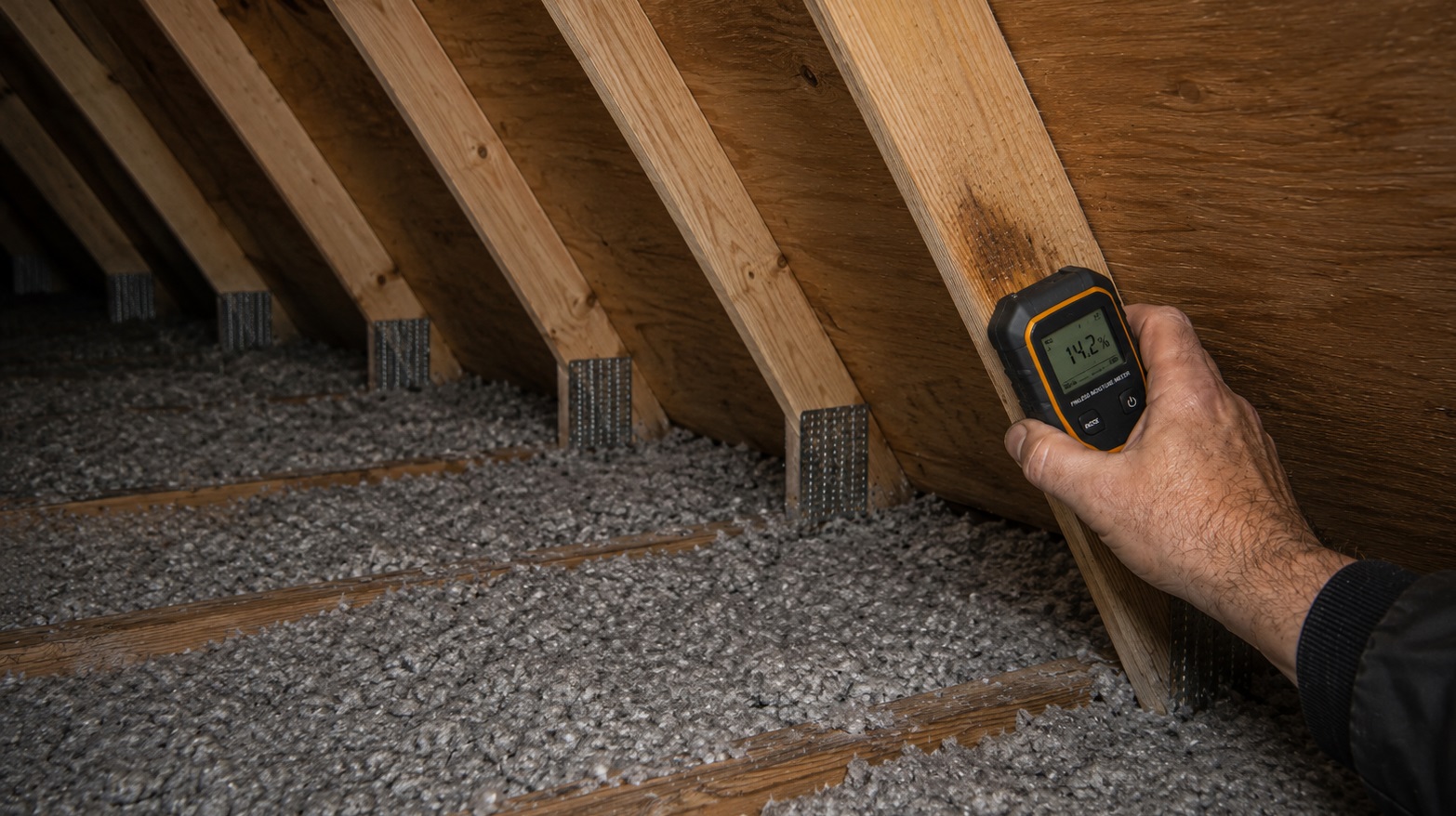
How to Detect Moisture in Roof Framing
You can detect moisture in roof framing by checking the most likely wet areas first, looking for fresh staining or rust, comparing suspicious rafters with known dry wood, and confirming the findings with a moisture meter. The goal is to determine whether the framing is currently wet, where the moisture is concentrated, and whether the problem appears active or historical.
Start near roof penetrations, valleys, eaves, rafter ends, damp insulation, and any framing below visible roof stains. If you have already noticed warning signs such as staining, odor, or soft wood, reviewing Signs of Moisture Damage in Roof Rafters can help confirm whether moisture damage is likely present.
This guide focuses on safe homeowner-level detection methods. It does not replace a full structural inspection, but it can help you decide whether moisture is present and whether further evaluation is needed.
Why Detecting Moisture in Roof Framing Matters
Roof framing supports the weight and shape of the roof, so trapped moisture should not be ignored. Small leaks, condensation, air leakage, and damp insulation can wet rafters or sheathing long before the damage is obvious from inside the house.
Early detection helps you separate minor staining from an active moisture problem. Many moisture sources begin with roof component failures, which are explained in more detail in Most Common Roofing Material Failures.
Where Moisture Usually Hides in Roof Framing
Moisture rarely spreads evenly across roof framing. Check the areas where water enters, airflow is restricted, or damp materials touch wood. These locations give you the best chance of finding moisture before testing random rafters.
Roof Penetrations and Flashing Areas
Roof penetrations are one of the most common locations where moisture enters roof framing. These areas interrupt the roof surface and depend on flashing to prevent water entry.
Common penetration locations include:
- Plumbing vent stacks
- Chimney flashing areas
- Skylight frames
- Roof-mounted exhaust vents
- Satellite or utility mounts
Moisture often travels downward from these points and spreads along rafters below. Detection efforts should begin in these areas whenever moisture damage is suspected.
Inside the attic, do not only check directly below the penetration. Also check the downslope rafter, nearby sheathing seams, and insulation below the path where water would naturally travel.
Water intrusion from penetration failures often creates patterns similar to those described in How to Detect Hidden Roof Leaks, where small entry points lead to hidden moisture movement inside structural components.
Roof Valleys and Low Drainage Areas
Roof valleys collect large volumes of water during rainfall. Because these areas experience concentrated water flow, even minor damage can allow moisture to enter roof framing.
Check areas beneath:
- Roof valley intersections
- Low roof slopes
- Transition areas between roof sections
- Junctions where multiple roof planes meet
Moisture from valley failures often appears along multiple rafters due to the wide drainage path above.
Eaves and Rafter Ends
Rafter ends near eaves are common moisture checkpoints because they sit close to soffit airflow, cold roof edges, and insulation that may be blocking ventilation paths.
Focus detection efforts near:
- Soffit areas
- Roof edges
- Vent openings
- Cold attic corners
Condensation-related moisture problems in these areas often occur alongside airflow restrictions or ventilation limitations. These patterns commonly overlap with symptoms discussed in Signs of Roof Condensation in Attics.
Safety note: Do not step on ceiling drywall, loose insulation, or unsupported areas while checking roof framing. Stay on safe framing members or an attic walkway, and avoid touching electrical wiring, wet fixtures, or visibly weakened wood.
Visual Detection Methods Homeowners Can Use
Visual detection is the safest and most accessible way to begin checking roof framing for moisture. In many cases, careful observation reveals clear patterns that point to moisture exposure even before tools are used.
While visual methods cannot always confirm active moisture, they provide critical starting points for identifying suspicious areas that require closer testing. These observations are especially useful when symptoms such as staining or odors are already present.
If you are unsure what moisture-damaged framing looks like, reviewing the patterns explained in Signs of Moisture Damage in Roof Rafters helps identify the types of changes that should trigger further testing.
Look for Active Water Patterns
One of the most reliable visual indicators of active moisture is the presence of water patterns that appear fresh or changing. Unlike old stains, active moisture often looks darker, shinier, or more defined.
Check for:
- Shiny or wet-looking wood surfaces
- Water droplets forming along rafters
- Dark streaks that appear recently
- Water trails running down wood grain
- New staining that was not present previously
Fresh moisture patterns usually appear shortly after rainfall or during high humidity conditions. If staining changes after storms, a roof leak is strongly suspected.
Identify Rust Patterns on Fasteners
Nails and metal connectors provide reliable clues about moisture conditions because metal reacts quickly to humidity and water exposure.
Look closely at:
- Nail tips protruding through roof sheathing
- Metal brackets and hangers
- Fasteners connecting rafters to beams
Common rust-related indicators include:
- Orange or brown staining around nail heads
- Rust streaks dripping downward
- Clusters of corrosion in specific areas
- Uniform rust patterns across wide sections
Rust forming on many nail tips often suggests condensation rather than localized leaks. This pattern is commonly associated with airflow and humidity problems described in Signs of Roof Condensation in Attics.
Check for Mold-Like Spots
Mold-like growth on roof framing usually means moisture has remained long enough to support biological activity. Surface growth does not prove that the wood is currently wet, but it strongly suggests that moisture has been present.
Look for:
- Dark speckling on rafters
- Gray or black patches on sheathing
- Fuzzy or powdery surface growth
- Musty odor near affected wood
- Growth concentrated near damp insulation
If mold-like growth is present, moisture detection should focus on confirming whether the conditions are still active. The causes of mold development in roof framing are explained more fully in Why Roof Framing Develops Mold Problems.
Observe Insulation and Surrounding Materials
Insulation often reveals moisture problems before wood framing does. Damp insulation can hold water against rafters or roof sheathing, making surrounding framing more vulnerable.
Warning signs include:
- Compressed insulation
- Darkened insulation patches
- Insulation clumped together
- Water stains on paper-faced insulation
- Musty odor near insulation cavities
When insulation appears damp or damaged, the nearby framing should be tested even if the wood surface appears dry.
Compare Suspicious Areas With Known Dry Sections
Comparison is one of the simplest ways to identify abnormal moisture conditions. A single stain or darkened rafter may be difficult to interpret, but comparing it with dry framing nearby provides context.
Compare:
- Color differences between rafters
- Surface texture differences
- Odor intensity between areas
- Moisture meter readings from dry and suspicious sections
- Insulation condition near each area
This makes it easier to tell whether one area is truly abnormal or simply darker because of age, dust, or wood variation.
How to Use a Moisture Meter on Roof Framing
Moisture meters provide one of the most useful ways to confirm moisture inside accessible roof framing. While visual inspection identifies suspicious areas, moisture meters help verify whether exposed wood contains measurable moisture.
These tools measure the percentage of moisture inside wood and help determine whether conditions are safe or potentially damaging.
Choosing the Right Moisture Meter Type
Two types of moisture meters are commonly used for roof framing detection:
- Pin-type moisture meters — Use probes inserted into wood to measure internal moisture levels
- Pinless moisture meters — Scan surfaces without penetrating the wood
Pin-type meters are often preferred when precise readings are required. Pinless meters are useful for scanning larger areas quickly and identifying zones that require closer testing.
Using both can help: scan first with a pinless meter, then confirm suspicious areas with a pin-type meter when the wood is accessible.
A pin-type meter is often more useful on exposed rafters because it can test the wood itself. A pinless meter can scan more quickly, but readings may be affected by surface texture, wood density, fasteners, and uneven contact.
How to Take Accurate Moisture Readings
Proper measurement technique improves accuracy and reduces false readings. Moisture readings should be taken in multiple areas rather than relying on a single measurement.
For accurate testing:
- Test visibly suspicious areas first
- Test nearby dry-looking wood for comparison
- Take readings along the length of rafters
- Test both stained and unstained areas
- Avoid testing directly over metal fasteners
- Insert pins firmly into solid wood when using pin meters
- Scan slowly across surfaces with pinless meters
- Record readings for comparison
Testing multiple locations is essential because moisture rarely distributes evenly across framing.
Understanding Moisture Level Readings
Moisture meter readings provide numerical values that indicate how much moisture exists inside the wood. Interpreting these readings correctly helps determine whether conditions are safe.
Typical moisture content ranges include:
- 6% to 12% — Normal dry wood conditions
- 12% to 16% — Elevated moisture levels
- 16% to 20% — Moisture concern range
- Above 20% — High risk for mold and decay
As a general guide, roof framing that reads below about 15 percent is usually considered dry in many conditions. Readings around 16 to 19 percent deserve monitoring and comparison with nearby dry framing. Readings at or above 20 percent usually suggest elevated moisture and should be investigated, especially if they remain high after dry weather.
If elevated moisture levels are confirmed, identifying the underlying source becomes the next step. In many cases, these sources relate to recurring roof or airflow failures.
Checking Hidden Moisture Behind Insulation
Insulation can hide roof framing moisture and make visual detection more difficult. In many attic spaces, insulation covers rafter ends, roof edges, ceiling joists, and areas where moisture accumulates.
Hidden moisture behind insulation is especially common when air leaks, condensation, or roof edge moisture problems are present.
When Hidden Moisture Is Most Likely to Occur
Hidden moisture is more likely when insulation covers or traps damp conditions. This can occur even when the visible framing appears dry.
Check behind insulation when:
- Insulation feels damp or compressed
- Musty odors are strongest near insulated areas
- Condensation appears near roof edges
- Moisture stains are visible above insulation lines
- Air leaks are suspected from the living space below
Moisture hidden behind insulation can continue affecting roof framing even after visible surfaces appear dry.
How to Safely Check Behind Insulation
Checking behind insulation should be done carefully. Insulation may contain dust, mold particles, animal debris, or other contaminants.
Use safe inspection practices:
- Wear gloves, eye protection, and a dust mask or respirator
- Avoid disturbing moldy insulation unnecessarily
- Move insulation gently only where needed
- Check the wood surface behind or below insulation
- Replace insulation only after the moisture source is corrected
If insulation is heavily contaminated or widespread mold is present, professional evaluation may be safer than continued DIY inspection.
Testing Moisture Beneath Insulated Areas
After exposing a small section of framing, test the wood beneath or beside the insulation. Compare the reading with a nearby dry section of wood that has not been covered by damp insulation.
This comparison helps determine whether insulation is trapping moisture against the roof framing.
Pay close attention to rafter ends, roof sheathing near eaves, and framing below condensation-prone areas.
How to Confirm Active vs Past Moisture
Not every stain means moisture is still active. Many roof framing stains remain long after leaks have been repaired or condensation conditions have improved. The key is determining whether moisture is currently present.
This distinction helps avoid unnecessary repairs while still identifying real risks.
Signs That Moisture Is Still Active
Active moisture problems usually show change over time. They may worsen after rain, during cold weather, or during periods of high indoor humidity.
Signs of active moisture include:
- Moisture readings that remain elevated
- Stains that grow larger or darker
- Recurring condensation on nail tips or sheathing
- Musty odors that intensify
- Wet insulation returning after drying
- Water appearing after rainfall
If these signs are present, moisture detection should continue until the source is identified.
Signs That Moisture Damage Is Historical
Past moisture damage may remain visible even after the source has been corrected. Old stains do not always mean active moisture is still present.
Historical moisture conditions often show:
- Dry moisture meter readings
- Stains that do not change over time
- No recurring odor
- No damp insulation nearby
- No new rust or water trails
Even historical damage should be monitored occasionally, especially after storms or seasonal humidity changes.
Why Multiple Test Points Matter
Moisture detection becomes more accurate when multiple test points are used. A single reading may be misleading because wood density, surface contamination, or localized conditions can affect results.
Test multiple areas including:
- The stained area
- Nearby unstained framing
- Wood directly below suspected entry points
- Framing near insulation
- Several rafters away from the suspicious area
Comparing these readings provides a clearer picture of moisture movement.
When Moisture Detection Requires Professional Tools
Some roof framing moisture problems cannot be confirmed with visual checks or a basic meter. Professional tools may be needed when moisture is hidden behind insulation, finished ceilings, roof decking, or large areas of framing.
Professional detection tools may include:
- Infrared thermal imaging cameras
- Advanced moisture mapping equipment
- Deep-probe moisture meters
- Borescope inspection tools
- Hygrometers for attic air conditions
These tools can identify temperature differences, moisture concentration patterns, and hidden wet areas behind insulation or sheathing.
When hidden moisture conditions are suspected but cannot be confirmed, professional testing methods similar to those used in How to Inspect Roof Framing for Moisture Damage provide more detailed evaluation results.
What to Do After Finding Moisture in Roof Framing
Detecting moisture in roof framing is only the first step. Once moisture is confirmed, the next priority is identifying the source and preventing further exposure. Moisture rarely disappears without intervention, and delaying corrective action increases the risk of structural damage.
For general mold prevention, the EPA emphasizes that moisture control is the key step. If roof framing or nearby materials are confirmed wet, the source should be addressed quickly instead of assuming the area will dry on its own.
Begin by documenting the affected areas. Recording moisture readings, photographing visible damage, and noting weather conditions provide valuable information that helps track changes over time.
Identify the Most Likely Moisture Source
After detecting moisture, determine where the water is coming from. In most homes, moisture originates from either roof leaks or condensation-related airflow problems.
Common moisture sources include:
- Damaged flashing around vents or chimneys
- Roof shingle failure
- Blocked or insufficient attic ventilation
- Air leakage from living spaces into the attic
- Wet insulation retaining moisture
Understanding how these failures develop helps narrow the search for root causes. Many recurring moisture issues begin with small structural failures explained in Most Common Roofing Material Failures.
Monitor Moisture Levels Over Time
After identifying suspicious areas, continued monitoring helps determine whether moisture conditions are improving or worsening.
Effective monitoring methods include:
- Rechecking moisture meter readings weekly
- Observing changes after rainfall
- Tracking odor intensity in attic spaces
- Watching for spreading stains
- Comparing readings across multiple rafters
If moisture levels remain elevated or increase over time, the source likely remains active and requires correction.
Improve Drying Conditions When Safe
Improving airflow may help reduce condensation-related moisture, but it should not be used as a substitute for repairing leaks. If the framing is wet because of blocked vents, damp insulation, or indoor air leakage, the long-term prevention steps in How to Prevent Structural Moisture in Roof Systems explain how to reduce recurring risk.
When to Seek Professional Moisture Testing
Professional evaluation is most important when the moisture appears widespread, persistent, or connected to structural movement.
Professional testing may be necessary when:
- Moisture readings remain consistently high
- Large sections of framing appear affected
- Hidden moisture is suspected behind finished materials
- Mold growth continues to spread
- Structural movement becomes visible
When these conditions occur, a detailed inspection process such as the one described in How to Inspect Roof Framing for Moisture Damage helps determine the full extent of moisture damage.
Frequently Asked Questions About Detecting Moisture in Roof Framing
How accurate are moisture meters when testing roof framing?
Moisture meters provide reliable readings when used correctly and when multiple test points are measured. Accuracy improves when readings are compared across both dry and suspicious areas.
Can roof framing moisture be detected without a meter?
Sometimes. Fresh stains, rusted nail tips, damp insulation, musty odor, and darkened rafter surfaces can point to moisture, but a meter is better for confirming whether the wood is currently wet.
How wet is too wet for roof framing?
Moisture readings above 20 percent typically indicate elevated risk for mold growth and structural deterioration. Persistent readings in this range should be investigated further.
How often should roof framing be checked for moisture?
Routine attic checks once or twice per year are usually sufficient for most homes. Additional checks may be necessary after major storms, roof repairs, or suspected leaks.
Should old roof framing stains be tested?
Yes. Old stains may be dry and harmless if the source was fixed, but they should be checked with a meter and monitored after rain or cold weather to confirm that moisture is not still active.
Conclusion
Detecting moisture in roof framing starts with checking the right areas: penetrations, valleys, eaves, rafter ends, damp insulation, and stained wood. Visual clues can show where to focus, but moisture meter readings help confirm whether the framing is actually wet.
If readings stay elevated, stains change after storms, or moisture appears across multiple rafters, the problem is likely active. At that point, the next step is to identify the source and decide whether a more detailed inspection is needed.
Key Takeaways
- Visual inspection is the first step in detecting moisture in roof framing.
- Moisture meters help confirm whether accessible roof framing is currently wet.
- Testing multiple locations improves detection accuracy.
- Hidden moisture often develops behind insulation and near roof penetrations.
- Monitoring changes over time helps distinguish active moisture from past damage.
- Professional testing may be required for complex or widespread moisture conditions.

One Comment
Comments are closed.