
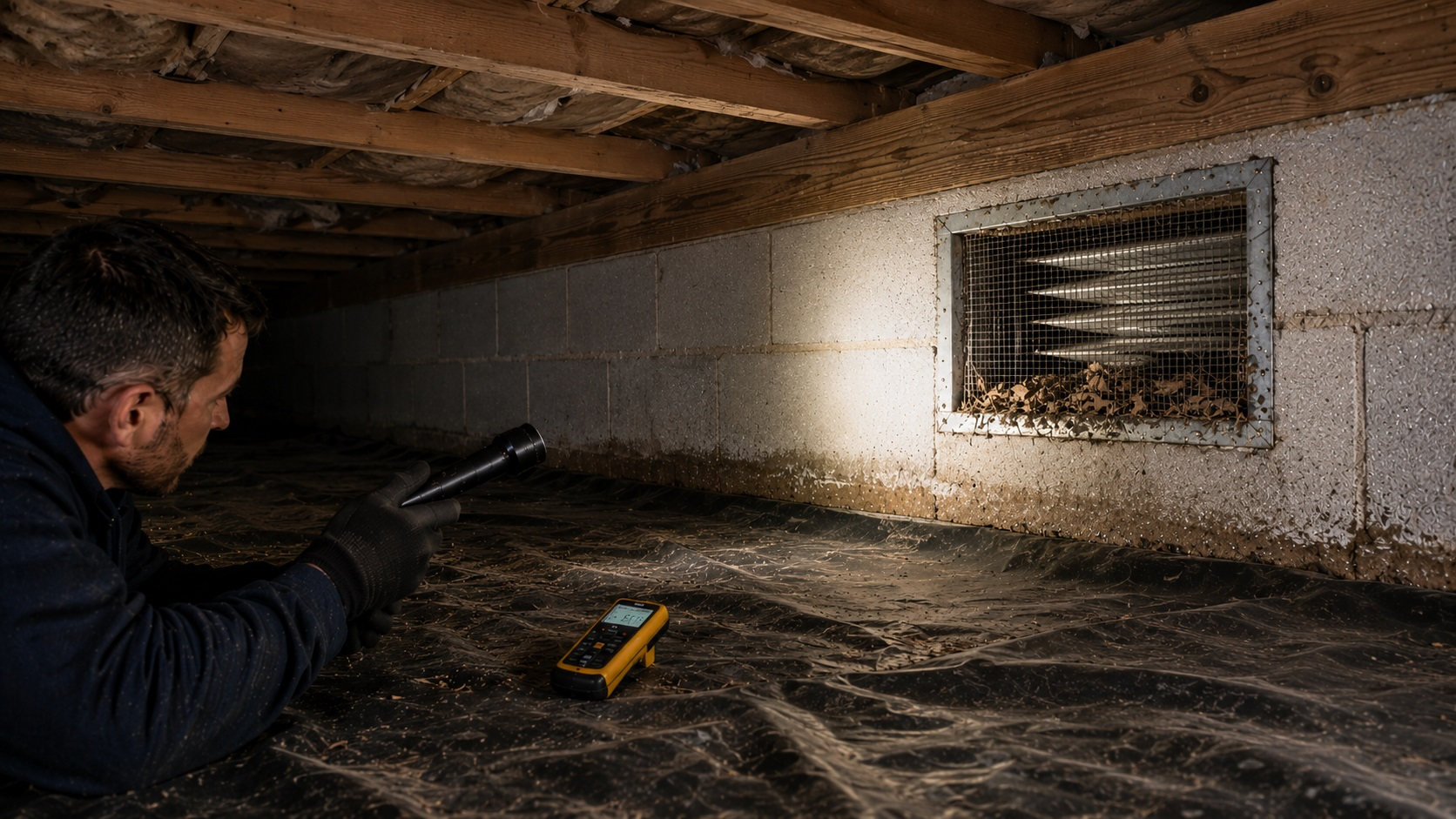
How to Detect Inadequate Crawl Space Airflow
You can detect inadequate crawl space airflow by checking whether vents are clear, testing whether air moves beyond the vent openings, comparing humidity readings in different areas, and looking for stagnant zones where dampness keeps returning. Open vents alone do not prove the crawl space is ventilating properly.
If you already see warning signs such as damp insulation, musty odors, condensation on pipes, or uneven moisture patterns, compare them with signs of poor crawl space ventilation. Then use the inspection steps below to confirm whether airflow is actually limited or whether another moisture source is involved.
This article focuses on detection, not repair. For a broader room-by-room moisture inspection process, use how to find hidden moisture in different areas of your home.
Why Detecting Crawl Space Airflow Problems Matters
Crawl space vents can look normal from outside while airflow inside the crawl space remains weak, uneven, or blocked. That is why detection has to focus on actual air movement and moisture behavior, not just whether vents exist.
Poor airflow can allow humidity to linger around framing, insulation, ductwork, and plumbing. Over time, this can contribute to condensation, damp insulation, wood moisture absorption, musty odors, and mold-friendly conditions.
Airflow testing also helps separate ventilation problems from other crawl space moisture sources. Standing water may point to drainage trouble, while isolated wet spots may suggest plumbing leaks. If the whole crawl space feels damp or humidity stays high in stagnant areas, airflow may be part of the problem.
In many homes, airflow problems exist alongside soil moisture, poor drainage, or high outdoor humidity. Those overlapping conditions are explained more fully in why crawl spaces stay damp.
Safety note: Do not enter a crawl space with standing water, exposed wiring, strong sewage odors, visible structural damage, heavy mold growth, or signs of animal activity. Inspect from the opening and call a qualified professional if the space appears unsafe.
Checking Crawl Space Vent Openings
Start by checking whether each crawl space vent is actually open and usable. A vent can appear present from the outside but still be blocked by mulch, leaves, vegetation, clogged screens, paint buildup, damaged covers, insulation, stored items, or debris inside the crawl space.
Walk the exterior foundation first, then check the same vent locations from inside the crawl space if it is safe to enter. Pay special attention to vents near landscaping, low soil lines, corners, and areas where insulation or stored materials may interrupt airflow.
If several vents are blocked or only partly open, airflow may be reduced before air can circulate through the crawl space. For a more detailed obstruction checklist, use how to inspect crawl space vents for blockages.
Evaluating Air Movement Inside the Crawl Space
After confirming that vents are physically open, the next step is evaluating whether air actually moves through the crawl space. Many crawl spaces appear ventilated but contain areas where air movement is weak or nonexistent. Detecting these stagnant zones helps determine whether ventilation is functioning as intended.
Air movement inside a crawl space is usually subtle rather than obvious. Strong air currents are not required for proper ventilation. Instead, gentle but consistent airflow is sufficient to remove moisture vapor over time.
Several simple observation methods can help detect air movement:
Using Lightweight Materials to Detect Airflow
One practical method involves using lightweight materials such as tissue paper, lightweight ribbon, or thin plastic strips. These materials react to small air movements that may not be visible otherwise.
To test airflow using this method:
- Hold a small strip of tissue, ribbon, or lightweight plastic near a vent opening
- Repeat the test a few feet inside the crawl space, not only at the vent
- Check center areas, corners, and spaces behind ductwork or insulation
- Compare whether the material moves consistently or only near the vent
Consistent movement across multiple locations suggests airflow is present. If movement occurs near vents but not in deeper areas of the crawl space, airflow may be restricted internally rather than at entry points.
Identifying Stagnant Air Zones
Airflow failures often create stagnant zones—areas where air remains trapped and humidity builds. These zones typically form in corners, behind obstructions, or beneath tightly packed insulation.
Signs of stagnant air zones include:
- Persistent dampness in isolated areas
- Localized mold or discoloration patterns
- Noticeably stale air compared to nearby areas
- Condensation forming repeatedly in the same locations
Stagnant zones provide important clues about airflow pathways. If airflow does not circulate evenly across the crawl space, moisture removal becomes uneven as well. Over time, this leads to localized damage even when other areas appear dry.
Air movement tests should be repeated under different weather conditions when possible. Airflow behavior often changes with outdoor temperature and humidity levels. Observing airflow during both dry and humid conditions helps confirm whether ventilation performance remains consistent.
If airflow appears weak or inconsistent, further evaluation of humidity behavior and temperature differences may be necessary. These additional detection methods help confirm whether ventilation capacity is adequate to control moisture effectively.
Measuring Humidity as an Airflow Indicator
Humidity levels inside a crawl space provide one of the most reliable ways to detect inadequate airflow. Even when vents appear open and air movement seems present, elevated humidity often reveals that ventilation is not removing moisture effectively. Because moisture naturally evaporates from soil and materials beneath the home, humidity readings can reveal airflow problems that are not visible during basic inspections.
Humidity is measured as relative humidity (RH), which reflects the amount of moisture present in the air. In properly ventilated crawl spaces, humidity levels generally remain stable and moderate. When airflow is restricted, humidity begins to increase and remains elevated for extended periods.
Typical crawl space humidity ranges include:
- Below 60% RH: Usually a lower-risk range when surfaces and materials are also dry
- 60%–70% RH: Warning range that should be watched, especially if readings stay elevated
- Above 70% RH: Higher-risk range where condensation, damp materials, and mold-supporting conditions become more likely
Persistent humidity readings above recommended levels can indicate that airflow is not removing moisture vapor effectively, especially when readings stay high in areas with weak air movement. Even when moisture sources are minor, trapped humid air allows damp conditions to develop gradually.
However, high humidity does not prove airflow is the only problem. Wet soil, missing ground vapor barriers, drainage issues, plumbing leaks, and humid outdoor air can also raise crawl space humidity. Treat humidity readings as an airflow clue, then compare them with vent conditions, air movement, and moisture patterns.
To measure humidity inside a crawl space, homeowners commonly use digital hygrometers or humidity monitors. These devices provide quick readings and help track changes over time. Placing humidity monitors in multiple areas helps identify airflow imbalances that affect moisture distribution.
Recommended measurement locations include:
- Near exterior vent openings
- In central areas away from vents
- Near areas with visible dampness
- Close to ducts or plumbing lines
If humidity readings vary significantly between locations, airflow may be uneven. Areas farthest from vents often experience higher humidity due to reduced air circulation. Comparing humidity patterns across the crawl space helps identify stagnant zones that require further inspection.
Track humidity over several days instead of relying on one reading. If humidity remains high despite dry weather, cleared vents, and no obvious standing water, airflow may be failing to remove moisture consistently. These patterns often align with moisture retention behaviors described in why crawl spaces stay damp.
Detecting Temperature Differences That Signal Poor Airflow
Temperature differences inside a crawl space can support an airflow diagnosis, especially when they appear in the same areas as high humidity or repeated condensation. Poor circulation often leaves corners, enclosed bays, or spaces behind obstructions warmer, cooler, or more stagnant than nearby areas.
Common temperature-related indicators include:
- Warm, stagnant air in enclosed corners
- Noticeable temperature differences between vent areas and interior sections
- Localized warm spots near insulation or obstructions
- Cool surfaces with persistent condensation nearby
Temperature checks can be performed using handheld digital thermometers. By measuring temperatures in multiple areas, homeowners can identify locations where air movement is limited. Areas with little temperature variation typically indicate consistent airflow, while uneven readings suggest circulation problems.
Seasonal changes can make these patterns easier to see. Warm weather may trap humid air in dead zones, while cooler weather may reveal condensation on cold pipes, ducts, or framing where air does not circulate well.
Repeated temperature variations near specific obstructions may indicate restricted airflow pathways. These patterns help identify areas where air movement is reduced, even when vents appear open.
Temperature-related airflow detection should always be considered alongside humidity observations. When both humidity and temperature imbalances appear together, ventilation failure becomes more likely.
Identifying Blocked or Restricted Air Paths Inside the Crawl Space
Even when vents remain open, airflow may still be restricted by obstacles inside the crawl space. Detecting these internal blockages is essential for confirming whether airflow can move freely across the entire crawl space area.
Air must travel from one vent to another to remove moisture effectively. When obstacles interrupt this path, air circulation weakens, allowing moisture to accumulate in isolated zones.
Common internal airflow obstructions include:
- Insulation hanging below floor framing
- Stored materials placed inside the crawl space
- Debris buildup along foundation walls
- Ductwork positioned directly in airflow paths
- Collapsed or displaced insulation batts
Obstructions rarely block airflow completely. Instead, they reduce circulation gradually, creating zones where air movement becomes limited. These areas often develop higher humidity levels and persistent dampness compared to surrounding areas.
When inspecting airflow paths, pay attention to:
- Areas where insulation appears compressed or shifted
- Locations where debris restricts movement between vents
- Sections of the crawl space that feel noticeably more humid
- Regions where condensation appears repeatedly
Uneven airflow patterns often produce uneven moisture patterns. If one section of the crawl space appears damp while another remains dry, restricted airflow may be responsible. These patterns help confirm that ventilation performance is inconsistent rather than completely absent.
If internal obstructions are suspected, reviewing airflow improvement methods such as those explained in how to improve airflow in crawl spaces can help identify long-term correction strategies once airflow limitations are confirmed.
Signs Airflow Is Present but Not Effective
In some crawl spaces, airflow exists but still fails to control moisture effectively. This condition can be difficult to detect because vents appear open and air movement may be noticeable near entry points. However, ineffective airflow often reveals itself through ongoing moisture problems that persist despite apparent ventilation.
Airflow that is technically present but insufficient usually creates uneven conditions rather than complete stagnation. Certain areas may remain damp while others appear dry, leading to confusion about the true cause of moisture buildup.
If you are seeing moisture symptoms but have not yet confirmed whether airflow is the cause, compare those patterns with signs of moisture caused by crawl space vent failure before deciding whether the issue is ventilation, drainage, plumbing, or ground moisture.
Common signs that airflow exists but is not effective include:
- Humidity levels remain high even after clearing blocked vents
- Condensation returns shortly after surfaces dry
- Moisture accumulates in areas farthest from vents
- Musty odors continue despite visible airflow
- Insulation remains damp even during dry weather
These conditions suggest that airflow is present near the openings but not strong or consistent enough to dry the full crawl space. This can happen when vents are undersized, vent placement creates dead zones, interior obstructions interrupt crossflow, or outdoor humidity keeps replacing damp crawl space air with more humid air.
When ineffective airflow persists, it becomes important to evaluate the underlying reasons behind airflow limitations. Understanding these root causes—such as those explained in why crawl space ventilation causes moisture problems—helps determine whether improvements or modifications may be necessary.
When to Perform a Professional Airflow Inspection
Basic airflow checks are useful, but they should stop when the crawl space is unsafe or when the readings point to a larger moisture-control problem. Crawl spaces may contain mold, exposed wiring, standing water, damaged framing, pests, or contaminated materials that should not be handled during a simple homeowner inspection.
Professional inspection should be considered when:
- Humidity levels remain high after clearing visible vent blockages
- Airflow tests show little or no air movement across large areas
- Mold growth becomes visible on framing or insulation
- Standing water is present inside the crawl space
- Wood framing shows signs of deterioration or softening
- Indoor humidity problems continue despite maintenance efforts
Professional inspectors may use specialized tools such as airflow meters, moisture meters, or thermal imaging equipment to identify ventilation failures. These tools provide more precise measurements than basic observation methods and can reveal hidden airflow restrictions.
In some cases, airflow testing reveals that ventilation systems alone cannot control moisture effectively. When this occurs, additional moisture control strategies—such as improved drainage or airflow redesign—may be required. Recognizing these conditions early helps prevent long-term structural damage.
Frequently Asked Questions About Detecting Crawl Space Airflow Problems
How can I tell if crawl space vents are working?
Check each vent from outside and inside, then test whether air movement reaches the center and corners of the crawl space. If tissue or ribbon moves only at the vent but humidity stays high deeper inside, the vents may be open but not moving enough air through the space.
Do crawl space vents always provide enough airflow?
No. Vents can be open and still fail if they are too small, poorly placed, blocked by insulation or debris, or unable to create circulation across the crawl space. Outdoor humidity can also limit how much drying vented air can provide.
Can humidity readings confirm airflow problems?
Humidity readings can support the diagnosis, especially when readings stay above 60% RH or vary sharply between vent areas and interior crawl space areas. However, high humidity can also come from wet soil, drainage issues, plumbing leaks, or missing vapor barriers, so it should not be used alone.
What tools help detect crawl space airflow issues?
Useful homeowner tools include a digital hygrometer, a thermometer, a flashlight, and lightweight tissue or ribbon for comparing air movement. Professionals may also use airflow meters, moisture meters, and thermal imaging to confirm hidden restrictions or moisture patterns.
When should airflow testing be done professionally?
Use a professional inspection when humidity remains high after obvious blockages are cleared, when mold or wood deterioration is visible, when standing water is present, or when the crawl space has electrical, structural, pest, or contamination hazards.
Conclusion: Confirming Airflow Problems Prevents Long-Term Damage
Inadequate crawl space airflow is confirmed by patterns, not by one sign alone. Open vents, weak tissue movement, high humidity, stagnant corners, repeated condensation, and uneven dampness should be evaluated together.
If airflow appears limited, correct obvious obstructions first, continue monitoring humidity, and investigate other moisture sources before assuming ventilation is the only problem. If humidity stays high, mold appears, standing water is present, or framing looks damaged, stop the DIY inspection and bring in a qualified crawl space or moisture professional.
Key Takeaways
- Open vents do not guarantee adequate airflow—circulation must occur throughout the crawl space.
- Humidity levels above 60% can support an airflow concern when they stay elevated or appear in stagnant areas.
- Uneven moisture patterns may signal restricted airflow pathways.
- Temperature differences inside the crawl space can reveal stagnant air zones.
- Persistent moisture despite open vents suggests airflow capacity is insufficient.
- Professional inspection is recommended when airflow problems continue or structural damage appears.
3 Comments
Comments are closed.