Signs of Mold in Laundry Rooms
Common signs of mold in laundry rooms include a musty smell, recurring dark spots, fuzzy or patchy growth, damp lint, stained baseboards, swollen trim, peeling paint, and suspicious growth behind the washer, dryer, drains, stored items, or flooring edges. These clues are easy to overlook because laundry rooms already contain moisture, heat, lint, wet clothing, plumbing, and appliances that hide wall and floor surfaces.
The first step is recognizing the warning signs without jumping to conclusions. Not every dark spot is mold, and mold type cannot be identified by color alone. But if suspicious spots appear with dampness, odor, staining, swelling, or recurring moisture, the laundry room should be inspected more carefully before the problem spreads.
This article focuses on signs of mold in laundry rooms. It does not cover full mold removal, washer repair, dryer vent repair, or long-term prevention routines. If you already know mold is present and need a broader cleanup framework, start with the guide on how to remove mold permanently. If you are still trying to determine whether the laundry room has mold, the signs below can help you narrow the problem.
Why Laundry Room Mold Is Easy to Miss
Laundry rooms create conditions where mold can begin quietly. Washing machines use water, drains can overflow, supply hoses can leak, dryer vents move humid air, and damp clothing may sit in baskets or machines longer than intended. Many laundry rooms are also small, enclosed, poorly ventilated, or crowded with stored supplies.
The most important hidden areas are often the least inspected. Homeowners may clean the visible floor and appliance tops but rarely look behind the washer, behind the dryer, under shelving, around the drain standpipe, or along the baseboards behind laundry baskets. Mold often starts in these low-airflow areas because moisture stays there longer.
Laundry-room mold is also easy to confuse with lint, dust, detergent residue, mildew-like surface staining, or ordinary dirt. Dryer lint can stick to damp walls and trim. Dust can collect behind appliances. Detergent splashes can leave residue near sinks or machines. The difference is that mold-like growth often appears with a musty odor, damp surface, spreading pattern, or recurring spots after cleaning.
Because mold signs usually point back to moisture, cleaning suspicious spots without finding the source often leads to the same stains or odors returning. This is part of the broader process of learning how to find, fix, and prevent moisture problems in the home.
Musty Odor That Returns After Cleaning
A musty odor is one of the most common early signs of possible mold in a laundry room. The room may look clean, but the odor returns after mopping, wiping surfaces, or running a washer cleaning cycle. That usually means the smell is not just surface dirt. It may be coming from damp materials, hidden growth, trapped moisture, or a moisture source that has not been corrected.
Musty odor is more concerning when it is localized. A general laundry smell may come from clothing, detergent, or a washer drum that needs cleaning. A stronger odor near the floor, behind the washer, around the dryer vent, inside a utility cabinet, or along baseboards suggests the source may be connected to hidden moisture.
Odor near the washer
A musty smell behind or beside the washer may point to moisture around supply hoses, drain lines, the standpipe, the wall behind the appliance, or the floor beneath the machine. Because washers are heavy and often placed close to the wall, small leaks can go unnoticed for a long time.
Check whether the odor becomes stronger after wash cycles. If the smell appears after the washer fills, drains, or spins, there may be moisture escaping behind the appliance or beneath the flooring. Mold behind a washer is especially common when the wall stays damp, the floor under the machine dries slowly, or the appliance blocks airflow.
Odor near the dryer or vent
A musty smell near the dryer can have several causes. Damp lint behind the dryer, a loose vent connection, weak dryer exhaust, or condensation in the vent route can all create moisture conditions that support odor and mold growth. This is especially common in small laundry closets where the dryer is pushed tightly against the wall.
If the odor gets stronger after drying cycles, inspect the dryer area carefully. Look for damp lint, warm humid air escaping behind the dryer, condensation near the vent connection, or staining around the wall outlet. When the strongest clues are near the dryer exhaust, the next step is to inspect dryer vents for moisture problems rather than assuming the entire laundry room is the source.
Odor near flooring, drains, and baseboards
A musty smell near the floor can mean moisture is trapped under flooring, inside baseboards, around a floor drain, or beneath appliances. This odor may be strongest when the room is closed up, after humid weather, or after laundry cycles add more moisture to the space.
Pay close attention to odor at the floor-wall joint. Mold can begin behind swollen trim, under lifting vinyl, near cracked grout, or beneath damp underlayment. If the odor appears with soft flooring, raised seams, or swollen baseboards, compare those clues with signs of water damage under laundry room flooring.
Visible Mold-Like Spots on Walls, Trim, or Floors
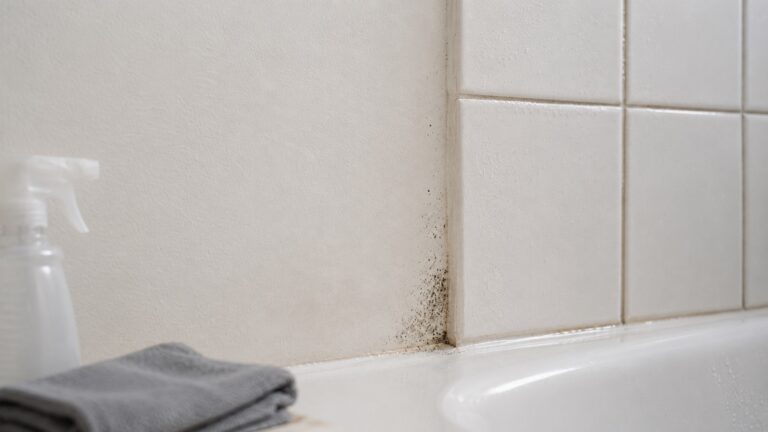
Visible mold-like spots are the clearest warning sign, but they still need to be interpreted carefully. Mold can appear in different colors and textures, and color alone does not identify the type or severity. Instead of focusing only on whether spots are black, green, gray, or brown, look at the pattern, location, moisture history, and whether the spots keep returning.
In laundry rooms, visible mold-like spots often appear near moisture sources and low-airflow areas. Common locations include the wall behind the washer, the dryer vent area, baseboards, corners, flooring edges, utility sink cabinets, drain areas, and behind stored items.
Before deciding what the spots mean, check whether the surrounding material is dry, stained, swollen, soft, peeling, or recently wet. The same dark mark is more concerning on damp drywall, swollen trim, or lifting flooring than it is on a dry, open shelf with loose dust.
Black, green, gray, or brown spotting
Mold-like spotting in laundry rooms may appear black, gray, green, brown, or dark yellow depending on the surface, moisture level, age of the growth, and surrounding dirt or lint. Do not assume that every black spot is “black mold,” and do not assume lighter-colored spots are harmless. The more useful question is whether the spotting appears in a damp area and behaves like growth rather than ordinary residue.
Look for spotting around:
- The wall behind the washing machine
- The area around washer supply hoses
- The drain standpipe or drain hose connection
- The wall or trim behind the dryer
- The dryer vent connection
- Baseboards and floor-wall joints
- Utility sink cabinets or drain areas
- Flooring seams and corners
- Stored boxes, baskets, shelving, or cleaning supplies
Spotting is more suspicious when it appears near moisture damage. For example, dark speckles on swollen trim, damp drywall, peeling paint, lifting flooring, or a stained wall are more concerning than dry dust on an open shelf. Mold needs moisture, so the surrounding material condition matters.
Fuzzy, patchy, or recurring growth
Texture is another important clue. Mold-like growth may look fuzzy, velvety, powdery, smeared, speckled, or patchy. It may spread unevenly instead of forming a clean, uniform dust layer. It may also return after wiping if the moisture source remains active.
Recurring growth is especially important in laundry rooms because many sources are intermittent. A washer may leak only during the drain cycle. A dryer vent may release humid air only during drying cycles. A damp floor edge may dry on the surface while moisture remains under the flooring. These conditions can allow spots to return even after the surface looks clean for a while.
If suspicious growth appears again in the same area, do not keep wiping it without investigating the source. Recurring mold-like spots usually mean the underlying moisture condition has not been corrected. For a deeper explanation of those moisture patterns, the related guide on why laundry rooms develop mold problems covers the causes in more detail.
How to avoid confusing mold with lint or dirt
Laundry rooms collect lint, dust, detergent residue, and fabric debris. These materials can look like mold when they stick to damp surfaces. The difference is often found in the pattern and context.
Lint or dirt is more likely when:
- The material is dry and loose
- It wipes away cleanly and does not return quickly
- It appears where dryer airflow or dust naturally collects
- There is no musty odor
- The surrounding wall, trim, or floor is dry and undamaged
Mold-like growth is more likely when:
- The area smells musty
- The spots return after cleaning
- The surface feels damp or has been damp recently
- The spots appear on swollen, stained, peeling, or softened material
- The pattern spreads or becomes darker over time
- The growth appears behind appliances or near drains, hoses, vents, or floor edges
If the area is large, recurring, on porous material, or connected to hidden moisture, avoid aggressive scrubbing or dry brushing. Disturbing suspicious growth can spread particles and may expose damaged materials that need a more careful inspection.
Mold Signs Behind the Washing Machine
The wall and floor behind a washing machine are among the most common places to find laundry-room mold signs. This area is often warm, dusty, blocked from airflow, and difficult to inspect. A small leak can stay hidden because the washer sits close to the wall and covers the source.
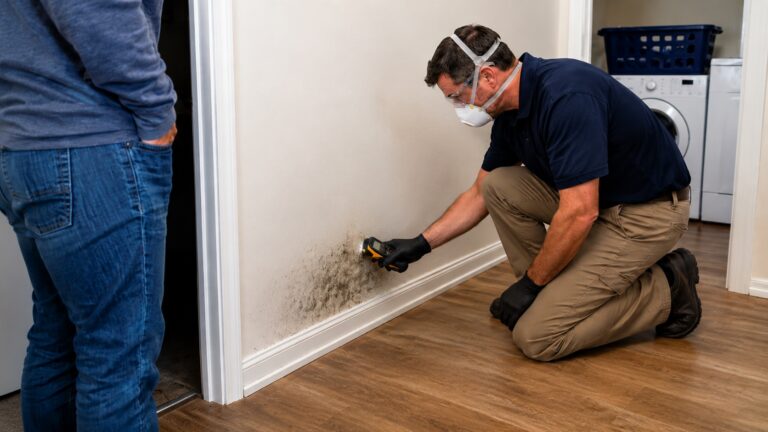
When it is safe to look behind the washer, use a flashlight and inspect the rear wall, supply hose connections, drain hose, standpipe, floor edge, and baseboards. Do not pull the washer forcefully if hoses or cords are tight. If the appliance is stacked, built in, or difficult to move, inspect only what you can see safely.
A phone camera held behind the appliance can sometimes show staining, damp lint, hose corrosion, or wall spotting without moving the machine.
Warning signs behind the washer include:
- Dark spotting on the rear wall
- Musty odor strongest behind the machine
- Swollen baseboards or trim
- Damp lint or dust stuck to the wall
- Water stains below supply hose connections
- Staining near the drain standpipe
- Peeling paint or soft drywall
- Mold-like growth near the appliance footprint
- Recurring spots after wash cycles
Mold behind the washer often points to a moisture source that needs separate attention. If you see staining, dampness, corrosion, or repeated moisture around the appliance, compare those findings with signs of water damage around washing machines. If the signs appear only during certain wash cycles or behind the appliance where the source is hard to see, the next step may be to detect hidden washing machine leaks.
Do not assume mold behind a washer is only from one past spill. If the wall stays damp, the drain area smells musty, or spots return after cleaning, the underlying moisture source may still be active.
Mold Signs Near the Dryer or Dryer Vent
Mold signs near the dryer are often connected to humid exhaust, damp lint, poor airflow, or a loose dryer vent connection. A dryer produces warm, moisture-heavy air as it removes water from clothing. That air should leave the home through the vent. If the vent is restricted, disconnected, crushed, or leaking, nearby surfaces may stay damp long enough to support mold-like growth.
Inspect the wall behind the dryer, the vent connection, the nearby baseboards, and the floor around the dryer. If the dryer sits in a tight closet or narrow laundry area, poor airflow can make the moisture problem worse because damp air stays trapped around the appliance.
Look for these warning signs near the dryer:
- Musty odor that gets stronger after drying cycles
- Damp lint behind or beside the dryer
- Dark spotting around the dryer vent wall outlet
- Condensation near metal duct sections
- Peeling paint or staining behind the dryer
- Mold-like spots near the baseboard behind the dryer
- Warm humid air escaping from the vent connection
- Recurring dust or lint clumps that feel damp instead of dry
When mold signs are strongest near the dryer vent, avoid assuming the issue is only surface dirt. Damp lint, humid exhaust, condensation, or staining near the vent may point to dryer vent moisture damage that needs separate inspection. A dryer vent issue can also raise room humidity and make other laundry-room surfaces dry more slowly.
Mold Around Baseboards, Flooring, and Corners
Baseboards, corners, and floor-wall joints are common places for laundry-room mold signs because moisture naturally collects at low points. Water from a small leak may travel under the appliance, along flooring seams, or into trim before it becomes visible. Humid air can also settle behind stored items or in corners with poor airflow.
Inspect the lower walls around the washer, dryer, utility sink, and doorway. Move laundry baskets, small shelves, and cleaning supplies if it is safe to do so. Mold-like growth often hides behind objects that block airflow and trap dampness against the wall.
Warning signs around baseboards and corners include:
- Dark speckling along the floor-wall joint
- Swollen or separating baseboards
- Peeling paint near the floor
- Musty odor strongest near corners
- Soft or crumbly lower drywall
- Recurring spots behind baskets or storage bins
- Staining that follows the floor edge
- Mold-like growth near lifting flooring seams
These signs often mean moisture is not only on the surface. It may be trapped behind trim, under flooring, or in the lower wall area. If the floor also feels soft, raised, uneven, or musty, review the signs of water damage under laundry room flooring so the floor and subfloor symptoms are evaluated separately.
Pay attention to recurring spots at the same floor edge. If they return after wiping, the moisture source may still be present. Cleaning the visible growth without addressing trapped moisture behind trim or under flooring usually does not solve the problem.
Mold Near Utility Sinks, Drains, and Storage Areas
Laundry rooms often include more than a washer and dryer. Utility sinks, floor drains, mop buckets, stored cleaning supplies, wet towels, cardboard boxes, shelving, and nearby plumbing can all create small moisture zones where mold signs appear.
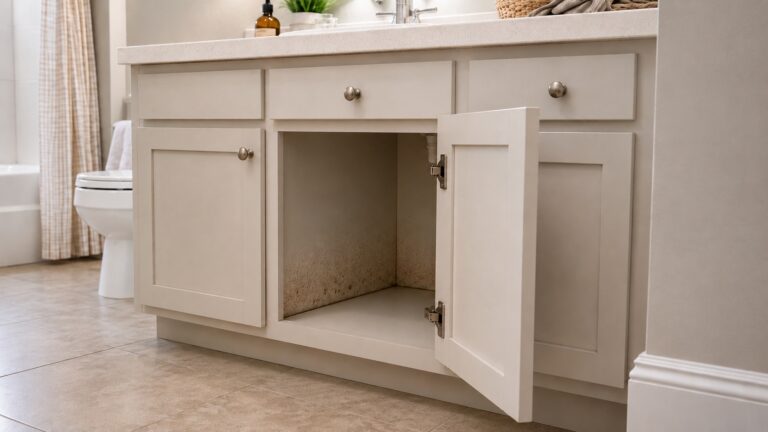
Utility sinks are common trouble spots because leaks may occur at the faucet, drain trap, supply connections, cabinet base, or wall penetration. Floor drains may hold odor, back up slightly, or collect damp lint and debris. Storage areas may trap moisture if wet items are placed against walls or floors.
Inspect these areas carefully:
- Under and behind utility sinks
- Around sink drain traps and supply lines
- Near floor drains or drain covers
- Behind detergent bottles and cleaning supplies
- Under stored laundry baskets
- Behind cardboard boxes or fabric storage bins
- Along shelves mounted near damp walls
- In corners where air circulation is poor
Warning signs include dark spotting, musty odor, damp cardboard, stained shelving, swollen cabinet bases, mold-like growth on stored items, or recurring surface growth near drains. If the room has several of these clues, the issue may be broader than one visible patch.
Stored items can make laundry-room mold easier to miss. Cardboard, fabric, paper packaging, and wood shelves can absorb moisture and hold it against walls or floors. If mold-like growth appears only behind stored materials, first look for the moisture source, then use the guide on how to prevent mold in laundry rooms for ongoing habits and maintenance.
When Laundry Room Mold Signs Need Professional Inspection
Some laundry-room mold signs can be monitored and investigated with basic visual inspection, but others should be taken seriously. Mold-like growth in a laundry room often points to a moisture source. If that source is hidden behind appliances, under flooring, inside walls, or around plumbing, the visible patch may be only part of the problem.
Professional inspection is recommended when:
- Mold-like growth keeps returning after cleaning
- The musty odor is strong or localized behind appliances
- Spots appear on soft, swollen, or damaged materials
- The floor feels soft, unstable, or damp
- There is suspected moisture inside a wall or under flooring
- Growth appears around plumbing, drains, or the dryer vent route
- The affected area is large or difficult to access safely
- You see mold-like growth on porous materials such as drywall, trim, wood, cardboard, or underlayment
- Water is active near electrical outlets, cords, or appliances
If active water is present near electricity, outlets, cords, or appliances, stop using the affected area until the safety issue is addressed. Do not keep running the washer or dryer to “test” the problem when water, unstable flooring, or electrical risk is present.
A professional may need to inspect for hidden leaks, vent problems, moisture under flooring, or contamination behind appliances. The right specialist depends on the source: a plumber for washer or sink leaks, a dryer vent technician for exhaust problems, a restoration professional for trapped moisture, or a mold professional when growth is widespread, recurring, or hidden.
FAQ About Mold Signs in Laundry Rooms
What are the first signs of mold in a laundry room?
The first signs are often a musty odor, recurring dark spots, damp lint, staining near appliances, swollen baseboards, peeling paint, or mold-like growth behind the washer, dryer, utility sink, drain, or stored items. Mold signs are more likely when odor, dampness, staining, and recurring growth appear together.
Why does my laundry room smell musty even after cleaning?
A musty smell that returns after cleaning usually means the source is not just surface dirt. The odor may be coming from moisture behind the washer, damp flooring, a dryer vent issue, a drain area, wet trim, or stored items that are holding moisture. Surface cleaning may temporarily reduce the smell, but it will usually return if the moisture source remains.
Is mold behind a washing machine common?
Yes, mold-like growth behind a washing machine is common because the area is hidden, low-airflow, and close to water supply hoses, drain lines, and the standpipe. Small leaks or repeated dampness can stay unnoticed behind the appliance until odor, staining, or visible spots appear.
Can a dryer vent cause mold in a laundry room?
A dryer vent can contribute to mold conditions if humid exhaust leaks indoors, the vent is restricted, damp lint collects behind the dryer, or condensation forms near the vent route. If the strongest odor, spotting, damp lint, or staining is near the dryer wall, check for dryer vent moisture damage as a possible moisture source.
How can I tell the difference between mold and lint or dirt?
Lint and dirt are usually dry, loose, and easy to wipe away. Mold-like growth is more suspicious when it appears in damp areas, smells musty, returns after cleaning, spreads unevenly, or appears on stained, swollen, peeling, or softened materials. If you are unsure, treat the area cautiously and focus on finding the moisture source before aggressive cleaning.
When should I call a professional for laundry room mold?
Call a professional if mold-like growth keeps returning, the odor is strong, the affected area is large, the growth is behind appliances or under flooring, the floor or wall feels soft, or active water is present near outlets, cords, or appliances. Professional inspection is also wise when you suspect hidden moisture but cannot safely access the washer, dryer, vent, drain, or flooring edge.
Laundry Room Mold Signs to Remember
- Mold in laundry rooms often starts behind appliances, along baseboards, near drains, around dryer vents, or under stored items.
- A musty odor that returns after cleaning is one of the strongest early warning signs of hidden moisture or possible mold.
- Dark spots are more suspicious when they appear with dampness, staining, swelling, peeling paint, or recurring growth.
- Mold behind a washer may point to supply hose, drain, standpipe, or hidden leak problems.
- Mold signs near a dryer may point to humid exhaust, damp lint, condensation, or dryer vent airflow problems.
- Recurring mold-like growth usually means the washer area, dryer vent, drain, floor edge, or stored-item area still has a moisture problem.
What to Do Next If You See Mold Signs in a Laundry Room
If you notice musty odor, recurring spots, damp lint, stained trim, peeling paint, or mold-like growth behind laundry appliances, treat the signs as moisture clues rather than isolated surface dirt. Start by checking the nearest likely source: the washer area, dryer vent, drain, flooring edge, baseboards, utility sink, or stored items.
If the growth is widespread, recurring, hidden behind appliances, connected to soft flooring or wall damage, or located near active water and electrical components, professional inspection is the safer path. Once the source is understood, the next step is correcting the moisture condition and using long-term prevention habits to keep the laundry room dry.