
How to Detect Hidden Washing Machine Leaks
A hidden washing machine leak is easiest to detect by matching the wet area to the timing of the washer cycle. The floor may look dry between loads, but water may appear only during fill, drain, spin, heavy loads, or behind the appliance where hoses and drain connections are hard to see.
The key to detecting a hidden washer leak is to look for patterns. Where does the water appear? When does it show up during the cycle? Is the moisture near the supply hoses, the drain hose, the front edge of the machine, or the flooring seams? Those clues can help you narrow the source before the leak damages floors, walls, baseboards, or nearby rooms.
This guide focuses on detection, not repair. It will help you inspect the washer area safely, separate supply-side leaks from drain-side leaks and machine-body leaks, and decide when the problem requires a plumber, appliance repair technician, or water damage professional. For visible warning signs before the inspection stage, see the guide to signs of water damage around washing machines.
Why Hidden Washing Machine Leaks Are Hard to Find
Washing machines can leak in ways that are not obvious during normal use. A hose connection may drip only when the washer fills. A drain hose may leak only when water is pumped out. An internal washer problem may appear only during spin, heavy loads, or high-water cycles.
Because of this, a hidden washer leak may not leave a puddle every time. Moisture may evaporate from the surface before you see it, or it may stay trapped under flooring, behind baseboards, or along the wall behind the machine. A dry-looking laundry room does not always mean the area is dry beneath the surface.
The washer also blocks the most important inspection zone. Most supply valves, hose couplings, drain hoses, standpipes, and wall connections are behind the appliance. If the washer sits in a tight closet, laundry alcove, basement corner, garage, or second-floor laundry room, it may be difficult to see the back area without careful inspection.
Another challenge is that water travels. A leak that begins behind the washer may appear several feet away along a flooring seam, baseboard, or low spot, so detection should focus on both the source area and the path the water takes. For the broader structural risk, review how plumbing leaks cause structural damage in floors, walls, trim, and subfloor systems.
Start With Safety Before Inspecting the Washer
Before you test or inspect anything, make sure the area is safe. A washing machine combines water, electricity, heavy appliance movement, and pressurized supply lines. Do not rush into moving the washer or reaching behind it if water is near electrical components.
Do Not Touch Wet Electrical Areas
If water is near an outlet, plug, extension cord, power strip, or the washer cord, do not reach into the area casually. Stop using the washer and avoid standing in water while touching the appliance or wall. Electrical risk is one of the main reasons to stop inspecting and call for help.
If the leak is active and the area is wet near electrical connections, focus on staying safe rather than finding the exact source immediately. Stop using the washer and get qualified help before continuing inspection in that area.
Stop Using the Washer if Active Leaking Is Visible
If you see water actively dripping, spraying, flowing, or spreading during a cycle, stop using the washer. Continuing to run loads can send more water into the floor, wall base, or surrounding materials.
If the hot and cold washer shutoff valves are easy to reach and the area is dry enough to access safely, turn them off. Do not force a corroded valve, and do not reach behind the washer if you cannot do so safely. If the shutoff valve itself is leaking, stuck, or difficult to turn, treat that as a plumbing repair issue rather than something to force during an active leak.
Do Not Pull Out a Heavy Washer Without Checking the Hoses
Moving the washer can help you inspect behind it, but it can also make a leak worse if the hoses are tight, brittle, kinked, or already damaged. Pulling too hard can stress supply lines, drain hoses, flooring, and wall connections.
If the washer is stacked, wedged into a closet, sitting on damaged flooring, or difficult to move, do not force it. Use a flashlight, phone camera, or mirror first. If you need to move the appliance, have help and move it slowly enough to avoid straining the hoses.
Clear the Area Before Testing
Move laundry baskets, rugs, detergent containers, cardboard boxes, towels, and stored items away from the washer. These items can hide damp flooring and soak up water, making the leak pattern harder to read.
Clearing the area also helps you see whether water is coming from the wall, under the machine, along the flooring seams, or from nearby stored items. Detection works best when the floor around the washer is visible and dry before you begin watching for new moisture.
Map Where the Water Appears
The first step in detecting a hidden washing machine leak is mapping the water pattern. Do not start by guessing which part failed. Start by identifying where the water appears, how far it spreads, and whether it begins near the wall, under the appliance, or along the finished floor.
Use a flashlight and look at the washer from several angles. If the area is dry when you begin, place a dry towel or paper towel in suspicious spots so fresh moisture becomes easier to see. Take photos before and after a cycle if the leak is intermittent. Label the pattern in simple terms: behind the washer, front edge, center underneath, left or right side, flooring seam, or baseboard. That location label will make the cycle test more useful later.
Water Behind the Washer
Water behind the washer often points toward the supply hoses, shutoff valves, valve box, drain hose, or standpipe. This is one of the most common hidden leak zones because the appliance blocks the wall and the rear floor edge.
If the damp area begins behind the washer and spreads forward, focus your inspection on the back wall first. Look below the hot and cold water connections, around the drain hose, near the standpipe, and along the baseboard behind the machine.
Water Under the Front Edge
Water under the front edge of the washer may point toward the door seal, detergent drawer, front panel area, pump filter access, oversudsing, or water escaping from the washer body. This pattern is common when the back wall looks dry but the floor near the front of the appliance becomes wet after a cycle.
If the washer is a front-load model, look around the door boot and detergent drawer area. If it is a top-load model, consider whether water is splashing during agitation, overflowing during fill, or escaping under the cabinet during operation.
Water Under the Center of the Machine
Water that appears under the center of the washer is harder to inspect without moving the appliance. It may indicate an internal hose, pump, tub seal, or other machine-body leak. The important detection clue is that the water seems to start beneath the appliance instead of at the wall or front edge.
Do not disassemble the washer to confirm this. If the floor is repeatedly wet under the center of the machine and hose or drain connections look dry, the next step may be appliance repair evaluation.
Water Along Flooring Seams or Baseboards
Water along flooring seams or baseboards may not show the original source. It may show the path water is taking after it escapes. Finished flooring can channel water along seams, transitions, wall edges, and low spots.
If the moisture seems to move under the floor or appears away from the washer, check whether the damage is becoming a flooring issue rather than only a surface leak. The guide to water damage under laundry room flooring covers deeper floor warning signs that go beyond washer-source detection.
Check the Washer During Different Cycles
Hidden washing machine leaks are often cycle-specific. The leak may not appear when the washer is idle, but it may show up during fill, wash, drain, spin, or only with large loads. Watching the timing is one of the most useful ways to narrow the source.
Before testing, start with a dry, clear floor around the washer. Use a flashlight and observe from a safe position. Do not reach behind the machine while it is moving, draining, or leaking near electrical areas.
If Water Appears During Fill
Water that appears during the fill cycle often points toward the supply side. Check the hot and cold hose connections, washer inlet connections, shutoff valves, and valve box. A loose coupling, failing washer, cracked hose, or valve leak may only show itself when water is flowing into the machine. If only one side is wet, note whether it is the hot or cold connection before wiping the area dry.
Pay attention to whether the leak begins high on the wall or low on the floor. A drip below the valve box or supply hose connection may run down the wall before collecting at the baseboard.
If Water Appears During Wash or Agitation
Water that appears during wash or agitation may point toward load imbalance, oversudsing, a worn seal, an internal hose, or water escaping from the machine body. This is especially likely if the hose and drain areas remain dry but water appears near the washer cabinet.
Notice whether the leak happens with large loads but not small ones. A washer that is overloaded, unlevel, or vibrating heavily may expose leak symptoms that do not appear during light use.
If Water Appears During Drain
Water that appears during the drain cycle often points toward the drain hose, standpipe, utility sink, or drain line. The washer releases water quickly during this part of the cycle, so loose drain hoses, partial clogs, or poor standpipe drainage may only show up when the machine pumps water out.
Look for water behind the washer, splash marks on the wall, lint residue, detergent film, or moisture around the standpipe. If the water appears only while the washer drains, the drain side deserves careful inspection.
If Water Appears During Spin
Water appearing during spin can point toward a machine-body leak, door boot issue, internal seal problem, pump area leak, or movement-related leak. The spin cycle creates vibration and movement, which can expose a leak that does not appear during fill or drain.
If the washer rocks or moves during spin, also check whether hoses are being pulled, kinked, or stressed. Vibration can worsen weak connections and make an intermittent leak harder to trace.
If Water Appears Only After the Cycle Ends
Water that appears after the cycle may come from slow dripping, delayed drain overflow, water trapped under the machine, or moisture that has traveled beneath the floor. Inspect the area immediately after the cycle and again later to see whether the wet spot grows, shrinks, or moves.
Do not assume the source is harmless just because the water appears late. Delayed moisture can still damage trim, flooring, and subfloor materials if it repeats over time.
Inspect Supply Hoses and Valve Connections
Washer supply hoses and valves are major hidden leak points because they are usually behind the appliance and connected to pressurized water. A slow drip can continue unnoticed, and a weakened hose can create serious water damage if it fails.
Inspect hose and valve areas carefully, especially if water appears during fill, while the washer is idle, or behind the machine. If hose deterioration is visible, review when to replace washing machine hoses before they fail instead of relying on repeated cleanup.
Look for Damp Couplings
The threaded hose connections should be dry. Check where each hose connects to the wall valve and where each hose connects to the washer. Dampness, droplets, staining, or mineral buildup around these points can indicate a slow leak.
A simple way to check a suspicious connection is to press a dry paper towel around the coupling after the area has been wiped dry. If the towel becomes damp during fill or after the washer sits, the connection may be leaking.
Check for Corrosion, Rust, or Mineral Deposits
Corrosion around shutoff valves, hose ends, or the recessed washer box can indicate repeated moisture exposure. Rust-colored marks, greenish corrosion, or white mineral deposits may appear before there is an obvious puddle.
Corrosion does not always prove an active leak, but it is a warning sign. If the valve is damp, crusted, difficult to turn, or surrounded by stained drywall, treat it as a plumbing concern.
Inspect the Hose Body
Look along the full visible length of each hose. Warning signs include cracking, bulging, stiffness, flattened sections, kinks, abrasion, or wet spots. Braided hoses can still fail at fittings or bends, so do not assume they are safe just because the outer braid looks strong.
If the hose body shows damage and there are moisture signs nearby, the hose may be part of the leak source. Broader hose warning patterns are covered in the article on how to recognize when appliance water hoses are failing.
Compare Hot and Cold Connections
Check both hot and cold connections, even if you usually wash with cold water. A leak may appear only on one side, and comparing the two can make the problem easier to see. One coupling may be dry and clean while the other has staining, corrosion, or dampness below it.
If one connection is wet and the other is dry, the leak may be localized to that valve, hose washer, coupling, or inlet connection. Avoid forcing the connection while it is pressurized. If the connection is corroded or will not stop dripping, call a plumber.
Inspect the Drain Hose and Standpipe Area
If water appears during or right after the washer drains, the drain hose and standpipe area should be inspected next. Drain-side leaks are often hidden because they happen quickly, then stop when the washer finishes pumping water out.
The drain area may look dry most of the time, but splash marks, residue, odor, and dampness behind the washer can reveal a problem. Unlike a slow supply leak, a drain leak may only appear when the washer releases a large volume of water.
Check Whether the Drain Hose Is Secure
The drain hose should stay properly positioned in the standpipe or laundry drain opening. If it is loose, too shallow, poorly supported, or able to move during the drain cycle, water can splash out or escape behind the washer.
Do not pull on the hose aggressively. Look first. If the hose appears displaced, kinked, crushed, or barely inserted into the drain opening, that may explain water behind the washer after drain cycles.
Look for Splash Marks or Residue
Splash marks near the standpipe can be more useful than a puddle. Look for dried water spots, lint residue, detergent film, dark streaks, or staining on the wall or floor behind the washer. These signs can show where water has been escaping during drain discharge.
Residue matters because drain water often carries lint, detergent, and soil from laundry. If you see dirty streaks or film near the standpipe, the drain side may be involved even if the floor is dry when you inspect it later.
Watch for Backup or Slow Drainage
If water rises in the standpipe, backs up, gurgles, or spills during draining, the issue may be a partial blockage or drain capacity problem. This is different from a washer-body leak because the water is escaping from the plumbing drain path rather than from the appliance itself.
Do not keep running test cycles if the drain backs up repeatedly. A drain backup can release enough water to damage flooring and wall materials quickly. This is usually a plumbing issue, especially if the washer drain is tied into older or partially clogged plumbing.
Check Nearby Utility Sinks or Floor Drains
Some laundry setups drain into a utility sink or share nearby drain lines. If water appears near the washer, check whether a utility sink, floor drain, or adjacent drain area is overflowing or backing up during the washer drain cycle.
This helps prevent misdiagnosis. The washer may be triggering the event, but the leak source may be the drain connection or backup point rather than the washer cabinet.
Look for Machine-Body Leak Clues
If the supply and drain areas look dry, the leak may be coming from the washing machine body. This does not mean you need to disassemble the washer. Instead, look for the pattern of where water appears during operation.
Machine-body leaks often show up under the front edge, under the center of the washer, near the detergent drawer, around the door boot on front-load machines, or after spin and agitation cycles.
Check the Front Edge of the Washer
Water under the front edge may point toward a front door seal, detergent drawer, pump filter access area, or overflow from too much detergent. On front-load washers, inspect the door gasket area visually for moisture, residue, tears, trapped debris, or water trails.
On top-load washers, water near the front may come from splashing, overfilling, cabinet leaks, or water traveling from another point beneath the machine. The goal is not to identify the exact internal part, but to confirm whether the leak seems to start at the washer body rather than the wall or drain.
Check the Center and Sides of the Machine
Water under the center or sides of the washer can suggest an internal hose, pump, tub seal, or machine-body leak. You may notice water spreading outward from beneath the appliance rather than from the back wall.
If the washer is difficult to move, do not force it. Use a flashlight from the side, a phone camera at floor level, or a small inspection mirror. If water repeatedly appears under the machine and the external hoses are dry, an appliance repair technician may be needed.
Notice Whether Heavy Loads Make the Leak Worse
Some leaks appear only when the washer is heavily loaded, unbalanced, or vibrating. A heavy load can stress seals, increase movement, and cause water to escape in ways that do not happen during a small test load.
If the washer leaks only with large loads, make note of that pattern. It may help an appliance technician identify whether the issue is related to load imbalance, oversudsing, tub movement, a seal, or another internal component.
Watch for Detergent Drawer or Suds-Related Leaks
Too much detergent, the wrong detergent, clogged dispenser areas, or residue buildup can cause water or suds to escape from the detergent drawer or front area. This may look like a machine leak even though the main problem is overflow or blocked flow through the dispenser path.
If water is mixed with foam or detergent residue, note that detail. It can help distinguish a clean water supply leak from a machine-body or dispenser-related leak.
Check Flooring and Wall Materials for Hidden Moisture
Detecting a washer leak also means checking whether water has moved into nearby materials. A leak can stop at the source while moisture remains under flooring, behind baseboards, or inside lower wall areas.
This is where many homeowners underestimate the problem. If the floor surface dries, they assume the leak is gone. But hidden moisture can remain in flooring seams, underlayment, drywall edges, and trim.
Inspect Flooring Seams and Edges
Look for darkened seams, raised edges, bubbling, curling, swelling, or loose areas near the washer. These signs can show where water has moved below the surface. Vinyl, laminate, engineered wood, and sheet flooring are especially vulnerable at seams and edges.
If the visible moisture travels beyond the washer footprint, the issue may have reached the flooring system. After the leak source is confirmed, use a separate drying process to dry floors after washing machine leaks instead of treating the surface as dry just because the puddle is gone.
Check Baseboards and Lower Wall Areas
Baseboards and lower drywall can absorb moisture from repeated washer leaks. Look for swelling, paint bubbles, dark lines, soft spots, peeling finish, or trim pulling away from the wall.
Damage near the wall base often means water has reached more than the open floor surface. If the staining is directly below the valve box, the leak may be supply-side. If it is near the drain area, the leak may be drain-side. If it spreads along the floor-wall joint, water may be moving under the flooring.
Use a Moisture Meter Carefully
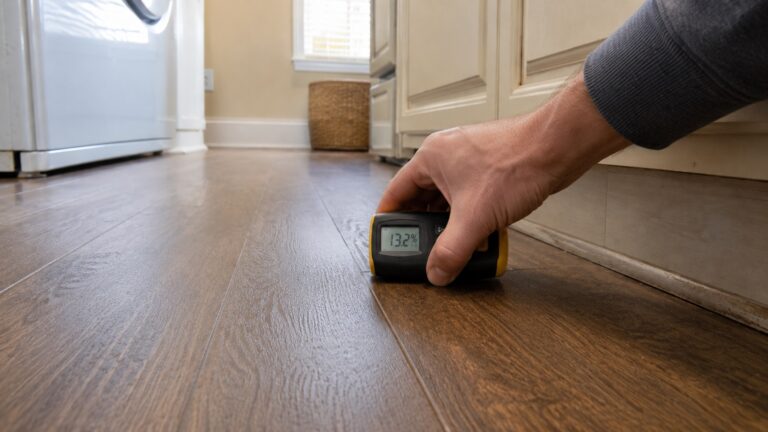
A moisture meter can help identify damp flooring, trim, or drywall, but it does not automatically identify the leak source. It tells you where material may be wet, not where the water started.
Use readings as part of the pattern: compare the area behind the washer with a dry area elsewhere in the room. Check suspicious flooring seams, baseboards, and lower wall sections. If you are comparing tool options, see this guide to the best moisture meters for hidden water damage.
Look Beyond the Washer Footprint
Water from a hidden washer leak can travel under finished flooring and appear away from the appliance. Check nearby doorways, closets, baseboards, and adjacent flooring transitions. The most visible damage may not be directly under the washer.
If moisture has spread into nearby rooms or flooring feels soft outside the immediate washer area, the problem may be larger than a simple appliance leak. At that stage, source detection and material evaluation both matter.
Tools That Can Help Detect a Hidden Washer Leak
You do not need professional equipment to start narrowing down a hidden washing machine leak. A flashlight, phone camera, dry paper towels, moisture meter, or leak sensor can help you see behind the appliance, confirm fresh moisture, and compare the wet area with the cycle timing.
Flashlight and Phone Camera
A bright flashlight is one of the most useful tools for checking behind a washing machine. Shine it behind the appliance, below the valve box, around the drain hose, along the floor-wall joint, and under the washer edges.
A phone camera can help in tight spaces. Hold the phone low near the floor or behind the side of the washer and take photos or video during a cycle from a safe position. This can reveal moisture, staining, or hose movement that is difficult to see directly.
Dry Paper Towels
Dry paper towels can make slow leaks easier to detect. After wiping the area dry, place paper towels below hose couplings, beneath valves, near the drain area, or along a suspicious floor edge. If the towel becomes damp during a specific cycle, it can help identify the leak zone.
Do not wrap anything tightly around moving parts or place towels where they can interfere with the washer, drain hose, or electrical connections. Use them only as temporary moisture indicators during observation.
Moisture Meter
A moisture meter can help you compare suspicious flooring, baseboards, and drywall with known dry areas. It is especially useful when the surface looks dry but you suspect moisture under flooring or behind trim.
Use the meter to map wet areas, not to make assumptions about the source. A damp baseboard may be wet because of a valve leak, drain overflow, water traveling under flooring, or repeated surface wetting. The reading tells you where moisture may be present; the leak pattern tells you where it may be coming from.
Water Leak Sensors
A water leak sensor can help monitor the washer area after you have cleaned and inspected it. It is especially useful behind washers, in laundry closets, under second-floor laundry appliances, or near hose connections that are hard to see.
A sensor is not a repair. It will not stop a leak or explain the source by itself. It simply alerts you when water reaches the sensor location. For monitoring options, see the guide to the best water leak sensors for early detection.
When to Stop Testing and Call a Professional
Some hidden washer leaks can be narrowed down with careful observation. Others should be handled by a professional because they involve pressurized plumbing, drain backups, electrical risk, internal appliance components, or hidden moisture in building materials.
Call a Plumber for Supply or Drain Problems
Call a plumber if the leak appears to come from shutoff valves, wall connections, supply hoses, the valve box, the standpipe, or a backed-up drain. These problems involve the plumbing system around the washer, not just the appliance itself.
You should also call if the shutoff valves are corroded, difficult to turn, dripping, or surrounded by wet drywall. A valve that cannot shut off reliably can make a small washer leak much harder to control.
Call an Appliance Repair Technician for Machine-Body Leaks
If water repeatedly appears under the center of the washer, near the front panel, around the door boot, near the pump/filter access area, or after spin cycles, the problem may be inside the appliance.
Do not disassemble the washer unless you are qualified to do so. Internal leaks may involve pumps, seals, hoses, dispensers, or mechanical parts. A technician can inspect the appliance without guessing or causing additional damage.
Call a Water Damage Professional if Materials Are Wet
If water has reached flooring seams, baseboards, drywall, or subfloor materials, fixing the leak source may not be enough. The affected materials may need drying, removal, or monitoring depending on how long they were wet and how far the moisture spread.
Soft flooring, swollen trim, persistent odor, dark staining, or moisture extending away from the washer footprint are signs that the problem may involve hidden materials. This is also when a broader plan for finding the source, drying affected materials, and preventing moisture from returning becomes more important than a quick cleanup.
Stop Immediately if Water Is Near Electrical Connections
If water is near an outlet, plug, cord, power strip, or electrical panel, stop testing and stay out of the wet area. Do not continue running cycles to “see what happens.” Electrical risk changes the situation from routine leak detection to a safety concern.
Frequently Asked Questions
Can a washing machine leak without leaving a puddle?
Yes. A washing machine can leak slowly or intermittently without leaving a large puddle. Water may evaporate, stay behind the appliance, soak into baseboards, or move under flooring seams before it becomes visible.
Why does my washer only leak during the drain cycle?
A leak that appears only during the drain cycle often points to the drain hose, standpipe, utility sink, or drain line. The washer releases water quickly during draining, so a loose hose, poor hose position, partial clog, or backup may show up only during that part of the cycle.
How can I tell if a washer hose is leaking slowly?
Look for damp hose couplings, rust, mineral buildup, staining below the connection, or moisture that appears during fill. A dry paper towel placed under a suspicious coupling can help reveal a slow drip during a test cycle.
Should I pull the washer out to inspect behind it?
Only move the washer if it is safe and easy to do so. Do not pull hard on a washer in a tight space, stacked setup, or wet area. Moving the appliance too quickly can stress hoses, damage flooring, or worsen a weak connection.
Can a moisture meter detect a washing machine leak?
A moisture meter can help detect damp flooring, trim, or drywall near the washer, but it does not identify the leak source by itself. Use it to map moisture, then compare that information with where and when water appears during the washer cycle.
How do I know whether to call a plumber or appliance technician?
Call a plumber if the leak appears to come from the supply valves, hose connections, wall box, standpipe, or drain line. Call an appliance repair technician if water appears to come from inside the washer body, under the center of the machine, near the door seal, or during spin and agitation.
Key Takeaways
- Hidden washer leaks often appear only during certain cycles, such as fill, drain, spin, or heavy loads.
- Water behind the washer often points toward hoses, valves, drain hoses, standpipes, or wall connections.
- Water under the front or center of the washer may suggest a machine-body leak.
- Dry paper towels, a flashlight, a phone camera, a moisture meter, or a leak sensor can help confirm where water appears, but cycle timing is what helps narrow the source.
- A moisture meter can show where materials are damp, but it does not prove where the water started.
- Call a plumber for supply, valve, wall connection, or drain problems.
- Call an appliance repair technician if the leak appears to come from inside the washer body.
- If flooring, trim, drywall, or subflooring is wet, the area may need drying and monitoring after the leak is fixed.
2 Comments
Comments are closed.