When Subfloors Must Be Replaced After Water Damage
A wet subfloor does not always need to be replaced. If the water was clean, the exposure was brief, drying began quickly, and the panel remains firm, flat, odor-free, and structurally stable, the subfloor may sometimes be saved. But when water damage leaves the subfloor soft, swollen, delaminated, moldy, contaminated, sagging, or unstable, drying alone is usually not enough.
The key question is not only whether the subfloor is dry. The better question is whether the subfloor is still strong enough to support finished flooring and normal use. A subfloor can feel dry on the surface but still be damaged from swelling, rot, contamination, fastener failure, or hidden moisture at seams and edges.
If you are still trying to confirm whether the damage is actually in the subfloor, start with the signs of water damage in subfloors before making a replacement decision.
This is why subfloor replacement is a decision point within larger structural moisture problems in homes. The subfloor is part of the floor system, not just a flat surface under your flooring. If it has lost stiffness, thickness, bonding, or fastener strength, installing new flooring over it can hide the problem and lead to future failure.
Quick Replacement Decision Checklist
- Replacement is more likely if the subfloor stays soft, swollen, delaminated, crumbly, musty, contaminated, or uneven after drying.
- Drying may be enough if the water was clean, exposure was brief, the source was fixed, and the panel remains hard, flat, odor-free, and stable.
- Professional evaluation is safer if the floor sags, bounces, spans multiple joist bays, sits near load-bearing framing, or was exposed to sewage or floodwater.
What Determines Whether a Wet Subfloor Can Be Saved
Whether a wet subfloor can be saved depends on several factors working together. A small clean-water leak that is dried quickly is very different from floodwater, sewage, repeated leaks, or water that stayed trapped under flooring for days. The material type also matters because plywood and OSB respond differently after saturation.
The Water Source
The first question is where the water came from. Clean water from a supply line, refrigerator line, dishwasher supply hose, or small plumbing leak may be less damaging if it is caught quickly and dried thoroughly. Contaminated water is different. Floodwater, sewage, toilet backups, and water that has passed through dirty materials can create sanitation and odor problems in addition to moisture damage.
When the water source is contaminated, replacement becomes more likely because the decision is no longer only about drying. Subfloor materials can absorb moisture and contaminants, especially around seams, panel edges, fastener holes, and penetrations. If contaminated water has soaked into the assembly, professional cleanup and removal may be needed.
How Long the Subfloor Stayed Wet
Time matters. A subfloor that gets wet briefly and is dried quickly has a better chance of recovery than a subfloor that remains wet under carpet, padding, laminate, vinyl, tile underlayment, cabinets, or appliances. The longer moisture stays trapped, the greater the risk of swelling, delamination, odor, mold growth, and loss of stiffness.
Repeated wetting is also a concern. A subfloor under a slow dishwasher leak, toilet leak, exterior door leak, or washing machine leak may be exposed to smaller amounts of water over a longer period. That kind of chronic moisture can be more damaging than one short clean-water event.
The Subfloor Material
Plywood and OSB can both be damaged by water, but they often fail in different ways. Plywood may separate into layers, swell at edges, soften near fasteners, or rot around seams and penetrations. OSB may swell, flake, crumble, expand at panel edges, or lose density after saturation.
The material does not decide everything by itself. Some plywood can be ruined by water, and some OSB may survive brief exposure if dried quickly. The replacement decision depends on how the material behaves after drying. If it remains flat, hard, and stable, replacement may not be necessary. If it is swollen, soft, flaky, or unstable, replacement is more likely.
Whether the Subfloor Dried Completely
Drying is an important first step, but it is not the whole decision. A subfloor must dry thoroughly before anyone can judge whether it recovered. Surface dryness is not enough because moisture can remain at seams, under flooring, between layers, around fasteners, along panel edges, and on the underside of the panel where airflow is limited.
If you are still in the drying stage, the process belongs more directly to drying a subfloor after water damage. This article focuses on the next question: after drying or attempted drying, is the subfloor still usable?
Whether the Panel Is Still Flat and Firm
A saved subfloor should remain flat, firm, and stable. It should not flex abnormally, crumble, sag, hold odor, or have raised seams that interfere with new flooring. Compare the damaged area with nearby undamaged flooring; a noticeable difference in bounce, height, texture, or sound is often more useful than judging the wet area by itself.
This matters because finished flooring depends on the subfloor below it. Tile can crack over movement. Vinyl plank can separate over uneven seams. Laminate can fail over swelling. Hardwood can cup, gap, or loosen if the subfloor remains damp or uneven. New flooring does not fix a weak subfloor; it only hides it temporarily.
Signs a Water-Damaged Subfloor Must Be Replaced
Subfloor replacement becomes more likely when the water damage affects strength, shape, odor, cleanliness, or the ability to hold flooring securely. Staining alone may not require replacement, but physical change is different. If the material has softened, swelled, separated, crumbled, or moved, drying may not restore it.
Soft Spots That Remain After Drying
A soft subfloor is one of the strongest signs that replacement may be needed. If the area feels spongy, weak, flexible, or unstable after drying, the material may have lost stiffness. A subfloor should not feel like it gives way under normal foot pressure.
Softness is especially concerning near toilets, tubs, showers, dishwashers, refrigerators, washing machines, water heaters, exterior doors, and plumbing penetrations. These areas often stay wet longer because water collects around seams, cutouts, and edges.
Swollen or Raised Panel Edges
Swollen seams or raised panel edges often mean the subfloor absorbed enough water to change shape. Minor surface unevenness may sometimes be corrected, but swelling that changes panel thickness or creates unstable seams can make the floor unsuitable for new flooring.
Raised seams are a major issue under rigid or floating flooring. Even if the surface is sanded flat, the panel may still have lost density or stability. Sanding can change the surface, but it does not restore the internal structure of a damaged panel.
Plywood Delamination
Plywood is made of layers bonded together. When water damages that bond, the layers may separate, bubble, peel, or feel hollow. This is called delamination, and it is a strong replacement sign because the panel no longer behaves as one stable sheet.
Delaminated plywood may flex, crack, or fail to hold fasteners properly. Even if it dries, the separated layers do not simply bond back together on their own. If the panel is separating, replacement is usually more reliable than trying to cover it.
OSB Flaking, Swelling, or Crumbling
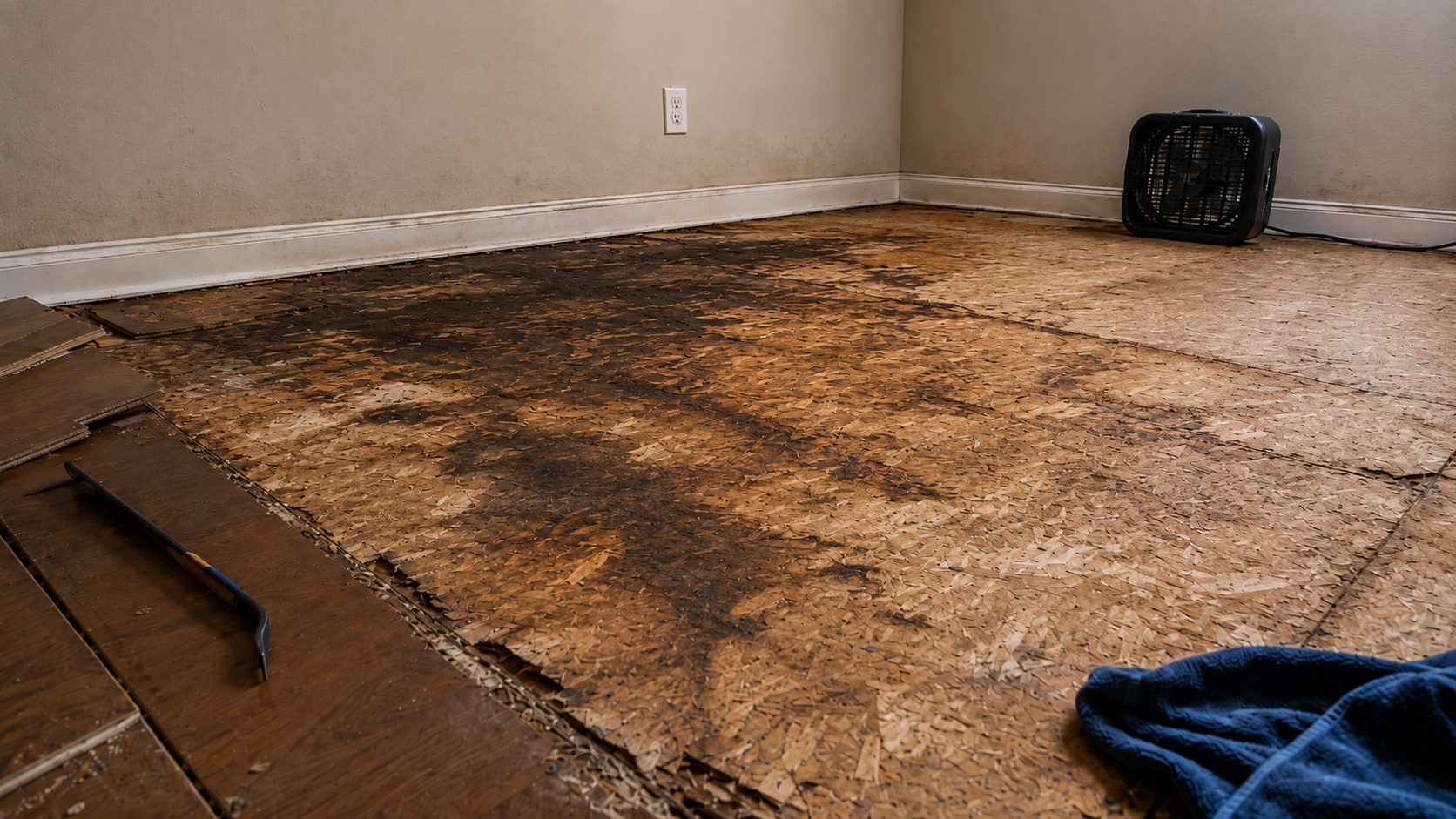
OSB can be especially vulnerable when it stays wet long enough to swell or lose density. Warning signs include flaking strands, crumbly edges, raised seams, uneven thickness, softness, or a surface that sheds material when touched.
If OSB has expanded and does not return to a flat, firm condition after drying, it may not provide a reliable base for finished flooring. Crumbling or flaky OSB should not be covered with new flooring because it may continue to break down under normal use.
Persistent Musty Odor
A musty odor after water damage can mean moisture is still trapped, mold is present, or contaminated material remains in the floor assembly. Odor alone does not always prove that a subfloor must be replaced, but odor combined with softness, swelling, staining, mold, or repeated wetting is a strong warning sign.
Subfloor odors are common when water has been trapped under carpet padding, laminate, vinyl, cabinets, appliances, or underlayment. If the odor returns after cleaning or drying attempts, the problem may be deeper than the finished flooring surface. The subfloor may need to be exposed and evaluated before new flooring is installed.
Mold With Material Breakdown
Mold on a subfloor does not automatically mean the entire floor system must be replaced. A small surface issue on a hard, dry, stable panel is different from mold growing on a soft, swollen, delaminated, or contaminated subfloor. The material condition matters.
Replacement becomes more likely when mold appears with crumbling OSB, separated plywood layers, persistent odor, damp seams, soft spots, or a history of long-term moisture. In that situation, the issue is not only mold on the surface. It is mold plus material damage, which means the subfloor may no longer be a sound base for flooring.
Fasteners No Longer Hold
A damaged subfloor may stop holding nails, screws, staples, or flooring fasteners properly. If fasteners spin, pull loose, or no longer bite into the panel, the material may have lost density or strength.
This is important because finished flooring depends on a stable base. Loose fasteners can lead to squeaks, movement, separated flooring, cracked tile, or failed underlayment. If the subfloor cannot hold fasteners reliably, replacement is usually safer than trying to build over it.
Sagging, Bounce, or Movement
Subfloor movement is a serious replacement clue. If the floor sags, flexes between joists, bounces more than nearby areas, or feels unstable under normal walking, the subfloor may be too damaged to remain in place. Movement may also suggest the damage extends beyond the panel into joists or other framing below.
This is where the decision becomes more structural. A damaged panel can often be replaced. But if joists, beams, supports, or load-bearing wall areas below the subfloor may be affected, the issue should be evaluated before the floor is closed back up.
New Flooring Will Not Sit Flat
If the subfloor is swollen, uneven, raised at seams, or wavy after water damage, new flooring may not install correctly. Floating floors may separate, tile may crack, vinyl may telegraph unevenness, and hardwood may loosen or move if the base below it is unstable.
New flooring should not be used to hide a damaged subfloor. If the subfloor cannot provide a flat, firm, clean, dry surface, the finished flooring is more likely to fail.
When Drying May Be Enough
Drying may be enough when the water exposure was limited, clean, and addressed quickly. A subfloor does not need to be replaced just because it got wet once. The key is whether the panel fully recovers after drying and whether the moisture source has been corrected; the actual drying process belongs to the separate subfloor drying guide linked above.
A subfloor may be salvageable when the water was clean, the wetting was brief, the panel dried completely, and there are no signs of softness, swelling, delamination, mold, odor, or movement. It should also be checked after the surrounding flooring or underlayment is removed if those materials trapped moisture above the subfloor.
Clean Water and Short Exposure
Clean water exposure is less severe than floodwater, sewage, or water that has moved through contaminated materials. A short leak from a supply line or appliance hose may not ruin the subfloor if it is discovered quickly and dried thoroughly.
The shorter the exposure, the better the chance of saving the panel. Problems become more likely when water sits under flooring, soaks into seams, reaches the underside of panels, or remains trapped under cabinets, appliances, or padding.
The Panel Stays Hard, Flat, and Stable
After drying, the panel should feel hard and firm. It should not flex, crumble, flake, or feel spongy. The surface should remain reasonably flat, and seams should not be raised enough to interfere with flooring.
This is the practical test that matters most. Drying is successful only if the subfloor remains usable. If the panel is dry but distorted, soft, or unstable, the fact that moisture readings improved does not mean the material is suitable for new flooring.
There Is No Persistent Odor or Mold Pattern
A salvageable subfloor should not continue to smell musty after drying. Odor can indicate trapped moisture, contaminated material, or microbial growth in the floor assembly. If the odor remains after the area is open and dry, the damage may need deeper investigation.
Minor staining without odor may be acceptable in some cases if the panel is firm and dry. Odor combined with softness, staining, or swelling is more concerning and often points toward removal.
The Moisture Source Has Been Fixed
A subfloor should not be covered until the water source is corrected. If a toilet seal, dishwasher hose, refrigerator line, washing machine connection, exterior door leak, plumbing drip, or roof leak is still active, the same area can become wet again.
Subfloor decisions should always include the source of moisture. Replacing a panel without fixing the leak can lead to repeated damage. Drying a panel while the source remains active can make the floor look better temporarily but does not solve the underlying problem.
When Plywood Subfloors Usually Need Replacement
Plywood subfloors can often handle brief moisture exposure better than homeowners expect, but they can still fail when water breaks down the layers, edges, or fastener-holding strength. Replacement becomes more likely when the plywood no longer behaves like one solid panel.
The Layers Are Separating
Layer separation is one of the clearest signs that plywood replacement is needed. If the plywood is peeling, bubbling, lifting, or separating between layers, the panel has lost its bonded structure.
Once delamination occurs, drying does not usually restore the original strength of the panel. The surface may flatten somewhat, but the internal bond is still compromised. Installing flooring over delaminated plywood can lead to movement, squeaks, cracks, or premature flooring failure.
The Edges Are Swollen or Soft
Plywood often shows water damage at edges, seams, and cutouts before the center of the panel fails. Damage around toilets, tubs, showers, exterior doors, dishwashers, and wall edges is common because water collects at these vulnerable points.
If the edges are swollen, soft, flaky, or no longer level with adjacent panels, replacement may be needed. Edge damage can interfere with support, fasteners, and finished flooring transitions.
The Panel Flexes Under Normal Use
A plywood subfloor should not flex abnormally under normal walking loads. If it moves between joists, feels soft underfoot, or creates a dip in the floor, the plywood may have lost stiffness or the support below it may be affected.
Flexing should not be ignored because it can damage finished flooring. Tile, grout, laminate, vinyl plank, and hardwood all depend on a stable base. If the plywood moves, the finished floor above it is likely to move too.
Fasteners Pull Loose From the Plywood
If screws, nails, or staples no longer hold in the plywood, the panel may be too damaged to keep. This often happens when water softens the wood fibers around fastener holes or causes layers to separate. A floor that squeaks, shifts, or lifts after fasteners are tightened may be showing deeper subfloor deterioration.
Fastener failure matters because flooring systems rely on the subfloor for stability. If the subfloor cannot hold fasteners, underlayment, tile backer, hardwood, or other flooring materials may not stay secure.
The Same Area Has Been Wet More Than Once
Repeated wetting is harder on plywood than one short clean-water event. A bathroom subfloor around a toilet, a kitchen subfloor near a dishwasher, or a laundry room subfloor near a washing machine may be exposed to small leaks over and over before the problem is discovered.
If the same area has a history of repeated leaks, stains, softness, or odor, replacement becomes more likely. Chronic moisture can damage the panel gradually, even when each individual leak seems minor.
When OSB Subfloors Usually Need Replacement
OSB subfloors can perform well when kept dry, but they often become less forgiving after prolonged saturation. Water can cause OSB to swell, raise at seams, flake, crumble, or lose density. The issue is not just appearance. Once the panel changes thickness or texture, it may no longer provide a reliable base for finished flooring.
The Seams Stay Raised After Drying
Raised seams are one of the most common OSB water-damage problems. If the panel edges swell and remain higher than the surrounding surface after drying, new flooring may not sit flat. This can cause visible ridges, gaps, uneven wear, cracked tile, or separation in floating floors.
Minor seam swelling may sometimes be evaluated separately, but raised seams that reflect deeper panel expansion are a replacement warning sign. Flattening the top surface does not always restore the panel’s original thickness, density, or strength.
The Surface Flakes or Sheds Material
OSB that flakes, sheds strands, or crumbles when touched has usually lost material integrity. The surface may look rough, fuzzy, uneven, or broken down. This is especially common after water sits on the panel or remains trapped beneath flooring.
A flaky OSB subfloor should not be covered with new flooring without evaluation. The finished floor needs a stable base. If the base is breaking apart, the flooring above it may eventually move, separate, crack, or fail.
The Panel Feels Spongy or Weak
OSB that feels spongy, soft, or weak after drying is a strong replacement candidate. A subfloor panel must distribute loads across joists. If it flexes or compresses under normal foot traffic, it may no longer be doing that reliably.
Softness is especially important near seams, cutouts, plumbing penetrations, exterior door thresholds, and appliance leak areas. Those are the places where water often enters and stays trapped longest.
The Panel Expanded and Will Not Return Flat
Some water-damaged OSB remains swollen even after moisture levels drop. If the panel expanded and did not return to a flat, stable shape, it may create ongoing problems for new flooring. Flooring may rock, separate, telegraph unevenness, or fail at seams.
This is one of the main reasons drying alone may not be enough. A panel can become dry but still remain physically distorted. If the shape has changed permanently, replacement is often the more reliable option.
Subfloor Replacement After Flooding or Contaminated Water
Flooding and contaminated water change the replacement decision. With clean water, the main concerns are moisture, drying success, and material stability. With floodwater, sewage, or toilet backups, the concerns also include contamination, odor, hidden residue, and the difficulty of cleaning porous or semi-porous assemblies.
Subfloors exposed to floodwater or sewage are much more likely to require removal, especially if water sat for an extended time or soaked into seams, panel edges, underlayment, insulation, or cavities below. In these situations, the question is not only whether the subfloor can dry. It is whether it can be cleaned, sanitized, and trusted as part of the floor assembly.
Do not cut, sand, or disturb contaminated subfloor materials without proper protection and containment. Sewage, floodwater, and mold-contaminated dust can create exposure risks during removal, not only after the floor is opened.
Floodwater Exposure
Floodwater can carry soil, debris, chemicals, bacteria, and other contaminants. If floodwater reaches the subfloor, especially under carpet, padding, laminate, vinyl, or cabinets, removal is often the safer direction. The water may have moved farther than the visible wet area suggests.
FEMA flood cleanup guidance generally treats porous flood-damaged materials as difficult to clean completely, which is why flood-soaked subfloor materials should be evaluated more cautiously than subfloors exposed to a brief clean-water leak.
For broader flood situations, the subfloor decision should be considered alongside carpet and subfloor flood recovery. Carpet, padding, underlayment, and subfloor layers can trap moisture and contamination differently, so each layer needs its own decision.
Sewage or Toilet Backup
Sewage backups and contaminated toilet overflows are different from clean-water leaks. If contaminated water soaks into the subfloor, especially around a toilet flange, bathroom wall, or flooring seam, replacement becomes much more likely.
Contamination can remain in edges, fastener holes, cracks, seams, and underlayment. Even if the surface appears dry later, odor or residue may remain inside the assembly. Professional cleanup is often appropriate when sewage or contaminated water is involved.
Long Saturation Under Finished Flooring
Water trapped under finished flooring can damage a subfloor more severely than water that is visible on the surface. Carpet padding, laminate, vinyl sheet, vinyl plank, tile layers, and underlayment can slow drying and keep moisture against the subfloor.
This is why finished flooring and subfloor decisions are related but separate. If the top layer has failed after a flood, review when flooring must be replaced after flooding, but do not assume replacing the finish floor solves the subfloor problem. The layer underneath must also be dry, clean, flat, and structurally sound.
Partial Replacement vs Full Panel Replacement
Subfloor replacement is not always all-or-nothing. In some cases, only the damaged section needs to be removed. In other cases, the damage pattern, panel layout, contamination, or flooring requirements make full panel replacement more reliable. The right boundary depends on where the damage stops and whether the remaining subfloor is still properly supported.
When Partial Replacement May Be Possible
Partial replacement may be possible when the water damage is localized, the surrounding subfloor is dry and firm, the affected area can be cut back to sound material, and the replacement section can be properly supported by joists or blocking. This is common around small toilet leaks, appliance leaks, or isolated plumbing failures.
The key is that the remaining material must be sound. A patch should not be attached to soft, swollen, delaminated, or unsupported edges. If the surrounding panel is questionable, a small patch may fail or move under the finished floor.
When Full Panel Replacement Is More Reliable
Full panel replacement may be more reliable when swelling extends across seams, the panel is delaminated, OSB has lost density, contamination is widespread, or the affected area crosses multiple support points. Full panel replacement may also be preferred when finished flooring requires a very flat, stable base.
If the damaged panel is part of a larger unstable area, replacing only the worst-looking section may not solve the problem. Water often spreads under flooring and along panel seams, so the visible stain may not show the full replacement boundary.
When Subfloor Damage May Point to Joist Problems
Subfloor damage does not always stop at the panel layer. Water can move through seams, cutouts, fastener holes, underlayment, and panel edges into the joists or framing below. When the subfloor is soft, sagging, or repeatedly wet, the structure underneath should be considered before the floor is closed back up.
This is especially important in bathrooms, kitchens, laundry rooms, crawl-space floors, and areas near exterior doors. These locations often have both water exposure and structural floor framing. If the subfloor has been wet long enough to fail, the joists below may also need inspection.
Sagging That Extends Beyond One Panel
A single damaged subfloor section may create a localized soft spot. Sagging that extends across a wider area may indicate a deeper floor-system problem. If the floor slopes, dips across multiple panels, or feels weak over more than one joist bay, the issue may involve joists, beams, or support framing.
Wide movement should not be treated as a simple surface patch. If the subfloor is failing because the framing below is weakened, replacing only the panel may not solve the structural problem.
Visible Damage From Below
If the subfloor can be seen from a crawl space or basement, inspect the underside for stains, swelling, mold, soft areas, dark joist edges, wet insulation, or water marks that continue into framing. Damage below the panel can reveal how far the moisture traveled.
If joists are soft, cracked, rotten, or pulling away from supports, the decision moves beyond subfloor replacement. In that case, the situation should be compared with when floor joists must be replaced, because joist damage has a different structural threshold than panel damage.
Subfloor Damage Along Joist Lines
Water often collects where panels meet framing, especially around seams, fasteners, and penetrations. If damage follows joist lines, appears along panel edges, or shows up where the subfloor is attached to framing, the joist contact area should be inspected.
Softness along joist lines may mean the panel edge has deteriorated. It may also mean moisture has affected the top of the joist. Either way, replacement planning should account for whether the new subfloor can be properly supported and fastened.
Loose or Failed Fasteners
If subfloor fasteners no longer hold, the problem may involve either the panel, the framing, or both. Screws can spin because the panel has lost density. Nails can loosen because the subfloor moved. Fasteners can also fail if the joist below is wet, soft, or deteriorated.
Before installing new flooring, the floor system needs a solid fastening base. A replacement patch attached to damaged framing may still move, squeak, or fail.
Mistakes to Avoid Before Replacing or Covering a Subfloor
When a subfloor has water damage, the most expensive mistake is covering the problem before the material has been evaluated. Finished flooring can hide softness, odor, contamination, and structural movement, but it cannot restore a damaged subfloor.
Do Not Install New Flooring Over a Soft Subfloor
New flooring should not be installed over a subfloor that feels soft, spongy, swollen, unstable, or weak. Finished flooring depends on the subfloor below it. If the base moves, the finished floor may crack, separate, cup, gap, or loosen.
This is especially important for tile, vinyl plank, laminate, hardwood, and engineered flooring. These materials usually require a stable, flat, dry base. Covering a weak subfloor often leads to repeated flooring failure.
Do Not Seal Over Odor or Contamination
Sealants, primers, and coatings may reduce some surface odor, but they should not be used to hide unresolved contamination or trapped moisture. If the subfloor smells musty, sewage-like, or sour after drying, the source of the odor needs to be understood.
Odor can indicate moisture still inside the assembly, mold growth, contaminated material, or water damage under adjacent flooring. Sealing over odor without solving the cause can trap the problem and make later repairs harder.
Do Not Assume Dry Means Structurally Sound
A dry subfloor can still be damaged. Dryness does not reverse delamination, swelling, crumbling OSB, fastener failure, or loss of stiffness. Before new flooring is installed, the panel must be dry and physically stable.
Moisture readings may improve, but the material still needs to be flat, firm, clean, odor-free, and capable of supporting the floor system.
Do Not Patch Unsupported Sections
A subfloor patch must be properly supported. A patch attached to soft edges, damaged framing, unsupported seams, or deteriorated joists can move underfoot. Movement can lead to squeaks, cracked tile, separated planks, or repeated soft spots.
This article is not a step-by-step replacement guide, but the principle is simple: replacement sections need sound support. If the damage boundary cannot be cut back to firm material and proper support, professional repair is usually the safer option.
Do Not Ignore the Water Source
Replacing the subfloor without fixing the leak or moisture source can lead to the same damage again. Before the floor is closed, the cause should be corrected. That may mean repairing a toilet seal, appliance line, plumbing leak, exterior door leak, roof leak, drainage problem, or crawl space moisture issue.
For long-term prevention, the subfloor decision should connect back to the broader need to find, fix, and prevent moisture problems throughout the home. A new subfloor will not last if the same moisture path remains active.
FAQ About Replacing Subfloors After Water Damage
Can a wet subfloor be saved?
Yes, sometimes. A wet subfloor may be saved if the water was clean, exposure was brief, drying started quickly, the panel dries completely, and the subfloor remains hard, flat, odor-free, and stable. If it becomes soft, swollen, delaminated, moldy with material breakdown, or contaminated, replacement is more likely.
Does a soft subfloor always need replacement?
A soft subfloor usually needs serious evaluation, especially if the softness remains after drying. Persistent softness means the panel may have lost stiffness or density. If the soft area flexes underfoot, will not hold fasteners, or sits near joist damage, replacement is usually the safer direction.
Is OSB subfloor more likely to need replacement after water damage?
OSB is often less forgiving after saturation because it can swell, flake, crumble, or lose density. However, not every brief clean-water exposure ruins OSB. The decision depends on whether the panel dries flat, firm, and stable. If the seams stay raised or the surface breaks down, replacement is more likely.
Can new flooring be installed over a water-damaged subfloor?
Only if the subfloor is dry, flat, firm, clean, odor-free, and structurally stable. New flooring should not be installed over a soft, swollen, musty, contaminated, delaminated, or unstable subfloor. Finished flooring may hide the issue temporarily, but it will not fix the damaged base below it.
Does mold mean the subfloor must be replaced?
Not automatically. A small surface mold issue is different from mold combined with softness, odor, swelling, contamination, or material breakdown. Replacement becomes much more likely when mold is extensive, the water was contaminated, or the panel has lost strength or stability.
When should a contractor inspect a water-damaged subfloor?
A contractor should inspect the subfloor when damage is extensive, soft, swollen, contaminated, moldy with material breakdown, near joists, under a load-bearing wall, or associated with sagging or floor movement. Professional inspection is also wise when you are unsure how far the water spread under finished flooring.
Final Subfloor Replacement Decision
A water-damaged subfloor must be replaced when it can no longer provide a dry, firm, flat, clean, and structurally stable base for the flooring above it. Staining alone may not require removal, but persistent softness, swelling, delamination, crumbling OSB, odor, contamination, mold with material breakdown, loose fasteners, or movement are strong signs that drying is not enough.
The decision depends on the water source, exposure time, material type, drying success, and whether the damage extends into joists or support framing. Clean water that is dried quickly may leave a subfloor serviceable. Floodwater, sewage, long saturation, repeated leaks, and physical panel breakdown push the decision toward replacement.
Before installing new flooring, make sure the subfloor is not only dry but sound. Covering a weak subfloor can lead to recurring odor, mold risk, floor movement, and failed flooring. When damage is extensive, contaminated, near structural framing, or associated with sagging, professional evaluation is the safer path.