
When Floor Joists Must Be Replaced
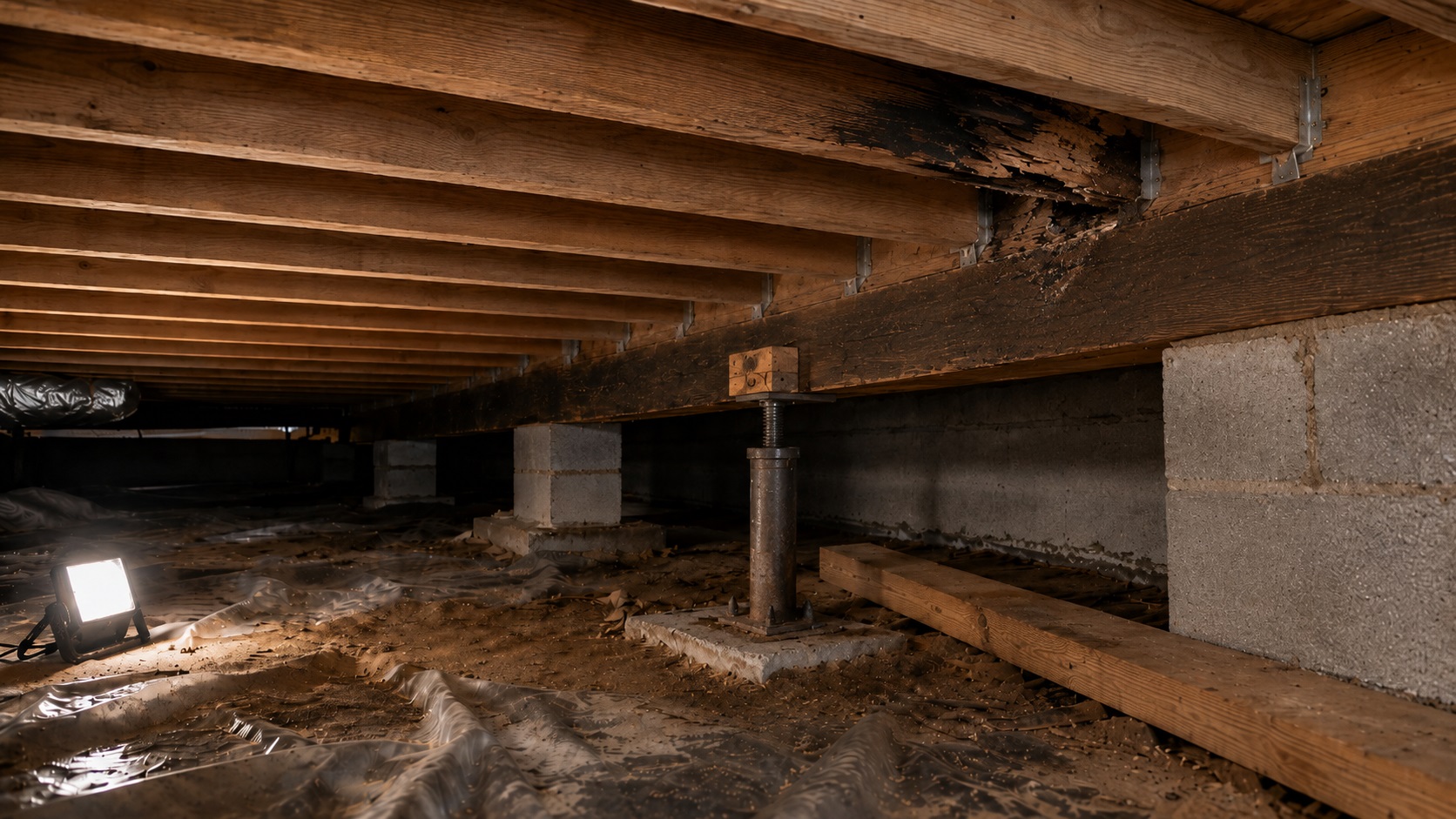
Floor joists usually need replacement, engineered repair, or major reinforcement when damage affects their ability to carry load. Old stains, minor checking, or small localized defects do not automatically require full replacement. The strongest replacement warnings are severe rot, crushed or unsupported joist ends, deep splits, major section loss, failed hangers, sagging floors, or damage across several joists.
The important question is not simply whether a joist looks damaged. The better question is whether the damage affects how the joist carries load. A dark stain in the middle of a dry, firm joist may be far less serious than a smaller rotten area at the end of a joist where it rests on a beam, sill plate, hanger, or foundation support.
Floor joists are part of the home’s structural floor system. When they are weakened by rot, water damage, insects, over-notching, deep splits, crushing, or movement, the issue belongs within the larger category of structural moisture problems in homes. The goal is not to make a homeowner diagnose structural capacity alone. The goal is to recognize when joist damage has moved beyond simple observation and needs professional evaluation. If the damage followed a leak, flood, or long-term moisture exposure, it may also help to review how to evaluate structural safety after water damage before deciding what to repair first.
What Determines Whether a Floor Joist Must Be Replaced
A floor joist replacement decision depends on the type of damage, where the damage is located, how much of the joist is affected, whether the joist is still properly supported, and whether the floor above is moving. A joist can sometimes be repaired or reinforced, but replacement becomes more likely when the damaged member can no longer perform its structural role.
Where the Damage Is Located
Location is one of the biggest factors. Damage in the middle of a joist is not automatically safe, but damage at a joist end, bearing point, hanger, beam connection, or sill plate connection is often more serious. The ends of joists are where loads are transferred into beams, walls, or foundation-supported framing.
For example, a joist with an old surface stain in the middle may only need monitoring if it is dry and firm. A joist with rot at the end where it rests on a beam may need repair or replacement because the joist may no longer be fully supported. The same visible amount of damage can matter more when it occurs at a support point.
How Much Strength or Material Has Been Lost
Joists need enough depth, width, stiffness, and sound wood to carry the floor above. If rot, insects, fire, cutting, crushing, or splitting removes a meaningful amount of the joist, replacement becomes more likely. The issue is not just the surface appearance; it is how much useful structural material remains. A simple probe can reveal the difference between staining and decay: sound wood resists pressure, while damaged wood may crush, flake, crumble, or feel spongy.
Major section loss is more serious than discoloration. A joist that is still full-size, dry, and hard may remain serviceable after past moisture exposure. A joist that is hollowed, deeply softened, split through, crushed, or cut through a critical area may no longer have enough sound material to trust without professional repair design.
Whether the Joist Is Still Properly Supported
A joist must transfer weight to something else, such as a beam, sill plate, hanger, ledger, or bearing wall. If the joist is pulling away from its hanger, no longer resting fully on a support, crushed at the end, or surrounded by rotten support wood, the floor system may not be carrying load correctly.
Support loss can be more important than the visible size of the damaged area. A joist with a relatively small amount of end rot may be more serious than a joist with a larger stain in a non-critical area. If the support point is compromised, replacement or engineered repair may be needed. Look especially at the last few inches of the joist, the hanger fasteners, the beam or sill plate below it, and whether the joist is still making full contact with its support.
Whether the Floor Is Moving, Sagging, or Bouncing
Movement changes the seriousness of joist damage. A damaged joist under a flat, stable floor is different from a damaged joist under a sagging, bouncy, sloped, or soft floor. When the finished floor above begins to move, the joist problem may already be affecting the structure.
Sagging does not always mean every joist must be replaced. Floors can sag from undersized framing, long spans, settlement, subfloor damage, or support problems. But when sagging appears with visible joist rot, cracks, separation, or bearing damage, the joists should be evaluated before new flooring or cosmetic repairs hide the problem.
How Many Joists Are Affected
One isolated damaged joist may be a localized repair issue. Several damaged joists in the same area can indicate a larger structural problem. Multiple affected joists may point to repeated moisture, crawl space dampness, flooding, insect activity, poor framing alterations, or support movement.
When several joists are damaged, the floor system may have less reserve strength. The surrounding joists may also be carrying more load than intended. This is one reason widespread joist damage should be inspected by a qualified contractor or structural professional rather than treated as a small patch job.
Whether the Moisture Source Has Been Fixed
If joist damage came from moisture, the water source matters as much as the joist condition. Replacing or repairing joists without fixing the leak, crawl space humidity, drainage issue, plumbing failure, or exterior water entry point can lead to the same damage again.
Long-term moisture control is part of the larger need to find, fix, and prevent moisture problems throughout the home. A new or repaired joist will not stay sound if the same moisture path continues.
Quick Decision Guide: Repair, Reinforce, or Replace?
| Condition | What It Usually Means |
|---|---|
| Old stain, dry wood, no softness, no movement | Usually monitor or evaluate; replacement is not automatic. |
| Localized damage away from supports | Repair or reinforcement may be possible if the joist remains structurally sound. |
| Soft, punky, hollow, crushed, or deeply split joist | Replacement or engineered repair becomes more likely. |
| Rotten end, lost bearing, failed hanger, or slipping support | Professional evaluation is needed because the load path may be compromised. |
| Multiple damaged joists, sagging, bounce, or movement | Treat it as a floor-system problem, not a single-board repair. |
Signs a Floor Joist May Need Replacement
Floor joist replacement is most likely when the damage affects support, stiffness, or structural continuity. These signs do not automatically prove replacement is required, but they show when the issue has moved beyond simple staining or minor cosmetic damage.
Severe Rot Through the Joist
Rotten joists are one of the most common reasons replacement becomes a concern. Surface staining alone is not enough to decide. The replacement question begins when rot makes the wood soft, punky, crumbly, hollow, or deeply weakened.
If a joist can be easily gouged, breaks apart when lightly probed, crumbles at the edge, or has rot extending through a meaningful depth, replacement becomes more likely. For symptom recognition before the replacement decision, compare the condition with the broader signs of rotting floor joists.
Rotten or Crushed Joist Ends
Joist end damage is one of the strongest replacement warning signs. The joist end is where the member usually rests on a beam, sill plate, hanger, or ledger. If that area is rotten, crushed, split, or no longer fully bearing, the joist may not be transferring load properly.
End damage is especially common near crawl spaces, rim joists, sill plates, foundation edges, exterior doors, bathroom leaks, and long-term subfloor moisture. Even if the middle of the joist looks better, a failed end can make the entire member unreliable unless the support is properly restored.
Deep Splits or Cracks Through Structural Areas
Minor checking can be normal in wood, especially as it ages. Deep splits are different. A crack that runs through a structural part of the joist, widens over time, appears near a support, or is paired with sagging should be treated seriously.
Cracks are more concerning when they affect the joist’s depth, run near large holes or notches, or appear where the joist carries concentrated load. A stable surface crack may not require replacement, but a deep split with movement or support loss should be professionally evaluated.
Major Sagging or Deflection
A visibly sagging joist may be overloaded, weakened, improperly supported, moisture-damaged, or structurally altered. If the joist bows downward, the floor above dips, or the sag appears to be increasing, replacement or engineered repair may be needed.
It is important not to assume that sagging can be fixed by simply jacking the floor back up. Sagging is a symptom. The cause may involve joists, beams, posts, sill plates, subfloor damage, or foundation support. The structure should be evaluated before lifting or repair decisions are made.
Joists Pulling Away From Hangers or Supports
A floor joist should remain properly supported at its ends. If a joist is pulling away from a hanger, separating from a beam, slipping off a bearing surface, or no longer sitting fully on its support, the problem may involve more than a damaged board. It may involve a failing connection.
Connection problems become more serious when the wood around the hanger or support is soft, split, rotten, or no longer holding fasteners. In those cases, simply adding more fasteners may not solve the structural issue. The damaged joist, the support, and the connection all need to be evaluated together.
Large Notches, Holes, or Cuts
Floor joists are sometimes weakened by plumbing, HVAC, electrical, or remodeling work. A small properly placed hole may not be a problem, but large holes, deep notches, cuts near supports, or notches in critical areas can reduce the joist’s strength. Because notch and hole limits depend on joist size, span, material, and local code requirements, questionable cuts should be checked against the applicable building code or reviewed by a qualified professional.
This is especially concerning when the joist also has cracks, sagging, moisture damage, or bounce in the floor above. Replacement may be needed if the joist has been cut so severely that reinforcement is not enough or cannot be done properly.
Insect Damage With Structural Loss
Insect activity near floor joists does not automatically mean replacement is required. The concern is structural loss. If the joist is hollowed, deeply tunneled, softened, weakened, or crumbles where insects have damaged the wood, replacement or engineered repair may be needed.
Insect damage is often worse when moisture is also present. Damp crawl spaces, wet sill plates, rotting subfloor edges, and poorly ventilated areas can create conditions where insect damage and decay appear together. When both are present, the remaining strength of the joist can be difficult to judge visually.
Multiple Damaged Joists in the Same Area
Several damaged joists in one area usually indicate a larger floor-system problem. This can happen after flooding, chronic crawl space moisture, long-term plumbing leaks, exterior water intrusion, or widespread insect activity. Multiple damaged joists also increase the chance that the floor above has lost stiffness or support.
When more than one joist is affected, replacement decisions become more complex. The repair may need to address load transfer, temporary support, subfloor removal, moisture correction, and possibly beams or sill plates. This is not the same as repairing one isolated damaged board.
When Repair May Be Enough Instead of Replacement
Floor joist damage does not always require full replacement. Repair or reinforcement may be possible when the damaged area is localized, the joist ends remain sound, the floor is stable, and the moisture source has been corrected. The repair still has to restore the joist’s ability to support the floor safely; cosmetic patching is not enough.
The Damage Is Localized
Localized damage means the problem is limited to a small area rather than spread across the joist or across several joists. A small damaged section away from a support may be repairable if the rest of the joist is dry, firm, and properly supported. The same amount of damage at a bearing end is more serious because that area transfers load.
The Joist Ends Are Still Sound
Repair is more likely when the joist ends remain solid and fully supported. If the joist still bears properly on a beam, sill plate, hanger, or ledger, reinforcement may be possible. If the ends are rotten, crushed, split, disconnected, or no longer fully bearing, replacement or engineered repair becomes more likely.
The Floor Is Stable
A stable floor improves the chance that repair may be enough. If there is no major sagging, bounce, sloping, or movement, the joist damage may be less severe or more localized. Movement changes the decision because it suggests the damage may already be affecting performance, not just appearance.
The Moisture Source Has Been Corrected
Moisture-related joist repair is only reliable if the water source has been fixed. If a bathroom leak, dishwasher leak, crawl space moisture problem, exterior door leak, or foundation moisture issue remains active, repaired joists may become damaged again.
Before deciding between repair and replacement, the source of wetting should be identified and corrected. Otherwise, the structural work may only be temporary.
When Sistering May Not Be Enough
Sistering means adding another member alongside a damaged joist to help reinforce or supplement it. It can be useful in some situations, but it is not a universal fix. Sistering is not the same as replacing the joist, and it may not solve the problem if the original joist has lost bearing support or the floor system is already moving.
Because sistering affects structural load paths, fastening, bearing, and support, it should be designed or performed by someone who understands the floor system. Homeowners should not assume that attaching another board to a damaged joist automatically restores the structure.
When the Bearing End Is Destroyed
Sistering may not be enough if the damaged joist end no longer bears properly on a support. If the end has rotted away, crushed, split, or pulled off its hanger, the repair must restore support at the end, not just add material in the middle.
A sistered board that does not bear correctly may not transfer load properly. This is why joist end damage often pushes the decision toward replacement, engineered repair, or professional structural work.
When There Is Severe Section Loss
If a joist has lost a large amount of its depth, width, or usable wood, sistering may not be enough unless the reinforcement is designed to take the needed load. Severe rot, insect damage, over-notching, fire damage, or deep cuts can leave too little sound joist for a simple repair approach.
The more material that is missing or weakened, the more likely the repair needs professional evaluation. In some cases, replacement is more reliable than trying to reinforce a badly compromised member.
When Multiple Joists Are Compromised
Sistering one joist may be a reasonable concept for isolated damage. When several joists are damaged, the issue becomes a floor-system problem. Multiple compromised joists may indicate widespread moisture, poor support, structural movement, or long-term deterioration.
In that situation, the repair may need to address the subfloor, beams, posts, sill plates, crawl space conditions, or the moisture source as well. Reinforcing one member at a time may not solve the underlying problem.
When the Joist Is Engineered Lumber
Engineered I-joists, laminated members, and other engineered floor systems require extra caution. They are not repaired the same way as ordinary solid sawn joists. Damage to flanges, webs, bearing areas, or manufacturer-made components may require manufacturer guidance, engineering review, or replacement.
If the damaged floor joist is engineered lumber, do not assume that standard sistering is appropriate. Engineered systems depend on specific shapes, materials, and connection details.
Joist End Damage and Bearing-Point Failure
Joist end damage deserves special attention because the end of the joist transfers load into a beam, sill plate, ledger, hanger, rim joist, or bearing wall. If that area is rotten, crushed, short, split, or disconnected, the rest of the joist may look better while the support point is still unsafe.
This is where joist damage connects closely with broader load-bearing wood damage. A floor joist is not just a board under the floor. It is part of the load path. When the bearing point fails, the floor system may shift, sag, bounce, or lose connection strength.
Rot at the Joist End
Rot at the joist end is more serious than staining in the middle of a joist. The joist end needs to remain firm enough to rest on its support and transfer weight. If the end is soft, punky, crumbly, hollow, or compressed, replacement or engineered repair may be needed.
End rot is common near rim joists, sill plates, foundation edges, exterior doors, crawl spaces, bathrooms, plumbing leaks, and long-term subfloor moisture because water often collects at edges and transitions.
Crushing at the Bearing Point
A joist can be damaged where it bears on a support. Crushing may appear as flattened fibers, split ends, compressed wood, or an uneven bearing surface. This can happen when wood has been weakened by moisture, overloaded, poorly supported, or damaged by settlement.
Crushing matters because the joist may no longer be distributing weight evenly. If the joist is sinking into softened wood, sitting unevenly, or no longer making full contact with the support, the floor system should be evaluated before repair work begins.
Joists Pulling Away From Hangers
Joist hangers are designed to support and connect joists when properly installed and attached to sound wood. If the joist is pulling away from the hanger, the hanger is separating from the support, or fasteners are loose, the connection may be failing.
Replacement may be needed if the joist end itself is rotten, split, crushed, or no longer able to hold fasteners. In some cases, the joist, hanger, and supporting member all need evaluation because the visible separation may be only one part of the problem.
Short or Lost Bearing
A joist must have enough bearing on its support. If a joist has shifted, been cut too short, rotted back from the end, or no longer rests fully on its beam or sill plate, replacement or structural repair may be necessary.
Lost bearing is a serious issue because the joist may still appear to be in place while not actually transferring load correctly. If the end is barely supported, hanging unevenly, or slipping away from the support, the floor should not be closed up until the condition is corrected.
Water-Damaged or Rotten Floor Joists
Moisture is one of the most common reasons floor joists become questionable. Water can reach joists from plumbing leaks, wet subfloors, crawl space humidity, exterior door leaks, foundation moisture, appliance leaks, flooding, or condensation. The replacement decision depends on how much damage the moisture caused, not only whether the joist got wet.
If the joists were exposed to floodwater, sewage, or other contaminated water, treat the issue as both a structural and contamination concern rather than only a drying problem.
If the issue is still at the symptom-recognition stage, review the broader signs of structural wood rot. For this replacement decision, focus on firmness, bearing support, section loss, alignment, and connection strength.
Soft or Punky Joists
A joist that is soft, spongy, punky, or easily gouged may have lost structural strength. Light surface staining is one thing. Wood that no longer resists pressure is a much stronger sign that the joist may need repair or replacement.
Softness is most serious at joist ends, near supports, around plumbing penetrations, and in areas where several joists are affected. A soft joist should not be covered with new subflooring or finished flooring until it has been evaluated.
Repeated Wetting From Leaks or Crawl Space Moisture
Repeated wetting can damage joists gradually. A small leak under a bathroom, kitchen, laundry room, water heater, exterior door, or appliance may not seem severe at first, but chronic moisture can soften wood, loosen fasteners, and lead to decay over time.
Crawl space moisture is another common source. Joists may stay damp because of ground moisture, poor drainage, missing vapor control, plumbing leaks, or trapped humidity. If the joists have been repeatedly wet, drying alone may not be enough to restore reliability.
Subfloor Damage Above the Joists
Severe subfloor damage can be a clue that the joists below need inspection. Water that ruins a subfloor may also reach the top edges of joists, fastener lines, blocking, rim joists, or beams. If the subfloor is soft, swollen, rotten, or contaminated, the joists underneath should not be assumed sound.
This is especially important when deciding when subfloors must be replaced after water damage. A new subfloor needs solid framing below it. If the joists are also damaged, replacing the panel alone may not solve the floor-system problem.
Dry Joists That Are Still Structurally Damaged
A joist can be dry and still need replacement. Drying removes moisture, but it does not restore wood that has already rotted, split, crushed, lost section, or been cut too deeply. This is a common mistake after leak repairs.
The question after drying is whether the joist remains structurally sound. If it is dry but soft, hollow, cracked through, crushed, or disconnected from its support, the damage remains even though the moisture level has improved.
Sagging Floors and Structural Movement
Sagging, bounce, and movement can indicate that joist damage is affecting the floor system. These signs are especially important when they appear after water damage, in a crawl space area, near a bathroom or kitchen, or above visibly damaged framing.
Sagging Floors Above Damaged Joists
Sagging floors do not automatically prove that joists must be replaced, but they are a serious warning sign. A sag may come from joist damage, beam problems, post settlement, subfloor failure, foundation movement, or undersized framing.
If sagging appears directly above rotten, cracked, cut, or separated joists, replacement or engineered repair becomes more likely. The floor should be evaluated as a system, not just as individual boards.
Bouncy or Soft Floor Areas
Some floors have a small amount of normal flex. A floor that suddenly becomes bouncy, soft, or unstable is different. Bounce becomes more concerning when it is localized over damaged joists or worsens over time.
Soft walking areas can also come from damaged subflooring, so the joists and subfloor should be evaluated together. If the joists are sound but the subfloor failed, the repair may be different than if both layers are damaged.
Wall, Trim, or Door Changes Near the Floor
Joist problems can show up in nearby finishes. Gaps may open between baseboards and floors. Doors may stick. Trim may separate. Drywall cracks may appear near floor lines or openings. These signs do not always mean joist replacement is required, but they can indicate movement in the floor system.
Movement clues matter most when they appear near visible joist damage, water damage, crawl space dampness, or subfloor failure. If the symptoms are growing, the issue should be inspected before cosmetic repairs are made.
Several Joists Moving Together
When several joists appear to sag, twist, split, or move together, the problem may involve a larger support issue. The beam, post, sill plate, foundation edge, or moisture source may also be involved. Replacing one joist may not correct the floor if the support system around it is failing.
Multi-joist movement is one of the clearest signs that the repair should be planned by a qualified professional. The cause may not be visible from the living space above.
When to Call a Contractor or Structural Engineer
Floor joist damage should be professionally evaluated when the damage affects support, movement, multiple joists, engineered lumber, or any area where the load path is unclear. A homeowner can recognize warning signs, but determining whether a joist can be repaired, reinforced, or replaced requires structural judgment.
Call if the Joist End Is Rotten, Crushed, or Unsupported
Joist end damage is one of the strongest reasons to call a professional. If the joist end is soft, missing, crushed, split, slipping off the support, or pulling away from a hanger, the floor may not be transferring load properly.
Because joist ends connect the floor system to beams, sill plates, ledgers, or foundation-supported framing, repairs often require more than covering the area or adding fasteners. The support condition must be restored, not just hidden.
Call if There Is Major Sagging or Movement
Major sagging, increasing slope, bouncing, wall cracks, trim gaps, or sticking doors near damaged joists should be inspected before repair decisions are made. Movement can mean that the floor system is already responding to weakened support.
If the issue affects more than one framing member or appears to involve broader framing repair, it may connect to when structural framing must be repaired. That broader repair decision is separate from this floor-joist-specific article, but the topics often overlap in real homes.
Call if Multiple Joists Are Damaged
Multiple damaged joists usually indicate a larger problem than one isolated board. The cause may be crawl space moisture, long-term plumbing leaks, flooding, insect activity, poor structural alterations, or support movement. A professional can evaluate whether the issue is limited to joists or whether beams, posts, sill plates, rim joists, or subfloors are also affected.
This is especially important if the floor feels unstable or if damage appears across several joist bays. The more members involved, the more important it becomes to evaluate the floor as a system.
Call if the Joists Are Engineered Lumber
Engineered I-joists and other engineered floor systems should not be treated like ordinary solid wood joists. Damage to flanges, webs, bearing points, or manufacturer-specific components may require manufacturer guidance, engineered repair details, or replacement.
If an engineered joist is cut, cracked, wet, crushed, or damaged at its end, do not assume standard sistering is appropriate. These products rely on specific shapes and connection details, and incorrect repairs can create new structural problems.
Call if You Are Unsure Whether the Floor Is Safe
If you are unsure whether a damaged joist is still safe, do not guess. Avoid loading the area heavily, avoid cutting or removing framing, and avoid closing the floor until the damage has been evaluated. Uncertainty is itself a reason to get help when structural support is involved.
A contractor may be appropriate for localized repair work. A structural engineer may be needed when there is major sagging, multiple damaged members, unclear load paths, engineered joists, major alterations, or signs that the damage affects more than one part of the structure.
What Homeowners Should Not Do
Floor joist damage can look like a simple repair from the outside, but joists carry load. The wrong action can make the floor less stable or hide a problem that continues to get worse. Document the damage, identify the moisture source, avoid heavy loading in questionable areas, and do not cut, jack, or remove structural members until the repair path is clear.
Do Not Cut or Remove a Damaged Joist Without Evaluation
A damaged joist may still be carrying weight. Cutting or removing it without proper support can shift loads into nearby framing. This is especially dangerous when the joist is under a bathroom, kitchen, load-bearing wall, appliance area, or heavy partition.
If a joist looks rotten, cracked, or damaged, that does not mean it is no longer structural. It may still be part of the load path, even in poor condition.
Do Not Jack a Sagging Floor Casually
Jacking a sagging floor without understanding the structure can cause damage. Lifting too quickly, lifting the wrong area, or lifting without correcting the underlying support problem can crack finishes, stress plumbing, shift walls, damage connections, or worsen framing issues.
A sagging floor should be treated as a symptom. The cause may involve joists, beams, posts, sill plates, subfloors, moisture damage, or foundation conditions. The cause should be evaluated before lifting is attempted.
Do Not Assume Sistering Solves Every Joist Problem
Sistering can be useful in some repairs, but it is not automatically enough. If the joist end has failed, the support below is rotten, the floor is moving, or multiple joists are compromised, simply attaching another board may not restore proper support.
Sistering must work with the load path, bearing points, and existing framing. If those conditions are not understood, the repair may only hide the damage.
Do Not Cover Joist Damage With New Flooring
New subflooring or finished flooring should not be installed over unresolved joist damage. Covering the area can hide soft wood, lost bearing, loose connections, or sagging while the structural issue remains.
If joists are questionable, the floor should be evaluated before it is closed. This is especially important after water damage because the surface floor may look repaired while the framing below remains weakened.
Do Not Ignore the Moisture Source
If moisture caused the joist damage, the source must be corrected. Plumbing leaks, crawl space humidity, drainage problems, exterior door leaks, appliance leaks, and foundation moisture can all damage floor framing. Replacing or reinforcing joists without fixing the source can lead to repeated failure.
Structural repair and moisture control must work together. Otherwise, the new repair may be exposed to the same conditions that damaged the original joist.
FAQ About When Floor Joists Must Be Replaced
Can a damaged floor joist be repaired instead of replaced?
Yes, sometimes. A damaged joist may be repairable if the damage is localized, the joist ends are sound, the floor is stable, and a proper repair can restore support. Replacement becomes more likely when the joist is severely rotten, crushed, deeply split, unsupported, or involved in structural movement.
Does a rotten floor joist always need replacement?
No. Some localized rot may be repairable, especially if the bearing ends are sound and the damage is limited. However, severe rot, soft wood through a meaningful depth, end rot, sagging, or lost bearing strongly increases the chance that replacement or engineered repair will be needed.
Is sistering the same as replacing a joist?
No. Sistering means adding another member alongside an existing joist to reinforce or supplement it. Replacement means removing and replacing the damaged member. Sistering may be useful in some situations, but it is not enough when the damaged joist has lost bearing support, has severe section loss, or is part of a larger moving floor system.
Should joists be replaced if the subfloor was water damaged?
Not automatically. A damaged subfloor does not always mean the joists must be replaced. However, joists should be inspected when subfloor damage was severe, long-term, contaminated, soft, sagging, or located near joist lines. A new subfloor needs sound framing below it.
When should an engineer inspect floor joist damage?
An engineer should be considered when damage is severe, widespread, near bearing points, associated with major sagging, or involves engineered joists, load-bearing walls, unclear support paths, or multiple damaged framing members. Engineering input is also useful when the repair must restore structural performance, not just replace damaged material.
The Bottom Line on Replacing Floor Joists
Floor joists must be replaced when the damage is severe enough that the member can no longer reliably support the floor system or transfer load to its supports. Stains, minor checking, or isolated surface damage do not automatically mean replacement. The strongest concerns are severe rot, crushed joist ends, lost bearing, deep splits, major section loss, improper cuts, hanger separation, sagging floors, and multiple damaged joists.
Repair or sistering may be possible when damage is localized, the joist ends are sound, the floor is stable, and the moisture source has been corrected. Replacement becomes more likely when the joist is no longer structurally reliable or when the repair cannot restore proper bearing and load transfer.
Homeowners should not cut, remove, jack, or cover damaged floor joists without understanding the structure. When joist damage affects support points, movement, engineered lumber, or several members, professional evaluation is the safer path.

One Comment
Comments are closed.