
How to Detect Moisture Without Opening Walls (Safe Non-Invasive Methods Explained)
You can often detect moisture inside walls without cutting drywall by combining visual inspection, moisture meter checks, humidity readings, temperature differences, infrared scanning, and repeated observations over time. These non-invasive methods help confirm whether a wall is likely damp before you decide whether professional inspection or limited opening is necessary.
The goal is not to guess from one stain or one tool reading. The most reliable approach is to compare suspicious areas with nearby dry areas, look for moisture patterns, and confirm the same problem with more than one method whenever possible.
If you have already noticed warning signs such as stains, odors, or peeling paint, reviewing the signs of hidden moisture in walls alongside these detection methods can help confirm whether hidden moisture is likely present.
This guide explains the most reliable non-invasive methods homeowners and professionals use to detect moisture behind drywall, inside framing, and around plumbing areas—without damaging finished walls.
This article focuses specifically on confirming whether moisture is present using non-invasive detection methods. For room-by-room inspection guidance, use the parent guide on how to find hidden moisture in different areas of your home. For locating the exact source of leaks, drying wet materials, or interpreting moisture percentage readings, follow the related guides linked throughout this article.
How to Detect Moisture Without Opening Walls
Moisture inside walls can often be detected without cutting drywall or removing materials. Non-invasive detection methods focus on identifying moisture patterns through observation, measurement, and comparison rather than direct removal of wall surfaces.
The most effective non-invasive moisture detection methods include:
- Careful visual inspection of wall surfaces
- Using moisture meters to measure material moisture
- Monitoring indoor humidity levels
- Checking for temperature differences
- Using infrared technology to detect hidden moisture patterns
- Tracking changes in moisture indicators over time
Using several of these methods together produces more reliable results than relying on a single technique alone.
A practical sequence is: inspect the area visually, compare it with nearby dry areas, check humidity, scan for temperature differences, then confirm suspicious spots with a moisture meter when possible.
Why You Should Test for Moisture Before Cutting Into Walls
Opening walls prematurely can increase repair costs and create unnecessary damage. In many situations, moisture can be located and confirmed without cutting into drywall.
Safety note: Do not probe, drill, or cut into a wall if you suspect active electrical hazards, sewage contamination, major structural damage, or a large hidden leak. If drywall feels soft, crumbling, hot, electrically unsafe, or heavily moldy, stop and call a qualified professional before disturbing the wall.
Non-invasive detection methods are important because they:
- Reduce repair costs by avoiding unnecessary demolition
- Allow moisture problems to be identified earlier
- Help pinpoint the most likely source of moisture
- Provide evidence before major repairs begin
- Protect structural materials from accidental damage
Many moisture problems develop slowly. Early detection allows homeowners to address leaks or humidity issues before they become widespread.
If you have already measured moisture levels using a meter, this article can help you decide where moisture is likely present, but the actual reading thresholds belong in a separate reference. Use moisture levels that indicate water damage to interpret whether drywall, wood, or wall readings fall into safe or risky ranges.
Method 1: Visual Inspection for Hidden Moisture Clues
Visual inspection is the simplest and most widely used method for detecting moisture problems. Although it does not measure moisture directly, it often reveals early warning signs that indicate hidden water damage.
Start here before using tools because stains, swelling, odor, and repeated damage patterns tell you where to test first.
What to Look for During Visual Inspection
Several visual changes can indicate moisture buildup inside walls. These signs may appear gradually and may only affect one section of the room.
Watch for:
- Yellow or brown discoloration on drywall
- Bubbling or peeling paint
- Warped or swollen baseboards
- Cracking or flaking wall surfaces
- Recurring stains in the same location
- Uneven drywall texture
- Small mold spots appearing repeatedly
These visual symptoms often appear before major structural damage occurs. If you are unsure whether what you see qualifies as a moisture problem, reviewing the full list of signs of hidden moisture in walls can help confirm whether your observations match known warning indicators.
Why Visual Patterns Matter
Moisture rarely spreads randomly. Instead, it follows predictable paths based on gravity, airflow, and material structure. Observing patterns helps identify where moisture is likely entering or accumulating.
For example:
- Stains below windows may indicate exterior leaks
- Damage near sinks may suggest plumbing leaks
- Moisture along ceilings may indicate roof problems
- Localized damage near corners may indicate condensation
Recognizing patterns improves detection accuracy and reduces guesswork.
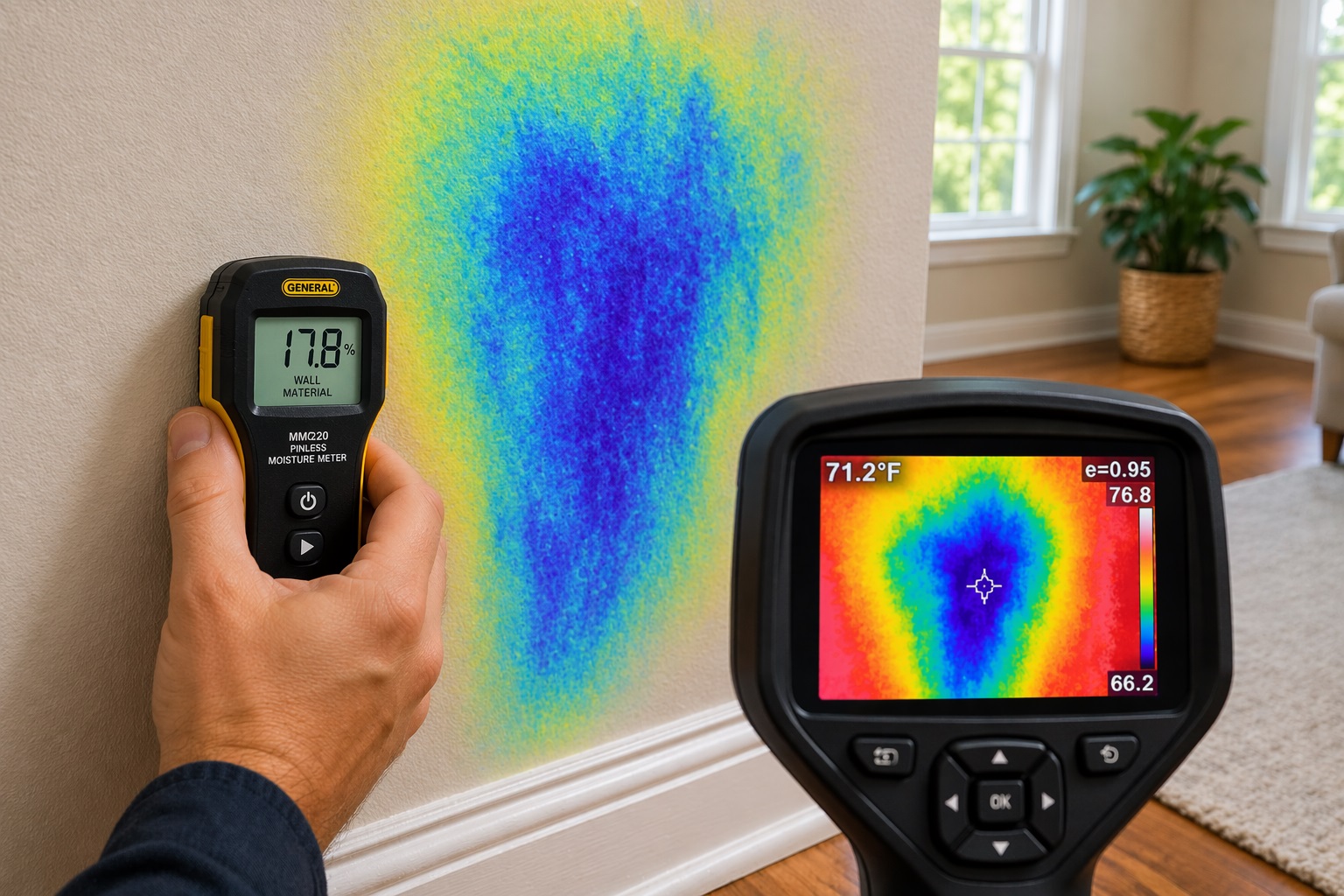
Method 2: Using Moisture Meters to Detect Moisture in Walls
Moisture meters are one of the most reliable tools for detecting hidden moisture without opening walls. These devices measure moisture levels inside drywall, wood, and other materials without requiring destructive testing.
Their main advantage is comparison: you can test a suspicious wall section against nearby dry areas instead of relying on appearance alone.
How Moisture Meters Help Detect Hidden Moisture
Moisture meters work by detecting changes in electrical resistance or electromagnetic signals within building materials. Elevated readings suggest that moisture may be present inside the wall structure.
For the most reliable check, test the suspicious area first, then test a nearby wall section that appears dry and is made from the same material. A single reading can be misleading, but a repeated pattern of higher readings in one area is much more useful.
These tools help identify:
- Damp areas behind drywall
- Hidden plumbing leaks
- Moisture buildup near windows
- Water intrusion from exterior walls
- Lingering moisture after flooding
When used correctly, moisture meters provide early confirmation of moisture problems before visible damage becomes severe.
Choosing the Right Moisture Meter
Not all moisture meters perform equally well. Some models are better suited for drywall, while others work best on wood framing or flooring.
If you are selecting a meter for home use, choosing a reliable model makes a significant difference. Our detailed guide to the best moisture meters for home use explains which features improve accuracy and usability.
Once readings are collected, understanding whether those numbers indicate damage is the next critical step. You can compare your measurements using our reference guide on moisture levels that indicate water damage.
Method 3: Using Infrared Thermal Cameras to Detect Hidden Moisture
Infrared thermal cameras are widely used by inspectors and restoration professionals to locate hidden moisture without opening walls. These devices detect temperature differences across surfaces, helping identify areas where moisture may be present behind drywall.
Although infrared cameras do not measure moisture directly, they reveal temperature patterns that often indicate damp areas. Moisture tends to cool surrounding materials, creating visible temperature contrasts when scanned with thermal imaging equipment.
How Infrared Detection Works
Infrared cameras display surface temperature differences using color variations. Cooler areas may appear darker or display different colors than surrounding materials. When moisture is present inside walls, evaporation often lowers temperature in the affected section.
This method helps detect:
- Hidden plumbing leaks
- Water intrusion from exterior walls
- Moisture buildup near insulation gaps
- Lingering moisture after water damage
- Areas with abnormal drying patterns
Because infrared imaging identifies temperature differences rather than moisture directly, suspicious areas usually require confirmation using another method, such as a moisture meter.
Do not assume every cold spot is wet. Missing insulation, air leaks, exterior wall exposure, and HVAC airflow can also create temperature differences. Treat infrared results as a map of areas to test, not as proof of moisture by themselves.
Infrared detection is especially helpful when combined with measurement tools and visual inspection. When these methods agree, confidence in the diagnosis increases significantly.
When Infrared Detection Is Most Useful
Thermal imaging works best when temperature differences are present. This often occurs after rain, during active leaks, or when indoor and outdoor temperatures differ significantly.
Infrared detection is commonly used when:
- A leak is suspected but not visible
- Moisture damage is spreading behind walls
- Drying progress needs monitoring
- Large areas require inspection
Although infrared cameras provide valuable insight, they are typically more expensive than other detection tools. Many homeowners rely on professional inspections when thermal imaging becomes necessary.
Method 4: Monitoring Indoor Humidity Levels
Indoor humidity monitoring is one of the most overlooked but highly effective ways to detect hidden moisture problems. Elevated humidity levels often signal moisture buildup inside walls, especially in enclosed spaces where airflow is limited.
Unlike moisture meters that measure material moisture directly, humidity monitoring helps detect moisture conditions in the surrounding air. When humidity remains high for extended periods, moisture can accumulate inside walls even without visible leaks.
Why Humidity Monitoring Is Important
Humidity levels provide early warnings of moisture conditions that may lead to mold growth or structural damage. Persistent humidity problems often develop before visible damage appears.
Warning signs of excessive humidity include:
- Fogging windows
- Condensation on surfaces
- Musty indoor odors
- Damp-feeling air
- Slow drying of surfaces
Monitoring humidity regularly helps identify rooms that may be at higher risk of hidden moisture problems.
Recommended Indoor Humidity Levels
| Humidity Level | Condition |
|---|---|
| 30%–50% | Ideal indoor humidity range |
| Above 60% | Increased moisture risk |
| Above 70% | High mold growth risk |
| Above 80% | Severe moisture concern |
Maintaining proper humidity levels helps reduce the risk of moisture buildup and mold growth. For exact recommended humidity ranges and moisture thresholds, review our guide on moisture levels that indicate water damage. If humidity remains elevated in specific rooms, further inspection may be required.
To monitor humidity accurately, many homeowners use hygrometers and humidity monitors. For humidity measurement tools and methods, see how to test indoor humidity levels.
These tools provide long-term tracking that helps identify moisture patterns before damage becomes severe.
Method 5: Detecting Cold Spots in Walls
Cold spots on walls can point to hidden moisture, insulation gaps, or air leaks. This no-tool method is useful for deciding where to inspect more closely, but it should not be treated as proof of moisture unless other signs or meter readings support it.
This method does not require specialized equipment and can be performed using simple observation techniques.
How to Identify Cold Spots
Cold spots are usually detected by comparing temperature differences across surfaces. These variations may be subtle but noticeable during certain conditions.
Cold spots are commonly found:
- Near exterior walls
- Below windows
- Around plumbing lines
- Inside closets
- Near poorly insulated areas
You may notice cold spots by:
- Running your hand across wall surfaces
- Feeling temperature differences between sections
- Observing condensation forming on specific areas
Although cold spots alone do not confirm moisture damage, they often identify areas worth testing further using moisture measurement tools.
Why Cold Spots Are Worth Testing Further
Moisture absorbs and releases heat differently than dry materials. When moisture is present, evaporation can cool surrounding materials, creating detectable temperature differences.
This cooling effect makes cold spot detection useful as an early warning method. When combined with other detection techniques, it helps identify hidden moisture zones before visible damage develops.
Method 6: Listening for Hidden Leaks Inside Walls
Hidden plumbing leaks often produce subtle sounds before visible damage appears. Listening carefully in quiet conditions can sometimes reveal early signs of moisture problems without opening walls.
This method is especially useful in homes with recent plumbing work, older pipe systems, or unexplained increases in water usage.
Common Sounds That May Indicate a Hidden Leak
Even small leaks can produce faint but recognizable sounds. These sounds may be easier to hear during quiet periods, such as late at night or early morning.
Listen for:
- Faint dripping sounds inside walls
- Soft rushing or flowing water when fixtures are off
- Ticking or tapping noises from pipes
- Hissing sounds near plumbing lines
- Unusual water movement after shutting off faucets
If these sounds occur consistently in the same location, they may indicate an active plumbing leak behind the wall. To safely trace the exact source of a leak, follow our guide on how to find hidden water leaks inside walls.
When Listening Methods Are Most Effective
This technique works best when the surrounding environment is quiet. Reducing background noise improves the ability to detect subtle sounds inside walls.
Listening detection is most effective:
- During nighttime hours
- When water fixtures are turned off
- Near plumbing-heavy areas such as bathrooms and kitchens
- After noticing rising water bills
Although listening alone cannot confirm moisture damage, it provides valuable clues that help narrow down suspected areas.
Method 7: Monitoring Moisture Changes Over Time
Moisture problems often develop gradually rather than appearing suddenly. Monitoring suspicious areas over time provides valuable insight into whether moisture conditions are improving or worsening.
This method is especially useful when moisture readings are borderline or when symptoms appear intermittently.
Why Monitoring Over Time Matters
Moisture readings taken once may not reveal the full picture. Repeated measurements allow you to identify trends and detect changes that indicate active moisture intrusion.
Signs that moisture conditions may be worsening include:
- Increasing moisture readings over several days
- Growing stains or discoloration
- Persistent odors that become stronger
- Recurring paint damage in the same location
Tracking changes helps determine whether moisture is still entering the wall or whether the problem has stabilized.
How to Track Moisture Changes Effectively
Consistent monitoring improves detection accuracy and helps identify patterns. Keeping simple records allows homeowners to compare past and current readings.
Effective tracking steps include:
- Recording moisture readings at regular intervals
- Testing the same locations consistently
- Comparing suspicious areas to known dry sections
- Watching for gradual increases over time
Monitoring moisture trends also helps determine whether drying efforts are working after repairs or water damage events. For structured drying methods that remove trapped moisture safely, review our guide on how to dry walls after water damage.
When Non-Invasive Methods Are Not Enough
Although non-invasive methods are highly effective, some moisture problems require more advanced investigation. When warning signs continue despite monitoring and testing, professional evaluation may become necessary.
Knowing when to move beyond basic detection methods helps prevent prolonged damage and unnecessary delays.
Signs That Professional Inspection May Be Needed
Certain conditions indicate that moisture problems may be more serious than initially expected.
Consider professional inspection if:
- Moisture readings continue increasing
- Visible damage spreads over time
- Strong odors persist despite cleaning
- Large sections of drywall feel soft
- Water leaks cannot be located
- Humidity levels remain elevated without clear cause
Professionals use specialized equipment to detect moisture patterns and locate hidden leaks more precisely. These tools may include advanced moisture meters, infrared scanners, and pressure testing equipment.
What Happens During Professional Moisture Inspection
Professional inspections usually begin with a detailed evaluation of suspected areas. Inspectors combine visual inspection, measurement tools, and environmental analysis to identify the source of moisture.
Typical inspection steps include:
- Mapping moisture patterns across wall surfaces
- Measuring moisture levels at multiple points
- Checking plumbing systems for leaks
- Evaluating ventilation and humidity levels
- Recommending targeted repair strategies
Professional evaluation becomes especially important when moisture problems affect structural materials or multiple rooms.
Frequently Asked Questions About Detecting Moisture Without Opening Walls
Can you detect moisture inside walls without cutting drywall?
Yes, moisture inside walls can often be detected without cutting drywall by using non-invasive methods such as moisture meters, humidity monitors, infrared cameras, and careful visual inspection. These tools help identify moisture patterns and confirm suspected problems before invasive repairs become necessary.
What is the easiest way to check for moisture in walls?
The easiest method is visual inspection combined with moisture measurement tools. Look for warning signs such as stains, peeling paint, or soft drywall, then confirm suspicious areas using a moisture meter. If you are unsure what symptoms to watch for, reviewing the signs of hidden moisture in walls can help identify early warning indicators.
How do professionals detect moisture behind drywall?
Professionals use a combination of tools and methods to detect moisture without damaging walls. These commonly include moisture meters, infrared thermal cameras, humidity monitors, and pattern analysis techniques. By comparing readings across multiple areas, inspectors can identify hidden moisture zones accurately.
Can humidity levels indicate hidden moisture problems?
Yes, elevated humidity levels often signal moisture problems inside walls or enclosed spaces. Persistent indoor humidity above 60% increases the likelihood of moisture buildup and mold growth. Monitoring humidity with reliable tools can help detect conditions that may lead to hidden damage. For humidity measurement tools and methods, see how to test indoor humidity levels.
Do cold spots in walls always mean moisture?
No, cold spots do not always indicate moisture, but they often highlight areas worth investigating. Cold surfaces may result from insulation gaps, exterior exposure, or damp materials. When cold spots appear alongside other warning signs, further testing is recommended.
When should I call a professional to inspect wall moisture?
Professional inspection is recommended when moisture readings remain elevated, visible damage spreads, strong odors persist, leaks cannot be located, electrical components may be wet, or drywall feels soft or crumbling. Early professional evaluation can prevent more serious structural damage and reduce repair costs.
Quick Moisture Detection Checklist Before Opening a Wall
Before cutting into drywall, look for a pattern. A moisture concern is more convincing when the same area shows more than one clue, such as discoloration, musty odor, elevated meter readings, persistent humidity, cold spots, or changes that worsen over time.
- Compare the suspicious area with a nearby dry wall section made from the same material.
- Retest the same spot over several days instead of relying on one reading.
- Use infrared or cold-spot checks only to identify areas that need confirmation.
- Call a professional if readings rise, damage spreads, odors persist, or electrical/structural safety is uncertain.
What to Do After You Detect Moisture Without Opening the Wall
Hidden moisture problems rarely begin with dramatic damage. Most issues develop gradually as small leaks, humidity buildup, or condensation introduce moisture into enclosed spaces. Detecting these problems early allows homeowners to take action before extensive repairs become necessary.
If you suspect moisture inside walls, combining observation with measurement provides the most reliable results. Understanding moisture readings is especially important when interpreting test results, which is why reviewing our guide on moisture levels that indicate water damage can help determine whether readings fall within safe or dangerous ranges.
When symptoms become visible, compare your measurements with physical warning signs instead of relying on either one alone. The signs of hidden moisture in walls guide covers the symptom side, while this article stays focused on non-invasive detection methods.
If moisture problems keep returning or spread beyond one wall area, the next step is broader moisture diagnosis rather than mold cleanup alone. Start with how to find, fix, and prevent moisture problems in homes so the source is identified before any surface repairs or cleanup begin.
4 Comments
Comments are closed.