Best Dryer Vent Cleaning Kits for Airflow and Moisture Control
Why a Cleaner Dryer Vent Matters for Airflow and Moisture Control
A restricted dryer vent can do more than make laundry take longer. When lint narrows the exhaust path, warm, humid air may remain inside the dryer and duct system instead of moving efficiently outdoors. This can contribute to condensation around vent connections, excessive heat, dampness in the laundry area, and moisture escaping through loose or damaged duct joints.
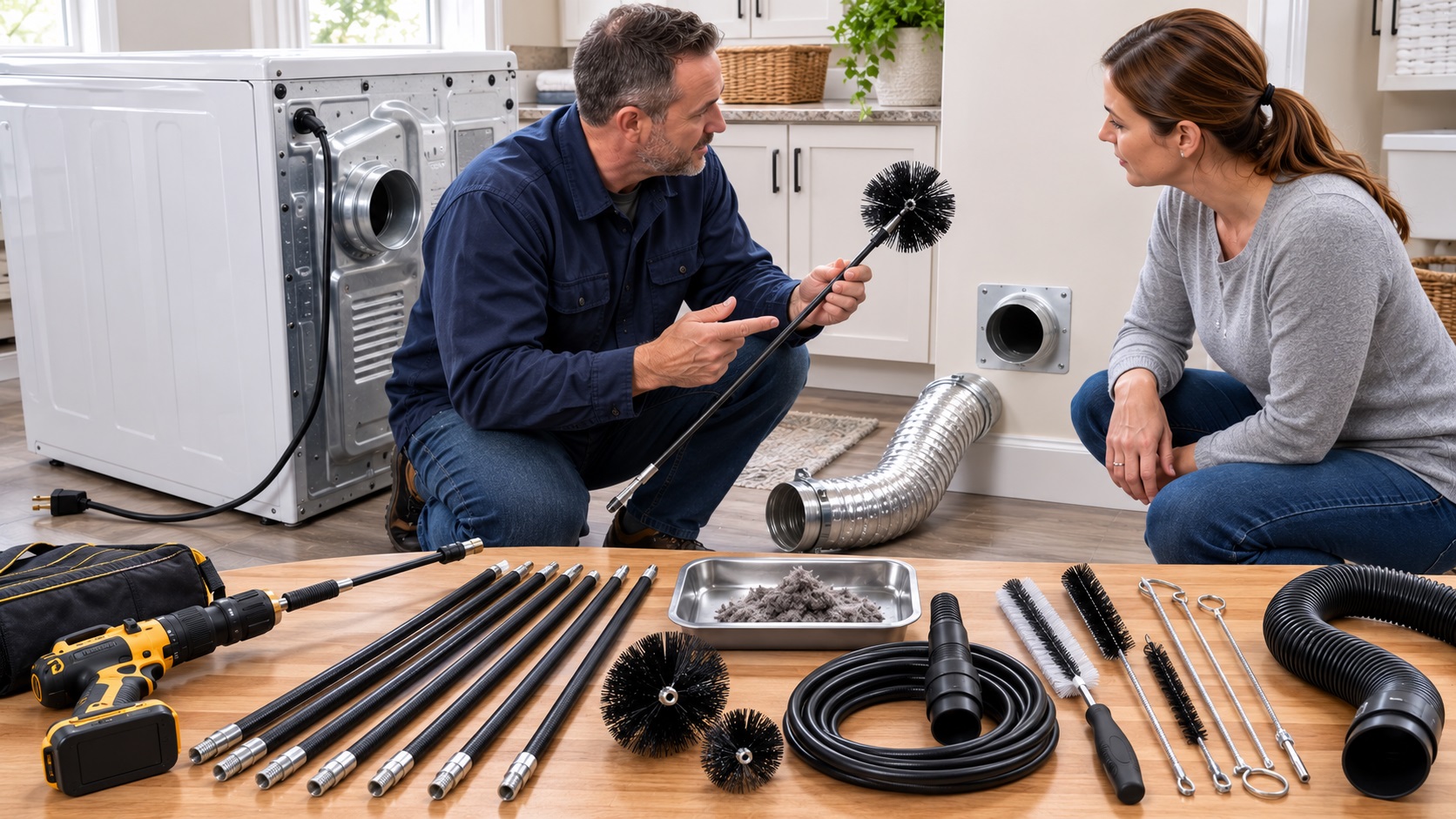
The best dryer vent cleaning kits help homeowners remove accumulated lint from accessible residential exhaust ducts, lint-trap passages, and areas behind the appliance. However, not every tool serves the same purpose. Rotary brush systems are designed to scrub the inside of the exhaust duct, while narrow vacuum attachments and hand brushes are better for collecting lint inside accessible dryer openings and tight appliance gaps.
This comparison focuses on reusable tools for residential dryer maintenance. It also explains when cleaning is appropriate—and when crushed, disconnected, excessively long, foil, plastic, or poorly routed ductwork may require repair or replacement instead. For more background, read why dryer vents cause moisture problems and learn how to inspect dryer vents for moisture problems.
As an Amazon Associate, this site earns from qualifying purchases. This does not affect the price you pay. Our recommendations are based on research, product reliability, and real-world usability in moisture-prone environments.
Quick Picks for Different Dryer Vent Layouts
- Best Overall Dryer Vent Cleaning System: Gardus RLE202 LintEater Rotary Dryer Vent Cleaner Kit
- Best Drill-Powered Kit for Long Vents: Holikme 30 Feet Dryer Vent Cleaner Kit
- Best All-in-One Dryer Cleaning Kit: Sealegend 58-Piece 35-Foot Dryer Vent Cleaner Kit
- Best Simple 30-Foot Rod Kit: Smart House Inc 30-Foot Dryer Vent Cleaner Kit
- Best Dryer Vent Vacuum Attachment: Sealegend 2-Piece Dryer Vent Cleaner Kit with Vacuum Attachment and Brush
- Best Manual Brush Set for Lint Traps and Appliance Gaps: Holikme Dryer Vent Cleaner Brush Two-Pack
Which Dryer Vent Cleaning Kit Fits Your Vent Layout?
Best Overall Dryer Vent Cleaning System: Gardus RLE202 LintEater Rotary Dryer Vent Cleaner Kit
The Gardus RLE202 LintEater is the strongest overall choice for homeowners who want a complete, established cleaning system rather than the longest possible collection of rods. Its four flexible three-foot rods provide approximately 12 feet of reach, making it practical for dryers located near an exterior wall or for ducts that can be approached from both ends.
The kit combines a four-inch rotary brush with accessories for collecting loosened lint and cleaning accessible dryer passages. Its shorter reach is a limitation for long concealed runs, but the system is better organized than many basic marketplace kits and has replacement components available within the broader LintEater product line.
Key Features
- Four flexible three-foot rods for approximately 12 feet of assembled reach
- Four-inch auger-style brush sized for common residential dryer ducts
- Designed for use with a cordless drill
- Includes vacuum and dryer adapters for managing loosened lint
- Includes a lint-trap brush and blockage-removal tool
- Replacement rods and related LintEater accessories are available
- More complete instruction and accessory package than many basic rod kits
Pros
- ✔ Complete system from an established dryer-vent cleaning brand
- ✔ Includes tools for both duct brushing and accessible lint removal
- ✔ Shorter rod sections are manageable during assembly
- ✔ Replacement components improve long-term reusability
- ✔ Well suited to common short and moderate residential vent runs
Cons
- ✖ Twelve feet may not reach a long duct from one access point
- ✖ Threaded rods require careful tightening before use
- ✖ Follow the manufacturer’s specified rotation direction because reversing threaded rods may loosen their connections
- ✖ The complete system may be unnecessary for a very short, straight duct
Best For
- Homeowners who want a durable, reusable dryer vent maintenance system
- Short and moderate ducts accessible from the dryer or exterior hood
- Users who value replacement accessories and a coordinated tool system
- Routine airflow maintenance in homes with sound metal ductwork
Check the Gardus RLE202 LintEater on Amazon to see current availability.
Best Drill-Powered Kit for Long Vents: Holikme 30 Feet Dryer Vent Cleaner Kit
The Holikme 30 Feet Dryer Vent Cleaner Kit is a better fit for homeowners whose dryer duct extends farther than the 12-foot reach of the Gardus system. Its sectional flexible rods can be added gradually, allowing users to match the assembled length to the actual vent run rather than connecting every rod at the beginning.
This kit may be used manually or with a drill. Drill power can improve brushing through a relatively straight, intact metal duct, while manual advancement offers more control near openings and bends. The threaded rod connections must remain tight, and the kit should be operated only in the direction allowed by the manufacturer’s instructions.
Key Features
- Approximately 30 feet of total assembled reach
- Flexible sectional rods that can be added during cleaning
- Synthetic brush head sized for common dryer exhaust ducts
- Manual and drill-powered operating options
- Useful for longer residential vent runs
- Reusable design for recurring dryer maintenance
- Compact storage compared with one-piece long-reach tools
Pros
- ✔ Longer reach than most starter dryer vent cleaning systems
- ✔ Can be used without a drill when greater control is needed
- ✔ Strong review history and broad marketplace recognition
- ✔ Rod length can be adjusted to suit the duct
- ✔ Practical for ducts that cannot be reached from both ends
Cons
- ✖ Numerous threaded connections create more points that must be checked
- ✖ Reverse drill rotation may disconnect rods unless specifically permitted
- ✖ Long flexible rods can be difficult to guide through several sharp elbows
- ✖ Does not include the broader accessory package found in the Sealegend set
Best For
- Longer residential dryer exhaust ducts
- Homeowners who want drill-powered brushing without buying a professional system
- Ducts with gradual bends and accessible endpoints
- Users willing to assemble and tighten each rod carefully
Check the Holikme 30 Feet Dryer Vent Cleaner Kit on Amazon to see current availability.
Best All-in-One Dryer Cleaning Kit: Sealegend 58-Piece 35-Foot Dryer Vent Cleaner Kit
The Sealegend 58-Piece kit is designed for homeowners who want more than a rotary brush and rods. In addition to approximately 35 feet of duct-cleaning reach, it includes vacuum adapters, a narrow vacuum attachment, a lint brush, and smaller accessories for cleaning accessible dryer and vent areas.
The large piece count should not be interpreted as proof that it cleans better than every simpler system. Many pieces are individual rods or small attachments. Its real advantage is versatility: it can address lint in the duct, below the removable lint screen, around the dryer connection, and in narrow appliance gaps with one coordinated package.
Key Features
- Approximately 35 feet of sectional rod reach
- Rotary brush for loosening lint from duct walls
- Narrow vacuum attachment for accessible lint-trap passages
- Flexible manual brush for loosening lint in tight spaces
- Vacuum and dryer adapters for collecting debris
- Multiple smaller cleaning accessories
- Combination design for duct, lint-trap, and appliance-area maintenance
Pros
- ✔ Broad accessory selection for first-time dryer maintenance
- ✔ Long enough for many extended residential vent runs
- ✔ Includes both brushing and vacuum-based cleaning tools
- ✔ Reduces the need to buy separate lint-trap accessories
- ✔ Useful for cleaning several accessible areas around the dryer
Cons
- ✖ The advertised piece count can make the kit sound more substantial than it is
- ✖ More accessories require additional storage and organization
- ✖ Threaded rods still require careful drill-direction control
- ✖ Some components may duplicate brushes or adapters already owned
Best For
- Homeowners purchasing their first comprehensive dryer cleaning kit
- Longer ducts combined with lint buildup inside accessible dryer passages
- Users who want vacuum adapters and manual brushes in the same package
- Households performing recurring dryer and laundry-area maintenance
Check the Sealegend 58-Piece 35-Foot Dryer Vent Cleaner Kit on Amazon to see current availability.
Best Simple 30-Foot Rod Kit: Smart House Inc 30-Foot Dryer Vent Cleaner Kit
The Smart House Inc 30-Foot Dryer Vent Cleaner Kit is a straightforward alternative for shoppers who do not need a large collection of adapters and small accessories. Its main components are sectional flexible rods and a four-inch brush, giving homeowners the essential tools needed to loosen lint from an accessible exhaust duct.
Its simplicity makes comparison easier: buyers are primarily paying for reach, flexibility, and the rotary brush rather than an accessory bundle. As with other screw-connected systems, every rod should be tightened securely, and the brush should not be forced through damaged, delicate, or sharply bent ductwork.
Key Features
- Approximately 30 feet of total reach
- Twenty-three sectional flexible rods
- Four-inch nylon brush head
- Manual or drill-powered cleaning
- Simple rod-and-brush design
- Reusable for periodic residential maintenance
- Suitable for gradual turns in intact metal ductwork
Pros
- ✔ Uncomplicated design without a large accessory bundle
- ✔ Enough reach for many longer residential exhaust systems
- ✔ Can be advanced manually when drill power is unnecessary
- ✔ Four-inch brush suits common dryer-vent dimensions
- ✔ Useful alternative to better-known long-reach systems
Cons
- ✖ Numerous rod connections require careful assembly
- ✖ Does not include a narrow vacuum attachment
- ✖ Offers fewer specialized accessories than Gardus or Sealegend
- ✖ May be excessive for a dryer positioned directly against an exterior wall
Best For
- Homeowners who want a basic long-reach rotary system
- Users who already own separate vacuum and lint-trap tools
- Moderate and longer residential ducts with gradual routing
- Buyers who prefer a focused kit over a high-piece-count package
Check the Smart House Inc 30-Foot Dryer Vent Cleaner Kit on Amazon to see current availability.
Best Dryer Vent Vacuum Attachment: Sealegend 2-Piece Lint Cleaning Kit
The Sealegend two-piece dryer vent cleaner kit is intended for accessible lint rather than full-length duct scrubbing. Its narrow hose connects to many conventional vacuum systems and reaches below the dryer’s removable lint screen, around the exhaust opening, and into spaces that are too narrow for a four-inch rotary brush.
This type of attachment is useful because a full duct-cleaning kit does not automatically remove lint inside every accessible appliance passage. However, the narrow hose cannot replace a rotary system when lint is attached to the walls of a long exhaust duct or compacted farther into the vent.
Key Features
- Narrow flexible vacuum hose for accessible dryer passages
- Adapter components for compatible household vacuums
- Long flexible manual brush for loosening lint
- No drill required
- Compact storage
- Useful around the lint screen, dryer outlet, and appliance gaps
- Designed to collect loose debris instead of pushing it farther into the dryer
Pros
- ✔ Reaches areas that a standard vacuum nozzle cannot access
- ✔ Useful for frequent lint-trap maintenance
- ✔ Manual brush helps loosen debris before vacuuming
- ✔ Easier to use and store than a long rotary system
- ✔ Useful companion tool for homeowners who already own vent rods
Cons
- ✖ Cannot brush the full length of a concealed duct
- ✖ Vacuum compatibility varies by hose design
- ✖ May not remove tightly compacted lint
- ✖ Narrow attachments can clog if large lint clumps are pulled in too quickly
Best For
- Cleaning below the removable dryer lint screen
- Removing loose lint around the dryer exhaust connection
- Routine maintenance between full duct cleanings
- Homeowners with compatible corded or shop-style vacuum hoses
Check the Sealegend 2-Piece Dryer Vent Cleaner Kit on Amazon to see current availability.
Best Manual Brush Set for Lint Traps and Appliance Gaps: Holikme Dryer Vent Cleaner Brush Two-Pack
The Holikme two-pack is the simplest recommendation in this comparison. These long manual brushes are designed for accessible lint-trap channels, exhaust openings, appliance gaps, and areas behind the dryer. They can also be used around refrigerator coils and other narrow household spaces.
The brushes do not clean an entire concealed dryer duct, but they are useful for frequent maintenance where lint first accumulates. They are particularly practical for apartment residents, dryers with very short vent connections, or homeowners who do not need a drill-powered system for every cleaning task.
Key Features
- Two long flexible manual brushes
- Narrow bristle profile for lint-trap passages and appliance gaps
- Flexible metal shafts
- Wooden handles for controlled manual cleaning
- No drill, vacuum, or power connection required
- Reusable design
- Useful for multiple appliance-cleaning tasks
Pros
- ✔ Simple and easy to use
- ✔ Useful for frequent lint-trap and behind-appliance cleaning
- ✔ Requires little storage space
- ✔ Does not risk disconnecting rods inside a duct
- ✔ Useful even when a full rotary kit is also owned
Cons
- ✖ Does not clean a long concealed dryer vent
- ✖ Can loosen lint without collecting it unless followed by vacuuming
- ✖ Limited ability to remove compacted blockages
- ✖ Should not be pushed blindly into internal dryer components
Best For
- Cleaning accessible lint-trap passages
- Removing lint from behind and beside the dryer
- Apartment residents and dryers with short vent connections
- Routine cleaning between more thorough duct maintenance
Check the Holikme Dryer Vent Cleaner Brush Two-Pack on Amazon to see current availability.
Compare Reach, Cleaning Method, and Best Use at a Glance
The table below compares the six recommendations by reach, cleaning method, intended use, and the main limitation to consider before buying.
| Product | Category | Best Use Case | Key Strengths | Main Limitation | Amazon Link |
|---|---|---|---|---|---|
| Gardus RLE202 LintEater | Best Overall | Short to moderate residential ducts | Complete system, established brand, replacement accessories | Approximately 12-foot reach | View on Amazon |
| Holikme 30 Feet Kit | Best Drill-Powered Kit for Long Vents | Longer residential vent runs | Thirty-foot reach, manual or drill use, strong review history | Threaded rods require careful directional control | View on Amazon |
| Sealegend 58-Piece 35-Foot Kit | Best All-in-One Kit | Duct, lint-trap, and appliance-area cleaning | Long reach, vacuum tools, manual brushes, multiple adapters | Large accessory package may be more than some users need | View on Amazon |
| Smart House Inc 30-Foot Kit | Best Simple 30-Foot Rod Kit | Users who want a focused rod-and-brush system | Simple design, four-inch brush, long reach | Few specialized accessories | View on Amazon |
| Sealegend 2-Piece Vacuum Kit | Best Vacuum Attachment | Accessible lint-trap passages and dryer openings | Narrow hose, manual brush, compact storage | Cannot clean a full concealed duct | View on Amazon |
| Holikme Brush Two-Pack | Best Manual Brush Set | Lint traps, appliance gaps, and behind-dryer cleaning | Simple, reusable, no drill required | Limited reach inside the exhaust system | View on Amazon |
How to Match a Cleaning Kit to Your Dryer Vent
Measure the Actual Exhaust Route, Not Just the Distance to the Wall
A dryer may sit only six feet from an exterior wall while the exhaust duct travels upward, across a ceiling, and around several bends before reaching the vent hood. Estimate the complete route before choosing a rod length.
Do not automatically buy the longest kit available. Extra rod connections add complexity, and an unusually long residential exhaust may indicate that the route itself needs evaluation. A cleaning kit can remove lint, but it cannot correct excessive equivalent length, poor routing, too many elbows, or an undersized exhaust path.
Choose a Tool for the Specific Area You Need to Clean
A four-inch rotary brush is appropriate for brushing the interior walls of many common dryer ducts. A narrow vacuum attachment serves a different purpose: collecting loose lint below the screen and near the dryer’s exhaust outlet. Manual brushes are best for openings, gaps, and frequent light maintenance.
Many homeowners benefit from owning both a rotary duct kit and a small vacuum or brush accessory. The rotary kit handles the exhaust route, while the smaller tools address lint that accumulates inside accessible appliance passages.
Inspect the Duct Material Before Using a Rotary Brush
Rotary tools are most appropriate for intact rigid metal exhaust duct and suitable semi-rigid metal transition connections. The short flexible connection behind the dryer is not the same as the permanent exhaust duct routed through walls, ceilings, or floors.
Thin foil or plastic exhaust ducting should not be treated as durable whole-house dryer venting. Aggressive brushing may tear, collapse, or disconnect weak material. If you find a damaged transition connection, disconnected joint, heavy corrosion, crushed section, or improperly routed exhaust, repair or replacement may be more important than cleaning.
Review the inspection steps in How to Inspect Dryer Vents for Moisture Problems before inserting long rods into an unfamiliar route.
Consider the Number and Sharpness of the Bends
Flexible rods can navigate gradual changes in direction, but they are not guaranteed to pass through every elbow. Several sharp turns increase friction and place more stress on rod connections. A vent with multiple bends may be easier to clean from both ends or through a dedicated access point.
Never assume that a 30-foot kit can safely travel through 30 feet of duct plus several tight elbows. Stop if the rods repeatedly bind, buckle, or require excessive force.
Understand How the Rods Connect
Most consumer dryer vent kits use threaded rods. These are effective when every connection is tightened and the drill rotates only in the approved direction. Reversing a threaded system can loosen a connection and leave a brush or rod inside the duct.
Read the current instructions for the exact product variation. Do not rely on general advice from another brand because connection designs and permitted drill directions vary.
Check Your Vacuum Hose Before Buying an Attachment
Narrow dryer vacuum attachments do not fit every cordless, canister, or proprietary hose. Compare the adapter dimensions with your vacuum before purchasing. Conventional round vacuum hoses and shop-vac-style connections are often easier to adapt than irregular cordless-vacuum nozzles.
Look for Replacement Parts When Buying for Long-Term Use
A reusable kit is more valuable when replacement rods, brushes, and adapters remain available. Gardus has the clearest accessory ecosystem in this group. With lower-cost systems, inspect the rods before every use and replace any section that is cracked, permanently bent, or damaged at the threads.
From Dryer Disconnection to Airflow Testing: A Safer Cleaning Process
Shut Down the Dryer Before Moving or Disconnecting It
Disconnect electrical power before pulling the dryer away from the wall or removing the exhaust connection. For gas dryers, follow the appliance manufacturer’s shutdown procedure and avoid disturbing the gas connection. When the gas line must be moved or disconnected, use a qualified professional.
Inspect the Vent Before Inserting the Brush
Look for crushed transition duct, loose clamps, torn foil, plastic exhaust ducting, disconnected sections, water staining, lint escaping at joints, and condensation around the outlet. Cleaning should not proceed aggressively through a visibly damaged route.
Use the Safest Available Access Point
Many short ducts can be cleaned from the dryer side after the transition connection is removed. Exterior access may be useful when the vent hood opens freely and can be reached safely from the ground. Do not climb onto an unsafe roof or unstable ladder simply to reach an exterior termination.
Keep Drill Speed Low and Controlled
High speed is not necessary. Slow, controlled rotation gives the brush time to loosen lint while reducing rod whipping and stress at the connections. Advance and withdraw the rods gradually.
Maintain the drill direction specified by the manufacturer. Unless the instructions clearly permit reverse rotation, do not reverse the drill while the rods are inside the duct.
Add Rod Sections Gradually
Connect only the length needed to enter the first portion of the duct. Add rods one section at a time as the brush advances. Check every connection before insertion, and keep unused rods organized so they do not collect dirt or become damaged.
Collect the Lint After Loosening It
Brushing loosens debris but does not guarantee that all lint exits automatically. Use an approved vacuum arrangement at an accessible opening when the kit supports it. Clean around the dryer outlet, lint-screen housing, transition connection, and exterior hood after brushing.
Reconnect the Dryer Without Crushing the Transition Duct
Reattach the exhaust securely while leaving enough room to avoid flattening or sharply bending the transition connection. Restore power and run the dryer according to the manufacturer’s guidance. Check that the exterior hood opens normally and that airflow has improved.
If long drying times, excessive heat, moisture, burning odors, or weak exterior airflow continue, stop treating the issue as ordinary lint accumulation. Further inspection may be needed.
Mistakes That Can Damage the Vent or Leave Lint Behind
Buying More Rod Length Instead of Investigating the Route
A 40- or 60-foot kit is not a substitute for a properly designed exhaust system. Very long routes and multiple elbows create resistance even when the duct is clean.
Running Threaded Rods in Reverse
Reverse rotation can unscrew some rod systems inside the duct. Follow the exact instructions for the product and maintain the approved direction during both insertion and withdrawal.
Using Excessive Drill Speed
Fast rotation can whip the rods, damage joints, strain elbows, and make the brush difficult to control. Slow operation is safer and usually more effective.
Forcing the Brush Through Resistance
Repeated resistance may indicate a sharp elbow, crushed duct, disconnected joint, compacted blockage, damper, or foreign object in the exhaust route. More pressure can worsen damage or trap the tool.
Brushing Fragile Foil or Plastic Exhaust Ducting
Thin, damaged, or unsuitable duct material may tear or disconnect during rotary cleaning. Replace unsafe ducting rather than treating it as a durable reusable exhaust path.
Assuming a Vacuum Attachment Cleans the Entire Vent
A narrow hose removes accessible loose lint. It does not scrub an entire concealed exhaust run or reliably clear buildup around distant bends.
Ignoring Moisture That Continues After Cleaning
Continued condensation or dampness may come from a disconnected duct, exterior blockage, poor routing, indoor venting, a building-envelope issue, or excessive laundry-room humidity. For a broader home assessment, see How to Find, Fix, and Prevent Moisture Problems in Homes.
Questions Homeowners Ask Before Cleaning a Dryer Vent
How often should a residential dryer vent be cleaned?
The right schedule depends on laundry volume, pets, duct length, bends, dryer type, and vent condition. Inspect the vent regularly and follow the dryer manufacturer’s maintenance instructions. Clean it when airflow declines, drying time increases, visible lint accumulation appears, or the exterior hood stops opening normally.
Can I use a dryer vent cleaning kit with flexible foil duct?
Aggressive rotary brushing is not a good choice for damaged or fragile foil duct. Thin material can tear, collapse, or disconnect. If the transition connection is crushed, torn, unsuitable, or improperly installed, replacement is generally more important than brushing it.
Is a 30-foot kit better than a 12-foot kit?
Only when the additional reach is actually needed. A 12-foot system such as the Gardus RLE202 may be easier to manage for a short route and can sometimes clean the vent from both ends. A 30-foot kit is more suitable when the duct is longer and has safe, gradual routing.
Can I reverse the drill to pull the brush back?
Do not reverse the drill unless the manufacturer specifically states that the rod system permits it. Many threaded rods can unscrew in reverse. Maintain the approved direction and withdraw the tool slowly.
Will cleaning the dryer vent stop laundry-room condensation?
It may help when restricted airflow is causing warm, humid exhaust to linger or escape through loose joints. However, cleaning cannot correct a disconnected duct, indoor vent box, damaged exhaust route, poor exterior termination, excessive laundry-room humidity, or another moisture source.
Can a vacuum attachment replace a rotary brush kit?
No. A vacuum attachment is useful for loose lint in accessible passages near the lint screen and dryer outlet. A rotary brush is designed to loosen buildup from the walls of a longer exhaust duct. The tools are complementary rather than interchangeable.
What should I do if the brush becomes stuck?
Stop applying force. Keep the rods aligned, avoid reversing a threaded system unless permitted, and withdraw them slowly using the approved rotation. If the tool will not move, professional retrieval may be safer than pulling hard enough to break a rod or damage the duct.
When should I call a professional instead of using a kit?
Professional help is appropriate when the vent is very long, inaccessible, routed through several sharp elbows, located on a roof, visibly disconnected, heavily compacted, or damaged. Burning odors, repeated overheating, shutdowns, weak airflow after cleaning, or persistent moisture also deserve further inspection.
Final Recommendation for Cleaner Dryer Airflow
The Gardus RLE202 LintEater is the best overall choice for homeowners who want a complete and established system for a short or moderate residential duct. Its 12-foot reach is not the longest, but its coordinated adapters, lint-trap brush, blockage tool, and replacement-part availability make it a practical recurring-maintenance purchase.
Choose the Holikme 30 Feet Dryer Vent Cleaner Kit when reach is the priority and the vent has an intact route with manageable bends. The Sealegend 58-Piece 35-Foot Kit is the better fit for buyers who want one broader package for the duct, lint-trap housing, dryer outlet, and nearby appliance gaps.
The Smart House Inc 30-Foot Kit is a simpler rod-and-brush alternative for users who already own separate vacuum and appliance-cleaning accessories. For lighter maintenance, the Sealegend vacuum attachment is useful for collecting accessible loose lint, while the Holikme manual brush set is a convenient choice for lint traps and areas behind appliances.
Whichever tool you choose, remember that lint removal supports airflow but cannot repair an unsafe exhaust system. Crushed, torn, disconnected, excessively long, or poorly routed ductwork should be corrected rather than repeatedly cleaned.