Best HVAC Condensate Drain Line Cleaning Tools and Treatments
A clogged HVAC condensate drain can turn normal air-conditioner moisture into an indoor leak. Water may overflow the drain pan, trigger a float switch, stain ceilings, wet insulation, or damage flooring near an air handler. The right solution depends on whether the line is already blocked or simply needs preventive maintenance.
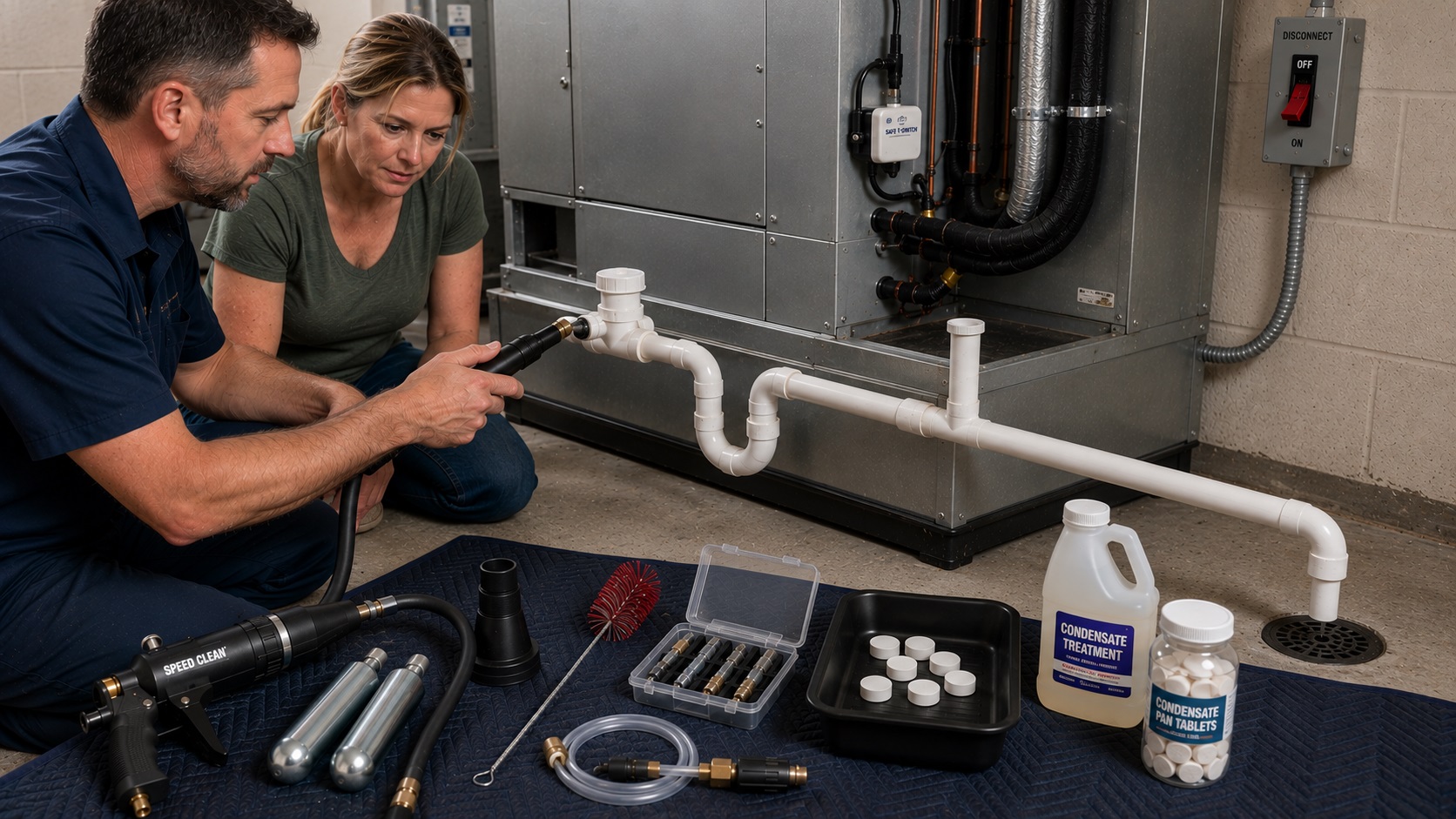
The best HVAC condensate drain line cleaning tools and treatments do not all perform the same job. A wet/dry-vac adapter removes loose material by suction. A CO₂ drain gun applies pressure to a stubborn obstruction. Purpose-made liquids can help manage organic residue, while pan tablets are intended mainly to reduce future buildup. Choosing the wrong product type can waste money or push debris toward the equipment.
This guide compares practical tools and maintenance treatments for residential condensate systems. Before servicing a line, inspect its access points and determine where the blockage may be located. Our guide to inspecting HVAC drain lines for blockages explains what to check before choosing a cleaning method.
As an Amazon Associate, this site earns from qualifying purchases. This does not affect the price you pay. Our recommendations are based on research, product reliability, and real-world usability in moisture-prone environments.
Quick Picks for Different Condensate Drain Maintenance Tasks
- Best Overall Condensate Drain Cleaning Tool: Diyvac Patented Specialty Wet Vac Attachment — a reusable adapter that helps pull water and loose debris away from an accessible drain outlet.
- Best Pressure-Based Tool for Experienced Users: RedRock Gallo Drain Gun with Five CO₂ Cartridges — a portable pressure tool for users who understand the drain layout and condition of the fittings.
- Best Liquid Treatment for Organic Buildup: Instant Power A/C Condensate Drain Line Cleaner — a purpose-made liquid for HVAC condensate lines affected by slime, residue, or recurring organic accumulation.
- Best Liquid for Scheduled Homeowner Maintenance: AC Drain Line Cleaner Four-Pack — four smaller bottles arranged as a simple recurring maintenance supply.
- Best Preventive Tablets for Most Homeowners: QwikTreat AC Pan Tablets, 100 Count — a practical supply of condensate-pan tablets for recurring maintenance in compatible systems.
- Best Bulk Preventive Treatment: HVAC GUYS Flow Treat Tabs, 200 Count — a large tablet supply for multiple systems or frequent maintenance.
Which Condensate Drain Tool or Treatment Fits Each Maintenance Task?
Best Overall Condensate Drain Cleaning Tool: Diyvac Patented Specialty Wet Vac Attachment
The Diyvac is our best overall choice for many homeowners because it uses suction rather than pressure. It connects a wet/dry vacuum to an accessible condensate drain termination so water, algae, loose sludge, and other movable debris can be pulled out of the line. This direction of cleaning can be preferable when the goal is to remove material away from the air handler instead of pushing it deeper into an unknown pipe layout.
The adapter is reusable, compact, and useful for seasonal maintenance as long as the drain outlet is compatible. It is especially practical for homeowners who already own a wet/dry vacuum. However, buyers should measure the actual drain termination before ordering. The manufacturer identifies a one-inch drain opening for the ribbed connection, but elbows, couplings, damaged pipe ends, and other termination shapes may affect the fit.
Key Features
- Uses an existing wet/dry vacuum to extract water and loose blockage material.
- Helps draw debris away from an accessible exterior drain termination.
- Clear central section allows the user to observe extracted water and residue.
- Stepped base accommodates several common wet/dry-vac hose connections.
- Reusable design does not depend on cartridges, tablets, or repeated liquid purchases.
- Compact enough to store with other HVAC and plumbing maintenance tools.
Pros
- ✔ Suction is generally easier to control than a sudden pressure burst.
- ✔ Useful for clearing loose buildup and checking whether water is moving through the line.
- ✔ Good fit for homeowners who already own a wet/dry vacuum.
- ✔ Does not introduce a chemical treatment into the condensate system.
- ✔ Can be reused during future maintenance visits.
Cons
- ✖ Requires a compatible wet/dry vacuum, which is not included.
- ✖ The drain connection does not fit every termination configuration.
- ✖ Cannot repair poor slope, separated fittings, a crushed pipe, or an improperly designed trap.
- ✖ May not remove a tightly compacted or solid obstruction.
Best For
- Homeowners with an accessible outdoor drain outlet and an existing wet/dry vacuum.
- Removing loose slime, sediment, standing water, or soft debris from a condensate line.
- Users who prefer pulling material away from the HVAC unit instead of applying positive pressure.
Check the Diyvac Patented Specialty Wet Vac Attachment on Amazon to see current availability.
Best Pressure-Based Tool for Experienced Users: RedRock Gallo Drain Gun
The RedRock Gallo Drain Gun is intended for condensate-line blockages that may respond to a controlled burst of compressed CO₂. Unlike a wet/dry-vac adapter, it pushes through the line rather than extracting material. That can be useful where suction access is poor, but it also requires a better understanding of the drain route, trap, fittings, and safe direction of discharge.
This is not the best first tool for every homeowner. Applying pressure without confirming the line configuration can separate fittings, dislodge a cap, stress a weak drain pan, or push debris toward the air handler. It is more appropriate for experienced DIY users, maintenance personnel, and HVAC technicians who can identify the correct access point and direct the blockage toward a safe outlet.
Key Features
- Portable handheld drain gun designed for HVAC condensate-line clearing.
- Includes five unthreaded CO₂ cartridges for initial use.
- Flexible hose helps reach condensate cleanouts and confined access points.
- Does not require an electrical outlet or a full-size compressed-gas tank.
- Reusable gun accepts replacement cartridges after the included supply is used.
Pros
- ✔ Compact and easy to transport between systems.
- ✔ Can deliver a focused pressure burst where vacuum access is unavailable.
- ✔ Includes cartridges rather than arriving as a tool-only purchase.
- ✔ Useful for experienced maintenance personnel who service several drain lines.
Cons
- ✖ Pressure can damage weak fittings or send debris in the wrong direction.
- ✖ Replacement cartridges create an ongoing consumable cost.
- ✖ Requires more judgment than a simple vacuum adapter.
- ✖ Not suitable when the drain route or outlet cannot be positively identified.
Best For
- Experienced users who understand the condensate-line layout.
- Drain lines with a known outlet and secure fittings.
- Situations where a wet/dry vacuum cannot be connected effectively.
Check the RedRock Gallo Drain Gun on Amazon to see current availability.
Best Liquid Treatment for Organic Buildup: Instant Power A/C Condensate Drain Line Cleaner
Instant Power A/C Condensate Drain Line Cleaner is a purpose-made HVAC treatment rather than an ordinary household drain opener. It is intended for condensate lines affected by slime, odor-producing residue, and other organic accumulation. This makes it a more appropriate option than corrosive sink or shower products that were not formulated for HVAC drain pans, traps, adhesives, or condensate components.
The important distinction is that this product is a treatment, not a mechanical repair tool. It may help with organic material and ongoing line cleanliness, but it should not be expected to fix a broken pipe, incorrect slope, obstructed vent, collapsed line, construction debris, or a solid blockage. When a drain is completely stopped, physical extraction or professional clearing may be necessary before a maintenance liquid can be useful.
Key Features
- Formulated specifically for air-conditioning and HVAC condensate drain lines.
- Intended for slime, residue, organic accumulation, and odors associated with condensate-line buildup.
- Non-corrosive positioning makes it more appropriate than generic caustic drain openers.
- Large bottle provides multiple uses when applied according to the label.
- Suitable for follow-up maintenance after normal drain flow has been restored.
Pros
- ✔ Specifically marketed for condensate systems rather than household plumbing clogs.
- ✔ Easy to store and apply through an appropriate cleanout.
- ✔ Useful where biological residue contributes to recurring slow drainage.
- ✔ Does not require a wet/dry vacuum or compressed-gas tool.
Cons
- ✖ Should not be relied on for a severe or solid obstruction.
- ✖ Requires safe access to the correct drain opening.
- ✖ Cannot correct installation defects or damaged components.
- ✖ Results depend on the type and severity of the buildup.
Best For
- Condensate lines affected by recurring organic slime or residue.
- Homeowners looking for a purpose-made alternative to generic drain chemicals.
- Maintenance after mechanical flow has been confirmed or restored.
Check the Instant Power A/C Condensate Drain Line Cleaner on Amazon to see current availability.
Best Liquid for Scheduled Homeowner Maintenance: AC Drain Line Cleaner Four-Pack
The AC Drain Line Cleaner four-pack is designed around a recurring maintenance schedule. Instead of one larger container that must be measured and stored after opening, the package provides four smaller bottles presented as a 12-month supply. That makes it easier for homeowners to connect condensate maintenance with seasonal filter changes or other recurring HVAC tasks.
This product is best viewed as a preventive liquid for a line that is already open and draining. It does not replace inspection or mechanical clearing when water is backing up. Its main advantage is convenience: the divided supply can make a routine easier to remember and reduces the temptation to estimate an oversized dose from a large jug.
Key Features
- Includes four smaller bottles rather than one large container.
- Four-bottle packaging is presented as a 12-month supply when used according to the product directions.
- Intended for HVAC condensate lines and related drainage applications.
- Pre-portioned format simplifies storage and recurring use.
- Useful for homeowners who want a structured annual maintenance supply.
Pros
- ✔ Convenient packaging supports consistent scheduled maintenance.
- ✔ Smaller bottles are easier to handle near a cleanout opening.
- ✔ Reduces the need to repeatedly measure from a larger container.
- ✔ Has a clearly different role from an emergency blockage-clearing tool.
Cons
- ✖ Not intended to repair a completely blocked or damaged drain line.
- ✖ The suggested schedule may not match every system manufacturer’s instructions or local climate.
- ✖ Requires the homeowner to locate the correct treatment access point.
- ✖ Offers less flexibility than a large bottle when several systems need different doses.
Best For
- Homeowners who prefer a simple recurring condensate-line maintenance schedule.
- Systems that are currently draining but have a history of organic buildup.
- Users who value convenient packaging over buying treatment in bulk.
Check the AC Drain Line Cleaner Four-Pack on Amazon to see current availability.
Best Preventive Tablets for Most Homeowners: QwikTreat AC Pan Tablets
QwikTreat AC Pan Tablets are designed for condensate pans rather than for blasting or vacuuming a clog from a pipe. As condensate contacts the tablets, the treatment helps control residue and deposits that may contribute to odors, restricted flow, and recurring drain problems. The 100-count container is large enough for ongoing use but less excessive than some 200-tablet service-size packages.
These tablets make sense when the appropriate condensate pan is safely accessible and the equipment manufacturer permits treatment products. They should be placed according to the label, normally away from the drain opening so condensate moves through the treated area. They should never be positioned where they can block the outlet, interfere with a float switch, or contact electrical parts.
Key Features
- Contains 100 tablets for recurring condensate-pan maintenance.
- Intended to reduce residue, odors, and buildup in compatible drain pans.
- Tablet format provides measured treatment without handling a liquid bottle during each application.
- Dosing instructions can be matched to system capacity.
- Package size is practical for homeowners with one or two systems.
Pros
- ✔ Convenient preventive format for accessible condensate pans.
- ✔ More homeowner-friendly quantity than a large professional bulk container.
- ✔ Dosing can be adjusted to the system capacity according to the product directions.
- ✔ Easy to include in a recurring cooling-season maintenance routine.
Cons
- ✖ Will not reliably reopen a severely blocked drain line.
- ✖ Requires safe access to the correct pan.
- ✖ Must be kept away from children and pets and used with appropriate precautions.
- ✖ Incorrect placement could interfere with drainage or nearby components.
Best For
- Homeowners with safely accessible condensate pans.
- Preventive maintenance after the drain line has been inspected and confirmed open.
- Managing recurring residue during periods of heavy air-conditioner use.
Check the QwikTreat AC Pan Tablets on Amazon to see current availability.
Best Bulk Preventive Treatment: HVAC GUYS Flow Treat Tabs
HVAC GUYS Flow Treat Tabs provide a larger supply for homeowners with multiple air-conditioning systems, rental-property maintenance needs, or a long-term preventive schedule. Like QwikTreat, these tablets are intended to manage buildup in a condensate pan and drainage path. They are not a substitute for vacuuming, pressure clearing, or correcting an installation problem.
The 200-count package can be practical for multi-system use, but it is more product than many single-system homeowners need. Dosing should be based on the manufacturer’s instructions and system capacity—not on the assumption that one tablet treats every air conditioner for a month. The container should be stored securely in a dry area where children and pets cannot reach it.
Key Features
- Large 200-tablet container for recurring preventive maintenance.
- Intended for condensate pans and related HVAC drainage applications.
- Slow-dissolving format supports treatment as condensate passes through the pan.
- Bulk quantity is suitable for multiple systems or frequent service work.
- Tablet dosing can be adjusted according to equipment size and label instructions.
Pros
- ✔ Large supply reduces the need for frequent reordering.
- ✔ Practical for landlords, multi-system homes, and maintenance personnel.
- ✔ Tablet format is convenient when the condensate pan is safely accessible.
- ✔ Useful for preventive treatment after drainage problems have been corrected.
Cons
- ✖ Excessive quantity for many homeowners with one HVAC system.
- ✖ Tablets cannot clear a serious existing blockage.
- ✖ Requires accurate dosing rather than using one tablet for every application.
- ✖ Must be stored carefully to prevent moisture exposure and accidental access.
Best For
- Homes with more than one air-conditioning system.
- Landlords and maintenance personnel servicing several condensate pans.
- Users who already know that their equipment permits preventive pan treatments.
Check the HVAC GUYS Flow Treat Tabs on Amazon to see current availability.
Compare Suction, CO₂ Pressure, Liquid Treatments, and Pan Tablets
Use the table below to compare products by task: suction and CO₂ tools physically clear material, liquids treat organic residue or support maintenance, and pan tablets are intended mainly for preventive buildup control.
| Product | Category | Best Use Case | Key Strength | Main Limitation | Amazon Link |
|---|---|---|---|---|---|
| Diyvac Wet Vac Attachment | Best Overall Condensate Drain Cleaning Tool | Extracting loose debris from an accessible drain outlet | Uses suction to pull material away from the HVAC unit | Requires a wet/dry vacuum and compatible drain opening | View on Amazon |
| RedRock Gallo Drain Gun | Best Pressure-Based Tool for Experienced Users | Known blockages where the drain route and outlet are understood | Portable CO₂-powered clearing action | Pressure can damage fittings or push debris in the wrong direction | View on Amazon |
| Instant Power A/C Condensate Drain Line Cleaner | Best Liquid Treatment for Organic Buildup | Slime, residue, odors, and maintenance after flow is restored | Purpose-made HVAC condensate formula | Not a reliable fix for a solid or severe blockage | View on Amazon |
| AC Drain Line Cleaner Four-Pack | Best Liquid for Scheduled Homeowner Maintenance | Recurring homeowner maintenance | Four convenient smaller bottles | Does not replace mechanical blockage removal | View on Amazon |
| QwikTreat AC Pan Tablets | Best Preventive Tablets for Most Homeowners | Recurring treatment in compatible accessible drain pans | Practical 100-tablet supply | Requires correct pan access, dosing, and placement | View on Amazon |
| HVAC GUYS Flow Treat Tabs | Best Bulk Preventive Treatment | Multiple systems, landlords, and frequent maintenance | Large 200-tablet container | More product than most single-system homeowners need | View on Amazon |
Choose a Clearing Tool or Treatment Based on What the Drain Is Doing
Standing Water Calls for Clearing; a Flowing Line May Only Need Maintenance
The most important buying decision is not between brands. It is between product types.
If water is backing up, the drain pan is filling, a float switch has shut down the system, or no water is emerging from the termination during humid cooling conditions, the line may require physical clearing. A wet/dry-vac adapter is usually the most approachable first option where the exterior outlet is accessible. A CO₂ gun is a more specialized alternative when the line configuration is known and its fittings are secure.
If the line is already open and draining, a liquid treatment or pan tablet may help reduce future organic accumulation. Preventive products should not be used to postpone correcting an active overflow. For a closer look at causes beyond ordinary buildup, read why HVAC drain lines overflow.
Measure the Actual Outlet Instead of Relying on Nominal PVC Size
Residential condensate drains commonly use PVC piping, but nominal pipe size does not guarantee that a tool will fit the termination. Elbows, adapters, cut pipe ends, threaded cleanouts, traps, vents, and shared drains all change how a product connects.
Before buying a vacuum adapter, measure the actual outside termination. Before using a pressure tool, identify where the line discharges and whether caps or vents must be temporarily sealed according to the tool instructions. Do not improvise a high-pressure seal on an unknown drain route.
Consider Which Direction Debris Will Move
A vacuum connected at the outlet normally pulls material toward the exterior. A pressure gun connected near the air handler pushes material down the line. Either method can fail if connected at the wrong point, but pressure creates greater risk when the pipe layout is unknown.
Never apply pressure merely because water is present in a pan. The obstruction could be downstream of a loose fitting, or the pan itself could be cracked. Water near electrical wiring, a blower compartment, control board, or damaged drain pan is a reason to stop and call a qualified HVAC technician.
Decide Whether You Need a Reusable Clearing Tool or Ongoing Treatment Supply
The Diyvac and Gallo gun are reusable tools, although the drain gun requires replacement CO₂ cartridges. Liquids and tablets are consumables that must be replenished. A reusable tool makes sense when a home has a history of drain-line blockage. A treatment may be more useful when the line has already been corrected and the goal is to manage recurring biological residue.
Do Not Confuse Drain Treatments with Condensate Pumps
A condensate pump moves water when gravity drainage is unavailable. It does not automatically clean a blocked upstream drain line. Conversely, clearing a line will not repair a failed pump. Homes that depend on pumped drainage should evaluate the pump, reservoir, check valve, tubing, and safety switch separately. See our guide to the best condensation pumps for HVAC systems when the problem involves lifting water rather than cleaning the drain.
How to Clear or Treat a Condensate Line Without Creating a New Problem
Turning Off the Thermostat Alone May Not Remove Power from the Air Handler
Turn the system off at the thermostat and disconnect the appropriate power source before opening a service panel, touching a drain pan, or working near internal components. A thermostat setting alone may not remove power from the air handler. Follow the equipment manufacturer’s shutdown instructions.
Look for Pan Damage, Loose Fittings, and Electrical Exposure First
Look for standing water, cracked plastic, rusted metal pans, loose PVC joints, disconnected tubing, sagging pipe, stained insulation, and signs that water has reached electrical parts. Confirm whether the line has a cleanout, vent, trap, exterior termination, or connection to a pump.
If the unit is leaking indoors, our guide to why HVAC units leak water indoors can help distinguish a drain blockage from other causes.
Pull Debris Toward the Outlet with a Wet/Dry Vacuum
Connect the adapter securely to the outdoor drain termination and the correct wet/dry-vac hose. Use a vacuum rated for wet pickup, remove any dry-only filter if its instructions require that step, and make the connection as airtight as practical without damaging the pipe.
Run the vacuum in short, controlled intervals. Observe whether water and debris enter the collection tank. After cleaning, confirm flow by using only the test method permitted by the HVAC manufacturer. Do not pour a large amount of water into an unknown opening.
Apply CO₂ Pressure Only When the Drain Route Is Known
Wear eye protection and follow the cartridge-loading instructions exactly. Identify the safe discharge direction, secure nearby caps and fittings, and keep people away from the outlet. Use only the pressure action recommended by the manufacturer.
Do not repeatedly fire cartridges into a line that remains blocked. Repeated pressure may worsen a fitting failure without resolving the underlying obstruction.
Add Liquid Treatment Only Through the Correct Cleanout
Confirm that the product is made for HVAC condensate systems and that your equipment manufacturer allows its use. Apply the specified amount through the correct cleanout only after establishing that the line is open enough to drain.
Never mix condensate treatment products with bleach, vinegar, household drain opener, disinfectant, or another chemical. Mixing products can create harmful reactions or damage components.
Place Pan Tablets Where They Cannot Block the Outlet or Float Switch
Place tablets only in a manufacturer-approved condensate pan that can be accessed safely. Follow the dose for the system’s capacity. Keep tablets away from the outlet opening, float switches, pumps, sensors, wiring, and moving parts.
Do not place tablets in a secondary emergency pan unless the product and equipment instructions specifically permit it. A normally dry emergency pan is not the same as the primary condensate pan.
Condensate Drain Cleaning Mistakes That Can Make the Problem Worse
Using Corrosive Household Drain Openers
A product labeled safe for PVC is not automatically appropriate for an HVAC condensate system. Household drain openers may contact drain-pan materials, adhesives, traps, pumps, seals, or metal components that differ from ordinary sink plumbing.
Treating Preventive Tablets as Emergency Clog Removers
Tablets can help limit buildup over time, but they do not mechanically remove a severe obstruction. Adding more tablets to a backed-up pan may introduce additional material without restoring drainage.
Applying Pressure Without Understanding the Drain Route
Blindly firing a pressure gun can push sludge toward the equipment or separate a weak joint hidden inside a wall or ceiling. Trace the line and identify its outlet before using pressure.
Buying an Adapter Without Measuring the Termination
Condensate piping may be called 3/4-inch PVC, but the fitting presented to the tool can have a different outside diameter or opening. Measure the exact access point rather than ordering based only on nominal pipe size.
Ignoring Repeated Blockages
A line that clogs repeatedly may have inadequate slope, a poorly designed trap, an obstructed vent, sagging pipe, microbial growth, or an incorrect termination. Continually adding chemicals or applying pressure can hide the real problem until water damages nearby materials.
Working Around Live Electrical Components
Water inside or near electrical sections is not a routine DIY cleaning situation. Shut down power and arrange professional service when moisture has reached wiring, motors, controls, or connections.
Assuming Every Indoor Water Leak Comes from the Drain Line
Frozen coils, dirty filters, damaged insulation, cracked pans, failed pumps, disconnected piping, and excessive condensation can produce similar symptoms. Check the source before buying a drain-cleaning product. Our guide to detecting HVAC condensation leaks covers the inspection process in more detail.
Frequently Asked Questions About HVAC Condensate Drain Cleaning
What is the best tool for cleaning an HVAC condensate drain line?
For many homeowners, a compatible wet/dry-vac adapter is the most practical starting point because it pulls loose blockage material toward an accessible outlet. The Diyvac is our overall recommendation for this task. A CO₂ drain gun may be useful for experienced users who understand the line configuration and pressure risks.
Can I use a household drain cleaner in an AC condensate line?
Do not use an ordinary household drain opener unless its manufacturer specifically confirms compatibility with HVAC condensate systems and your equipment instructions permit it. Products intended for sinks and showers may be too corrosive or unsuitable for drain pans, pumps, seals, adhesives, and HVAC components.
Will condensate pan tablets clear a clogged drain line?
Pan tablets are primarily preventive treatments. They may help control residue that contributes to future blockages, but they should not be expected to reopen a severely clogged pipe. Restore drainage first, then use tablets only when permitted by the equipment and treatment manufacturers.
Is vacuuming better than blowing out a condensate line?
Vacuuming is often easier for homeowners because it can pull material away from the HVAC unit. Blowing the line may be effective, but it requires knowing the drain route and ensuring fittings can tolerate the pressure. Neither method is appropriate for every installation.
How often should an HVAC condensate drain be treated?
Follow the treatment label and HVAC manufacturer’s instructions. Frequency can vary with climate, cooling runtime, system capacity, drainage design, and the history of biological buildup. Do not assume that every line needs monthly chemicals or tablets.
Why does my condensate line keep clogging?
Repeated blockage can result from biological growth, poor pipe slope, an incorrectly configured trap, inadequate venting, sagging sections, debris entering a cleanout, or a poorly located termination. Repeated clogs deserve a full inspection rather than continual treatment alone.
Should I pour bleach or vinegar into an HVAC drain line?
Do not add bleach, vinegar, or any other chemical unless the HVAC manufacturer and drain-line instructions specifically allow it. Never mix products. A purpose-made condensate treatment is generally a more defensible choice than improvising with household chemicals, but it must still be compatible with the system.
When should I call an HVAC technician?
Call a professional when water is near electrical components, the drain pan is cracked or badly corroded, the line runs through inaccessible areas, fittings have separated, pressure would need to be applied blindly, or the blockage returns after cleaning. Professional evaluation is also appropriate when the system repeatedly shuts down or leaks into finished ceilings and walls.
Final Recommendation: Match the Product to the Drain Problem
Choose the Diyvac Wet Vac Attachment when you have an accessible compatible drain outlet and want to extract loose material with a wet/dry vacuum. It is the most practical overall tool for many residential situations.
Choose the RedRock Gallo Drain Gun only when you understand the drain layout, can direct the blockage toward a safe outlet, and are comfortable using a pressure-based tool.
For organic residue in an open or partially flowing line, the Instant Power A/C Condensate Drain Line Cleaner is our preferred treatment-focused option. The AC Drain Line Cleaner Four-Pack is better suited to homeowners who want a simple scheduled maintenance supply.
Choose QwikTreat AC Pan Tablets for routine preventive use in an accessible compatible pan. The HVAC GUYS Flow Treat Tabs make more sense for multiple systems or frequent maintenance.
No clearing tool or preventive treatment can correct every condensate drainage problem. If blockage keeps returning, inspect the slope, trap, vent, fittings, pan, pump, and termination. Resolving the cause is more important than repeatedly treating the symptom. HVAC drainage is one part of a larger moisture-control strategy covered in our guide to how plumbing leaks cause structural damage.