How to Detect Roof Condensation Problems
To detect roof condensation problems, inspect the attic during cold or early-morning conditions, look for moisture across wide roof surfaces, check nail tips and metal fasteners for frost or droplets, examine insulation below the roof deck, and compare the pattern to recent weather. Condensation usually appears after temperature drops or humid indoor air reaches cold attic surfaces, while roof leaks usually follow rain, snowmelt, or a localized entry path.
Many homeowners see damp wood, frost, or ceiling stains and assume the roof is leaking. A structured attic inspection helps separate condensation from exterior water intrusion before unnecessary roof repairs are made or hidden moisture damage is overlooked.
If you are still identifying the basic warning signs, first review the signs of roof condensation in attics. This guide focuses on the next step: confirming whether the attic moisture pattern is actually condensation.
For a broader understanding of how moisture behaves inside homes, you may also find it helpful to review this complete moisture problem identification guide.
When You Should Inspect for Roof Condensation
Roof condensation is easiest to detect when attic surfaces are cold and moisture has not yet dried. The best inspections usually happen early in the morning, during cold weather, or soon after a sudden temperature drop.
After Noticing Moisture Symptoms
Inspect the attic when you notice ceiling stains, damp insulation, frost, musty attic odors, or moisture that does not match recent rainfall. Widespread dampness across several attic areas points more toward condensation than a single roof leak.
During Cold Weather or Seasonal Temperature Drops
Cold weather creates ideal conditions for condensation formation. Roof surfaces become colder than indoor air, increasing the likelihood that moisture will condense on attic materials.
The most effective inspection periods often occur:
- Early in the morning after overnight cooling
- During winter months
- After sudden temperature changes
- When frost conditions are present
Morning inspections are especially valuable because condensation often forms overnight and becomes visible before daytime warming dries surfaces.
When Stains Do Not Match Recent Rainfall
Interior ceiling stains often lead homeowners to suspect roof leaks. However, condensation can also cause moisture to drip downward onto ceiling surfaces, creating similar damage patterns.
If stains appear without recent rainfall or worsen during colder weather, condensation should be considered as a possible cause. Comparing interior symptoms to signs of roof leaks inside the house can help distinguish between leak-related and condensation-related damage.
When Attic Odors Become Noticeable
Musty odors inside attic spaces often indicate moisture retention. Even when visible water is not obvious, lingering odors can signal hidden condensation cycles.
If attic air smells damp or stale, inspection should occur promptly to identify hidden moisture accumulation before mold develops.
Safety Steps Before Entering the Attic
Attic inspections involve physical hazards that should not be overlooked. Safe inspection practices protect homeowners from injury while ensuring accurate observations. Before entering an attic, proper preparation is essential.
Do not enter an attic if you see exposed electrical hazards, active dripping near wiring, unstable framing, heavy mold growth, or no safe place to stand. In those cases, inspect only from the access opening and call a qualified professional.
Use Reliable Lighting
Adequate lighting is one of the most important tools for detecting condensation. Moisture droplets, frost, and staining may be difficult to see without strong illumination.
Recommended lighting practices include:
- Use a bright flashlight or headlamp
- Avoid relying on weak attic lighting alone
- Illuminate surfaces from multiple angles
- Focus on reflective surfaces such as metal fasteners
Light reflecting off moisture often reveals droplets that would otherwise remain unnoticed.
Walk Only on Stable Surfaces
Attic floors may not be fully covered with solid walking surfaces. Stepping on unsupported areas can cause damage to ceiling materials or create safety risks.
Before moving inside the attic:
- Walk only on joists or designated flooring boards
- Avoid stepping on insulation-covered surfaces
- Move slowly and maintain stable footing
- Keep both hands available for balance when possible
Maintaining stable movement helps prevent accidents and protects ceiling structures below.
Wear Basic Protective Gear
Protective equipment reduces exposure to dust, insulation fibers, and airborne particles that may be present in attic environments.
Basic protective gear includes:
- N95 mask or respirator, especially if dust, insulation fibers, or mold-like growth is present
- Protective gloves
- Safety glasses
- Long-sleeved clothing
These precautions improve safety during extended inspections and help reduce irritation from insulation materials.
Step-by-Step Roof Condensation Detection Process
Once safe access is established, inspection should follow a logical sequence. Random observation often leads to missed clues. A structured inspection improves accuracy and helps confirm whether condensation patterns are present.
Step 1: Inspect the Underside of Roof Sheathing
The underside of roof sheathing is the primary location where condensation forms. This surface is exposed to outdoor temperatures and frequently becomes the coldest area inside the attic.
During inspection, look for:
- Water droplets forming on wood surfaces
- Thin moisture films across wide areas
- Dark staining patterns
- Frost formation during cold weather
- Moisture appearing across multiple sections
Wide moisture distribution across sheathing surfaces strongly suggests condensation rather than a localized roof leak.
A single wet trail below a roof penetration, flashing area, valley, chimney, or vent pipe is less typical of condensation and should be treated as a possible leak until proven otherwise.
If visible moisture matches known symptom patterns, reviewing signs of condensation on roof sheathing can help confirm whether your observations align with typical condensation behavior.
Step 2: Check Nail Tips and Metal Fasteners
After inspecting roof sheathing, the next step is examining exposed nail tips and metal connectors. These small components often reveal condensation earlier than surrounding materials because metal cools faster than wood. As a result, moisture tends to form on these surfaces first.
Focus your inspection on nail points extending through roof sheathing and any visible metal brackets or connectors. Use a bright flashlight and angle the beam across metal surfaces to detect reflective moisture or frost.
Look for the following indicators:
- Small droplets forming on metal nail tips
- White frost buildup during cold weather
- Rust developing around fasteners
- Water dripping from melting frost
- Repeated moisture appearing in the same areas
Frost on nail tips is one of the strongest indicators of condensation. Unlike roof leaks, which usually follow a downward path from a single entry point, condensation often forms simultaneously across many metal surfaces.
Step 3: Examine Insulation for Dampness or Compression
Insulation can reveal repeated condensation because droplets from the roof deck may fall onto the material below. Look for damp, matted, darker, or compressed areas directly under cold roof surfaces.
Carefully inspect insulation near roof slopes and eaves, where condensation commonly collects. Avoid disturbing insulation unnecessarily, but visually examine its condition and texture.
Warning signs include:
- Flattened or compressed insulation
- Darker coloration compared to surrounding areas
- Clumped or matted insulation fibers
- Visible moisture staining
- Musty odors near insulation layers
Wet insulation reduces thermal resistance, which increases temperature differences inside the attic and encourages further condensation cycles. Persistent insulation dampness should not be ignored, especially when it appears repeatedly in the same locations.
If insulation dampness overlaps with ceiling staining below, compare your findings with common signs of roof leaks inside the house to determine whether the moisture source is internal condensation or external roof failure.
Step 4: Inspect Ventilation Pathways
Ventilation problems do not prove condensation by themselves, but blocked airflow can explain why humid attic air is not drying between temperature cycles.
Inspect visible ventilation components such as soffit vents, ridge vents, and roof vents. Ensure these areas remain open and unobstructed.
During inspection, check for:
- Insulation covering soffit vent openings
- Debris blocking airflow pathways
- Damaged or crushed vent components
- Visible airflow restrictions
- Signs of moisture buildup near ventilation points
Blocked airflow often leads to repeated condensation cycles. If ventilation limitations appear present, reviewing signs of poor attic ventilation helps determine whether airflow problems are contributing to attic moisture.
How to Map Moisture Patterns Inside the Attic
After checking individual surfaces, map where the moisture appears. Condensation usually shows a repeated pattern across cold surfaces, while leaks usually concentrate around an entry point and travel downward.
Look for Widespread Moisture Distribution
Condensation typically forms across wide surfaces rather than concentrated areas. If moisture appears scattered across multiple roof sections, condensation is more likely than a localized roof leak.
Observe whether moisture:
- Appears across several roof bays
- Occurs evenly across surfaces
- Forms in repeated patterns
- Appears on both wood and metal components
- Extends beyond a single location
Compare Moisture Patterns to Weather Conditions
Environmental timing provides valuable clues during pattern mapping. Moisture that appears after cold nights or temperature drops often indicates condensation rather than rainfall.
Track moisture patterns over several days and compare them to:
- Outdoor temperature changes
- Rainfall events
- Humidity levels
- Seasonal transitions
If moisture forms without rainfall but follows temperature changes, condensation becomes the more likely cause.
Document Findings for Ongoing Observation
Photographing moisture areas helps track changes over time. Documentation allows homeowners to compare new observations with previous conditions and determine whether moisture patterns are expanding or stabilizing.
Use consistent reference points when taking photos, such as rafters or ventilation openings. Over time, this record helps confirm whether condensation patterns remain stable or worsen.
If moisture spreads or appears more frequently, the problem may be progressing beyond early-stage condensation.
Tools That Help Confirm Roof Condensation Problems
Most roof condensation inspections start with visual evidence, but a few basic tools can make the findings more reliable.
Using a Flashlight to Identify Hidden Moisture
A bright flashlight is the single most important tool for detecting roof condensation. Moisture often appears as small droplets or thin films that are difficult to see without strong lighting.
When using a flashlight:
- Shine the light across surfaces rather than directly at them
- Use angled lighting to reveal reflective moisture
- Focus on metal surfaces, where droplets form first
- Check corners, joints, and shaded areas
- Move slowly to allow moisture reflections to become visible
Angled lighting makes water droplets sparkle, allowing even thin moisture films to become visible during inspection.
Using a Hygrometer to Measure Humidity Levels
A hygrometer measures humidity levels inside the attic. Elevated humidity increases the likelihood of condensation forming on cold surfaces.
During inspection, measure humidity in both the attic and living spaces below. Differences between these readings can indicate moisture movement into attic areas.
Signs that humidity levels may contribute to condensation include:
- High attic humidity compared to indoor living areas
- Humidity levels remaining elevated during cold weather
- Persistent moisture despite dry outdoor conditions
- Condensation forming at moderate temperature differences
Monitoring humidity over time provides valuable insight into moisture behavior. If humidity remains elevated even when ventilation appears normal, additional investigation may be required.
For a fuller explanation of indoor humidity measurement, see this guide on how to test indoor humidity levels.
Using a Thermometer to Compare Temperature Differences
Temperature differences between indoor air and attic surfaces play a major role in condensation development. A basic thermometer allows homeowners to identify areas where surfaces become unusually cold.
During inspection, compare:
- Indoor living area temperatures
- Attic air temperatures
- Roof surface temperatures when possible
Large temperature differences increase condensation risk. Cold surfaces inside the attic often act as condensation points when warm indoor air reaches them.
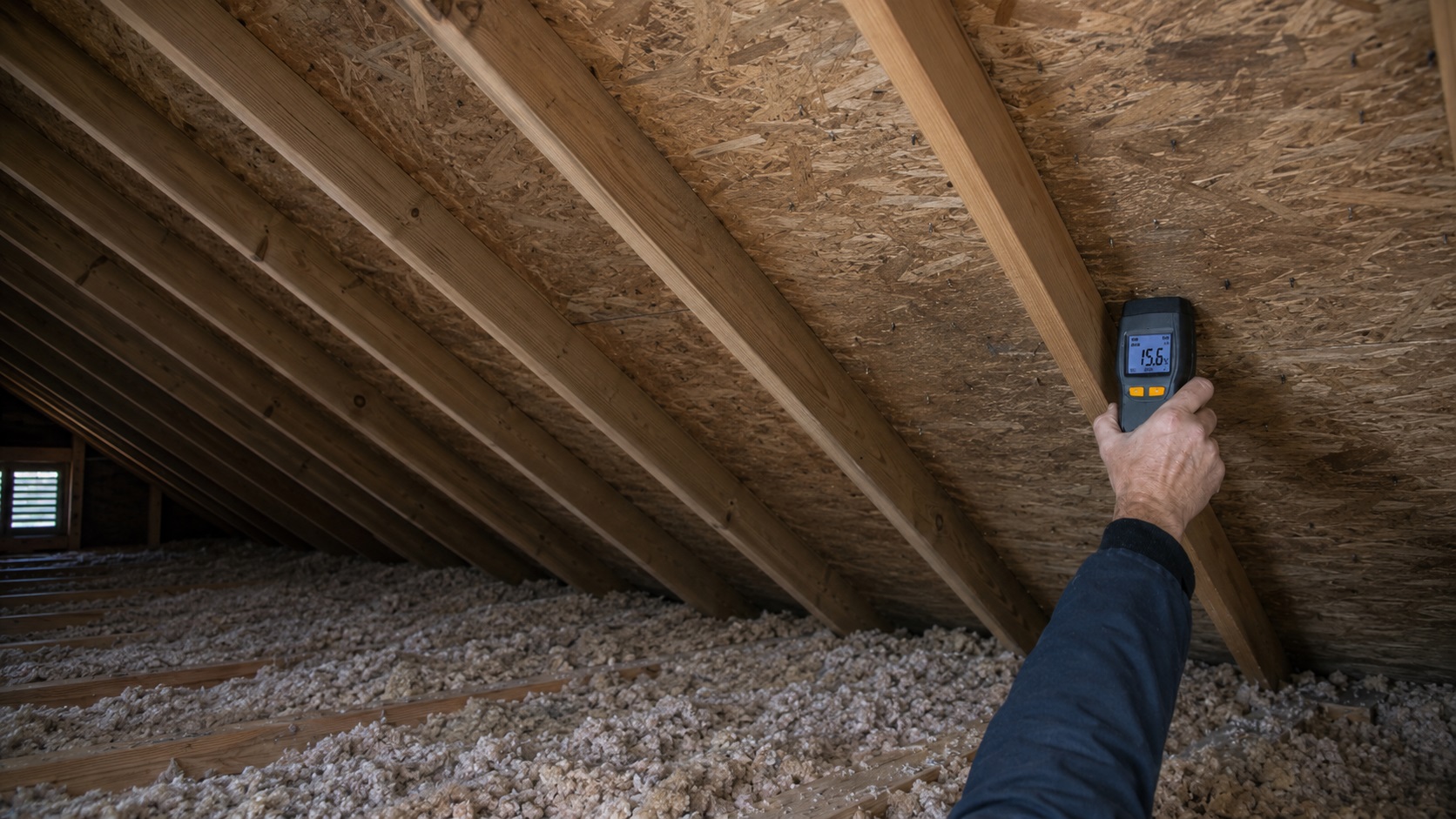
Using a Moisture Meter for Surface Testing
A moisture meter can help confirm whether roof sheathing or framing is still damp after visible moisture has dried.
Moisture meter readings can help identify:
- Hidden moisture beneath visible surfaces
- Areas where moisture remains trapped
- Differences between dry and damp materials
- Persistent dampness that may lead to mold growth
If moisture readings remain elevated across wide areas, condensation becomes a likely explanation. However, localized high readings may indicate leak-related moisture instead.
Understanding how condensation affects wood surfaces can also help explain why mold eventually develops in damp attic areas. This relationship is explained further in why roof condensation causes mold growth.
How to Confirm Roof Condensation vs Roof Leak
The strongest clue is not one wet spot but the pattern. Condensation usually follows cold-surface and humidity cycles; roof leaks usually follow rain, snowmelt, flashing defects, or a localized path from an exterior opening.
Evaluate Weather Timing Patterns
Weather timing offers valuable clues when distinguishing condensation from leaks.
Condensation patterns typically:
- Appear during cold nights
- Become visible in the morning
- Occur without rainfall
- Repeat during temperature drops
Roof leak patterns typically:
- Appear during rainfall
- Worsen during storms
- Follow snowmelt cycles
- Increase after severe weather events
Tracking weather conditions alongside moisture observations helps clarify the true source of water intrusion.
Analyze Moisture Distribution Patterns
Distribution matters because condensation and leaks usually spread differently. Condensation often appears across several cold surfaces, while leak moisture usually starts at one entry point and travels downward.
Compare distribution characteristics:
- Widespread moisture suggests condensation
- Localized wet areas suggest leaks
- Repeated patterns across surfaces indicate humidity-related condensation
- Directional water marks indicate exterior intrusion
If uncertainty remains, comparing observed symptoms to signs of roof condensation in attics helps reinforce pattern recognition before making repair decisions.
Repeat Inspections to Confirm Trends
Single inspections may not reveal the full picture. Condensation behavior changes based on temperature and humidity cycles. Repeating inspections improves reliability and confirms whether moisture patterns remain consistent.
Repeat inspections are especially helpful when:
- Moisture appears intermittently
- Seasonal conditions change
- Humidity levels fluctuate
- Insulation conditions shift
Tracking trends over time provides stronger confirmation than relying on one-time observations.
When Your Inspection Results Require Professional Help
Homeowner inspection is useful for recognizing patterns, but some findings should move beyond monitoring. Call a professional when moisture persists, mold appears, materials deteriorate, or the source remains unclear.
Call a Professional If Moisture Continues Despite Monitoring
If condensation patterns remain visible across multiple inspections, especially after several days or weeks, the underlying cause may be more complex than simple seasonal moisture.
Professional evaluation is recommended when:
- Moisture remains visible across wide areas
- Condensation appears regardless of weather changes
- Insulation stays damp over extended periods
- Wood surfaces fail to dry between inspection cycles
Persistent moisture often indicates airflow restrictions, humidity buildup, or insulation deficiencies that require targeted solutions.
Call a Professional If Mold Becomes Visible
Visible mold growth is a clear signal that moisture has remained present long enough to support biological contamination. Mold should not be ignored, especially when it spreads across roof sheathing or structural components.
If mold appears during inspection, professional testing and remediation may be necessary. Understanding the relationship between condensation and biological growth helps explain why these conditions develop. Learn more about how roof condensation causes mold growth to better understand the risks associated with prolonged moisture exposure.
Call a Professional If Structural Damage Is Suspected
Moisture that remains trapped inside wood materials can weaken structural components over time. If roof sheathing or framing begins to show signs of deterioration, professional inspection should occur promptly.
Structural warning signs include:
- Soft or crumbling roof sheathing
- Splitting or flaking wood surfaces
- Sagging roof components
- Persistent dark staining that spreads over time
Structural damage rarely resolves without intervention and may require repair to restore safe building performance.
Call a Professional If Moisture Source Remains Unclear
If repeated inspections fail to clearly distinguish condensation from leaks, professional diagnosis becomes necessary. Some attic moisture problems involve multiple causes that are difficult to identify without specialized tools.
Professional inspectors may evaluate:
- Ventilation performance
- Humidity movement patterns
- Air leakage pathways
- Roof integrity and flashing conditions
- Insulation performance
Combining homeowner observations with professional testing creates a more complete understanding of attic moisture conditions.
What to Do After Confirming Roof Condensation
Once the pattern points to condensation, the next step is reducing the conditions that allow it to return. For the prevention side of the problem, see this guide on how to prevent roof condensation.
Because some attic moisture patterns can overlap with roofing defects, it is also helpful to compare your findings with common roofing material failures before assuming condensation is the only issue.
FAQ: How to Detect Roof Condensation Problems
What time of day is best to inspect for roof condensation?
Early morning is usually the best time to inspect for condensation. Overnight cooling allows moisture to form on cold surfaces, making droplets or frost easier to detect before daytime warming dries the attic.
How often should I inspect my attic for condensation?
Inspect at least seasonally, especially before and during cold weather. Also inspect after new ceiling stains, attic odors, frost on nail tips, damp insulation, or moisture that appears without recent rainfall.
Do I need special tools to detect condensation?
Most inspections can be completed using basic tools such as a flashlight and protective gear. Optional tools such as hygrometers or moisture meters improve accuracy but are not required for initial observation.
Can condensation occur without visible water droplets?
Yes. Early-stage condensation may appear as damp surfaces, mild staining, or musty odors rather than visible droplets. Over time, these subtle signs may develop into more noticeable moisture accumulation.
How long should I monitor condensation patterns?
Monitoring should continue over several days or weeks to confirm consistent patterns. Observing moisture during different weather conditions improves diagnostic accuracy.
Can condensation and roof leaks occur at the same time?
Yes. Some homes experience both problems simultaneously. Moisture from leaks and condensation may overlap, making careful observation essential before determining corrective actions.
Conclusion: Confirm the Pattern Before Choosing a Repair
Roof condensation is detected by pattern, timing, and location. Moisture that appears across cold attic surfaces after temperature drops points toward condensation, while localized wet trails after rain or snowmelt point more toward a leak. If repeated inspections still leave the source unclear, get a professional evaluation before choosing a repair path.