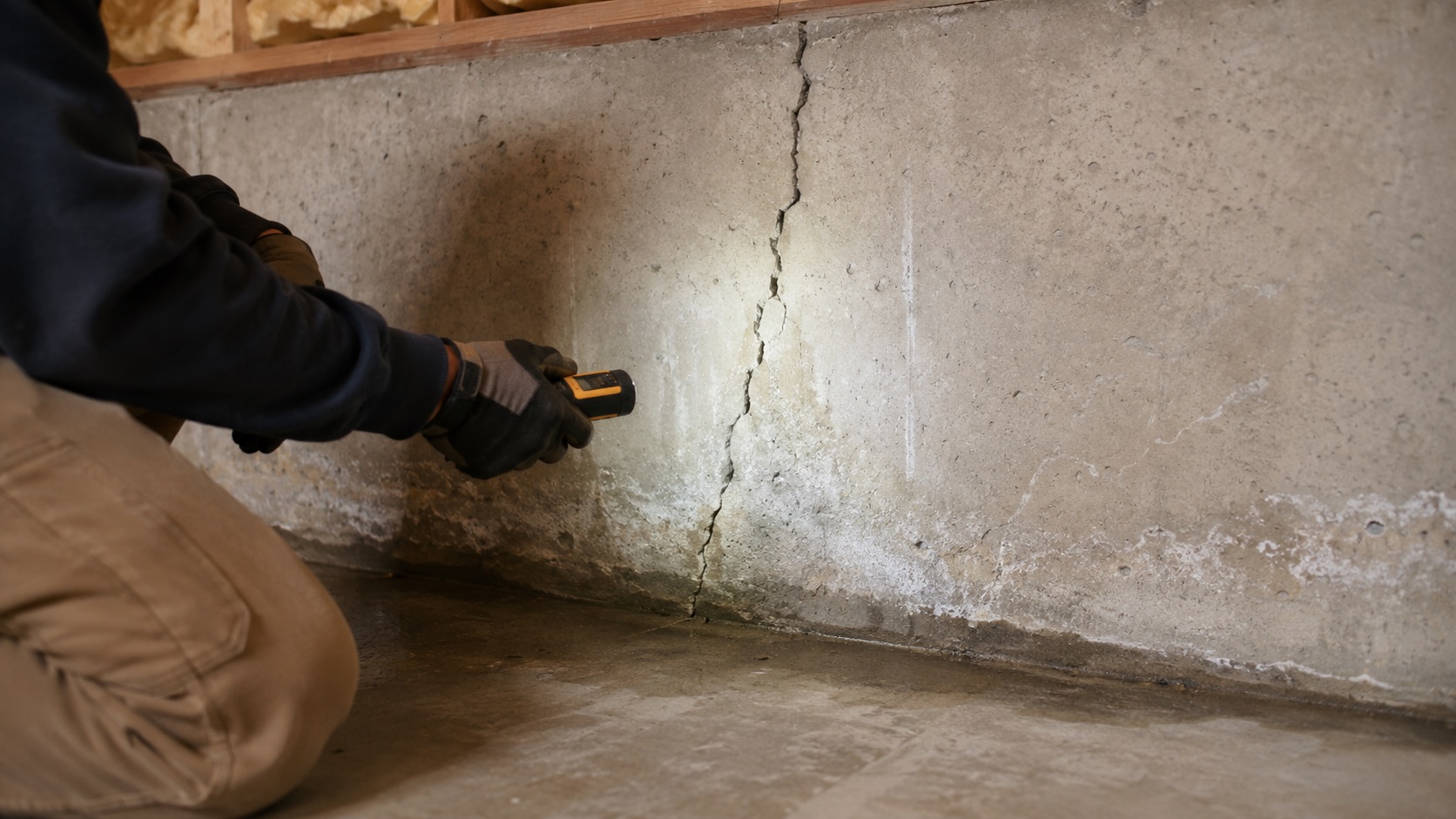
How Much Does Foundation Crack Repair Cost?
Foundation crack repair usually costs about $250 to $1,000 per crack for simple sealing or injection work. However, the cost can rise into the several-thousand-dollar range if the crack is connected to water pressure, wall movement, settlement, bowing, drainage failure, or structural instability.
This is why foundation crack repair prices vary so much. One homeowner may pay a few hundred dollars to seal a stable vertical crack in a poured concrete basement wall. Another may receive a much larger quote because the crack is horizontal, leaking during rain, widening over time, or connected to a foundation wall that is moving inward.
The key is to understand what the crack represents. Foundation crack repair is priced by cause, location, water involvement, repair method, access, and whether the foundation is still moving. If the crack is part of a broader moisture or structural pattern, it may need more than a surface patch. For a larger view of how moisture affects framing, foundations, floors, and walls, see structural moisture problems in homes.
How Much Does Foundation Crack Repair Usually Cost?
Most simple foundation crack repairs fall into a few common pricing tiers. A small, dry, stable crack may only require sealing or injection. A leaking crack may need polyurethane injection or waterproofing work. A crack caused by settlement, bowing, or lateral soil pressure may require structural repair instead of basic crack filling.
A practical cost range looks like this:
| Repair situation | Typical cost range | What usually drives the price |
|---|---|---|
| Small cosmetic or non-structural crack sealing | $250 to $500 per crack | Dry, narrow, stable cracks with easy access |
| Epoxy or polyurethane crack injection | $400 to $1,000 per crack | Injection material, crack length, preparation, and access |
| Leaking foundation crack repair | $500 to $1,500 or more | Water entry, rain leaks, hydrostatic pressure, and repair method |
| Exterior excavation and waterproofing around a crack | Several thousand dollars | Soil removal, exterior access, waterproofing materials, and backfilling |
| Structural foundation stabilization | Several thousand dollars to $10,000 or more | Wall movement, settlement, anchors, piers, beams, or reinforcement |
These are planning ranges, not fixed prices. Local labor rates, foundation type, crack condition, basement finish, accessibility, soil pressure, water entry, and repair method all affect the quote. A contractor may also charge more if the crack is behind finished walls, cabinets, utilities, insulation, or other obstructions.
Why simple cracks cost less
Simple cracks cost less when they are dry, narrow, stable, and easy to access. These cracks may come from concrete shrinkage, minor settlement, or normal curing behavior in poured concrete. If the crack is not leaking and there are no movement signs, the repair may involve cleaning, sealing, or injecting the crack with an appropriate repair material. The repair should also make future changes easier to monitor, not just hide the line.
Why some crack repairs become expensive
Foundation crack repair becomes more expensive when the crack points to a bigger problem. Leaking cracks may involve saturated soil or water pressure. Stair-step cracks may suggest settlement or wall movement. Horizontal cracks may suggest lateral pressure against the wall. Widening cracks may mean the foundation is still moving. In those cases, the contractor may need to address drainage, soil pressure, reinforcement, settlement, or exterior waterproofing instead of only filling the crack.
Because foundation cracks can be related to water movement, the long-term fix often depends on finding and fixing moisture problems before they return, not just covering the visible crack.
Foundation Crack Repair Cost by Crack Type
The type of crack affects the likely repair method and cost. Shape alone does not prove whether a foundation is safe or unsafe, but it does show how cautious the homeowner should be. The main cost questions are whether the crack is dry or leaking, stable or widening, isolated or part of a pattern, and whether the wall or floor around it is moving.
Hairline cracks
Hairline foundation cracks are often the least expensive to address when they are dry, stable, and not connected to movement. Many come from shrinkage or minor curing behavior. If there is no water entry and no widening, the repair may be mostly preventive or cosmetic, such as surface sealing or a small localized repair. If the crack widens, leaks, spreads, or appears with other structural symptoms, the repair may no longer be minor.
Vertical cracks
Vertical cracks are common in poured concrete foundation walls. Many are repairable with epoxy or polyurethane injection if the wall is stable. A dry vertical crack may cost less than one that leaks during rain. Polyurethane is often used for leaking cracks because it can expand and seal water pathways, while epoxy may be considered for stable cracks where rigid bonding is useful.
Diagonal cracks
Diagonal cracks deserve more attention than simple hairline shrinkage cracks because they may be related to settlement, soil movement, or stress in the foundation. A narrow diagonal crack that has not changed in years may not require the same repair as a fresh diagonal crack that is widening.
The cost depends on whether the crack is only being sealed or whether the foundation movement must be evaluated and corrected. If doors stick, floors slope, trim separates, or the crack continues to grow, the repair may move beyond basic sealing.
Stair-step cracks
Stair-step cracks often appear in concrete block, brick, or masonry foundation walls. They follow mortar joints in a step-like pattern. These cracks can be more concerning than a simple vertical crack in poured concrete because they may suggest settlement, lateral pressure, or movement between masonry units.
A small stair-step crack may be repairable, but it should not automatically be treated as a simple caulk job. If the wall is bowing, the crack is widening, blocks are displaced, or water is entering, the repair may require structural evaluation or reinforcement.
Horizontal cracks
Horizontal cracks are often among the most concerning foundation crack patterns. They may indicate lateral pressure from soil, water, frost, or expansive soil pushing against the foundation wall. If the wall is bowing inward, leaning, or visibly displaced, the repair can become much more expensive than crack sealing.
Horizontal cracks may require wall anchors, steel beams, carbon fiber reinforcement, drainage improvements, or other structural stabilization methods. Because of that, the cost can move quickly from hundreds of dollars into several thousand dollars.
Slab cracks
Slab cracks vary widely in cost. A narrow, stable slab crack may be minor. A slab crack with uneven floor surfaces, heaving, settlement, plumbing leaks, or recurring moisture may require a more serious investigation. If the slab is moving or the crack is connected to soil settlement, plumbing leaks, or structural movement, the repair may involve more than filling the crack.
Leaking cracks
Leaking foundation cracks usually cost more than dry cracks because the repair has to deal with water entry. A crack that leaks during heavy rain may be under hydrostatic pressure or connected to poor exterior drainage, clogged gutters, saturated soil, failed waterproofing, or grading problems.
Interior injection may stop water through the crack, but it does not always fix the condition pushing water against the foundation. If the crack keeps leaking after patching, the home may need broader drainage or waterproofing work. For the prevention side of that problem, see how to prevent basement water intrusion.
Foundation Crack Repair Methods and Typical Cost Differences
The repair method has a major effect on foundation crack repair cost. A simple surface seal is not priced the same as epoxy injection, polyurethane injection, exterior excavation, wall reinforcement, or piering. The right method depends on whether the crack is dry or leaking, stable or moving, cosmetic or structural.
When comparing quotes, make sure the contractors are pricing the same scope. One may be quoting localized crack injection. Another may be quoting wall reinforcement, drainage correction, or foundation stabilization. A higher quote may be reasonable if it addresses a larger cause, but the contractor should clearly explain why that larger repair is necessary.
Surface sealing or patching
Surface sealing is usually the lowest-cost foundation crack repair method. It may involve applying a sealant, cement-based patch, or repair compound to the visible face of the crack. This may be appropriate for small, dry, stable cracks where the goal is cosmetic sealing or minor moisture prevention.
The limitation is that surface patching does not usually fill the full depth of the crack. If water pressure is pushing through the wall, or if the crack is still moving, a surface patch may fail. This is why a cheap patch can become expensive if it hides a problem instead of solving it.
Epoxy injection
Epoxy injection is commonly used for stable cracks in poured concrete. The epoxy fills the crack and hardens into a rigid bond. It can be useful when the crack needs more than a surface patch and the wall is not actively moving.
Epoxy injection usually costs more than simple surface sealing because it requires preparation, injection ports, repair material, and controlled installation. It is not always the best choice for active leaking cracks or cracks that move seasonally because cured epoxy is rigid.
Polyurethane injection
Polyurethane injection is commonly used for leaking foundation cracks. The material expands inside the crack and can help seal water pathways. It is often more flexible than epoxy, which can make it useful for cracks that experience small seasonal movement or water seepage.
Polyurethane injection may cost more than a simple patch but less than exterior excavation. It can be a practical interior repair for many leaking poured-concrete wall cracks. However, it does not automatically correct exterior drainage, saturated soil, or hydrostatic pressure. If water pressure remains high, other moisture-control work may still be needed.
Exterior excavation and waterproofing
Exterior crack repair is usually more expensive because the contractor may need to excavate soil around the foundation, expose the crack from the outside, repair the exterior wall surface, apply waterproofing materials, and backfill the area. This can cost much more than an interior injection because of the labor and site disruption involved.
Exterior work may be considered when interior repair is not enough, when the crack is part of a broader waterproofing failure, or when water pressure against the wall needs to be managed from the outside. If the crack is only one symptom of a larger basement water problem, compare the repair with basement waterproofing cost before assuming a single crack repair will solve everything.
Carbon fiber straps, wall anchors, and steel reinforcement
If the foundation wall is bowing, leaning, or cracking horizontally, the repair may require reinforcement instead of crack sealing. Carbon fiber straps, wall anchors, or steel beams may be used to stabilize walls affected by lateral pressure.
These repairs usually cost significantly more than crack injection because they are structural stabilization methods. They may also require engineering evaluation, permits, drainage improvements, or long-term monitoring. A horizontal crack with wall movement should not be treated as a simple cosmetic repair.
Piers, underpinning, and settlement repair
If foundation cracks are caused by settlement, sinking, or unstable soil, the repair may involve piers, underpinning, slab stabilization, or other foundation support systems. These repairs can cost several thousand dollars or more because they address the foundation support system rather than the crack itself.
This is one reason foundation crack quotes can vary dramatically. A contractor quoting $700 may be offering crack injection. A contractor quoting $10,000 may be addressing settlement. Those are not the same repair, and the homeowner should ask what evidence supports each recommendation.
What Affects the Cost of Foundation Crack Repair?
Foundation crack repair cost depends on the crack itself, but also on the conditions around it. The repair may be simple if the crack is dry, stable, and accessible. It may become more expensive if the crack leaks, has moved, affects a finished basement, or is connected to drainage or structural pressure.
Before comparing prices, note four details: whether the crack leaks, whether it has changed size, whether nearby walls or floors have moved, and whether the crack is easy to access. Those four observations usually explain why one quote is a few hundred dollars and another is several thousand.
Crack size and depth
Wider, deeper, or longer cracks usually cost more to repair than small hairline cracks. They may require more material, more preparation, and more careful evaluation. However, crack size alone does not determine cost. A narrow crack that leaks under pressure may cost more than a wider dry crack that has been stable for years.
Contractors may also look at whether the crack goes through the full wall thickness, whether it reaches the floor slab, whether it follows a cold joint, and whether it appears on both sides of the foundation wall.
Whether the crack leaks
A leaking crack usually costs more than a dry crack because the repair must stop water movement, not just close a visible line. The contractor may need polyurethane injection, exterior sealing, drainage correction, or waterproofing work.
If the crack leaks only during heavy rain, the issue may be connected to saturated soil, poor grading, clogged gutters, or drainage pressure. In that case, the crack repair may need to be paired with exterior water management.
Interior vs. exterior access
Interior crack repair is usually less expensive when the crack is accessible from inside the basement or crawl space. Exterior repair can cost more because it may require excavation, landscaping disruption, soil removal, and exterior waterproofing materials.
Interior access is not always simple, though. Finished walls, insulation, cabinets, utilities, storage, or framing may block access to the crack. Removing and restoring those finishes can add cost.
Foundation type
Poured concrete, concrete block, brick, stone, slab-on-grade, and crawl space foundations can all crack differently. Poured concrete cracks are often repaired with injection methods. Masonry walls may require mortar repair, block repair, reinforcement, drainage correction, or structural stabilization depending on the pattern.
Older stone or brick foundations may require specialized repair because the materials and mortar behave differently from modern poured concrete. The contractor’s experience with your foundation type matters.
Soil and drainage pressure
Soil conditions can affect both the cause and cost of foundation cracks. Expansive soil, saturated soil, poor grading, clogged gutters, short downspouts, failed drain tile, and hydrostatic pressure can all push water or pressure against the foundation.
If the crack is part of a drainage problem, sealing the crack alone may not be enough. The repair may need grading improvements, gutter corrections, drainage work, sump pump improvements, or basement waterproofing to reduce pressure against the wall.
Active movement
Active movement is one of the biggest cost factors. A stable crack may be repairable with sealing or injection. A crack that is widening, shifting, or appearing with other movement signs may require structural evaluation and stabilization.
Signs such as bowing walls, uneven floors, sticking doors, widening gaps, or multiple new cracks can indicate that the foundation is still moving. In those cases, the crack is a symptom, not the whole problem.
Number of cracks
Repairing one crack costs less than repairing several cracks. Multiple cracks may also suggest a broader foundation or moisture issue, especially if they appeared around the same time or are concentrated in one wall.
If several cracks are leaking or widening, the contractor may recommend a more complete investigation rather than pricing each crack as an isolated repair.
Finished basement conditions
Finished basements can make crack repair more expensive because drywall, flooring, trim, insulation, cabinets, or framing may hide the crack. The contractor may need to remove finishes to access the foundation wall and then repair those finishes afterward.
Finished materials may also hide moisture damage. If water from a foundation crack has damaged flooring, drywall, insulation, or trim, the homeowner may also need to consider water damage restoration cost in addition to the crack repair.
Engineering or permit requirements
Some foundation crack repairs are simple enough for a qualified contractor to handle without engineering. Others may require a structural engineer, permit, or engineered repair plan. This is more likely when the crack is horizontal, stair-stepped, widening, connected to settlement, or accompanied by wall movement.
An engineering evaluation adds cost, but it can also prevent expensive mistakes. If the crack reflects structural movement, guessing can lead to the wrong repair and higher costs later.
When a Foundation Crack Is More Than a Simple Repair
A foundation crack becomes more than a simple repair when it suggests movement, pressure, settlement, or repeated water entry. The visible crack may be only one symptom, while the real cost comes from stabilization, drainage correction, waterproofing, or hidden moisture repair. If the crack appears with other warning signs, compare the situation with signs of structural moisture problems before treating it as a minor patch.
Horizontal cracks
Horizontal foundation cracks often deserve more caution than small vertical cracks. They may indicate lateral soil pressure pushing against the wall. If the wall is also bowing inward, leaning, or visibly displaced, the repair may require reinforcement rather than simple sealing.
A horizontal crack may need carbon fiber straps, wall anchors, steel beams, drainage improvements, or a structural evaluation. These repairs cost more because they address wall movement, not just the visible crack line.
Bowing or leaning walls
A foundation wall that bows, leans, or bulges is usually beyond a basic crack repair. Wall movement can happen when saturated soil, expansive soil, frost pressure, or poor drainage pushes against the foundation. Filling the crack will not stop that pressure.
When bowing is present, the contractor may recommend stabilization. The cost depends on the severity of the movement, wall length, foundation type, access, and whether exterior drainage must also be corrected.
Stair-step cracks in block or brick
Stair-step cracks in concrete block, brick, or masonry walls can be a sign of settlement or pressure. They follow mortar joints and may appear near corners, windows, doors, or areas where the foundation is shifting unevenly.
A small old stair-step crack may not require the same repair as a fresh, widening crack. But if blocks are displaced, mortar joints are opening, or water is entering, the repair may require more than mortar patching.
Cracks that are widening or changing
A crack that changes over time is more concerning than a crack that has remained stable for years. Widening, lengthening, shifting, or reopening after repair can suggest active movement or ongoing pressure.
Homeowners can mark the ends of a crack and take dated photos to monitor changes, but active movement should be evaluated professionally. The repair cost may be higher because the contractor must address the movement causing the crack.
Uneven floors, sticking doors, or wall gaps
Foundation cracks are more concerning when they appear with other movement signs. Sticking doors, uneven floors, sloping floors, gaps around windows, cracked interior drywall, separating trim, or misaligned frames may suggest that the structure is shifting.
These symptoms do not automatically prove a severe foundation problem, but they do mean the crack should not be evaluated in isolation. A contractor or structural engineer may need to look at the whole pattern.
Leaking Foundation Cracks: Why Water Changes the Price
A leaking foundation crack usually costs more than a dry crack because the repair has to stop water movement, not just close a visible gap. Water may enter during heavy rain, snowmelt, high groundwater, poor drainage, or hydrostatic pressure against the foundation wall. The repair may involve injection, exterior waterproofing, drainage improvement, sump system work, or a combination of methods, depending on whether the crack is isolated or part of a larger basement moisture problem.
Hydrostatic pressure can push water through cracks
Hydrostatic pressure builds when water accumulates in the soil around a foundation. That pressure can force water through cracks, joints, pipe penetrations, and weak points in basement walls or floors. If the pressure is not reduced, a crack patch may fail or another leak may appear nearby. To understand that pressure cycle, see hydrostatic pressure behind basement leaks.
Rain-triggered leaks may need more than injection
If a foundation crack leaks only during rain, the home may have an exterior water management problem. Interior injection can seal many poured-concrete cracks, but it may not reduce the amount of water collecting outside the wall.
Recurring rain leaks should be evaluated carefully. The contractor may need to check gutters, downspouts, grading, window wells, drain tile, or waterproofing membranes. If the basement wall leaks repeatedly during storms, review why basement walls leak during rain before assuming the crack itself is the only problem.
Interior injection vs. exterior waterproofing
Interior injection is often less disruptive and less expensive than exterior excavation. It may be a good option for many leaking poured-concrete wall cracks, especially when the wall is accessible from the inside and there is no major structural movement.
Exterior waterproofing usually costs more because it requires digging outside the foundation. It may be considered when water pressure is severe, when interior repair has failed, when the exterior waterproofing system is damaged, or when drainage work is needed at the same time.
Repeated leaking can increase total cost
A crack that has leaked repeatedly may have already caused hidden damage. Finished basement walls, insulation, flooring, baseboards, framing, and stored belongings may be affected. If mold or water damage has developed, the repair may include more than sealing the crack.
This is why the cheapest repair is not always the least expensive long-term option. If a low-cost patch fails and water continues entering the basement, the homeowner may later pay for crack repair, waterproofing, drying, mold cleanup, and interior repairs.
Can You Repair Foundation Cracks Yourself?
Some small, dry, stable foundation cracks may be appropriate for careful DIY sealing, especially when the goal is minor cosmetic repair or reducing small moisture entry. But DIY repair is not appropriate for every foundation crack.
Do-it-yourself products can help with narrow, non-structural cracks when there is no leaking, bowing, settlement, widening, or structural movement. They are not a substitute for professional evaluation when the crack pattern suggests foundation movement or water pressure.
Do not cover, finish over, or paint over a foundation crack until you know whether it is leaking or moving. Hiding the crack can make future monitoring harder and may allow moisture damage to continue behind finished materials.
When DIY repair may be reasonable
DIY repair may be reasonable when the crack is small, dry, stable, easy to access, and not connected to other warning signs. In that situation, a homeowner may use a crack sealant or repair kit to close the visible gap and monitor it over time.
Even then, the repair should be treated as limited. If the crack reopens, leaks, widens, or appears with new moisture, the problem may require a professional inspection.
When DIY repair is risky
DIY repair is risky when the crack is horizontal, stair-stepped, widening, leaking heavily, connected to bowing walls, or accompanied by uneven floors, sticking doors, or other movement signs. These conditions may require structural repair or drainage correction.
DIY patching can also hide symptoms without solving the cause. A sealed surface may look better while water pressure or wall movement continues behind it. That can make the later repair more expensive.
DIY kits have a limited role
Foundation crack repair kits can be useful for small, stable cracks, but they should be matched to the crack type and moisture condition. A kit designed for dry crack sealing may not work for an actively leaking crack. A flexible polyurethane product may be better for water seepage, while epoxy may be more appropriate for some stable concrete cracks.
If you are comparing product options for a minor crack, see foundation crack repair kits. Use those products only when the crack is within a safe DIY scope and does not show signs of structural movement.
How to Compare Foundation Crack Repair Quotes
Foundation crack repair quotes can vary widely because contractors may be looking at different causes and repair scopes. One quote may only include sealing a visible crack. Another may include injection, drainage correction, wall reinforcement, engineering review, or foundation stabilization. Before choosing the lowest price, make sure each quote is solving the same problem.
Ask what repair method is being used
Ask whether the contractor plans to use surface sealing, epoxy injection, polyurethane injection, exterior excavation, wall reinforcement, piers, anchors, or another method. The contractor should explain why that method fits the crack type, water condition, and foundation material.
If a crack is dry and stable, a basic repair may be enough. If it leaks during rain, the contractor should explain how the method handles water pressure. If the wall is moving, the contractor should explain why crack filling alone is not enough.
Ask whether the crack is active or stable
A stable crack can often be repaired more simply than a crack that is widening or shifting. Ask whether the contractor sees evidence of active movement, such as offset crack edges, fresh dust, new separation, bowing, or repeated reopening after past repair. If they do, ask how that movement will be addressed.
A repair that only fills an active crack may fail. Active movement may require monitoring, structural evaluation, reinforcement, drainage improvement, or stabilization. If one contractor says the crack is cosmetic and another says the wall is moving, ask both to explain the evidence behind their conclusion.
Ask whether water pressure or drainage is part of the problem
If the crack leaks, the quote should address more than the visible opening. Ask whether the contractor checked grading, gutters, downspouts, soil saturation, window wells, drainage systems, sump pump function, or waterproofing failure.
If drainage is causing pressure against the foundation, crack repair alone may not prevent future leaks. A complete solution may include both crack repair and water management.
Ask what the warranty covers
Foundation crack repair warranties vary. Some may cover the repaired crack against future leakage. Others may exclude movement, new cracks, drainage problems, exterior water pressure, or structural settlement.
Read the warranty carefully. A warranty that only covers the repair material is different from one that covers future leakage through the repaired crack. Also ask whether finishing over the repair, changing drainage, or failing to maintain gutters can affect coverage.
Ask whether an engineer is needed
A structural engineer is not necessary for every small foundation crack. But engineering evaluation may be helpful when cracks are horizontal, stair-stepped, widening, connected to settlement, or accompanied by bowing walls, sloping floors, or sticking doors.
An engineer adds cost, but the report can help separate a simple crack repair from a foundation stabilization problem. It can also help when contractor recommendations conflict or when the repair is expensive enough that you want independent confirmation.
Ask what is excluded from the quote
Foundation crack repair quotes may exclude drywall removal, finished basement repairs, painting, flooring, landscaping restoration, exterior drainage work, permits, engineering, mold cleanup, or water damage restoration. Ask for these exclusions in writing.
This is especially important if the crack leaked into a finished basement. The crack repair may stop future water entry, but it may not include fixing damaged drywall, insulation, baseboards, flooring, or mold. Those may be separate costs.
FAQ
How much does it cost to repair a foundation crack?
Simple foundation crack repair often costs about $250 to $1,000 per crack. The cost may be lower for small dry cracks and higher for leaking cracks, finished basement access, exterior work, or cracks that require injection. If the crack is related to settlement, bowing, or structural movement, the repair can cost several thousand dollars or more.
Is a leaking foundation crack more expensive to repair?
Yes, leaking cracks usually cost more than dry cracks because the repair must stop water movement. A leaking crack may require polyurethane injection, exterior waterproofing, drainage correction, or other moisture-control work. If the leak has damaged interior materials, water damage repair may add to the total cost.
How much does epoxy injection cost for foundation cracks?
Epoxy injection commonly costs several hundred dollars per crack, often within the broader $400 to $1,000 range depending on crack length, access, preparation, and local labor. Epoxy is usually used for stable cracks where rigid bonding is appropriate.
Is polyurethane injection better for leaking cracks?
Polyurethane injection is often used for leaking foundation cracks because it expands and can seal water pathways. It may be a better choice than rigid epoxy when the main goal is stopping seepage through a poured concrete crack. The right repair depends on the crack, water pressure, and whether the foundation is moving.
When is a foundation crack structural?
A foundation crack may be structural when it is horizontal, stair-stepped, widening, connected to bowing walls, associated with settlement, or accompanied by sticking doors, uneven floors, wall gaps, or other movement signs. A professional evaluation is the safest way to determine whether the crack is only a surface problem or part of a structural issue.
Can I seal a foundation crack myself?
You may be able to seal a small, dry, stable, non-structural crack yourself. DIY repair is not recommended for leaking cracks, horizontal cracks, stair-step cracks, widening cracks, bowing walls, settlement symptoms, or cracks connected to structural movement. In those cases, professional evaluation is safer than hiding the symptom with a patch.
Does homeowners insurance cover foundation crack repair cost?
Coverage depends on the cause of the crack and the policy. Many foundation cracks caused by settlement, soil movement, wear, poor drainage, or maintenance issues are not covered. Sudden accidental damage may be treated differently, but homeowners should contact their insurer and review the policy before assuming coverage applies.
Why did one contractor quote crack repair and another quote foundation stabilization?
The contractors may be evaluating different parts of the problem. One may see a stable crack that can be injected. Another may see wall movement, settlement, or pressure that requires stabilization. Ask each contractor to explain the evidence behind the recommendation, including crack pattern, wall movement, moisture conditions, and whether the crack is active.
Should I hire a structural engineer for a foundation crack?
You may not need an engineer for a small, dry, stable crack. Consider an engineer when cracks are horizontal, stair-stepped, widening, connected to bowing walls, near settlement symptoms, or when contractor opinions differ. An engineer can provide an independent evaluation before you commit to an expensive repair.
Foundation Crack Repair Cost: Key Takeaways
- Simple foundation crack repair often costs about $250 to $1,000 per crack.
- Leaking cracks usually cost more than dry cracks because water pressure must be addressed.
- Horizontal, stair-step, widening, or bowing-wall cracks may require structural evaluation.
- Epoxy injection is often used for stable cracks, while polyurethane injection is often used for leaking cracks.
- Exterior waterproofing and structural stabilization can move the cost into the several-thousand-dollar range.
- DIY repair is only appropriate for small, dry, stable, non-structural cracks.
- The best quote explains the cause of the crack, not just the material used to fill it.