Best Foundation Crack Repair Kits for Homeowners
Introduction
Foundation cracks are one of the most stressful moisture problems a homeowner can find. A thin vertical crack in a basement wall may only look cosmetic at first, but if it lets in water during rain, leaves mineral deposits, or stays damp, it can turn into a recurring moisture problem. The right product depends on the type of crack: some cracks need a polyurethane injection kit, some dry static cracks are better suited to epoxy-style repair, and some basement floor or slab cracks only need a flexible concrete sealant.
This guide to the best foundation crack repair kits focuses on practical products homeowners can use for basement wall cracks, slab cracks, surface repairs, and non-structural concrete gaps. It also explains when a DIY product is not enough. If you see bowing walls, widening cracks, horizontal cracking, stair-step movement, or repeated water intrusion, start with a broader structural review such as Structural Moisture Problems in Homes: Causes, Risks, and Repair Guide before choosing a repair product.
Because not every foundation crack is the same, this guide compares injection kits, flexible concrete sealants, and patch compounds by the type of crack they are best suited to repair.
As an Amazon Associate, this site earns from qualifying purchases. This does not affect the price you pay. Our recommendations are based on research, product reliability, and real-world usability in moisture-prone environments.
Quick Picks for Basement Wall, Slab, and Surface Crack Repairs
Important: Not every product below is a true foundation wall injection kit. Some are better for basement floor cracks, exterior concrete gaps, or shallow surface patching. Match the product to the crack location and moisture behavior before buying.
If the crack is horizontal, widening, offset, stair-stepped, or connected to wall movement, do not rely on a DIY crack repair product alone.
- Best Overall Foundation Wall Kit: RadonSeal Complete DIY Foundation Crack Repair Kit, 10 Ft
- Best for Active / Wet Basement Cracks: 10′ Fast Set Concrete Foundation Crack Repair Kit-Hydra Stop 300 Injection System
- Best for Basement Floor and Slab Cracks: SIKA Sikaflex Self-Leveling Sealant, Gray Polyurethane, 10.1 fl. oz Cartridge
- Best Polyurethane Sealant for Vertical Non-Structural Cracks: SIKA Sikaflex Concrete Fix, Limestone, 10.1 fl oz
- Best for Wider Surface Repairs: DAP Ready-Mixed Concrete Patch, Gray, 32 Oz
- Best for Small Stable Concrete Cracks: Red Devil 0644 Pre-Mixed Concrete Patch, 1 Quart, Gray
Foundation Crack Repair Kit Reviews
RadonSeal Complete DIY Foundation Crack Repair Kit: Best Overall Foundation Wall Kit
The RadonSeal Complete DIY Foundation Crack Repair Kit is the strongest overall choice for homeowners dealing with a vertical crack in a poured concrete basement wall. It is designed for foundation wall crack injection rather than simple surface patching, which makes it more directly relevant than general concrete fillers. This is the type of kit to consider when a basement wall crack seeps water, leaves damp marks after rain, or needs a more complete seal inside the crack rather than a cosmetic coating over the surface.
This product is best suited for poured concrete foundation walls, not block walls, large structural movement, or cracks that are still widening. If the crack is connected to major wall movement, review the warning signs in Signs of Structural Moisture Problems before attempting a DIY repair.
Key Features
- Designed for vertical poured concrete foundation wall cracks
- Uses low-viscosity urethane to flow into narrow cracks
- Drill-free approach for many common basement wall crack repairs
- Appropriate for water seepage through basement wall cracks
- 10-foot kit size works well for many single-crack repairs
Pros
- ✔ More directly matched to foundation wall cracks than standard caulk or patch products
- ✔ Good choice when water seepage is the main concern
- ✔ Designed for DIY use without professional injection equipment
- ✔ Useful for narrow cracks where surface patching may not reach deeply enough
Cons
- ✖ Not the right solution for bowing walls, horizontal cracks, or structural movement
- ✖ Requires careful surface preparation and patient application
- ✖ More involved than applying a simple concrete patch
- ✖ Not intended for block wall stair-step cracking or mortar-joint seepage
Best For
- Homeowners with a leaking vertical crack in a poured concrete basement wall
- DIY users who want a more complete crack-filling system than surface sealant
- Basement wall cracks that are narrow, accessible, and not actively shifting
Check the RadonSeal Complete DIY Foundation Crack Repair Kit on Amazon to see current availability.
10′ Fast Set Concrete Foundation Crack Repair Kit-Hydra Stop 300 Injection System: Best for Active / Wet Basement Cracks
The 10′ Fast Set Concrete Foundation Crack Repair Kit with Hydra Stop 300 is another true foundation wall crack repair kit, and it is especially relevant for homeowners trying to stop water seepage through a basement wall crack. It uses expanding polyurethane foam, which is often preferred for wet cracks because it can fill irregular spaces and create a flexible waterproof seal inside the crack.
This is a stronger fit for actual basement wall leak repair than general-purpose patch compounds. However, it is not necessarily the easiest product for a first-time DIY user. Injection work takes preparation, patience, and attention to the crack path. If you are still unsure whether the water is coming through the wall crack or from another basement source, read How to Detect Basement Wall Leaks before choosing a product.
Key Features
- Polyurethane injection system for poured concrete foundation cracks
- Designed for basement wall leak sealing
- Expanding foam helps fill uneven crack paths
- 10-foot kit size suits many single-crack repairs
- Useful where water seepage is more important than cosmetic surface repair
Pros
- ✔ Strong match for wet or leaking basement wall cracks
- ✔ Expanding polyurethane can fill irregular voids inside the crack
- ✔ More purpose-built than concrete patch or surface caulk
- ✔ Good option when the crack is accessible from the interior side
Cons
- ✖ More complicated than standard sealant application
- ✖ Not meant for major structural foundation failure
- ✖ Product quantity and dispensing must be managed carefully
- ✖ Not ideal for shallow cosmetic cracks or horizontal slab joints
Best For
- Wet vertical cracks in poured concrete basement walls
- Homeowners who want a polyurethane injection approach
- Basement wall cracks that leak during rain but do not show structural displacement
Check the Hydra Stop 300 Foundation Crack Repair Kit on Amazon to see current availability.
SIKA Sikaflex Self-Leveling Sealant: Best for Basement Floor and Slab Cracks
SIKA Sikaflex Self-Leveling Sealant is not a foundation wall injection kit, but it is a very useful product for basement floor cracks, garage slab cracks, control joints, sidewalks, patios, and horizontal concrete gaps. Its self-leveling behavior is the key advantage. When applied to a properly prepared horizontal crack or joint, it flows into the opening and levels out instead of needing heavy tooling.
This product should not be used on vertical basement wall cracks because it is designed to flow. It also should not be treated as a structural fix for slab movement. But for homeowners dealing with damp basement floors, minor slab cracks, or horizontal concrete joints where water can collect, it can be a practical choice. For floor leaks connected to pressure below the slab, also review Why Hydrostatic Pressure Causes Basement Leaks.
Key Features
- Self-leveling polyurethane formula for horizontal concrete cracks and joints
- Useful for basement floors, garage floors, patios, sidewalks, and slabs
- Flexible seal helps handle minor movement in concrete joints
- Cartridge format works with a standard caulk gun
- Best used where the crack surface is horizontal and clean
Pros
- ✔ Excellent fit for basement floor and slab cracks
- ✔ Easier to apply neatly on horizontal surfaces than many patch compounds
- ✔ Flexible polyurethane is useful for joints and small movement
- ✔ Strong brand recognition and broad homeowner use
Cons
- ✖ Not for vertical wall cracks
- ✖ Not a structural repair product
- ✖ Requires a clean, dry, properly prepared crack for best results
- ✖ Can run where the surface slopes or the crack is open-ended
Best For
- Basement floor cracks
- Garage slab cracks and expansion joints
- Horizontal concrete gaps where a flexible waterproof sealant makes sense
Check the SIKA Sikaflex Self-Leveling Sealant on Amazon to see current availability.
SIKA Sikaflex Concrete Fix: Best Polyurethane Sealant for Vertical Non-Structural Cracks
SIKA Sikaflex Concrete Fix is a better fit than self-leveling sealant when you need a non-sag polyurethane product for vertical concrete or masonry gaps. It can be useful around exterior foundation gaps, non-structural concrete cracks, joints, and areas where a flexible sealant is more appropriate than a rigid patch. For homeowners trying to keep wind-driven rain, splashback, or surface water from entering small exterior gaps, this product has a clear place.
The important limitation is that Sikaflex Concrete Fix should not be presented as a full foundation wall injection kit. It seals from the surface. It does not fill an entire deep wall crack the way a proper injection kit can. If water is entering through the basement wall during storms, also read Why Basement Walls Leak During Rain so you can decide whether the crack is only one part of a larger drainage or pressure problem.
Key Features
- Non-sag polyurethane sealant for vertical and horizontal cracks
- Useful for concrete, masonry, and exterior joints
- Flexible after curing, which helps with minor movement
- Cartridge format works with a standard caulk gun
- Better suited to vertical gaps than self-leveling sealants
Pros
- ✔ Good choice for vertical non-structural cracks and gaps
- ✔ Flexible sealant can handle small movement better than brittle patches
- ✔ Easier to apply than injection kits for simple surface gaps
- ✔ Useful around exterior concrete and masonry details
Cons
- ✖ Not a full-depth injection repair
- ✖ Not for serious foundation movement
- ✖ Surface preparation strongly affects the result
- ✖ May not stop water coming from behind the wall under pressure
Best For
- Vertical non-structural concrete cracks
- Exterior foundation gaps and masonry joints
- Homeowners who need a flexible surface seal rather than an injection kit
Check the SIKA Sikaflex Concrete Fix on Amazon to see current availability.
DAP Ready-Mixed Concrete Patch: Best for Wider Surface Repairs
DAP Ready-Mixed Concrete Patch is a practical surface repair product for homeowners dealing with chips, shallow cracks, small holes, and rough concrete or masonry damage. It is not the right product for active water intrusion through a foundation wall, but it can be useful when the problem is surface deterioration rather than a deep leaking crack.
For example, if a basement wall has a chipped edge, a shallow non-moving surface crack, or damaged concrete around a utility area, a ready-mixed patch may be easier than a cartridge sealant. It also helps homeowners avoid mixing a full batch of concrete repair material for a small repair. Just be clear about the limitation: if the crack is a water pathway, the repair needs to address moisture movement, not just appearance.
Key Features
- Ready-mixed concrete patch for small repairs
- Useful for cracks, chips, holes, and imperfections
- Can be used on concrete and masonry surfaces
- Good option for surface repair where injection is unnecessary
- Quart-size container works for multiple small touch-ups
Pros
- ✔ Convenient ready-to-use format
- ✔ Helpful for wider shallow surface defects
- ✔ Good for cosmetic and minor concrete repairs
- ✔ Easier for small jobs than mixing cement-based repair material
Cons
- ✖ Not a foundation wall injection kit
- ✖ Not designed to stop active water seepage through deep cracks
- ✖ Less flexible than polyurethane sealants
- ✖ Should not be used to hide structural foundation movement
Best For
- Small holes, chips, and shallow surface cracks
- Interior or exterior concrete and masonry patching
- Homeowners who need a simple patch compound rather than a leak-stopping kit
Check the DAP Ready-Mixed Concrete Patch on Amazon to see current availability.
Red Devil 0644 Pre-Mixed Concrete Patch: Best for Small Stable Concrete Cracks
Red Devil 0644 Pre-Mixed Concrete Patch is another useful surface repair option for homeowners who need a simple concrete patch rather than an injection system. It is best suited to small concrete cracks, surface flaws, chips, and minor repair areas where the goal is to patch damaged concrete or masonry. It earns a place in this list because many homeowners searching for the best foundation crack repair kits are not always dealing with true full-depth foundation wall cracks. Some are dealing with shallow cracks around basement floors, foundation edges, garage slabs, or masonry surfaces.
This product should be positioned honestly. It is not the best choice for a wet basement wall crack. It is a patching product, not a waterproofing system. If the crack is connected to repeated seepage or basement moisture, use this only after you have identified the moisture source and ruled out bigger water-control problems. For a broader system view, see How to Waterproof Basements and Control Water Intrusion.
Key Features
- Pre-mixed concrete patch for small repair areas
- Useful for patching cracks, chips, and surface imperfections
- Good option for homeowners who want a simple ready-to-apply product
- Works best on stable, clean, non-moving repair areas
- Appropriate for minor concrete and masonry surface work
Pros
- ✔ Very easy to use for small surface repairs
- ✔ Good backup option when a full injection kit is unnecessary
- ✔ Useful for cosmetic or shallow damage around concrete surfaces
- ✔ Convenient for homeowners doing multiple small patch jobs
Cons
- ✖ Not suitable for active leaking wall cracks
- ✖ Not a structural foundation repair material
- ✖ Not flexible like polyurethane sealant
- ✖ Can fail if used over damp, dirty, or moving cracks
Best For
- Small stable cracks and chips in concrete or masonry
- Surface repairs around basement, garage, or exterior concrete areas
- Homeowners who need an easy patch product rather than a waterproof injection kit
Check the Red Devil 0644 Pre-Mixed Concrete Patch on Amazon to see current availability.
Compare the Best Foundation Crack Repair Products
| Product | Pick | Best Use Case | Key Strengths | Main Limitation | Amazon Link |
|---|---|---|---|---|---|
| RadonSeal Complete DIY Foundation Crack Repair Kit, 10 Ft | Best Overall Foundation Wall Kit | Leaking vertical cracks in poured concrete basement walls | Purpose-built foundation wall crack injection kit | Not for structural movement or basement floor cracks | View on Amazon |
| Hydra Stop 300 Foundation Crack Repair Kit | Best for Active / Wet Basement Cracks | Wet basement wall cracks where polyurethane expansion is useful | Expanding polyurethane foam helps fill irregular crack paths | More technique-sensitive than simple surface products | View on Amazon |
| SIKA Sikaflex Self-Leveling Sealant | Best for Basement Floor and Slab Cracks | Horizontal concrete cracks, basement floors, garage slabs, and joints | Self-leveling polyurethane is practical for horizontal repairs | Not for vertical wall cracks | View on Amazon |
| SIKA Sikaflex Concrete Fix | Best Polyurethane Sealant for Vertical Non-Structural Cracks | Vertical concrete gaps, exterior foundation joints, and non-structural cracks | Non-sag flexible polyurethane sealant | Surface seal only, not full-depth injection | View on Amazon |
| DAP Ready-Mixed Concrete Patch | Best for Wider Surface Repairs | Shallow holes, chips, surface cracks, and small masonry repairs | Ready-mixed patch is convenient for small jobs | Not for active water seepage | View on Amazon |
| Red Devil 0644 Pre-Mixed Concrete Patch | Best for Small Stable Concrete Cracks | Minor concrete and masonry surface repairs | Simple patch product for stable surface defects | Not a waterproofing or structural repair system | View on Amazon |
How to Match the Repair Product to the Crack Type
The best foundation crack repair kit is the one that matches the crack, not just the one with the strongest description. Before buying anything, identify whether the crack is vertical or horizontal, wet or dry, moving or stable, and in a wall or floor. Concrete block foundation walls can leak through mortar joints, hollow cores, and stair-step cracks, so they often require a different repair approach than poured concrete wall cracks.
Choose a polyurethane injection kit for leaking vertical wall cracks
If water seeps through a narrow vertical crack in a poured concrete basement wall, a polyurethane injection kit is usually the most relevant DIY category. Products like the RadonSeal kit and Hydra Stop 300 kit are designed to fill the crack internally instead of only coating the surface. This matters because water often travels through the crack path, not just over the visible opening.
However, a leaking crack may be a symptom of a larger pressure or drainage issue. If water enters only during storms, the crack may be connected to exterior drainage, saturated soil, or hydrostatic pressure. In that case, a crack repair product may help the crack itself, but it may not solve the reason water is pushing against the foundation.
Choose self-leveling sealant for horizontal concrete cracks
For basement floors, garage slabs, patios, sidewalks, and control joints, a self-leveling polyurethane sealant is often easier and cleaner than a wall injection kit. SIKA Sikaflex Self-Leveling Sealant is designed for horizontal use, where gravity helps the product flow into the crack or joint. Do not use this type of product on vertical wall cracks because it can run before it cures.
Choose non-sag polyurethane sealant for vertical surface gaps
Some cracks and gaps do not need an injection kit. If the issue is a vertical non-structural gap around exterior concrete, masonry, or a foundation edge, a non-sag polyurethane sealant such as Sikaflex Concrete Fix may be more practical. This is especially true when the goal is to seal a surface gap from splashback, wind-driven rain, or minor exterior moisture exposure.
Choose concrete patch for stable surface damage
DAP Ready-Mixed Concrete Patch and Red Devil Pre-Mixed Concrete Patch are better for shallow surface repairs than for foundation leak repair. Use these when you need to patch chips, small holes, surface imperfections, or stable cosmetic cracks. Do not expect them to stop pressurized water, fill deep wall cracks, or repair structural movement.
If you are unsure whether the crack is the actual water entry point, inspect the wall before sealing it. This guide to inspecting basement walls for water intrusion can help you separate crack seepage from condensation, floor seepage, and other moisture sources.
Call a professional for structural warning signs
DIY foundation crack repair kits are not meant to correct structural foundation failure. Horizontal cracks, stair-step cracks in block walls, widening cracks, inward wall movement, sloping floors, sticking doors, or repeated water entry after repairs are all warning signs. In those cases, read How Much Does Foundation Crack Repair Cost? and consider getting a professional inspection before buying a DIY product.
How to Prepare and Apply Foundation Crack Repair Products
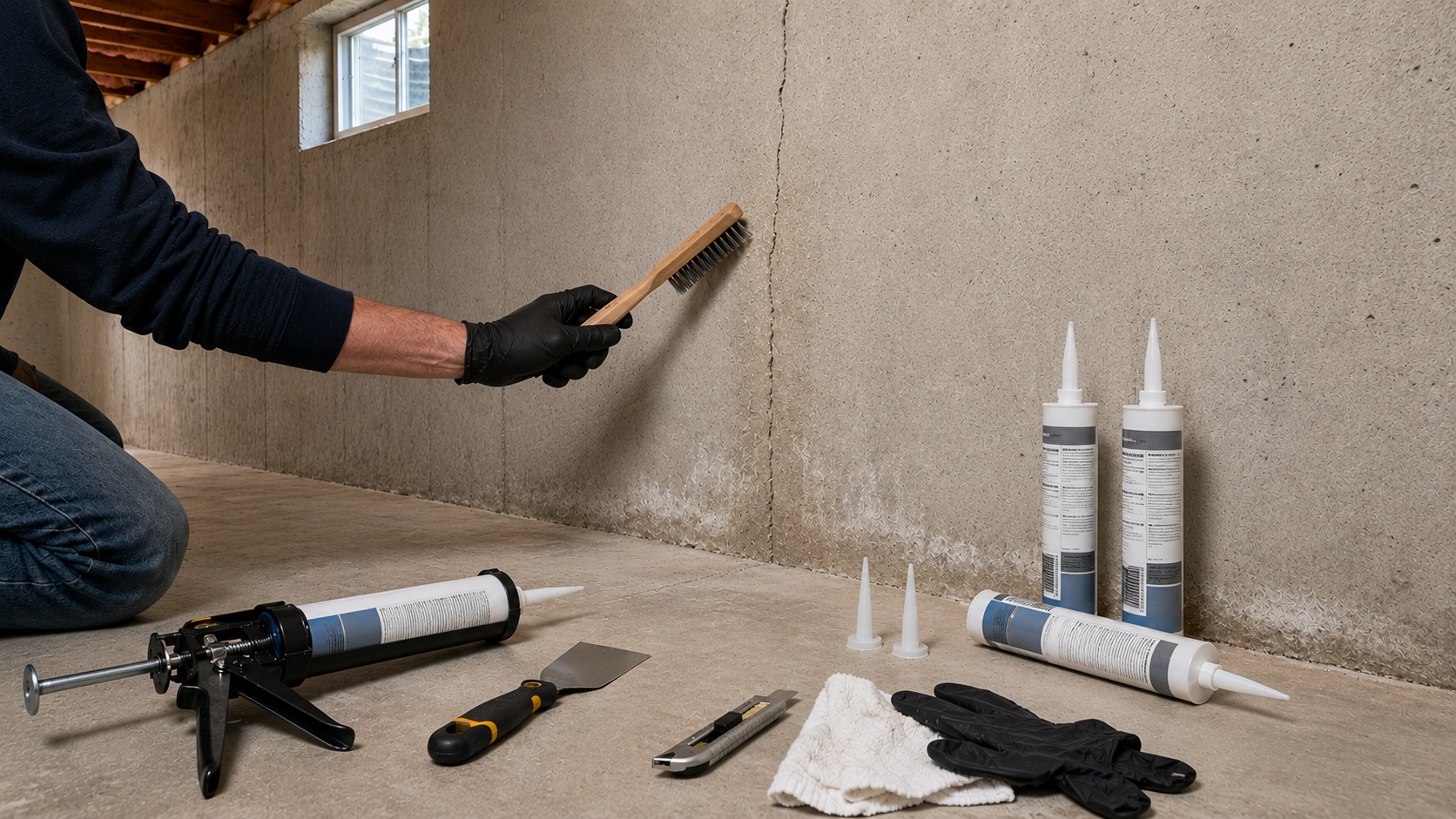
Good crack repair starts before the product is opened. Clean the crack area thoroughly, remove loose concrete, brush away dust, and make sure you understand whether the product requires a dry surface, damp-tolerant application, or special timing. Many failed repairs happen because the product was applied over dirt, paint, wet residue, or loose material.
For injection kits, read the instructions fully before beginning. Lay out all ports, cartridges, nozzles, surface seal material, and tools in advance. Injection products often have working-time limits, so you do not want to stop halfway through to search for a missing part. Work from one end of the crack to the other according to the kit instructions, and avoid rushing the injection process.
For self-leveling sealants, protect the ends of the crack so the product does not flow out where you do not want it. Make sure the surface is actually horizontal enough for a self-leveling product. If the crack slopes toward a drain, step, or open edge, the sealant may run. Backer rod may be needed for deeper joints so you do not waste product filling a deep void.
For non-sag sealants, cut the nozzle to match the crack width and tool the bead as recommended. A neat surface bead is not just cosmetic; it helps the sealant make better contact with both sides of the crack. For patch compounds, apply in appropriate layer thicknesses and allow the repair to cure before exposing it to heavy moisture or traffic.
After repair, monitor the area during the next few rains. Look for damp staining, mineral deposits, new seepage, or moisture returning around the edges of the repair. The article Signs of Water Seepage Through Basement Walls can help you recognize whether the repair area is still showing moisture symptoms.
Foundation Crack Repair Mistakes That Lead to Failed Seals
Using surface patch on an active wall leak
A surface patch may look good for a while, but if water is moving through the crack under pressure, the repair can fail or water may simply find another path. Active basement wall leaks usually need a more appropriate crack injection system or a broader waterproofing solution.
Using self-leveling sealant on a vertical crack
Self-leveling sealant is made to flow. That is helpful on horizontal concrete but frustrating on vertical walls. Use a non-sag sealant or an injection kit for vertical applications.
Ignoring exterior water management
A crack repair product may seal one crack, but it cannot correct overflowing gutters, short downspouts, poor grading, clogged drains, or saturated soil around the foundation. If the same wall keeps getting wet after storms, the crack may only be one visible symptom.
Repairing structural cracks cosmetically
Horizontal foundation cracks, offset cracks, stair-step masonry cracks, or cracks wider than they used to be should not be hidden with patch compound. Those patterns can indicate movement, pressure, or structural stress.
Skipping moisture diagnosis
Before choosing a product, confirm whether the crack is actually the moisture source. Basement moisture can come from condensation, wall seepage, floor seepage, plumbing leaks, drainage failure, or humidity. If the source is unclear, review How to Find, Fix, and Prevent Moisture Problems in Homes for a broader diagnostic framework.
Applying products over dirty or loose concrete
Dust, paint, efflorescence, loose concrete, old failed sealant, and damp debris can weaken adhesion. Preparation is often the difference between a repair that holds and one that peels away.
Assuming one repair means the basement is waterproofed
Repairing a crack is not the same as waterproofing a basement. If you have repeated seepage, musty odors, damp walls, or water on the floor after heavy rain, you may need drainage, grading, sump pump, membrane, or waterproofing system improvements.
Foundation Crack Repair Kit FAQs
What is the best foundation crack repair kit for a leaking basement wall?
For a narrow vertical crack in a poured concrete basement wall, a polyurethane injection kit such as the RadonSeal Complete DIY Foundation Crack Repair Kit or Hydra Stop 300 Foundation Crack Repair Kit is usually more appropriate than a surface patch. These products are designed to fill the crack path rather than only cover the visible surface.
Can I use concrete patch to stop a basement wall leak?
Concrete patch can work for shallow surface damage, chips, and stable cosmetic cracks, but it is usually not the best choice for an active basement wall leak. Water moving through a foundation crack may push behind the patch or find another weak point.
Should I use epoxy or polyurethane for foundation cracks?
Polyurethane is often preferred for leaking cracks because it remains more flexible and can seal water pathways. Epoxy is more rigid and is usually better for dry, static cracks where bonding strength matters. If the foundation is moving, neither product should be treated as a substitute for structural repair.
Can Sikaflex Self-Leveling Sealant be used on basement walls?
No. Sikaflex Self-Leveling Sealant is designed for horizontal cracks and joints. It can run on vertical surfaces. For vertical non-structural cracks, use a non-sag sealant such as Sikaflex Concrete Fix, or use a foundation wall injection kit if the crack is leaking through the wall.
Are DIY foundation crack repair kits safe for homeowners?
They can be appropriate for certain non-structural cracks, especially narrow vertical cracks in poured concrete walls. They are not appropriate for bowing walls, horizontal cracks, widening cracks, stair-step cracks, or other signs of foundation movement. When in doubt, get a professional inspection first.
Will repairing a foundation crack prevent mold?
Repairing a crack may reduce one source of moisture, but no crack repair product can guarantee mold prevention. Mold prevention also depends on humidity control, drying, ventilation, drainage, and stopping all moisture sources. Keep monitoring the repaired area after rain.
How do I know if a crack is structural?
Warning signs include horizontal cracking, stair-step cracking in masonry, widening over time, wall bowing, crack displacement, sloping floors, sticking doors, and recurring water intrusion. These signs deserve more caution than a simple hairline shrinkage crack.
What should I do if water keeps coming back after crack repair?
If moisture returns after repair, the crack may not be the only problem. Look for exterior drainage issues, hydrostatic pressure, wall seepage, floor seepage, failed waterproofing, or plumbing leaks. Repeated moisture usually means the source needs more diagnosis, not just another layer of patch.
Final Recommendations for Foundation Crack Repairs
The best foundation crack repair kit depends on the crack type. For a leaking vertical crack in a poured concrete basement wall, the RadonSeal Complete DIY Foundation Crack Repair Kit is the strongest overall choice because it is built for foundation wall injection. For wet basement wall cracks where expanding polyurethane foam makes sense, the Hydra Stop 300 Foundation Crack Repair Kit is another practical option.
For basement floor cracks, slab joints, and horizontal concrete gaps, choose SIKA Sikaflex Self-Leveling Sealant. For vertical non-structural surface cracks or exterior concrete gaps, SIKA Sikaflex Concrete Fix is the better fit. For shallow surface damage, chips, and stable cosmetic repairs, DAP Ready-Mixed Concrete Patch or Red Devil 0644 Pre-Mixed Concrete Patch may be more practical.
Do not use any DIY product to hide serious foundation movement. A crack repair kit can help with the right crack, but it cannot replace proper drainage, waterproofing, or structural repair when the foundation itself is under stress.