When to Repair vs Replace a Rubber Roof
Deciding whether to repair or replace a rubber roof depends on the condition of the membrane, the seams, the edges, and the materials below the roof surface. A rubber roof can often be repaired when the damage is localized, the membrane is still flexible, and the substrate below is dry. Replacement becomes more likely when seams are separating across the roof, the membrane is shrinking or brittle, leaks keep returning, or moisture has reached insulation or decking below the membrane.
Because rubber roofs are usually used on flat and low-slope areas, small membrane problems can become serious when water sits on the roof, enters through open seams, or travels below the membrane before showing up indoors.
This guide focuses only on rubber roofs. For the broader roof-level decision across all materials, see the guide on how to decide whether to repair or replace a roof. For rubber roofs specifically, the decision depends on membrane condition, seam stability, ponding water, surface wear, previous patches, and whether hidden moisture is already present.
Is the Rubber Membrane Locally Damaged or Failing Across the Roof?
The first step is to decide whether the rubber membrane has one repairable defect or whether the membrane is failing across a larger area.
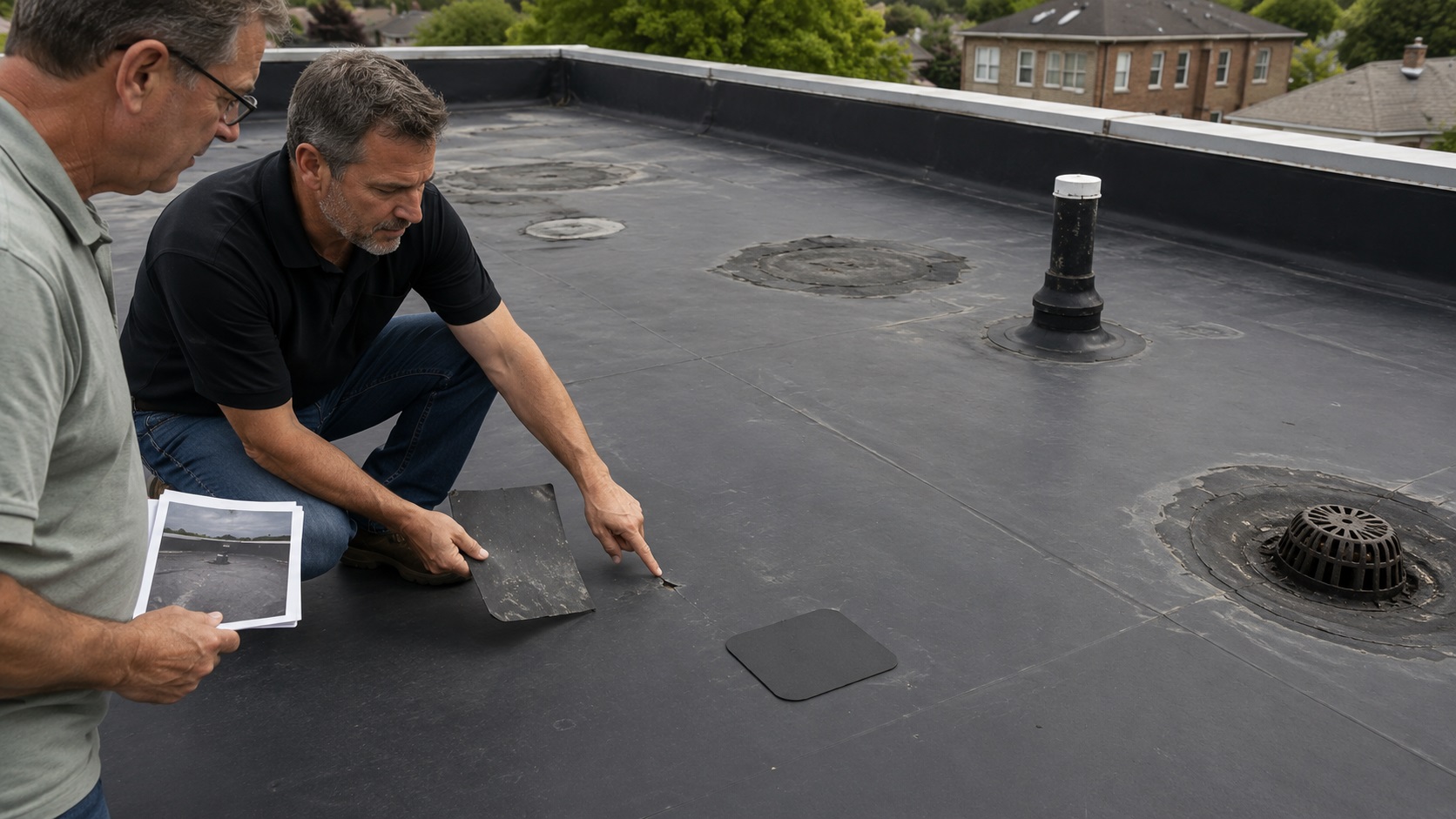
Localized damage usually points toward repair. A small puncture, minor tear, isolated seam opening, loose flashing edge, or one damaged area around a roof penetration may be repairable if the membrane is still flexible and the substrate below is dry. In that situation, the roof may still have useful life left.
Roof-wide membrane failure is different. If several seams are opening, edges are pulling away, the membrane is shrinking, patches keep failing, ponding water is causing soft areas, or the surface is brittle and cracked across large sections, the roof may no longer be a good candidate for repeated small repairs.
Rubber roofs often fail at seams, edges, drains, penetrations, and transition points. Those areas carry more stress than the open field of the membrane. A single seam problem may be repairable. Many seam problems across the same roof can indicate that the membrane, adhesive, flashing, or installation details are aging as a system.
Use this quick test:
- Repair is more likely when the membrane damage is limited, the roof is dry below the surface, and the surrounding membrane is still flexible.
- Replacement is more likely when seams, edges, surface condition, and moisture problems are widespread.
Rubber roofs are part of the broader group of common roofing material failures, but their failure pattern is different from shingles, metal panels, or slate tiles. The decision depends less on individual pieces and more on whether the membrane still works as a continuous waterproof layer.
When Rubber Roof Repair Usually Makes Sense
Rubber roof repair usually makes sense when the damage is limited, the membrane is still usable, and the roof has not absorbed water below the surface.
One common repair-friendly situation is a small puncture or tear. Foot traffic, dropped tools, branches, roof equipment, or sharp debris can damage the membrane. If the tear is isolated and the membrane around it is still flexible and well-adhered, a repair may be enough.
Another repairable situation is a localized seam issue. If one seam has started to open but the rest of the roof is stable, that seam may be corrected. The repair should still address why the seam opened. A seam affected by age, trapped water, poor adhesion, or movement may need more careful evaluation than a simple surface patch.
Flashing and edge problems may also be repairable when they are limited. Rubber roofs often rely on secure edges, wall transitions, drains, scuppers, and penetrations. If one detail has failed but the surrounding membrane is still sound, repair may be practical.
Rubber roof repair is more reasonable when:
- The puncture, tear, seam opening, or flashing problem is limited to one area.
- The membrane is still flexible and not brittle or cracked across the roof.
- The roof has not been patched repeatedly in the same location.
- Seams and edges are generally stable.
- Ponding water is not chronic or has not damaged the substrate.
- The insulation or decking below the membrane is dry.
- The roof still has useful service life left.
A repair should be based on the actual membrane condition, not just the size of the visible leak indoors. Water under a flat or low-slope roof can travel before it appears on a ceiling. A small interior stain may come from a seam, edge, drain, or puncture located away from the stain. That is why rubber roof repairs need a roof-surface inspection, not only an interior guess.
When Rubber Roof Replacement Usually Makes More Sense
Rubber roof replacement usually makes more sense when the membrane problem is no longer limited to one isolated area. A small puncture or one open seam may be repairable, but widespread seam separation, shrinkage, brittle membrane, repeated leaks, wet insulation, or many failed patches point to a larger roof-system problem.
One of the strongest replacement signs is repeated leakage after previous repairs. If the same rubber roof has been patched several times and water keeps returning, the problem may not be one isolated hole. The membrane may be aging, seams may be failing, water may be trapped below the surface, or drainage may be stressing the same weak areas repeatedly.
Membrane shrinkage is another serious concern. As a rubber roof ages, the membrane may pull away from edges, walls, drains, penetrations, or flashing details. When that happens, seams and transitions can be stressed. A small area of pulling may be repairable, but widespread shrinkage often makes patching less reliable.
Surface deterioration also affects the decision. A rubber membrane that is still flexible may accept repairs more reliably. A membrane that is brittle, cracked, chalky, split, or deteriorated across large areas may not provide a stable surface for long-term repair. If the membrane itself is breaking down, patching one spot will not restore the rest of the roof.
Replacement deserves serious consideration when:
- Seams are opening in several areas.
- The membrane is shrinking or pulling away from edges and penetrations.
- The surface is brittle, cracked, split, or deteriorated across large sections.
- Patches keep failing or leaks return after repairs.
- Ponding water has created soft areas or recurring leaks.
- Insulation or decking below the membrane is wet.
- The roof has reached the end of its expected service life.
- Repair cost is high compared with remaining membrane life.
If several of these problems are present, the roof may also match broader signs a roof needs replacement. A rubber roof does not need replacement for every small puncture, but widespread membrane failure should not be treated as a patch-only problem.
How Seam Separation Affects the Decision
Seam separation is one of the most important repair-or-replace factors on a rubber roof. Rubber roofs depend on continuous membrane coverage, and seams are among the most vulnerable points in that system. When a seam opens, water can enter below the membrane and travel before it appears indoors.
Isolated seam separation may be repairable. If one seam has opened because of a localized adhesion problem, minor movement, or damage in one area, a contractor may be able to repair the seam and restore the waterproof layer. This is more likely when the surrounding membrane is flexible, cleanable, and well-adhered.
Widespread seam failure is more serious. If several seams are opening, previous seam repairs have failed, or seams are separating near edges, drains, or penetrations, the problem may involve membrane age, shrinkage, poor installation, trapped moisture, or roof movement. In that situation, repairing one seam at a time may become a cycle of recurring leaks.
Seams near roof edges and flashing transitions deserve special attention. The membrane may be pulled by shrinkage, wind uplift, thermal movement, or poor attachment. If the membrane is pulling away from walls, parapets, drains, or edge metal, the issue may be larger than one open seam.
Also look for dirt lines, loose seam tape, lifted laps, bubbling beside the seam, or water stains that follow a seam line rather than a single puncture.
When evaluating seam separation, ask:
- Is only one seam open, or are several seams separating?
- Is the membrane shrinking or pulling away from edges?
- Has this seam been repaired before?
- Is water trapped below the membrane?
- Are nearby seams still adhered and stable?
- Is the roof surface dry and structurally sound below the seam?
Seam separation does not automatically mean full replacement. But when seam failure is widespread or connected to membrane shrinkage, wet insulation, or repeated leaks, replacement becomes much more likely.
How Punctures, Tears, and Surface Damage Affect Repair
Punctures and tears are often repairable when they are small, isolated, and caught early. Rubber membranes can be damaged by foot traffic, falling branches, tools, HVAC work, sharp debris, or roof-mounted equipment. If the surrounding membrane is still flexible and dry below the surface, a patch may be enough.
The size and shape of the damage matter. A small puncture is usually easier to repair than a long tear, jagged opening, or damaged area near a seam or flashing transition. Damage near roof edges, drains, penetrations, or previous patches may be more complicated because those areas already experience more movement and water stress.
A puncture in the open field of the membrane is usually simpler than damage beside a drain, curb, skylight, wall transition, or old patch.
Surface condition matters just as much as the puncture itself. A patch depends on the surrounding membrane being stable enough to hold the repair. If the membrane is brittle, dirty, wet, shrinking, cracked, or deteriorated, a patch may not bond reliably or may fail soon after installation.
Old patchwork should also be evaluated carefully. One past patch does not mean the roof is failing. But many patches across a rubber roof can show a pattern of recurring problems. If patches are lifting, cracking, or leaking, the roof may be losing its ability to hold repairs.
Punctures, tears, and surface damage point more strongly toward replacement when:
- Damage appears in multiple areas.
- The membrane tears easily or feels brittle.
- Several old patches are failing.
- The damage is near failing seams or edges.
- Water has reached insulation or decking below the membrane.
- The surface is broadly cracked, split, or deteriorated.
A rubber roof patch is only as reliable as the membrane around it. If the membrane still has strength and flexibility, repair may work well. If the membrane is deteriorating across the roof, patching one hole may only delay replacement.
How Ponding Water Changes the Repair vs Replacement Decision
Ponding water is especially important on rubber roofs because flat and low-slope roofs do not drain the same way steep roofs do. A small amount of temporary water after rain may not mean the roof needs replacement, but water that remains for long periods can stress seams, patches, flashing, and low areas of the membrane.
Chronic ponding can make repairs less reliable. If water repeatedly sits over the same seam, patch, drain area, or low section, that area may deteriorate faster than the rest of the roof. Even a good repair can fail sooner if the underlying drainage problem is not corrected.
Ponding also increases the risk of hidden moisture below the membrane. Water may enter through a small seam opening, puncture, or edge gap, then spread below the roof surface before it appears indoors. On a flat roof, the ceiling stain may not be directly below the leak point.
Ponding water does not automatically mean the rubber roof must be replaced. If the membrane is still sound and the drainage issue is limited, repair or drainage correction may be possible. But if ponding has caused soft spots, recurring leaks, wet insulation, or membrane deterioration, replacement becomes more reasonable.
When evaluating ponding water, ask:
- Does water remain on the roof long after rain stops?
- Is the ponding concentrated near seams, drains, edges, or old patches?
- Are there soft spots under the membrane?
- Has the same area leaked more than once?
- Are drains, scuppers, or gutters blocked or poorly placed?
- Is the membrane deteriorating where water sits?
This is one reason low-slope roofs need a different decision process from steep roofs. A rubber roof repair should not only close the visible opening; it should also account for how water moves, where water sits, and whether drainage problems are stressing the same weak area repeatedly.
How Roof Age and Membrane Condition Affect the Decision
Age matters on a rubber roof because the membrane changes over time. A newer rubber membrane with one puncture or isolated seam issue is usually a better repair candidate than an older membrane that has become brittle, cracked, shrinking, or difficult to bond to.
On a newer rubber roof, repair is often the first option to consider when the damage is localized. A small tear, puncture, seam opening, or flashing issue may be repairable if the membrane is still flexible and the substrate below is dry. Full replacement may be unnecessary unless there is poor installation, severe damage, or widespread water intrusion.
On a mid-life rubber roof, the decision depends on condition. If the membrane remains flexible, seams are stable, and leaks are limited, repair may still make sense. But if there are several patches, recurring seam issues, ponding problems, and early surface deterioration, the homeowner should consider whether continued repair is only delaying replacement.
On an older rubber roof, replacement becomes more likely when the membrane no longer accepts repairs reliably. A brittle or shrinking membrane may not hold patches well. If the roof has many old repairs, open seams, cracked surface areas, or repeated leaks, the cost of continued patching may be hard to justify.
Membrane condition is more important than age by itself. A rubber roof that has been maintained, protected from unnecessary foot traffic, and drained well may remain repairable longer than a roof exposed to chronic ponding, debris, poor installation, or repeated patching. For age context, compare the roof’s condition with realistic expectations for how long rubber roofs usually last.
The most important age-related question is not simply, “How old is the rubber roof?” It is, “Is the membrane still flexible, stable, dry below the surface, and strong enough for a repair to last?” If the answer is yes, repair may be reasonable. If the answer is no, replacement may be the better long-term choice.
How Moisture Below a Rubber Roof Changes the Decision
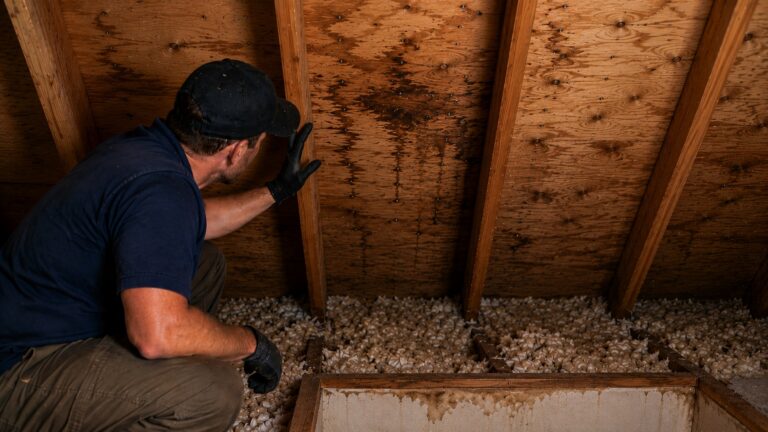
Moisture below a rubber roof can turn a surface patch into a larger replacement decision. A puncture, open seam, or flashing leak may look small from above, but water can spread through insulation or along the deck before it appears inside the building.
If the leak is caught early and the insulation or substrate below the membrane is dry, a focused repair may be enough. But if the roof feels soft, insulation is wet, ceiling stains keep returning, or water is trapped below the membrane, the damage may be larger than the visible surface opening.
Signs that moisture may be below a rubber roof include:
- Soft or spongy areas under the membrane
- Recurring ceiling stains after rain
- Damp insulation below the roof system
- Musty odors near the roof or ceiling area
- Blisters, bubbles, or raised membrane areas
- Water appearing indoors away from the visible roof damage
- Leaks that return after patching
These signs do not automatically mean the entire roof must be replaced. A localized wet area may sometimes be opened, dried, repaired, or partially replaced. But widespread wet insulation or a soft substrate usually makes surface patching unreliable. The repair may stop one leak while leaving trapped moisture below the roof.
This is also why coating should be used carefully. A coating may extend the life of a rubber roof when the membrane is sound, dry, compatible with the coating, and properly prepared. It should not be used to cover open seams, trapped moisture, wet insulation, or a failing substrate. Coating over hidden moisture can make the roof look improved while the underlying problem continues.
When water has entered below the membrane, the goal is not only to stop the next leak. The goal is to prevent recurring damage to insulation, decking, ceilings, and interior materials. That decision fits into the larger process of how to find, fix, and prevent moisture problems in a home.
A rubber roof repair is strongest when the membrane is sound and the materials below it are dry. Replacement becomes more logical when water has already affected insulation, decking, or other materials below the membrane.
Questions to Ask Before Repairing a Rubber Roof
Before approving a rubber roof repair, ask questions that show whether the repair will solve the real problem or only cover the most visible damage. Rubber roof repairs can work well when the membrane is still sound, but they become less reliable when seams, drainage, surface condition, or hidden moisture problems are widespread.
Start with the condition of the membrane. A small puncture on a flexible, dry, well-adhered membrane is very different from a tear in a brittle roof that has several old patches and recurring leaks. The repair should be judged by the condition of the roof system, not only the size of the visible opening.
Ask these questions before approving the repair:
- Is the damage limited to one puncture, tear, seam, or flashing area?
- Is the membrane still flexible, or is it brittle and cracked?
- Are seams and edges stable across the rest of the roof?
- Is the membrane shrinking or pulling away from edges, walls, drains, or penetrations?
- Is ponding water contributing to the problem?
- Are the insulation and roof deck below the membrane dry?
- Has this area been patched before?
- Are old patches still bonded and watertight?
- Would coating solve the real issue, or would it only cover visible wear?
- Would the repair still make sense if replacement is likely soon?
These questions help separate a practical repair from a short-term patch. A small membrane repair may be a good investment if the surrounding roof is sound. The same repair may be a poor investment if the roof has widespread seam separation, trapped moisture, chronic ponding, or a membrane that no longer bonds reliably.
Cost should also be viewed in context. A small repair on a rubber roof with useful life left can be reasonable, while a large repair on an old, wet, repeatedly patched roof should be compared with replacement. If you are reviewing estimates, it can help to understand typical roof leak repair cost factors before deciding whether the work is still a repair or has become a larger roof decision.
When to Call a Roofing Contractor
You should call a roofing contractor when a rubber roof has repeated leaks, ponding water, open seams, membrane shrinkage, soft spots, or signs of wet insulation. Flat and low-slope roofs can be difficult to evaluate from the ground because water may travel below the membrane before it appears indoors. Do not walk on a wet, soft, icy, steep, or unsafe roof surface to inspect it yourself.
A contractor inspection is especially important if previous patches have failed. Repeated patching may mean the original repair did not address the full leak path, the membrane is no longer stable, or water is trapped below the roof surface. A good inspection should identify whether the problem is isolated, whether the membrane is still repairable, and whether the substrate below the roof is dry.
Professional help is also important when the roof has drainage problems. Ponding water can place repeated stress on seams, patches, drains, and low areas. A repair that does not address drainage may fail even if the patch itself was applied correctly.
A good rubber roof inspection should evaluate membrane flexibility, seams, edges, flashings, drains, scuppers, ponding areas, old patches, surface deterioration, and signs of wet insulation or soft decking. The contractor should be able to explain whether the roof needs a patch, seam repair, partial replacement, coating, drainage correction, or full replacement.
If water has already affected insulation, decking, or interior ceilings, review guidance on when to hire a roofing contractor for moisture problems. If you are comparing repair scopes, warranties, or replacement recommendations, it also helps to know how to choose a roofing contractor for leak repairs.
FAQ: Repairing or Replacing a Rubber Roof
Can a rubber roof be patched?
Yes, a rubber roof can often be patched if the damage is localized, the membrane is still flexible, and the substrate below is dry. Patching is less reliable when the membrane is brittle, shrinking, wet underneath, dirty, deteriorated, or failing across several areas.
Does seam separation mean a rubber roof needs replacement?
Not always. One isolated seam opening may be repairable if the surrounding membrane is stable and dry. Widespread seam separation, repeated seam leaks, membrane shrinkage, or wet insulation below the seams may point toward partial replacement or full roof replacement.
Is ponding water on a rubber roof always a replacement issue?
No. Temporary ponding does not always mean replacement is needed. Chronic ponding is more serious because it can stress seams, patches, flashing, and low areas. If ponding has caused soft spots, wet insulation, or recurring leaks, replacement or drainage correction may be needed.
Can coating fix an old rubber roof?
Sometimes, but only when the membrane is still sound, dry, compatible with the coating, and properly prepared. Coating should not be used to hide open seams, wet insulation, membrane shrinkage, soft decking, or serious surface deterioration. A coating may extend service life, but it does not rebuild a failing roof system.
How do I know if moisture is under a rubber roof?
Possible signs include soft or spongy roof areas, recurring ceiling stains, damp insulation, musty odors, raised membrane areas, blisters, or leaks that return after patching. Moisture under a rubber roof can spread away from the original entry point, so inspection may be needed.
Should I replace a rubber roof if it leaks once?
Not automatically. One leak may come from a repairable puncture, seam, flashing detail, drain area, or edge problem. Replacement becomes more likely when leaks repeat, the membrane is brittle or shrinking, seams are failing widely, or moisture has reached the insulation or deck below.
Final Decision: Repair the Defect or Replace the Failing Roof System
A rubber roof should usually be repaired when the damage is localized, the membrane is still flexible, seams and edges are mostly stable, and the materials below the roof are dry. Replacement becomes more reasonable when seam separation, shrinkage, surface deterioration, ponding damage, recurring leaks, wet insulation, or soft decking are present.
The most important distinction is whether the roof has one repairable defect or whether the membrane is failing as a continuous waterproof layer. A roof with many failed seams, old patches, chronic ponding, and hidden moisture may not be worth continued patching.
Before spending money on repairs, compare the repair scope with the remaining life of the membrane. A good rubber roof repair should solve a specific problem and leave the surrounding roof reliable. If the repair only adds another patch to a rubber roof that keeps leaking, replacement may be the smarter long-term decision.