
Types of Roofing Materials Explained: How Each Option Handles Moisture, Lifespan, and Roof Damage
Roofing materials are not just an appearance choice. The material on your roof affects how water drains, how long the roof may last, how much maintenance it needs, how it responds to wind and impact, and how easily leaks can develop when the system ages or is installed poorly.
Most homeowners first think about color, cost, and lifespan. Those matter, but the roof material also has to match the roof slope, climate, structural load capacity, ventilation conditions, underlayment system, flashing details, and long-term moisture exposure. A roof that performs well in one home may be a poor fit for another if the design or environment is different.
This guide explains the major types of residential roofing materials and how each one generally behaves. It is meant to help you understand the options before moving into a more specific selection guide, comparison article, or contractor discussion.
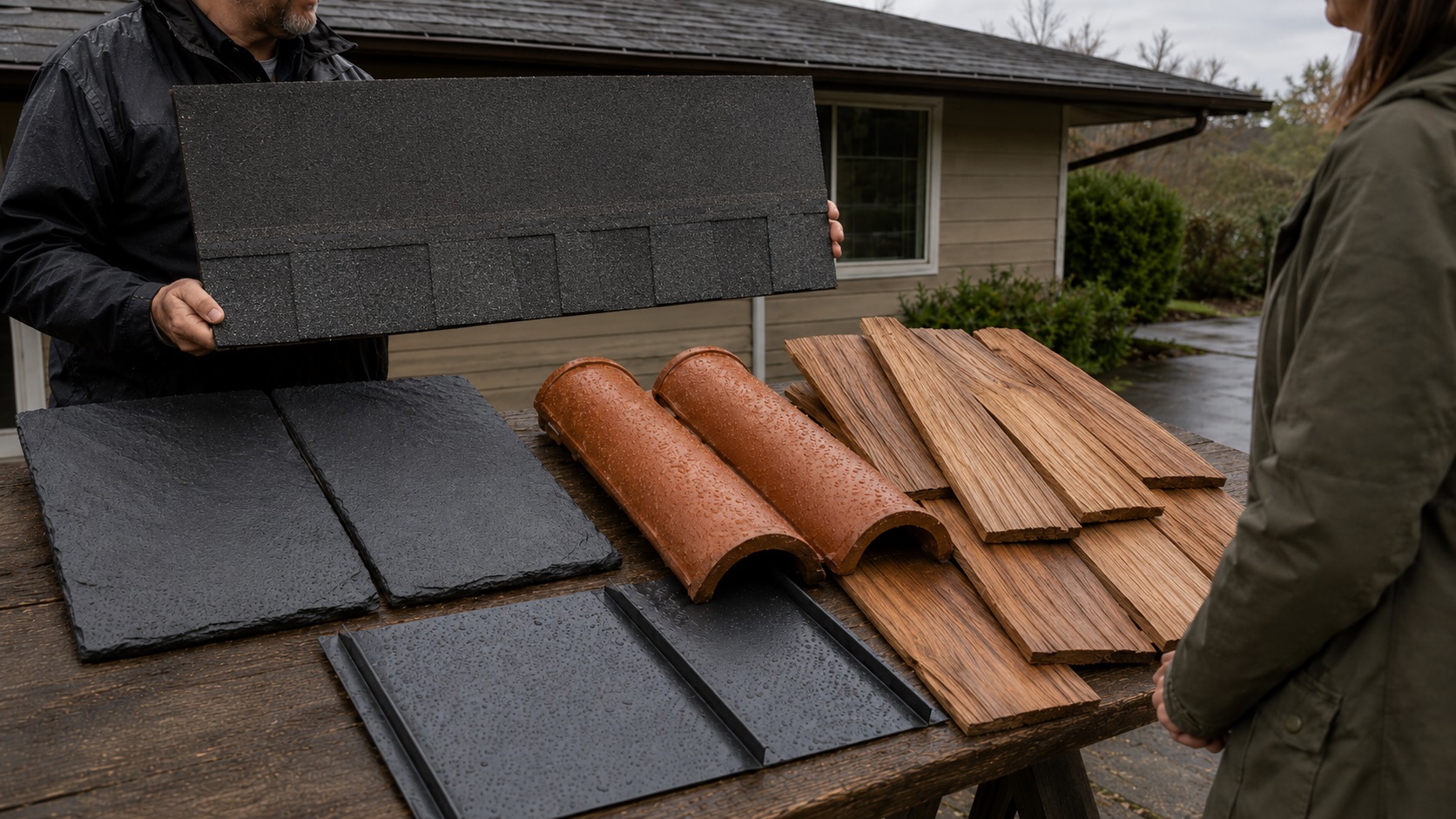
In simple terms, asphalt shingles are common and repairable for pitched roofs, metal sheds water efficiently when seams and fasteners are detailed well, membrane roofing is usually the better fit for low-slope sections, tile and slate can last a long time when the structure is right, cedar shake needs excellent drying conditions, and synthetic roofing varies widely by product quality.
Why Roofing Material Type Matters
Every roof material has one basic job: help move water off the home before it enters the structure. But different roofing materials do that job in different ways. Some rely on overlapping layers that shed water downward. Others use panels, seams, coatings, or membranes to create a more continuous water-shedding surface.
Roofing material type affects:
- How quickly water drains from the roof
- Which roof slopes the material can handle
- How much weight the roof structure must support
- How the roof responds to heat, sun, wind, hail, and freeze-thaw cycles
- How easily individual pieces can be repaired or replaced
- How much maintenance the roof may need over time
- How vulnerable the system is to flashing, underlayment, seam, or fastener problems
This is why roofing material failures are usually system failures, not just surface failures. A roof leak may involve the main roofing material, but it may also involve flashing, valleys, penetrations, underlayment, fasteners, roof slope, attic ventilation, or installation quality. For a broader look at how roof materials fail over time, see most common roofing material failures.
Roof material helps keep exterior water out, but attic ventilation, insulation, flashing, drainage, and interior humidity can all affect roof performance. That is why roof decisions should fit into the larger process of finding, fixing, and preventing moisture problems in homes.
Asphalt Shingles
Asphalt shingles are one of the most common residential roofing materials because they are widely available, familiar to contractors, relatively affordable, and suitable for many steep-slope homes. They are installed in overlapping rows so water sheds from one shingle course to the next and drains down the roof.
Asphalt shingles are not a waterproof membrane by themselves. They are part of a water-shedding system that depends on roof slope, underlayment, flashing, proper nailing, starter strips, drip edges, ridge caps, and ventilation. When the system is installed correctly and maintained reasonably, asphalt shingles can be a practical roof covering for many homes.
3-tab asphalt shingles
3-tab shingles are the traditional flat asphalt shingle style. They have a uniform, thinner appearance and are usually less expensive than architectural shingles. They can work on suitable steep-slope roofs, but they typically have a shorter service life and less dimensional strength than heavier laminated shingles.
Common age-related issues include granule loss, curling edges, cracked tabs, lifted tabs, missing shingles, and wear around valleys, eaves, and high-exposure slopes. Wind and installation quality can also affect performance. If 3-tab shingles are nailed incorrectly or installed on a poorly prepared roof deck, they may become more vulnerable to lifting and leakage.
Architectural asphalt shingles
Architectural shingles, also called dimensional or laminated shingles, are thicker than standard 3-tab shingles and have a more textured appearance. They are often chosen because they look more substantial and may provide better durability than basic 3-tab shingles.
They still depend on the same roofing system principles: proper slope, underlayment, flashing, ventilation, and installation. A higher-grade asphalt shingle can still leak if valleys are poorly detailed, flashing is incorrect, nails are misplaced, or the roof deck is damaged. For a focused comparison, see architectural shingles vs 3-tab shingles.
How asphalt shingles handle moisture
Asphalt shingles shed water well when the roof is steep enough, the shingles overlap correctly, and the roof details are properly installed. Problems often develop when shingles age, lose granules, crack, lift, or allow wind-driven rain to reach vulnerable edges. Moss, debris, poor attic ventilation, and repeated heat exposure can also shorten service life.
Asphalt shingles are usually a good fit for homeowners who want a common, repairable, cost-conscious roofing material for a standard pitched roof. They are not usually the right material for flat or very low-slope roof areas, where water drains too slowly for normal shingle performance.
Metal Roofing
Metal roofing is a broad category that includes several systems with different moisture behavior, maintenance needs, and installation details. The two residential types homeowners most often compare are standing seam metal roofing and corrugated or exposed-fastener metal roofing.
Metal roofs can shed water very effectively because panels often run in long vertical sections from the ridge toward the eave. When the panel layout, seams, fasteners, coatings, flashing, and roof slope are appropriate, metal roofing can be a durable option in many climates.
Metal roofing is not automatically leak-proof. Panel seams, penetrations, fasteners, trim details, expansion and contraction, and coating wear all affect long-term performance. A poorly installed metal roof can leak even if the material itself is strong.
Standing seam metal roofing
Standing seam metal roofs use raised seams that connect panels while keeping many fasteners concealed. This design can reduce exposed fastener points on the main roof surface, which is one reason standing seam systems are often viewed as a premium metal roofing option.
Because the seams are raised above the flat panel surface, standing seam roofs can be strong water-shedding systems when installed correctly. They are commonly used on homes where the owner wants a long-lasting roof with clean lines and fewer exposed fastener maintenance points.
Corrugated and exposed-fastener metal roofing
Corrugated metal and exposed-fastener panels are also common, especially on outbuildings, porches, rural homes, and some residential roofs. These panels can perform well when properly installed, but the exposed fasteners are an important maintenance point.
Fastener washers can age, shrink, loosen, or become damaged over time. When that happens, water can enter at fastener points. This does not mean exposed-fastener metal is always a poor choice. It means the homeowner should understand that the maintenance profile is different from standing seam metal. For a focused comparison, see standing seam metal vs corrugated metal roofing.
How metal roofing handles moisture
Metal roofing generally performs well at shedding rain and snow when the roof is designed for it. The main moisture concerns are usually not the metal panel itself, but the details around seams, fasteners, flashing, valleys, penetrations, and edges. Condensation can also become a concern if attic ventilation, insulation, or underlayment details are wrong.
Metal is often compared with asphalt because both are common options for pitched roofs, but they behave differently in cost, lifespan, noise perception, repair approach, and installation details. For a dedicated comparison, see metal roof vs asphalt shingles.
Rubber and Membrane Roofing
Rubber and membrane roofing materials are commonly used on flat and low-slope roof areas where typical steep-slope shingles are not the best fit. These systems are designed to handle slower drainage and create a more continuous barrier across the roof surface.
Common membrane roofing materials include EPDM, TPO, PVC, and modified bitumen. Homeowners may hear these terms when dealing with low-slope additions, porch roofs, dormers, garages, commercial-style roof sections, or flat roof areas on modern homes.
EPDM roofing
EPDM is a synthetic rubber roofing membrane. It is often used on flat and low-slope roofs because it can cover broad areas with fewer individual pieces than a shingle system. Its performance depends heavily on seam quality, edge details, flashing, drainage, and protection from punctures.
EPDM can be practical for low-slope roof sections, but it should not be treated as a maintenance-free surface. Seams, penetrations, ponding areas, and edges should be inspected because those are common places for leaks to develop.
TPO, PVC, and modified bitumen
TPO and PVC are single-ply membrane systems often used on low-slope roofs. Modified bitumen is another low-slope roofing option that may be installed in rolls or layers depending on the system. Each material has different installation methods, seam requirements, and performance characteristics.
For homeowners, the main point is that these materials are chosen because low-slope roofs need a different water-management strategy than steep-slope shingle roofs. Water drains more slowly on low-slope surfaces, so seams, edges, flashing, and drainage become especially important.
How membrane roofing handles moisture
Membrane roofing is designed to resist water across a more continuous surface, but it can fail at seams, punctures, penetrations, flashing transitions, and areas where water ponds. Debris buildup and poor drainage can increase stress on the system. Because flat and low-slope roofs do not shed water as quickly as steep roofs, small defects can become more important.
Rubber or membrane roofing is often compared with shingles when homeowners have a roof section that is not steep enough for a typical shingle system. For that specific decision, see rubber roof vs asphalt shingles.
Flat and Low-Slope Roof Sections
Flat and low-slope roof sections need a different water-control strategy than standard pitched roofs. Water drains more slowly, so seams, penetrations, edges, drains, scuppers, and transitions become more important than they are on many steep-slope roofs.
This is why ordinary asphalt shingles are usually not the right solution for flat roof areas. Shingles are water-shedding materials, not continuous waterproof membranes. When the slope is too low, wind-driven rain or slow drainage can push water into places shingles were not designed to protect.
If your home has both steep-slope and low-slope roof sections, it may need more than one roofing material. A main pitched roof may use shingles or metal, while a porch, addition, or low-slope section may need a membrane system designed for slower drainage.
Clay and Concrete Tile Roofing
Clay and concrete tile roofs are known for their distinctive appearance, long service potential, and strong water-shedding design. They are common in warmer climates and in homes with architectural styles that support the weight and profile of tile roofing.
Tile roofs work by shedding water over overlapping pieces. The tiles themselves can be durable, but the full roof system depends on more than the visible tile. Underlayment, flashing, battens, fasteners, roof slope, and structural support all affect performance.
Clay tile roofing
Clay tile is made from fired clay and is often associated with Spanish, Mediterranean, and Southwestern-style homes. It can resist sun exposure well and may last a long time when the roof structure and underlayment system are appropriate.
The main limitations are weight, cost, breakage risk, and repair complexity. Clay tiles can crack from impact or improper foot traffic. When tiles break or shift, water can reach the underlayment. The tile may be the visible roof surface, but the underlayment is still critical for preventing leaks.
Concrete tile roofing
Concrete tile is usually heavier than many other roofing materials and can be shaped to resemble clay tile, slate, or other profiles. It can be durable, but it also requires a roof structure designed to support the load.
Concrete tiles can absorb some moisture at the surface, weather over time, and crack under impact. Like clay tile, concrete tile depends heavily on underlayment and flashing. A tile roof may look intact from the ground while the underlayment beneath it is aging.
How tile roofing handles moisture
Tile roofs can shed water effectively on appropriate roof slopes, but they should not be misunderstood as simple waterproof shells. Water can get under individual tiles during wind-driven rain, breakage, or poor installation. The underlayment and flashing system must be able to manage that water.
Tile roofing is often chosen for durability and appearance, but it is not the right fit for every roof structure. If a homeowner is comparing tile against more common shingle options, clay tile roof vs asphalt shingles is the better place for a direct comparison.
Slate Roofing
Slate is a natural stone roofing material known for very long lifespan potential and a premium appearance. A properly installed slate roof can be one of the longest-lasting residential roof systems, but it is also one of the most demanding in terms of structure, installation skill, and repair expertise.
Slate is heavy, so the roof framing must be able to support it. It is also brittle under certain types of impact or improper foot traffic. A slate roof should not be treated like a standard shingle roof during inspection or repair because individual pieces can crack if walked on incorrectly.
How slate roofing handles moisture
Slate pieces shed water well when properly overlapped on an appropriate roof slope. Like tile, slate is part of a roof system that also depends on underlayment, flashing, fasteners, valleys, penetrations, and roof deck condition. A slate roof can still leak if flashing fails, underlayment ages, pieces crack, or repairs are done incorrectly.
Slate is usually best suited for homeowners who want a premium, long-lasting material and have a structure that can support it. It is not usually chosen for low-budget projects or roofs that may need frequent walking, simple DIY repair, or easy material replacement.
For homeowners comparing premium stone roofing with a standard shingle roof, see slate roof vs asphalt shingles.
Cedar Shake and Wood Roofing
Cedar shake and wood roofing create a natural appearance that is very different from asphalt, metal, tile, or slate. Wood roofing can shed water when properly installed, but it also behaves differently because wood is an organic material that expands, contracts, weathers, and responds to moisture.
Cedar shakes are thicker and more textured than many wood shingles. They can offer strong curb appeal, but they require careful installation, ventilation, and maintenance. In damp or shaded environments, wood roofing may be more vulnerable to moss, algae, rot, splitting, cupping, or moisture retention.
How wood roofing handles moisture
Wood roofing depends on the ability to shed water and dry between wetting events. If debris, shade, poor ventilation, or constant moisture prevents drying, the roof can deteriorate faster. This makes maintenance and climate suitability especially important.
Wood roofing may not be ideal in every fire-risk zone or moisture-heavy environment. Local requirements, fire ratings, treatment options, and maintenance expectations should be discussed with a qualified roofer before choosing it.
For a direct homeowner comparison, see cedar shake roof vs asphalt shingles.
Synthetic and Composite Roofing
Synthetic and composite roofing materials are designed to imitate the appearance of materials such as slate, cedar shake, or tile while reducing some of the weight, cost, or fragility concerns. These products vary widely, so performance depends heavily on the specific material, manufacturer, installation system, and roof design.
Some synthetic roofing products are designed for impact resistance, lighter structural loads, or easier installation compared with natural slate or tile. Others focus mainly on appearance. Because this category includes many different products, homeowners should avoid assuming all synthetic roofs perform the same way.
How synthetic roofing handles moisture
Synthetic roofing can shed water effectively when designed and installed as a complete roof system. As with other materials, the weak points are usually not just the visible surface. Flashing, underlayment, fasteners, penetrations, roof slope, and installation quality still matter.
Synthetic materials can be useful when a homeowner wants the look of slate, shake, or tile without the same weight or maintenance profile. But product quality and warranty terms should be evaluated carefully, especially in climates with hail, high heat, heavy rain, freeze-thaw cycles, or strong sun exposure.
Roofing Material Lifespan Comparison
Roofing material lifespan depends on more than the material name. Product quality, roof slope, installation quality, underlayment, flashing, ventilation, sun exposure, storm exposure, tree coverage, maintenance, and attic moisture conditions all affect how long a roof performs.
For that reason, lifespan ranges should be treated as general expectations, not guarantees. A premium material can fail early if it is installed poorly or used on the wrong roof. A basic material can perform well when the slope, ventilation, flashing, and maintenance are right.
As a general pattern, basic asphalt shingles tend to be the shorter-life option, architectural shingles and membrane systems sit in the middle depending on conditions, and metal, tile, and slate can last much longer when the roof structure and installation details are right.
| Roofing material | Best fit | Main moisture concern | Lifespan note |
|---|---|---|---|
| 3-tab asphalt shingles | Budget-conscious pitched roofs | Granule loss, curling, lifting, and wind-driven rain at worn edges | Usually the shorter-life asphalt option |
| Architectural asphalt shingles | Standard pitched roofs needing better durability than 3-tab | Valley, flashing, nail, and ventilation problems can still cause leaks | Often longer-lasting than basic 3-tab shingles |
| Metal roofing | Pitched roofs where long panels and efficient shedding make sense | Seams, fasteners, coating wear, flashing, and condensation details | Can be long-lasting when details are maintained |
| Rubber and membrane roofing | Flat and low-slope roof sections | Seams, punctures, ponding water, penetrations, and edge details | Depends heavily on drainage and seam condition |
| Clay and concrete tile | Homes built to support tile weight and profile | Cracked tiles, aging underlayment, flashing, and structural load | Can last a long time when the system beneath the tile is maintained |
| Slate roofing | Premium roofs with adequate structural support | Cracked pieces, flashing failure, underlayment aging, and repair errors | Very long lifespan potential with skilled installation |
| Cedar shake roofing | Homes where appearance and maintenance commitment fit the climate | Moisture retention, moss, rot, splitting, and poor drying conditions | Highly dependent on climate, ventilation, and maintenance |
| Synthetic and composite roofing | Homes wanting the look of slate, shake, or tile with different weight or cost | Product quality, installation details, flashing, and warranty limitations | Varies widely by product and manufacturer |
Weather exposure can shorten or extend roof performance depending on the material. Heat, UV exposure, freeze-thaw cycles, hail, high winds, heavy rain, and trapped moisture all affect lifespan differently. For a deeper look at environmental wear, see how weather affects roof lifespan.
Which Roofing Materials Handle Moisture Best?
No roofing material should be judged only by whether it is “waterproof.” Most steep-slope roofing materials are designed to shed water, not hold standing water. Moisture performance depends on the whole system: slope, overlap, underlayment, flashing, valleys, ventilation, drainage, and installation quality.
Asphalt shingles can handle moisture well on standard pitched roofs when they are properly installed and maintained. Metal roofing can shed water efficiently, but seams, fasteners, and penetrations must be detailed correctly. Tile and slate can shed water for a long time, but underlayment and flashing remain critical. Cedar shake needs the ability to dry between wetting events. Membrane roofs are designed for low-slope conditions, but seams and ponding areas need attention.
In wet climates, the best roof material is usually the one that fits the roof slope, drains well, resists repeated moisture exposure, and can be maintained without trapping water. The material alone does not solve poor drainage, bad flashing, clogged valleys, attic condensation, or installation mistakes. For a fuller climate-based comparison, see best roofing materials for wet climates.
How to Use This Guide Before Choosing a Roof
This guide gives you the broad material categories. The next step is to match the realistic options to your actual home. Roof pitch, climate, structural capacity, budget, neighborhood requirements, maintenance expectations, contractor skill, and how long you plan to stay in the home all affect that decision.
Before choosing a roofing material, ask:
- Is my roof steep-slope, low-slope, or a combination of both?
- Can my roof structure support heavier materials like tile or slate?
- Does my climate create heavy rain, snow, hail, heat, humidity, or freeze-thaw exposure?
- How much maintenance am I willing to handle?
- Are there roof valleys, skylights, chimneys, vents, or wall transitions that make flashing more important?
- Will this material work with my attic ventilation and moisture-control needs?
- Do local rules, fire ratings, or neighborhood guidelines limit my options?
If you are ready to move from learning the material types to choosing among them, use how to choose the right roofing material for your home as the next step.
When to Talk to a Roofing Contractor
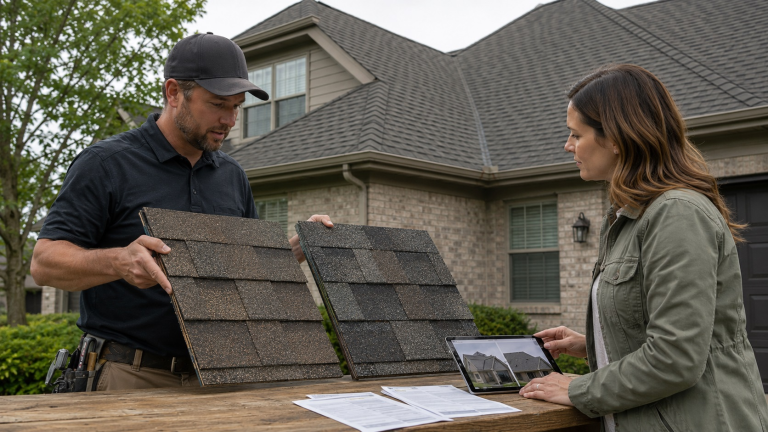
A roofing contractor can help determine whether a material is appropriate for your roof design. This is especially important if you are changing from a lighter material to a heavier one, replacing shingles with metal, adding a membrane to a low-slope area, or considering tile, slate, cedar, or synthetic materials.
You should also get professional input when the roof has multiple slopes, chronic leaks, poor attic ventilation, complicated flashing areas, structural concerns, or previous repair failures. A roofing material decision should not be made from appearance alone. It should be based on the entire roof system.
Do not walk on steep, wet, icy, brittle, tile, slate, or visibly damaged roof surfaces to inspect materials yourself. Many roofing questions can be evaluated from the ground, attic, photos, contractor documentation, or a professional roof inspection.
Ask the contractor why the material fits your roof, how the underlayment and flashing will be handled, what maintenance will be needed, and how the material performs in your climate. A good recommendation should explain both the visible material and the hidden system that supports it.
FAQs About Types of Roofing Materials
What are the most common types of roofing materials?
The most common residential roofing materials include asphalt shingles, metal roofing, rubber or membrane roofing for low-slope areas, clay tile, concrete tile, slate, cedar shake, and synthetic or composite roofing. Asphalt shingles are especially common on standard pitched residential roofs.
Which roofing material lasts the longest?
Slate, clay tile, concrete tile, and some metal roofing systems can have long lifespan potential when installed correctly. However, lifespan depends on roof structure, underlayment, flashing, weather exposure, ventilation, maintenance, and repair quality. A long-life material can still leak early if the system around it fails.
Which roofing material is best for wet climates?
The best roofing material for a wet climate depends on slope, drainage, installation quality, flashing, and maintenance. Metal, tile, slate, high-quality asphalt shingles, and membrane systems can all perform well in the right setting. The key is matching the material to the roof design and preventing water from being trapped.
Are asphalt shingles still a good roofing material?
Yes, asphalt shingles can still be a good choice for many pitched residential roofs. They are common, repairable, and cost-conscious. Their performance depends on correct installation, roof slope, ventilation, underlayment, flashing, and maintenance. Architectural shingles usually offer better durability than basic 3-tab shingles.
Is metal roofing better than shingles?
Metal roofing can last longer and shed water efficiently, but it usually costs more and depends on proper seams, fasteners, coatings, and flashing. Asphalt shingles are more common and often less expensive. The better choice depends on roof design, budget, climate, appearance goals, and maintenance expectations.
What roofing material is used for flat roofs?
Flat and low-slope roofs commonly use membrane materials such as EPDM, TPO, PVC, or modified bitumen. These systems are designed for slower drainage and more continuous water resistance. Standard asphalt shingles are usually not the right fit for flat roof sections because they rely on slope and overlap to shed water.
Can one house use more than one roofing material?
Yes. A home may use asphalt shingles or metal on the main pitched roof and a membrane system on a low-slope porch, dormer, garage, or addition. Mixed roof materials are common when different roof sections have different slopes, drainage patterns, or moisture risks.
Final Takeaway on Roofing Material Types
The main roofing material types protect homes in different ways. Asphalt shingles are common and practical for many pitched roofs. Metal roofing sheds water efficiently when seams, fasteners, coatings, and flashing are maintained. Rubber and membrane systems are designed for low-slope roof areas. Tile and slate can offer long lifespan potential, but they require the right structure, underlayment, and skilled installation. Cedar shake needs good drying conditions and regular maintenance. Synthetic roofing can imitate premium materials, but performance varies by product and installation system.
The best roofing material is not the same for every home. It depends on roof slope, structural capacity, climate, drainage, underlayment, flashing, ventilation, budget, and maintenance expectations. Use the material overview above to narrow the options, then compare the materials that actually fit your roof design before making a final decision.
5 Comments
Comments are closed.