Best Roofing Caulks for Leak Prevention
Introduction
Small roof openings can become expensive moisture problems when they are ignored. Exposed nail heads, aging sealant around vent boots, small gaps near flashing, roof trim seams, gutter edges, and minor cracks around roof penetrations can all give rainwater a place to start working its way into the roof system. The goal of using the best roofing caulks for leak prevention is not to replace a damaged roof or stop a major active leak. It is to maintain vulnerable roof details before water intrusion spreads into decking, attic insulation, drywall, or hidden mold-prone cavities.
This guide focuses on preventive roof-detail caulks and sealants for small cracks, nail heads, trim, flashing edges, vent penetrations, and minor gaps. If you are already seeing interior water stains, wet insulation, or active dripping, start with a roof inspection and use this guide alongside broader moisture guidance such as Most Common Roofing Material Failures, How to Find Roof Leaks Before Mold Forms, and the sitewide moisture guide, How to Find, Fix, and Prevent Moisture Problems in Homes.
As an Amazon Associate, this site earns from qualifying purchases. This does not affect the price you pay. Our recommendations are based on research, product reliability, and real-world usability in moisture-prone environments.
Quick Picks for Preventive Roof Caulking Jobs
- Best Overall Roofing Caulk for Preventive Detail Sealing: Geocel Pro Flex RV Flexible Sealant
- Best for Horizontal Roof Penetrations and RV Roof Details: Dicor Self-Leveling Lap Sealant, 4 Pack
- Best Roof Repair Caulk Cartridge for Small Preventive Repairs: Liquid Nails Roof Repair, 12 Pack
- Best for Gutters and Flashing Edges: DAP Butyl-Flex Gutter & Flashing Sealant, Aluminum Gray, 12 Pack
- Best Pro-Grade Flashing Caulk: Loctite PL Roof Flashing Polyurethane Sealant
- Best for Slightly Larger Minor Gaps Around Roof Details: Gorilla Waterproof Patch & Seal Rubberized Sealant Paste, 1 lb Can
What This Roofing Caulk Guide Does Not Cover
This guide is limited to preventive caulking around small roof details before active leaks develop. It does not cover emergency wet-surface roof sealants, roofing tar, roof patch products, flashing repair tape, self-adhesive flashing membranes, siding caulks, or general exterior waterproofing sealants. Those are separate product categories with different use cases, application methods, and overlap risks.
Roofing Caulk Reviews for Small Gaps, Nail Heads, and Penetrations
Best Overall Roofing Caulk for Preventive Detail Sealing: Geocel Pro Flex RV Flexible Sealant
Geocel Pro Flex RV Flexible Sealant is the best overall choice for homeowners who want a flexible roofing caulk for preventive maintenance around small roof details. Although it is often marketed for RV use, its practical value is in flexible exterior sealing around seams, trim, roof accessories, and exposed detail areas where movement and weather exposure matter. For a homeowner trying to reduce moisture risk before a small gap becomes a larger leak pathway, this is a strong all-around option.
This product makes the most sense for small sealing jobs where a flexible bead is needed around roof trim, metal edges, roof-mounted accessories, or minor exterior roof details. It should not be treated as a substitute for replacing failed flashing, rotten decking, torn membrane, or missing shingles. If you already see signs of roof moisture inside the attic, compare the area against Signs of Hidden Roof Moisture before assuming caulk alone is enough.
Key Features
- Flexible exterior sealant suited for small roof-detail maintenance.
- Useful around trim, seams, roof accessories, and similar detail areas.
- Cartridge format works with a standard caulk gun for controlled bead placement.
- Good fit for preventive maintenance where movement and weather exposure are concerns.
Pros
- ✔ Strong all-around option for small roof-detail sealing.
- ✔ Flexible enough for areas that may expand and contract with temperature changes.
- ✔ Easier to apply neatly than brush-on coatings or roof cement tubs.
- ✔ Useful for homeowners doing routine moisture-prevention maintenance.
Cons
- ✖ RV-oriented labeling may confuse homeowners looking only for house-roof products.
- ✖ Not intended to solve major active leaks or structural roof failures.
- ✖ May not be the right choice for every roofing membrane or skylight material.
Best For
- Homeowners sealing small roof details before they become leak points.
- Minor gaps around trim, seams, roof accessories, and exposed fastener areas.
- Preventive maintenance on flexible roof-detail areas where rigid sealants may crack.
Check the Geocel Pro Flex RV Flexible Sealant on Amazon to see current availability.
Best for Horizontal Roof Penetrations and RV Roof Details: Dicor Self-Leveling Lap Sealant, 4 Pack
Dicor Self-Leveling Lap Sealant is a specialty choice for horizontal roof penetrations, especially on RV roofs and similar flat or low-slope detail areas. It is commonly used around vents, vent pipes, screw heads, roof edges, and other horizontal roof accessories where a self-leveling sealant can spread into place and form a smooth seal. For homeowners dealing with roof moisture risk around small penetrations, this product can be very useful when the surface and roof type are appropriate.
The important limitation is that self-leveling sealant is not a general-purpose vertical flashing caulk. It can sag or run on steep or vertical surfaces, so it should not be used like a standard exterior caulk on wall-side flashing, vertical trim, or upright roof joints. Use it where a horizontal application is intended, and inspect the surrounding area for deeper roof-penetration failure if moisture signs are already visible. The article Signs Roof Penetrations Are Leaking is a useful companion when deciding whether a vent boot or pipe penetration needs more than fresh sealant.
Key Features
- Self-leveling formula designed for horizontal roof-detail applications.
- Commonly used around vent pipes, roof edges, screw heads, and roof accessories.
- Four-pack format is useful for multiple penetration maintenance jobs.
- Especially relevant for RV roof maintenance and compatible roof surfaces.
Pros
- ✔ Excellent fit for horizontal roof penetrations.
- ✔ Smooths out after application, reducing the need for heavy tooling.
- ✔ Strong option for RV owners maintaining roof seams and accessories.
- ✔ Multi-pack is practical for several vents, screw heads, or roof-edge details.
Cons
- ✖ Not ideal for vertical seams or steep flashing details.
- ✖ Easy to misuse if treated like ordinary roofing caulk.
- ✖ Best for specific roof-detail applications rather than broad house-roof repairs.
Best For
- Horizontal RV roof penetrations and roof accessories.
- Vent pipes, screw heads, roof edges, and low-slope detail areas.
- Preventive sealing where a self-leveling bead is appropriate.
Check the Dicor Self-Leveling Lap Sealant on Amazon to see current availability.
Best Roof Repair Caulk Cartridge for Small Preventive Repairs: Liquid Nails Roof Repair, 12 Pack
Liquid Nails Roof Repair is the closest fit on this list for homeowners who want a roof repair product in a familiar caulk-cartridge format. It is best used for small preventive roof repairs, minor cracks, small gaps, shingle-edge touch-ups, and limited roof-detail sealing. The 12-pack format is more than many homeowners need for one small job, but it can make sense for ongoing maintenance, multiple buildings, rental properties, workshops, garages, or repeated roof-detail work.
This product should be framed carefully. It is a roof repair caulk cartridge for small preventive repairs, not a cure-all for major leaks. If water is already entering the home, visible damage may need diagnosis before sealing over the outside surface. Start with How to Inspect Roof Decking From the Attic if you suspect moisture has moved beyond the exterior roof surface.
Key Features
- Roof repair product supplied in standard caulk cartridges.
- Useful for small roof cracks, minor gaps, and detail sealing.
- Works with a caulk gun for controlled application.
- Bulk 12-pack format is practical for repeated or multi-area maintenance.
Pros
- ✔ Familiar cartridge format for homeowners used to caulking projects.
- ✔ Good fit for small preventive roof repairs and touch-ups.
- ✔ Useful when several minor roof details need attention.
- ✔ More precise than applying roof cement from a large container.
Cons
- ✖ The 12-pack may be excessive for one small homeowner repair.
- ✖ Should not be used to hide serious shingle, flashing, or decking problems.
- ✖ Dark roof repair materials may be visually noticeable on lighter roof surfaces.
Best For
- Small roof repair caulking around minor cracks and gaps.
- Homeowners or property managers with multiple preventive roof-detail jobs.
- Garage, shed, utility building, and residential roof maintenance where a cartridge product is preferred.
Check the Liquid Nails Roof Repair on Amazon to see current availability.
Best for Gutters and Flashing Edges: DAP Butyl-Flex Sealant
DAP Butyl-Flex Gutter & Flashing Sealant is a strong match for homeowners who need to seal small gaps around gutter seams, flashing edges, roof vents, corrugated roofing, and metal roof-adjacent details. Butyl-style sealants are often chosen for exterior areas that need water resistance and flexibility, which makes this product a good fit for roof-edge and flashing-adjacent maintenance.
The main issue is format. The strong listing is an aluminum-gray 12-pack, which may be ideal for a contractor, property manager, or homeowner with several exterior maintenance jobs, but it may be more than needed for one tiny gap. It also belongs in a narrow roof-detail context here. Do not let this product turn the article into a general siding caulk or broad exterior sealant guide. For siding-specific caulking, the separate siding article owns that topic, while this guide stays focused on roofing caulks for leak prevention.
Key Features
- Designed for gutters, flashing, roof vents, and exterior metal-adjacent details.
- Butyl-style sealant suited for weather-exposed joints.
- Aluminum-gray color can blend better with some metal and flashing surfaces.
- Bulk pack is practical for larger maintenance projects or multiple roof-edge details.
Pros
- ✔ Strong topical fit for gutters and flashing edges.
- ✔ Useful around metal roof details and exterior water-shedding components.
- ✔ Flexible enough for areas exposed to weather movement.
- ✔ Good option when several roof-edge seams need attention.
Cons
- ✖ Aluminum-gray color may not match every roof surface.
- ✖ 12-pack quantity may be too much for small one-time jobs.
- ✖ Should not be used as a replacement for failed flashing installation.
Best For
- Gutter seams, flashing edges, roof vent details, and minor metal roof-adjacent gaps.
- Homeowners maintaining multiple roof-edge details at once.
- Preventive sealing where a flexible exterior gutter and flashing sealant is appropriate.
Check the DAP Butyl-Flex Gutter & Flashing Sealant on Amazon to see current availability.
Best Pro-Grade Flashing Caulk: Loctite PL Roof Flashing Polyurethane Sealant
Loctite PL Roof Flashing Polyurethane Sealant is one of the cleanest fits for a roof-specific flashing caulk. It is well suited for homeowners who want a more professional-style sealant for roof and chimney gaps, flashing joints, and small weather-exposed roof details. Polyurethane sealants are often chosen when flexibility, adhesion, and exterior durability are important, especially around materials that move slightly with temperature changes.
This is a good choice when the roof detail itself is still structurally sound but the sealant line is aging, cracked, or missing in a small area. It should not be used to compensate for badly installed step flashing, missing counterflashing, or separated chimney flashing. If the flashing itself is visibly failing, start with Signs Roof Flashing Is Failing before deciding whether caulk is enough.
Key Features
- Polyurethane roof and flashing sealant for weather-exposed gaps and joints.
- Good fit for roof flashing, chimney joints, and small roof-detail seams.
- Designed for flexible exterior sealing where movement may occur.
- Cartridge format allows controlled application around narrow roof details.
Pros
- ✔ Strong roof-specific fit compared with general exterior caulks.
- ✔ Good option for flashing and chimney-adjacent detail sealing.
- ✔ Useful where flexibility and exterior durability matter.
- ✔ Better suited to professional-style roof detailing than many general-purpose caulks.
Cons
- ✖ May be more specialized than casual homeowners need for simple gaps.
- ✖ Surface preparation matters for good results.
- ✖ Not a fix for loose, missing, or improperly layered flashing.
Best For
- Preventive caulking around roof flashing and chimney-adjacent joints.
- Small gaps where a durable polyurethane roof sealant is preferred.
- Homeowners who want a more professional-grade flashing caulk for roof maintenance.
Check the Loctite PL Roof Flashing Polyurethane Sealant on Amazon to see current availability.
Best for Slightly Larger Minor Gaps Around Roof Details: Gorilla Waterproof Patch & Seal Paste
Gorilla Waterproof Patch & Seal Rubberized Sealant Paste is the one product in this list that is not a traditional caulk cartridge. It belongs here only because some roof-detail gaps are slightly too large or irregular for a neat caulk bead. For small but wider gaps around roof details, gutter transitions, skylight edges, flashing-adjacent areas, or chimney-adjacent surfaces, a rubberized paste can be easier to work into uneven spaces.
This product should be used carefully in the article. It is not the main answer for standard roof caulking, and it should not replace proper flashing, shingle repair, or roof patching. It is best positioned as a final pick for slightly larger minor gaps around roof details before they become active leak points. If a gap is large enough to expose underlayment, decking, or structural material, repair the roof assembly rather than simply covering the opening with paste.
Key Features
- Rubberized paste format for small but irregular roof-detail gaps.
- Can be worked into areas where a standard caulk bead may not fill evenly.
- Useful around certain roof details, gutters, skylight-adjacent edges, flashing, and chimney-adjacent surfaces.
- 1 lb can format provides more material for patch-style detail sealing.
Pros
- ✔ Better for slightly larger minor gaps than a narrow caulk bead.
- ✔ Useful on irregular surfaces where a cartridge may be awkward.
- ✔ Strong household brand recognition.
- ✔ Good backup option for small roof-detail maintenance tasks that need more body than caulk.
Cons
- ✖ Not technically a standard roofing caulk.
- ✖ Can overlap with patch products if the article is not framed carefully.
- ✖ Not appropriate for major active leaks, large holes, or structural roof damage.
Best For
- Slightly larger minor gaps around roof details.
- Irregular surfaces near gutters, skylights, flashing, or chimney-adjacent details.
- Homeowners who need a thicker sealant paste rather than a narrow caulk bead.
Roofing Caulk Comparison Table for Preventive Leak Maintenance
| Product | Recommended For | Best Use Case | Key Strengths | Main Limitation | Amazon Link |
|---|---|---|---|---|---|
| Geocel Pro Flex RV Flexible Sealant | Best Overall Roofing Caulk for Preventive Detail Sealing | Small roof seams, trim, accessories, and flexible detail areas | Flexible, controlled cartridge application, strong all-around roof-detail fit | RV-focused labeling and not for every roof material | View on Amazon |
| Dicor Self-Leveling Lap Sealant, 4 Pack | Best for Horizontal Roof Penetrations and RV Roof Details | Horizontal vents, screw heads, roof edges, and RV roof details | Self-leveling formula, strong penetration-detail use, multi-pack format | Not suitable for vertical or steep flashing details | View on Amazon |
| Liquid Nails Roof Repair, 12 Pack | Best Roof Repair Caulk Cartridge for Small Preventive Repairs | Minor roof cracks, small gaps, and roof-detail touch-ups | Cartridge format, roof-specific use, practical for multiple maintenance jobs | 12-pack may be too much for one small job | View on Amazon |
| DAP Butyl-Flex Gutter & Flashing Sealant, Aluminum Gray, 12 Pack | Best for Gutters and Flashing Edges | Gutter seams, flashing edges, roof vents, and metal roof-adjacent details | Butyl-style flexibility, good roof-edge fit, aluminum-gray color for metal details | Color and bulk quantity may not suit every homeowner | View on Amazon |
| Loctite PL Roof Flashing Polyurethane Sealant | Best Pro-Grade Flashing Caulk | Roof flashing, chimney gaps, and weather-exposed roof joints | Roof-specific polyurethane sealant, flexible, strong flashing fit | Requires good surface prep and does not replace failed flashing | View on Amazon |
| Gorilla Waterproof Patch & Seal Rubberized Sealant Paste, 1 lb Can | Best for Slightly Larger Minor Gaps Around Roof Details | Slightly wider or irregular minor gaps near roof details | Thicker paste format, useful on uneven surfaces, more body than caulk | Not a standard caulk cartridge and not for major roof damage | View on Amazon |
How to Choose Roofing Caulk for Roof Penetrations, Flashing, and Minor Gaps
The right roofing caulk depends on the roof detail you are sealing. A small exposed nail head is not the same as a vent boot seam, a gutter joint, a chimney flashing gap, or a larger irregular opening near a roof accessory. Choosing the wrong product can lead to messy application, poor adhesion, or a false sense of security while moisture continues entering the roof assembly.
For General Preventive Roof-Detail Sealing
Choose Geocel Pro Flex RV Flexible Sealant if you want one flexible product for small roof seams, trim edges, and accessory details. It is the best general pick when the surface is compatible and you need a clean bead rather than a patch or coating.
For Horizontal Penetrations
Choose Dicor Self-Leveling Lap Sealant only when the application surface is horizontal or low-slope enough for self-leveling sealant. It is especially useful around RV roof vents, roof edges, vent pipes, and screw heads. Avoid it on vertical flashing seams.
For Small Roof Repair Caulking
Choose Liquid Nails Roof Repair when you want a cartridge-style roof repair product for small preventive roof gaps or cracks. This is a practical option for repeated maintenance tasks, but it should not be used to cover up a roof failure that needs repair.
For Gutters and Flashing Edges
Choose DAP Butyl-Flex Gutter & Flashing Sealant when the job involves gutter seams, flashing edges, roof vents, or metal-adjacent roof details. It is less ideal if you only need one small tube or if the aluminum-gray color would look out of place.
For Pro-Grade Flashing Work
Choose Loctite PL Roof Flashing Polyurethane Sealant when the priority is a durable flashing caulk for roof and chimney-adjacent joints. This is the strongest fit for homeowners who want a more professional-style sealant for small roof flashing details.
For Slightly Larger Minor Gaps
Choose Gorilla Waterproof Patch & Seal Rubberized Sealant Paste only when a standard caulk bead is too narrow for the gap. It is useful for small irregular openings around roof details, but it should not become a substitute for proper patching, flashing, or roof repair.
How to Apply Roofing Caulk Without Trapping Moisture
Roofing caulk works best when it is applied as part of a careful inspection and maintenance process. Before applying any product, identify the source of the vulnerability. Look for cracked old sealant, exposed fasteners, small separations at roof trim, minor gaps at roof accessories, and early flashing-edge openings. If the surrounding shingles, roof membrane, decking, or flashing are damaged, caulk may only hide the problem temporarily.
Before applying any roof caulk or sealant, check the manufacturer’s surface-compatibility guidance, especially on EPDM, TPO, acrylic skylights, rubber roofs, coated metal, or specialty roofing materials.
Clean the area as well as the product allows. Loose granules, dirt, old failing sealant, oily residue, and wet debris can reduce adhesion. Use a brush, scraper, or cloth where safe and appropriate. Never work on a roof in unsafe weather or from an unstable ladder. Many roof-detail jobs are better handled from a secure ladder position or by a qualified roofer.
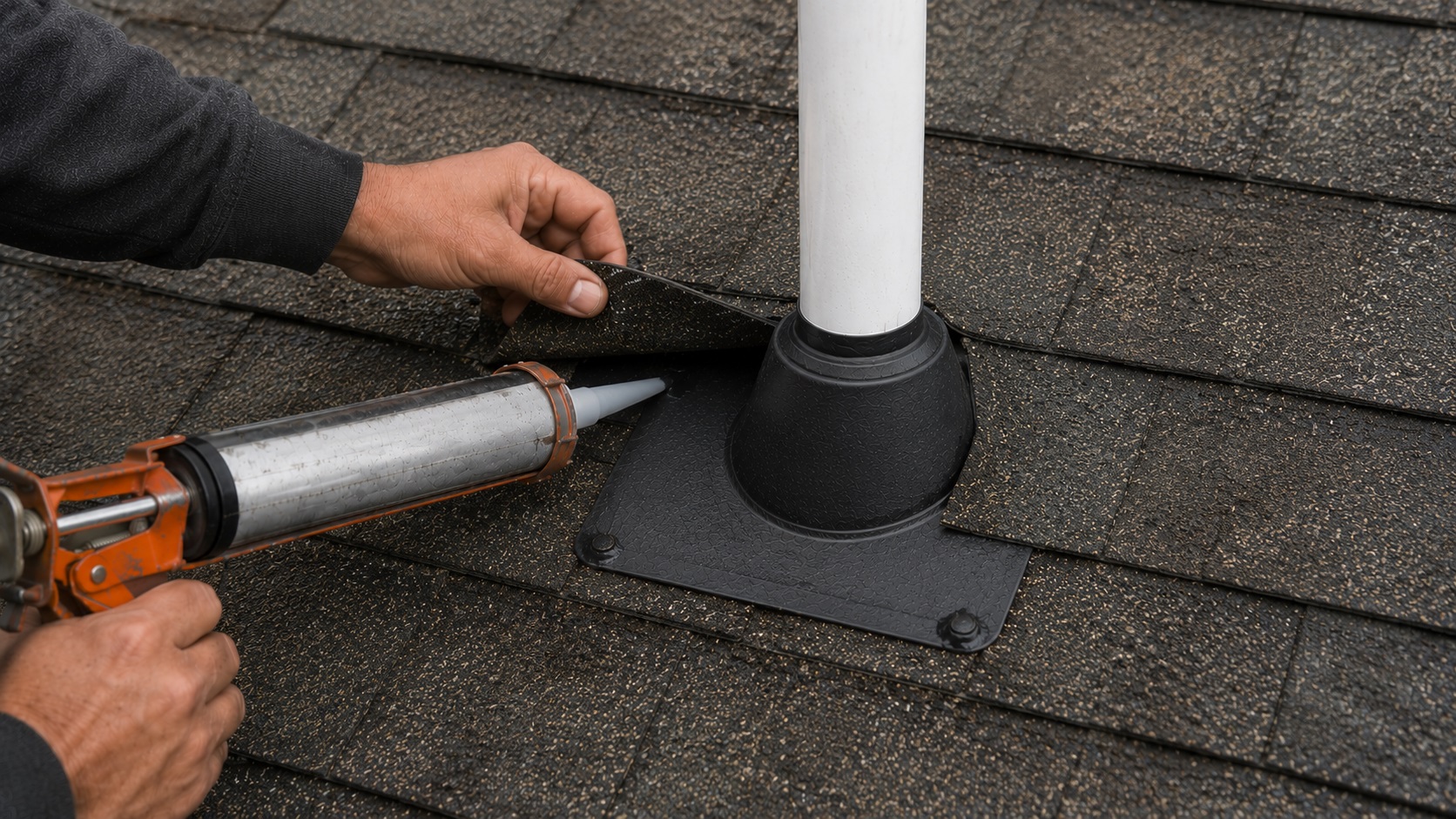
Apply roofing caulk in a continuous bead rather than random blobs. For nail heads, cover the exposed fastener and feather the sealant slightly onto the surrounding surface. For small seams, bridge the gap without smearing sealant too widely. For flashing edges, avoid blocking drainage paths that are designed to move water out and away from the roof assembly.
After application, monitor the area during the next few rains. A preventive seal should reduce vulnerability, but it is not a guarantee that no hidden moisture exists. If you notice attic staining, musty odors, damp insulation, or recurring ceiling marks, review Signs of Water Damage from Roof Leaks and inspect further.
Roof Caulking Mistakes That Can Let Moisture Keep Getting In
Using Preventive Caulk on Active Leaks
This article is about preventive roofing caulks for leak prevention, not emergency leak stopping. If water is actively entering the house, the roof may need immediate inspection, temporary protection, or professional repair.
Caulking Over Failed Flashing
Flashing is designed to shed water in layers. Caulk can help seal small details, but it should not replace missing, bent, loose, reversed, or poorly installed flashing.
Using Self-Leveling Sealant Vertically
Self-leveling products such as Dicor are useful on horizontal roof details, but they can run or sag on vertical surfaces. Use a non-sag flashing sealant for vertical or steep applications.
Blocking Drainage Paths
Some roof details are designed to let water drain out. Sealing every opening without understanding the roof assembly can trap moisture instead of preventing it.
Ignoring Attic Signs After Exterior Sealing
A roof can look sealed from outside while moisture remains inside the attic or decking. If you suspect hidden moisture, inspect from inside as well as outside.
Choosing a Product Only by Brand Name
Even strong brands make different products for different surfaces. Match the sealant to the roof material, application angle, gap size, and exposure level.
Applying Too Much Material
Thick, messy sealant can crack, peel, trap debris, or make future repairs harder. A controlled bead on a prepared surface is usually better than a large smear.
Roofing Caulk FAQ for Leak Prevention
What Is the Best Roofing Caulk for Leak Prevention?
For general preventive roof-detail sealing, Geocel Pro Flex RV Flexible Sealant is the best overall pick in this list. For flashing-specific work, Loctite PL Roof Flashing Polyurethane Sealant is a stronger match. For horizontal RV roof penetrations, Dicor Self-Leveling Lap Sealant is the better specialty option.
Can Roofing Caulk Stop an Active Roof Leak?
Sometimes a roof caulk may slow water entry at a small exterior detail, but this guide is not focused on active emergency leaks. If water is already entering the house, inspect the roof system and the interior moisture path before relying on caulk.
Where Should Roofing Caulk Be Used?
Roofing caulk is most useful around small roof details such as exposed nail heads, minor cracks, vent boot edges, roof trim seams, gutter joints, flashing edges, and small gaps around roof accessories. It should not replace shingles, flashing, underlayment, or roof decking.
Is Self-Leveling Roof Sealant the Same as Roofing Caulk?
No. Self-leveling sealant flows after application and is best for horizontal details. Standard roofing caulk is usually better for vertical or sloped seams where the bead needs to stay in place.
Should I Use Roofing Caulk or Roof Patch Paste?
Use roofing caulk for narrow cracks, seams, nail heads, and controlled bead applications. Use a thicker paste only for slightly larger minor gaps or uneven surfaces where a bead will not fill properly. Large holes or damaged roof assemblies need repair, not just sealant.
Can I Use Exterior Siding Caulk on a Roof?
Not always. Siding caulks are made for wall joints, trim, and siding movement, while roofing caulks must handle roof exposure, roof materials, and water-shedding details. Use a roof-specific product whenever the application is on a roof surface, roof flashing, roof penetration, or gutter-adjacent detail.
How Often Should Roof Caulk Be Inspected?
Inspect roof caulk at least seasonally and after major storms, especially around penetrations, flashing, and exposed fasteners. Also inspect from the attic if you see stains, musty odors, or damp insulation.
Can Roofing Caulk Prevent Mold?
Roofing caulk can help reduce water entry risk at small roof details, which may reduce conditions that contribute to mold. However, no caulk can guarantee mold prevention. Mold prevention also depends on stopping leaks, drying wet materials, maintaining ventilation, and monitoring hidden moisture.
Which Roofing Caulk Should You Use for Preventive Leak Maintenance?
The best roofing caulk for leak prevention depends on the roof detail you are maintaining. Choose Geocel Pro Flex RV Flexible Sealant if you want the best overall flexible option for small preventive roof-detail sealing. Choose Dicor Self-Leveling Lap Sealant for horizontal roof penetrations and RV roof details. Choose Liquid Nails Roof Repair if you prefer a roof repair cartridge for small preventive repairs and have multiple areas to maintain.
For gutters, flashing edges, and metal-adjacent details, DAP Butyl-Flex Gutter & Flashing Sealant is the most relevant pick. For a more professional flashing-focused caulk, Loctite PL Roof Flashing Polyurethane Sealant is the strongest choice. If the gap is slightly larger or irregular, Gorilla Waterproof Patch & Seal Rubberized Sealant Paste can be useful as a thicker minor-gap option.
Use these products for preventive maintenance, not as a substitute for repairing failed roofing materials. If you see signs of hidden moisture, attic staining, recurring roof leaks, or structural deterioration, inspect the roof system before relying on caulk alone.