When Structural Framing Must Be Repaired
Structural framing does not always need repair just because it got wet once. In some cases, wood framing can dry properly and remain strong, straight, and stable. But framing must be repaired when water damage, rot, movement, improper cuts, crushing, or connection failure affects the wood’s strength, shape, support, or ability to safely hold finishes and loads.
The important question is not only whether the framing looks stained or old. The better question is whether the framing can still do its job. Studs, plates, headers, joists, rafters, rim joists, sill plates, beams, posts, and structural sheathing all serve different roles. Damage in one non-structural area may be minor, while similar damage in a load-bearing wall, floor system, roof frame, or exterior wall assembly may require repair before the area is closed back up.
This article focuses on repair timing. It does not explain how to replace studs, size headers, sister joists, jack floors, or rebuild framing. Instead, it explains when damaged framing should not be ignored, covered, or treated cosmetically. If the issue is part of broader structural moisture problems in homes, the safest repair plan starts with understanding both the damaged material and the moisture source that caused it.
In practical terms, structural framing usually needs repair when it is soft, rotten, crushed, deeply split, displaced, no longer holding fasteners, improperly cut, or connected to a floor, wall, roof, or opening that is sagging, shifting, or cracking. Framing that is only stained, briefly wet, and still dry, firm, straight, and well connected may not need structural repair.
What Determines Whether Structural Framing Needs Repair
Framing repair decisions depend on the member’s structural role, the type of damage, the location of the damage, whether the structure is moving, and whether the moisture source has been corrected. A wet stud that dries straight and firm may not need replacement. A dry bottom plate that is rotten, crushed, or no longer holding fasteners may still need repair.
The Structural Role of the Damaged Member
The more important the framing member is to the structure, the more carefully damage should be treated. Damage in a decorative trim board is different from damage in a load-bearing stud, sill plate, rim joist, roof rafter, beam, post, or header. Structural members transfer weight, resist movement, support openings, or hold assemblies together.
Homeowners often cannot tell exactly which members are load-bearing from appearance alone. A wall may look ordinary but support framing above. A header may be hidden behind drywall. A sill plate may be partly concealed by insulation or flooring. If damaged framing may be carrying weight, repair decisions should be made before finishes are replaced.
The Type of Damage
Some damage is mostly cosmetic. Old stains, minor surface checking, or past moisture marks may not require structural repair if the wood is dry, hard, straight, and fully connected. Other damage directly affects performance.
Framing is more likely to need repair when it is soft, punky, rotten, crushed, deeply split, bowed, twisted, displaced, cut too deeply, or disconnected from surrounding members. Fastener failure, loose connectors, sagging, and movement are also stronger repair indicators than staining alone.
Whether the Framing Dried Sound
Drying is important, but drying does not automatically mean the framing is safe to cover. Wood can become dry after damage has already occurred. If a stud, plate, joist, rafter, or beam is dry but remains soft, warped, split, crushed, or unable to hold fasteners, repair may still be needed.
This distinction is especially important after leaks, flooding, or long-term hidden moisture. A wall, floor, or ceiling can look dry from the room side while damaged framing remains hidden inside the assembly. For a deeper explanation of why wet wood can lose strength even after it dries, see how moisture weakens structural framing. Before drywall, flooring, insulation, siding, or roofing materials go back, the framing should be sound enough to support the finished system.
Whether the Structure Is Moving
Movement raises the seriousness of framing damage. Sagging floors, bowed walls, roofline dips, ceiling cracks, diagonal wall cracks, sticking doors, and widening trim gaps can all suggest that framing damage is affecting the structure around it.
Movement does not always prove that a specific member must be replaced, but it does mean the issue should not be treated as cosmetic. When damaged framing and movement appear together, the repair decision should include professional evaluation.
How Many Framing Members Are Affected
One damaged stud, joist, or plate section may be a localized repair. Multiple damaged members in the same area suggest a broader problem. Several softened studs, a long section of rotted bottom plate, multiple damaged joists, or widespread attic framing damage may indicate long-term moisture exposure or system-level movement.
The more members involved, the less likely the problem is isolated. Multi-member damage may require repair planning that addresses load paths, temporary support, moisture correction, and surrounding assemblies.
Whether the Moisture Source Has Been Corrected
Moisture-related framing repair should not happen in isolation. If the water source remains active, repaired framing may be damaged again. Common sources include roof leaks, plumbing leaks, exterior wall leaks, window or door leaks, crawl space humidity, basement moisture, condensation, and poor drainage.
Long-term repair depends on the same larger goal: find, fix, and prevent moisture problems throughout the home. If the framing is repaired but the moisture path stays active, the repair may only hide the problem temporarily.
Signs Structural Framing Should Be Repaired
Structural framing should be repaired when the damage affects strength, alignment, connections, or the ability to safely close the wall, floor, ceiling, or roof assembly. Stains and discoloration are clues, but repair decisions depend more on physical condition and structural role.
A simple way to sort the issue is to ask four questions: Is the member structural? Has the wood lost strength or shape? Are the connections still secure? Is the surrounding floor, wall, ceiling, or roof moving? A “yes” to any of these questions makes repair more likely than cosmetic treatment.
Soft, Punky, or Rotten Framing
Soft framing is one of the clearest signs that repair may be needed. Healthy structural wood should resist light pressure. If a stud, plate, joist, rafter, beam, post, or header feels spongy, punky, crumbly, or easily gouged, the wood may have lost strength.
This is especially serious in load-bearing areas. Soft wood at a bottom plate, sill plate, rim joist, joist end, header, rafter seat, or post base should not be covered with new finishes. If the damage looks like structural wood rot, the repair decision should focus on whether the affected member still performs its structural role.
Crushed or Compressed Bearing Areas
Crushing is a strong repair sign because it often appears where loads concentrate. Look for flattened fibers, compressed wood, sunken support areas, or members that no longer sit squarely on their supports. This can happen at posts, beams, sill plates, joist ends, headers, rafter seats, or bearing wall plates.
Crushed framing is more concerning than ordinary staining because it suggests the wood is deforming under load or has been weakened by moisture, decay, poor support, or movement. A crushed bearing point should not be hidden behind drywall, flooring, trim, or insulation.
Deep Splits, Cracks, or Separation
Some surface checking in wood is normal. Deep splits are different. A crack that runs through a structural part of a member, widens over time, appears near a bearing point, or combines with sagging or displacement may require repair.
Cracks are more concerning when they appear in beams, posts, rafters, headers, joists, or load-bearing wall members. A stable cosmetic crack may be monitored, but a split that affects support or alignment should be evaluated before the area is closed.
Bowed, Twisted, or Displaced Framing
Framing members should generally remain aligned with the assembly they support. If a stud, joist, rafter, beam, or plate is bowed, twisted, shifted, or pulled out of position, the issue may involve structural movement, moisture distortion, poor repairs, or connection failure.
Displacement is especially important when the damaged member is part of a wall, roof, floor, or exterior opening. A twisted stud in a non-load-bearing partition may be less urgent than a displaced header, bowed rafter, shifted sill plate, or joist that no longer bears properly on its support.
Loose Fasteners or Connectors
Structural framing depends on connections. Nails, screws, hangers, brackets, straps, clips, anchor bolts, and plates help hold framing members in position. If fasteners pull loose, connectors separate, or wood no longer holds hardware properly, the repair may need to address both the damaged wood and the failed connection.
This is common after long-term moisture exposure because softened wood may lose fastener-holding strength. It can also happen when framing has shifted or when previous repairs were poorly done. Loose connectors near beams, joists, rafters, headers, sill plates, or posts should not be treated as a surface issue.
A practical warning sign is hardware that can be moved by hand, fasteners that spin without tightening, or connector plates attached to wood that crumbles around the fastener holes.
Sagging Floors, Walls, Ceilings, or Roof Areas
Sagging is one of the clearest signs that framing damage may need repair. A sagging floor can point to joist, beam, post, sill plate, or subfloor problems. A sagging roof area can point to rafter, roof sheathing, ridge, or support damage. A bowed wall can point to framing movement, moisture damage, or load problems.
Visible sagging does not always prove which member has failed, but it does show that the structure is moving or deflecting. When sagging appears with damaged framing, the repair decision should happen before finishes are replaced or cosmetic work hides the evidence.
Improper Cuts, Notches, or Removed Framing
Structural framing may need repair even when moisture is not the cause. Plumbing, HVAC, electrical, or remodeling work can weaken framing if studs, joists, rafters, headers, or bracing are cut too deeply or removed. Large holes, deep notches, missing sections, and unsupported alterations should be treated seriously.
Improper cuts are especially concerning near supports, openings, load-bearing walls, roof framing, and floor joists. If a previous repair or installation removed part of the load path, the framing may need correction before the area is covered.
When Drying Is Not Enough
Drying wet framing is important, but drying is not the same as repair. A framing member can become dry and still remain unsafe if the earlier moisture left it soft, rotten, warped, split, crushed, displaced, contaminated, or unable to hold fasteners.
Repair is more likely when dried framing still feels punky or hollow, no longer lines up with the surrounding wall or floor, has crushed bearing points, or will not securely hold nails, screws, hangers, brackets, or connectors. These conditions show that the problem is no longer just moisture; the wood or connection has lost function.
Persistent odor after drying can also indicate trapped moisture, contamination, mold growth, or decayed material. Odor alone does not prove structural failure, but it should not be sealed inside a wall, floor, ceiling, or roof assembly without investigation. Floodwater, sewage, or contaminated water exposure may also require professional cleanup before the framing is closed.
Framing Damage in Walls
Wall framing repair depends on whether the damaged member is part of a load-bearing wall, exterior wall, braced wall, or opening support. Moisture sources such as plumbing leaks, exterior water intrusion, roof leaks, window leaks, door leaks, condensation, and flooding matter because they often damage framing before the room-side finish shows the full problem.
Damaged Studs
Studs may need repair when they are soft, rotten, deeply split, bowed, cut too deeply, displaced, or no longer connected properly to plates. One damaged non-load-bearing stud may be a smaller issue than a damaged stud in a load-bearing wall or exterior wall assembly.
Stud damage is especially important near bathrooms, kitchens, laundry areas, exterior walls, windows, doors, and plumbing chases. These are common places for hidden moisture to reach framing before the damage becomes visible.
Damaged Bottom Plates
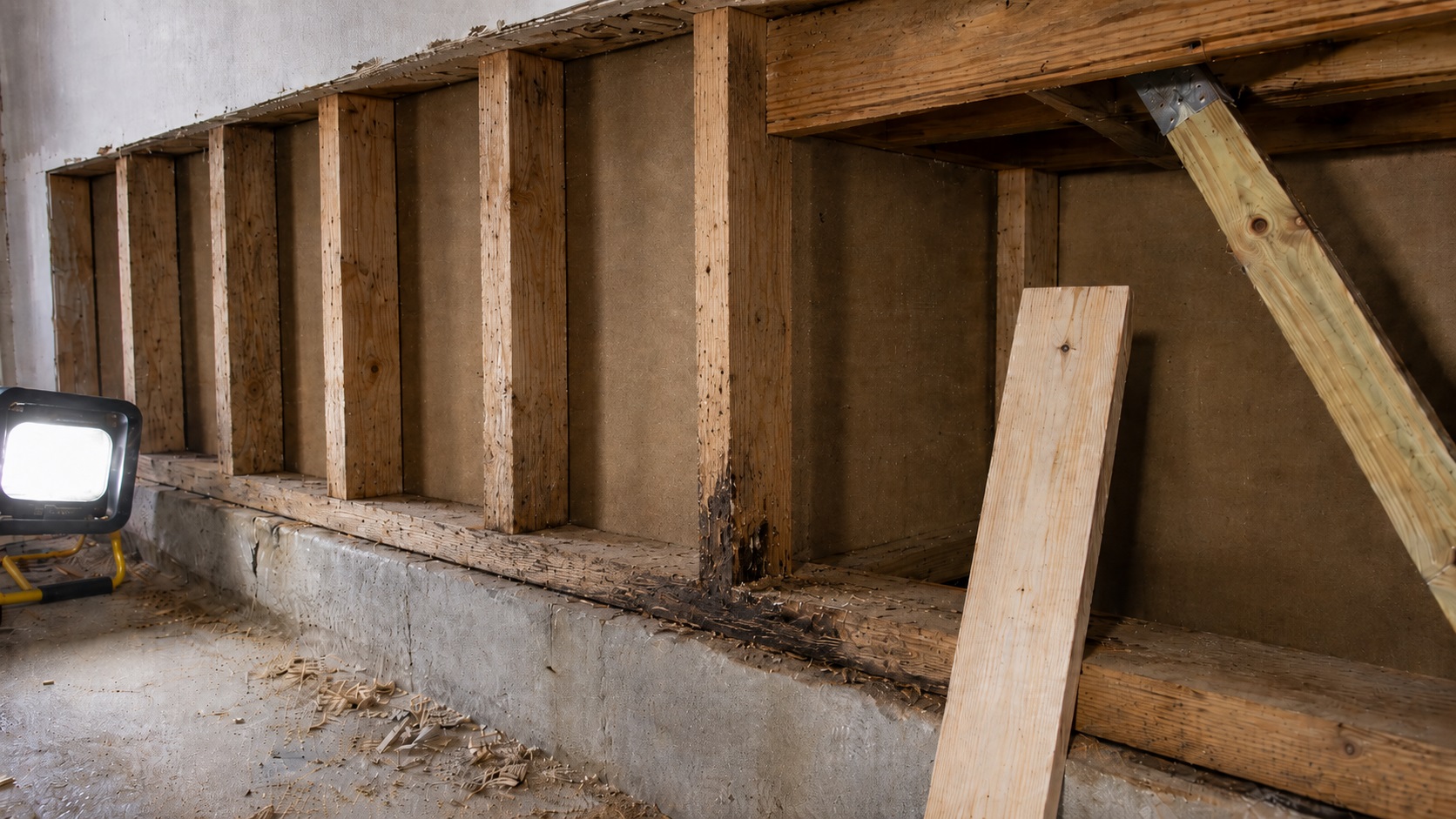
Bottom plates are vulnerable because water often collects at the base of walls. Leaks, floods, wet flooring, exterior water entry, and condensation can all affect the plate where studs meet the floor. A damaged bottom plate can compromise wall stability, fastener holding, and the connection between wall framing and the floor system.
Repair becomes more likely when the plate is soft, rotten, swollen, crushed, or no longer holding studs securely. Bottom plate damage should be evaluated before drywall, trim, flooring, or cabinets are replaced.
Header Damage Around Windows and Doors
Headers help carry loads around wall openings. Damage around windows and doors is common because these areas are vulnerable to flashing failures, exterior leaks, condensation, and poor sealing. Header damage may show up as sagging above an opening, sticking doors, uneven window gaps, diagonal cracks, soft framing, or stains around the opening.
Because headers can be part of the load path, damaged framing above openings should not be treated like ordinary trim damage. If the header or supporting studs are soft, cut, displaced, or sagging, repair may be needed before the opening is refinished.
Exterior Wall Sheathing Damage
Exterior wall sheathing can be part of the wall’s structural performance, not just a backing material behind siding. Water-damaged sheathing may need repair when it is soft, swollen, delaminated, moldy with material breakdown, no longer holding fasteners, or no longer supporting the exterior wall assembly properly.
Sheathing damage is common behind siding leaks, window leaks, door leaks, flashing failures, roof-to-wall leaks, and long-term exterior moisture intrusion. If siding or drywall is being replaced, damaged sheathing should be evaluated before the wall is closed again.
When Drywall Should Not Be Reinstalled Yet
Drywall should not be reinstalled over framing that is still wet, soft, rotten, displaced, contaminated, or structurally questionable. Closing the wall too soon can hide moisture, odor, mold risk, or framing weakness. It can also make future repairs more expensive because the new drywall may need to be removed again.
Before the wall is closed, the framing should be dry enough, firm enough, and properly aligned. If wall framing shows support-related warning signs, compare the situation with signs of load-bearing wood damage before treating it as a cosmetic wall repair.
Framing Damage in Floors and Crawl Spaces
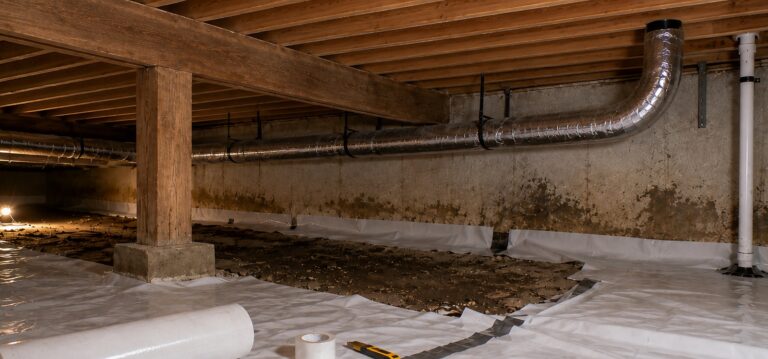
Floor and crawl space framing often carries significant loads and is frequently exposed to moisture. Joists, beams, posts, rim joists, sill plates, blocking, and subfloor connections can all be affected by leaks, crawl space humidity, poor drainage, flooding, or long-term dampness.
Floor Joist Damage
Floor joists may need repair or replacement when they are rotten, deeply split, crushed at their ends, sagging, pulling away from hangers, cut too deeply, or no longer properly supported. Joist damage should be treated separately from finished flooring damage because joists are part of the structural floor system.
If the decision is specifically about joist replacement rather than broad framing repair, review when floor joists must be replaced. That topic covers joist end failure, severe rot, sistering limits, and replacement thresholds in more detail.
Beam, Post, and Support Damage
Beams and posts help transfer weight through the floor system. Damage to these members is more serious than damage to non-structural wood. Repair may be needed when beams are split, sagging, rotating, crushed at bearing points, or damaged by rot or insects. Posts may need attention when they are leaning, settling, cracked, rotted at the base, or no longer in firm contact with the beam above.
Support damage is especially common in crawl spaces with moisture problems, poor drainage, soil contact, or inadequate ventilation. Because beams and posts carry concentrated loads, homeowners should not cut, remove, or adjust them casually.
Rim Joist and Sill Plate Damage
Rim joists and sill plates are vulnerable because they sit near the exterior edge of the floor system and foundation. Water can reach them from siding failures, exterior wall leaks, crawl space moisture, foundation dampness, window and door leaks, or poor drainage.
Repair may be needed when these members are soft, rotted, crushed, separated, or no longer holding fasteners or anchors properly. Damage in this area can affect the connection between the house framing and the foundation-supported structure.
Subfloor and Framing Interaction
Subfloor damage can expose deeper framing problems, but the subfloor layer itself is a separate repair decision. For framing, the concern is whether repeated wetting, softness, swelling, or contamination has reached the joists, rim joists, plates, or beams that support the floor. A new subfloor needs sound support below it, and damaged framing can cause the replacement floor to move or fail.
If the main decision is whether the subfloor layer itself can stay or must be removed, use the more specific guide on when subfloors must be replaced after water damage. For this article, the key point is that framing repair may be needed when subfloor damage has reached the joists, rim joists, plates, or beams below.
Crawl Space Moisture and Repeated Framing Damage
Crawl space framing should not be repaired without addressing the moisture conditions that damaged it. Standing water, high humidity, poor drainage, plumbing leaks, missing vapor control, and damp insulation can keep wood framing wet long enough to cause repeated deterioration.
If framing has already been repaired once and the same area is damp again, the issue may not be the repair material. It may be the moisture environment. Structural repair and moisture correction need to happen together for the repair to last.
Framing Damage in Roofs and Attics
Roof and attic framing should be repaired when leaks, condensation, poor ventilation, flashing failures, wet insulation, improper alterations, or long-term humidity leave rafters, sheathing, ceiling joists, collar ties, ridge supports, or related framing soft, displaced, sagging, split, or poorly connected.
Rafter Damage
Rafters may need repair when they are cracked, bowed, sagging, rotten, cut, or separated from their supports. Damage near rafter seats, ridge connections, valleys, roof penetrations, or leak paths is especially important because those areas can carry concentrated loads or repeated moisture.
Rafter damage should not be hidden under insulation or ceiling repairs. If the roofline is sagging, the ceiling below is cracking, or the rafter appears soft or split, professional evaluation is appropriate before the area is closed.
Roof Sheathing Damage
Roof sheathing may need repair when it is soft, delaminated, swollen, moldy with material breakdown, sagging between rafters, or no longer holding fasteners properly. Roof sheathing supports roofing materials and helps the roof assembly perform as a system.
Water-damaged sheathing is common near roof leaks, condensation problems, poor attic ventilation, ice-dam areas, flashing failures, and plumbing or exhaust penetrations. If the sheathing feels soft or deflects under load, it should not be treated as a surface stain.
Ceiling Joist and Attic Framing Damage
Ceiling joists and attic framing can be affected by roof leaks, stored loads, moisture, pests, or improper alterations. Damage may show up as ceiling cracks, sagging drywall, displaced insulation, cracked joists, or framing that has been cut or notched for mechanical work.
Attic framing is easy to damage by stepping in the wrong place or overloading members not intended for storage. If the framing already shows moisture damage or movement, avoid walking on questionable areas and get the condition evaluated safely.
When Improper Cuts or Alterations Require Repair
Structural framing sometimes needs repair because of human alteration rather than moisture. Plumbing, HVAC, electrical, or remodeling work can weaken framing when members are cut, drilled, notched, removed, or altered without preserving the load path. These problems are common in floors, walls, ceilings, attics, and basements where mechanical systems were added after the home was built.
Over-Notched or Cut Studs
Wall studs may need repair when they are cut too deeply, notched repeatedly, split, or weakened around plumbing and wiring. This is more serious in load-bearing walls, exterior walls, braced wall sections, and walls supporting headers or framing above.
A shallow notch in a non-load-bearing partition is different from a deep cut through several studs in a support wall. If multiple studs are altered in the same area, or if the wall shows cracking, movement, or door and window problems, the framing should be evaluated before the wall is closed.
Cut Joists or Rafters
Joists and rafters can be seriously weakened by large holes, deep notches, cuts near supports, or sections removed for pipes, ducts, vents, or wiring. Damage is more concerning when it appears near bearing points, in the middle of long spans, or in members that already show sagging or cracking.
Improper cuts should not be hidden with drywall, insulation, or flooring. A cut joist or rafter may still appear to be in place while carrying less load than intended. If the member is part of a larger floor or roof system, repair should be planned before finishes are replaced.
Altered Headers or Removed Bracing
Headers and bracing are easy to underestimate because they are often hidden inside walls or attics. A header above a window or door helps transfer weight around the opening. Bracing can help keep framing aligned and resist movement. If either has been cut, removed, or altered, the framing may need repair even if there is no water damage.
Warning signs include sagging above openings, diagonal cracks from window or door corners, sticking doors, uneven gaps, roof or wall movement, and framing that no longer lines up properly. These symptoms should be addressed before cosmetic repairs hide the underlying alteration.
Poor Previous Repairs
Some framing problems come from earlier repairs that did not restore support properly. Examples include short patches that do not bear correctly, unsupported subfloor edges, loose sistered members, undersized replacement pieces, fasteners placed into soft wood, or framing covered before the source of moisture was fixed.
Poor previous repairs can make later damage harder to diagnose because the area may look patched but still move, sag, smell musty, or fail again. If a repaired area keeps showing the same symptoms, the repair may not have addressed the actual structural or moisture problem.
When to Call a Contractor or Structural Engineer
Structural framing repair often starts with a qualified contractor, but some conditions may require a structural engineer. Professional evaluation becomes more important when damage may affect load-bearing members, multiple framing components, engineered lumber, roof framing, braced wall areas, or unclear support paths.
- Call when damaged framing may support floors, walls, roofs, headers, beams, posts, or openings.
- Call when there is movement, such as sagging floors, roofline dips, bowed walls, ceiling cracks, widening trim gaps, sticking doors, or diagonal wall cracks.
- Call when several studs, joists, rafters, plates, beams, or supports are damaged in the same area.
- Call when engineered joists, laminated beams, trusses, or other engineered framing products are damaged.
- Call when inspection would require walking on questionable roof sheathing, entering unstable crawl space areas, disturbing contaminated materials, or working near wet electrical zones.
If movement appeared after a leak, flood, crawl space moisture problem, roof leak, or structural alteration, it may help to evaluate structural safety after water damage before deciding what repair is needed.
What Homeowners Should Not Do
The main mistake with structural framing damage is closing the assembly too soon. New drywall, flooring, insulation, siding, roofing, or trim can make the home look repaired while damaged framing remains hidden. Before finishes go back, the framing should be dry, sound, aligned, connected, and supported, and any unsafe electrical, contamination, or instability risks should be addressed first.
Do Not Cover Damaged Framing
Do not cover soft, rotten, bowed, cracked, crushed, or displaced framing with new finishes. Covering damage may hide the warning signs, trap moisture, and make the next repair more expensive. If framing is questionable, it should be evaluated before the wall, floor, ceiling, or roof is closed.
Do Not Assume Mold Cleaning Equals Framing Repair
Mold on framing and damaged framing are related but different issues. Cleaning surface mold does not repair soft wood, crushed bearing areas, split members, or framing that no longer holds fasteners. If mold appears with wood deterioration, odor, moisture persistence, or material breakdown, the framing condition still needs evaluation.
Do Not Cut, Remove, Jack, or Brace Framing Casually
Structural framing may still be carrying weight even when it is damaged. Cutting out a stud, removing a plate, jacking a floor, bracing a roof, or altering a beam without understanding the load path can create additional damage. These actions should not be improvised.
Do Not Ignore the Moisture Source
Framing repair will not last if the same moisture problem remains active. Before the assembly is closed, the leak, drainage issue, condensation problem, crawl space humidity, roof defect, plumbing failure, or exterior water entry path must be corrected. Repairing the framing without fixing the source invites repeat damage.
FAQ About When Structural Framing Must Be Repaired
Can wet framing be left in place if it dries?
Sometimes. Water-damaged framing may be left in place if it dries properly and remains firm, straight, connected, odor-free, and structurally sound. It should not be left in place if it is soft, rotten, warped, crushed, deeply split, contaminated, disconnected, or part of a moving assembly.
Does framing need repair if it is dry now?
Not always. Dry framing may be acceptable if it remains sound. However, dry framing still needs repair if it has lost strength, shape, fastener-holding ability, alignment, or support. Dry rot-damaged, crushed, split, or displaced framing should not be treated as safe just because moisture levels improved.
When does wall framing need repair?
Wall framing usually needs repair when studs, plates, headers, exterior sheathing, or load-bearing wall components are soft, rotten, cut too deeply, crushed, displaced, or no longer properly connected. Repair is also more likely when damaged wall framing causes cracks, sticking doors, uneven openings, or trim movement.
Should framing be repaired before replacing drywall?
Yes, if the framing is still wet, soft, rotten, moldy with deterioration, warped, contaminated, structurally unstable, or affected by an unresolved moisture source. Drywall should not be used to hide framing damage. The framing behind it should be dry, firm, aligned, and sound first.
Can a contractor repair structural framing without an engineer?
Sometimes. Many localized framing repairs can be handled by qualified contractors. A structural engineer may be needed when damage affects load-bearing members, multiple framing components, engineered lumber, roof framing, braced wall areas, major sagging, or unclear load paths.
What happens if damaged framing is covered instead of repaired?
The problem can remain hidden and continue to worsen. Finishes may crack, flooring may move, doors may stick, odors may return, moisture may stay trapped, and later repairs may require removing the new finish materials again. Covering framing damage does not restore strength, reconnect loose members, or stop the moisture source.
Final Repair Decision
Structural framing must be repaired when damage affects strength, shape, alignment, support, connections, or the ability to safely close the assembly. Wet framing does not always need replacement, but framing that is soft, rotten, crushed, deeply split, displaced, improperly cut, or part of a moving floor, wall, or roof system should not be covered and forgotten.
The safest repair timing is before drywall, flooring, siding, insulation, roofing, or trim goes back. Once the framing is hidden, moisture damage and structural weakness become harder to see. If the damaged framing may be load-bearing, if several members are affected, or if the structure is sagging or moving, professional evaluation is the right next step.
Good framing repair is not only about replacing damaged wood. It also means correcting the moisture source, restoring support, and making sure the surrounding assembly can perform as intended before the home is closed back up.