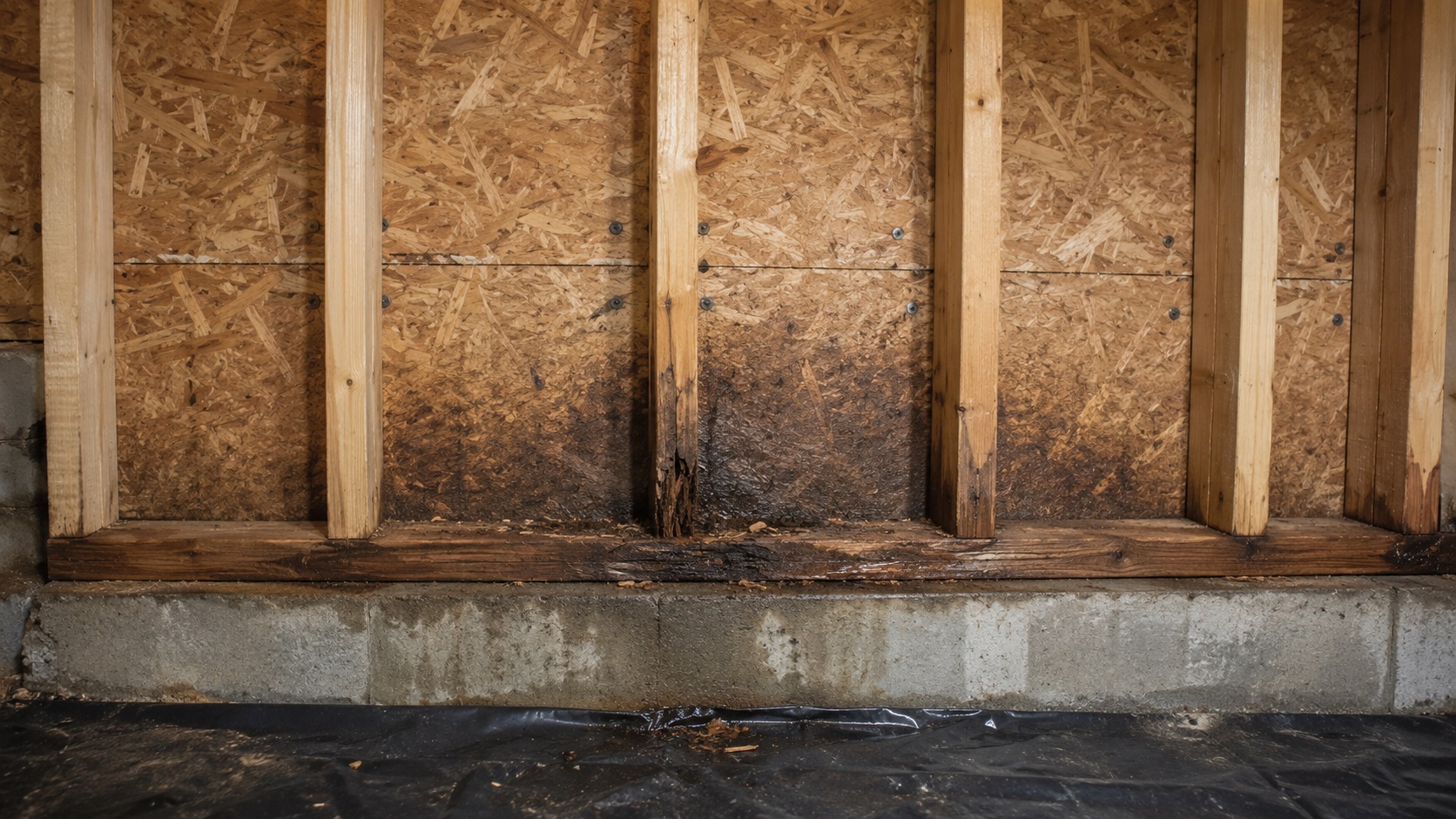
How Moisture Weakens Structural Framing
Moisture does not automatically ruin structural framing the moment wood gets wet. A short-term leak that is found quickly and dried correctly may leave framing usable. The bigger concern is moisture that stays trapped, returns repeatedly, or allows wood to swell, shrink, decay, or lose reliable connections.
Structural framing includes the wood members that help support the house: studs, joists, rafters, sill plates, rim joists, beams, posts, headers, subfloors, and roof sheathing. These materials do more than sit behind drywall or under floors. They carry weight, transfer loads, hold surfaces flat, and keep the building stable.
When moisture affects framing, the damage can happen slowly. Wood can absorb water, change shape, hold moisture in hidden cavities, support mold growth, develop rot, loosen fasteners, or weaken at bearing points. The surface may look only stained while the more important problem is hidden inside a wall, under flooring, in a crawl space, or above a ceiling.
This article explains how moisture weakens structural framing, why repeated dampness matters, and when wet framing becomes more than a drying issue. For a broader warning-sign guide, see Signs of Structural Moisture Problems. For the full home moisture authority guide, see How to Find, Fix, and Prevent Moisture Problems in Homes.
What Happens When Structural Framing Gets Wet
Wood framing is porous and naturally responds to moisture. It can absorb moisture from direct leaks, flooding, condensation, damp insulation, humid crawl spaces, wet basements, roof leaks, plumbing leaks, and exterior wall intrusion. Moisture can enter through exposed surfaces, cut ends, joints, cracks, fastener holes, and areas where wood touches damp materials.
Once framing gets wet, the most important factors are duration, drying conditions, and whether the water source has been corrected. A joist that gets wet briefly and dries thoroughly is different from a joist that stays damp for weeks in a crawl space. A wall stud exposed by a quick plumbing leak is different from a bottom plate that has been absorbing moisture behind drywall for months.
Moisture can affect framing in several ways:
- It can make wood swell and change shape.
- It can lead to shrinkage as the wood dries.
- It can cause checking, splitting, cupping, or twisting.
- It can keep enclosed cavities damp long after surfaces look dry.
- It can create conditions for mold growth.
- It can support decay fungi if damp conditions persist.
- It can loosen or corrode fasteners and connectors.
- It can weaken bearing points where loads are concentrated.
The first stage is often not visible structural failure. It may simply be damp wood, dark staining, musty odor, or moisture readings that remain elevated. If the moisture continues, framing can gradually lose stiffness, shape, connection strength, or wood fiber integrity. That is why structural framing should not be judged by surface appearance alone: a painted wall may hide wet studs, a finished floor may hide swollen subflooring, and a ceiling stain may hide wet rafters or roof sheathing.
Why Short-Term Wetting Is Different From Long-Term Moisture
Not all wet framing has the same risk. The difference between a recoverable moisture event and a structural concern usually comes down to how long the wood stayed wet, how often it gets wet, and whether it can dry completely.
Brief Wetting That Dries Quickly
Brief wetting may not permanently weaken framing if the water source is stopped, the wood dries thoroughly, and the framing remains firm, straight, and properly connected. For example, a short plumbing leak that wets an exposed stud bay may be manageable if the cavity is opened, dried, and inspected before it is closed again.
In these cases, the framing should still be checked. The wood should not feel soft, punky, spongy, or crumbly. It should not be cracked, bowed, or twisted in a way that affects support. Fasteners and connectors should remain secure. If the framing dries and remains stable, replacement may not be necessary.
The better question is whether the framing dried soon enough and retained its firmness, shape, support, and connections.
Persistent Dampness in Enclosed Framing
Persistent dampness is more serious than short-term wetting. Structural framing often sits inside assemblies that do not dry quickly. Wall cavities, rim joist areas, insulated crawl spaces, subfloors under vinyl, roof sheathing under shingles, and sill plates against foundation walls can trap moisture for a long time.
When framing stays damp, the risk increases. Damp wood can keep swelling, support mold, hold musty odors, and create conditions where decay may begin. Even when the visible surface feels dry, moisture may remain deeper in the material or behind surrounding finishes.
This is common after slow leaks. A homeowner may notice only a small stain or odor, but the framing behind the area may have been damp for months. Slow leaks under sinks, behind showers, around exterior doors, inside wall cavities, or near roof penetrations can create hidden framing moisture before obvious structural symptoms appear.
Repeated Wetting and Drying Cycles
Repeated wetting and drying can be especially damaging. Wood swells as it absorbs moisture and shrinks as it dries. One controlled drying event may not cause serious damage, but repeated cycles can stress framing, finishes, fasteners, and connections.
Over time, repeated cycles may cause:
- Loose fasteners
- Raised subfloor seams
- Cracked drywall near framing movement
- Separated trim or baseboards
- Twisted or bowed lumber
- Checks and splits in framing
- Weakening near joist ends or bearing points
- Recurring mold or decay risk
This is why recurring moisture is often more concerning than one obvious leak that was fixed immediately. A crawl space that gets damp every rainy season, a roof leak that returns after each storm, or a plumbing connection that drips slowly over months can quietly weaken framing even when no single event seems severe.
If you already have water damage and need to decide whether the area is safe to use, see How to Evaluate Structural Safety After Water Damage. That article focuses on safety evaluation, while this one explains why framing weakens in the first place. For a broader stage-by-stage view, see How Structural Damage Progresses After Moisture Exposure.
How Moisture Changes the Shape of Wood Framing
Wood framing is designed to stay reasonably straight, stable, and well connected. Even before wood rots, moisture can make framing swell, shrink, warp, twist, cup, check, or split. These changes can affect how floors feel, how walls look, and how loads move through the structure.
Swelling and Shrinkage
When wood absorbs moisture, it can swell. When it dries, it can shrink. This movement is normal to some degree, but excessive or uneven moisture can create problems. A joist that gets wet on one side may move differently than a joist that dries evenly. A bottom plate that stays damp while nearby studs dry may create stress at connections. A subfloor panel that swells at the edges may never return perfectly flat.
Swelling can push against finishes, raise seams, tighten openings, or distort surfaces. Shrinkage during drying can leave gaps, loosen fasteners, or create cracks. This is why a water-damaged area may look worse after drying than it did while it was wet. Drying removes moisture, but it does not always reverse the movement caused by moisture.
In floors, swelling may appear as ridges, lifted seams, cupping, or uneven transitions. In walls, it may appear as cracked drywall, separated trim, or doors that rub. In roof framing, moisture movement may contribute to uneven sheathing, nail movement, or visible distortion.
Twisting, Cupping, Checking, and Splitting
When wood dries unevenly, it may twist, cup, check, or split. Checking refers to cracks that develop along the grain as wood dries and releases moisture. Some checking can be minor, especially in larger timbers, but deeper cracks or splits in structural members should be taken seriously when they appear after water exposure.
Twisting and bowing are also important because framing members need to carry loads in predictable ways. A twisted stud may affect wall surfaces. A bowed joist may contribute to uneven flooring. A distorted rafter or roof sheathing area may point to moisture movement above the ceiling.
These changes do not always mean the framing is unsafe, but they show that the water affected more than the surface. The more a structural member changes shape, the more important it becomes to evaluate whether it is still properly supported and connected.
Why Dimensional Movement Affects Floors, Walls, and Ceilings
Framing is connected to many other materials. When framing moves, the symptoms often show up somewhere else. A wet joist may contribute to floor bounce. A swollen subfloor may lift flooring. A wet wall plate may affect drywall or baseboards. A roof framing problem may first appear as a ceiling crack or stain.
Homeowners often notice finish symptoms before they see framing damage. A drywall crack, uneven floor, or separated trim may be the visible result of hidden movement in the framing behind it. Slight finish movement may be cosmetic, but sagging, dipping, spreading cracks, or load-bearing movement is more serious. The location of the affected framing matters just as much as the amount of visible damage.
How Moisture Leads to Mold, Decay, and Wood Rot
Moisture can weaken framing in two different ways: by physically changing the wood and by creating conditions for biological growth. Mold and rot are often discussed together, but they are not the same thing. Understanding the difference helps homeowners avoid both panic and false reassurance.
Mold as a Moisture Warning Sign
Mold on framing means moisture conditions have supported growth on or near the wood surface. This is a warning sign because structural framing should not stay damp enough to support mold. However, mold on the surface does not automatically mean the framing has lost structural strength.
For example, crawl space joists may show surface mold because the crawl space has high humidity. That does not always mean the joists are rotten. A wall stud may have mold after a plumbing leak, but the stud may still be firm once the source is fixed and the area is dried. Mold tells you the moisture problem must be corrected. It does not, by itself, prove the wood has failed.
The concern rises when mold appears with other symptoms, such as softness, crumbling wood, persistent dampness, musty odor, staining that keeps returning, distorted framing, or visible decay. Mold is a moisture signal. Structural weakening depends on the condition of the wood and the framing system.
Decay Fungi and Strength Loss
Wood rot is different from surface mold because decay fungi break down the wood itself. As decay progresses, wood can lose strength, stiffness, and reliability. This is where moisture damage becomes a more direct structural concern.
Rot often develops where wood stays damp long enough for decay organisms to remain active. Common locations include joist ends, sill plates, rim joists, crawl space beams, post bases, wall bottom plates, roof sheathing, rafters near leaks, and framing in enclosed cavities that dry slowly.
Decay may not be obvious at first. Early rot may look like dark staining, dull wood, or slight softness. Later rot may become punky, crumbly, stringy, brittle, cracked, or easy to penetrate. By the time wood can be scraped apart easily with a screwdriver, the problem is no longer just a moisture stain.
For a deeper explanation of the lifecycle of rot after moisture exposure, see How Wood Rot Develops After Water Damage. This article focuses on framing weakening overall, while that article focuses specifically on how rot forms and progresses.
Why Soft or Punky Wood Is More Serious Than Staining
Staining shows that moisture reached the wood. Softness shows that the wood may have changed physically. Punky, crumbly, or easily compressed wood suggests material breakdown. That distinction is important.
A dark stain on a joist may remain after a past leak even if the wood is dry and firm. A soft joist end near a foundation wall is more concerning because the end of the joist may be part of the load path. A stained rafter may need monitoring. A rafter that is soft, cracked, or decayed near a roof leak needs professional evaluation.
When wood loses firmness, the framing may no longer carry loads the way it was designed to. This is especially important in beams, posts, joists, rafters, sill plates, and headers. These members do not have to be completely destroyed before they become a concern. Localized decay at a bearing point or connection can matter because loads are concentrated there.
If the main issue appears to be visible decay, soft wood, crumbling fibers, or rot patterns, the related article Signs of Structural Wood Rot gives a more detailed symptom guide.
Why Fasteners, Connectors, and Bearing Points Matter
Structural framing is not just a collection of individual boards. It is a connected system. Joists need support. Studs need plates. Rafters need bearing points. Beams need posts or walls. Subfloors need fasteners. Joist hangers, nails, screws, straps, plates, bolts, and brackets all help transfer loads through the home.
Moisture can weaken this system even when the lumber itself is not completely rotten. A board may look mostly intact while its connection, bearing point, or fasteners become less reliable.
Moisture and Fastener Movement
When wood swells and shrinks, fasteners can move with it. Repeated wetting and drying may loosen nails, screws, and subfloor fasteners. This can contribute to squeaks, bounce, lifted seams, loose sheathing, or shifting finishes.
Fastener movement is especially important in subfloors, roof sheathing, joist hangers, stair framing, and wall plates. A fastener does not have to fall out to become less effective. If the wood around it has swollen, shrunk, split, or softened, the connection may no longer perform the same way.
This is one reason repeated moisture is risky. A single wetting event may dry without major movement. Repeated cycles can gradually enlarge holes, stress connections, and reduce the grip between wood and fasteners.
Corrosion in Damp Areas
Damp environments can also affect metal connectors. Joist hangers, nails, screws, bolts, straps, post bases, and brackets may corrode when exposed to persistent moisture. Corrosion is especially common in crawl spaces, basements, exterior wall transitions, roof areas, and places where wet wood contacts metal hardware.
Rust on a connector does not always mean immediate failure, but heavy corrosion, flaking metal, missing fasteners, loose hangers, or staining around connection points should be taken seriously. A damp crawl space with corroded joist hangers and darkened joist ends may have more than a surface moisture problem.
Fasteners and connectors matter because they hold the framing system together. If they loosen, corrode, or lose contact with sound wood, loads may shift to nearby members or finishes. That can lead to sagging, bounce, cracks, or separation over time.
During a basic visual check, focus first on the areas where loads transfer: joist ends, beam pockets, post bases, sill plates, rim joists, hangers, and headers. Moisture damage in these locations usually deserves more caution than staining in a flat, non-bearing surface.
Joist Ends, Post Bases, Hangers, and Sill Plates
Moisture damage is often most serious where structural members bear on other materials. Joist ends, post bases, beam pockets, sill plates, rim joists, and hanger locations are common weak points because they sit near foundations, exterior walls, crawl space air, basement moisture, or leak paths.
Joist ends can absorb moisture where they meet rim joists, masonry, or damp framing. Post bases can decay if they sit on wet concrete, damp soil, or poorly drained supports. Sill plates can stay wet when foundation walls, exterior leaks, or crawl space humidity keep moisture near the base of the wall. Hangers can corrode or loosen when wood movement and moisture affect the connection.
This is why a small amount of decay in the wrong location can be more serious than a larger stain in a nonstructural area. Damage at a bearing point can affect how weight transfers through the structure.
If water damage appears near beams, posts, joists, headers, or load-bearing walls, compare what you see with the warning signs in Signs of Load-Bearing Wood Damage. Load-bearing framing needs more caution than trim, drywall, or surface sheathing.
Framing Areas Most Vulnerable to Moisture Damage
Some framing areas are more likely to weaken from moisture because they are close to water sources, hidden from view, poorly ventilated, or exposed to repeated dampness. These areas deserve extra attention because they often stay wet longer than visible wall or floor surfaces.
Crawl Space Joists and Beams
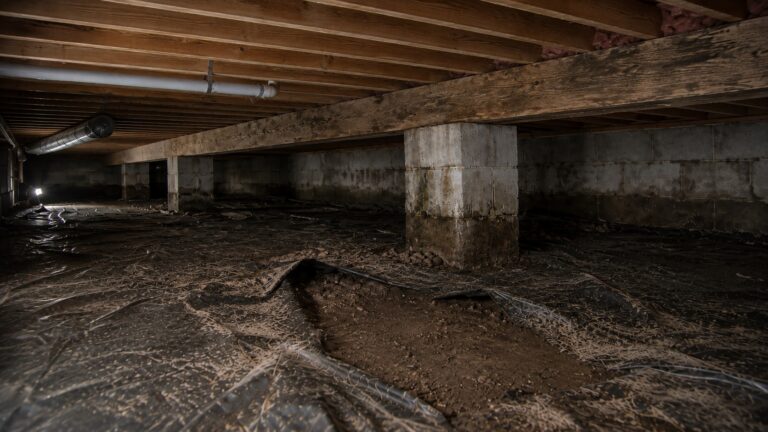
Crawl spaces are one of the most common places for moisture to affect structural framing. Ground moisture, poor drainage, humid air, standing water, missing vapor barriers, wet insulation, and poor air movement can keep joists and beams damp for long periods.
Crawl space joists may look dark, stained, moldy, or damp before the living area above shows obvious symptoms. Over time, moisture can contribute to softness, sagging, wood rot, fastener corrosion, and floor bounce. The risk is higher when joists remain damp season after season or when insulation traps moisture against the wood.
For a more specific look at this area, see Signs of Moisture Damage in Crawl Space Joists. If you need to identify hidden moisture in crawl space framing, see How to Detect Moisture in Crawl Space Framing.
Sill Plates and Rim Joists
Sill plates and rim joists are vulnerable because they sit near the edge of the structure. They may be affected by foundation moisture, exterior wall leaks, siding failures, poor drainage, crawl space humidity, basement dampness, or air leaks that create condensation.
Damage in this area matters because sill plates and rim joists help connect the floor system to the foundation or exterior wall assembly. Moisture problems here can remain hidden behind insulation, band joist cavities, finished basement ceilings, or exterior cladding.
Warning signs include dark wood, musty odor, damp insulation, insect activity, softness near the foundation edge, corrosion on fasteners, or recurring moisture along the perimeter of the home. These areas should be checked carefully before finishes are replaced or insulation is reinstalled.
Wall Studs and Bottom Plates
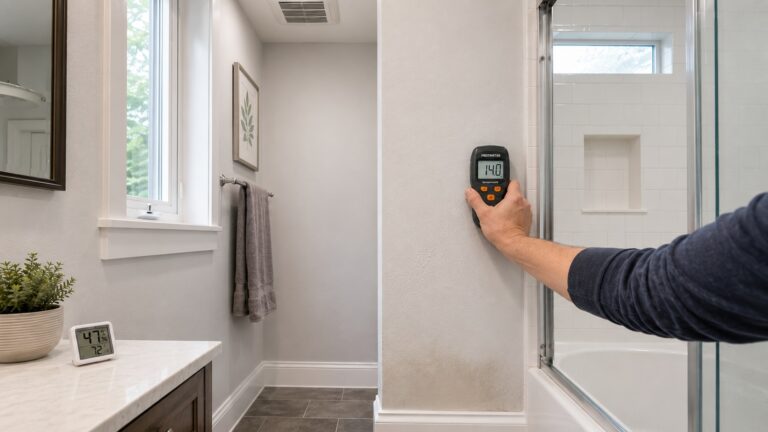
Wall studs and bottom plates often become wet after plumbing leaks, exterior wall leaks, window leaks, flooding, or roof water that travels down through wall cavities. The visible drywall may show only staining or bubbling, while the framing behind it remains damp.
Bottom plates are especially vulnerable because water settles at the lower edge of walls. After flooding, appliance leaks, bathroom leaks, or exterior water intrusion, water can wick into drywall, insulation, studs, and the bottom plate. If the area is enclosed too soon, the wood may stay damp and create conditions for mold, decay, or fastening problems.
Wet wall framing becomes more concerning when the affected wall is load-bearing, supports a beam, surrounds a large opening, or sits near a foundation edge. Soft studs, dark bottom plates, cracked headers, loose sheathing, or persistent dampness inside the cavity should be evaluated before the wall is closed again.
Roof Rafters and Sheathing
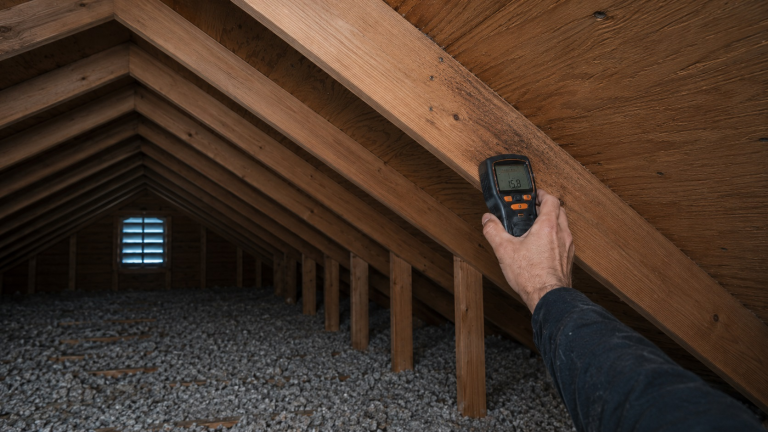
Roof framing can be weakened by leaks, condensation, poor attic ventilation, ice damming, flashing failures, and trapped attic humidity. The first visible sign inside the home may be a ceiling stain, but the actual moisture problem may be above the ceiling in rafters, trusses, roof sheathing, or insulation.
Roof sheathing can soften, swell, delaminate, or lose fastener strength if it stays wet. Rafters and trusses may show staining, mold growth, checking, or decay near leak paths. Moisture damage is especially concerning near roof valleys, chimneys, skylights, vents, eaves, and areas where attic airflow is poor.
Roof framing should not be judged only from below. A small interior stain may hide a larger area of wet roof sheathing. If roof framing appears soft, sagging, cracked, decayed, or repeatedly wet, it needs professional inspection before interior finishes are repaired.
Subfloors and Structural Panels
Subfloors and structural panels are vulnerable because they often absorb water from above while drying slowly from below. Bathrooms, kitchens, laundry rooms, entry doors, dishwashers, refrigerators, water heaters, and crawl spaces are common locations for subfloor moisture damage.
When subfloor panels get wet, they may swell at seams, lift under flooring, delaminate, soften, or lose fastener grip. Some panels may look acceptable from above while the underside shows staining, swelling, or surface breakdown. Finished flooring can hide the problem until the floor feels soft, uneven, or spongy.
Subfloor damage matters because the subfloor helps distribute loads across the joists. If it loses stiffness or separates from the framing, floors may feel bouncy, tile may crack, flooring may lift, and fasteners may loosen. Moisture-damaged subfloors should be evaluated before new flooring is installed over them.
When Wet Framing Can Dry Safely
Wet framing can sometimes dry safely and remain structurally sound. The key conditions are brief exposure, corrected moisture source, complete drying, firm wood, stable shape, and sound connections. If those conditions are met, replacement may not be necessary.
Framing is more likely to dry successfully when the water source is found quickly, the cavity is opened if needed, insulation or finishes that trap moisture are removed, airflow reaches the wet area, and drying continues until the wood is actually dry rather than just surface-dry.
Safe drying is more likely when:
- The wetting was brief and not repeated.
- The source of water has been corrected.
- The wood remains firm and solid.
- There is no visible rot or punky texture.
- The framing has not sagged, twisted, cracked, or shifted.
- Fasteners, hangers, and bearing points remain secure.
- The area is open enough to dry completely.
- Moisture is not trapped behind insulation, flooring, or wall finishes.
A moisture meter can help confirm progress, but readings should be compared with nearby dry framing of the same material whenever possible. A single surface reading is less useful than a pattern showing that the affected framing has returned close to normal for that area.
The most common mistake is closing the assembly too soon. Framing inside walls, under floors, or above ceilings may dry more slowly than the visible surface. If damp wood is covered with drywall, insulation, flooring, or vapor-retarding materials too early, moisture can remain trapped and continue causing problems.
In crawl spaces, drying structural wood may require source control, drainage correction, insulation removal, vapor barrier improvements, dehumidification, ventilation changes, or professional drying. For that specific situation, see How to Dry Crawl Space Structural Wood.
When Moisture-Damaged Framing Needs Professional Evaluation
Moisture-damaged framing needs professional evaluation when the issue goes beyond damp but firm wood. The more the framing affects support, load transfer, or structural stability, the more cautious you should be.
Call a qualified professional if you see:
- Soft, punky, crumbly, or easily penetrated wood
- Cracked, split, sagging, bowed, or twisted structural members
- Joists, beams, posts, rafters, sill plates, or headers affected by moisture
- Repeated wetting in the same framing area
- Visible rot near bearing points or connections
- Corroded or loose hangers, brackets, nails, screws, or bolts
- Floors that sag, bounce, dip, or feel unstable
- Walls that bow, crack, or shift after water exposure
- Roof framing or sheathing that appears softened or delaminated
- Foundation-adjacent framing that remains damp or deteriorated
Professional evaluation is especially important when the framing is load-bearing. A damaged beam, joist, post, rafter, header, or sill plate may affect more than the visible area. The issue may involve how weight is being transferred through the home.
If a floor, wall, ceiling, roof area, beam, post, or stair system appears unstable after water damage, avoid loading that area and get qualified help before probing, cutting, or removing materials around it.
If framing is soft, distorted, rotted, or repeatedly wet, do not simply cover it with new drywall, flooring, insulation, or trim. The source of moisture must be corrected first, then the framing must be evaluated before repair or replacement decisions are made. For that decision stage, see Should You Repair or Replace Structural Wood Affected by Moisture?.
Common Mistakes That Make Wet Framing Worse
Moisture-damaged framing is often misjudged in two opposite ways. Some homeowners assume every wet board is ruined. Others assume that if wood looks dry again, it is automatically safe. Both reactions miss the real issue: whether the framing stayed firm, straight, connected, and supported after the moisture exposure.
- Covering framing too soon: Drywall, insulation, flooring, or trim can trap moisture if the cavity was not fully dried first.
- Treating mold as the same thing as rot: Mold signals a moisture problem, but rot means the wood itself is breaking down.
- Ignoring connections: A joist, stud, or rafter may look mostly intact while fasteners, hangers, or bearing points have weakened.
- Repairing before source control: Replacing wood or closing walls before fixing the leak, drainage issue, or humidity source can let the same damage return.
FAQ
Can wet framing dry out and still be safe?
Yes, wet framing can sometimes dry out and remain safe if the exposure was brief, the water source was corrected, the wood dried completely, and the framing stayed firm, straight, and properly connected. Framing that remains soft, distorted, rotted, or repeatedly wet needs professional evaluation.
How long does it take for moisture to damage framing?
There is no single timeline because it depends on how wet the wood became, how quickly it dried, temperature, airflow, wood type, enclosure conditions, and whether the moisture source continued. A one-time leak found quickly is less risky than framing that stays damp for weeks or gets wet repeatedly.
Is mold on framing the same as rot?
No. Mold grows on surfaces and indicates a moisture problem. Rot involves decay fungi breaking down the wood itself. Mold may appear before rot, but mold alone does not automatically mean the wood has lost structural strength. Soft, punky, crumbly, or decayed wood is more serious.
Can damp crawl space joists weaken over time?
Yes. Crawl space joists can weaken over time if they stay damp because of ground moisture, poor drainage, standing water, wet insulation, or high humidity. Long-term dampness can lead to mold, decay, fastener corrosion, and floor movement above the crawl space, especially near joist ends and bearing points.
Does water damage weaken load-bearing walls?
Water damage can weaken load-bearing walls if it affects studs, bottom plates, headers, sheathing, fasteners, or bearing points. Surface stains on drywall are not automatically structural, but softened framing, decayed plates, shifted openings, or persistent moisture in a load-bearing wall should be inspected.
What is the biggest warning sign that wet framing has weakened?
Softness is one of the biggest warning signs. Staining alone may remain after a past leak, but wood that feels punky, crumbly, spongy, easily penetrated, distorted, or loose at connections may have lost strength and should be evaluated before it is covered or reused.
Bottom Line
Moisture weakens structural framing when it lasts long enough to change the wood, support decay, loosen connections, corrode hardware, or damage bearing points. Not every wet stud, joist, or rafter needs replacement, but framing that stays damp, changes shape, becomes soft, develops rot, or loses secure connections should not be covered up or ignored.
The safest way to judge wet framing is to look beyond stain color. Check firmness, shape, fasteners, bearing points, moisture history, and whether the member is load-bearing. When those factors are uncertain, professional evaluation is the safer path.