Signs of Mold Around Window Trim
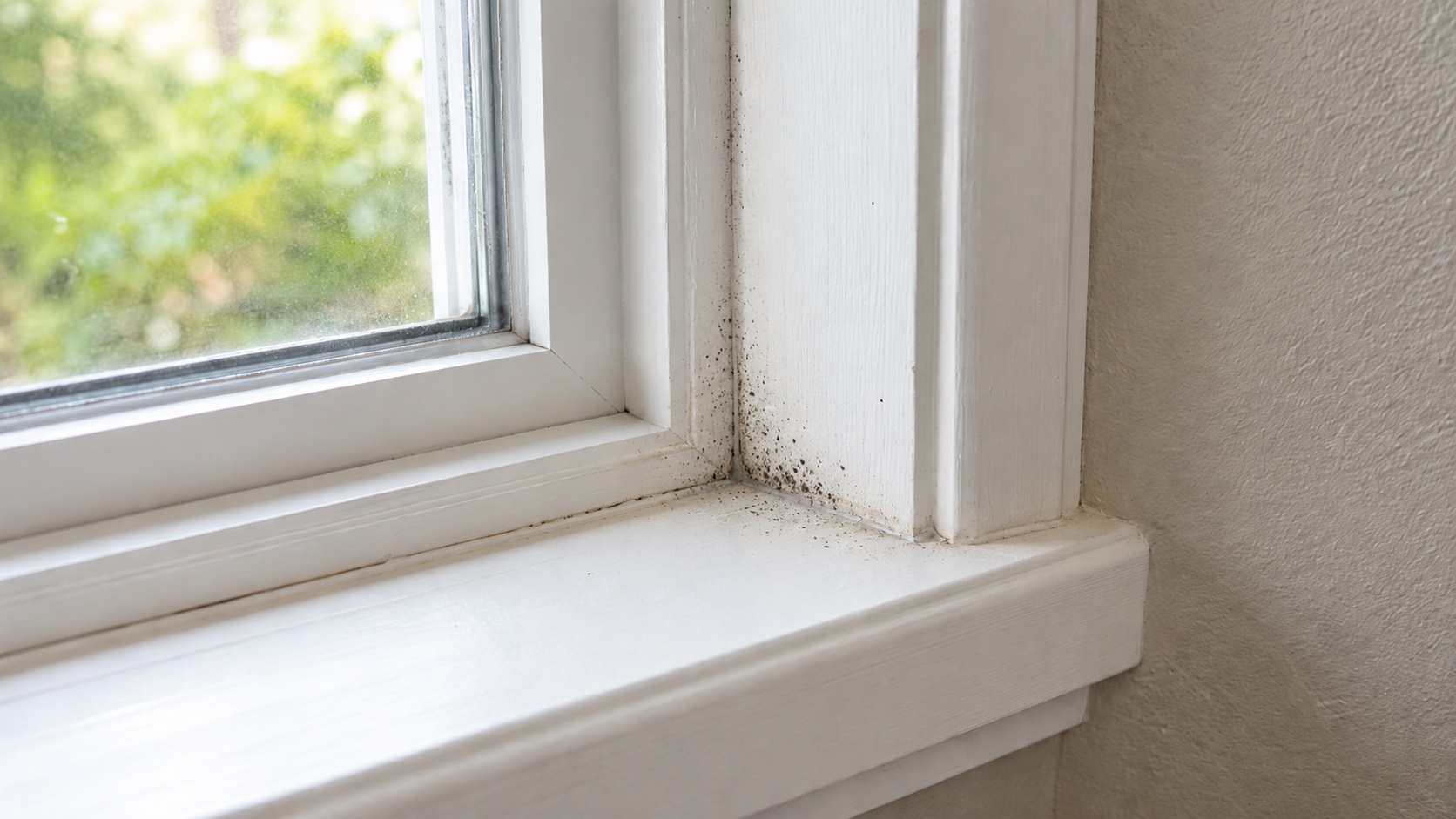
Signs of mold around window trim can include tiny black, green, gray, or white specks, faint staining along trim edges, rough or raised paint, musty odor near the window, and recurring spots that return after cleaning. These signs often appear first in lower corners, seams, and areas where condensation or small leaks keep the trim damp.
This guide explains how to identify visible mold symptoms on window trim, what patterns to watch for, and when the signs may point to hidden moisture behind nearby materials. If moisture exposure is suspected but not confirmed, it may also help to detect moisture around window frames before mold growth becomes more severe.
This article belongs to the window and door moisture cluster. For the broader parent guide, see how windows and doors cause hidden moisture problems, which explains how frame leaks, trim moisture, seal failures, and condensation can lead to hidden dampness around openings.
Why Mold Shows Up Around Window Trim First
Window trim is vulnerable to mold because wood, MDF, and painted trim surfaces can hold moisture along seams, corners, and small gaps. When condensation, humidity, or minor leaks keep those areas damp, mold can begin as surface spotting before spreading into larger patches.
Moisture Retention Along Trim Edges
Trim edges create natural collection points for moisture, especially where the casing meets the wall, sill, or lower corners. Small gaps can hold condensation or minor leak moisture long enough for spotting, staining, or surface mold to appear.
Paint and Wood Vulnerability
Painted trim surfaces provide limited protection against moisture. Once paint begins to crack, peel, or separate from the underlying surface, moisture can enter small openings and become trapped beneath the coating.
Wood trim is especially vulnerable because it naturally expands and contracts in response to humidity changes. These movements create microscopic openings where moisture can penetrate.
As moisture cycles continue, paint deterioration accelerates, creating additional areas where mold can develop.
Repeated Condensation Exposure
Condensation is one of the most common contributors to mold growth on window trim. When warm indoor air meets cooler window surfaces, moisture forms on glass and surrounding materials. Over time, repeated condensation creates consistently damp conditions along trim edges.
Understanding why condensation occurs helps explain why mold often appears around windows before other areas of the home. A detailed explanation of condensation behavior can be found in why windows develop condensation and mold, which explains how temperature differences and humidity levels contribute to recurring moisture cycles.
Condensation-related mold growth often develops gradually and may follow seasonal patterns, appearing more frequently during colder months.
Early Signs of Mold Around Window Trim
Mold rarely appears suddenly in large patches. Most growth begins as small visual changes that become more noticeable over time. Recognizing these early signs allows homeowners to investigate moisture problems before widespread contamination occurs.
Small Spotting Patterns
The earliest visible sign of mold on window trim usually involves small, scattered spots. These spots may appear as tiny dark specks that resemble dust or dirt. However, unlike normal surface dirt, mold spotting often returns after cleaning.
Spotting patterns commonly appear:
- Along lower trim corners
- Near joints between trim pieces
- At the bottom edge of vertical casing
- Where trim meets the wall surface
To check early spotting, shine a bright light across the trim at an angle and inspect the lower corners, seams, and bottom edge of the vertical casing. Spots that return after gentle cleaning, appear slightly embedded in the paint, or cluster near damp areas are more suspicious than loose surface dust.
Color Changes in Paint
Paint discoloration often occurs before visible mold clusters form. Changes in color may include faint gray shading, light brown staining, or uneven darkening along trim edges.
These color changes usually appear in areas where moisture accumulates repeatedly. Over time, discoloration becomes more noticeable as mold colonies expand.
Color changes may also signal moisture problems affecting nearby areas. In some cases, inspecting adjacent surfaces such as the sill may help determine whether moisture is spreading. A more focused inspection method is explained in inspect window sills for moisture damage, which helps identify moisture patterns that contribute to mold development.
Texture and Surface Changes
Mold growth often alters the texture of painted trim surfaces. Slight roughness, raised grain patterns, or uneven paint texture may indicate early mold activity.
Texture changes occur because mold colonies gradually break down surface materials. As growth continues, the affected surface may feel slightly rough or chalky to the touch.
These changes may appear before visible discoloration becomes obvious, making texture inspection an important step in early mold identification.
What Mold on Window Trim Looks Like
Mold on window trim can appear in several different forms depending on moisture levels, material type, and how long moisture has been present. While mold often begins as tiny specks, it can eventually form visible patches or clusters that become easier to identify.
Recognizing these visual patterns helps homeowners distinguish mold from ordinary dust, dirt, or staining. Understanding how mold typically looks on trim also helps determine whether the problem is likely to worsen over time.
Black Spotting Mold
Black spotting is one of the most common visual patterns associated with mold growth on window trim. These spots often begin as tiny dark dots that appear in clusters, especially near corners and seams.
Unlike surface dirt, black mold spotting usually spreads gradually and becomes more noticeable over time. The spots may appear slightly raised or embedded into the painted surface rather than sitting loosely on top.
Black spotting frequently appears in:
- Lower corners of trim
- Seams between trim sections
- Edges near the sill
- Areas where condensation collects
In early stages, these spots may resemble minor staining. However, repeated appearance in the same location often indicates active mold growth rather than simple dirt accumulation.
Green or Gray Mold Discoloration
Not all mold appears black. Some mold types develop greenish, gray, or even faint white discoloration. These variations may appear fuzzy, dusty, or slightly powdery depending on the environment.
Green or gray mold often develops in areas with consistent humidity exposure. These colors may appear softer in appearance than black spotting but can still indicate significant mold presence.
Color variations may include:
- Light green patches forming near trim corners
- Gray discoloration along horizontal trim edges
- Powdery white growth in persistently damp areas
- Mixed color patterns developing over time
Regardless of color, recurring discoloration strongly suggests ongoing moisture exposure. Understanding the moisture source becomes essential when these patterns appear.
Patch Formation Patterns
As mold growth continues, individual spots may merge into larger patches. These patches often develop irregular shapes that follow moisture pathways across the surface.
Patch formation commonly occurs when moisture remains present for extended periods. The growth may appear darker near the center and lighter toward the edges, indicating expanding colonies.
Typical patch characteristics include:
- Irregular shapes with uneven edges
- Dark centers surrounded by lighter discoloration
- Growth that follows seams or joints
- Gradual outward expansion over time
Patch formation usually indicates that mold has remained active long enough to establish stable colonies. Monitoring the size and shape of these patches helps determine whether the problem is worsening.
Signs Mold Is Active and Growing
Active mold usually changes over time. Spots may spread, return after cleaning, or become accompanied by odor when moisture conditions remain favorable.
Spreading Clusters Over Time
Active mold growth often spreads outward from the original location. Clusters that increase in size or number indicate that moisture is still present and supporting expansion.
Spreading clusters commonly appear when:
- Moisture remains trapped behind trim
- Condensation occurs repeatedly
- Water intrusion continues intermittently
- Humidity levels remain consistently high
Clusters that grow outward usually suggest ongoing moisture exposure rather than isolated past damage.
Recurring Growth After Cleaning
If mold spots disappear temporarily but return in the same location, the underlying moisture source likely remains active. Recurring growth indicates that mold spores are re-establishing colonies due to continued damp conditions.
This pattern often signals deeper moisture issues affecting surrounding materials. If mold keeps returning in the same area, hidden growth around the frame may be more likely. Additional structural-level warning signs are explained in signs of hidden mold around window frames, which focuses on mold that develops beyond visible trim surfaces.
Recurring mold is rarely harmless. Continued growth suggests that moisture conditions remain unresolved.
Increasing Musty Odor
A growing musty odor often accompanies expanding mold colonies. Odor strength typically increases as mold populations grow and release airborne particles.
Musty smells near window trim may indicate:
- Hidden moisture trapped behind trim
- Growing mold colonies inside wall cavities
- Poor ventilation allowing moisture to remain
- Repeated condensation cycles
Odor alone can sometimes signal mold presence before visible growth becomes obvious.
Signs Mold May Be Hiding Behind Window Trim
Visible mold on trim sometimes represents only part of the problem. This section stays focused on trim-level clues, but swelling, separation, persistent dampness, or musty odor can also point toward hidden mold around the window frame or nearby wall materials.
Trim Deformation or Swelling
Trim that appears swollen, warped, or uneven often indicates moisture trapped behind the surface. When materials absorb water repeatedly, expansion occurs and visible distortion may develop.
Deformation warning signs include:
- Trim edges separating from the wall
- Uneven alignment between trim sections
- Visible gaps forming near seams
- Bulging areas along the trim surface
Swelling suggests that moisture is reaching deeper layers beneath the visible surface.
Persistent Moisture Indicators
Moisture that remains present for long periods often leads to hidden mold growth behind trim. Even when visible mold appears minor, hidden moisture may continue feeding growth out of sight.
Persistent moisture indicators may include:
- Dampness that remains after cleaning
- Recurring discoloration in the same area
- Stains spreading outward from trim edges
- Softness beneath the painted surface
When these conditions appear alongside visible mold, hidden growth becomes increasingly likely. Check whether the trim feels cool, damp, soft, swollen, or separated from the wall; those clues suggest the issue may be more than surface staining.
Warning Signs Mold Around Window Trim Is Getting Worse
Not all mold growth presents the same level of concern, but certain patterns indicate increasing health, moisture, or material risks. Mold that spreads, persists, or produces strong odors should not be ignored. Recognizing these warning signs helps homeowners decide when further evaluation may be necessary.
Mold becomes more concerning when moisture remains present long enough to support continuous growth. Repeated exposure to damp conditions allows mold colonies to expand into surrounding materials, increasing both contamination and cleanup difficulty.
Air Quality Risks From Growing Mold
As mold colonies grow, they can release spores and fragments into the air. These may contribute to respiratory irritation, allergic reactions, or worsening indoor air quality, especially for people who are sensitive to mold or have existing respiratory concerns.
Air quality concerns become more likely when:
- Mold growth covers larger surface areas
- Musty odors persist or intensify
- Multiple rooms show signs of mold presence
- Ventilation remains limited in affected spaces
Even small areas of mold can contribute to discomfort if growth continues unchecked. Monitoring air quality changes helps identify situations where mold exposure may be increasing.
Rapid Mold Expansion
Mold growth that spreads quickly across trim surfaces often signals favorable moisture conditions. Rapid expansion usually occurs when moisture remains available continuously rather than drying between cycles.
Signs of rapid expansion include:
- Patches that noticeably enlarge within days or weeks
- New clusters forming near existing growth
- Growth spreading into adjacent wall areas
- Increasing discoloration across multiple surfaces
Rapid expansion strongly suggests that moisture sources remain active. Identifying and correcting moisture conditions becomes essential to prevent continued spread.
Hidden Mold Spread Beyond Visible Trim
Visible mold on trim sometimes indicates hidden growth deeper within surrounding materials. Mold that spreads behind trim or into nearby wall cavities may remain undetected until damage becomes severe.
Hidden spread often occurs when moisture persists behind surfaces where evaporation cannot occur easily. Once mold moves into concealed spaces, removal becomes more complicated.
Understanding long-term mold behavior is essential for preventing repeated growth cycles. If the problem is no longer limited to trim symptoms, the broader guide on how to remove mold permanently explains why safe cleanup and moisture control must work together.
When to Seek Professional Inspection for Mold Around Window Trim
Some mold conditions remain minor and stable, while others require professional evaluation. Recognizing when mold growth exceeds safe limits helps prevent long-term structural and air quality problems.
Large Areas of Visible Mold Growth
Professional inspection may be appropriate when mold growth covers large sections of trim or spreads into surrounding materials. Larger affected areas often indicate persistent moisture that has remained unresolved for extended periods.
Situations that may require evaluation include:
- Mold covering several inches or more of trim
- Growth extending beyond the original location
- Multiple window areas showing similar damage
- Visible deterioration of surrounding materials
Large areas of mold growth increase the likelihood of hidden contamination within surrounding materials.
Recurring Mold That Returns Frequently
Recurring mold growth suggests that moisture conditions remain unresolved. Even if mold is cleaned repeatedly, it may reappear if moisture continues to affect the same area.
Recurring mold patterns often include:
- Mold returning shortly after cleaning
- New growth appearing in previously cleaned areas
- Persistent discoloration that does not fade
- Ongoing musty odor near affected trim
Frequent recurrence usually indicates that moisture sources remain active beneath visible surfaces.
Structural Changes or Material Weakness
Material changes around window trim can signal deeper moisture damage. Weakening materials may compromise the stability of trim sections and surrounding wall components.
Structural warning signs may include:
- Trim separating from surrounding surfaces
- Soft wood that compresses easily
- Cracks forming near trim joints
- Paint failure occurring repeatedly
These changes suggest that moisture has affected materials long enough to weaken their structural integrity.
FAQ: Signs of Mold Around Window Trim
What does mold look like on window trim?
Mold on window trim often appears as small black, green, or gray spots that gradually expand into irregular patches. These spots may look dusty or slightly raised and often appear near corners, seams, or areas where moisture collects.
Can mold grow under painted window trim?
Yes. Mold can grow beneath painted surfaces when moisture becomes trapped below the paint layer. Paint may bubble, crack, or discolor before visible mold appears on the surface.
Is mold around window trim dangerous?
Mold becomes more concerning when it spreads, produces strong odors, or affects indoor air quality. Small areas may remain manageable, but expanding mold growth increases health and structural risks.
Why does mold keep returning on window trim?
Recurring mold usually indicates that moisture conditions remain unresolved. Moisture may come from condensation, leaks, or humidity problems that continue feeding mold growth.
Can mold spread from trim into surrounding walls?
Yes. Mold can move beyond trim into surrounding materials when moisture remains present long enough to support growth. Hidden mold behind trim may continue spreading even when surface growth appears minor.
How fast does mold grow on window trim?
Mold growth speed depends on moisture levels, temperature, and ventilation. Under favorable conditions, visible mold may begin forming within days and continue expanding as long as moisture remains present.
Conclusion: Recognizing Trim Mold Early Prevents Larger Problems
Mold around window trim often begins with small, subtle signs that gradually become more visible over time. Spotting patterns, discoloration, texture changes, and recurring growth all provide valuable clues about moisture exposure and developing mold activity.
Early recognition of these warning signs allows homeowners to investigate moisture sources before mold spreads into surrounding materials. Monitoring trim condition regularly helps prevent long-term structural damage and reduces the risk of widespread contamination.
Key Takeaways
- Mold around window trim usually begins as small spotting patterns near corners and seams.
- Discoloration, texture changes, and recurring growth are common early indicators.
- Expanding patches and persistent odor suggest active mold growth.
- Hidden mold may exist behind trim when swelling or repeated moisture occurs.
- Large or recurring mold problems often indicate ongoing moisture exposure.
- Early identification helps prevent mold from spreading into surrounding structures.