How Hidden Moisture Causes Recurring Mold
Recurring mold often starts where you cannot see it. A wall, cabinet, floor, or ceiling may look clean after mold cleanup, but hidden moisture can remain behind the surface. When that dampness stays trapped inside drywall, trim, flooring, insulation, cabinets, or wall cavities, mold can return even though the visible area was cleaned.
The pattern often looks like this: the surface dries, the stain fades, or the smell improves for a few days. Then the musty odor returns, a stain darkens, paint bubbles, or mold appears near the same seam, edge, cabinet, wall, ceiling, or floor area. In many cases, the mold is being supported by moisture that was never fully found, dried, or removed.
Hidden moisture is one of the most important reasons mold becomes a recurring problem instead of a one-time cleanup. The broader recurrence pattern is explained in Why Moisture Problems Keep Returning, while this article focuses specifically on how concealed dampness feeds mold after the surface appears clean.
Why Hidden Moisture Makes Mold Come Back
Mold needs moisture to keep growing. Cleaning the visible mold may remove what you can see, but it does not automatically remove moisture inside the materials behind it. If dampness remains inside drywall paper, wood fibers, insulation, carpet padding, cabinet panels, subflooring, or wall cavities, the conditions that supported mold may still be active.
The basic pattern is simple. Water enters or condenses in a hidden area. A nearby material absorbs that moisture. The visible surface dries first or gets cleaned. The hidden material stays damp longer because it has limited airflow. Over time, mold odor, staining, or visible growth returns at the surface.
This is why a surface-only cleaning can fail even when the visible mold was removed. The cleanup may have treated the symptom, but the damp material behind the symptom was still there. For the broader mold cleanup framework, see How To Remove Mold Permanently.
Hidden moisture can also keep mold active without obvious dripping or puddles. A slow plumbing seep, damp insulation, condensation inside a wall, or moisture under flooring may not look dramatic, but damp material can continue feeding the same mold pattern.
How Moisture Hides Behind Clean-Looking Surfaces
Moisture often hides because finished surfaces dry and clean differently than the materials behind them. Paint, tile, vinyl flooring, laminate, cabinet finishes, and trim can make a surface look normal while moisture remains behind or underneath.
This is especially common after leaks, floods, condensation, roof drips, appliance leaks, shower leaks, window leaks, and basement seepage. The visible surface may be the last place moisture appears and the first place someone tries to clean, but the actual damp material may be deeper inside the assembly.
Drywall and wall cavities
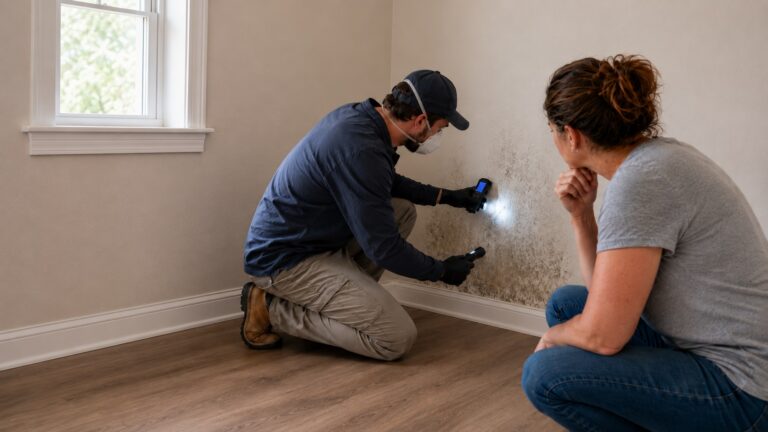
Drywall is one of the most common places hidden moisture causes recurring mold. The painted face of drywall may look dry while the paper layer, cut edge, backside, or wall cavity remains damp. If moisture entered from behind, surface cleaning may never reach the affected side of the material.
This matters because mold can return at the visible face even when the surface was scrubbed. Moisture can move through drywall, collect at seams, or remain trapped near insulation and framing. A wall may feel mostly dry but still have damp areas behind paint, behind baseboards, or inside the cavity.
Warning signs include mold returning near the same wall section, staining that bleeds through paint, a musty smell near a wall, cool or soft drywall, bubbling paint, and mold appearing along seams or corners. If you suspect the issue is inside the wall rather than on the surface, compare the situation with Signs of Mold Behind Walls.
Baseboards, trim, and floor edges
Baseboards and trim can hide moisture at the wall-floor joint. This area often receives water from leaks, mopping, condensation, exterior wall dampness, plumbing problems, or minor flooding. It also has limited airflow, especially when trim is tight against the wall and floor.
When moisture collects behind trim, mold may return at the top edge of the baseboard, the bottom edge of the wall, inside corners, or along flooring seams. The visible wall may be cleaned, but the lower edge of the drywall, the backside of the trim, or the floor edge may still be damp.
Swollen baseboards, soft trim, darkened edges, peeling paint near the floor, and musty odor along a wall are all signs that the problem may be hidden at the joint rather than limited to the surface stain.
Cabinets, flooring, and insulation
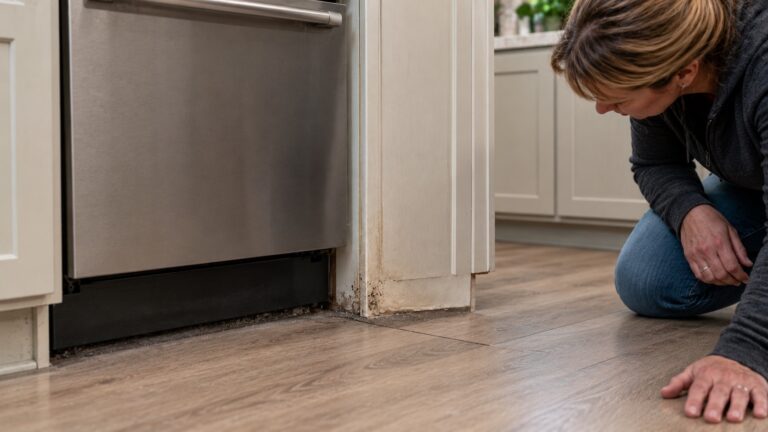
Cabinets can hide moisture after sink leaks, dishwasher leaks, refrigerator water line leaks, bathroom fixture leaks, or slow plumbing seepage. Cabinet bases, toe kicks, back panels, and unfinished edges can absorb water and dry slowly. The visible cabinet surface may be wiped clean while the material behind or below it stays damp.
This is why mold can return inside a cabinet even after the shelves and visible panels were cleaned. If the back panel, cabinet floor, wall behind the cabinet, or toe-kick area remains damp, the cabinet can continue to smell musty or develop new dark spots at seams and corners.
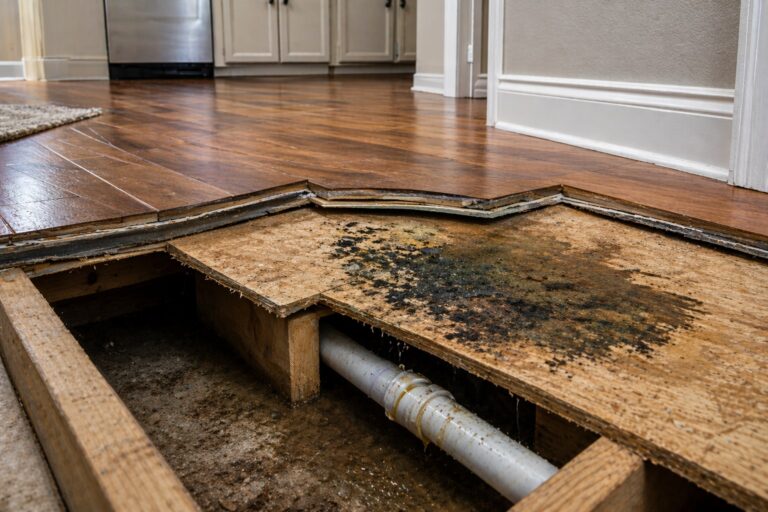
Flooring can hide moisture in a similar way. Finished flooring may feel dry on top while moisture remains in carpet padding, underlayment, subflooring, adhesive layers, or seams. Mold may not appear on the walking surface right away. Instead, the homeowner may notice musty odor, lifted edges, soft spots, staining near baseboards, or recurring mold where the floor meets the wall.
Insulation is another hidden moisture concern. Wet insulation inside walls, ceilings, attics, crawl spaces, and basement finishes can hold moisture against nearby materials. When insulation stays damp, it can keep drywall, framing, or ceiling materials damp long after the visible surface looks normal.
Why Surface Cleaning Does Not Fix Hidden Moisture
Surface cleaning can remove visible mold from the area you can reach, but it cannot dry hidden materials by itself. It also cannot correct the leak, condensation, humidity, or trapped moisture that allowed the mold to grow in the first place.
This is where many recurring mold problems begin. A homeowner sees mold on a wall, cabinet, ceiling, or trim area and cleans what is visible. The surface looks better, so the problem seems fixed. But if the damp material behind that surface remains wet, the same conditions continue underneath.
This does not mean every cleaning attempt is useless. Minor surface mold on a dry, hard, nonporous surface is very different from mold connected to wet drywall, insulation, carpet padding, cabinet panels, or wall cavities. The problem is assuming that all mold behaves like a simple surface stain.
Porous materials make recurring mold more likely because moisture and organic material can exist inside the material, not just on the face. Drywall paper, MDF trim, unfinished wood, carpet backing, insulation, and cabinet panels can all hold moisture in places a cloth, spray, or brush cannot reach.
This is also why mold may return after the visible area was cleaned carefully. The cleaner may have removed what was on the surface, but the source of dampness may have stayed behind. For more on post-cleanup warning signs, see Signs Mold Was Not Fully Removed.
Common Places Hidden Moisture Causes Recurring Mold
Hidden moisture can occur anywhere water enters, condenses, or becomes trapped. The strongest clue is usually the pattern: where the mold returns, what material surrounds it, and what conditions make the area damp again.
Behind walls and ceilings
Walls and ceilings can hide moisture from roof leaks, plumbing leaks, shower leaks, condensation, exterior wall intrusion, or HVAC problems. A cleaned ceiling stain does not prove the drywall, insulation, or cavity above it is dry.
Recurring mold on walls and ceilings is especially concerning when it appears near old water stains, around corners, below bathrooms, under roof areas, near windows, or along exterior walls. These locations often have hidden moisture paths that are not obvious from the room side.
Under flooring and carpet padding
Flooring systems can hide moisture after appliance leaks, plumbing leaks, door leaks, basement seepage, minor flooding, or wet cleaning. The top layer may dry first while water remains below it. This is common with carpet padding, laminate underlayment, vinyl edges, hardwood seams, and subfloors.
Mold related to hidden floor moisture may show up as a musty smell, staining near baseboards, lifted flooring edges, soft spots, or dark growth where the floor meets trim.
Behind cabinets and fixtures
Cabinets and fixtures create enclosed spaces where moisture dries slowly. Kitchen sinks, bathroom vanities, dishwashers, refrigerators, toilets, tubs, showers, and laundry fixtures can all create hidden moisture behind or beneath finished surfaces.
If mold returns inside a cabinet, near a toe kick, behind a toilet, under a sink, or around a fixture after cleaning, the visible surface may not be the main source. The wall, floor, pipe connection, fixture seal, cabinet back, or enclosed base area may still be damp.
Around windows, doors, basements, and crawl spaces
Windows and doors can hide moisture in rough openings, trim pockets, sill areas, and wall cavities. Mold around the trim may come from condensation, air leakage, failed flashing, exterior water entry, or repeated wetting during storms.
Basements and crawl spaces are also common hidden moisture sources because soil moisture, drainage problems, humid air, foundation seepage, and limited drying conditions can keep nearby materials damp.
For a broader room-by-room inspection framework, see How to Find Hidden Moisture in Different Areas of Your Home.
Signs Hidden Moisture Is Feeding Mold
Hidden moisture usually reveals itself through patterns. One sign by itself may not prove mold is growing behind the surface, but repeated signs in the same area make hidden dampness much more likely.
Mold returns in the same area after cleaning
Mold that returns in the same area after cleaning is one of the strongest signs that hidden moisture may still be active. The visible mold may have been removed, but the material behind it may still be damp enough to support regrowth.
This is especially important when mold returns around the same seam, corner, baseboard, ceiling stain, cabinet joint, window trim, or floor edge. Those locations often act as exit points where hidden moisture shows up at the surface.
Same-area recurrence can be caused by hidden moisture, poor drying, recurring condensation, or a repeated leak. For the fuller same-location diagnosis, see Why Mold Returns in the Same Locations.
A musty odor remains after the surface looks clean
A persistent musty odor is another important clue. Mold does not always remain visible after cleaning, especially if the visible surface was scrubbed, painted, or covered. But damp material behind the surface may continue to produce odor.
The odor may be strongest near a wall, cabinet, closet, floor edge, ceiling stain, window, or basement corner. It may also become stronger when the room is closed up, when humidity rises, after rain, after showers, or when the HVAC system moves air through the area.
A musty smell does not prove that hidden mold is present, but it does suggest that moisture, organic dust, contaminated material, or poor airflow may still be part of the problem. If the smell returns repeatedly after cleaning, do not treat it as just a cleaning-product issue.
Stains, soft materials, and edge growth keep appearing
Hidden moisture often causes visible damage before it causes obvious mold. Watch for stains that bleed through paint, paint that bubbles or peels, drywall that feels soft or swollen, trim that warps, cabinet panels that puff, or flooring edges that lift.
Mold that appears along edges is especially common when moisture is hidden behind the surface. Baseboard lines, cabinet seams, window corners, wall-floor joints, ceiling-wall corners, and flooring transitions can all collect moisture or reveal moisture moving from behind the material.
These material changes matter because they show that moisture is affecting the structure of the surface, not just leaving a cosmetic mark. Once a material is soft, swollen, warped, or delaminating, repeated surface cleaning is unlikely to solve the full problem.
Rain, humidity, shower, or HVAC triggers make it worse
Hidden moisture often becomes more obvious after a trigger. Mold or odor may return after rain, after showers, during humid weather, during cold-weather condensation, or when HVAC equipment runs. These triggers can help identify whether the moisture is coming from outside, inside air, plumbing use, or mechanical equipment.
For example, mold that gets worse after rain may point to exterior water entry. Mold that returns after showers may point to bathroom humidity or a shower leak. Mold that appears around ducts or air handlers may point to condensation or drainage issues. Mold that worsens during humid months may point to indoor humidity and poor airflow.
If the trigger is not obvious, track the timing for a few days or weeks. Write down when the odor or spots appear, what the weather was like, whether plumbing fixtures were used, whether the HVAC system ran, and whether humidity felt high. Pattern tracking often reveals the source better than repeated cleaning.
How Hidden Moisture Can Stay Active After Repairs
Hidden moisture can remain active even after a repair appears successful. This often happens when the leak was fixed but wet materials were not fully dried, when a wall or floor was closed too soon, or when the original repair addressed only one source while another source remained nearby.
For example, a pipe repair may stop the drip, but the cabinet base or wall behind it may still be wet. A roof repair may stop new water from entering, but the ceiling insulation may remain damp. A window may be recaulked, but the rough opening or trim pocket may still hold moisture. In each case, the repair may be real, but the hidden damp material remains part of the mold problem. This poor-drying pattern is covered more directly in How Poor Drying Causes Mold Recurrence.
Hidden moisture can also stay active when airflow is poor. Wall cavities, cabinet backs, enclosed floor layers, closet corners, insulated ceilings, and basement finishes dry slowly because air cannot move through them easily. If new paint, trim, flooring, or cabinets are installed before drying is complete, moisture can become trapped again.
This is why recurring mold is often connected to broader moisture recurrence. The article Why Moisture Problems Come Back explains how source, path, storage, and drying conditions work together when dampness returns after a repair.
When Hidden Moisture Requires Deeper Inspection
Hidden moisture does not always mean you should immediately open a wall or remove flooring. But certain signs make deeper inspection more reasonable, especially when the problem repeats after cleaning or repair.
Deeper inspection may be needed when mold returns in the same area more than once, when a musty odor persists with no visible source, when drywall or trim is soft, when flooring is lifting, when a cabinet base is swollen, when insulation may have been wet, or when the mold appears after a known leak or water damage event.
Professional inspection is more important when the suspected moisture is inside wall cavities, ceilings, insulation, HVAC components, crawl space framing, structural wood, or large finished areas. Disturbing moldy materials without containment, PPE, or a plan can spread dust and spores, and hidden wet materials can be difficult to evaluate from the room side alone.
If the affected area is small and there are no signs of hidden material damage, non-invasive checks may be enough at first. If the problem keeps returning, spreads, smells stronger, or involves soft materials, it is usually time to stop treating only the surface.
What to Do If You Suspect Hidden Moisture
If you suspect hidden moisture is causing recurring mold, do not start by repeatedly cleaning the same visible spot. Start by looking for the moisture pattern. Recurring mold is usually easier to solve when you identify where the dampness is coming from, where it is being stored, and what keeps reactivating it.
- Watch where the mold returns. Same-area mold often points to a local hidden moisture source behind the surface, near a seam, or inside a nearby material.
- Track the timing. Note whether mold or odor returns after rain, showers, HVAC use, humid weather, cold weather, appliance cycles, or plumbing use.
- Compare nearby materials. Look for surfaces that feel cooler, softer, damper, more swollen, or more musty than surrounding materials.
- Check edges and seams first. Hidden moisture often appears at baseboards, trim, wall-floor joints, cabinet seams, window corners, door frames, ceiling edges, and flooring transitions.
- Compare the suspect area with a dry control area. Check a similar wall, floor edge, cabinet, or trim section nearby so you can tell whether the problem area feels cooler, softer, more swollen, or more odor-prone than normal.
- Look for the nearest likely source. Consider plumbing, roof paths, window or door leaks, foundation seepage, HVAC condensation, bathroom humidity, and exterior water entry.
- Use non-invasive checks before opening surfaces. Visual inspection, odor patterns, humidity readings, thermal differences, and moisture meter comparisons can help narrow the suspect area.
- Avoid covering the area too soon. Do not paint, caulk, reinstall trim, or close flooring over a damp area before the moisture source and material condition are understood.
- Do not disturb contaminated or widespread mold casually. If the area is large, hidden, sewage-related, flood-related, or connected to HVAC or structural materials, get professional guidance before cutting, sanding, or removing materials.
- Escalate when the pattern repeats. If mold keeps returning after cleanup, the problem may need deeper inspection instead of stronger cleaning products.
If you need to investigate moisture without immediately opening walls or ceilings, start with How to Detect Moisture Without Opening Walls. For recurring, hidden, widespread, or material-damaging mold problems, When to Hire a Mold Remediation Professional can help you decide when the problem has moved beyond basic homeowner inspection.
FAQ
How do I know if mold is coming from behind the wall?
Possible signs include mold returning in the same area, a musty smell near the wall, stains bleeding through paint, bubbling paint, soft drywall, cool or damp surfaces, and mold appearing along seams, corners, or baseboards. These signs do not prove hidden wall mold by themselves, but they justify closer moisture investigation.
Can drywall look dry but still have hidden moisture?
Yes. Drywall can look dry on the painted surface while moisture remains in the paper layer, backside, cut edges, insulation, or wall cavity. This is especially common after leaks, condensation, flooding, or water that entered from behind the wall.
Does a musty smell mean hidden moisture?
A musty smell does not prove hidden moisture, but it is a strong clue when it persists after cleaning or returns during humid weather, rain, showers, or HVAC use. The smell may come from damp material, hidden mold growth, contaminated dust, or poor airflow.
Can mold return if the leak was fixed?
Yes. A repaired leak stops new water from entering, but it does not automatically dry the materials that were already wet. Mold can return if drywall, insulation, cabinets, flooring, trim, or framing stayed damp after the repair.
Should I open the wall if mold keeps coming back?
Not immediately in every case. Start with pattern tracking, visual inspection, humidity checks, moisture comparisons, and likely source checks. Opening a wall may be necessary when signs are strong, materials are soft, odor persists, or mold keeps returning, but larger or moldy areas are often safer to evaluate with professional help.
Can a dehumidifier dry hidden moisture behind walls or floors?
A dehumidifier can help lower indoor humidity and support drying, but it cannot fix active leaks, wet insulation, sealed wall cavities, trapped subfloor moisture, or contaminated porous material by itself. It is a support tool, not a complete solution for hidden moisture.
When should hidden moisture be inspected professionally?
Professional inspection is wise when mold returns repeatedly, the source is hidden, materials are soft or swollen, insulation may be wet, odors are widespread, the affected area is large, HVAC components are involved, or structural wood may be damp. These situations often require more than surface cleaning.
Key Points About Hidden Moisture and Recurring Mold
- Drywall, trim, insulation, flooring, cabinets, and wall cavities can hold moisture below or behind the surface.
- Musty odors, same-area regrowth, bubbling paint, soft drywall, swollen trim, and edge growth are important warning signs.
- Recurring mold often appears at seams, baseboards, cabinets, floor edges, window trim, ceiling corners, and other hidden moisture exit points.
- Rain, showers, humidity, HVAC use, and cold-weather condensation can reactivate hidden moisture problems.
- Repeated mold recurrence usually calls for deeper moisture investigation, not repeated surface cleaning.
The Mold Is Usually the Symptom, Not the Source
Recurring mold is often a moisture clue, not just a cleaning failure. A wall, floor, cabinet, ceiling, or trim area may look clean while damp material remains behind it.
The lasting solution is not simply to clean harder. It is to find the moisture source, understand where water is being stored, confirm that affected materials can dry, and avoid covering the area before hidden dampness is resolved.
When mold keeps returning after cleanup, the next step is to find the damp material or moisture path that keeps reactivating it.