How Much Does Mold Inspection Cost?
Mold inspection usually costs between $300 and $1,100 for most homes, with many standard inspections falling around the $500 to $700 range. The final price depends on the size of the home, how many areas need to be checked, whether lab testing is included, and whether the inspector needs to investigate hidden areas such as wall cavities, crawl spaces, attics, basements, or HVAC systems.
For many homeowners, the bigger question is not just “How much does a mold inspection cost?” It is whether paying for an inspection is actually useful. If you already have obvious mold growing on a small bathroom surface, a full lab-based inspection may not be necessary. But if you smell mold and cannot find it, have recurring mold after cleaning, are buying a home, or suspect hidden moisture behind walls or flooring, a professional inspection can help identify the source before cleanup begins.
A mold inspection is most useful when you need to understand where the moisture is coming from. Mold is usually a symptom of a moisture problem, not the original cause, so the inspection should focus on both visible growth and the conditions allowing it to grow. If you are still trying to understand the larger cleanup process, start with how mold removal fits into the larger remediation process before deciding whether inspection, testing, or professional cleanup is the next step.
How Much Does Mold Inspection Usually Cost?
A basic mold inspection for a typical home often costs a few hundred dollars. A more detailed inspection with air sampling, surface sampling, lab analysis, a written report, or hard-to-access areas can cost significantly more. A practical homeowner-facing range is:
- Basic visual mold inspection: often around $300 to $500
- Standard mold inspection with limited testing: often around $500 to $700
- Detailed inspection with multiple samples or complex areas: often around $700 to $1,100 or more
- Post-remediation clearance testing: may be priced separately after cleanup
These numbers are not fixed prices. Mold inspection costs vary by region, home size, company pricing model, and what is included in the service. One company may quote a low inspection price but charge separately for every air or surface sample. Another may offer a higher flat-rate package that already includes several samples and a written report.
The most important thing is to ask what the quote actually includes. A $300 inspection that only includes a visual walkthrough is very different from a $700 inspection that includes moisture readings, multiple air samples, lab analysis, photos, and a written summary. The cheaper quote is not always worse, and the more expensive quote is not always better. The value depends on the situation you are trying to solve.
Why mold inspection prices vary so much
Mold inspection prices vary because not every mold concern requires the same level of investigation. A small visible patch near a bathroom ceiling fan may only need a basic moisture and ventilation check. A musty basement with no visible mold may require moisture mapping, humidity evaluation, foundation checks, and possibly air or surface sampling. Home size, access difficulty, number of suspected areas, and lab testing can all change the final price.
What Is Included in a Mold Inspection?
A professional mold inspection should do more than confirm that something looks suspicious. A useful inspection should help answer three practical questions: where is the mold or suspected mold, what moisture condition is allowing it to grow, and what should happen next?
Most mold inspections include some combination of the following:
- Visual inspection of visible staining, discoloration, water damage, or suspected mold growth
- Moisture checks around walls, ceilings, flooring, trim, cabinets, bathrooms, basements, attics, or crawl spaces
- Evaluation of musty odors and likely hidden moisture sources
- Inspection of areas with past leaks, flooding, condensation, or humidity problems
- Photos or notes documenting suspicious areas
- Recommendations for testing, cleanup, repair, or further investigation
- Optional air, surface, or material samples sent to a lab
- A written report, depending on the company and inspection package
The best mold inspections are moisture investigations, not just mold-spotting visits. If the inspector only looks for visible growth but does not ask about leaks, humidity, condensation, plumbing problems, roofing issues, or previous water damage, the inspection may miss the reason mold appeared in the first place.
This matters because mold can return after cleaning if the moisture source remains. In those cases, the inspection should help connect the mold concern to the underlying moisture behavior. For a broader view of how moisture problems start and return in homes, see how to find, fix, and prevent moisture problems in a house.
Visual inspection
A visual inspection is the starting point. The inspector looks for visible mold growth, staining, water marks, swollen materials, peeling paint, warped trim, soft drywall, musty odors, and other signs that moisture has been present long enough to support mold growth.
Visible mold does not always require lab testing to prove that it exists. If mold-like growth is clearly visible, the more important questions are usually how large the affected area is, what material is involved, whether the moisture source is active, and whether the growth is only on the surface or possibly hidden behind the material.
Moisture checks
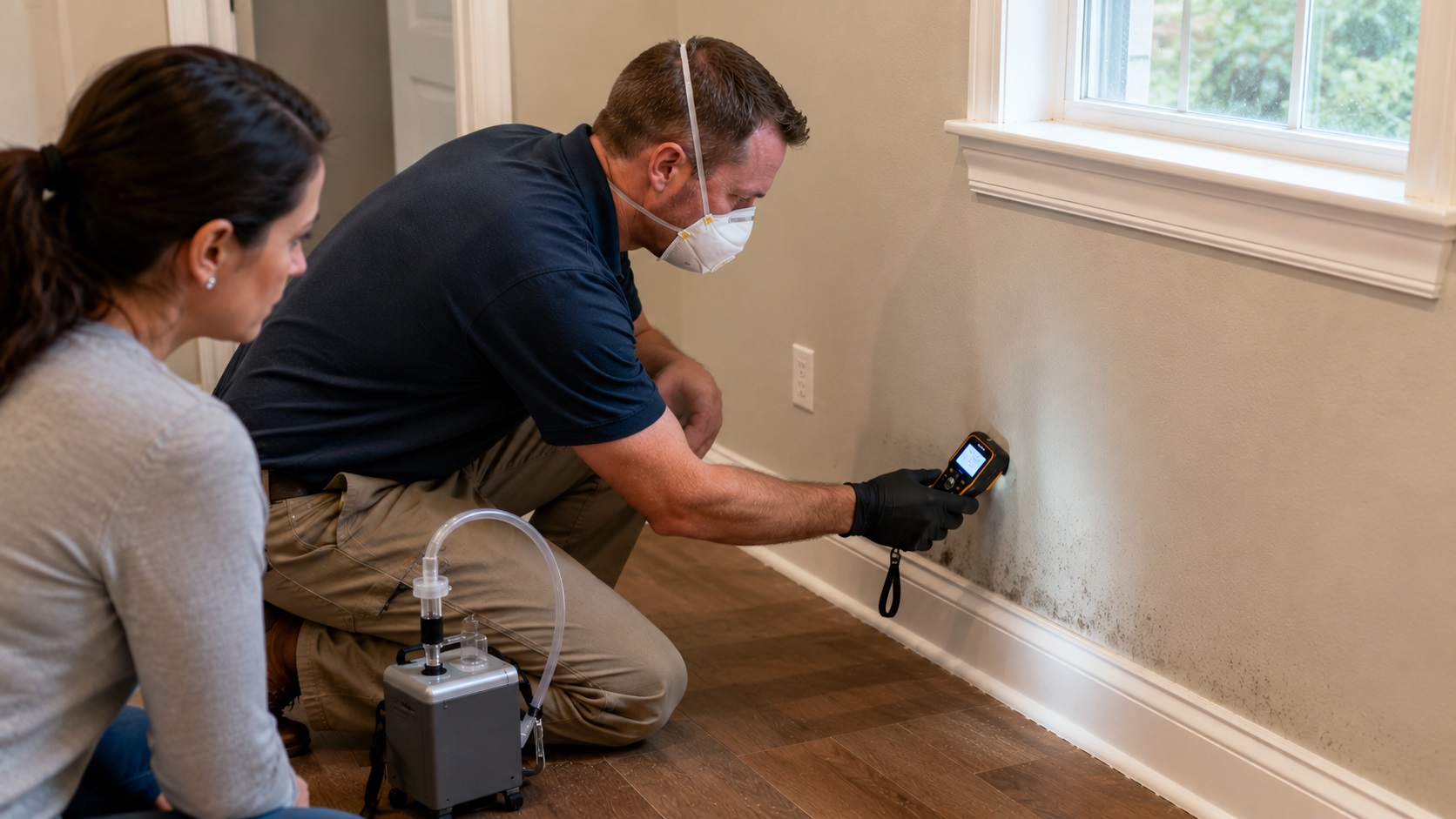
A mold inspector may use a moisture meter, humidity meter, infrared camera, or other inspection tools to look for areas where materials are damp. These readings help identify whether the mold concern is connected to an active leak, trapped moisture, condensation, high humidity, or past water damage that did not dry properly.
Moisture checks are often more useful than simply identifying the mold type. A lab result may tell you that mold spores were present, but it may not tell you why the wall is damp, why the odor keeps returning, or whether water is still entering the structure.
Air or surface sampling
Air and surface samples may be useful when mold is suspected but not visible, when a real estate transaction requires documentation, when post-remediation clearance is needed, or when the situation is disputed. Sampling may include air cassettes, swabs, tape-lift samples, or pieces of affected material.
However, testing is not always necessary. If mold is already visible, the priority is usually to correct the moisture source and remove contaminated material safely. Sampling can add cost, so it should have a clear purpose. Homeowners should ask why each sample is being collected, what the result will show, and how it will change the next step.
Written report
A written report may include photos, moisture readings, suspected mold locations, sample results, lab interpretation, and recommendations. Reports are especially useful for real estate transactions, insurance discussions, landlord disputes, post-remediation clearance, or situations where several contractors may need to understand the same problem.
If you are paying for a professional inspection, ask whether a written report is included. A verbal opinion may be enough for a simple concern, but a more expensive inspection should usually provide clear documentation of what was found and what was not found.
Mold Inspection vs. Mold Testing: Why the Price Changes
Mold inspection and mold testing are often discussed together, but they are not the same service. A mold inspection is the investigation. Mold testing is the sampling and lab analysis that may be added when the situation calls for it. This distinction is one of the biggest reasons mold inspection prices vary from one company to another.
A mold inspection may include a visual review, moisture readings, humidity checks, odor investigation, and a review of past leaks or water damage. Mold testing usually means collecting air, surface, or material samples and sending them to a lab. Because samples take time to collect, document, submit, and interpret, one quote may include lab work while another charges for each sample separately. Before comparing prices, ask each company exactly what is included.
When mold testing may add value
Mold testing may be useful when mold is suspected but not visible, when there is a musty odor with no clear source, when a home sale requires documentation, when a landlord or insurance situation needs written evidence, or when post-remediation clearance testing is needed after cleanup.
Testing can also help when the inspection finds moisture patterns that suggest hidden mold behind walls, under flooring, inside ceiling cavities, in HVAC areas, or in a crawl space. In those situations, samples may support the inspector’s findings, but they should not replace a physical moisture investigation.
If your main concern is a musty odor without visible growth, the more important first step is finding where the odor is coming from. A lab result can confirm that mold spores exist, but it may not identify the damp wall cavity, wet cabinet base, attic condensation problem, or crawl space moisture source causing the smell. For that specific situation, see what a mold smell with no visible mold may mean.
When testing may not be necessary
Testing is not always needed when mold is already visible. If there is obvious mold growth on drywall, trim, ceiling material, or another building surface, the practical priority is usually to identify the moisture source, determine whether the affected material can be cleaned or must be removed, and plan the cleanup correctly.
For example, if a bathroom ceiling has visible mold because the exhaust fan does not remove moisture well, a lab test may not change the solution. The homeowner still needs to correct the moisture problem and clean or replace affected material as appropriate. In that case, paying extra to identify the exact mold species may not provide much practical benefit.
Testing should have a purpose. Before approving samples, ask the inspector what the test will answer and how the result will affect the next decision. If the answer is vague, the sample may not be necessary.
For general mold cleanup guidance, the EPA notes that mold sampling is usually unnecessary when visible mold is already present, because the moisture source and cleanup plan usually matter more than identifying the exact mold type.
Main Factors That Affect Mold Inspection Cost
Mold inspection cost depends on the amount of work required to understand the problem. A quick inspection of one visible area costs less than a whole-home investigation with samples from several rooms. The most common cost factors are home size, number of suspected areas, testing needs, accessibility, documentation requirements, and whether follow-up clearance testing is included.
Home size
Larger homes usually cost more to inspect because there are more rooms, systems, and moisture-prone areas to evaluate. A small condo with one suspected mold area may only require a short inspection. A large home with several bathrooms, a basement, attic, crawl space, HVAC system, and past water damage history may take much longer.
Size also affects sampling decisions. A larger home may require samples from different zones if the inspector is trying to compare suspected mold areas with cleaner reference areas. More samples usually means higher cost.
Number of suspected mold areas
An inspection focused on one bathroom wall is different from an inspection involving several rooms. If the homeowner reports musty odors in the basement, staining near windows, previous roof leaks, and possible crawl space moisture, the inspector has to evaluate multiple moisture pathways.
Each suspected area adds time. It may also require different tools or different access methods. A simple surface stain can be inspected quickly. Hidden mold behind walls or below flooring may require more careful moisture readings and a more detailed explanation of next steps.
If you suspect mold inside wall cavities, it helps to understand the warning signs before paying for invasive investigation. You can compare your situation with the common signs of mold behind walls to decide whether a professional inspection is justified.
Air, surface, or material samples
Sampling is one of the biggest cost variables. A basic inspection may not include any samples. A more complete inspection may include indoor air samples, outdoor comparison samples, tape-lift samples from visible growth, swabs from suspicious surfaces, or material samples from damaged building components.
Each added sample can increase the cost. Some companies charge per sample. Others bundle several samples into a package. If a quote includes testing, ask how many samples are included, what kind of samples will be taken, which lab will analyze them, and whether the written interpretation is part of the price.
Lab analysis
Lab analysis adds cost because the sample has to be processed and interpreted. The lab may identify mold types, spore counts, or growth patterns depending on the sample type. However, lab results should be interpreted carefully. A result showing mold spores does not automatically prove where the mold is growing, how large the problem is, or whether a specific health symptom is caused by the home.
This is why lab testing should be connected to an inspection strategy. The sample should answer a practical question. For example: Is the suspected room different from the rest of the home? Did remediation appear successful? Is the visible growth likely mold? Is there evidence supporting hidden growth in a disputed area?
Hidden or difficult-to-access areas
Inspections cost more when the inspector has to evaluate areas that are hard to access. Crawl spaces, attics, roof framing, HVAC ducts, basements, wall cavities, and tight utility areas can add time and complexity.
Crawl spaces are a good example. A crawl space may involve standing water, exposed soil, damaged vapor barrier, poor drainage, wood moisture, pest debris, insulation problems, or mold on framing. That is a very different inspection than checking a visible stain on a painted wall.
Moisture source investigation
A good mold inspection should not stop at identifying mold-like growth. The inspector should look for the moisture source. That may include plumbing leaks, roof leaks, window leaks, foundation seepage, condensation, high humidity, drainage problems, or poor ventilation.
This matters because mold removal can fail if the moisture source is not corrected. A cheaper inspection that ignores the moisture source may lead to repeated cleanup costs later. In many homes, finding the water source is the most valuable part of the inspection.
Real estate transactions
Mold inspections connected to buying or selling a home may cost more when the inspection requires formal documentation, fast turnaround, lab results, or a report that can be shared with agents, sellers, buyers, lenders, or contractors.
In a real estate situation, the goal is often not just to know whether mold exists. The buyer may need to understand whether the issue is minor, whether the moisture source is active, whether the problem affects the value of the home, and whether further repair or remediation quotes are needed before closing.
Post-remediation clearance testing
Post-remediation clearance testing is usually separate from the initial inspection. It happens after a mold remediation company has completed cleanup. The purpose is to evaluate whether the affected area appears clean and whether the work area meets the agreed clearance standard.
This can add another inspection cost after remediation. However, it may be worthwhile for larger jobs, real estate transactions, insurance-related projects, or situations involving hidden mold where the homeowner wants documentation that cleanup was completed properly.
When a Mold Inspection Is Worth the Cost
A mold inspection is worth the cost when it helps you make a better decision than guessing. If the mold source is obvious, the affected area is small, and the moisture problem is easy to identify, a full inspection may not be necessary. But when the source, extent, or cause is unclear, an inspection can prevent wasted money on incomplete cleanup.
You smell mold but cannot see it
A musty odor with no visible mold is one of the strongest reasons to consider an inspection. Mold may be hidden behind baseboards, inside wall cavities, under flooring, behind cabinets, in crawl spaces, in attics, or near HVAC equipment. A homeowner may clean the room repeatedly and still notice the same odor because the source is not on the visible surface.
In this situation, a professional inspection can help narrow down the likely source. The inspector may check moisture levels, look for past water damage, inspect concealed areas, and decide whether air or surface sampling would add useful information.
Mold keeps coming back after cleaning
If mold returns after you clean it, the problem is usually not the cleaner. It is usually moisture. Recurring mold may point to high humidity, condensation, a slow leak, poor ventilation, damp building materials, or water trapped behind a surface.
This is where an inspection can save money. Paying repeatedly for surface cleaning does not solve the problem if damp drywall, wet framing, or ongoing condensation remains behind the growth. An inspector can help identify whether the issue is only a surface problem or part of a larger moisture pattern.
You are buying or selling a home
A mold inspection may be useful during a real estate transaction when there are visible stains, musty odors, previous water damage, basement dampness, crawl space concerns, or disclosure issues. Buyers often want to know whether the problem is minor and localized or whether it points to a larger moisture or structural issue.
In this setting, documentation matters. A written report can help buyers, sellers, agents, and contractors discuss the same findings. It may also help the buyer decide whether to request repairs, negotiate credits, or get a remediation estimate before closing.
You suspect hidden mold after water damage
Leaks, floods, roof failures, plumbing problems, appliance leaks, and basement water intrusion can create mold risk if materials stay damp long enough. Even after the surface looks dry, moisture can remain behind trim, under flooring, inside wall cavities, or in insulation.
If the water involved sewage, floodwater, or electrical hazards, do not rely on a routine mold inspection as the first step. Treat the area as a safety concern and bring in the appropriate restoration or licensed professionals before disturbing materials.
If the water event was recent, the inspection may focus on moisture detection and drying risk. If the water event happened weeks or months ago, the inspection may focus more on hidden mold indicators, material damage, and whether removal is needed.
You need to know whether professional cleanup is necessary
Small surface mold problems may be manageable with careful cleaning and moisture correction. Larger areas, hidden mold, contaminated porous materials, HVAC involvement, sewage-related moisture, recurring mold, or mold caused by major water damage may require professional help.
If you are unsure whether the problem is beyond DIY cleanup, a mold inspection can help you understand whether the situation is small and contained or whether it is time to review when to hire a mold remediation professional.
When You May Not Need Full Mold Testing
Not every mold concern requires full lab testing. In some situations, testing adds cost without changing the next step. This is especially true when mold is already visible and the moisture source is obvious.
For example, if you see mold on a bathroom ceiling directly above a shower and the bathroom has poor ventilation, an air sample may not be the most useful expense. The practical solution is to fix the ventilation problem, control moisture, and clean or remove affected material safely.
Visible mold usually needs action, not proof
If mold-like growth is clearly visible, you may not need to pay extra just to prove that mold exists. The more important questions are whether the affected material is porous, how large the area is, whether moisture is still present, and whether the mold is only on the surface or hidden deeper in the structure.
Testing may still be useful in some visible-mold situations, but it should have a specific purpose. For example, it may support a real estate negotiation, document post-remediation conditions, or help clarify a disputed situation. But for routine visible mold, testing is often less important than fixing the moisture source.
A DIY mold test kit has limits
Home mold test kits can be useful as a low-cost first look, but they do not replace a full inspection. Mold spores are common in indoor and outdoor environments, so a basic test result may not tell you where mold is growing, how serious the problem is, or what moisture source is feeding it.
If you are comparing do-it-yourself options before paying for a professional, review home mold test kits with the understanding that a kit is only one piece of information. It should not be treated as a full building investigation.
Testing does not diagnose health problems
A mold inspection evaluates the home. It does not diagnose illness. If someone in the home has respiratory irritation, allergy-like symptoms, headaches, fatigue, coughing, or other health concerns, those symptoms should be discussed with a qualified medical professional.
That said, an inspection can still be useful when symptoms seem worse in a specific home or room. The inspector may help identify visible mold, hidden dampness, humidity problems, or indoor air concerns that should be corrected. For broader home-related exposure context, see how mold exposure and indoor air quality are connected.
How to Avoid Overpaying for Mold Inspection
The best way to avoid overpaying is to compare what each quote includes, not just the price. A low quote may be reasonable for a simple visual inspection, but it may become expensive if every sample, lab fee, report, or return visit is added separately. A higher quote may be fair if it includes a detailed inspection, several samples, lab analysis, moisture readings, photos, and a written report.
Ask whether testing is included
Before agreeing to the inspection, ask whether the quoted price includes air samples, surface samples, lab analysis, and written interpretation. If not, ask the price per sample, how many samples the inspector expects to take, whether an outdoor comparison sample is included, and whether the report explains what the lab results mean.
This prevents surprise charges. It also forces the inspector to explain why each test is needed. A good inspector should be able to tell you what the sample is intended to answer.
Ask what areas will be inspected
Make sure the inspection scope matches your concern. If you smell mold in the basement, the inspection should not only involve a quick look at the living room. If you suspect attic condensation, the attic should be part of the scope. If you are worried about a crawl space, confirm that the inspector will actually enter or evaluate the crawl space if access is safe.
A vague whole-home inspection may sound comprehensive, but the details matter. Ask whether the inspector checks moisture readings, humidity levels, HVAC areas, basements, crawl spaces, attics, plumbing areas, exterior water entry points, and areas connected to the odor or staining you reported.
Be careful with “free mold inspections”
Some free inspections are legitimate estimates. Others are sales calls designed to lead directly into a remediation contract. A free inspection is not automatically bad, but you should understand the company’s incentive.
If the same company performs the inspection and sells the cleanup, ask how they separate diagnosis from sales. For a major project, a second opinion or independent inspection may be worth the added cost, especially when the proposed remediation is expensive.
Ask for a written report
A written report is especially important if you are buying or selling a home, comparing remediation quotes, dealing with a landlord, documenting a recurring problem, or trying to understand whether cleanup was successful.
The report should clearly explain what was inspected, what was found, what was not accessible, whether samples were taken, what moisture conditions were observed, and what next steps are recommended. If the inspection is expensive but produces only a vague verbal summary, it may not be worth the price.
Compare inspection cost with the potential cost of guessing wrong
A mold inspection can feel expensive, but guessing wrong can cost more. Removing only visible mold while ignoring a hidden leak can lead to repeated growth, while paying for major remediation without confirming the scope can also waste money. The inspection is most valuable when it helps you avoid both underreacting to hidden moisture and overreacting to a small surface issue.
Mold Inspection Cost vs. Mold Remediation Cost
Mold inspection and mold remediation are different expenses. Mold inspection is the diagnostic step. Mold remediation is the cleanup, containment, removal, disposal, drying, and repair-related work that may come after the inspection.
This distinction matters because a mold inspection may cost several hundred dollars, while remediation can cost much more depending on the size of the affected area, the materials involved, and whether hidden moisture or structural damage is present. If the inspection finds only a small surface problem, cleanup may be simple. If it finds hidden mold behind walls, wet insulation, contaminated flooring, or crawl space growth, the remediation scope can become much larger.
A mold inspection should help clarify whether remediation is actually needed and how serious the problem appears to be. It may also help you avoid paying for unnecessary cleanup or missing hidden moisture that would cause mold to return later. If the inspection confirms that cleanup is needed, compare the findings with typical mold remediation cost so you understand the difference between inspection pricing and removal pricing.
Inspection does not usually include removal
Most mold inspections do not include mold removal. The inspector may identify suspicious growth, collect samples, document moisture conditions, and recommend next steps, but the actual cleanup is usually a separate service.
This is important when comparing quotes. A $500 mold inspection and a $3,000 mold remediation job are not two versions of the same service. One identifies and documents the problem. The other removes or cleans affected materials and addresses contamination control.
Inspection can help prevent an inaccurate remediation quote
A remediation quote is only as useful as the scope behind it. If a contractor estimates cleanup without understanding the moisture source, the affected materials, or the possible hidden spread, the quote may be too low or too high.
For example, visible mold on drywall may be only the surface symptom. The real issue could be a leaking pipe, condensation inside the wall, a window leak, or a roof leak. If the source is not found, removing the visible mold may not stop the problem from returning.
A good inspection can help define whether the problem is localized, whether materials are still wet, whether hidden areas need further evaluation, and whether more than one contractor may be needed. In some cases, mold cleanup must be paired with plumbing repair, roof repair, basement waterproofing, crawl space repair, or humidity control.
Questions to Ask Before Hiring a Mold Inspector
Before paying for a mold inspection, ask specific questions. This helps you understand whether the quote is fair and whether the inspector is offering the level of service your situation requires.
What is included in the inspection fee?
Ask whether the price includes only a visual inspection or whether it also includes moisture readings, humidity readings, photos, sampling, lab fees, and a written report. If samples are not included, ask how much each sample costs.
Do you perform mold remediation too?
Some companies inspect and remediate. Others only inspect. Neither model is automatically wrong, but you should understand the relationship. If the same company sells cleanup, ask how they document findings and how they avoid recommending unnecessary work.
For larger projects, it may be helpful to get an independent inspection before choosing a remediation company. Once you have inspection findings, you can use them when choosing a mold remediation company or comparing cleanup quotes.
How many samples do you recommend, and why?
A good inspector should be able to explain why each sample is needed. If they recommend several samples, ask what each one will answer. For example, one sample may test visible growth, another may compare indoor and outdoor air, and another may evaluate a separate suspected room.
Avoid approving samples without understanding their purpose. More samples are not automatically better if the results will not change the next step.
Will I receive a written report?
Ask whether you will receive a written report with photos, findings, sample results, moisture observations, and recommendations. A report is especially useful if you are buying or selling a home, planning remediation, dealing with a landlord, or documenting a recurring moisture problem.
Will the inspection identify the moisture source?
This may be the most important question. Mold grows because moisture is present. If the inspection only identifies mold but does not investigate the moisture source, the problem may return after cleaning.
A useful inspection should consider leaks, condensation, humidity, ventilation, drainage, water intrusion, and damp building materials. The goal is not only to find mold. The goal is to understand why the mold developed and what must change to keep it from returning.
FAQ
How much does a mold inspection cost for an average home?
Most mold inspections for an average home cost about $300 to $1,100. Many standard inspections fall around $500 to $700, especially when the inspection includes moisture checks, limited sampling, and a written report. The price can be lower for a simple visual inspection and higher for larger homes, multiple samples, crawl spaces, attics, HVAC areas, or real estate documentation.
Is mold testing included in a mold inspection?
Sometimes, but not always. Some companies include a limited number of samples in the inspection fee. Others charge separately for air samples, surface samples, lab analysis, and written interpretation. Always ask how many samples are included before agreeing to the inspection.
Is mold inspection worth it if I already see mold?
It depends on the situation. If the mold is small, visible, and connected to an obvious moisture source, full testing may not be necessary. But inspection can be worth it if the mold covers a larger area, keeps returning, appears near structural materials, may extend behind walls, or is connected to a hidden leak or water damage event.
Can I use a home mold test kit instead of hiring an inspector?
A home mold test kit may provide limited information, but it does not replace a professional inspection. A kit may show that mold spores or growth are present, but it usually will not identify the moisture source, hidden spread, affected materials, or cleanup scope. DIY testing is most useful as a first look, not a complete building diagnosis.
Does homeowners insurance cover mold inspection?
Insurance coverage depends on the policy and the cause of the mold. Mold inspection may be more likely to be considered when the mold is connected to a sudden covered water event, such as a burst pipe, but policies often limit or exclude mold-related costs. Homeowners should contact their insurer before assuming inspection, testing, or remediation will be covered.
Should I hire a mold inspector before a remediation company?
For small, obvious mold problems, you may not need a separate inspector. For larger, hidden, recurring, disputed, or expensive mold situations, an independent inspection can help define the scope before remediation begins. This can be especially helpful when comparing contractor recommendations.
Why do mold inspection quotes vary so much?
Quotes vary because companies include different services. One quote may include only a visual inspection. Another may include moisture readings, multiple samples, lab fees, photos, a written report, and post-inspection consultation. The number of samples, home size, accessibility, and documentation needs all affect the final price.
Mold Inspection Cost: Quick Takeaways
- Mold inspection usually costs about $300 to $1,100, with many standard inspections around $500 to $700.
- Inspection and testing are not the same thing. Inspection investigates the problem, while testing involves samples and lab analysis.
- Sampling can increase the cost, especially when multiple air or surface samples are collected.
- Testing is not always necessary when mold is already visible and the moisture source is obvious.
- A useful mold inspection should look for the moisture source, not just visible mold growth.
- DIY test kits can provide limited information, but they do not replace a professional moisture and building inspection.
- For hidden, recurring, real estate, or large mold concerns, inspection can help prevent costly mistakes before remediation.
Is a Mold Inspection Worth the Price?
A mold inspection is worth the price when it gives you information you could not safely or confidently get by looking at the surface. For a small, obvious mold spot with a clear moisture source, full lab testing may not change the next step. For hidden odors, recurring mold, real estate concerns, crawl spaces, basements, attics, or suspected mold behind walls, a professional inspection can help define the source, scope, and next decision before you pay for cleanup.
The best inspection does not just say whether mold may be present. It connects the mold concern to the moisture behavior behind it, explains whether testing is useful, and helps you avoid paying for the wrong solution.